
Interim president Oleksandr Turchynov on Monday was the latest to indicate that the spiraling violence in an increasingly divided Ukraine looks more and more like civil war as efforts to contain uprisings in the east against Kiev's authority have only elevated the violence in recent days.
"War is in effect being waged against us, and we must be ready to repel this aggression," said Turchynov in a televised address from Kiev and referring to violence in the cities of Odessa, Slavyansk, and elsewhere over the weekend.
According to Agence France-Presse, the latest high-level warning from Kiev comes as Ukraine spirals "further into a chaos that many fear could result in open civil war."
Turchynov has called up additional forces and reintroduced conscription for military-aged Ukrainians citing fear of a Russian invasion on the eastern border.
This AFP video report shows how some regular Ukrainians are preparing for "civil war":
Report: civilians in Ukraine ready for civil warCitizens of the Ukrainian city of Luhansk, 30 kilometres from the Russian border, are learning how to use Kalashnikovs in case the ...
Meanwhile, in and around the city of Slavyansk on Monday, journalists reported that opposing factions were exchanging heavy gunfire and that loud explosions could be heard throughout the area.
And in Donetsk, militias opposed to Kiev's rule and calling for a referendum vote on their autonomy have now taken full control of the city despite continued threats from the Ukraine army.
"What is happening in the east is not a short-term action," said Vasyl Krutov, who heads the Kiev government's military operations in the east. "This is essentially a war."
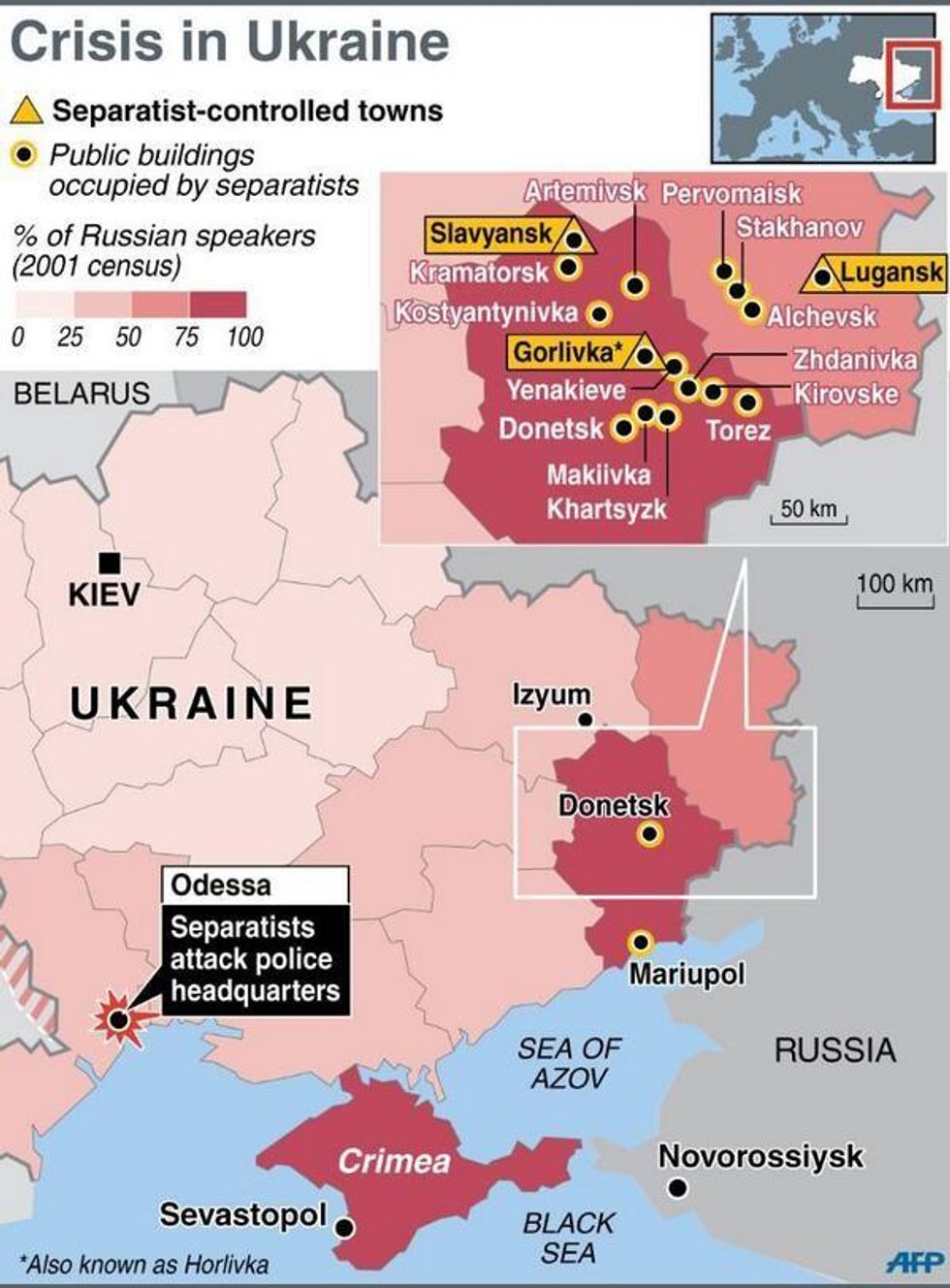
As the following map by AFP shows, the number of cities in open revolt against the Kiev government is growing:
The Associated Press reports:
Ukraine is facing its worst crisis in decades as the polarised nation of 46 million tries to decide whether to look towards Europe, as its western regions want to do, or improve ties with Russia, which is favoured by the many Russian-speakers in the east.
In the last few weeks, anti-government forces have stormed and seized government buildings and police stations in a dozen eastern Ukrainian cities. Authorities in Kiev - who blame Russia for backing the insurgents - have up to now been largely powerless to react.
And since Russia has kept tens of thousands of troops along Ukraine's eastern border - and annexed its key Black Sea peninsula of Crimea last month - Ukraine's central government fears Russia could try to invade and grab more territory.
Since the government began trying to take back the buildings late last week, Slavyansk has been under a tight security cordon. Movement in and out of the city has ground almost to a halt, causing shortages in basic supplies. Lines have been seen at grocery stores.
The goals of the insurgency are ostensibly geared towards pushing for broader powers of autonomy for the region, but some insurgents favour separatism, and the annexation of Crimea looms over the entire political and military discussion.
Following Friday's violence in Odessa and the growing number of revolts in the east, former U.S. ambassador to Moscow, Michael McFaul, spoke with Time magazine and made this warning: "The last 24 hours was a major escalation," told TIME. "This is real. This is war."
Interim president Oleksandr Turchynov on Monday was the latest to indicate that the spiraling violence in an increasingly divided Ukraine looks more and more like civil war as efforts to contain uprisings in the east against Kiev's authority have only elevated the violence in recent days.
"War is in effect being waged against us, and we must be ready to repel this aggression," said Turchynov in a televised address from Kiev and referring to violence in the cities of Odessa, Slavyansk, and elsewhere over the weekend.
According to Agence France-Presse, the latest high-level warning from Kiev comes as Ukraine spirals "further into a chaos that many fear could result in open civil war."
Turchynov has called up additional forces and reintroduced conscription for military-aged Ukrainians citing fear of a Russian invasion on the eastern border.
This AFP video report shows how some regular Ukrainians are preparing for "civil war":
Report: civilians in Ukraine ready for civil warCitizens of the Ukrainian city of Luhansk, 30 kilometres from the Russian border, are learning how to use Kalashnikovs in case the ...
Meanwhile, in and around the city of Slavyansk on Monday, journalists reported that opposing factions were exchanging heavy gunfire and that loud explosions could be heard throughout the area.
And in Donetsk, militias opposed to Kiev's rule and calling for a referendum vote on their autonomy have now taken full control of the city despite continued threats from the Ukraine army.
"What is happening in the east is not a short-term action," said Vasyl Krutov, who heads the Kiev government's military operations in the east. "This is essentially a war."
As the following map by AFP shows, the number of cities in open revolt against the Kiev government is growing:
The Associated Press reports:
Ukraine is facing its worst crisis in decades as the polarised nation of 46 million tries to decide whether to look towards Europe, as its western regions want to do, or improve ties with Russia, which is favoured by the many Russian-speakers in the east.
In the last few weeks, anti-government forces have stormed and seized government buildings and police stations in a dozen eastern Ukrainian cities. Authorities in Kiev - who blame Russia for backing the insurgents - have up to now been largely powerless to react.
And since Russia has kept tens of thousands of troops along Ukraine's eastern border - and annexed its key Black Sea peninsula of Crimea last month - Ukraine's central government fears Russia could try to invade and grab more territory.
Since the government began trying to take back the buildings late last week, Slavyansk has been under a tight security cordon. Movement in and out of the city has ground almost to a halt, causing shortages in basic supplies. Lines have been seen at grocery stores.
The goals of the insurgency are ostensibly geared towards pushing for broader powers of autonomy for the region, but some insurgents favour separatism, and the annexation of Crimea looms over the entire political and military discussion.
Following Friday's violence in Odessa and the growing number of revolts in the east, former U.S. ambassador to Moscow, Michael McFaul, spoke with Time magazine and made this warning: "The last 24 hours was a major escalation," told TIME. "This is real. This is war."