

SUBSCRIBE TO OUR FREE NEWSLETTER
Daily news & progressive opinion—funded by the people, not the corporations—delivered straight to your inbox.
5
#000000
#FFFFFF
To donate by check, phone, or other method, see our More Ways to Give page.
Daily news & progressive opinion—funded by the people, not the corporations—delivered straight to your inbox.
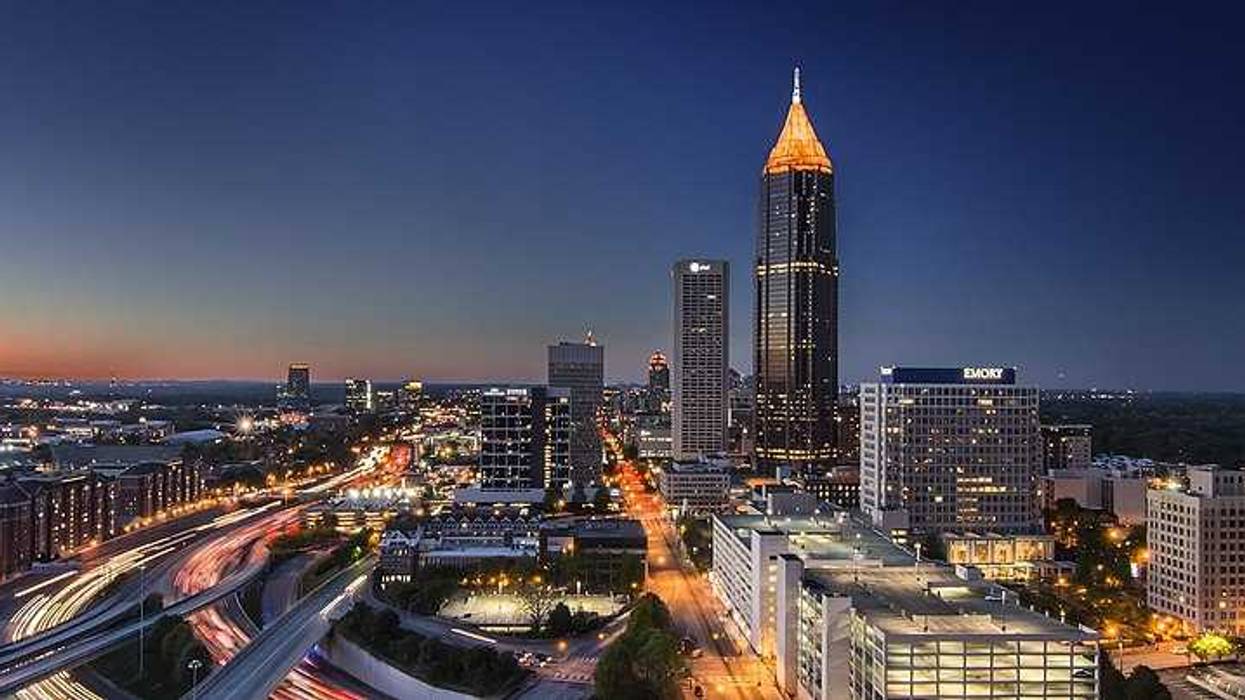
Unless residents are meaningfully included from the start, we’ll continue to pay the price for decisions that will be made without us.
On some streets in Atlanta’s Westside neighborhoods, you can smell the flood before you see it. Gray wastewater rises into the roads, seeps into homes and cars, and lingers long after the storm has passed. Residents step onto their porches, hands over their faces, taking in the now-familiar scene. All it takes is a strong rainstorm to overwhelm a system that was never built to support the people who live here.
In one area, flooding became more severe after new construction added housing density without adequate upgrades to drainage infrastructure. A developer installed a retention pond across from a residential block as part of the deal, but it hasn’t been enough. This pattern is not unique to Atlanta. Many cities with legacies of redlining, highway expansion, and racially unequal investment are now experiencing the cumulative toll of decades of neglect and the rising cost of excluding communities from the decisions that shape their neighborhoods.
The flooding that plagues Atlanta’s Westside isn’t just a weather issue. It’s the result of decades of disinvestment, shortsighted planning, and infrastructure that was never designed to serve the communities that live here. And while other cities long ago updated their water systems to separate drinking water from wastewater, Atlanta still runs both through the same outdated pipes. When a heavy rain hits, the system overflows, and neighborhoods are submerged in sewage.
Many of Atlanta’s historic Black neighborhoods are situated at the base of hills, downhill from the wealthier, whiter parts of the city. That’s not a coincidence. It reflects a long history of redlining, highway construction through Black communities, and the repeated exclusion of Westside residents from decisions that shape our lives. We live in the lowlands, and we’ve been treated like an afterthought for generations.
Atlanta often celebrates its civil rights legacy, and as someone who calls the Westside home and works to support communities across the region, I understand the weight of that history. But legacy alone won’t stop the floods.
Now, as the city rushes to accommodate new developments, from Mercedes-Benz Stadium to the Gulch, we are told that flooding will finally be addressed, but only because it now threatens new investment. Downtown Atlanta sits atop massive concrete structures built 50 feet above what was once an industrial rail hub. These platforms were funded with public money, including half a billion dollars to support a luxury development in The Gulch.
Developers were handed city resources and made a promise to include affordable housing and community benefits. As part of a nearly $1.9 billion incentive package, developers agreed to make 20% of the new housing in Centennial Yards affordable. Instead, builders opted to pay an $8 million in-lieu fee, thereby avoiding any affordable housing options altogether. It’s a legal way to sidestep the promises used to gain public support in the first place. And without strong accountability, that money rarely flows back into the communities that were supposed to benefit.
Existing Westside neighborhoods are absorbing the infrastructure demands created by new development. One of many examples is Georgia Power's proposal to build a new electrical substation just two blocks from an elementary school to power nearby luxury developments. These decisions are made without our input, yet our neighborhoods are left to manage the fallout at once: an overwhelmed watershed system, expanding energy needs, and the strain on roads and public services that were never built to support this kind of growth.
This kind of development process is reactive and extractive. It’s a pattern I have seen over and over again. A developer shows up. A problem is discovered, and the community raises concerns. At that point, the city scrambles to hold a few meetings or patch together a short-term fix. But the damage has already been done.
This isn’t just inconvenient. It’s disruptive to our lives and our stability. It undermines property values, displaces long-time residents, and increases the financial burden on families already stretched thin. I have seen neighbors leave not because they wanted to, but because living here became unsustainable.
Living through the consequences and working inside the systems that produced them, I know change is possible, but only if we change how decisions are made. My journey, shaped by life in Atlanta’s Westside neighborhoods and a career focused on building community power, brought me to lead the national Just Communities initiative. The Westside is where so much of Atlanta’s civil rights legacy was born. That history of resistance and resilience is not just part of the past. It’s what drives me, and many others, to continue fighting for justice.
Just Communities is grounded in the belief that equity is a forethought. It shapes the process, not just the outcomes. The Just Communities Protocol offers a practical road map for doing exactly that. At its heart is the Declaration of Collaboration, a tool designed to formalize shared governance among community members, city officials, and developers. It’s not about public input after the fact. It’s about building structures where residents shape decisions from the beginning: what gets built, where, and how.
Right now, the City of Atlanta is updating its comprehensive plan, zoning ordinances, and watershed infrastructure. These are opportunities to finally do things differently. However, unless residents are meaningfully included from the start, we’ll continue to pay the price for decisions that will be made without us.
Atlanta often celebrates its civil rights legacy, and as someone who calls the Westside home and works to support communities across the region, I understand the weight of that history. But legacy alone won’t stop the floods. Honoring it requires more than symbolism; we need a new process, one rooted in justice and shared power. If we want different outcomes, we must change how decisions are made. Until that happens, communities like mine will continue to pay the price.
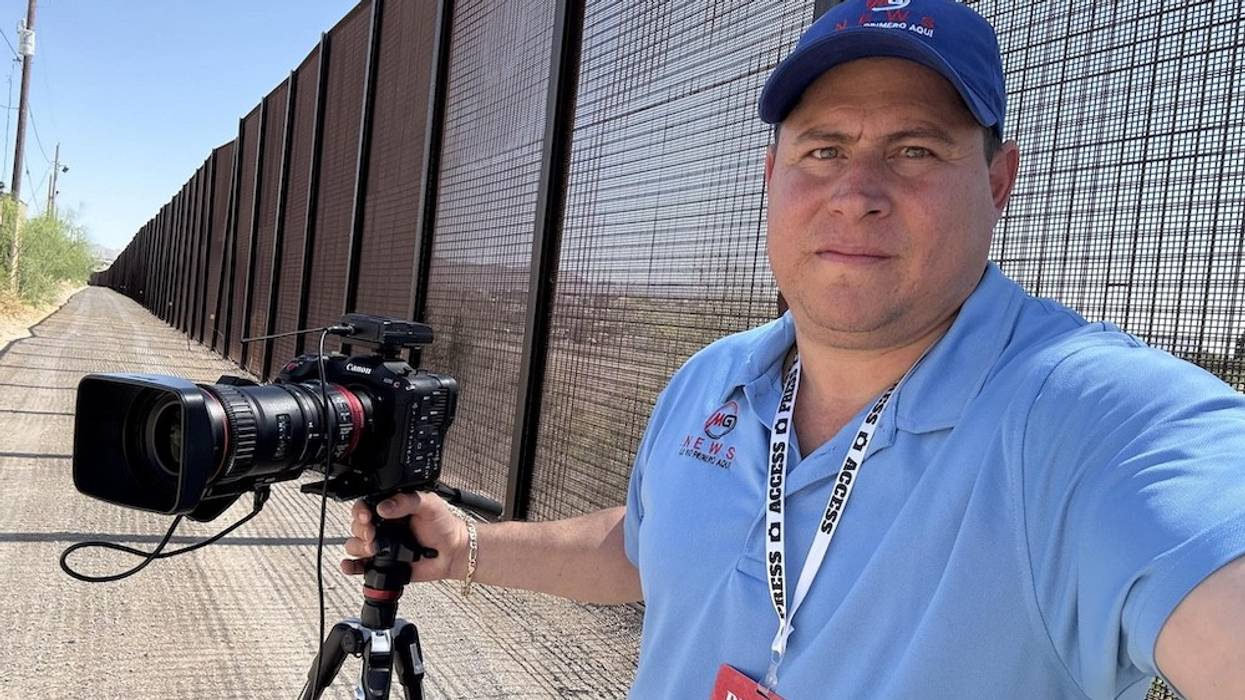
José Zamora of the Committee to Protect Journalists called Mario Guevara's arrest "a blatant attack on press freedom."
Press freedom and immigrants' rights advocates are calling for the release of an Atlanta journalist from U.S. Immigration and Customs Enforcement detention after he was arrested last month while filming an anti-Trump protest.
Mario Guevara, a native of El Salvador, has lived in the United States legally for more than two decades, where he became renowned as one of the Atlanta area's most trusted immigration reporters.
The Guardian described Guevara, an Emmy-winning reporter, as "the person that immigrants call when they see an [ICE] raid going down in their neighborhood."
That was until June 14, when the 47-year-old was snatched up by police while filming an Atlanta area "No Kings" protest and handed over to ICE.
(Video: CNN)
Guevara was charged with traffic offenses related to his coverage of law enforcement activities earlier in the month, but those charges were later dropped. However, Guevara has remained in ICE custody for more than five weeks under a detainer from the immigration agency, which is now attempting to deport him.
On June 24, the U.S. Department of Homeland Security claimed that Guevara "is in our country ILLEGALLY." However, he has been granted authorization to work legally in the U.S. while he awaits his green card. He also entered the country through legal processes.
"I'm plainly convinced that my situation in this ICE jail is direct retaliation for my coverage," Guevara told The Atlanta Journal-Constitution. "I haven't committed any crimes."
On July 1, an immigration judge granted Guevara a $7,500 bond for his release. But when his family tried to pay it, ICE refused to accept it and instead placed a stay on his bond, which will keep him in detention until a judge rules on his appeal.
Guevara has since been shuffled between several different ICE facilities, an experience he told the ACJ has left him "emotionally destroyed."
At a press conference held Tuesday by the Committee to Protect Journalists—which has headed the legal effort to free Guevara—José Zamora, the group's director for the Americas, said that Guevara is "the only journalist in prison in the U.S. in direct retaliation for his reporting."
— (Video: Atlanta News First)
"This is a blatant attack on press freedom, on the First Amendment, and on the right of communities, especially immigrant communities, to be informed," Zamora continued. "These communities rely on voices like Mario's to help make sense of the world around them."
Guevara's lawyer, Giovanni Diaz, described the stay placed on Guevara's bond by ICE as a "surprise" to him and the legal team. Though Zamora said he expected that his legal team will ultimately win the appeal, he said it was "a confirmation to us that they wanted to treat Mario very differently than other detained individuals."
But, he said, this is of a piece with how ICE has conducted itself during President Donald Trump's second term.
"The administration has made it perfectly clear that anybody who's not a legal permanent resident at least, or a citizen, even if they've been given certain protections and they've been allowed to remain in the United States legally—ICE has decided that these people are targets as well." Diaz said.
Two of Guevara's children also pleaded for his release.
"My father is a reporter," said Guevara's daughter Katherine. "He chased stories that mattered, stories that told the truth about immigration, about injustice, about people who usually go ignored."
"My dad did nothing wrong. He was arrested while wearing a press badge. He was live streaming. He wasn't in the way. He wasn't breaking any law. He was doing his job," she continued.
"His work wasn't just a job," said Guevara's son, Oscar. "It was a calling. And now he's being punished for answering that call."
Oscar said that his dad's dedication to his work inspired him to become a photojournalist himself.
"We were raised to believe that in this country, freedom of speech mattered, that journalism mattered, that hard work and honesty meant something," he said. "But none of that seems to matter right now."
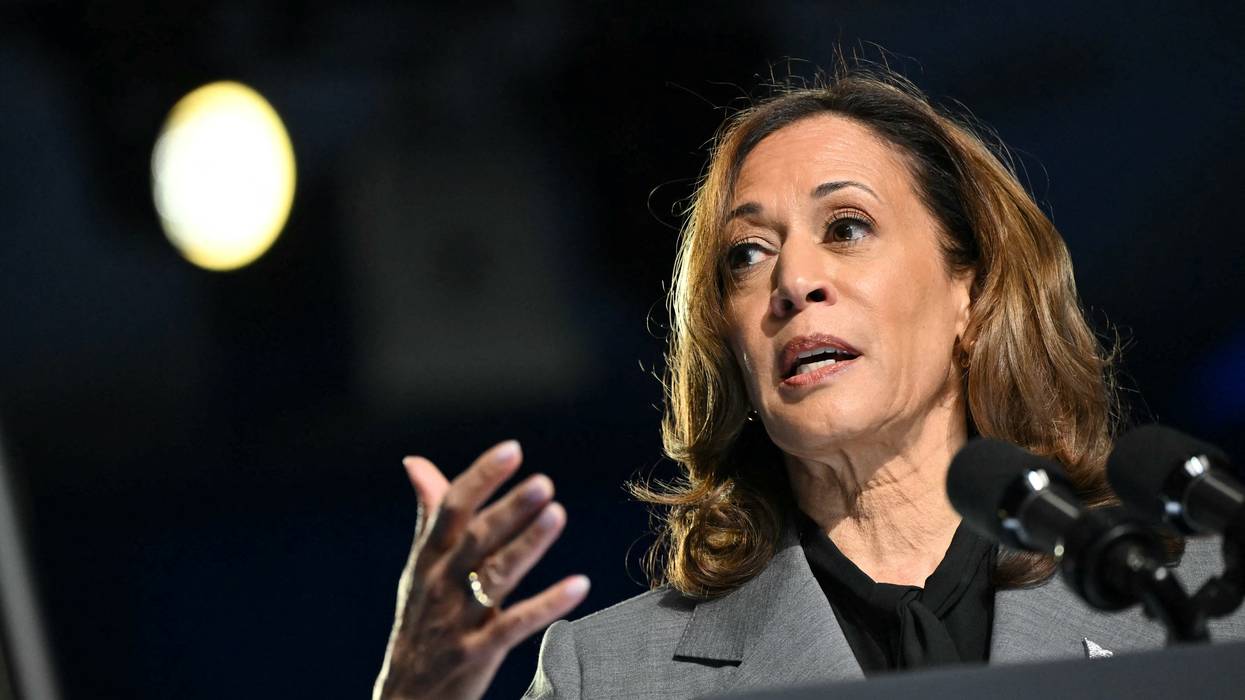
"He is proud? Proud that women are dying?" said the vice president. "Proud that doctors and nurses could be thrown in prison for administering care?"
Speaking at a campaign event in Atlanta, Georgia on Friday, U.S. Vice President Kamala Harris paid tribute to two women from the state whose deaths have been deemed by health experts as "preventable" and the result of the state's six-week abortion ban.
Amber Nicole Thurman and Candi Miller, said the Democratic presidential candidate, are doubtlessly just two of many people who have died because they couldn't access abortion care since the U.S. Supreme Court overturned Roe v. Wade—and she blamed former Republican President Donald Trump for their deaths.
"This is a healthcare crisis and Donald Trump is the architect of this crisis," said Harris. "He brags about overturning Roe v. Wade. In his own words, quote, 'I did it and I'm proud to have done it.'"
"He is proud? Proud that women are dying?" she said. "Proud that doctors and nurses could be thrown in prison for administering care? Proud that today, young women have fewer rights than their mothers and grandmothers? How dare he."
Harris shared the stories, reported on this week by ProPublica, of Thurman and Miller, who both died in 2022 after medication abortions did not entirely expel the fetal tissue from their pregnancies.
Thurman spent 20 hours in a hospital growing increasingly sick from sepsis while doctors dangerously delayed performing a dilation and curettage (D&C), a common procedure used for miscarriage and abortion care, due to Georgia's six-week abortion ban. While the ban includes an "exception" to safe the life of a pregnant person, the law's language only makes clear that doctors can perform a D&C for someone having a miscarriage.
The law stopped Miller from seeking healthcare after suffering the same rare complication as Thurman. The mother of three acquired pills for a medication abortion online but did not expel all the fetal tissue and was "bedridden and moaning" for days before her husband found her unresponsive, next to her three-year-old daughter.
Miller's family said she had not sought care "due to the current legislation on pregnancies and abortions."
At the event on Friday, Harris said that "at least two women—and those are only the stories we know—here in the state of Georgia, died because of a Trump abortion ban."
The vice president noted that Trump said last month he plans to vote against Amendment 4 in his home state of Florida—a ballot measure that would outlaw pre-viability abortion bans in the state.
Harris warned voters not to believe the claims by Trump and his running mate, Sen. JD Vance (R-Ohio), that they don't support making abortion illegal across the nation, a proposal made by Sen. Lindsey Graham (R-S.C.) months after Roe was overturned.
"The stakes are so high," said Harris, "because if he is elected again, I am certain he will sign a national abortion ban."
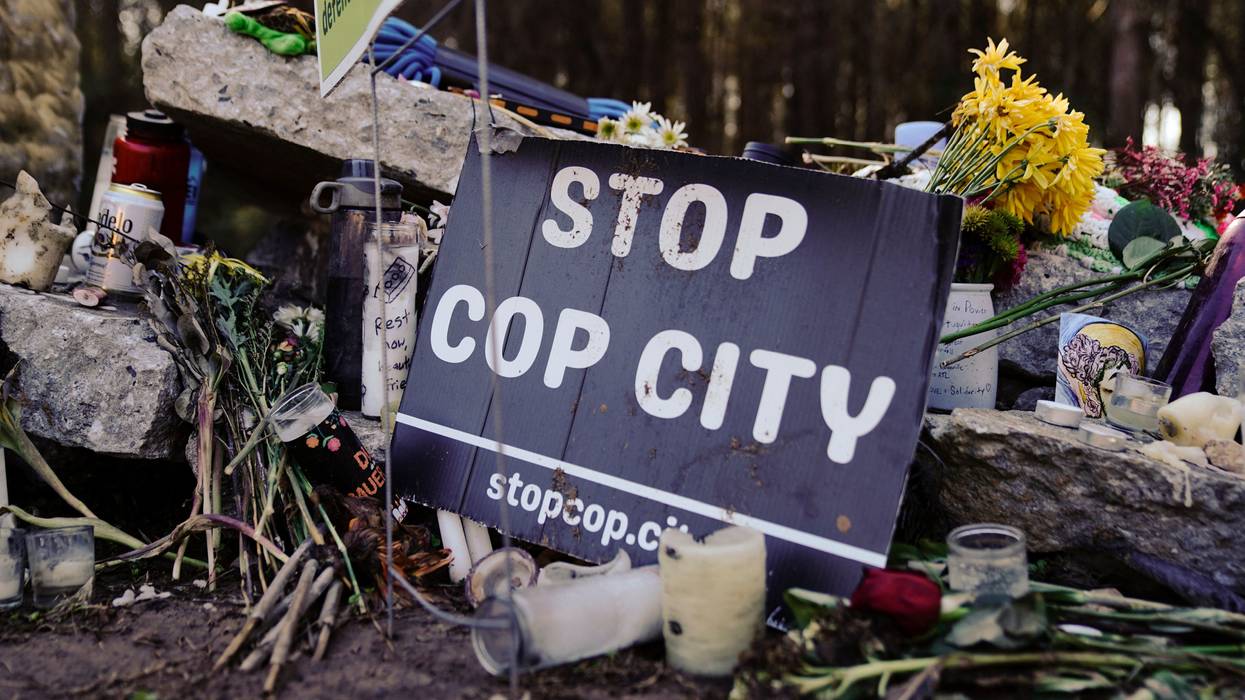
"From the beginning, we knew these charges were not based on any evidence, but were instead politically motivated and intended to target a social movement," said an opponent of the facility.
Members of the "Stop Cop City" movement on Tuesday celebrated that Georgia prosecutors are dropping money laundering charges as a "major victory in the ongoing fight against the political repression of forest defenders and activists," but reiterated criticism of the broader case.
"The state has previously claimed that the Atlanta Solidarity Fund is at the center of the alleged criminal enterprise, using the money laundering charges to do so," explained Keyanna Jones, a Stop Cop City activist and co-pastor at Park Avenue Baptist Church, in a statement. "Now, it is admitting that it doesn't have the evidence to prove its allegations, just as it lacks the evidence to prove its case altogether."
A deputy attorney general revealed in court that the state will no longer pursue money laundering charges against Atlanta Solidarity Fund leaders Marlon Kautz, Adele MacLean, and Savannah Patterson, though the trio and 58 other opponents of the DeKalb County law enforcement facility—which remains under construction—still face widely condemned racketeering charges.
As The Associated Press reported:
Just as a motions hearing was about to start Tuesday, Deputy Attorney General John Fowler told Fulton County Judge Kimberly Esmond Adams that he would be filing paperwork to dismiss the 15 counts. A spokesperson for Georgia Attorney General Chris Carr did not immediately respond to an emailed request for comment Tuesday afternoon on why the charges were dropped.
But Kristen Novay, the attorney for Patterson, applauded the decision.
"The entire indictment is defective, but with those particular counts, I think it is a wise move for a seasoned prosecutor to say, 'This isn't worth it,'" Novay told The Associated Press. "Sometimes the hardest call as a prosecutor is to not go for something."
Stop Cop City activist Kris Hermes also applauded the development while blasting the state for the remaining charges.
"From the beginning, we knew these charges were not based on any evidence, but were instead politically motivated and intended to target a social movement," said Hermes. "Defeating these bogus charges is a major victory, and the attorney general will ultimately be forced to drop or lose the entire case against Stop Cop City activists."
The news out of the courthouse came after some Cop City protesters disrupted a Monday afternoon Atlanta City Council meeting with chants, pingpong balls, and a banner for the Democratic mayor that read, "Andre Dickens: You dropped the ball on democracy."
The protesters "were demonstrating on the one-year anniversary of submitting 116,000 petition signatures calling for a referendum on the public training facility," according to Atlanta News First.
"While council members are complicit by turning a blind eye to the signatures collected by not evoking the verification process, it has been the mayor's office that has spent an estimate of $1,000,000 on legal fees to withhold the vote from its own tax-paying residents," the protesters said in a statement.
Construction on the 85-acre, $110-million Atlanta Public Safety Training Center—as the facility is formally called—is set to be largely finished by December, despite local opposition.
"To be clear—Cop City is not just a controversial training center," Kwame Olufemi of Community Movement Builders has said. "It is a war base where police will learn military-like maneuvers to kill Black people and control our bodies and movements. The facility includes shooting ranges, plans for bomb testing, and will practice tear gas deployment. They are practicing how to make sure poor and working-class people stay in line."
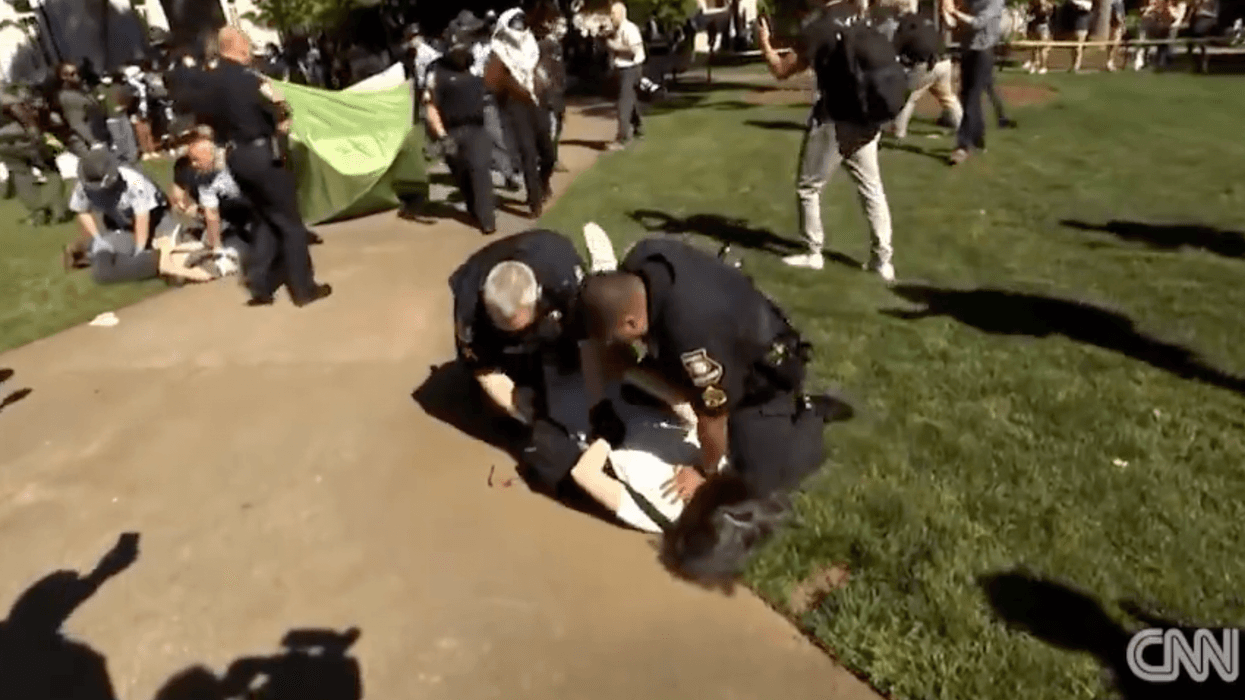
"To sustain this level of blind support for Israel, the U.S. must erode its own democracy," said one foreign policy expert. "And that is what we see happening on U.S. campuses now."
Emory University economics professor Caroline Fohlin approached several police officers who were holding a student down on the ground on Thursday and demanded an explanation—but by the end of the day videos of her own arrest became some of the most widely circulated images of the rapidly spreading anti-war movement on college campuses across the U.S.
As she knelt down to ask the university officers, "What are you doing?" another law enforcement agent grabbed her arm and pushed her away before repeatedly ordering her to "get on the ground."
"Stop it!" Fohlin yelled before the officer pushed her to the ground and called for more police to help subdue her.
Fohlin then screamed, "Oh my God!" as the police pushed her down and told the police that she was a professor at the university as they held her on the ground.
Fohlin's arrest—after which she was detained for 11 hours and then charged with "battery of a police officer"—came a week after Columbia University suspended more than 100 students for setting up an encampment in solidarity with Gaza, where more than 34,000 Palestinians have been killed by the U.S.-backed Israel Defense Forces (IDF) since October, and allowed police to arrest them. The mass arrests only served to galvanize students and faculty at Columbia and at dozens of other schools, with more than 400 people being detained so far.
The American Association of University Professors called the arrest "antithetical to the mission of higher education."
"Our institutions exist to foster robust exchanges of ideas and open dialogue in service of knowledge and understanding," said the group. "Sometimes that includes open dissent. Peaceful campus protests should never be met with violence."
Foreign policy expert Trita Parsi suggested that Fohlin's arrest was among the on-campus incidents that have strained the Democratic Party's argument that "democracy is on the ballot in November."
"To sustain this level of blind support for Israel, the U.S. must erode its own democracy. And that is what we see happening on U.S. campuses now," said Parsi, executive vice president of the Quincy Institute for Responsible Statecraft, sharing a video of police tasing an Emory student who was already being held down on the ground.
Emil' Keme, a professor of English and Indigenous studies at Emory, told Democracy Now! on Friday that the scene on campus resembled "a war zone," especially after university and Atlanta police deployed tear gas and rubber bullets to disperse protesters.
"I started feeling the tear gas, and I held arms with some people," he said. "We were being pushed back out of the encampment. And the student I was holding arms with, she was then arrested and the next thing I knew I was on the floor and I was being arrested."
Writer Abdullah Shihipar said Emory president Gregory Fenves—and all university administrators who have allowed the arrest of students who have peacefully protested, including several who have unilaterally altered school codes in order to ban protests—should resign.
"It has been a disgusting and embarrassing week for higher education," said Shihipar.
The crackdown on Emory students and faculty came a day after Texas state troopers descended on the University of Texas at Austin campus, some on horseback, and clamped down on a student walkout there, arresting more than 50 protesters.
Also on Thursday, students at Indiana University and Ohio State University (OSU)—where more than 30 and a dozen students were arrested, respectively—reported seeing snipers stationed on the rooftops of campus buildings, which an Ohio State representative denied.
The Biden administration has not directly addressed the protests or their demands since Monday, when President Joe Biden suggested the nationwide student uprising is "antisemitic."
"The use of state violence against peaceful protestors is unacceptable," said Sara Haghdoosti, executive director of Win Without War. "Police batons deployed against students calling for peace in Gaza are not a source of safety on campus, nor are they a bulwark against antisemitism. They hurt people, impinge on fundamental liberties, and serve an extreme right-wing agenda that threatens Jews, Muslims, and the right to protest across the country. University leaders and government officials must take steps to protect students exercising their right to protest, not enlist police to attack them."
"Antisemitism and anti-Muslim bigotry are on the rise and serious issues nationwide, including on college campuses," continued Haghdoosti. "The people endangered by these scourges deserve better than to be the targets of cynical political ploys or to be used as excuses for violent repression. No one is made safer by police violence, and politicians who say otherwise are only attempting to sow division for their own reprehensible ends. What we need from our leaders right now is to de-escalate, permit protests, and not allow state violence against people exercising their fundamental rights."
Irene Khan, the United Nations special rapporteur on the promotion and protection of the right to freedom of opinion and expression, said Thursday that the protests spreading across the U.S. and internationally are a sign that "the Gaza crisis is truly becoming a global crisis of the freedom of expression."
"Legitimate speech must be protected," Khan said Thursday, "but, unfortunately, there is a hysteria that is taking hold in the U.S."
"We must not mix [antisemitism] up with criticism of Israel as a political entity, as a state," she added. "Criticizing Israel is perfectly legitimate under international law."
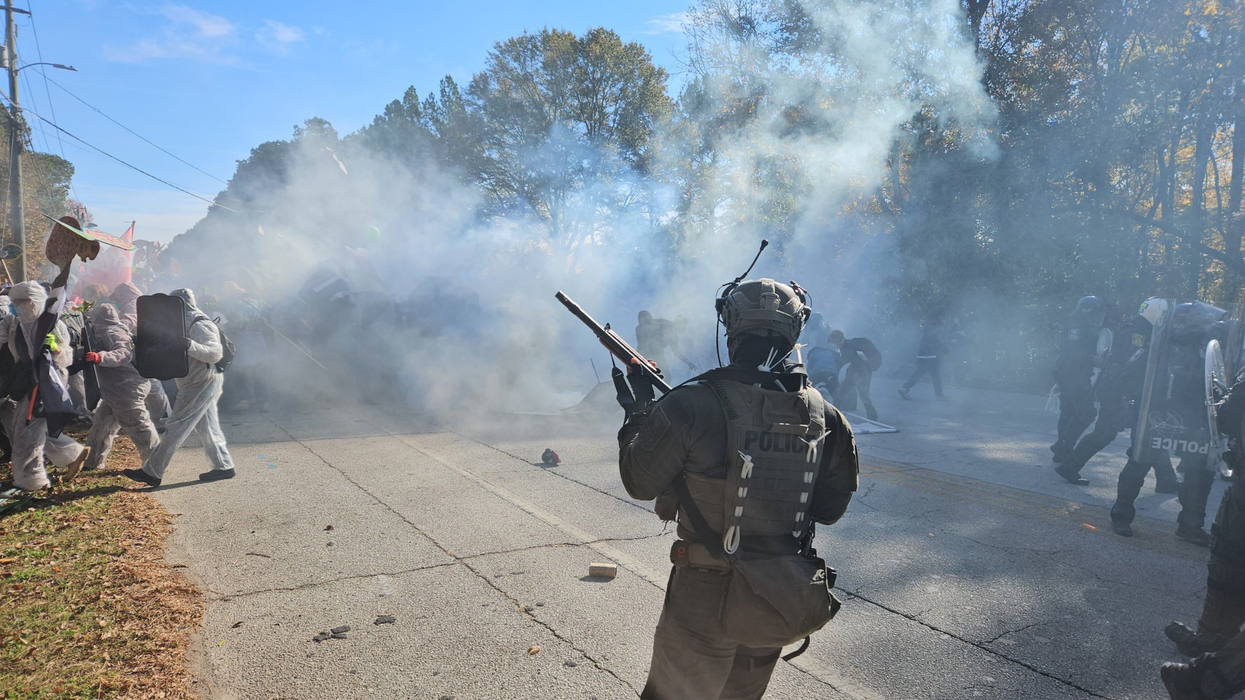
"This is the type of 'training' they will get if Cop City is built," said one activist group.
Militarized state and local police on Monday attacked a peaceful protest against the construction of the so-called "Cop City" training center outside Atlanta, Georgia with "less-lethal" weapons including tear gas, pepper balls, and flash-bang grenades, journalists and activists there said.
Hundreds of #StopCopCity activists marched from a park toward the Weelaunee Forest in suburban DeKalb County early Monday morning. Some carried large and elaborate puppets, others had saplings to plant in woodlands bulldozed during construction, and a few carried banners reading "Block Cop City" and "Viva Tortuguita"—a reference to forest defender Manuel Esteban Paez Terán, aka "Tortuguita," who was fatally shot 57 times with live ammunition by police during a January raid on a protest camp.
A marching band and members of the Wanbli Ska Society—a South Dakota-based Indigenous advocacy group—hyped up the activists, who then started their two-mile march toward the Cop City construction site.
Journalists and protesters said police blocked the road about half a mile from the march's planned destination.
"The police have effectively separated the press at the front of the march from the rest of the march," the group Defend the Atlanta Forest wrote on social media. "Police are preventing them from rejoining the march and threatening to tow their cars."
NDN Collective, an Indigenous advocacy group, posted video of police pushing reporters away from the march, calling the area a "crime scene" and threatening to arrest journalists.
Backed by menacing SWAT vehicles, including one labeled "The Beast," police attacked the nonviolent marchers, some of whom attempted to push through the line of armored officers.
Many of the activists chanted: "Don't panic, stay tight, we gonna be alright!"
Some protesters lobbed tear gas canisters back at the officers.
"Protestors and police both retreated because neither group was wearing gas masks," Defend the Atlanta Forest reported. Neither were the police dogs, whose only protection appeared to be goggles and noise-reducing ear coverings.
The activists regrouped and continued their march. Eight activists reportedly made it to the construction site and locked themselves to equipment there.
Responding to the police action, Mary Hooks, field secretary for the Movement for Black Lives, said in a statement: "We just witnessed overt violations of our civil rights on a road named after the U.S. Constitution. Atlanta claims itself to be a civil rights hub, but it erases its own legacy when protests arise that confront the power of politicians and police. The police's violence against protestors today affirms our belief that Cop City must never be built."
Prior to the march, activists gathered in a local park, where speakers included community organizer Kamau Franklin and Tortuguita's parents.
"Now is not a time for cowardice. You are either with the oppressed or with the oppressors," Franklin told the crowd. "You cannot stand in the middle. You cannot be [on] both sides. You cannot close your eyes to the terror of policing that happens in this country and in this world. And you cannot deny and cannot be silent on the capitalist economics and the system that controls all of our people across the world."
"You're either with the colonialist or the colonized," he added. "So today when you march and demonstrate and conduct acts of civil disobedience… you are doing it with the oppressed people."
Cop City—which is funded by the private Atlanta Police Foundation and backed by major corporations including Amazon, Home Depot, Wells Fargo, JPMorgan Chase, and UPS—is being built on land stolen from the Muscogee people, many of whom were forced westward during the genocidal Trail of Tears period in the late 1830s.
Since Terán's killing, more than 40 Stop Cop City campaigners have been criminally charged as domestic terrorists, while over 60 activists have also been indicted under the state's Racketeer Influenced and Corrupt Organizations (RICO) Act—some for simply handing out fliers.
On Monday, Belkis Terán, Tortuguita's mother, said that "we are here to protect nature."
"To fight the police, we must be happy. And to be happy we must be strong," she added. "This is one step. We will continue."
Echoing Terán, Joel Paez, Tortuguita's father, told the crowd: "We are going to continue defending the forest. We are going to continue defending the legacy of Tortuguita. We are family. You are my family."
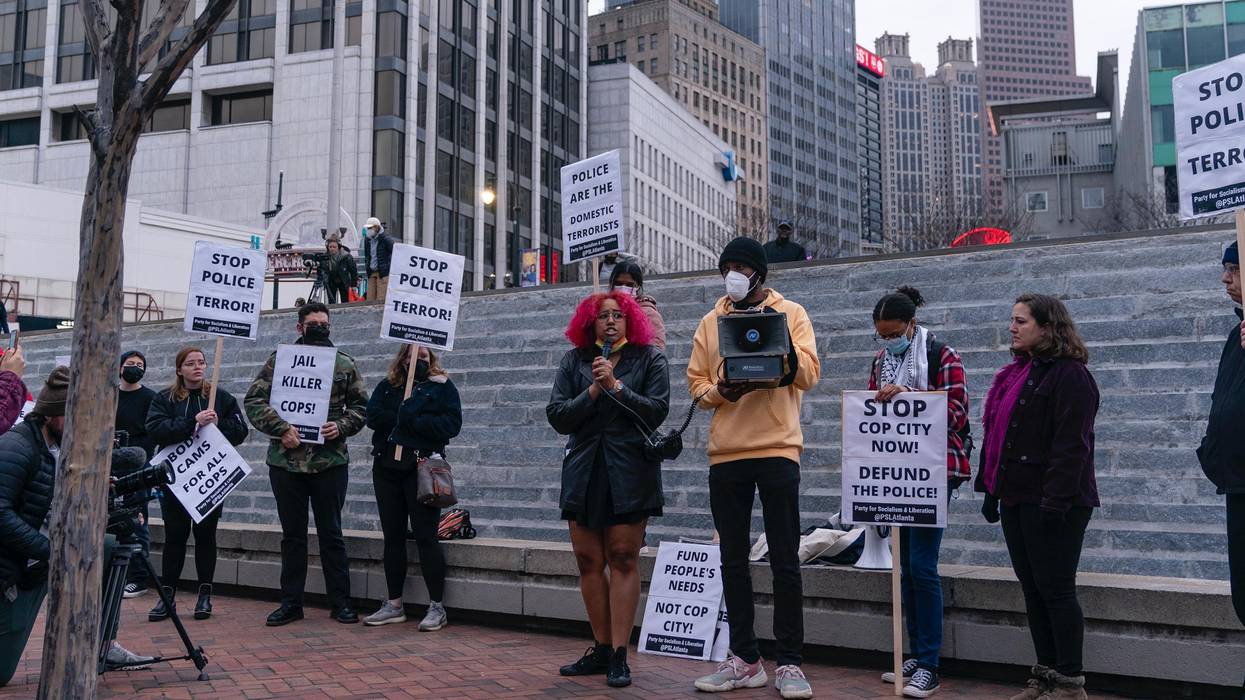
"Equating activism with terrorism is undemocratic and serves to silence dissenters," said Deepa Kumar, who analyzed how major U.S. media outlets have covered protesters of "Cop City" in Georgia.
A paper published Tuesday by a media studies scholar explores what she calls "one of the enduring costs of the 'War on Terror,'" mainstream outlets parroting police talking points on terrorism and "legitimating state violence while stifling democratic protest."
Rutgers University professor Deepa Kumar's paper—released by the Costs of War Project at Brown University's Watson Institute for International and Public Affairs—focuses on how major U.S. media outlets have covered protesters of "Cop City," Atlanta's proposed Public Safety Training Center just outside of city limits in Georgia.
"Even though the 'War on Terror' is supposedly over now that the U.S. has withdrawn from Afghanistan, U.S. federal and state governments continue to use and even expand punitive measures targeting those they label as 'terrorists,'" Kumar said in statement. "The U.S. mainstream media sometimes supports this expansion, and in doing so imperils U.S. democracy. All of this is part of the legacy of the post-9/11 wars."
As Kumar's paper notes, "previous research has shown that the mainstream media's framing of terrorism influences public opinion and shapes support or opposition to policies such as Georgia's 2017 terrorism law," which expanded the definition of terrorism to include certain property crimes committed with the intent to use intimidation or coercion to change policy.
The expert analyzed how a local newspaper, The Atlanta Journal-Constitution, and six national outlets—USA Today, The Wall Street Journal, The Washington Post, The New York Times, the New York Post, and the Los Angeles Times—reported on the "domestic terrorism" arrests of 42 anti-Cop City activists from December 2022 to March 2023.
The paper details her findings:
At first, the national news media did not cover the terrorism arrests in Atlanta. The local The Atlanta Journal-Constitution effectively served as the Atlanta Police Foundations' propaganda outlet. In January, 2022 several national media outlets picked up the story when violence and property destruction occurred, following the "if it bleeds, it leads" framework. However, some newspapers adopted a more critical stance. The Washington Post, The New York Times, and the LA Times humanized the protestors, depicting them as concerned activists opposing police militarization and environmental destruction. The New York Post and TheWall Street Journal, however, portrayed protestors as violent Antifa activists and justified their arrest on the grounds of terrorism. USA Today adopted a sensational tone, in effect also justifying the arrests.
As the protest movement gained national and international support, national media paid more attention. All seven outlets covered the story in March 2023. Also significant is that The Atlanta Journal-Constitution shifted to a more balanced tone and included the voices of Atlanta residents opposing Cop City. Rather than labeling protesters solely as "outsider agitators" and "far-left" activists who exist on the fringes of society, the newspaper quoted local activists, civil rights groups, and clergy. This happened at the highpoint of government arrests, when 23 more people were indicted on terrorism charges.
However, the analysis also reveals that apart from a handful of notable articles in The Washington Post and the LA Times that tacitly criticize the wider application of terrorism charges evidenced in Georgia, the majority of the seven media outlets have deferred unquestioningly to government authorities in the use of this label.
"Government and police officials have portrayed the protestors as violent terrorists," Kumar stressed. "For instance, in January 2023, when Georgia State Patrol Troopers shot and fatally injured activist Manuel Esteban Paez Terán, also known as Tortuguita, they claimed that Terán had initiated gunfire. Shockingly, Tortuguita was shot a staggering 57 times."
The DeKalb County medical examiner's autopsy report "indicated an absence of gunshot residue on Tortuguita's hands," the professor pointed out. There was also an independent autopsy. The Georgia Bureau of Investigation later claimed gunshot residue was found on the activist's hands. Stone Mountain Judicial Circuit District Attorney George R. Christian concluded last month that the use of deadly force "was objectively reasonable under the circumstances of this case," so police will face no charges for killing Tortuguita.
Kumar wrote that "in theory, the media are entrusted with the responsibility of posing critical questions and disseminating accurate information to the public so that troubling practices like the use of state violence and extrajudicial killings are not normalized. In reality, U.S. media institutions have often continued to defer to government sources, reproducing and thus reinforcing the expansion of terrorism discourses to criminalize protestors—with sometimes deadly consequences."
Costs of War Project co-director Stephanie Savell responded to the paper by nudging journalists to do better. She said, "The media can make or break how activism is portrayed in an increasingly militarized era of policing that imperils our democratic rights."
The research comes after 57 of the 61 Cop City protesters charged in September under Georgia's Racketeer Influenced and Corrupt Organizations (RICO) law appeared in court on Monday, as hundreds of their supporters rallied outside the building in Atlanta.
"Among the defendants: more than three dozen people who were previously facing domestic terrorism charges in connection to the protests; three leaders of a bail fund previously accused of money laundering; and three activists previously charged with felony intimidation after authorities said they distributed flyers calling a state trooper a 'murderer' for his involvement in Paez Terán's death," according to The Associated Press.
Noting the RICO charges, Kumar's paper quotes a pair of ACLU experts, who wrote in September that the indictment "paints the provision of mutual aid, the advocacy of collectivism, and even the publishing of zines as hallmarks of a criminal enterprise. In doing so, it flies in the face of First Amendment protections for speech, assembly, and association."
This post has been updated with additional autopsy reports.
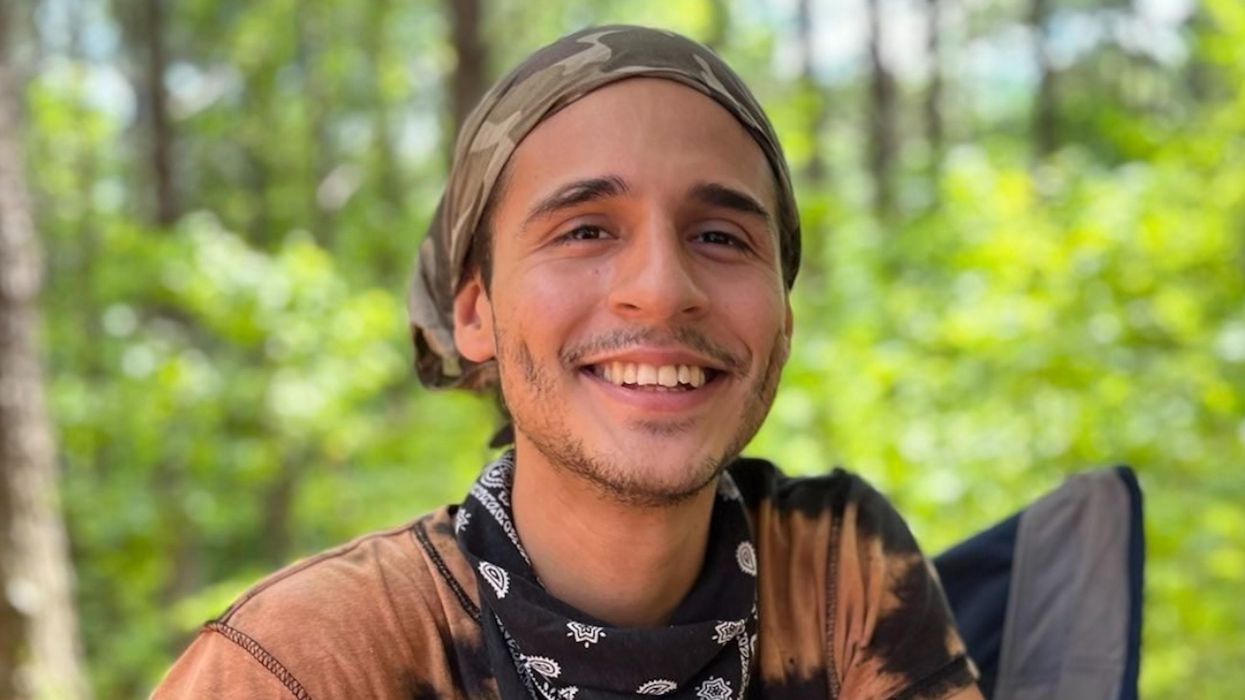
"The system has, once again, declared its own innocence," lamented one activist after a Georgia prosecutor's office said it would not charge the killers of Manuel Terán, better known as "Tortuguita."
Human rights advocates on Friday condemned a Georgia prosecutor's decision to not charge the state troopers who fatally shot forest defender Manuel Esteban Paez Terán—better known as "Tortuguita"—during a militarized January raid at a Stop Cop City protest camp outside Atlanta.
"The system has, once again, declared its own innocence," Stop Cop City activist Micah Herskind wrote on social media in response to the decision by the Stone Mountain Judicial Circuit District Attorney's office.
The Cop City Vote Coalition (CCVC) campaign said that "Tortuguita's memory and the memories of all those stolen by police killings demand that we all continue the collective struggle for a future without state violence."
Georgia State Patrol officers say they shot Terán after the 26-year-old Venezuelan activist opened fire on them, wounding an officer in the leg during the January 18 raid to evict protesters from the encampment protesting the $90 million, 85-acre Public Safety Training Center—widely known as "Cop City"—in the Weelaunee Forest just outside Atlanta city limits in DeKalb County.
According to a statement from Stone Mountain Judicial Circuit District Attorney Pro Tempore George Christian explaining the decision not to charge the troopers:
Terán... refused to comply with the lawful commands of the troopers to come out of a tent. The troopers used a 'less lethal' device known as a pepperball launcher in an effort to have Terán leave the tent. Terán responded by shooting four times his 9mm pistol through the tent, striking and seriously injuring a Georgia State Trooper. Six troopers returned fire resulting in the death of Teran.
"The use of lethal... force by Georgia State Patrol was objectively reasonable under the circumstances of this case," the prosecutor concluded.
A DeKalb County Medical Examiner's Office autopsy—which officials suppressed for months—revealed that Terán was shot 57 times and that there was no gunpowder residue on the victim's hands, which advocates say debunks claims that the activist fired first. There is no police bodycam video of the incident.
The Georgia Bureau of Investigation said that ballistics analysis proved a gun found at the scene of Terán's killing—a Smith & Wesson 9mm pistol GBI said the victim legally purchased in 2020—fired the bullet that wounded the trooper.
CCVC said that "from the start, the state's response to Tortuguita's murder has been to lie and cover up the facts."
"Today's announcement ruling the killing as 'reasonable' is just the latest in a long line of changing stories and withholding evidence," the campaign added.
Since Terán's killing, more than 40 Stop Cop City campaigners have been criminally charged as domestic terrorists, while over 60 activists have also been indicted under the state's Racketeer Influenced and Corrupt Organizations (RICO) Act—some for simply handing out fliers.
"These charges, like the previous repressive prosecutions by the state of Georgia, seek to intimidate protesters, legal observers, and bail funds alike, and send the chilling message that any dissent to Cop City will be punished with the full power and violence of the government," organizers with CCVC told The Appeal last month.
Friday's decision to not charge the troopers comes as CCVC attempts to get a referendum on the project on November's ballot. Although they've collected more than 115,000 signatures—more than double the number needed to qualify for the ballot—campaigners accuse Atlanta officials of voter suppression due to what they say is an onerous signature verification process created solely to thwart the initiative.
City officials are refusing to even start the signature verification process, arguing that the campaign may have missed an August 21 submission deadline. Although the deadline had been extended until September by a federal judge, an appeals court subsequently blocked enforcement of the extension, creating a state of legal limbo for the initiative.
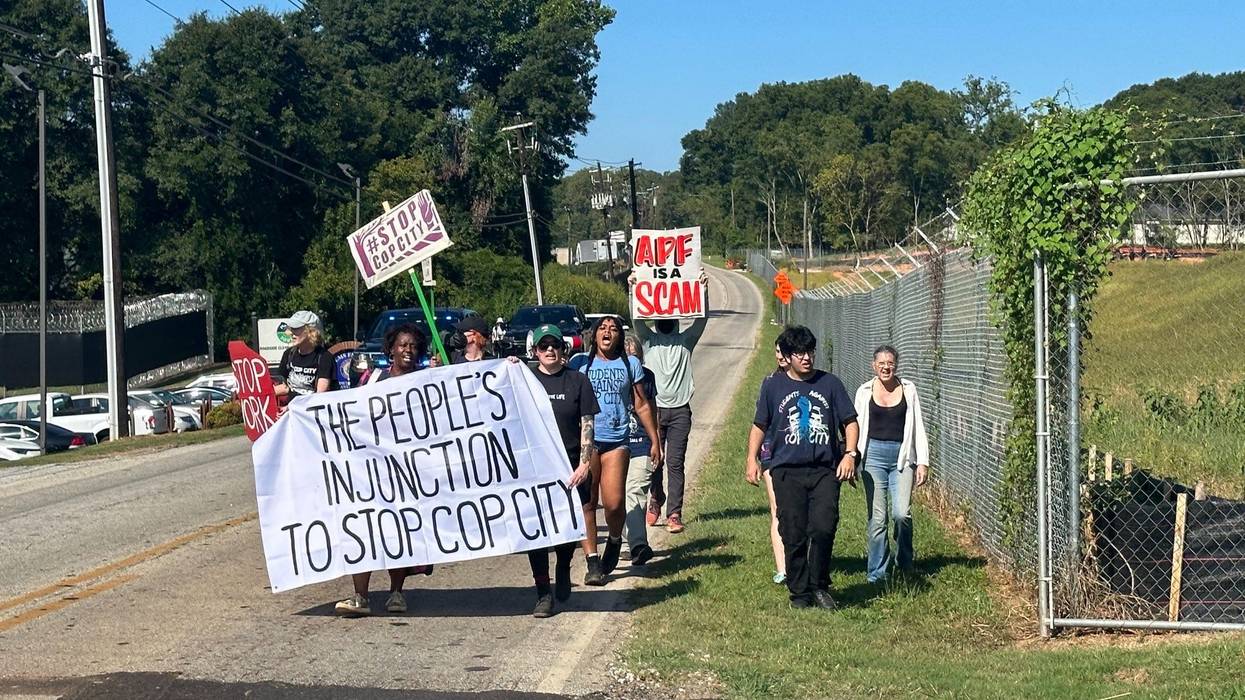
"This movement cannot be won with a ballot alone; we must organize together for mass direct actions if we want to have a chance at protecting our community and saving our planet," said one of those arrested.
Five "Stop Cop City" demonstrators, including faith leaders, were arrested Thursday morning after chaining themselves to construction equipment at Atlanta's proposed Public Safety Training Center just outside of city limits in DeKalb County, Georgia.
The arrestees are Rev. Jeff Jones, a Unitarian Universalist volunteer community minister; Rev. David Dunn, a Unitarian Universalist minister; Ayeola Omolara Kaplan, an Atlanta-based revolutionary artist; Atlanta resident Lalita Martin; and Georgia resident Timothy Sullivan, according to the Atlanta Community Press Collective.
The Atlanta Police Department (APD) said in a statement that "those five people have been taken into custody and we are working with the Georgia Bureau of Investigation regarding charges on these individuals. Around this same time, approximately 25 people gathered outside the site to protest."
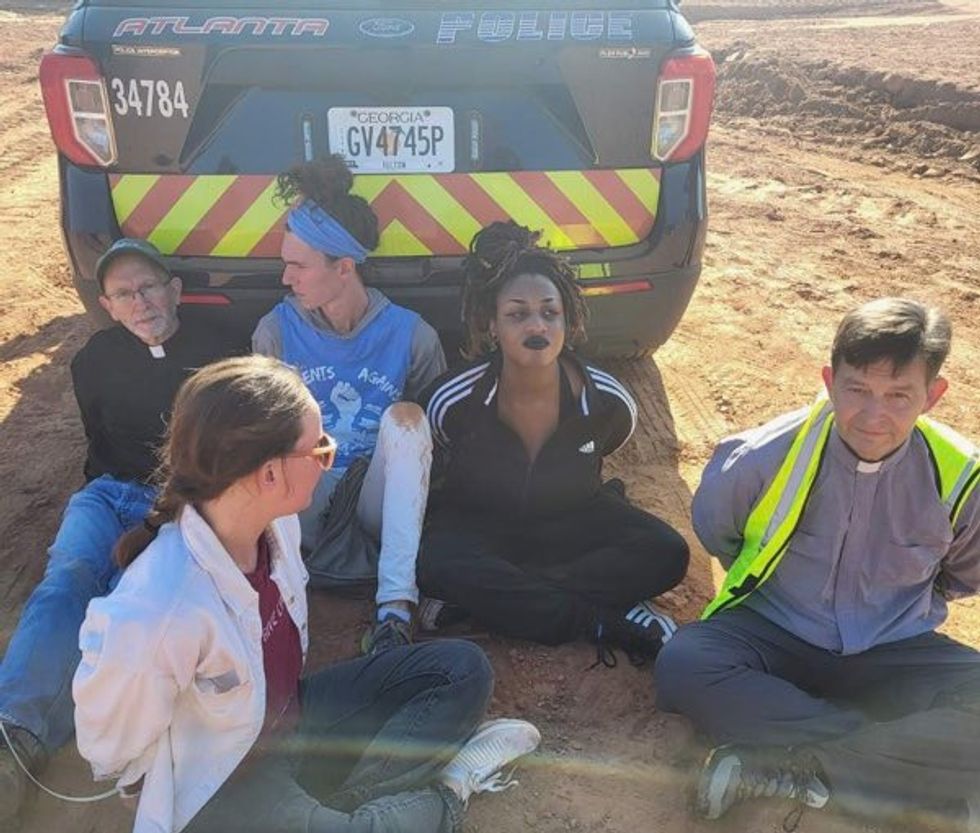 Protesters were arrested in Georgia on September 7, 2023. (Photo: Atlanta Police Department)
The Atlanta Journal-Constitution reported that protesters outside the construction site of the contested 85-acre facility chanted "Cop City will never be built."
Photos shared on social media showed demonstrators carrying signs that said "#StopCopCity," "No Cop City on Stolen Land," and "The People's Injunction: Stop Work Order."
A notice protesters posted on metal fencing said that the people were shutting down the project for violations including "destruction of a forest, destruction of the public trust, polluting Intrenchment Creek, violating the will of the community, undermining the democratic process."
"We have tried to get justice in the courts, we have tried to get justice using our politicians, and unfortunately, they have betrayed and failed us," said Mary Hooks of the Movement for Black Lives, according to the AJC. "So when our government systems fail, that is when the people must stand up and take action."
"Anytime somebody puts their bodies on the line for the cause," added Hooks, "it was worth the risk."
The "people's injunction" to halt construction came after Georgia Republican Attorney General Chris Carr announced Tuesday that a grand jury indicted 61 Stop Cop City protesters under the state's Racketeer Influenced and Corrupt Organizations (RICO) Act.
Omolara Kaplan, one of the demonstrators arrested Thursday, said in a statement that "there is a war happening against protesters. If we don't stand up for our right to protest now, standing up in the future will be in vain. Cop City is in the process of being built and this can only continue if we allow it."
The protester also highlighted an effort by Cop City opponents to collect signatures for an Atlanta referendum to block the project—and the pushback from political leadership in the city, such as a related verification process that critics have denounced as a form of voter suppression.
"As Atlanta Mayor Andre Dickens fights against our right to stop Cop City via the ballot, we must continue our struggle to stop the project with direct actions like sit-ins, boycotts, and blockades," said Omolara Kaplan. "This movement cannot be won with a ballot alone; we must organize together for mass direct actions if we want to have a chance at protecting our community and saving our planet."
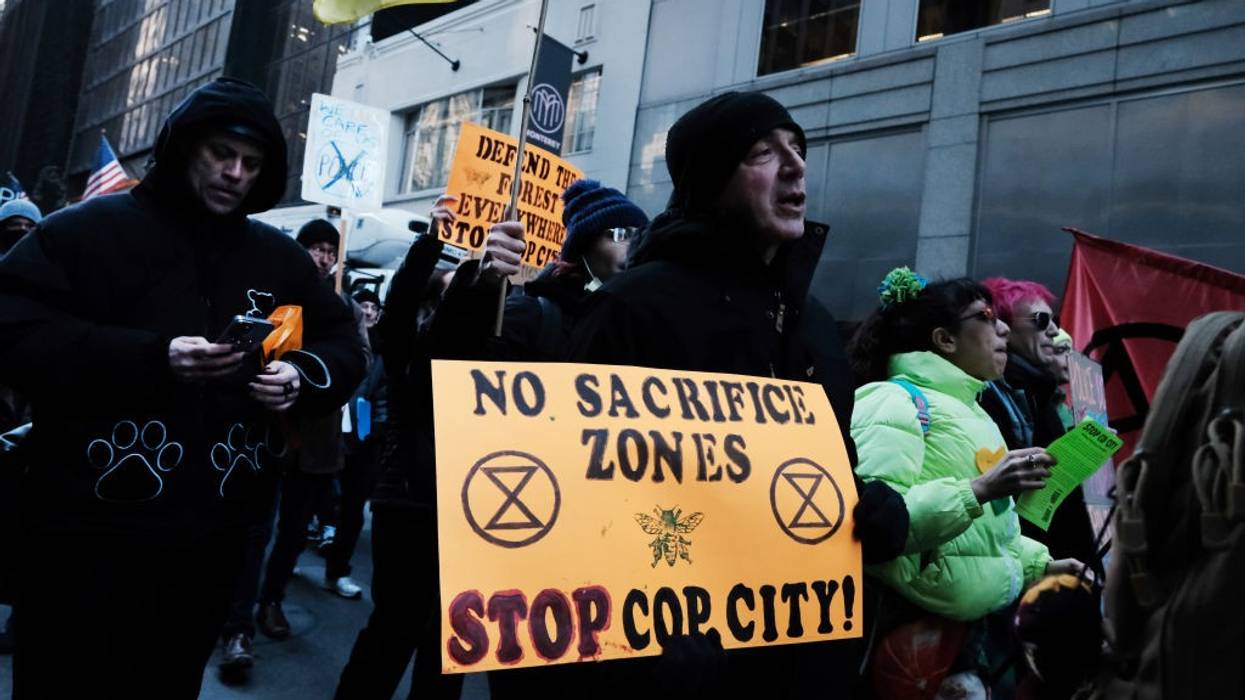
The indictments "send a chilling message that any dissent to Cop City will be punished with the full power and violence of the government."
Organizers with the Stop Cop City movement in Atlanta said Tuesday that new organized crime and racketeering charges against more than 60 campaigners were aimed at quashing all dissent against the construction of a $90 million police training facility in the city, as well as similar law enforcement projects.
Georgia's Republican attorney general, Chris Carr, announced that a grand jury indicted 61 protesters under the state's Racketeer Influenced and Corrupt Organizations (RICO) Act, with some accused only of distributing fliers.
"These charges, like the previous repressive prosecutions by the State of Georgia, seek to intimidate protesters, legal observers, and bail funds alike, and send the chilling message that any dissent to Cop City will be punished with the full power and violence of the government," organizers with the Cop City Vote Coalition (CCVC) told The Appeal. "The Cop City Vote Coalition strongly condemns these anti-democratic charges."
The indictments are the latest escalation by the state against movement to "Stop Cop City," as opponents have called the proposed 85-acre Public Safety Training Center planned in the Weelaunee Forest in DeKalb County.
Forest defender Manuel Esteban Paez Terán, known as Tortuguita, was shot and killed by police earlier this year while trying to stop the clearing of the area, and prosecutors in DeKalb County and Fulton County filed domestic terrorism charges against 42 people who have protested the training center. Many of those charged were also listed in Tuesday's indictments.
As Common Dreams reported in May, the Georgia and Atlanta police also arrested three organizers of a bail fund supporting protesters, accusing them of money laundering and charity fraud. The organizers are also among those facing RICO charges.
The New Republic noted that the date listed on the indictments is May 25, 2020—the day George Floyd was murdered by a Minneapolis police officer, marking the beginning of a nationwide uprising against police violence. The date suggests "that the attorney general's office plans to link the Stop Cop City movement with the larger protests that followed Floyd's death," wrote Edith Olmsted at the outlet.
The RICO charges, said racial justice group Color of Change, represent "a blatant attempt to silence democratic protest—and a dangerous violation of the constitutional right to protest."