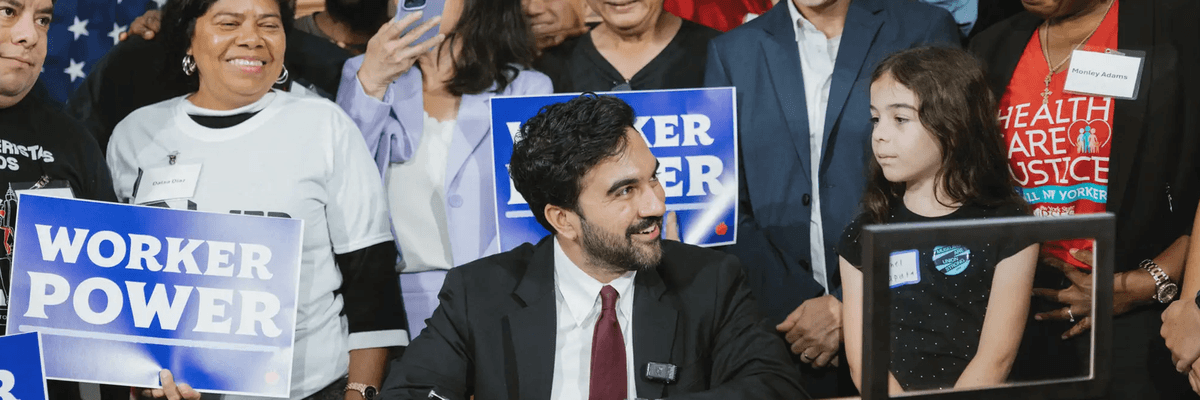
New York City Mayor Zohran Mamdani signs an executive order establishing the Office of Worker Power on September 7, 2026.
On Labor Day, Mamdani Announces First-of-Its-Kind 'Office of Worker Power' in NYC
"We’re setting it up to help workers organize in an economy where more and more is stacked against them."
New York City Mayor Zohran Mamdani marked Labor Day on Monday by announcing a new Office of Worker Power, an initiative aimed at bolstering union organizing at a time when wage growth is being swallowed by inflation and corporations are fighting as aggressively as ever to prevent employees from wielding their collective strength.
"This is a first-of-its-kind office in the country, and we’re setting it up to help workers organize in an economy where more and more is stacked against them," Mamdani said of the new project, which will "utilize city government to help workers organize themselves and build power to improve their working conditions and their lives."
"We created the first-in-the-nation Office of Worker Power to put the full weight of City Hall behind the people who keep New York running," said Mamdani. "The nurse working a double shift. The teacher working a second job. The warehouse workers organizing for a union. Every New Yorker working hard to build a life and support a family. On Labor Day, we honor the workers who came before us by fighting for the workers who come next."
Julie Su, the former acting US Labor Secretary who now serves as New York City's deputy mayor for economic justice, will oversee the new office, which will be led by longtime union organizer Tony Perlstein.
"When workers can organize, everything changes," said Su. "When they can build lasting, durable power, power that lets them transform their work experience, and by extension their lives, everything changes."
The office's website, debuted amid the Trump administration's assault on labor unions at the national level, includes a "get help" section that contains information on how workers interested in organizing can contact city officials, who will "share what you need to know and connect you with organizations that support workers like you."
"Someone might come to this office because they’re a worker and they want to better their own conditions, or the conditions of those around them, and they’re not sure where to go next," Mamdani told Jacobin in an interview. "In New York City, it’s very hard to know who you should call about any of these issues. Now we’re saying you will soon be able to go to nyc.gov/workerpower and finally get the kind of information you need, so that you know what rights you already have available to you and what rights you can win."
BREAKING: Mayor Zohran Mamdani announces a first-of-its-kind office focused on organizing workers in New York City.
The Mayor’s Office of Worker Power will provide workers with resources needed to organize their workplaces, hold public hearings on major worker issues, and more. pic.twitter.com/tkOg3s3fpn
— Jacobin (@jacobin) September 7, 2026
A recent report by the City University of New York School of Labor and Urban Studies found that "while union density remains strong in New York, membership rates remain largely unchanged, despite renewed organizing, successful strikes, and strong public support for labor."
"Union density stands at 20.5% in New York City and 20.9% statewide, more than double the national rate of 10%, yet well below levels recorded two decades ago," the report notes.
Perlstein, the leader of the new Office of Worker Power who previously served as an organizing director at the United Auto Workers, told reporters that "there is a huge gap between what workers want and what workers have." Perlstein pointed to a recent Gallup survey showing that more than 70% of Americans approve of labor unions—a figure far higher than the unionization rate.
“We’re going to be looking to provide opportunities to working-class New Yorkers to get educated on their rights to form unions and what it means to build power,” said Perlstein. “We’re going to work to connect workers to organizations that can help them build that power.”
We are at a crossroads
This country and this world are at a monumental crossroads. In a few short weeks, US voters will have an opportunity to beat back the forces of fascism and confront the billionaires who are rigging the economy, our media system, and our democracy, making it increasingly impossible for ordinary people to get by. We’re not just talking about the election. We’re talking about what must be done once these fascist elements are vanquished from power. We need a bolder set of solutions than what either major party has so far been willing to offer and a working-class movement ready to fight like hell for it. Trump didn't emerge from nowhere. The conditions that fueled MAGA authoritarianism were created by decades of radical neoliberal economic policies and a corrupt political system dominated by corporate interests. They slashed taxes on the super-rich, promising that the benefits would trickle down. They said giveaways to the corporate titans would make life more affordable for the rest of us. It was all bullshit. And when a bitter, betrayed populace searches for someone to blame, right-wing demagogues have little trouble finding scapegoats. People know when they're being lied to, but you won't hear any of this from the corporate media. Only independent journalism—powered and funded by people who believe in building a better world—can deliver truly trustworthy daily news. Our Fall Campaign is underway, and we need your help. To power our newsroom through the rest of the year, we need to raise $125,000 by midnight on October 31. So if you share our vision, please contribute whatever you can to sustain our work. |
New York City Mayor Zohran Mamdani marked Labor Day on Monday by announcing a new Office of Worker Power, an initiative aimed at bolstering union organizing at a time when wage growth is being swallowed by inflation and corporations are fighting as aggressively as ever to prevent employees from wielding their collective strength.
"This is a first-of-its-kind office in the country, and we’re setting it up to help workers organize in an economy where more and more is stacked against them," Mamdani said of the new project, which will "utilize city government to help workers organize themselves and build power to improve their working conditions and their lives."
"We created the first-in-the-nation Office of Worker Power to put the full weight of City Hall behind the people who keep New York running," said Mamdani. "The nurse working a double shift. The teacher working a second job. The warehouse workers organizing for a union. Every New Yorker working hard to build a life and support a family. On Labor Day, we honor the workers who came before us by fighting for the workers who come next."
Julie Su, the former acting US Labor Secretary who now serves as New York City's deputy mayor for economic justice, will oversee the new office, which will be led by longtime union organizer Tony Perlstein.
"When workers can organize, everything changes," said Su. "When they can build lasting, durable power, power that lets them transform their work experience, and by extension their lives, everything changes."
The office's website, debuted amid the Trump administration's assault on labor unions at the national level, includes a "get help" section that contains information on how workers interested in organizing can contact city officials, who will "share what you need to know and connect you with organizations that support workers like you."
"Someone might come to this office because they’re a worker and they want to better their own conditions, or the conditions of those around them, and they’re not sure where to go next," Mamdani told Jacobin in an interview. "In New York City, it’s very hard to know who you should call about any of these issues. Now we’re saying you will soon be able to go to nyc.gov/workerpower and finally get the kind of information you need, so that you know what rights you already have available to you and what rights you can win."
BREAKING: Mayor Zohran Mamdani announces a first-of-its-kind office focused on organizing workers in New York City.
The Mayor’s Office of Worker Power will provide workers with resources needed to organize their workplaces, hold public hearings on major worker issues, and more. pic.twitter.com/tkOg3s3fpn
— Jacobin (@jacobin) September 7, 2026
A recent report by the City University of New York School of Labor and Urban Studies found that "while union density remains strong in New York, membership rates remain largely unchanged, despite renewed organizing, successful strikes, and strong public support for labor."
"Union density stands at 20.5% in New York City and 20.9% statewide, more than double the national rate of 10%, yet well below levels recorded two decades ago," the report notes.
Perlstein, the leader of the new Office of Worker Power who previously served as an organizing director at the United Auto Workers, told reporters that "there is a huge gap between what workers want and what workers have." Perlstein pointed to a recent Gallup survey showing that more than 70% of Americans approve of labor unions—a figure far higher than the unionization rate.
“We’re going to be looking to provide opportunities to working-class New Yorkers to get educated on their rights to form unions and what it means to build power,” said Perlstein. “We’re going to work to connect workers to organizations that can help them build that power.”
New York City Mayor Zohran Mamdani marked Labor Day on Monday by announcing a new Office of Worker Power, an initiative aimed at bolstering union organizing at a time when wage growth is being swallowed by inflation and corporations are fighting as aggressively as ever to prevent employees from wielding their collective strength.
"This is a first-of-its-kind office in the country, and we’re setting it up to help workers organize in an economy where more and more is stacked against them," Mamdani said of the new project, which will "utilize city government to help workers organize themselves and build power to improve their working conditions and their lives."
"We created the first-in-the-nation Office of Worker Power to put the full weight of City Hall behind the people who keep New York running," said Mamdani. "The nurse working a double shift. The teacher working a second job. The warehouse workers organizing for a union. Every New Yorker working hard to build a life and support a family. On Labor Day, we honor the workers who came before us by fighting for the workers who come next."
Julie Su, the former acting US Labor Secretary who now serves as New York City's deputy mayor for economic justice, will oversee the new office, which will be led by longtime union organizer Tony Perlstein.
"When workers can organize, everything changes," said Su. "When they can build lasting, durable power, power that lets them transform their work experience, and by extension their lives, everything changes."
The office's website, debuted amid the Trump administration's assault on labor unions at the national level, includes a "get help" section that contains information on how workers interested in organizing can contact city officials, who will "share what you need to know and connect you with organizations that support workers like you."
"Someone might come to this office because they’re a worker and they want to better their own conditions, or the conditions of those around them, and they’re not sure where to go next," Mamdani told Jacobin in an interview. "In New York City, it’s very hard to know who you should call about any of these issues. Now we’re saying you will soon be able to go to nyc.gov/workerpower and finally get the kind of information you need, so that you know what rights you already have available to you and what rights you can win."
BREAKING: Mayor Zohran Mamdani announces a first-of-its-kind office focused on organizing workers in New York City.
The Mayor’s Office of Worker Power will provide workers with resources needed to organize their workplaces, hold public hearings on major worker issues, and more. pic.twitter.com/tkOg3s3fpn
— Jacobin (@jacobin) September 7, 2026
A recent report by the City University of New York School of Labor and Urban Studies found that "while union density remains strong in New York, membership rates remain largely unchanged, despite renewed organizing, successful strikes, and strong public support for labor."
"Union density stands at 20.5% in New York City and 20.9% statewide, more than double the national rate of 10%, yet well below levels recorded two decades ago," the report notes.
Perlstein, the leader of the new Office of Worker Power who previously served as an organizing director at the United Auto Workers, told reporters that "there is a huge gap between what workers want and what workers have." Perlstein pointed to a recent Gallup survey showing that more than 70% of Americans approve of labor unions—a figure far higher than the unionization rate.
“We’re going to be looking to provide opportunities to working-class New Yorkers to get educated on their rights to form unions and what it means to build power,” said Perlstein. “We’re going to work to connect workers to organizations that can help them build that power.”