SUBSCRIBE TO OUR FREE NEWSLETTER
Daily news & progressive opinion—funded by the people, not the corporations—delivered straight to your inbox.
5
#000000
#FFFFFF
To donate by check, phone, or other method, see our More Ways to Give page.
Daily news & progressive opinion—funded by the people, not the corporations—delivered straight to your inbox.
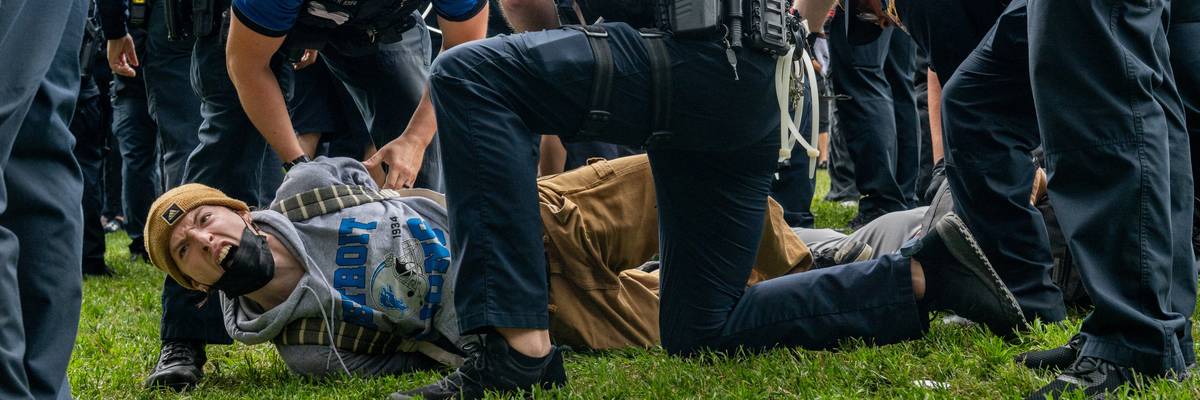
A student is arrested during a pro-Palestine demonstration at the the University of Texas at Austin on April 24, 2024 in Austin, Texas.
"Why do we even have these institutions of higher learning if we won't let students speak their conscience and protest?" said one University of Texas professor.
This is a developing story... Please check back for possible updates...
Civil rights advocates on Wednesday expressed alarm at a rapid escalation by Texas state troopers who descended on a student-led protest at University of Texas at Austin, which was organized in solidarity with Gaza and other U.S. college students taking part in a growing anti-war movement.
UT students gathered on campus at midday and were promptly given two minutes to disperse by state troopers, who had already been called to the scene.
The troopers were equipped with riot gear, with some carrying assault rifles and several stationed on horses.
Erick Lara, a 20-year-old sophomore, told The Dallas Morning News that the nonviolent protest transformed "within minutes" after the police began arresting demonstrators.
"I didn't think it would escalate this far," he told the outlet. "And I didn't think there would be this much police intervention from what's supposed to be a peaceful protest. Not very peaceful when there's a bunch of aggressors around, especially on horses."
The organizers called the gathering "The Popular University" and said it was aimed at pressuring UT to "divest from death."
The protesters walked out of their classes to demand UT divest from weapons manufacturers in order to end its complicity in Israel's U.S.-backed assault on Gaza, which has killed at least 34,262 Palestinians.
Student-run newspaper The Daily Texan reported roughly 50 state troopers were deployed to stop the initial protest of about 150-200 people.
Ryan Chandler, a reporter for NBC affiliate KXAN-TV and UT alum, reported that there were at least 10 students detained.
"Went here for four years, never saw anything like this," said Chandler, posting a video of a group of police pushing one student to the ground and arresting them.
Joseph Pierce, a Stony Brook University professor who attended graduate school at UT, also said the escalation was an unusually "drastic response to students advocating for an end to the genocide of the Palestinian people."
"It is a response that did not occur when in 2005 we protested the anti-gay marriage bill; in the late 2000s when we protested anti-immigration bills; in the 2010s when we protested the open-carry bill," Pierce said. "It is a clear attempt at silencing Palestinian and anti-Zionist Jewish voices."
The students faced the state troopers in a standoff on the university's main street.
"This violence against peaceful student protesters at UT Austin is absolutely horrifying—and should be condemned in the strongest terms by every politician and mainstream journalist," said former New Yorker editor Erin Overbey.
UT media and Middle East studies professor Nahid Siamdoust said the university "brought out everything but the kitchen sink to make sure" students couldn't erect an anti-war encampment like students at Columbia University, New York University, and other schools across the U.S. have in recent days.
The university had informed organizers with the on-campus Palestine Solidarity Committee on Tuesday that exercising their First Amendment rights in support of Palestinians in Gaza would "violate our policies and rules."
"The freedom to protest is integral to our democracy," said the ACLU of Texas Wednesday amid reports of the crackdown. "UT Austin students have a First Amendment right to freely express their political opinions—without threats of arrest and violence."
Dear Common Dreams reader, It’s been nearly 30 years since I co-founded Common Dreams with my late wife, Lina Newhouser. We had the radical notion that journalism should serve the public good, not corporate profits. It was clear to us from the outset what it would take to build such a project. No paid advertisements. No corporate sponsors. No millionaire publisher telling us what to think or do. Many people said we wouldn't last a year, but we proved those doubters wrong. Together with a tremendous team of journalists and dedicated staff, we built an independent media outlet free from the constraints of profits and corporate control. Our mission has always been simple: To inform. To inspire. To ignite change for the common good. Building Common Dreams was not easy. Our survival was never guaranteed. When you take on the most powerful forces—Wall Street greed, fossil fuel industry destruction, Big Tech lobbyists, and uber-rich oligarchs who have spent billions upon billions rigging the economy and democracy in their favor—the only bulwark you have is supporters who believe in your work. But here’s the urgent message from me today. It's never been this bad out there. And it's never been this hard to keep us going. At the very moment Common Dreams is most needed, the threats we face are intensifying. We need your support now more than ever. We don't accept corporate advertising and never will. We don't have a paywall because we don't think people should be blocked from critical news based on their ability to pay. Everything we do is funded by the donations of readers like you. When everyone does the little they can afford, we are strong. But if that support retreats or dries up, so do we. Will you donate now to make sure Common Dreams not only survives but thrives? —Craig Brown, Co-founder |
This is a developing story... Please check back for possible updates...
Civil rights advocates on Wednesday expressed alarm at a rapid escalation by Texas state troopers who descended on a student-led protest at University of Texas at Austin, which was organized in solidarity with Gaza and other U.S. college students taking part in a growing anti-war movement.
UT students gathered on campus at midday and were promptly given two minutes to disperse by state troopers, who had already been called to the scene.
The troopers were equipped with riot gear, with some carrying assault rifles and several stationed on horses.
Erick Lara, a 20-year-old sophomore, told The Dallas Morning News that the nonviolent protest transformed "within minutes" after the police began arresting demonstrators.
"I didn't think it would escalate this far," he told the outlet. "And I didn't think there would be this much police intervention from what's supposed to be a peaceful protest. Not very peaceful when there's a bunch of aggressors around, especially on horses."
The organizers called the gathering "The Popular University" and said it was aimed at pressuring UT to "divest from death."
The protesters walked out of their classes to demand UT divest from weapons manufacturers in order to end its complicity in Israel's U.S.-backed assault on Gaza, which has killed at least 34,262 Palestinians.
Student-run newspaper The Daily Texan reported roughly 50 state troopers were deployed to stop the initial protest of about 150-200 people.
Ryan Chandler, a reporter for NBC affiliate KXAN-TV and UT alum, reported that there were at least 10 students detained.
"Went here for four years, never saw anything like this," said Chandler, posting a video of a group of police pushing one student to the ground and arresting them.
Joseph Pierce, a Stony Brook University professor who attended graduate school at UT, also said the escalation was an unusually "drastic response to students advocating for an end to the genocide of the Palestinian people."
"It is a response that did not occur when in 2005 we protested the anti-gay marriage bill; in the late 2000s when we protested anti-immigration bills; in the 2010s when we protested the open-carry bill," Pierce said. "It is a clear attempt at silencing Palestinian and anti-Zionist Jewish voices."
The students faced the state troopers in a standoff on the university's main street.
"This violence against peaceful student protesters at UT Austin is absolutely horrifying—and should be condemned in the strongest terms by every politician and mainstream journalist," said former New Yorker editor Erin Overbey.
UT media and Middle East studies professor Nahid Siamdoust said the university "brought out everything but the kitchen sink to make sure" students couldn't erect an anti-war encampment like students at Columbia University, New York University, and other schools across the U.S. have in recent days.
The university had informed organizers with the on-campus Palestine Solidarity Committee on Tuesday that exercising their First Amendment rights in support of Palestinians in Gaza would "violate our policies and rules."
"The freedom to protest is integral to our democracy," said the ACLU of Texas Wednesday amid reports of the crackdown. "UT Austin students have a First Amendment right to freely express their political opinions—without threats of arrest and violence."
This is a developing story... Please check back for possible updates...
Civil rights advocates on Wednesday expressed alarm at a rapid escalation by Texas state troopers who descended on a student-led protest at University of Texas at Austin, which was organized in solidarity with Gaza and other U.S. college students taking part in a growing anti-war movement.
UT students gathered on campus at midday and were promptly given two minutes to disperse by state troopers, who had already been called to the scene.
The troopers were equipped with riot gear, with some carrying assault rifles and several stationed on horses.
Erick Lara, a 20-year-old sophomore, told The Dallas Morning News that the nonviolent protest transformed "within minutes" after the police began arresting demonstrators.
"I didn't think it would escalate this far," he told the outlet. "And I didn't think there would be this much police intervention from what's supposed to be a peaceful protest. Not very peaceful when there's a bunch of aggressors around, especially on horses."
The organizers called the gathering "The Popular University" and said it was aimed at pressuring UT to "divest from death."
The protesters walked out of their classes to demand UT divest from weapons manufacturers in order to end its complicity in Israel's U.S.-backed assault on Gaza, which has killed at least 34,262 Palestinians.
Student-run newspaper The Daily Texan reported roughly 50 state troopers were deployed to stop the initial protest of about 150-200 people.
Ryan Chandler, a reporter for NBC affiliate KXAN-TV and UT alum, reported that there were at least 10 students detained.
"Went here for four years, never saw anything like this," said Chandler, posting a video of a group of police pushing one student to the ground and arresting them.
Joseph Pierce, a Stony Brook University professor who attended graduate school at UT, also said the escalation was an unusually "drastic response to students advocating for an end to the genocide of the Palestinian people."
"It is a response that did not occur when in 2005 we protested the anti-gay marriage bill; in the late 2000s when we protested anti-immigration bills; in the 2010s when we protested the open-carry bill," Pierce said. "It is a clear attempt at silencing Palestinian and anti-Zionist Jewish voices."
The students faced the state troopers in a standoff on the university's main street.
"This violence against peaceful student protesters at UT Austin is absolutely horrifying—and should be condemned in the strongest terms by every politician and mainstream journalist," said former New Yorker editor Erin Overbey.
UT media and Middle East studies professor Nahid Siamdoust said the university "brought out everything but the kitchen sink to make sure" students couldn't erect an anti-war encampment like students at Columbia University, New York University, and other schools across the U.S. have in recent days.
The university had informed organizers with the on-campus Palestine Solidarity Committee on Tuesday that exercising their First Amendment rights in support of Palestinians in Gaza would "violate our policies and rules."
"The freedom to protest is integral to our democracy," said the ACLU of Texas Wednesday amid reports of the crackdown. "UT Austin students have a First Amendment right to freely express their political opinions—without threats of arrest and violence."