
SUBSCRIBE TO OUR FREE NEWSLETTER
Daily news & progressive opinion—funded by the people, not the corporations—delivered straight to your inbox.
5
#000000
#FFFFFF
To donate by check, phone, or other method, see our More Ways to Give page.


Daily news & progressive opinion—funded by the people, not the corporations—delivered straight to your inbox.
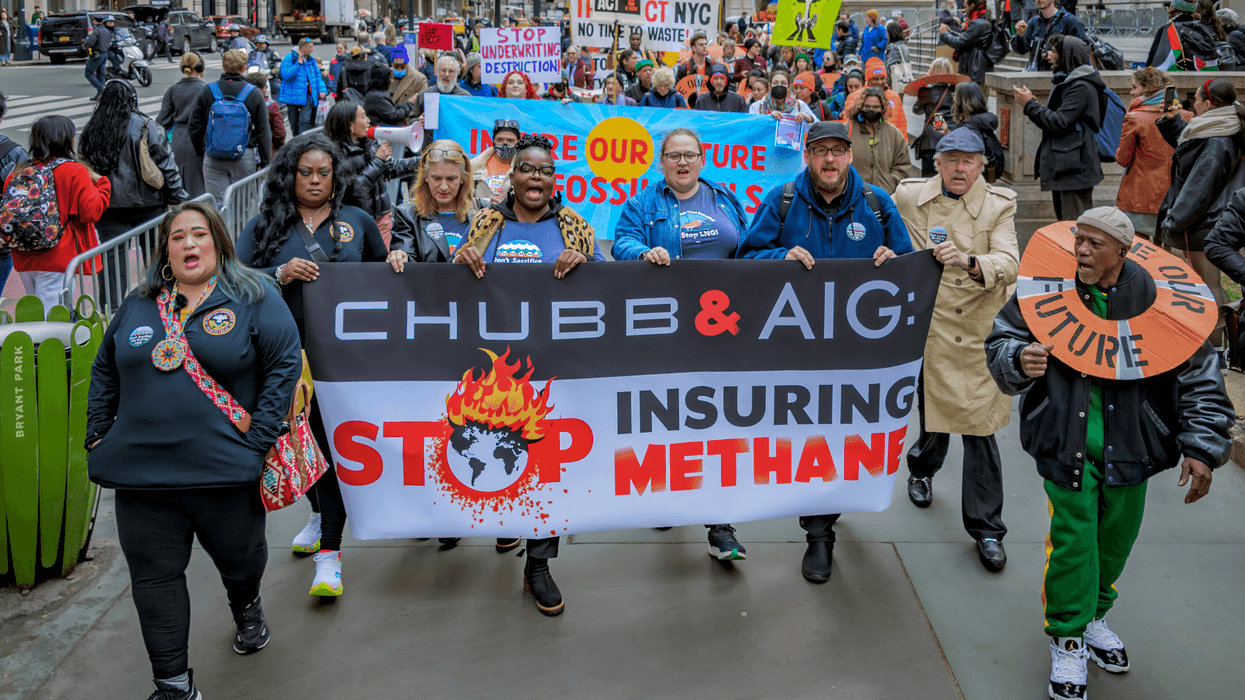
"Chubb has the potential to lead the industry and raise the bar for AIG and Liberty Mutual to follow suit," said one campaigner.
Climate, environmental, and Indigenous rights defenders on Tuesday welcomed news that global insurance giant Chubb dropped out of a highly controversial methane gas project on the Texas Gulf Coast after months of grassroots community pressure.
The Sunrise Project published an insurance certificate obtained via a public information act request showing that Chubb is no longer insuring the Rio Grande liquefied natural gas (LNG) terminal in Brownsville. Houston-based NextDecade—which touts itself as a "sustainable LNG" company—says Phase I of Rio Grande LNG is currently under construction and that the 984-acre site "will be the largest privately funded infrastructure project in Texas."
In addition to exacerbating the climate emergency, Rio Grande LNG threatens land and sites sacred to the Carrizo/Comecrudo Tribe, which opposes the project.
"When you do the due diligence and understand Indigenous rights, this project is a no-go," Carrizo/Comecrudo Tribe of Texas Chair Juan Mancias said in a statement. "Investors and major banks have dropped Rio Grande LNG, and now insurers are following suit because the claims of the fossil fuel companies can't be trusted—here, or anywhere in Texas."
According to the Sunrise Project:
This is the latest setback for the not-yet-built project that would harm the coastal landscape of the Rio Grande Valley as one of the last pristine areas of the Texas coastline—a haven for wildlife, fishing, tourism, and recreation and home to Latine and Indigenous communities—into an industrial methane export hub. Years of campaigning was a likely factor in the insurer backing away. Five banks—SMBC, Société Générale, Credit Suisse, and privately, two additional banks—committed to not financing the project after pressure from community leaders.
Community members voiced the impacts that the methane terminal's gas storage tanks, flare stacks, pipelines, and explosion risks pose to the Port of Brownsville, including the city of Brownsville and those known as the "Laguna Madre": Port Isabel, South Padre Island, Laguna Vista, Long Island Village, and Laguna Heights. The cumulative impacts on soils, air and water quality, community health, vegetation, wildlife, threatened and endangered species, tourism, commercial fisheries, and noise would be significant.
"We tell companies the truth about these projects that would be an environmental disaster for our South Texas community. It feels good to be heard," said Bekah Hinojosa of the South Texas Environmental Network. "I expect other insurers like AIG and Sompo to drop next because the LNG facility, the pipeline, the company—they're losers with a dangerous project."
In June, hundreds of Gulf Coast residents traveled to Chubb's New York office to protest the company's insurance of fossil fuel projects including Rio Grande LNG, Texas LNG, Freeport LNG, and Cameron LNG. Six activists were arrested for blocking the main entrance to Chubb's building. The protest—one of several targeting fossil fuel funders and insurers—was part of the Summer of Heat, a civil disobedience campaign aimed at getting Wall Street to stop funding planet-heating oil, gas, and coal projects.
Ethan Nuss of Rainforest Action Network (RAN) asserted that "Chubb is showing some promising leadership by pulling out of Rio Grande LNG."
"Now Chubb must take the next step of becoming a true climate leader and stop insuring all methane," Nuss added. "Now Chubb must take the next step of becoming a true climate leader and stop insuring all methane. Chubb has the potential to lead the industry and raise the bar for AIG and Liberty Mutual to follow suit."
In February, RAN and the consumer advocacy group Public Citizen published a report revealing that at least 35 different insurance companies were underwriting Rio Grande LNG. The report named Chubb and AIG as the world's two most prolific insurers of fossil fuel projects.
"AIG has tripped over itself to insure Rio Grande LNG in the wake of Chubb's exit," Public Citizen insurance campaigner Rick Morris said on Tuesday.
"This move is the latest in a long pattern of insuring and investing in fossil fuels that shows AIG's climate and human rights commitments aren't worth the paper they're written on," he added. "We have one message for AIG: We won't stop fighting until you drop these disastrous projects."
"We will continue to stand in solidarity and fight together with our African comrades to stop EACOP, to stop the plunder of our homelands, to stop the displacement of our peoples, and to stop imperialist climate destruction."
The "Summer of Heat" continues—both in terms of record-breaking temperatures driven by fossil fuels and a series of nonviolent direct actions targeting Wall Street for its contributions to the climate emergency.
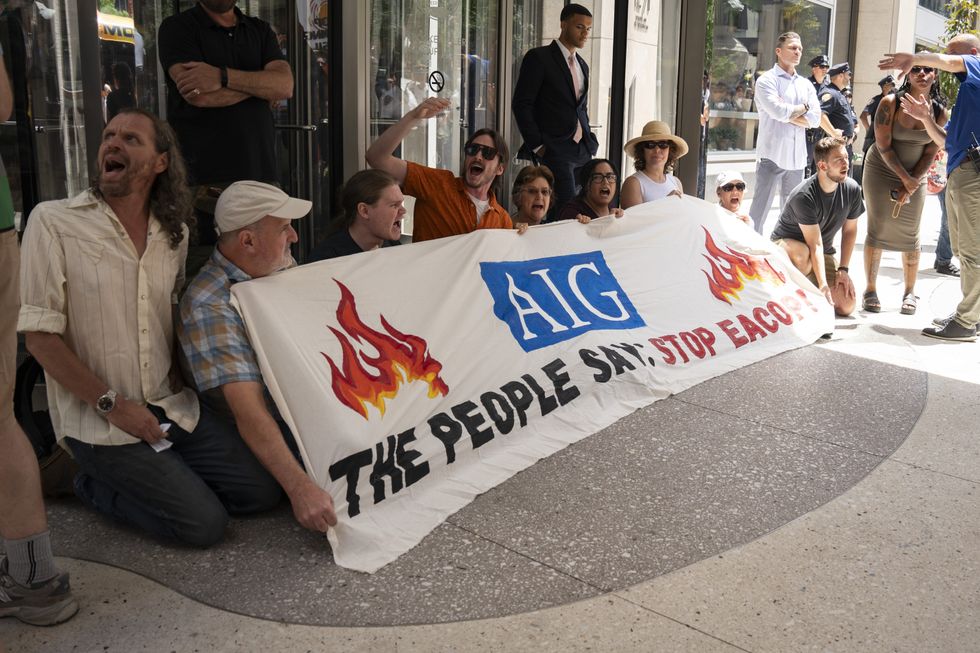
After protests last month calling out Citibank for "financing the arsonists," climate campaigners on Friday set their sights on finance and insurance giant AIG for "stubbornly" refusing to join over two dozen other insurers that won't cover the East African Crude Oil Pipeline (EACOP).
EACOP is set to run nearly 900 miles from Uganda's Lake Albert oilfields to the port of Tanga in Tanzania. Rights groups have sounded the alarm about how the project has devastated the lives and livelihoods of people in its path as well as violence endured by African activists, who have been "kidnapped, arbitrarily arrested, detained, or subjected to different forms of harassment."
Ugandan climate activist Hillary Taylor Seguya declared Friday that "EACOP is a carbon bomb being built in my backyard."
"Thousands of communities in Uganda are being displaced because of corporate greed," added the campaigner, who is affiliated with StopEACOP. "Today, as Ugandans, as Tanzanians, as Africans, we want to be loud and clear that we shall not allow any pipeline to put oil in our backyards."
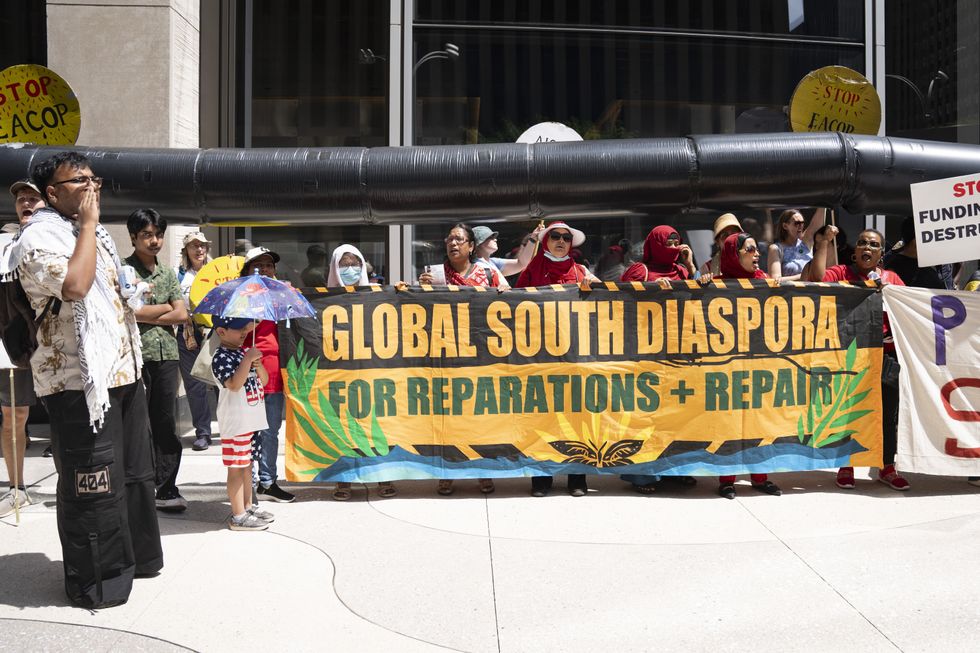
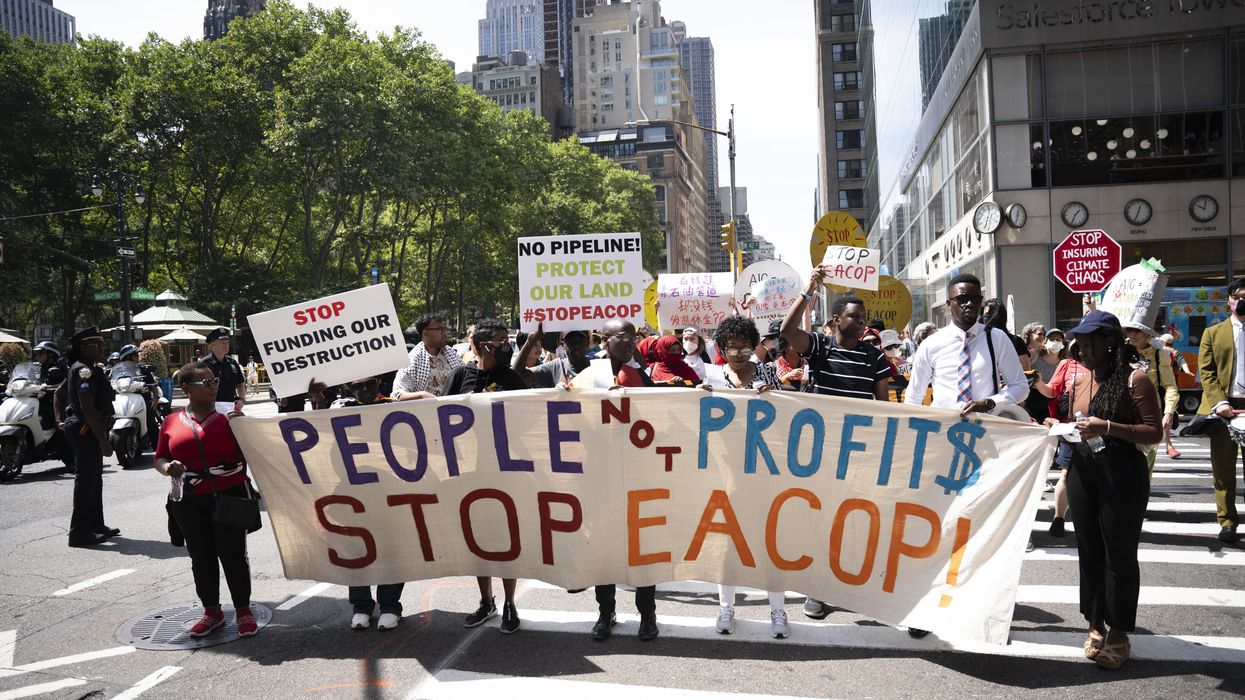
Friday's demonstration targeting AIG's office in New York City was organized by activists from the Ugandan diaspora and groups including 350.org, the Black Hive, and Desis Rising Up and Moving (DRUM).
"I am here to ask AIG to refuse to insure EACOP, and to insure our future instead," said Joseph Senyonjo, a Ugandan diaspora activist. "AIG is one of the biggest insurance companies in the world, and they still haven't ruled out insuring EACOP. So we are here to say: We don't want carbon bombs, we don't want fossil fuels. We want renewable energy. Insure our futures instead."
Protesters held signs and banners with messaging that included: "AIG = Climate Crimes," "Protect Our Land," "People Not Profits," "Stop Funding Our Destruction," "Stop Insuring Climate Chaos," and "The People Say: Stop EACOP!"

"From the pipeline's path in East Africa, to the corporate offices here, to our government institutions, we need to make our message clear: Stop EACOP!" said Evan Bell of 350 Mass. "I am willing to do what it takes to make sure AIG does not insure EACOP."
Bell noted that he is afraid of the New York Police Department, "especially after their brutal response to campus protesters peacefully demonstrating for an end to genocide in Gaza."
"But I am more afraid of runaway climate change," he added. "I'm more concerned about the current human rights abuses in Uganda and Tanzania. But we are more determined than we are scared."
Molly Ornati of 350 Brooklyn emphasized that "the EACOP pipeline is a doubly destructive disaster—for the people of Uganda and Tanzania, and the planet. The construction of the 900-mile pipeline will disrupt and destroy the homes, land, and livelihood of 100,000 people along the route, as well as the surrounding water and ecosystems."
"Once built, it will be a carbon bomb for humanity," Ornati warned. "In the climate crisis there are no borders, and we are a global movement, united in support of frontline communities, fighting to stop the greed of fossil fuel finance."
DRUM's Mohiba Ahmed delivered a similar message of unity, saying that "we add our communities' voices to the growing international demand 'Stop EACOP!' because we know that our struggles are one and interconnected."
"Our peoples in Bangladesh, Pakistan, Nepal, Guyana, and Trinidad are similarly harmed by foreign domination, imperialism, and capitalist projects that reduce our lives to investments, profit margins, and coins," she stressed.
"Our people and homelands contribute the least to the human-caused climate crisis but disproportionately suffer the most," she added, "and that is why we will continue to stand in solidarity and fight together with our African comrades to stop EACOP, to stop the plunder of our homelands, to stop the displacement of our peoples, and to stop imperialist climate destruction."

Beth Yirga of the Black Hive—part of the Movement for Black Lives—highlighted the frontline resistance to the pipeline, declaring that "we stand with Ugandans and Tanzanians, whose bravery and stories of resistance to stop EACOP are inspiring."
"The climate crisis we are facing exacerbates the oppressive systems designed to extract the most from our planet and global majority community, and unites us that are most impacted," she said. "From Cancer Alley on the riverbanks of the Mississippi River to the lead in Flint, Michigan's water, to the attempts of crude oil extraction in Western Uganda, to the ongoing cobalt mining crisis in Congo, the destructive practices of environmental racism on Black communities is collectively held and felt across the world."
"As we fight to stop climate injustices globally," Yirga added, "we also collaborate to imagine and build a world free of the capitalistic pillaging of Mother Earth."
Until this self-reinforcing cycle is broken, we’ll have a corporate tax and compensation system that works for top executives—and no one else.
In his State of the Union address, President Joe Biden called out “massive executive pay” and vowed to “make big corporations and the very wealthy finally pay their share” of taxes.
Corporate tax dodging and CEO pay have gotten so out of control that many major U.S. companies are paying their top executives more than they’re paying Uncle Sam.
Tesla is perhaps the most dramatic example. Over the period 2018-2022, the electric car maker raked in $4.4 billion in profits but paid no federal income taxes. Meanwhile, Tesla CEO Elon Musk became one of the world’s richest men.
When it comes to fleecing taxpayers while overpaying executives, Tesla is hardly alone. A new report we co-authored for the Institute for Policy Studies and Americans for Tax Fairness analyzes executive pay data for some of the country’s most notorious corporate tax dodgers.
Congress can tackle the entwined problems of inadequate corporate tax payments and excess executive pay on several fronts.
What did we find? In addition to Tesla, 34 other large and profitable U.S. firms—including household names like Ford, Netflix, and T-Mobile—paid less in federal income taxes between 2018 and 2022 than they paid their top five executives.
Another 29 profitable corporations paid their top executives more than they paid Uncle Sam in at least two of the five years of the study period.
One company on our list stands out for the infamous role its executives played in the 2008 financial crisis: American International Group. Back then, the insurance giant ignited a firestorm by pocketing a $180 billion taxpayer bailout and then announcing plans to hand out $165 million in bonuses to the very same executives responsible for pushing the company—and the nation—to the brink of collapse.
Today, AIG is playing the same greedy game of overpaying its top brass and sticking taxpayers with the bill. Between 2018 and 2022, the company paid its top five executives more than it paid in federal income taxes, despite collecting $17.7 billion in U.S. profits. In 2022, CEO Peter Zaffino alone made $75 million.
Lavish executive compensation packages and skimpy corporate tax payments are not unrelated. Executives have a huge personal incentive to hire armies of lobbyists to push for corporate tax cuts because the windfalls from these cuts often wind up in their own pockets.
The 2017 Republican tax law slashed the corporate tax rate from 35% to 21% and failed to close loopholes that whittle down IRS bills even further. Many large, profitable corporations ended up paying no federal taxes at all.
Corporations took the savings from those tax cuts and spent a record-breaking $1 trillion on stock buybacks, a financial maneuver that artificially inflates the value of executives’ stock-based pay.
Wealthy executives became even wealthier while the nation lost billions of dollars in corporate revenue that could have been used to lower costs and improve services for ordinary people. Until this self-reinforcing cycle is broken, we’ll have a corporate tax and compensation system that works for top executives—and no one else.
What can we do to break this cycle?
Congress can tackle the entwined problems of inadequate corporate tax payments and excess executive pay on several fronts. Raising the corporate tax rate to 28% (just halfway back to Obama-era levels) would generate $1.3 trillion in new revenue over the next decade.
Congress must also close loopholes and eliminate wasteful tax breaks, for instance by removing the incentives for American firms to shift profits and production offshore.
Policymakers also have a wealth of tools to curb excessive executive pay, from tax and contracting reforms to stronger regulations to rein in stock buybacks and banker bonuses.
We know we need change when corporations are rewarding a handful of top executives more than they are contributing to the cost of public services needed for our economy to thrive.
"Make no mistake, money made off the extraction of oil and gas is blood money," one frontline Indigenous campaigner said.
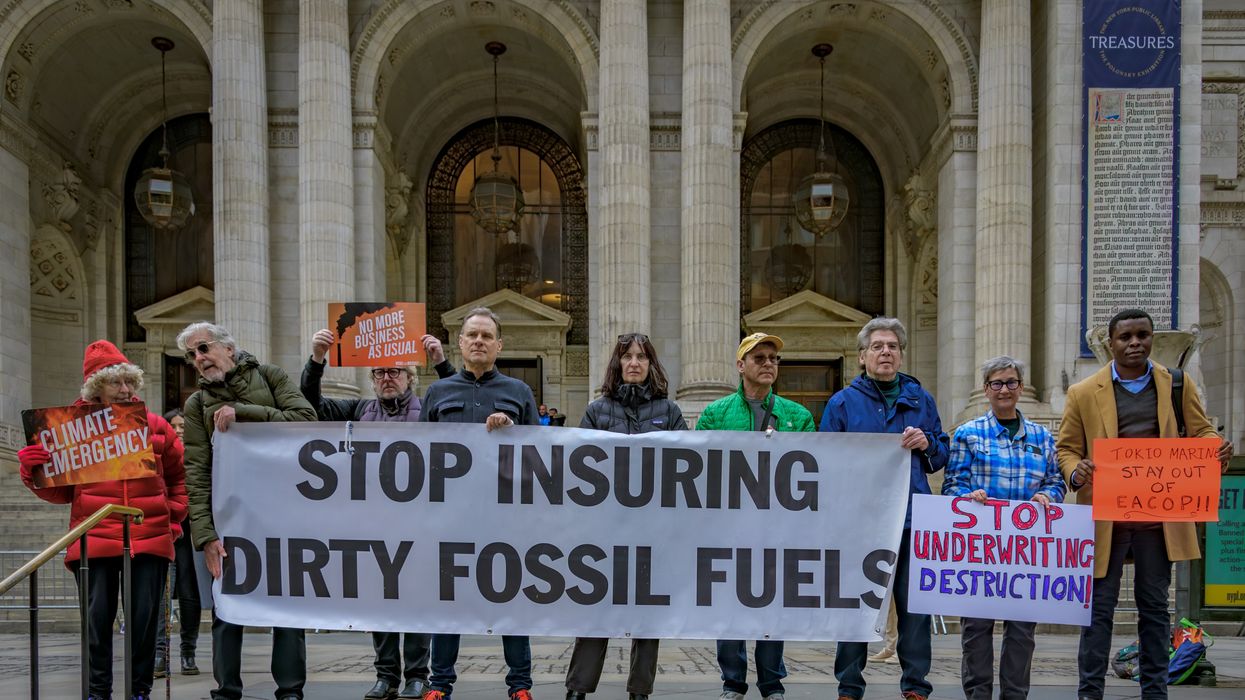
More than 100 frontline community members from Louisiana, Texas, and New York marched on the Manhattan offices of four insurance giants Tuesday, demanding that they stop backing new fossil fuel projects that would intensify the climate crisis.
The march and rally come as part of the Insure Our Future Global Week of Action from February 26 to March 3, as activists in nearly 30 countries and on five continents are staging protests to demand that major insurance companies stop insuring fossil fuels, respect human rights, and support a just transition to renewable energy.
"We have been telling financiers and insurers about the destruction and devastation oil and gas projects are causing to our health, communities, and sacred lands for years, yet they continued to enable its unhinged expansion," Juan Mancias, the tribal chair of the Carrizo/Comecrudo Tribe of Texas, said in a statement. "Make no mistake, money made off the extraction of oil and gas is blood money. We are tired of empty promises, we want results. End your support for oil and gas now."
"The insurance industry readily covers polluting pipelines as part of routine business, despite potential costs. However, when it comes to insuring our homes, they either refuse or make it prohibitively expensive."
The protest came days after a report from Insure Our Future, Rainforest Action Network, and Public Citizen revealed that at least 35 insurers are underwriting controversial liquefied natural gas (LNG) export infrastructure along the U.S. Gulf Coast. The insurers, the names of which were obtained via more than 50 Freedom of Information Act requests, include AIG, Tokio Marine, Chubb, and Sompo, the four companies targeted during Tuesday's action.
For example, Sompo and Chubb are two of the insurers behind Rio Grande LNG, a terminal in Brownsville, Texas, that threatens land and sites sacred to the Carrizo/Comecrudo Tribe, which has not given its Free, Prior, and Informed Consent to the project. Protesters delivered a petition to Chubb with more than 345,000 signatures asking it and other insurers to withdraw their support.
"The proposed terminal will support the continued environmental racism in the gulf by perpetuating the displacement, pollution, and physical harm of impacted communities," the petition reads. "It is imperative that the supporting insurance companies listen to Indigenous and impacted communities. And time is running out for transformative action to tackle the climate crisis."
In addition, the new LNG terminals would increase the pollution burden on communities that are already disproportionately exposed to toxins from the region's many petrochemical facilities and harm local ecosystems and wildlife.
"If built, Texas LNG, Rio Grande LNG, and their proposed Rio Bravo Pipeline would destroy our low-income Latine community's way of life," Bekah Hinojosa of South Texas Environmental Justice Network said in the report. "Pollution from these mega LNG/ methane export terminals would destroy the waterways where shrimp lay their eggs and our people fish to feed their families. We're calling on these insurance companies to stop insuring LNG/methane terminals because it's blatant environmental racism."
In terms of global impact, the projects backed by the insurers would emit the same amount of climate-warming emissions every year as 239 coal plants.
"These companies are insuring one of the largest build-outs of fossil fuels in the world, from investment to underwriting, these companies are culpable for providing material support through millions in coverage, while simultaneously abandoning communities in Texas and Louisiana," Mary Lowell of Rainforest Action Network said in a statement.
The report and the protest came after climate and frontline advocates in the U.S. succeeded in persuading the Biden administration to pause Department of Energy approvals for new LNG exports while they reassess their decision-making criteria, including climate impacts. Activists note that these projects also cannot move forward without insurance, which gives these companies a pivotal role. At the same time, many insurance companies internally recognize the risks posed by the climate crisis. On Wednesday, reinsurance company Swiss Re calculated that it already costs the U.S. around $97 billion a year.
Tuesday's march included a rally at AIG. The company, along with Chubb, Liberty Mutual, and SCOR, was featured on a majority of the certificates detailed in the report, including those for Louisiana's Cameron LNG and Sabine Pass LNG. At the same time, AIG has stopped backing Louisiana-based businesses amid extreme weather events fueled by the climate crisis.
Many community members exposed to pollution from petrochemical facilities are also exposed to more dangerous storms. Roishetta Ozane, a Louisiana environmental justice leader who founded the Vessel Project for disaster relief, stood in front of AIG explaining how she had survived Hurricanes Laura and Delta, as well as a winter storm and flood in 2021.
"All of these disasters that happened in my community because of these climate-inducing, climate-causing, climate catastrophe-ensuring projects like LNG terminals that are insured by companies like AIG, Chubb, and Tokio Marine," she said.
Another participant, Donna Simbo of New York Communities for Change, said she had survived Hurricane Sandy only to still be living in temporary housing more than 10 years later, with insurance premiums 70% higher.
"The insurance industry readily covers polluting pipelines as part of routine business, despite potential costs," Simbo said. "However, when it comes to insuring our homes, they either refuse or make it prohibitively expensive. Despite acknowledging the risks of climate change, insurance companies have avoided taking their fair share of responsibility."
Beyond New York, actions this week are also planned across the globe including in Colombia, Costa Rica, Congo, France, Germany, India, Indonesia, Japan, Kenya, Nigeria, Pakistan, Peru, Romania, South Korea, Switzerland, the U.K., Uganda, and Tanzania.
Uganda-based activist Hilda Flavia Nakabuye wrote for Common Dreams urging insurers to back away from the East African Crude Oil Pipeline, which would threaten local biodiversity and livelihoods and emit 32.3 million metric tons of carbon pollution each year. While 28 insurers have promised not to back it, several have not, including AIG, Tokio Marine, Chubb, Hiscox, and Lloyd's of London.
"We need all major (re)insurers to rule out supporting such a dangerous new oil pipeline to make sure that it never gets built," Nakabuye said.
To date, not a single global insurer has a policy in line with the Paris agreement goal of limiting global heating to 1.5°C above preindustrial levels, according to Insure Our Future.
"Insurance companies are supposed to be experts at measuring and mitigating risks, yet their ongoing support for oil, gas, and coal expansion is paving the way to a dangerous and devastating future," Isabelle L'Héritier, senior campaigner and lead organizer of the Insure Our Future Global Week of Action, said in a statement.
"Billions of us are living through the catastrophic impacts of brutal wildfires, storms, floods, heatwaves, and droughts which are getting worse every year," L'Héritier continued. "The effects of the climate crisis, from water shortages to rising food prices, are being felt on every continent. Companies like Zurich, AIG, and Tokio Marine have the power to push for a cleaner, safer world for the next generation if they act now. It's time to insure our future, not destruction."
"The choices of these companies reflect a clear double standard in who is expected to pay the price for climate change," said one advocate.
Reports have mounted in recent months about U.S. insurers announcing plans to end new insurance policies for homeowners in certain parts of the country, including California, where residential areas are increasingly vulnerable to wildfires, and Florida, where residents face the threat of hurricane and flood damage.
But a new report by consumer watchdog Public Citizen and advocacy group Insure Our Future shows that insurance companies' newfound awareness of the climate emergency hasn't stopped them from continuing to underwrite the top source of the carbon dioxide emissions that are heating the planet, causing sea levels to rise, and fueling extreme weather events.
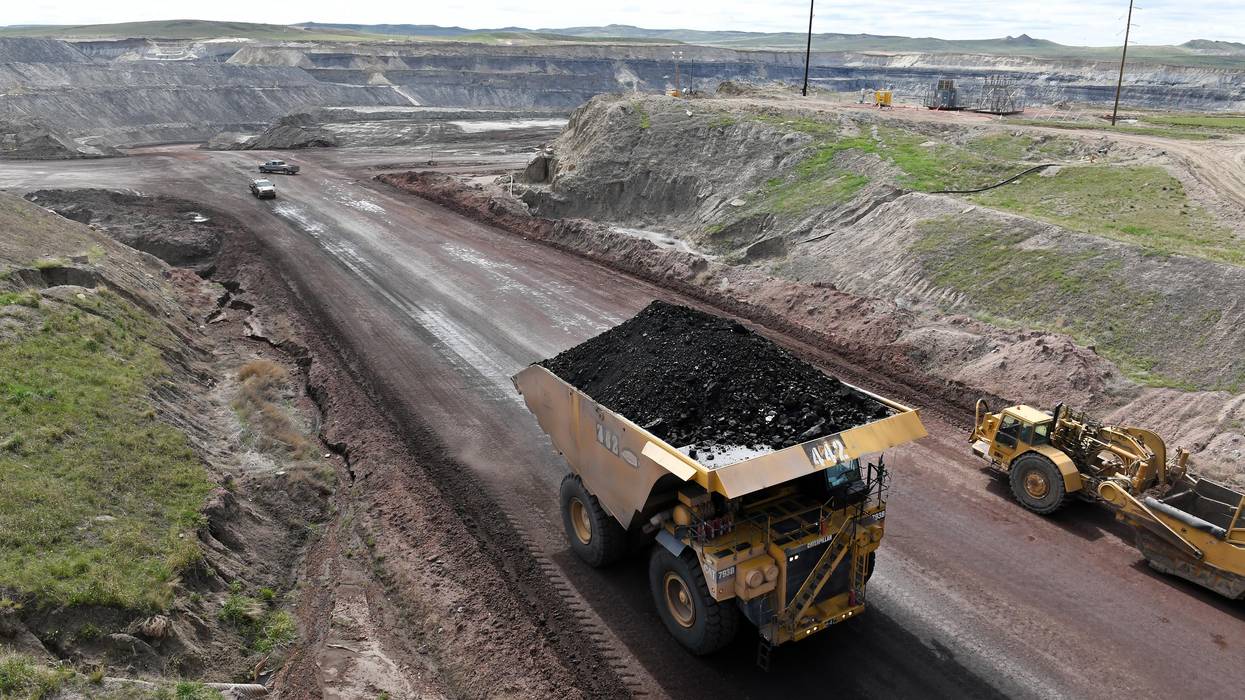
Insurance companies including Liberty Mutual, Swiss Re, American International Group (AIG), Lloyd's of London, and Zurich are among 16 firms that are still underwriting the top 25 coal mines in the United States.
The companies' support has allowed the pollution-causing industry to produce 60% of the country's current coal output, according to Public Citizen.
Last year, the top five insurers listed above issued coverage for the production of more than 245 million tons of coal, representing at least 41% of the coal produced.
AIG was the worst offender last year, underwriting at least 28% of coal production, and companies including Swiss Re and Liberty Mutual blatantly violated their own stated policies on coal.
"The hypocrisy is staggering," said Public Citizen.
The companies' continued support for coal—combined with their abandonment of homeowners—amounts to "greenwashing," said Carly Fabian, an insurance policy advocate for Public Citizen.
"While insurance companies claim to have seen the light on climate change when they abandon homeowners, that same concern appears to be nowhere in sight when they chose to insure coal mines," said Fabian. "Insurance providers seem to be greenwashing their images by claiming to restrict coal, while undermining their policyholders and their own stated policies to continue underwriting one of the dirtiest forms of energy."
Public Citizen's analysis found that Liberty Mutual has violated its own coal policy, which states that it will "no longer accept underwriting risk for companies where more than 25% of their exposure arises from the extraction and/or production of energy from thermal coal" and that it will phase out coverage for companies with such exposure by 2023.
Liberty Mutual underwrote Signal Peak Energy's Bull Mountain Mine No. 1 in 2022; while the company's policy does not define "exposure," the project likely violates the insurer's stated threshold because 90% of Signal Peak's revenue is derived from coal.
While it continues to underwrite coal production, Liberty Mutual announced in July that it would stop issuing business owners policies in California.
Swiss Re also violated its own policy, by underwriting a coal mine operated by Buckskin Mining Company, which generates 90% of its revenue from the coal business and produces nearly 10 million metric tons of coal each year.
The insurer has stated that it will phase out thermal coal production coverage by 2030 in Organization for Economic Cooperation and Development (OECD) countries and by 2040 worldwide, and that until then it will "exclude re/insurance support to companies or projects that have more than 30% of exposure to thermal coal."
Fabian said that "the choices of these companies reflect a clear double standard in who is expected to pay the price for climate change. The insurance industry needs to muster the courage to cut their coverage for fossil fuels before it becomes too risky to insure the rest of us."x
Zurich's coal policy contains a loophole, said Public Citizen, that has allowed the company to insure thermal coal mines even though in 2019 it said it would "no longer underwrite or invest in companies that generate more than 30% of their revenue from mining thermal coal or produce more than 20 million tons of thermal coal per year."
The group said open records requests for insurance certificates showed that:
From 2020 until November 2022, Zurich insured two subsidiaries of Alpha Metallurgical Resources—Alpha Coal West and the third-largest U.S. coal producer, Alpha Natural Resources—for operation of the Eagle Butte and Belle Ayr mines. While the mines are among the top producers of U.S. thermal coal, Zurich is not violating its coal policy because it applies only to companies involved in the thermal coal business and in this case, the companies involved appear to conduct most of their business in metallurgical coal, not thermal coal. This underscores the need for Zurich, and all insurers, to explicitly address metallurgical coal in underwriting restrictions, since metallurgical coal, which is currently the basis for making steel, is a significant source of carbon emissions and low-carbon alternatives exist.
"We expected some companies to be underwriting coal projects, but the data underscore the loopholes in their policies and disregard for public commitments across the insurance industry," said Fabian.
Meanwhile, Zurich's affiliate, Farmers Insurance Group, is among the companies that have pulled out of Florida due to climate risks.
Clara Vondrich, senior policy counsel at Public Citizen, said U.S. insurers are "double-dipping in the worst way."
The report called on all insurance firms to:
The report was released days before Insure Our Future and other groups are set to rally at the Insurance Leadership Forum in Colorado Springs, where advocates will demand companies "insure our communities instead of oil, gas, and coal."
"On October 1, insurance executives will be gathering in Colorado Springs to play golf, drink cocktails, and discuss 'insurance leadership,'" said Rainforest Action Network. "Join us as we rally to demand real climate leadership!"