SUBSCRIBE TO OUR FREE NEWSLETTER
Daily news & progressive opinion—funded by the people, not the corporations—delivered straight to your inbox.
5
#000000
#FFFFFF
To donate by check, phone, or other method, see our More Ways to Give page.
Daily news & progressive opinion—funded by the people, not the corporations—delivered straight to your inbox.
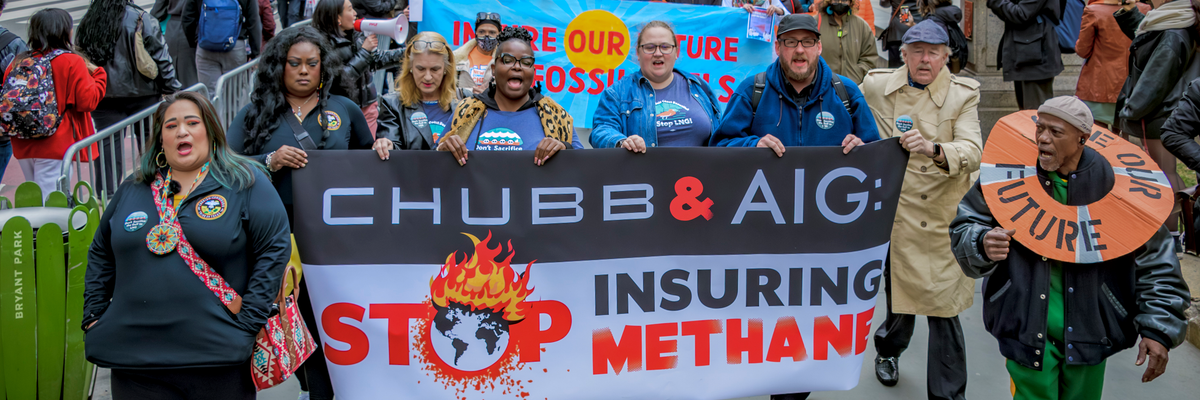
Activists march against insurance companies Chubb and AIG for insuring fossil fuel projects during a demonstration in New York City on February 27, 2024.
"Chubb has the potential to lead the industry and raise the bar for AIG and Liberty Mutual to follow suit," said one campaigner.
Climate, environmental, and Indigenous rights defenders on Tuesday welcomed news that global insurance giant Chubb dropped out of a highly controversial methane gas project on the Texas Gulf Coast after months of grassroots community pressure.
The Sunrise Project published an insurance certificate obtained via a public information act request showing that Chubb is no longer insuring the Rio Grande liquefied natural gas (LNG) terminal in Brownsville. Houston-based NextDecade—which touts itself as a "sustainable LNG" company—says Phase I of Rio Grande LNG is currently under construction and that the 984-acre site "will be the largest privately funded infrastructure project in Texas."
In addition to exacerbating the climate emergency, Rio Grande LNG threatens land and sites sacred to the Carrizo/Comecrudo Tribe, which opposes the project.
"When you do the due diligence and understand Indigenous rights, this project is a no-go," Carrizo/Comecrudo Tribe of Texas Chair Juan Mancias said in a statement. "Investors and major banks have dropped Rio Grande LNG, and now insurers are following suit because the claims of the fossil fuel companies can't be trusted—here, or anywhere in Texas."
According to the Sunrise Project:
This is the latest setback for the not-yet-built project that would harm the coastal landscape of the Rio Grande Valley as one of the last pristine areas of the Texas coastline—a haven for wildlife, fishing, tourism, and recreation and home to Latine and Indigenous communities—into an industrial methane export hub. Years of campaigning was a likely factor in the insurer backing away. Five banks—SMBC, Société Générale, Credit Suisse, and privately, two additional banks—committed to not financing the project after pressure from community leaders.
Community members voiced the impacts that the methane terminal's gas storage tanks, flare stacks, pipelines, and explosion risks pose to the Port of Brownsville, including the city of Brownsville and those known as the "Laguna Madre": Port Isabel, South Padre Island, Laguna Vista, Long Island Village, and Laguna Heights. The cumulative impacts on soils, air and water quality, community health, vegetation, wildlife, threatened and endangered species, tourism, commercial fisheries, and noise would be significant.
"We tell companies the truth about these projects that would be an environmental disaster for our South Texas community. It feels good to be heard," said Bekah Hinojosa of the South Texas Environmental Network. "I expect other insurers like AIG and Sompo to drop next because the LNG facility, the pipeline, the company—they're losers with a dangerous project."
In June, hundreds of Gulf Coast residents traveled to Chubb's New York office to protest the company's insurance of fossil fuel projects including Rio Grande LNG, Texas LNG, Freeport LNG, and Cameron LNG. Six activists were arrested for blocking the main entrance to Chubb's building. The protest—one of several targeting fossil fuel funders and insurers—was part of the Summer of Heat, a civil disobedience campaign aimed at getting Wall Street to stop funding planet-heating oil, gas, and coal projects.
Ethan Nuss of Rainforest Action Network (RAN) asserted that "Chubb is showing some promising leadership by pulling out of Rio Grande LNG."
"Now Chubb must take the next step of becoming a true climate leader and stop insuring all methane," Nuss added. "Now Chubb must take the next step of becoming a true climate leader and stop insuring all methane. Chubb has the potential to lead the industry and raise the bar for AIG and Liberty Mutual to follow suit."
In February, RAN and the consumer advocacy group Public Citizen published a report revealing that at least 35 different insurance companies were underwriting Rio Grande LNG. The report named Chubb and AIG as the world's two most prolific insurers of fossil fuel projects.
"AIG has tripped over itself to insure Rio Grande LNG in the wake of Chubb's exit," Public Citizen insurance campaigner Rick Morris said on Tuesday.
"This move is the latest in a long pattern of insuring and investing in fossil fuels that shows AIG's climate and human rights commitments aren't worth the paper they're written on," he added. "We have one message for AIG: We won't stop fighting until you drop these disastrous projects."
Dear Common Dreams reader, It’s been nearly 30 years since I co-founded Common Dreams with my late wife, Lina Newhouser. We had the radical notion that journalism should serve the public good, not corporate profits. It was clear to us from the outset what it would take to build such a project. No paid advertisements. No corporate sponsors. No millionaire publisher telling us what to think or do. Many people said we wouldn't last a year, but we proved those doubters wrong. Together with a tremendous team of journalists and dedicated staff, we built an independent media outlet free from the constraints of profits and corporate control. Our mission has always been simple: To inform. To inspire. To ignite change for the common good. Building Common Dreams was not easy. Our survival was never guaranteed. When you take on the most powerful forces—Wall Street greed, fossil fuel industry destruction, Big Tech lobbyists, and uber-rich oligarchs who have spent billions upon billions rigging the economy and democracy in their favor—the only bulwark you have is supporters who believe in your work. But here’s the urgent message from me today. It's never been this bad out there. And it's never been this hard to keep us going. At the very moment Common Dreams is most needed, the threats we face are intensifying. We need your support now more than ever. We don't accept corporate advertising and never will. We don't have a paywall because we don't think people should be blocked from critical news based on their ability to pay. Everything we do is funded by the donations of readers like you. When everyone does the little they can afford, we are strong. But if that support retreats or dries up, so do we. Will you donate now to make sure Common Dreams not only survives but thrives? —Craig Brown, Co-founder |
Climate, environmental, and Indigenous rights defenders on Tuesday welcomed news that global insurance giant Chubb dropped out of a highly controversial methane gas project on the Texas Gulf Coast after months of grassroots community pressure.
The Sunrise Project published an insurance certificate obtained via a public information act request showing that Chubb is no longer insuring the Rio Grande liquefied natural gas (LNG) terminal in Brownsville. Houston-based NextDecade—which touts itself as a "sustainable LNG" company—says Phase I of Rio Grande LNG is currently under construction and that the 984-acre site "will be the largest privately funded infrastructure project in Texas."
In addition to exacerbating the climate emergency, Rio Grande LNG threatens land and sites sacred to the Carrizo/Comecrudo Tribe, which opposes the project.
"When you do the due diligence and understand Indigenous rights, this project is a no-go," Carrizo/Comecrudo Tribe of Texas Chair Juan Mancias said in a statement. "Investors and major banks have dropped Rio Grande LNG, and now insurers are following suit because the claims of the fossil fuel companies can't be trusted—here, or anywhere in Texas."
According to the Sunrise Project:
This is the latest setback for the not-yet-built project that would harm the coastal landscape of the Rio Grande Valley as one of the last pristine areas of the Texas coastline—a haven for wildlife, fishing, tourism, and recreation and home to Latine and Indigenous communities—into an industrial methane export hub. Years of campaigning was a likely factor in the insurer backing away. Five banks—SMBC, Société Générale, Credit Suisse, and privately, two additional banks—committed to not financing the project after pressure from community leaders.
Community members voiced the impacts that the methane terminal's gas storage tanks, flare stacks, pipelines, and explosion risks pose to the Port of Brownsville, including the city of Brownsville and those known as the "Laguna Madre": Port Isabel, South Padre Island, Laguna Vista, Long Island Village, and Laguna Heights. The cumulative impacts on soils, air and water quality, community health, vegetation, wildlife, threatened and endangered species, tourism, commercial fisheries, and noise would be significant.
"We tell companies the truth about these projects that would be an environmental disaster for our South Texas community. It feels good to be heard," said Bekah Hinojosa of the South Texas Environmental Network. "I expect other insurers like AIG and Sompo to drop next because the LNG facility, the pipeline, the company—they're losers with a dangerous project."
In June, hundreds of Gulf Coast residents traveled to Chubb's New York office to protest the company's insurance of fossil fuel projects including Rio Grande LNG, Texas LNG, Freeport LNG, and Cameron LNG. Six activists were arrested for blocking the main entrance to Chubb's building. The protest—one of several targeting fossil fuel funders and insurers—was part of the Summer of Heat, a civil disobedience campaign aimed at getting Wall Street to stop funding planet-heating oil, gas, and coal projects.
Ethan Nuss of Rainforest Action Network (RAN) asserted that "Chubb is showing some promising leadership by pulling out of Rio Grande LNG."
"Now Chubb must take the next step of becoming a true climate leader and stop insuring all methane," Nuss added. "Now Chubb must take the next step of becoming a true climate leader and stop insuring all methane. Chubb has the potential to lead the industry and raise the bar for AIG and Liberty Mutual to follow suit."
In February, RAN and the consumer advocacy group Public Citizen published a report revealing that at least 35 different insurance companies were underwriting Rio Grande LNG. The report named Chubb and AIG as the world's two most prolific insurers of fossil fuel projects.
"AIG has tripped over itself to insure Rio Grande LNG in the wake of Chubb's exit," Public Citizen insurance campaigner Rick Morris said on Tuesday.
"This move is the latest in a long pattern of insuring and investing in fossil fuels that shows AIG's climate and human rights commitments aren't worth the paper they're written on," he added. "We have one message for AIG: We won't stop fighting until you drop these disastrous projects."
Climate, environmental, and Indigenous rights defenders on Tuesday welcomed news that global insurance giant Chubb dropped out of a highly controversial methane gas project on the Texas Gulf Coast after months of grassroots community pressure.
The Sunrise Project published an insurance certificate obtained via a public information act request showing that Chubb is no longer insuring the Rio Grande liquefied natural gas (LNG) terminal in Brownsville. Houston-based NextDecade—which touts itself as a "sustainable LNG" company—says Phase I of Rio Grande LNG is currently under construction and that the 984-acre site "will be the largest privately funded infrastructure project in Texas."
In addition to exacerbating the climate emergency, Rio Grande LNG threatens land and sites sacred to the Carrizo/Comecrudo Tribe, which opposes the project.
"When you do the due diligence and understand Indigenous rights, this project is a no-go," Carrizo/Comecrudo Tribe of Texas Chair Juan Mancias said in a statement. "Investors and major banks have dropped Rio Grande LNG, and now insurers are following suit because the claims of the fossil fuel companies can't be trusted—here, or anywhere in Texas."
According to the Sunrise Project:
This is the latest setback for the not-yet-built project that would harm the coastal landscape of the Rio Grande Valley as one of the last pristine areas of the Texas coastline—a haven for wildlife, fishing, tourism, and recreation and home to Latine and Indigenous communities—into an industrial methane export hub. Years of campaigning was a likely factor in the insurer backing away. Five banks—SMBC, Société Générale, Credit Suisse, and privately, two additional banks—committed to not financing the project after pressure from community leaders.
Community members voiced the impacts that the methane terminal's gas storage tanks, flare stacks, pipelines, and explosion risks pose to the Port of Brownsville, including the city of Brownsville and those known as the "Laguna Madre": Port Isabel, South Padre Island, Laguna Vista, Long Island Village, and Laguna Heights. The cumulative impacts on soils, air and water quality, community health, vegetation, wildlife, threatened and endangered species, tourism, commercial fisheries, and noise would be significant.
"We tell companies the truth about these projects that would be an environmental disaster for our South Texas community. It feels good to be heard," said Bekah Hinojosa of the South Texas Environmental Network. "I expect other insurers like AIG and Sompo to drop next because the LNG facility, the pipeline, the company—they're losers with a dangerous project."
In June, hundreds of Gulf Coast residents traveled to Chubb's New York office to protest the company's insurance of fossil fuel projects including Rio Grande LNG, Texas LNG, Freeport LNG, and Cameron LNG. Six activists were arrested for blocking the main entrance to Chubb's building. The protest—one of several targeting fossil fuel funders and insurers—was part of the Summer of Heat, a civil disobedience campaign aimed at getting Wall Street to stop funding planet-heating oil, gas, and coal projects.
Ethan Nuss of Rainforest Action Network (RAN) asserted that "Chubb is showing some promising leadership by pulling out of Rio Grande LNG."
"Now Chubb must take the next step of becoming a true climate leader and stop insuring all methane," Nuss added. "Now Chubb must take the next step of becoming a true climate leader and stop insuring all methane. Chubb has the potential to lead the industry and raise the bar for AIG and Liberty Mutual to follow suit."
In February, RAN and the consumer advocacy group Public Citizen published a report revealing that at least 35 different insurance companies were underwriting Rio Grande LNG. The report named Chubb and AIG as the world's two most prolific insurers of fossil fuel projects.
"AIG has tripped over itself to insure Rio Grande LNG in the wake of Chubb's exit," Public Citizen insurance campaigner Rick Morris said on Tuesday.
"This move is the latest in a long pattern of insuring and investing in fossil fuels that shows AIG's climate and human rights commitments aren't worth the paper they're written on," he added. "We have one message for AIG: We won't stop fighting until you drop these disastrous projects."