SUBSCRIBE TO OUR FREE NEWSLETTER
Daily news & progressive opinion—funded by the people, not the corporations—delivered straight to your inbox.
5
#000000
#FFFFFF
To donate by check, phone, or other method, see our More Ways to Give page.
Daily news & progressive opinion—funded by the people, not the corporations—delivered straight to your inbox.
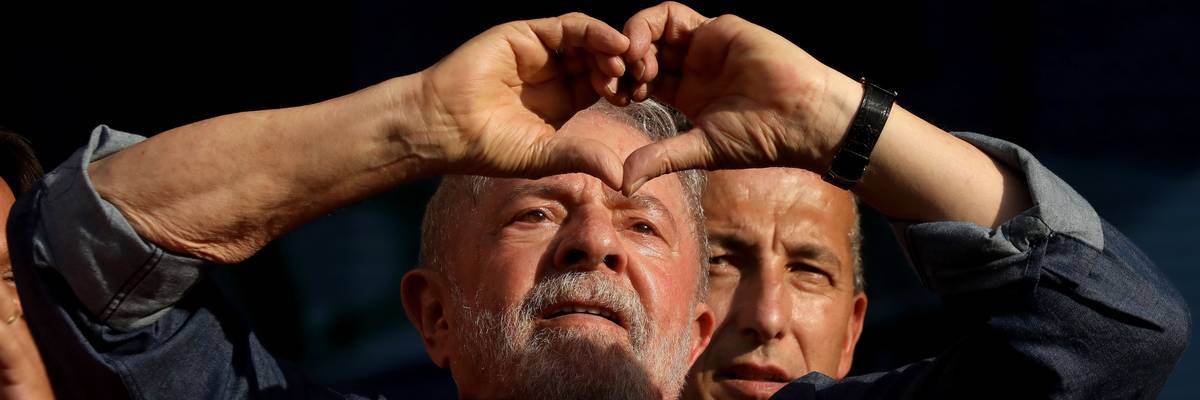
Former president of Brazil Luiz Inacio Lula da Silva gestures during a labour day demonstration to support him on May 1, 2022 in Sao Paulo, Brazil.
At a time when so many Latin American governments have shifted to the right—or even the far right—all eyes are on Brazil.
This week marks the beginning of Brazil's presidential campaign, with the two front-runners—current President Luiz Inácio Lula da Silva and Senator Flávio Bolsonaro—officially launching their campaigns. After visiting Brazil and talking with politicians, activists, journalists, and ordinary citizens, I came away with the conviction that this is one of the most consequential presidential elections in Brazil's recent history. The outcome on October 4 will shape not only Brazil's future but also the political direction of Latin America.
President Luiz Inácio Lula da Silva, now 80 years old, is seeking a fourth presidential term. Brazil's Constitution allows presidents to serve only two consecutive terms, but they may run again after sitting out at least one term. That is how Lula returned to office in 2023 after governing from 2003 to 2010.
Following the four-year presidency of the far-right Jair Bolsonaro, Lula’s supporters say he has rebuilt many of the institutions and policies weakened under Bolsonaro. His government has reduced hunger, expanded social programs, strengthened environmental protections for the Amazon, and pursued a more independent foreign policy rather than simply following Washington's dictates. Brazil has reasserted itself as an important voice in the Global South, advocating for a more multipolar world and strengthening ties with countries across Africa, Asia, and Latin America.
Although Lula remains popular and has a good chance of winning the election, many Brazilians are frustrated by sluggish economic growth, persistent concerns about crime, and political fatigue after years of bitter polarization. His more ardent critics say Lula is a corrupt left-wing politician who has remained in public life for too long.
The outcome on October 4 will shape not only Brazil's future but also the political direction of Latin America.
Lula also has detractors on the left, who accuse him of being too centrist. They point to his inability to deliver many campaign promises, harsh austerity measures under his administration, policies that expand privatization, and his reluctance to reverse several of Bolsonaro-era regressive policies. They criticize him for moving too slowly on land reform and for accommodating powerful agribusiness and fossil fuel interests. Some also call on him to go much further in challenging US influence in Latin America, including by sending oil to Cuba as it suffers under the cruel decades-long US blockade.
Yet despite these criticisms, most of Brazil's progressive movements remain united behind Lula. Whatever their frustrations with his government, they see defeating the far right as the overriding priority. They also recognize that Brazil's far right is stronger, better organized, and more deeply rooted than it was a decade ago. They believe Lula's cautious approach reflects not only political pragmatism but also a desire to avoid provoking forces that have already demonstrated a willingness to challenge democratic institutions through violence.
That became clear when the right, led by President Jair Bolsonaro, refused to accept that Lula had won the 2022 elections. On January 8, 2023, Bolsonaro supporters stormed Brazil's Congress, Supreme Court, and presidential palace in an effort to overturn the election. The similarities with the January 6 insurrection by Trump supporters are striking.
But in Brazil, Bolsonaro was actually convicted for his role in the conspiracy. He is now serving a prison sentence under house arrest and is unable to run for president. So his movement is represented by his son, 45-year-old Senator Flávio Bolsonaro.
Flávio brings his own political baggage. His reputation was damaged by allegations that members of his legislative staff were required to kick back part of their taxpayer-funded salaries in a scheme to enrich him personally. His campaign has also been shaken by revelations that he sought millions of dollars from a jailed banker to finance a film celebrating his father's presidency in hopes of boosting his own presidential campaign. Even his own family has become a political liability. A bitter public dispute with his stepmother, former First Lady Michelle Bolsonaro, exposed deep divisions within the Bolsonaro movement and deprived him of one of the Brazilian right's most influential voices among women voters.
As Flávio struggles to broaden his support at home, he has sought help from abroad. Argentine President Javier Milei traveled to Brazil to campaign on his behalf. Donald Trump and members of his administration have openly supported Flávio, aggravating US-Brazil tensions that recently blew up when Lula's government refused visas to two US State Department officials on grounds that they intended to interfere in Brazil's democratic process. The Trump administration responded by revoking the US visa of Brazil's ambassador to Washington. The episode reflects growing concern about US attempts to influence Brazil’s election.
Perhaps the most astonishing example of foreign influence comes from Israel. Instead of announcing his presidential ambitions to the Brazilian people at home, Flávio first did so during a visit to Israel, where he accused Lula of antisemitism and pledged to move Brazil's embassy to Jerusalem. Benjamin Netanyahu later publicly endorsed him.
At a time when so many Latin American governments have shifted to the right—or even the far right—all eyes are on Brazil. It is Latin America's largest country, its largest economy, and one of the most influential voices in the Global South.
Polls show Lula with a narrow lead over Flávio. But if no candidate secures more than 50% of the vote in the October 4 first round, the election will go to a runoff between the top two contenders on October 25.
If Lula is reelected, Brazil is expected to continue pursuing an independent foreign policy, strengthening South-South cooperation, deepening its role in BRICS, and resisting efforts to pull Latin America back into Washington's geopolitical orbit. A Flávio Bolsonaro victory, by contrast, would likely bring Brazil into much closer alignment with the Trump administration and revive the nationalist, authoritarian politics associated with his father's presidency.
That is why so many Brazilians see this election as far more than a contest between two political rivals. For them, it is a choice between two fundamentally different visions of Brazil's future—and of its place in the world.
Dear Common Dreams reader, It’s been nearly 30 years since I co-founded Common Dreams with my late wife, Lina Newhouser. We had the radical notion that journalism should serve the public good, not corporate profits. It was clear to us from the outset what it would take to build such a project. No paid advertisements. No corporate sponsors. No millionaire publisher telling us what to think or do. Many people said we wouldn't last a year, but we proved those doubters wrong. Together with a tremendous team of journalists and dedicated staff, we built an independent media outlet free from the constraints of profits and corporate control. Our mission has always been simple: To inform. To inspire. To ignite change for the common good. Building Common Dreams was not easy. Our survival was never guaranteed. When you take on the most powerful forces—Wall Street greed, fossil fuel industry destruction, Big Tech lobbyists, and uber-rich oligarchs who have spent billions upon billions rigging the economy and democracy in their favor—the only bulwark you have is supporters who believe in your work. But here’s the urgent message from me today. It's never been this bad out there. And it's never been this hard to keep us going. At the very moment Common Dreams is most needed, the threats we face are intensifying. We need your support now more than ever. We don't accept corporate advertising and never will. We don't have a paywall because we don't think people should be blocked from critical news based on their ability to pay. Everything we do is funded by the donations of readers like you. When everyone does the little they can afford, we are strong. But if that support retreats or dries up, so do we. Will you donate now to make sure Common Dreams not only survives but thrives? —Craig Brown, Co-founder |
This week marks the beginning of Brazil's presidential campaign, with the two front-runners—current President Luiz Inácio Lula da Silva and Senator Flávio Bolsonaro—officially launching their campaigns. After visiting Brazil and talking with politicians, activists, journalists, and ordinary citizens, I came away with the conviction that this is one of the most consequential presidential elections in Brazil's recent history. The outcome on October 4 will shape not only Brazil's future but also the political direction of Latin America.
President Luiz Inácio Lula da Silva, now 80 years old, is seeking a fourth presidential term. Brazil's Constitution allows presidents to serve only two consecutive terms, but they may run again after sitting out at least one term. That is how Lula returned to office in 2023 after governing from 2003 to 2010.
Following the four-year presidency of the far-right Jair Bolsonaro, Lula’s supporters say he has rebuilt many of the institutions and policies weakened under Bolsonaro. His government has reduced hunger, expanded social programs, strengthened environmental protections for the Amazon, and pursued a more independent foreign policy rather than simply following Washington's dictates. Brazil has reasserted itself as an important voice in the Global South, advocating for a more multipolar world and strengthening ties with countries across Africa, Asia, and Latin America.
Although Lula remains popular and has a good chance of winning the election, many Brazilians are frustrated by sluggish economic growth, persistent concerns about crime, and political fatigue after years of bitter polarization. His more ardent critics say Lula is a corrupt left-wing politician who has remained in public life for too long.
The outcome on October 4 will shape not only Brazil's future but also the political direction of Latin America.
Lula also has detractors on the left, who accuse him of being too centrist. They point to his inability to deliver many campaign promises, harsh austerity measures under his administration, policies that expand privatization, and his reluctance to reverse several of Bolsonaro-era regressive policies. They criticize him for moving too slowly on land reform and for accommodating powerful agribusiness and fossil fuel interests. Some also call on him to go much further in challenging US influence in Latin America, including by sending oil to Cuba as it suffers under the cruel decades-long US blockade.
Yet despite these criticisms, most of Brazil's progressive movements remain united behind Lula. Whatever their frustrations with his government, they see defeating the far right as the overriding priority. They also recognize that Brazil's far right is stronger, better organized, and more deeply rooted than it was a decade ago. They believe Lula's cautious approach reflects not only political pragmatism but also a desire to avoid provoking forces that have already demonstrated a willingness to challenge democratic institutions through violence.
That became clear when the right, led by President Jair Bolsonaro, refused to accept that Lula had won the 2022 elections. On January 8, 2023, Bolsonaro supporters stormed Brazil's Congress, Supreme Court, and presidential palace in an effort to overturn the election. The similarities with the January 6 insurrection by Trump supporters are striking.
But in Brazil, Bolsonaro was actually convicted for his role in the conspiracy. He is now serving a prison sentence under house arrest and is unable to run for president. So his movement is represented by his son, 45-year-old Senator Flávio Bolsonaro.
Flávio brings his own political baggage. His reputation was damaged by allegations that members of his legislative staff were required to kick back part of their taxpayer-funded salaries in a scheme to enrich him personally. His campaign has also been shaken by revelations that he sought millions of dollars from a jailed banker to finance a film celebrating his father's presidency in hopes of boosting his own presidential campaign. Even his own family has become a political liability. A bitter public dispute with his stepmother, former First Lady Michelle Bolsonaro, exposed deep divisions within the Bolsonaro movement and deprived him of one of the Brazilian right's most influential voices among women voters.
As Flávio struggles to broaden his support at home, he has sought help from abroad. Argentine President Javier Milei traveled to Brazil to campaign on his behalf. Donald Trump and members of his administration have openly supported Flávio, aggravating US-Brazil tensions that recently blew up when Lula's government refused visas to two US State Department officials on grounds that they intended to interfere in Brazil's democratic process. The Trump administration responded by revoking the US visa of Brazil's ambassador to Washington. The episode reflects growing concern about US attempts to influence Brazil’s election.
Perhaps the most astonishing example of foreign influence comes from Israel. Instead of announcing his presidential ambitions to the Brazilian people at home, Flávio first did so during a visit to Israel, where he accused Lula of antisemitism and pledged to move Brazil's embassy to Jerusalem. Benjamin Netanyahu later publicly endorsed him.
At a time when so many Latin American governments have shifted to the right—or even the far right—all eyes are on Brazil. It is Latin America's largest country, its largest economy, and one of the most influential voices in the Global South.
Polls show Lula with a narrow lead over Flávio. But if no candidate secures more than 50% of the vote in the October 4 first round, the election will go to a runoff between the top two contenders on October 25.
If Lula is reelected, Brazil is expected to continue pursuing an independent foreign policy, strengthening South-South cooperation, deepening its role in BRICS, and resisting efforts to pull Latin America back into Washington's geopolitical orbit. A Flávio Bolsonaro victory, by contrast, would likely bring Brazil into much closer alignment with the Trump administration and revive the nationalist, authoritarian politics associated with his father's presidency.
That is why so many Brazilians see this election as far more than a contest between two political rivals. For them, it is a choice between two fundamentally different visions of Brazil's future—and of its place in the world.
This week marks the beginning of Brazil's presidential campaign, with the two front-runners—current President Luiz Inácio Lula da Silva and Senator Flávio Bolsonaro—officially launching their campaigns. After visiting Brazil and talking with politicians, activists, journalists, and ordinary citizens, I came away with the conviction that this is one of the most consequential presidential elections in Brazil's recent history. The outcome on October 4 will shape not only Brazil's future but also the political direction of Latin America.
President Luiz Inácio Lula da Silva, now 80 years old, is seeking a fourth presidential term. Brazil's Constitution allows presidents to serve only two consecutive terms, but they may run again after sitting out at least one term. That is how Lula returned to office in 2023 after governing from 2003 to 2010.
Following the four-year presidency of the far-right Jair Bolsonaro, Lula’s supporters say he has rebuilt many of the institutions and policies weakened under Bolsonaro. His government has reduced hunger, expanded social programs, strengthened environmental protections for the Amazon, and pursued a more independent foreign policy rather than simply following Washington's dictates. Brazil has reasserted itself as an important voice in the Global South, advocating for a more multipolar world and strengthening ties with countries across Africa, Asia, and Latin America.
Although Lula remains popular and has a good chance of winning the election, many Brazilians are frustrated by sluggish economic growth, persistent concerns about crime, and political fatigue after years of bitter polarization. His more ardent critics say Lula is a corrupt left-wing politician who has remained in public life for too long.
The outcome on October 4 will shape not only Brazil's future but also the political direction of Latin America.
Lula also has detractors on the left, who accuse him of being too centrist. They point to his inability to deliver many campaign promises, harsh austerity measures under his administration, policies that expand privatization, and his reluctance to reverse several of Bolsonaro-era regressive policies. They criticize him for moving too slowly on land reform and for accommodating powerful agribusiness and fossil fuel interests. Some also call on him to go much further in challenging US influence in Latin America, including by sending oil to Cuba as it suffers under the cruel decades-long US blockade.
Yet despite these criticisms, most of Brazil's progressive movements remain united behind Lula. Whatever their frustrations with his government, they see defeating the far right as the overriding priority. They also recognize that Brazil's far right is stronger, better organized, and more deeply rooted than it was a decade ago. They believe Lula's cautious approach reflects not only political pragmatism but also a desire to avoid provoking forces that have already demonstrated a willingness to challenge democratic institutions through violence.
That became clear when the right, led by President Jair Bolsonaro, refused to accept that Lula had won the 2022 elections. On January 8, 2023, Bolsonaro supporters stormed Brazil's Congress, Supreme Court, and presidential palace in an effort to overturn the election. The similarities with the January 6 insurrection by Trump supporters are striking.
But in Brazil, Bolsonaro was actually convicted for his role in the conspiracy. He is now serving a prison sentence under house arrest and is unable to run for president. So his movement is represented by his son, 45-year-old Senator Flávio Bolsonaro.
Flávio brings his own political baggage. His reputation was damaged by allegations that members of his legislative staff were required to kick back part of their taxpayer-funded salaries in a scheme to enrich him personally. His campaign has also been shaken by revelations that he sought millions of dollars from a jailed banker to finance a film celebrating his father's presidency in hopes of boosting his own presidential campaign. Even his own family has become a political liability. A bitter public dispute with his stepmother, former First Lady Michelle Bolsonaro, exposed deep divisions within the Bolsonaro movement and deprived him of one of the Brazilian right's most influential voices among women voters.
As Flávio struggles to broaden his support at home, he has sought help from abroad. Argentine President Javier Milei traveled to Brazil to campaign on his behalf. Donald Trump and members of his administration have openly supported Flávio, aggravating US-Brazil tensions that recently blew up when Lula's government refused visas to two US State Department officials on grounds that they intended to interfere in Brazil's democratic process. The Trump administration responded by revoking the US visa of Brazil's ambassador to Washington. The episode reflects growing concern about US attempts to influence Brazil’s election.
Perhaps the most astonishing example of foreign influence comes from Israel. Instead of announcing his presidential ambitions to the Brazilian people at home, Flávio first did so during a visit to Israel, where he accused Lula of antisemitism and pledged to move Brazil's embassy to Jerusalem. Benjamin Netanyahu later publicly endorsed him.
At a time when so many Latin American governments have shifted to the right—or even the far right—all eyes are on Brazil. It is Latin America's largest country, its largest economy, and one of the most influential voices in the Global South.
Polls show Lula with a narrow lead over Flávio. But if no candidate secures more than 50% of the vote in the October 4 first round, the election will go to a runoff between the top two contenders on October 25.
If Lula is reelected, Brazil is expected to continue pursuing an independent foreign policy, strengthening South-South cooperation, deepening its role in BRICS, and resisting efforts to pull Latin America back into Washington's geopolitical orbit. A Flávio Bolsonaro victory, by contrast, would likely bring Brazil into much closer alignment with the Trump administration and revive the nationalist, authoritarian politics associated with his father's presidency.
That is why so many Brazilians see this election as far more than a contest between two political rivals. For them, it is a choice between two fundamentally different visions of Brazil's future—and of its place in the world.