

SUBSCRIBE TO OUR FREE NEWSLETTER
Daily news & progressive opinion—funded by the people, not the corporations—delivered straight to your inbox.
5
#000000
#FFFFFF
To donate by check, phone, or other method, see our More Ways to Give page.

The American Civil Liberties Union was founded in 1920 and is our nation's guardian of liberty. The ACLU works in the courts, legislatures and communities to defend and preserve the individual rights and liberties guaranteed to all people in this country by the Constitution and laws of the United States.
(212) 549-2666
The bill, titled the Reimagining Safety Act, would not only eliminate ICE and Customs and Border Protection (CBP). It seeks to eliminate immigration detention altogether and begin the process of replacing it with a civil court-based immigration system run through the US Department of Justice (DOJ).
In a dramatic departure from current immigration procedures, all deportations would need to be approved by Congress before they could proceed.
The bill comes just one day after agents with the DHS Investigations unit raided the home of Ramirez's colleague, Rep. Ilhan Omar (D-Minn.), as part of a federal criminal investigation related to her citizenship documents.
The investigation---which follows years of attacks by President Donald Trump and other Republicans against Omar's Somali background and Muslim faith, and comes just weeks before an election---has been described by critics as intimidation against a political opponent.
"For almost a decade, Trump and Republicans have lied about Congresswoman Omar to silence her dissent," Ramirez said on Monday. "My sister [Ilhan] has not backed down, so now they are using DHS and the federal government to target and persecute her."
"We must strip them of their weapons," she said. "We must dismantle DHS."
Under Ramirez's legislation, a new agency called the Department of Community Safety would assume DHS's duties. This would include running the Federal Emergency Management Agency (FEMA), which handles the federal response to natural disasters and other emergencies.
The new agency would use DHS's massive pot of federal funding for programs that aim to stop gun violence and other crime; provide support to asylum seekers at the border; redirect federal resources toward community needs like healthcare, housing, education, and emergency preparedness; and support community-based safety programs that do not adopt the militarized law enforcement of DHS.
Other functions of DHS would be scattered across different agencies: Immigration enforcement would belong to the DOJ, the Department of Transportation would take over the Transportation Security Administration and Coast Guard, and the Treasury Department would conduct customs enforcement.
Some of the expansive powers introduced during the War on Terror would also be rolled back: Those without criminal convictions or warrants would no longer be able to be put on "no-fly" lists, which civil liberties advocates have long criticized for stripping people of their right to travel on arbitrary, often racist, grounds.
The legislation would also eliminate the authority of the secretary of state to declare "foreign terrorist" organizations, a power that has been wielded to criminalize protest.
Ramirez told The Intercept that the need to abolish the agency was also underscored by an ICE agent's shooting of 28-year-old Oscar Belgal in the neck last week in New York. Belgal was shot through the window of his car while his 5-year-old child was in the back seat. In the past year, ICE agents have shot at least 25 people, and six of those shootings have been fatal.
Since Trump's return to office in January 2025, at least 58 people have died in immigration custody, according to the ACLU—a dramatic spike from previous administrations.
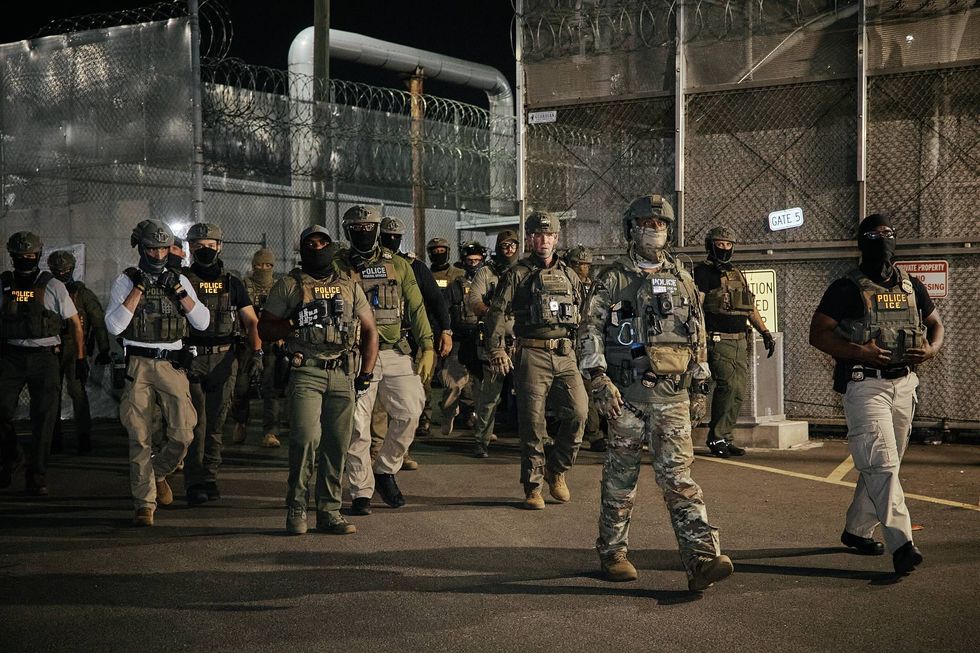 ICE agents arrive to clear protesters from a gate outside the Delaney Hall detention facility during a demonstration protesting the transfer of detainees and conditions inside the facility on June 11, 2026, in Newark, New Jersey. (Photo by Andres Kudacki/Getty Images)
The rising death toll comes as the Trump administration and Republican Congress have dramatically expanded DHS and its budget to create a massive network of new detention camps, where immigrants (and some US citizens)—most of whom have not been convicted of crimes—have been disappeared, often arbitrarily, denied access to legal representation, and subjected to severe physical mistreatment.
Some noncitizens have been targeted explicitly over their political speech, including the hundreds of students who suddenly found their legal status stripped over their participation in pro-Palestine protests, many of whom were summarily arrested and faced with the threat of deportation.
Ramirez told The Intercept all of these were examples of how DHS is "not rogue," but working as designed.
"For 23 years, since its inception, DHS has been utilized by the government to target and persecute those they consider the public enemy," she said, "whether it is Muslim Americans, Haitians escaping violence, Latinos yearning for a better life, or dissenting voices demanding an end to the genocide in Palestine and the kidnapping of our neighbors.”
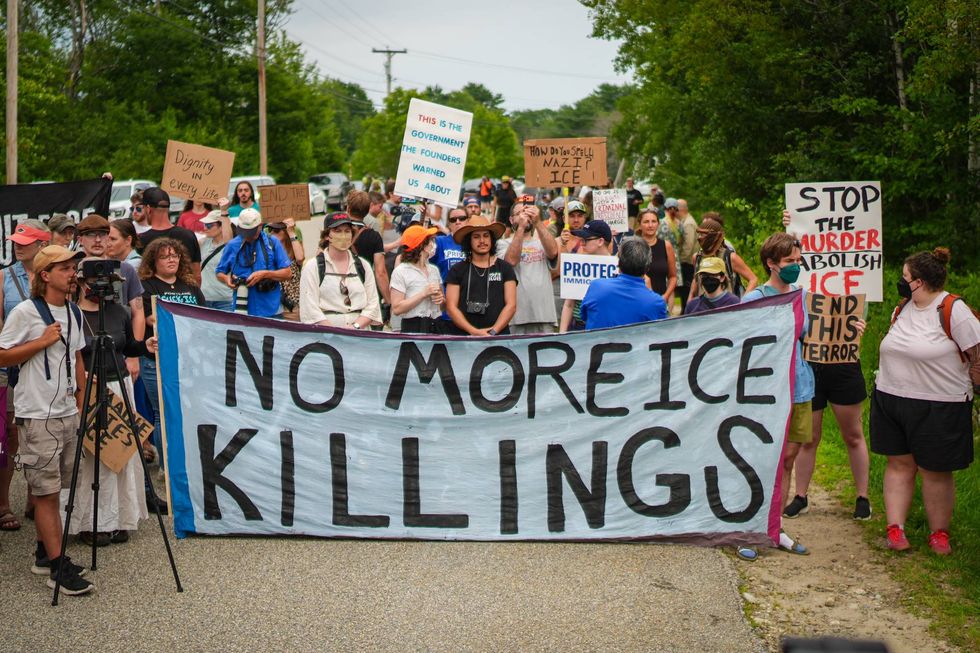 People protest outside a federal immigration office after a man was fatally shot by ICE agents on July 14, 2026, in Scarborough, Maine. (Photo by Ryan Murphy/Getty Images)
During the second Trump administration, public opinion has dramatically shifted against ICE, to the point where a plurality of voters, 48%, said they wanted the agency abolished in a July YouGov poll. In a February poll by the Public Religion Institute, 60% said they opposed increasing ICE's budget, compared with just 36% who favored it.
“In the past, the type of policy we are fighting for would have been written off as outlandish, too ‘extreme,’ or simply put, impossible," said Viviana Baraja, a Chicago-based immigrants' rights advocate who has helped to launch Ramirez's proposal.
"I have seen this administration make the most impossible nightmares possible," Baraja said. "And in the most distorted way, it has strengthened my resolve that if the worst can be possible, we can also dare to dream and to believe that the best can be possible too."







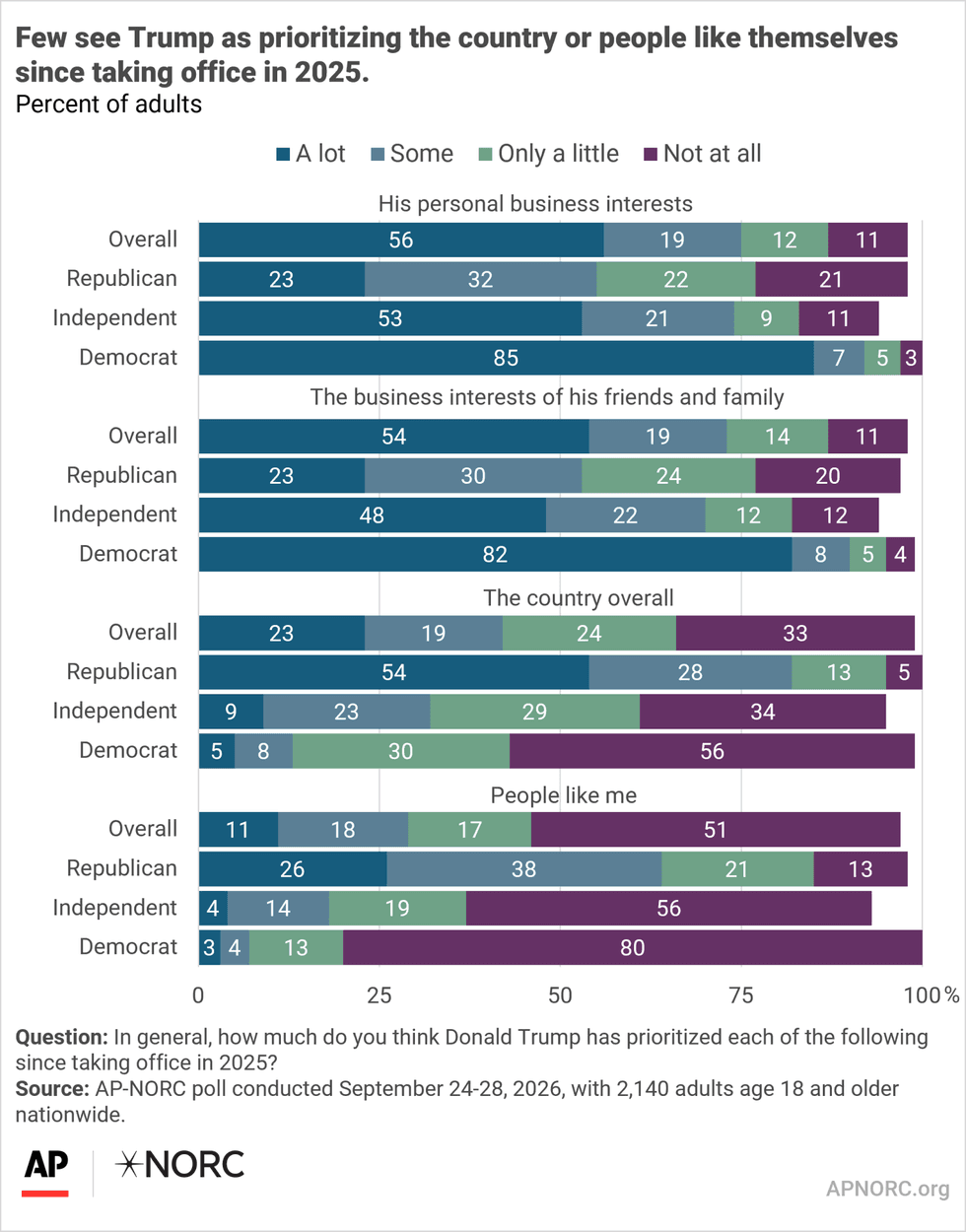
As for prioritizing the business interests of his friends and family, 54% said he has done so a lot, and 19% said some—figures published just days after an analysis estimating that companies backed financially by the president's sons, Donald Trump Jr. and Eric Trump, have scored more than $6 billion in contracts from the US Department of Defense.
Meanwhile, as Americans struggle with the high cost of everything from gasoline and groceries to healthcare and housing, and with the midterm elections just weeks away, only 23% of those polled said the president has prioritized the country a lot, and 19% said some. Even worse, 11% said he's prioritized "people like me" a lot, and 18% said some.
Trump—whose approval rating has recently plummeted to record lows, fueling GOP fears about losing majorities in both chambers of Congress next month—disclosed in July that he pocketed at least $2.2 billion, over half of which came from his family’s cryptocurrency grift.
That "completely unprecedented" windfall generated allegations of corruption—as have Trump's stock trading disclosures since then, despite White House attempts to stress that his "stock and bond portfolio is independently managed by third-party financial institutions."
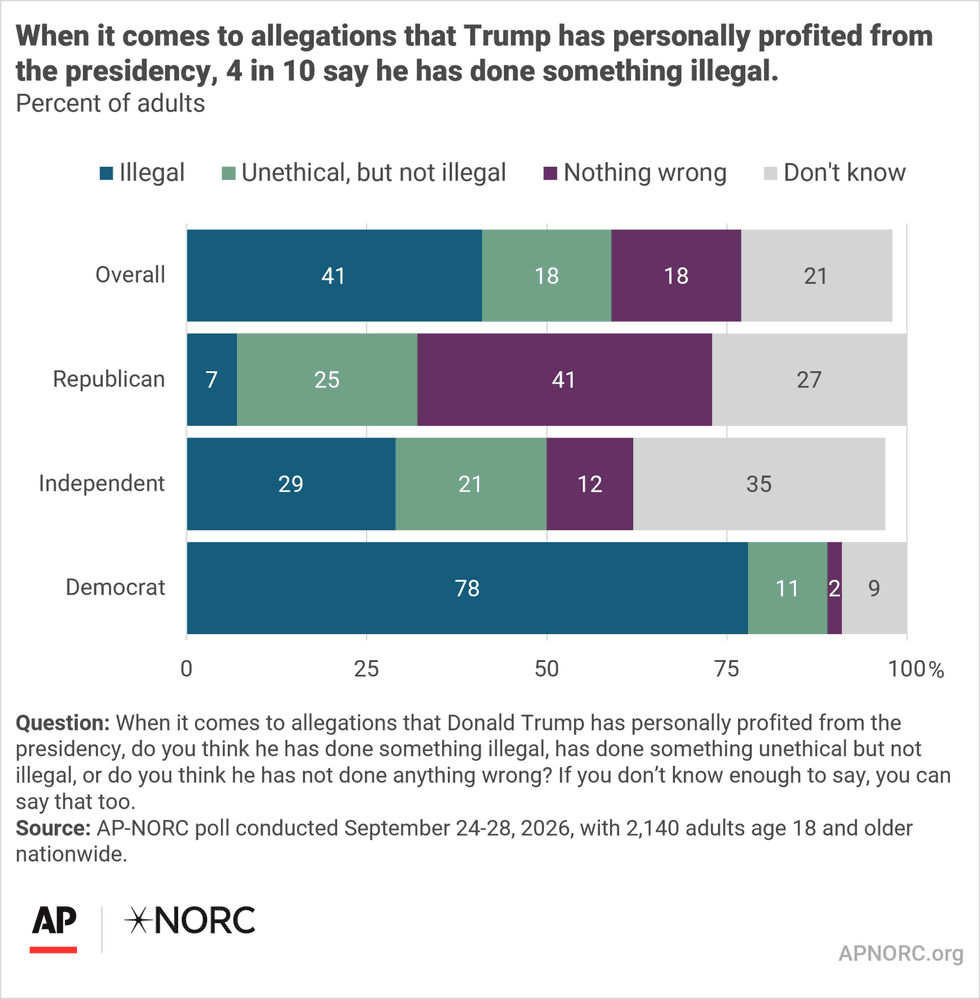
AP-NORC found that 59% of Americans across the political spectrum believe Trump has done something illegal (41%) or unethical but not unlawful (18%) to profit from the presidency. That includes 89% of Democrats, 50% of independents, and 32% of Republicans.
"His wealth increases," 87-year-old retiree Barbara Thaxton, an independent from Summerfield, Florida, told the AP, "but the people in the country are just barely getting by."
Last week, Senate Banking, Housing, and Urban Affairs Committee Ranking Member Elizabeth Warren (D-Mass.) released the "Trumpflation Tracker," a tool that she said shows "families across the country exactly how much of a price they are paying for Trump's and Republicans' failed economic agenda."
According to Warren's tracker, during Trump's second term, gasoline prices have soared 43.7%, healthcare costs are up 14.6%, residential electricity prices are 12.7% higher, childcare has risen 7.6%, and rent has jumped 5.1%. The tool suggests the average US household is paying thousands of dollars more due to GOP policies, from the president's illegal war on Iran and tariffs to cuts in his party's 2025 budget package.
"So much for Trump's 'Golden Age' of economic opportunity," retiring Sen. Dick Durbin (D-Ill.) said in response to the tracker. "Inflation is up more than 5% since he returned to the White House. Whether it's the president's tariffs, war with Iran, or cuts to healthcare and food assistance, his administration is making it harder for you to afford the basics."