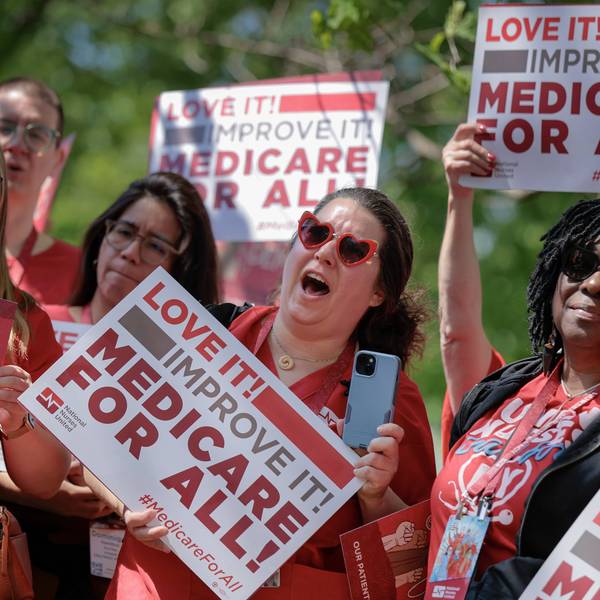
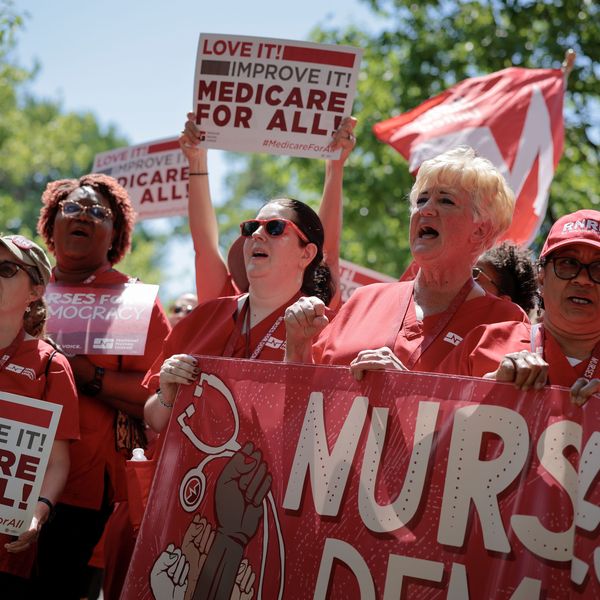
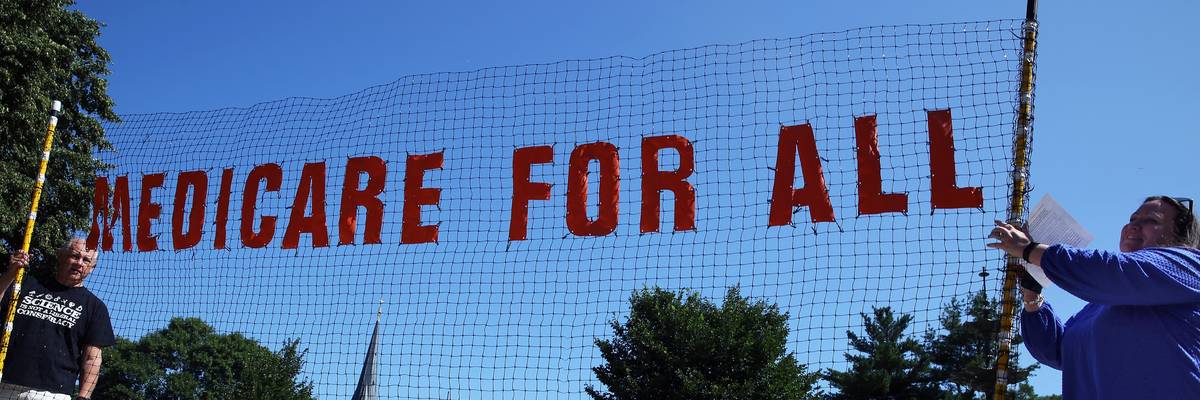
Bill Weber of Portland, Maine and Marie Follayttar of South Portland unfurl a see-through banner at the start of a rally at Lincoln Park in Portland on Saturday as part of a national effort to demand improved and expanded Medicare for everyone. Follayttar is the director of Mainers for Accountable Leadership.
True Universal Healthcare Means Medicare For All, Not a 'Public Option'
As politicians debate “universal healthcare,” we need those two words to be much more than a campaign slogan or an empty promise. Healthcare must be a true human right, easily exercised by every single person in America.
As a Maryland pediatrician, I serve patients and communities who struggle at the broken edges of the American healthcare “system.” My patients are from families working three or four jobs with no benefits, just barely getting by. With more grace than I could ever summon, these families diligently follow the protocols to determine their children’s “eligibility” for healthcare. The American healthcare system scrutinizes a family’s pay stubs, bank statements, and employment status—a process called means testing—to determine if they are eligible for Medicaid or a pittance of help to purchase a private insurance plan. It is not enough to be a human being. Our healthcare system must determine where you are on the spectrum of worthy to unworthy before you can get any medical care.
My pediatric patients whose parents get health insurance through their employment are not doing much better. An inhaler that helps an asthmatic breathe easier is covered by the insurance corporation one year, but not the next. Similarly, a specialist who has masterfully managed a patient’s seizures for several years is suddenly “out of network.” Never mind that the patient’s parents are paying premiums from every single paycheck to that multibillion-dollar insurance corporation. Playing by the corporate greed machine’s rules does not protect patients from arbitrary decisions that are supposedly good for business.
Over the course of my 20 years working in healthcare, I have seen more and more patients with supposedly good insurance avoid necessary medical care because the out-of-pocket costs keep increasing. In the richest country in the world, families are stuck between the false choices of paying for rent, groceries, utilities, or healthcare. Choosing healthcare can cost anywhere from feeding your family to putting a roof over their head.
All of us are trapped in this infuriating maze of puzzles and peril. Looking at this cruel mess of a system, we have politicians saying a “public option” is enough to fix things. There are think tanks describing a system of “universal healthcare” where the expensive (and yet, worthless) plans from private insurance corporations, the 50 shades of Medicaid, and a public option somehow achieve a magical harmony. To make things even more complicated, it is unclear what exactly a public option could look like. It could mean patients have the option of buying into Medicare or Medicaid. Or it could mean a separate public insurance plan at the federal level, possibly available to everyone or possibly just the ones deemed needy enough.
Medicare For All is true universal healthcare, where patients and families have peace of mind whenever and wherever they need medical help.
We need to be clear about what “universal healthcare” ought to mean. Everybody getting expensive-but-worthless plans from insurance corporations is universal financial stress, not universal healthcare. Similarly, adding any kind of “public option” fragment to a ridiculously fragmented system is universal confusion, not universal healthcare.
Insurance corporations have a long track record of deploying lobbyists and misinformation to undermine provisions of the Affordable Care Act. It is foolish to think these greed machines will become good-faith partners in our healthcare, competing fair and square with any kind of public option. Corporate lobbyists will see to it that any public option uses complicated means testing to determine which members of the public are worthy or unworthy of the care. These corporations will also manipulate their own plans to shut out patients who need healthcare the most, leaving them to a public option struggling to pay doctors and hospitals. Insurance greed machines do not want competition, and will undermine a public option any way they can.
Rather than tinker with a corporate-driven healthcare system determined to put profits before patients, let’s build universal healthcare through Medicare For All. Because healthcare is a human right, Medicare For All guarantees every single person living in America is eligible. We can save billions of dollars when we stop scrutinizing who is worthy or unworthy. Medicare For All provides the kind of coverage that stays with people from cradle to grave. It is mobile coverage, staying with patients from state to state, or job to job. Hospitals and clinics will remain open and properly staffed because Medicare For All puts patients first, not profits. Because all 342 million of us are covered, Medicare For All will have powerful leverage to negotiate with Big Pharma about the cost of prescriptions. Medicare For All is true universal healthcare, where patients and families have peace of mind whenever and wherever they need medical help.
We have tolerated an intolerable healthcare system for far too long. In the coming years, as politicians debate “universal healthcare,” we need those two words to be much more than a campaign slogan or an empty promise. Healthcare must be a true human right, easily exercised by every single person in America. We can and we will make that right a reality with Medicare For All.
We are at a crossroads
This country and this world are at a monumental crossroads. In a few short weeks, US voters will have an opportunity to beat back the forces of fascism and confront the billionaires who are rigging the economy, our media system, and our democracy, making it increasingly impossible for ordinary people to get by. We’re not just talking about the election. We’re talking about what must be done once these fascist elements are vanquished from power. We need a bolder set of solutions than what either major party has so far been willing to offer and a working-class movement ready to fight like hell for it. Trump didn't emerge from nowhere. The conditions that fueled MAGA authoritarianism were created by decades of radical neoliberal economic policies and a corrupt political system dominated by corporate interests. They slashed taxes on the super-rich, promising that the benefits would trickle down. They said giveaways to the corporate titans would make life more affordable for the rest of us. It was all bullshit. And when a bitter, betrayed populace searches for someone to blame, right-wing demagogues have little trouble finding scapegoats. People know when they're being lied to, but you won't hear any of this from the corporate media. Only independent journalism—powered and funded by people who believe in building a better world—can deliver truly trustworthy daily news. Our Fall Campaign is underway, and we need your help. To power our newsroom through the rest of the year, we need to raise $125,000 by midnight on October 31. So if you share our vision, please contribute whatever you can to sustain our work. |
As a Maryland pediatrician, I serve patients and communities who struggle at the broken edges of the American healthcare “system.” My patients are from families working three or four jobs with no benefits, just barely getting by. With more grace than I could ever summon, these families diligently follow the protocols to determine their children’s “eligibility” for healthcare. The American healthcare system scrutinizes a family’s pay stubs, bank statements, and employment status—a process called means testing—to determine if they are eligible for Medicaid or a pittance of help to purchase a private insurance plan. It is not enough to be a human being. Our healthcare system must determine where you are on the spectrum of worthy to unworthy before you can get any medical care.
My pediatric patients whose parents get health insurance through their employment are not doing much better. An inhaler that helps an asthmatic breathe easier is covered by the insurance corporation one year, but not the next. Similarly, a specialist who has masterfully managed a patient’s seizures for several years is suddenly “out of network.” Never mind that the patient’s parents are paying premiums from every single paycheck to that multibillion-dollar insurance corporation. Playing by the corporate greed machine’s rules does not protect patients from arbitrary decisions that are supposedly good for business.
Over the course of my 20 years working in healthcare, I have seen more and more patients with supposedly good insurance avoid necessary medical care because the out-of-pocket costs keep increasing. In the richest country in the world, families are stuck between the false choices of paying for rent, groceries, utilities, or healthcare. Choosing healthcare can cost anywhere from feeding your family to putting a roof over their head.
All of us are trapped in this infuriating maze of puzzles and peril. Looking at this cruel mess of a system, we have politicians saying a “public option” is enough to fix things. There are think tanks describing a system of “universal healthcare” where the expensive (and yet, worthless) plans from private insurance corporations, the 50 shades of Medicaid, and a public option somehow achieve a magical harmony. To make things even more complicated, it is unclear what exactly a public option could look like. It could mean patients have the option of buying into Medicare or Medicaid. Or it could mean a separate public insurance plan at the federal level, possibly available to everyone or possibly just the ones deemed needy enough.
Medicare For All is true universal healthcare, where patients and families have peace of mind whenever and wherever they need medical help.
We need to be clear about what “universal healthcare” ought to mean. Everybody getting expensive-but-worthless plans from insurance corporations is universal financial stress, not universal healthcare. Similarly, adding any kind of “public option” fragment to a ridiculously fragmented system is universal confusion, not universal healthcare.
Insurance corporations have a long track record of deploying lobbyists and misinformation to undermine provisions of the Affordable Care Act. It is foolish to think these greed machines will become good-faith partners in our healthcare, competing fair and square with any kind of public option. Corporate lobbyists will see to it that any public option uses complicated means testing to determine which members of the public are worthy or unworthy of the care. These corporations will also manipulate their own plans to shut out patients who need healthcare the most, leaving them to a public option struggling to pay doctors and hospitals. Insurance greed machines do not want competition, and will undermine a public option any way they can.
Rather than tinker with a corporate-driven healthcare system determined to put profits before patients, let’s build universal healthcare through Medicare For All. Because healthcare is a human right, Medicare For All guarantees every single person living in America is eligible. We can save billions of dollars when we stop scrutinizing who is worthy or unworthy. Medicare For All provides the kind of coverage that stays with people from cradle to grave. It is mobile coverage, staying with patients from state to state, or job to job. Hospitals and clinics will remain open and properly staffed because Medicare For All puts patients first, not profits. Because all 342 million of us are covered, Medicare For All will have powerful leverage to negotiate with Big Pharma about the cost of prescriptions. Medicare For All is true universal healthcare, where patients and families have peace of mind whenever and wherever they need medical help.
We have tolerated an intolerable healthcare system for far too long. In the coming years, as politicians debate “universal healthcare,” we need those two words to be much more than a campaign slogan or an empty promise. Healthcare must be a true human right, easily exercised by every single person in America. We can and we will make that right a reality with Medicare For All.
- CNBC Host Doesn't Know How to Fix Runaway Healthcare Costs. Ro Khanna Says: Medicare for All ›
- Urging Congress to Support Medicare for All, Groups Declare Universal Healthcare 'A Racial Justice Necessity' ›
- 62% of Americans Agree US Government Should Ensure Everyone Has Health Coverage ›
- More Than 70% of Democrats Back Government-Run Universal Healthcare: Poll ›
- Let's Be Very Clear: Medicare for All Is Not Socialism ›
- It's Obvious the US Healthcare System Isn't Working, So Why Not Try Medicare for All? ›
- Opinion | How to Celebrate Medicare's 61st Birthday? Expand It to Everyone | Common Dreams ›
- Opinion | Medicare For All May Not Be as Far Away as You Fear | Common Dreams ›
- 'Medicare for Americans' Is the Dumbest Healthcare Idea Yet From Billionaire-Backed 'Centrist' Democrats | Common Dreams ›
As a Maryland pediatrician, I serve patients and communities who struggle at the broken edges of the American healthcare “system.” My patients are from families working three or four jobs with no benefits, just barely getting by. With more grace than I could ever summon, these families diligently follow the protocols to determine their children’s “eligibility” for healthcare. The American healthcare system scrutinizes a family’s pay stubs, bank statements, and employment status—a process called means testing—to determine if they are eligible for Medicaid or a pittance of help to purchase a private insurance plan. It is not enough to be a human being. Our healthcare system must determine where you are on the spectrum of worthy to unworthy before you can get any medical care.
My pediatric patients whose parents get health insurance through their employment are not doing much better. An inhaler that helps an asthmatic breathe easier is covered by the insurance corporation one year, but not the next. Similarly, a specialist who has masterfully managed a patient’s seizures for several years is suddenly “out of network.” Never mind that the patient’s parents are paying premiums from every single paycheck to that multibillion-dollar insurance corporation. Playing by the corporate greed machine’s rules does not protect patients from arbitrary decisions that are supposedly good for business.
Over the course of my 20 years working in healthcare, I have seen more and more patients with supposedly good insurance avoid necessary medical care because the out-of-pocket costs keep increasing. In the richest country in the world, families are stuck between the false choices of paying for rent, groceries, utilities, or healthcare. Choosing healthcare can cost anywhere from feeding your family to putting a roof over their head.
All of us are trapped in this infuriating maze of puzzles and peril. Looking at this cruel mess of a system, we have politicians saying a “public option” is enough to fix things. There are think tanks describing a system of “universal healthcare” where the expensive (and yet, worthless) plans from private insurance corporations, the 50 shades of Medicaid, and a public option somehow achieve a magical harmony. To make things even more complicated, it is unclear what exactly a public option could look like. It could mean patients have the option of buying into Medicare or Medicaid. Or it could mean a separate public insurance plan at the federal level, possibly available to everyone or possibly just the ones deemed needy enough.
Medicare For All is true universal healthcare, where patients and families have peace of mind whenever and wherever they need medical help.
We need to be clear about what “universal healthcare” ought to mean. Everybody getting expensive-but-worthless plans from insurance corporations is universal financial stress, not universal healthcare. Similarly, adding any kind of “public option” fragment to a ridiculously fragmented system is universal confusion, not universal healthcare.
Insurance corporations have a long track record of deploying lobbyists and misinformation to undermine provisions of the Affordable Care Act. It is foolish to think these greed machines will become good-faith partners in our healthcare, competing fair and square with any kind of public option. Corporate lobbyists will see to it that any public option uses complicated means testing to determine which members of the public are worthy or unworthy of the care. These corporations will also manipulate their own plans to shut out patients who need healthcare the most, leaving them to a public option struggling to pay doctors and hospitals. Insurance greed machines do not want competition, and will undermine a public option any way they can.
Rather than tinker with a corporate-driven healthcare system determined to put profits before patients, let’s build universal healthcare through Medicare For All. Because healthcare is a human right, Medicare For All guarantees every single person living in America is eligible. We can save billions of dollars when we stop scrutinizing who is worthy or unworthy. Medicare For All provides the kind of coverage that stays with people from cradle to grave. It is mobile coverage, staying with patients from state to state, or job to job. Hospitals and clinics will remain open and properly staffed because Medicare For All puts patients first, not profits. Because all 342 million of us are covered, Medicare For All will have powerful leverage to negotiate with Big Pharma about the cost of prescriptions. Medicare For All is true universal healthcare, where patients and families have peace of mind whenever and wherever they need medical help.
We have tolerated an intolerable healthcare system for far too long. In the coming years, as politicians debate “universal healthcare,” we need those two words to be much more than a campaign slogan or an empty promise. Healthcare must be a true human right, easily exercised by every single person in America. We can and we will make that right a reality with Medicare For All.
- CNBC Host Doesn't Know How to Fix Runaway Healthcare Costs. Ro Khanna Says: Medicare for All ›
- Urging Congress to Support Medicare for All, Groups Declare Universal Healthcare 'A Racial Justice Necessity' ›
- 62% of Americans Agree US Government Should Ensure Everyone Has Health Coverage ›
- More Than 70% of Democrats Back Government-Run Universal Healthcare: Poll ›
- Let's Be Very Clear: Medicare for All Is Not Socialism ›
- It's Obvious the US Healthcare System Isn't Working, So Why Not Try Medicare for All? ›
- Opinion | How to Celebrate Medicare's 61st Birthday? Expand It to Everyone | Common Dreams ›
- Opinion | Medicare For All May Not Be as Far Away as You Fear | Common Dreams ›
- 'Medicare for Americans' Is the Dumbest Healthcare Idea Yet From Billionaire-Backed 'Centrist' Democrats | Common Dreams ›