SUBSCRIBE TO OUR FREE NEWSLETTER
Daily news & progressive opinion—funded by the people, not the corporations—delivered straight to your inbox.
5
#000000
#FFFFFF
To donate by check, phone, or other method, see our More Ways to Give page.
Daily news & progressive opinion—funded by the people, not the corporations—delivered straight to your inbox.
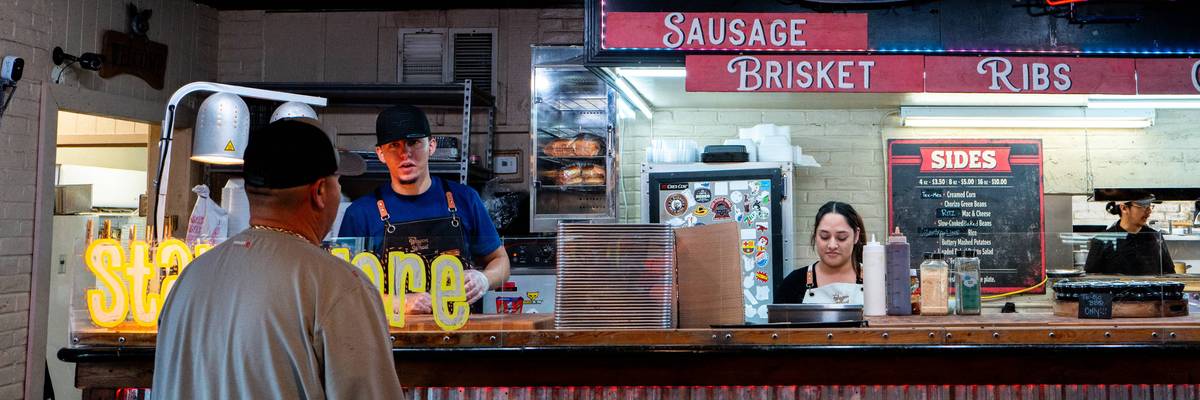
A customer prepares to order at The Wheel Wagon on June 3, 2026 in Eagle Pass, Texas. The owner of the small business expressed concern about rising prices, saying that "we've been stressed and have taken a big hit with cattle and meat."
"Costs are hitting Main Street from every direction at once and Washington doesn't seem to care about the needs of small business owners," said the head of a national coalition.
Arizona-based Gabe Hagen said Tuesday that "to keep my business afloat, I invested my 401(k) savings and leveraged my home equity as collateral for additional capital, putting my family's financial security on the line to sustain my business and employees."
"I raised my prices, but sales have just flattened out because customers are ordering less," explained Hagen, who founded the Tempe coffee roasting company Brick Road Community Corporation. He's among over 1,000 US small business owners polled by the national coalition Small Business for America's Future from mid-August to early October.
Among those surveyed, 77% have seen customers spend less, delay purchases, or trade down recently, with 46% saying that shoppers are spending "significantly less." Meanwhile, owners like Hagen are increasingly enduring more financial stress, with many cutting their own pay or pulling money from personal savings to keep their companies operating.
The survey exposes how "a combination of factors is crushing small business," the coalition said in a statement announcing its resulting report—which highlights soaring costs for everything from fuel to healthcare, and was released just weeks away from the US midterm elections that will determine control of Congress for the latter half of Trump's second term.
"Costs are hitting Main Street from every direction at once and Washington doesn't seem to care about the needs of small business owners," said Walt Rowen, the coalition's co-chair and president of Susquehanna Glass Co., a family-owned glass manufacturer in Columbia, Pennsylvania that's been around for over a century.
Rowen—whose company is located in a key swing state—noted that "my business is a good example of what is happening. We've been navigating erratic tariff policies that have disrupted our supply chains, and now my heating oil costs $4,000 to $6,000 a month."
"We've lived through the Depression, wars, and recessions," he said. "Heating my factory in this current economy is some of the hardest math I've ever had to do, and I'm expecting the bill to jump 30% to 40% this winter. This survey shows us that I am far from alone. Small business owners everywhere are comparing this economy to some of the worst moments we've had this century."
The survey shows that 83% of small business owners are concerned about their company's financial health over the next year, including 44% who are very concerned. Three-quarters called this one of the hardest economies of their careers, with over half drawing comparisons to the Covid-19 pandemic, and nearly a third pointing to the Great Recession.
A similar share (78%) accused decision-makers in Washington, DC of putting large corporations first, and 72% said running their business is harder than it was a year ago—with 85% citing inflation and rising prices as the source of strain. Majorities saw increases for utilities (72%); fuel (68%); transportation, shipping, or supplies (64%); business services (64%); healthcare and health insurance (54%); and employee wages and benefits (53%).
Those soaring costs have had consequences. Two-thirds of surveyed owners said they canceled, delayed, or scaled back investments in equipment, facilities, or technology. Over half did the same for hiring and expansion to new markets. Nearly two-thirds skipped or reduced their own pay, and 52% said their personal debt has increased in the past year.
Rising costs can be clearly connected to decisions by Trump and congressional Republicans—many of whom are up for reelection next month, as the GOP tries to hang on to its slim majorities in both chambers.
The president returned to power early last year having campaigned on a mass detention and deportation agenda, despite arguments from economists and elected Democrats that his approach was not only inhumane but economically risky. A clear majority of surveyed owners (61%) said that immigration enforcement has hurt the small business economy.
Trump and Republican lawmakers also enacted a 2025 budget package that cut federal healthcare spending and did not extend Affordable Care Act enhanced premium tax credits. Among surveyed business owners who buy their own insurance coverage through an ACA marketplace, 90% saw their premiums rise after the subsidies expired. Nearly three-quarters also said they fear rising health insurance costs will make it harder to hire and keep needed employees.
The administration's shifting tariff policy and refund process have caused further stress: 59% of owners said trade-related cost increases have made it harder to run their business, and only 3% have filed refund claims since the US Supreme Court's February ruling against many of Trump's tariffs.
Trump's illegal war on Iran continues to drive up fuel prices. The construction of artificial intelligence data centers—which the president has encouraged—is also increasing energy costs. Nearly three-quarters of those surveyed are worried about the impact of electricity demand from new AI facilities. Around the same share is concerned about the consequences of the new armed conflict in the Middle East, which the GOP-controlled Congress never authorized, but has refused to end.
In a social media post about all the findings, Small Business for America's Future urged, "Lawmakers, make your next decision with Main Street in mind."
Dear Common Dreams reader, It’s been nearly 30 years since I co-founded Common Dreams with my late wife, Lina Newhouser. We had the radical notion that journalism should serve the public good, not corporate profits. It was clear to us from the outset what it would take to build such a project. No paid advertisements. No corporate sponsors. No millionaire publisher telling us what to think or do. Many people said we wouldn't last a year, but we proved those doubters wrong. Together with a tremendous team of journalists and dedicated staff, we built an independent media outlet free from the constraints of profits and corporate control. Our mission has always been simple: To inform. To inspire. To ignite change for the common good. Building Common Dreams was not easy. Our survival was never guaranteed. When you take on the most powerful forces—Wall Street greed, fossil fuel industry destruction, Big Tech lobbyists, and uber-rich oligarchs who have spent billions upon billions rigging the economy and democracy in their favor—the only bulwark you have is supporters who believe in your work. But here’s the urgent message from me today. It's never been this bad out there. And it's never been this hard to keep us going. At the very moment Common Dreams is most needed, the threats we face are intensifying. We need your support now more than ever. We don't accept corporate advertising and never will. We don't have a paywall because we don't think people should be blocked from critical news based on their ability to pay. Everything we do is funded by the donations of readers like you. When everyone does the little they can afford, we are strong. But if that support retreats or dries up, so do we. Will you donate now to make sure Common Dreams not only survives but thrives? —Craig Brown, Co-founder |
Arizona-based Gabe Hagen said Tuesday that "to keep my business afloat, I invested my 401(k) savings and leveraged my home equity as collateral for additional capital, putting my family's financial security on the line to sustain my business and employees."
"I raised my prices, but sales have just flattened out because customers are ordering less," explained Hagen, who founded the Tempe coffee roasting company Brick Road Community Corporation. He's among over 1,000 US small business owners polled by the national coalition Small Business for America's Future from mid-August to early October.
Among those surveyed, 77% have seen customers spend less, delay purchases, or trade down recently, with 46% saying that shoppers are spending "significantly less." Meanwhile, owners like Hagen are increasingly enduring more financial stress, with many cutting their own pay or pulling money from personal savings to keep their companies operating.
The survey exposes how "a combination of factors is crushing small business," the coalition said in a statement announcing its resulting report—which highlights soaring costs for everything from fuel to healthcare, and was released just weeks away from the US midterm elections that will determine control of Congress for the latter half of Trump's second term.
"Costs are hitting Main Street from every direction at once and Washington doesn't seem to care about the needs of small business owners," said Walt Rowen, the coalition's co-chair and president of Susquehanna Glass Co., a family-owned glass manufacturer in Columbia, Pennsylvania that's been around for over a century.
Rowen—whose company is located in a key swing state—noted that "my business is a good example of what is happening. We've been navigating erratic tariff policies that have disrupted our supply chains, and now my heating oil costs $4,000 to $6,000 a month."
"We've lived through the Depression, wars, and recessions," he said. "Heating my factory in this current economy is some of the hardest math I've ever had to do, and I'm expecting the bill to jump 30% to 40% this winter. This survey shows us that I am far from alone. Small business owners everywhere are comparing this economy to some of the worst moments we've had this century."
The survey shows that 83% of small business owners are concerned about their company's financial health over the next year, including 44% who are very concerned. Three-quarters called this one of the hardest economies of their careers, with over half drawing comparisons to the Covid-19 pandemic, and nearly a third pointing to the Great Recession.
A similar share (78%) accused decision-makers in Washington, DC of putting large corporations first, and 72% said running their business is harder than it was a year ago—with 85% citing inflation and rising prices as the source of strain. Majorities saw increases for utilities (72%); fuel (68%); transportation, shipping, or supplies (64%); business services (64%); healthcare and health insurance (54%); and employee wages and benefits (53%).
Those soaring costs have had consequences. Two-thirds of surveyed owners said they canceled, delayed, or scaled back investments in equipment, facilities, or technology. Over half did the same for hiring and expansion to new markets. Nearly two-thirds skipped or reduced their own pay, and 52% said their personal debt has increased in the past year.
Rising costs can be clearly connected to decisions by Trump and congressional Republicans—many of whom are up for reelection next month, as the GOP tries to hang on to its slim majorities in both chambers.
The president returned to power early last year having campaigned on a mass detention and deportation agenda, despite arguments from economists and elected Democrats that his approach was not only inhumane but economically risky. A clear majority of surveyed owners (61%) said that immigration enforcement has hurt the small business economy.
Trump and Republican lawmakers also enacted a 2025 budget package that cut federal healthcare spending and did not extend Affordable Care Act enhanced premium tax credits. Among surveyed business owners who buy their own insurance coverage through an ACA marketplace, 90% saw their premiums rise after the subsidies expired. Nearly three-quarters also said they fear rising health insurance costs will make it harder to hire and keep needed employees.
The administration's shifting tariff policy and refund process have caused further stress: 59% of owners said trade-related cost increases have made it harder to run their business, and only 3% have filed refund claims since the US Supreme Court's February ruling against many of Trump's tariffs.
Trump's illegal war on Iran continues to drive up fuel prices. The construction of artificial intelligence data centers—which the president has encouraged—is also increasing energy costs. Nearly three-quarters of those surveyed are worried about the impact of electricity demand from new AI facilities. Around the same share is concerned about the consequences of the new armed conflict in the Middle East, which the GOP-controlled Congress never authorized, but has refused to end.
In a social media post about all the findings, Small Business for America's Future urged, "Lawmakers, make your next decision with Main Street in mind."
Arizona-based Gabe Hagen said Tuesday that "to keep my business afloat, I invested my 401(k) savings and leveraged my home equity as collateral for additional capital, putting my family's financial security on the line to sustain my business and employees."
"I raised my prices, but sales have just flattened out because customers are ordering less," explained Hagen, who founded the Tempe coffee roasting company Brick Road Community Corporation. He's among over 1,000 US small business owners polled by the national coalition Small Business for America's Future from mid-August to early October.
Among those surveyed, 77% have seen customers spend less, delay purchases, or trade down recently, with 46% saying that shoppers are spending "significantly less." Meanwhile, owners like Hagen are increasingly enduring more financial stress, with many cutting their own pay or pulling money from personal savings to keep their companies operating.
The survey exposes how "a combination of factors is crushing small business," the coalition said in a statement announcing its resulting report—which highlights soaring costs for everything from fuel to healthcare, and was released just weeks away from the US midterm elections that will determine control of Congress for the latter half of Trump's second term.
"Costs are hitting Main Street from every direction at once and Washington doesn't seem to care about the needs of small business owners," said Walt Rowen, the coalition's co-chair and president of Susquehanna Glass Co., a family-owned glass manufacturer in Columbia, Pennsylvania that's been around for over a century.
Rowen—whose company is located in a key swing state—noted that "my business is a good example of what is happening. We've been navigating erratic tariff policies that have disrupted our supply chains, and now my heating oil costs $4,000 to $6,000 a month."
"We've lived through the Depression, wars, and recessions," he said. "Heating my factory in this current economy is some of the hardest math I've ever had to do, and I'm expecting the bill to jump 30% to 40% this winter. This survey shows us that I am far from alone. Small business owners everywhere are comparing this economy to some of the worst moments we've had this century."
The survey shows that 83% of small business owners are concerned about their company's financial health over the next year, including 44% who are very concerned. Three-quarters called this one of the hardest economies of their careers, with over half drawing comparisons to the Covid-19 pandemic, and nearly a third pointing to the Great Recession.
A similar share (78%) accused decision-makers in Washington, DC of putting large corporations first, and 72% said running their business is harder than it was a year ago—with 85% citing inflation and rising prices as the source of strain. Majorities saw increases for utilities (72%); fuel (68%); transportation, shipping, or supplies (64%); business services (64%); healthcare and health insurance (54%); and employee wages and benefits (53%).
Those soaring costs have had consequences. Two-thirds of surveyed owners said they canceled, delayed, or scaled back investments in equipment, facilities, or technology. Over half did the same for hiring and expansion to new markets. Nearly two-thirds skipped or reduced their own pay, and 52% said their personal debt has increased in the past year.
Rising costs can be clearly connected to decisions by Trump and congressional Republicans—many of whom are up for reelection next month, as the GOP tries to hang on to its slim majorities in both chambers.
The president returned to power early last year having campaigned on a mass detention and deportation agenda, despite arguments from economists and elected Democrats that his approach was not only inhumane but economically risky. A clear majority of surveyed owners (61%) said that immigration enforcement has hurt the small business economy.
Trump and Republican lawmakers also enacted a 2025 budget package that cut federal healthcare spending and did not extend Affordable Care Act enhanced premium tax credits. Among surveyed business owners who buy their own insurance coverage through an ACA marketplace, 90% saw their premiums rise after the subsidies expired. Nearly three-quarters also said they fear rising health insurance costs will make it harder to hire and keep needed employees.
The administration's shifting tariff policy and refund process have caused further stress: 59% of owners said trade-related cost increases have made it harder to run their business, and only 3% have filed refund claims since the US Supreme Court's February ruling against many of Trump's tariffs.
Trump's illegal war on Iran continues to drive up fuel prices. The construction of artificial intelligence data centers—which the president has encouraged—is also increasing energy costs. Nearly three-quarters of those surveyed are worried about the impact of electricity demand from new AI facilities. Around the same share is concerned about the consequences of the new armed conflict in the Middle East, which the GOP-controlled Congress never authorized, but has refused to end.
In a social media post about all the findings, Small Business for America's Future urged, "Lawmakers, make your next decision with Main Street in mind."