SUBSCRIBE TO OUR FREE NEWSLETTER
Daily news & progressive opinion—funded by the people, not the corporations—delivered straight to your inbox.
5
#000000
#FFFFFF
To donate by check, phone, or other method, see our More Ways to Give page.
Daily news & progressive opinion—funded by the people, not the corporations—delivered straight to your inbox.
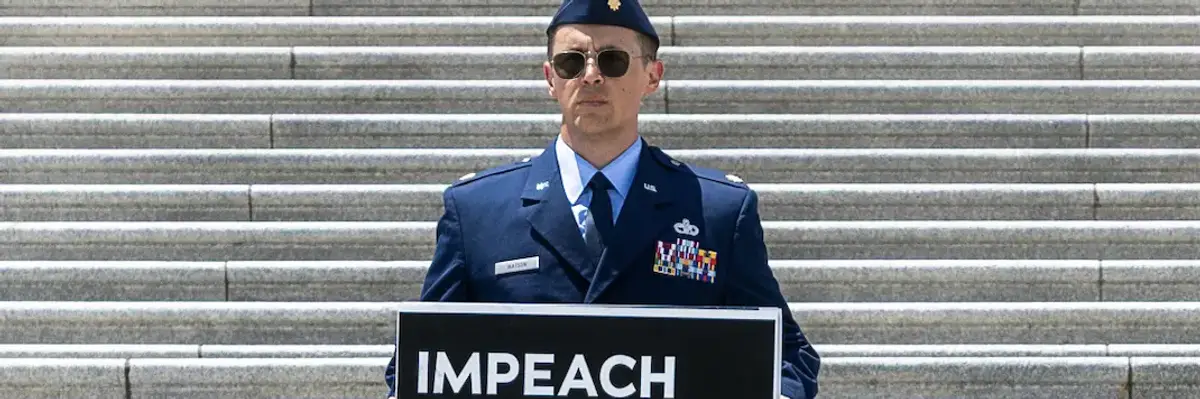
Air Force Maj. Jason Watson stands on the steps of the US Capitol in Washington, DC, holding a sign calling for the impeachment and removal of US President Donald Trump on July 1, 2026.
One law professor told Common Dreams the detention of Maj. Jason Watson was a "blatant case of illegal pretrial punishment."
Air Force Maj. Jason Watson was arrested July 1 on the steps of the US Capitol after calling for the impeachment of President Donald Trump. According to his lawyer, he's now being held in solitary confinement 24 hours a day in what some legal experts say could amount to illegal pretrial punishment.
The Uniform Code of Military Justice (UCMJ) contains provisions barring officers from engaging in public political activities that are typically protected for civilians, including criticizing the president and other elected officials.
Prosecutors have charged Watson with violating them when he participated in a news conference calling for Trump to be removed from office over his launching of military actions against Iran, Cuba, and Venezuela without congressional authorization.
After the speech, Watson stood on the Capitol steps holding a sign that read “Impeach, Convict, Remove" and was arrested after he refused to move.
Before he was charged, Watson gave a CNN interview on August 17 in which he continued to criticize Trump, accusing him of "flagrantly violating the Constitution" and "breaking the law."
He acknowledged that he could face severe consequences as a result of his speech: "We just have to be willing to accept that we can change what is happening in our country if we are just willing to pay a price for it," he said.
One day later, he was arrested while on duty and taken into pretrial confinement. He now faces a general court-martial, the military's most severe trial, which is capable of imposing lengthy prison sentences.
On Friday, Watson's lawyer, Christopher Mutimer, told CNN that after nearly two months, Watson is "still in solitary confinement 24 hours a day," which he said amounted to "cruel and unusual" punishment.
"Even if he gets an hour to eat or to exercise, he is alone," Mutimer said. "He is literally by himself, with his thoughts, in a room where the light never turns off all day."
In an essay published Sunday by writer Monte Mader, Watson himself acknowledged spending his days in isolation, revealing that his Bible had only recently been returned to him and that he had little access to news.
Watson described the conditions of his confinement as the reality one must accept when choosing to engage in nonviolent resistance.
“Walking this path," he said, "means exposing oneself to violence while refusing to retaliate against it.”
After his July 1 protest, Watson had been restricted to Joint Base Anacostia-Bolling in Washington. Though the base reportedly has a confinement facility, following his detention, he was instead moved to a county jail in Maryland.
During Watson's September 18 preliminary hearing, Maj. Joshua Wendell, the hearing officer, said Watson could not be confined with civilians and was therefore kept in solitary confinement.
"He was placed in confinement because of the law, which puts him in solitary confinement," Wendell said, according to Stars and Stripes.
Article 13 of the UCMJ "forbids punishing a service member before trial and forbids pretrial restraint more rigorous than the circumstances require."
Mutimer has pointed out that solitary confinement is "usually reserved for individuals who are disobeying or are violent, and injuring other people," and usually only for "a day or two, or a week." Watson, he said, has "been in there for months now."
Rachel VanLandingham, a former Air Force judge advocate and professor of law at Southwestern Law School, told Common Dreams that this "seems to be a blatant case of illegal pretrial punishment given that the nature of his pretrial restraint does not seem necessary to either ensure his presence at trial or to prevent foreseeable serious criminal misconduct."
“Solitary confinement is rare, and must be justified,” she said. “What, is the administration so afraid of this major’s words that he cannot talk to anyone?”
Military defense attorney Cody Harnish, who attended Watson's preliminary hearing, has raised concerns that his detention could be unlawful and that his especially harsh treatment was political in nature.
"I represent people at court-martial in the military, who are accused of doing some very bad things," he said during an interview this weekend with Meidas Defense. "They are not in pretrial confinement."
Harnish noted other abnormal aspects of Watson’s preliminary hearing: He was denied the ability to wear his uniform and instead arrived handcuffed, unshaven, and wearing an undershirt, which pointed to the possibility that he was facing degrading treatment.
He also pointed out that Watson had submitted a request to resign his commission in exchange for avoiding a court-martial, but that the request was denied in 24 hours.
"Nothing gets processed in the military that fast," he said, suggesting that this could indicate influence from senior Pentagon officials.
During his second term, Trump has used members of the military for political purposes in ways that have challenged longstanding norms of political neutrality. This has included hosting overtly political rallies before uniformed troops, screening them for ideology, and purging senior military officers deemed disloyal.
Harnish suggested that the Trump administration was seeking to make an example out of Watson for speaking out against the president.
"When someone speaks out against this administration in the military," he said, "they're going to crush him to silence anyone else in the ranks from ever thinking about it."
Dear Common Dreams reader, It’s been nearly 30 years since I co-founded Common Dreams with my late wife, Lina Newhouser. We had the radical notion that journalism should serve the public good, not corporate profits. It was clear to us from the outset what it would take to build such a project. No paid advertisements. No corporate sponsors. No millionaire publisher telling us what to think or do. Many people said we wouldn't last a year, but we proved those doubters wrong. Together with a tremendous team of journalists and dedicated staff, we built an independent media outlet free from the constraints of profits and corporate control. Our mission has always been simple: To inform. To inspire. To ignite change for the common good. Building Common Dreams was not easy. Our survival was never guaranteed. When you take on the most powerful forces—Wall Street greed, fossil fuel industry destruction, Big Tech lobbyists, and uber-rich oligarchs who have spent billions upon billions rigging the economy and democracy in their favor—the only bulwark you have is supporters who believe in your work. But here’s the urgent message from me today. It's never been this bad out there. And it's never been this hard to keep us going. At the very moment Common Dreams is most needed, the threats we face are intensifying. We need your support now more than ever. We don't accept corporate advertising and never will. We don't have a paywall because we don't think people should be blocked from critical news based on their ability to pay. Everything we do is funded by the donations of readers like you. When everyone does the little they can afford, we are strong. But if that support retreats or dries up, so do we. Will you donate now to make sure Common Dreams not only survives but thrives? —Craig Brown, Co-founder |
Air Force Maj. Jason Watson was arrested July 1 on the steps of the US Capitol after calling for the impeachment of President Donald Trump. According to his lawyer, he's now being held in solitary confinement 24 hours a day in what some legal experts say could amount to illegal pretrial punishment.
The Uniform Code of Military Justice (UCMJ) contains provisions barring officers from engaging in public political activities that are typically protected for civilians, including criticizing the president and other elected officials.
Prosecutors have charged Watson with violating them when he participated in a news conference calling for Trump to be removed from office over his launching of military actions against Iran, Cuba, and Venezuela without congressional authorization.
After the speech, Watson stood on the Capitol steps holding a sign that read “Impeach, Convict, Remove" and was arrested after he refused to move.
Before he was charged, Watson gave a CNN interview on August 17 in which he continued to criticize Trump, accusing him of "flagrantly violating the Constitution" and "breaking the law."
He acknowledged that he could face severe consequences as a result of his speech: "We just have to be willing to accept that we can change what is happening in our country if we are just willing to pay a price for it," he said.
One day later, he was arrested while on duty and taken into pretrial confinement. He now faces a general court-martial, the military's most severe trial, which is capable of imposing lengthy prison sentences.
On Friday, Watson's lawyer, Christopher Mutimer, told CNN that after nearly two months, Watson is "still in solitary confinement 24 hours a day," which he said amounted to "cruel and unusual" punishment.
"Even if he gets an hour to eat or to exercise, he is alone," Mutimer said. "He is literally by himself, with his thoughts, in a room where the light never turns off all day."
In an essay published Sunday by writer Monte Mader, Watson himself acknowledged spending his days in isolation, revealing that his Bible had only recently been returned to him and that he had little access to news.
Watson described the conditions of his confinement as the reality one must accept when choosing to engage in nonviolent resistance.
“Walking this path," he said, "means exposing oneself to violence while refusing to retaliate against it.”
After his July 1 protest, Watson had been restricted to Joint Base Anacostia-Bolling in Washington. Though the base reportedly has a confinement facility, following his detention, he was instead moved to a county jail in Maryland.
During Watson's September 18 preliminary hearing, Maj. Joshua Wendell, the hearing officer, said Watson could not be confined with civilians and was therefore kept in solitary confinement.
"He was placed in confinement because of the law, which puts him in solitary confinement," Wendell said, according to Stars and Stripes.
Article 13 of the UCMJ "forbids punishing a service member before trial and forbids pretrial restraint more rigorous than the circumstances require."
Mutimer has pointed out that solitary confinement is "usually reserved for individuals who are disobeying or are violent, and injuring other people," and usually only for "a day or two, or a week." Watson, he said, has "been in there for months now."
Rachel VanLandingham, a former Air Force judge advocate and professor of law at Southwestern Law School, told Common Dreams that this "seems to be a blatant case of illegal pretrial punishment given that the nature of his pretrial restraint does not seem necessary to either ensure his presence at trial or to prevent foreseeable serious criminal misconduct."
“Solitary confinement is rare, and must be justified,” she said. “What, is the administration so afraid of this major’s words that he cannot talk to anyone?”
Military defense attorney Cody Harnish, who attended Watson's preliminary hearing, has raised concerns that his detention could be unlawful and that his especially harsh treatment was political in nature.
"I represent people at court-martial in the military, who are accused of doing some very bad things," he said during an interview this weekend with Meidas Defense. "They are not in pretrial confinement."
Harnish noted other abnormal aspects of Watson’s preliminary hearing: He was denied the ability to wear his uniform and instead arrived handcuffed, unshaven, and wearing an undershirt, which pointed to the possibility that he was facing degrading treatment.
He also pointed out that Watson had submitted a request to resign his commission in exchange for avoiding a court-martial, but that the request was denied in 24 hours.
"Nothing gets processed in the military that fast," he said, suggesting that this could indicate influence from senior Pentagon officials.
During his second term, Trump has used members of the military for political purposes in ways that have challenged longstanding norms of political neutrality. This has included hosting overtly political rallies before uniformed troops, screening them for ideology, and purging senior military officers deemed disloyal.
Harnish suggested that the Trump administration was seeking to make an example out of Watson for speaking out against the president.
"When someone speaks out against this administration in the military," he said, "they're going to crush him to silence anyone else in the ranks from ever thinking about it."
Air Force Maj. Jason Watson was arrested July 1 on the steps of the US Capitol after calling for the impeachment of President Donald Trump. According to his lawyer, he's now being held in solitary confinement 24 hours a day in what some legal experts say could amount to illegal pretrial punishment.
The Uniform Code of Military Justice (UCMJ) contains provisions barring officers from engaging in public political activities that are typically protected for civilians, including criticizing the president and other elected officials.
Prosecutors have charged Watson with violating them when he participated in a news conference calling for Trump to be removed from office over his launching of military actions against Iran, Cuba, and Venezuela without congressional authorization.
After the speech, Watson stood on the Capitol steps holding a sign that read “Impeach, Convict, Remove" and was arrested after he refused to move.
Before he was charged, Watson gave a CNN interview on August 17 in which he continued to criticize Trump, accusing him of "flagrantly violating the Constitution" and "breaking the law."
He acknowledged that he could face severe consequences as a result of his speech: "We just have to be willing to accept that we can change what is happening in our country if we are just willing to pay a price for it," he said.
One day later, he was arrested while on duty and taken into pretrial confinement. He now faces a general court-martial, the military's most severe trial, which is capable of imposing lengthy prison sentences.
On Friday, Watson's lawyer, Christopher Mutimer, told CNN that after nearly two months, Watson is "still in solitary confinement 24 hours a day," which he said amounted to "cruel and unusual" punishment.
"Even if he gets an hour to eat or to exercise, he is alone," Mutimer said. "He is literally by himself, with his thoughts, in a room where the light never turns off all day."
In an essay published Sunday by writer Monte Mader, Watson himself acknowledged spending his days in isolation, revealing that his Bible had only recently been returned to him and that he had little access to news.
Watson described the conditions of his confinement as the reality one must accept when choosing to engage in nonviolent resistance.
“Walking this path," he said, "means exposing oneself to violence while refusing to retaliate against it.”
After his July 1 protest, Watson had been restricted to Joint Base Anacostia-Bolling in Washington. Though the base reportedly has a confinement facility, following his detention, he was instead moved to a county jail in Maryland.
During Watson's September 18 preliminary hearing, Maj. Joshua Wendell, the hearing officer, said Watson could not be confined with civilians and was therefore kept in solitary confinement.
"He was placed in confinement because of the law, which puts him in solitary confinement," Wendell said, according to Stars and Stripes.
Article 13 of the UCMJ "forbids punishing a service member before trial and forbids pretrial restraint more rigorous than the circumstances require."
Mutimer has pointed out that solitary confinement is "usually reserved for individuals who are disobeying or are violent, and injuring other people," and usually only for "a day or two, or a week." Watson, he said, has "been in there for months now."
Rachel VanLandingham, a former Air Force judge advocate and professor of law at Southwestern Law School, told Common Dreams that this "seems to be a blatant case of illegal pretrial punishment given that the nature of his pretrial restraint does not seem necessary to either ensure his presence at trial or to prevent foreseeable serious criminal misconduct."
“Solitary confinement is rare, and must be justified,” she said. “What, is the administration so afraid of this major’s words that he cannot talk to anyone?”
Military defense attorney Cody Harnish, who attended Watson's preliminary hearing, has raised concerns that his detention could be unlawful and that his especially harsh treatment was political in nature.
"I represent people at court-martial in the military, who are accused of doing some very bad things," he said during an interview this weekend with Meidas Defense. "They are not in pretrial confinement."
Harnish noted other abnormal aspects of Watson’s preliminary hearing: He was denied the ability to wear his uniform and instead arrived handcuffed, unshaven, and wearing an undershirt, which pointed to the possibility that he was facing degrading treatment.
He also pointed out that Watson had submitted a request to resign his commission in exchange for avoiding a court-martial, but that the request was denied in 24 hours.
"Nothing gets processed in the military that fast," he said, suggesting that this could indicate influence from senior Pentagon officials.
During his second term, Trump has used members of the military for political purposes in ways that have challenged longstanding norms of political neutrality. This has included hosting overtly political rallies before uniformed troops, screening them for ideology, and purging senior military officers deemed disloyal.
Harnish suggested that the Trump administration was seeking to make an example out of Watson for speaking out against the president.
"When someone speaks out against this administration in the military," he said, "they're going to crush him to silence anyone else in the ranks from ever thinking about it."