

SUBSCRIBE TO OUR FREE NEWSLETTER
Daily news & progressive opinion—funded by the people, not the corporations—delivered straight to your inbox.
5
#000000
#FFFFFF
To donate by check, phone, or other method, see our More Ways to Give page.
Daily news & progressive opinion—funded by the people, not the corporations—delivered straight to your inbox.
Mr. Jim Puckett, BAN Executive Director, 206-652-5555, jpuckett@ban.org
Ms. Sian Wu, Resource Media, 206.374.7795, x102, sian@resource-media.org
Mr. Jose Cardona, Corporate Communications, Samsung, 201-229- 4118, jcardona@sea.samsung.com
Ms. Stephanie Rico, Assistant Vice President Environmental Affairs, Wells Fargo, 415-396-5804, Stephanie.Rico@wellsfargo.com
Mr. Mick Schum, President, WeRecycle! LLC, 914-530-2350 X2209, mschum@werecycle.com
The Basel Action Network (BAN),
the group that first documented the dumping of toxic electronic waste in
China and Africa, announced today the official launch of the world's
first global e-waste recycler certification and the first such program
backed by environmental organizations and major corporations alike. The
accredited, third-party audited certification program has not only been
endorsed by Greenpeace USA, the Sierra Club, the Natural Resources
Defense Council (NRDC), the Electronics TakeBack Coalition and 68 other
environmental organizations, it has also drawn the support of major
corporate "e-Stewards Enterprises" including:
"Samsung is honored to be the first electronics manufacturer
recognized with the e-Stewards standard for rigorous recycling and
e-waste materials management," said Mr. J. C. Ser, Senior Vice
President for Samsung Electronics America. "This is a major
validation of our efforts as we have responsibly recycled more than 20
million pounds of e-waste since the beginning of our Samsung Recycling
Direct program in 2008 and plan to continue strengthening our commitment
and leadership in this industry."
At the heart of the program is the e-Stewards Standard, created by BAN with the advice
of industry leaders and health and environmental specialists. It calls
for recyclers to eliminate exports of hazardous e-wastes to developing
countries; to halt the dumping of such wastes in municipal landfills or
incinerators; and to cease the use of captive prison populations to
manage toxic e-wastes. It also calls for strict protection of
customer's private data and occupational health safeguards to ensure
that workers in recycling plants are not exposed to toxic dusts and
fumes.
"The e-Stewards Enterprise program makes it easy for us to
demonstrate that our electronic waste management standards are
responsible and align with best practices. By using e-Stewards
Recyclers, we know that our old computers and other electronics aren't
going to be disposed of in a way that harms people or the environment
and that, when possible, electronic components are recycled and reused,"
said Mary Wenzel, director of Environmental Affairs, Wells Fargo.
Currently there are about 50 e-Stewards Recyclers, each of which has
passed a rigorous internal review by BAN as a preliminary step to full
certification. All are regarded as responsible recyclers, and each has
committed to becoming fully certified by September 2011. Today's
announcement names the first companies that have become fully
certified. They have passed additional, independent audits conducted by
three ANAB accredited certifying Bodies: AQA International LLC, Orion
Registrar Inc., and SAI Global. These very first Certified e-Stewards
Recyclers are:
Already, there are an additional twelve recyclers next in line
that have contracted with certifying bodies to begin the process. They
are: A greenSpan Computer Recycling, California Electronic Asset
Recovery (CEAR), CloudBlue, Creative Recycling Solutions, eGreen IT
Solutions, Glezco (Mexico), Materials Processing Corporation, Metech,
Nextend, Regency Technologies, Surplus Exchange, and Universal Recycling
Technologies.
"We are making history here," said Mick Schum, President
of WeRecycle! "Today, e-Stewards Recyclers and their
customers are taking a significant step forward in achieving the most
responsible level of management for obsolete electronic equipment. Now,
we can provide a competitive domestic alternative to the irresponsible
exportation and dumping that runs rampant throughout the industry.
Finally, consumers can really know they are doing the right thing when
they recycle their old electronics and as Certified e-Stewards
Recyclers, we can prove it."
Basel Action Network's mission is to champion global environmental health and justice by ending toxic trade, catalyzing a toxics-free future, and campaigning for everyone's right to a clean environment.
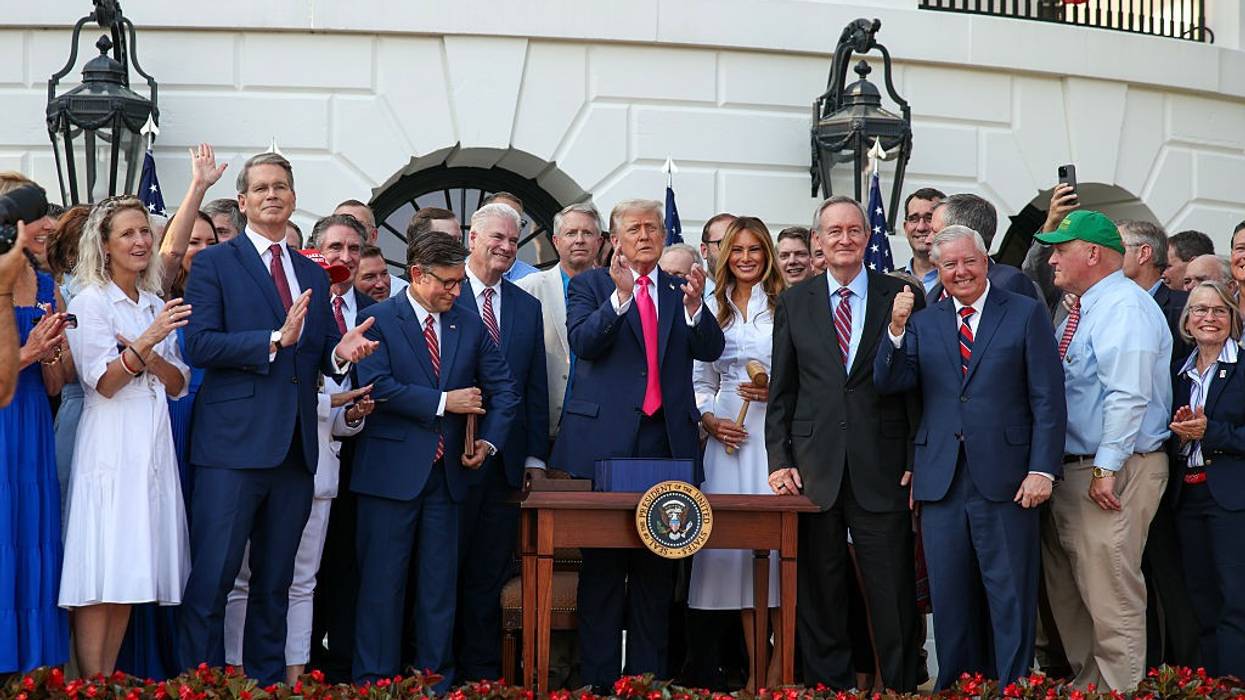
"The Republican tax law has proven to be a callous bill that punishes working families to reward billionaires," said one critic.
As Republicans rammed their so-called One Big Beautiful Bill through Congress last year on the way to President Donald Trump's desk, opponents of the legislation sounded the alarm over the pain it would inflict upon working families for the benefit of the wealthiest Americans. One year in, those warnings have borne out—and experts say the worst is yet to come.
The GOP budget reconciliation package that Trump signed into law last July 4 ushered in the biggest cuts to Medicaid and the Supplemental Nutritional Assistance Program (SNAP) in the programs’ histories in order to fund trillions of dollars in tax reductions that disproportionately benefit the wealthiest Americans.
Senate Democrats said Wednesday that "Republicans stole from the working class to give to the rich," highlighting how "millions of families are going hungry and how the law's cuts "are endangering lives."
“When Republicans passed their ‘Big, Ugly Bill,’ they chose the wealthy elite over working Americans,” US Senate Minority Leader Chuck Schumer (D-NY) said Wednesday in a statement marking the law's looming anniversary. “It wasn’t beautiful; it was a betrayal."
"Republicans gutted healthcare, SNAP, and low-cost clean energy to benefit billionaires and big corporations," he added. "Now, Americans are dealing with a cost-of-living crisis, and they have Donald Trump and Republicans to thank for it. While Trump says, ‘I love the inflation’ and affordable housing is ‘a big yawn’ between rounds of golf, Democrats are fighting tooth and nail to lower costs, expand housing, and make life more affordable.”
The law's Medicaid eligibility restrictions and paperwork requirements are expected to dramatically increase the number of uninsured Americans. The advocacy group Protect Our Care estimates that, since the passage of the GOP legislation, 3.8 million people have lost coverage they previously had under Medicaid and the Children’s Health Insurance Program. Combined with the loss of Affordable Care Act (ACA) subsidies that Trump and congressional Republicans let expire late last year, approximately 8 million more people are now uninsured.
Health insurance premiums have more than doubled for nearly 22 million families, with further increases expected in 2027.
Since enactment of the Republican law, more than 1,000 hospitals, clinics, and nursing homes have been forced to either close or face the prospect of closure, with rural healthcare services hit particularly hard.
“A mind-boggling number of Americans have found themselves joining the ranks of the uninsured. And this is just the beginning," Protect Our Care president Brad Woodhouse said on Tuesday. "As working families continue to get squeezed left and right by GOP-driven healthcare cost hikes and bureaucratic red tape, millions more Americans will lose the care they rely on to stay alive and healthy."
Meanwhile, more than 3.5 million people have lost food assistance, including 770,000 children, due at least in part to the law's SNAP cuts. According to a Center on Budget and Policy Priorities analysis of SNAP caseload data, enrollment in the crucial food aid program plummeted by 4 million between the OBBBA's enactment and March 2026. The result has been what the New York Federal Reserve Bank in late May called a “remarkable increase in food insecurity, particularly among lower-educated and lower-income households and households with young children."
Lindsay Owens, executive director of the progressive economic advocacy group Groundwork Collaborative, said Wednesday that “President Trump promised to lower costs. Instead, his signature legislative achievement has left Americans to foot the bill for tax cuts for his wealthy friends and donors."
"Millions have lost healthcare coverage and food assistance, hundreds of nursing homes and clinics have shuttered, and the prices for basics like groceries continue to climb," Owens added. "One year later, the Republican tax law has proven to be a callous bill that punishes working families to reward billionaires.”
There is much more pain to come. The research organization RAND estimates that impending Medicaid cuts under the OBBBA will result in 7.6 million fewer program enrollees by 2034. Overall, roughly 15 million people are projected to lose health coverage and become uninsured by 2034 due to Medicaid and ACA marketplace cuts in the OBBBA, according to estimates from the nonpartisan Congressional Budget Office.
"We weren’t being hysterical. We knew this would happen," Congresswoman Sara Jacobs (D-Calif.) said this week. "When Republicans passed the Big Ugly Bill and cut funding for healthcare, they literally signed away millions of Americans’ ability to afford health insurance. And now it’s happening."
On Tuesday, the Washington Center for Equitable Growth published an analysis examining the OBBBA's impacts on the overall economy. The research nonprofit noted that the legislation "makes enormous cuts to critical income supports on which Americans depend to survive," while at the same time "is a windfall for corporations and wealthy households, making it the most regressive tax and budget law in at least 40 years."
As Common Dreams reported, the OBBBA is expected to give the wealthiest 1% of Americans $1 trillion in tax cuts while adding $4.6 trillion to the federal deficit over the next decade.
"Even so, its tax cuts were not paid for," the Washington Center said of the law. "By increasing the federal budget deficit, the law not only limits the nation’s ability to invest in future needs but also drives up interest rates on mortgages, car loans, and business loans."
"Thus far, implementation guidance from the Trump administration has been faster and harsher than anticipated, with looming consequences for state budgets—which will necessitate further cuts to state initiatives that support families and that lead to longer-term state economic growth," the center added.
The American Federation of State, County, and Municipal Employees (AFSCME)—a union representing 1.3 million public sector workers and retirees—said Monday that the year of harm wrought by the OBBBA "is only the beginning."
"Some of the law’s cuts hit immediately, while extreme changes and cuts to Medicaid, for example, won’t happen until after November this year. But working families are already feeling its impact," the union said.
"You feel it when you ask yourself whether the energy bill gets paid or the rent does—because you can’t always do both," AFSCME continued. "You feel it when you watch your health insurance premiums climb while your neighborhood clinic cuts its hours."
"For AFSCME members, you feel it at work too—when you talk to families and have to break it to them that new policies mean they will lose food assistance, Medicaid, and other life-sustaining support," the union said. "You feel it when low pay drives high turnover, so you’re forced to work mandatory overtime. And you feel it when states, cities, and towns say they don’t have the resources to compensate you fairly for your work or invest in our schools, hospitals, and roads."
AFSCME asserted that the Republican law and its harms should sound "a nationwide call to action for working families to get organized and demand more."
"The labor movement is how working people have always asserted that we are not spectators in our own lives," the union added. "That we have a voice, a vote, and the power to drive change."

The commission's upcoming first meeting will focus on "strengthening AI infrastructure, accelerating AI's impact on health, education, food security, and disaster response, and ensuring trust and safety," said its CEO co-chair.
A week after United Nations Secretary-General António Guterres called on artificial intelligence companies to "come clean" about the full costs of power-sucking data centers, and as a UN panel on Wednesday released a report detailing the risks and impacts of AI, Axios revealed the creation of a related commission that's full of Big Tech executives.
"The UN and its International Telecommunication Union (ITU) are convening the AI for Good Global Commission, which will hold its first meeting on July 8 in Geneva, Switzerland," according to the outlet. It will be co-chaired by Salesforce CEO Marc Benioff and Rwandan President Paul Kagame, with other tech and policy leaders joining as members.
So far, Axios reported, they include ITU Secretary-General Doreen Bogdan-Martin, Estonian President Alar Karis, Amazon CEO Andy Jassy, Anthropic co-founder Jack Clark, Cohere co-founder Aidan Gomez, Microsoft president Brad Smith, Nvidia founder and CEO Jensen Huang, and AI and tech policymakers from Kazakhstan, Namibia, Nigeria, Saudi Arabia, and Singapore.
"AI is the most profound technological transition in history. And our values have to guide every step, because responsibility is the core of AI ethics," Benioff said. The commission will bring together "the people who build AI, deploy it, shape policy, and represent communities."
He added that "our inaugural meeting will focus on where this group is uniquely positioned to act together: strengthening AI infrastructure, accelerating AI's impact on health, education, food security, and disaster response, and ensuring trust and safety."
However, given recent polls showing that the public has limited confidence in large technology companies, opposes constructing data centers for artificial intelligence in their local area, is wary of AI’s impact on daily life, and has concerns about politicians having a "cozy relationship" with Big Tech, the commission may be met with skepticism or even backlash.
In the lead-up to the commission's meeting next week at the ITU's AI for Good Global Summit, the UN plans to hold the inaugural Global Dialogue on AI Governance, featuring a presentation of the "Preliminary Report of the Independent International Scientific Panel on Artificial Intelligence," published Wednesday.
Established with a UN resolution last August, the panel is the first global scientific body on AI—and, as Guterres said in a statement about its new report, "the panel is intended to help the world separate fact from fakes, and science from slop."
"We are looking to them to provide an authoritative reference point at a moment when reliable, unbiased understanding of AI has never been more critical," the UN chief explained. "I am pleased to say that they have delivered a down payment on that commitment—in record time."
The panel's co-chair, Canadian computer scientist Yoshua Bengio, noted that "AI capabilities are outpacing both scientific understanding and governments' ability to adapt. With growing evidence of deceptive AI behavior, science currently cannot guarantee that as capabilities continue to increase, AI will not cause catastrophic harm, either on its own or due to malicious users."
"To act effectively, global policymakers must understand these systems," he asserted. "This panel provides exactly that: a rigorous, shared scientific foundation to guide our collective way forward."
The report discusses AI's recent advances and expected trajectories; societal applications, from agriculture to education to healthcare; economic implications; security and environmental concerns; impacts on democracy, human rights, and information; potential harms to child safety and culture; and governance of the rapidly developing technology.
"The technology is transformative, but if the world keeps moving along this trajectory, humanity will fail to realize the gains it promises. The risks—to societies, to security, and to our species—are too high, and the forces driving AI forward are not the forces that will deliver its benefits," said Maria Ressa, a panel's co-chair and Nobel Peace Prize-winning Filipino-American journalist.
Guterres, whose term ends this year, similarly stressed the need for urgent action on a global scale. He said that the "single lesson" he wanted to highlight from the multifaceted report is that "the more AI advances without shared rules, the less say governments and people will have in the outcome. So my message to governments is simple: Do not wait."
"Next week in Geneva, the first Global Dialogue on AI Governance will begin to turn science into shared action—with every nation at the same table," he said. "I look forward to joining member states there to help carry this work forward. And soon, I will set out proposals to help countries build the capacity to adequately deal with this technology—and share in its rewards."
Guterres' Wednesday comments came after he publicly took aim at artificial intelligence companies last week, proposing the AI Environmental Transparency Initiative during London Climate Action Week, as the second heatwave in as many months scorched the United Kingdom and various other European countries, killing at least hundreds of people.
"I am calling on every major AI company to measure and publicly disclose the full environmental impact of its systems—carbon, water, and land footprints—and to commit to power every data center with renewable energy by 2030," he declared. "No more hidden costs. No more shifting the burden onto those least able to bear it."

"Affordability?" said Rep. Troy Nehls. "What are you talking about?"
Republican Rep. Troy Nehls, a leading defender of President Donald Trump, didn't seem too concerned when asked on Tuesday about Americans' struggles to pay for food on the Fourth of July, saying they may just not work as hard as he does.
As Nehls (R-Texas) prepared to depart for the holiday recess, a pair of reporters—Pablo Manríquez of Meidas Touch and Julian Andreone of Drop Site News—caught him on the steps of the Capitol and asked how Republicans planned to address the high cost of living, which voters consistently say is their top concern entering midterm election season.
Manríquez asked Nehls how House Republicans planned to "make the case that you're fighting for affordability when you go back to your districts?"
Nehls responded: "Affordability? What are you talking about?"
Unprompted, he proceeded to brag about his plans for the holiday: "I'm gonna go there tomorrow. I'm gonna get me a couple of big lobster tails. I'm gonna get me some nice rib-eyes. I'm gonna sit in my backyard with my family and my neighbors, and we're going to be enjoying the Fourth, celebrating 250 years... celebrating the greatest president of my lifetime, Donald J. Trump."
According to the latest Consumer Price Index report from the Bureau of Labor Statistics, annual inflation has surged to 4.2% after Trump's war with Iran caused energy costs to spike and prices to soar throughout the economy.
High inflation has affected the cost of many holiday staples. According to a report out Tuesday from the Groundwork Collaborative, the cost of ground beef has surged more than 20%, and Ball Park brand hot dogs have climbed 13% in price since last summer.
"Everybody understands, you're going to see a little increase in energy prices because of Iran," Nehls said Tuesday. "I mean, come on, people aren't stupid, you realize that when you have a conflict in Iran."
Though oil and gas companies are reportedly set to make an additional $700 billion this year on the backs of consumers beyond what they would have made without the war, Nehls credited Trump with taking on "price gouging." And though gas prices are still projected to remain elevated through the year's end despite a possible end to the war, he said the high costs were a "temporary issue."
Andreone then asked Nehls, "Do you think the 60% of Americans who are living paycheck to paycheck can afford lobster tails and rib-eyes and all of that?"
"Maybe not," Nehls responded. "Maybe the 60% of Americans don't work as hard as I do, neither, I mean I don't know."
With Trump's approval rating on the economy in shambles—a record low 33% of American adults said they approve of his performance in an NPR/PBS News/Marist poll last week—Nehls' comments were perceived as yet another sign that Republicans were hopelessly out of touch with Americans' needs.
It was not the only one. At a time when more than three-quarters of Americans said the cost of housing was an important issue, Trump justified his refusal to sign a piece of bipartisan housing legislation on Monday by saying: "I don't want to drive housing prices down. I want to drive housing prices up."
Trump has previously described the concept of affordability as a Democratic "hoax" and said that when making decisions related to the Iran War, "I don't think about Americans' financial situation."
While Nehls is retiring and won't have to face voters' wrath in November, his tin-eared surf and turf boast could provide more ammunition to Democrats hammering on affordability as they hope to take back the House and Senate, in part by gaining ground in his home state of Texas.
Responding to the video of Nehls, journalist and commentator Mehdi Hasan said, "Democrats should turn this into an ad."