SUBSCRIBE TO OUR FREE NEWSLETTER
Daily news & progressive opinion—funded by the people, not the corporations—delivered straight to your inbox.
5
#000000
#FFFFFF
To donate by check, phone, or other method, see our More Ways to Give page.
Daily news & progressive opinion—funded by the people, not the corporations—delivered straight to your inbox.
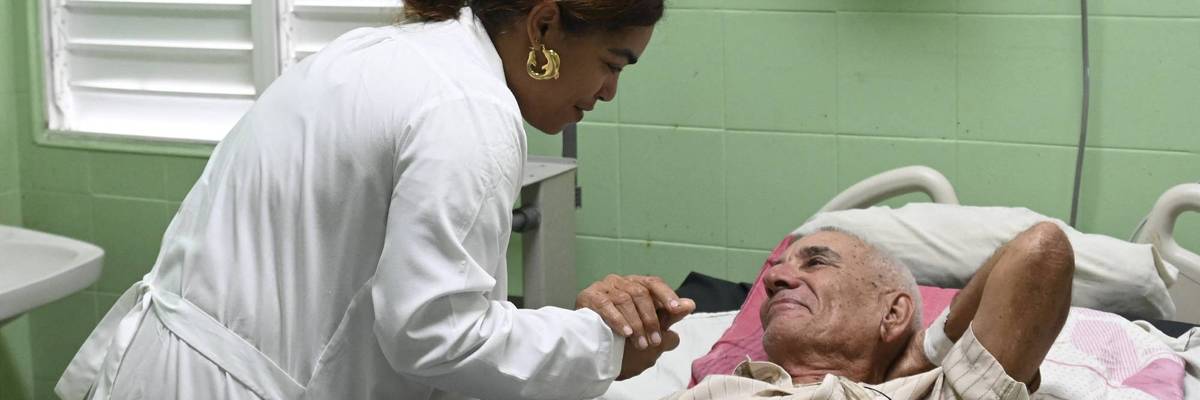
A doctor talks to a patient in the cardiology room of the Calixto Garcia Hospital in Havana on February 12, 2024.
"We do everything with love to assist people, but the reality right now is that we don’t have enough resources," said one Cuban doctor, who added that "the main cause of everything is the USA."
The Trump administration's oil blockade of Cuba—an escalation of the 65-year US stranglehold on the socialist island's economy—is killing Cubans amid a severe shortage of electricity and critical basic medical supplies, doctors and nurses there told reporters this week.
"I can’t tell you how many deaths, but I’m sure there are more than in the same period last year,” Dr. Alioth Fernandez, chief anesthesiologist at William Soler Pediatric Hospital in Havana, told The New York Times in an article published Friday. “I see it in shift handovers, in colleagues’ comments, and in children I’ve operated on.”
Cuba's universal healthcare system is internationally known. Its "Army of White Coats" has been deployed around the world, both to provide routine and specialized care, as well as during emergencies such as the Haiti earthquake, Sierra Leone Ebola outbreak, and Covid-19 pandemic in Italy.
Despite decades of success under increasingly adverse conditions, Cuba's vaunted health system is under tremendous strain, due in no small part to the cumulative effects of generations of US economic sanctions.
"Since I was born, this is the most difficult time, without any doubt," José Carlos, a resident intern at Havana Cardiology Institute, told the Canadian Broadcasting Corporation on Thursday. "We do everything with love to assist people, but the reality right now is that we don’t have enough resources."
The lack of fuel is limiting ambulance service and keeping many doctors and other medical professionals from commuting to hospitals that are canceling surgeries and discharging patients early. As Common Dreams reported earlier this week, more than 96,000 Cubans—including 11,000 children—are waiting for surgery due to the fuel shortage.
"Everything is hitting us—energy, resources, transportation," Carlos told the CBC.
When the lights go out, neonatal nurses use hand-pumped ventilators to keep infants alive. Without power, hospitals and clinics can't administer chemotherapy cycles or dialysis treatments.
“I don’t know how long we can keep going,” Xenia Álvarez, the mother of a 21-year-old man who suffers a rare genetic disease and requires full-time use of a ventilator, told The New York Times.
Shortages of basic medicines and supplies are forcing doctors to substitute medications, delay treatments, or even ask patients' relatives to find supplies themselves. Antibiotics, painkillers, and medications to treat chronic diseases are scarce, as are gloves, syringes, and diagnostic equipment. Hospital staff also report difficulty maintaining sterile conditions.
While the US government claims that humanitarian goods like medicine are exempt from sanctions, critics counter that the fuel blockade, along with severe restrictions on banking and shipping, effectively block many medical supplies from reaching the island. The Trump administration has also been pressuring countries into expelling the lifesaving Cuban medical teams, sparking widespread outrage and condemnation.
After the Fidel Castro-led revolution that ousted the US-backed dictatorship of Fulgencio Batista, the United States imposed an economic embargo on the island that has been perennially condemned by an overwhelming majority of United Nations member states for 33 years. Cuba says US sanctions have cost its economy more than $200 billion in inflation-adjusted losses.
US Secretary of State Marco Rubio recently admitted that the economic chokehold is meant to force political change in Cuba while simultaneously disparaging the Cuban economy as "dysfunctional."
Rubio also said that although President Donald Trump is currently focused on the US-Israeli war of choice on Iran—one of seven nations attacked since the self-proclaimed "president of peace" returned to the White House—he would "be doing something with Cuba very soon."
Trump said earlier this month that he believes he'll "be having the honor of taking Cuba," language echoing the 19th century US imperialists who conquered the island along with Puerto Rico and the Philippines from Spain.
In addition to patients, the crisis in Cuba is also taking a physical and psychological toll on Cuban doctors—who, even with a recent raise earn just 100 pesos, or about $2.40, per 12-hour shift. This, in a country in which a dozen eggs cost nearly $10. Many doctors rely upon side hustles to get by.
"Doctors' pay is just for basic things," said Carlos. "It doesn’t allow you to buy many things in the supermarket or go to a restaurant or a hotel, or things like that."
Breakdowns and burnout are on the rise.
"I've seen doctors cry," one physician, who wished to remain anonymous for fear of retaliation, told Reuters. "With this crisis, they cry. They've stopped working, they've become depressed. You can see it on their faces."
Despite the worsening situation, Carlos told the CBC that he does not want to leave Cuba, and blamed the US for the crisis.
"The main cause of everything is the USA," he said. "I have no doubt about that."
Some do want to leave, blaming their own government as well the US embargo for Cuba's suffering. Others are taking things one day at a time.
"We don’t know what will happen," a nurse who gave only her first name, Rita, told the CBC, "so we just keep working."
The mounting—and preventable—deaths in Cuba are prompting renewed calls for the US to lift sanctions on Cuba.
"No patient deserves this. Trump's cruel Cuban blockade is killing people unnecessarily," National Nurses United, the largest US nurses' union, said on social media Friday. "Depriving Cubans of essential resources needed to sustain life and health is an unconscionable violation of human rights. Nurses say: End the blockade now!"
Congresswoman Ilhan Omar (D-Minn.) also weighed in during a Thursday floor speech in which she said that "Cuba poses no threat to us, yet we are strangling an entire nation with economic warfare."
Trump's oil blockade is strangling an entire nation.
Families are going without food. Water systems are failing. Hospitals are struggling to stay open. This is economic warfare.
I'm calling for an immediate end to this cruel and indefensible blockade. Hands off Cuba. pic.twitter.com/MNybPNlBHn
— Rep. Ilhan Omar (@Ilhan) March 26, 2026
"Families are going without food. Water systems are failing. Hospitals are struggling to stay open," she continued. "These tactics are designed to suffocate an island into submission. Make no mistake: This unconscionable suffering is occurring because Trump is trying to force regime change."
"Hands off Cuba," Omar added. "End the blockade now."
Dear Common Dreams reader, It’s been nearly 30 years since I co-founded Common Dreams with my late wife, Lina Newhouser. We had the radical notion that journalism should serve the public good, not corporate profits. It was clear to us from the outset what it would take to build such a project. No paid advertisements. No corporate sponsors. No millionaire publisher telling us what to think or do. Many people said we wouldn't last a year, but we proved those doubters wrong. Together with a tremendous team of journalists and dedicated staff, we built an independent media outlet free from the constraints of profits and corporate control. Our mission has always been simple: To inform. To inspire. To ignite change for the common good. Building Common Dreams was not easy. Our survival was never guaranteed. When you take on the most powerful forces—Wall Street greed, fossil fuel industry destruction, Big Tech lobbyists, and uber-rich oligarchs who have spent billions upon billions rigging the economy and democracy in their favor—the only bulwark you have is supporters who believe in your work. But here’s the urgent message from me today. It's never been this bad out there. And it's never been this hard to keep us going. At the very moment Common Dreams is most needed, the threats we face are intensifying. We need your support now more than ever. We don't accept corporate advertising and never will. We don't have a paywall because we don't think people should be blocked from critical news based on their ability to pay. Everything we do is funded by the donations of readers like you. When everyone does the little they can afford, we are strong. But if that support retreats or dries up, so do we. Will you donate now to make sure Common Dreams not only survives but thrives? —Craig Brown, Co-founder |
The Trump administration's oil blockade of Cuba—an escalation of the 65-year US stranglehold on the socialist island's economy—is killing Cubans amid a severe shortage of electricity and critical basic medical supplies, doctors and nurses there told reporters this week.
"I can’t tell you how many deaths, but I’m sure there are more than in the same period last year,” Dr. Alioth Fernandez, chief anesthesiologist at William Soler Pediatric Hospital in Havana, told The New York Times in an article published Friday. “I see it in shift handovers, in colleagues’ comments, and in children I’ve operated on.”
Cuba's universal healthcare system is internationally known. Its "Army of White Coats" has been deployed around the world, both to provide routine and specialized care, as well as during emergencies such as the Haiti earthquake, Sierra Leone Ebola outbreak, and Covid-19 pandemic in Italy.
Despite decades of success under increasingly adverse conditions, Cuba's vaunted health system is under tremendous strain, due in no small part to the cumulative effects of generations of US economic sanctions.
"Since I was born, this is the most difficult time, without any doubt," José Carlos, a resident intern at Havana Cardiology Institute, told the Canadian Broadcasting Corporation on Thursday. "We do everything with love to assist people, but the reality right now is that we don’t have enough resources."
The lack of fuel is limiting ambulance service and keeping many doctors and other medical professionals from commuting to hospitals that are canceling surgeries and discharging patients early. As Common Dreams reported earlier this week, more than 96,000 Cubans—including 11,000 children—are waiting for surgery due to the fuel shortage.
"Everything is hitting us—energy, resources, transportation," Carlos told the CBC.
When the lights go out, neonatal nurses use hand-pumped ventilators to keep infants alive. Without power, hospitals and clinics can't administer chemotherapy cycles or dialysis treatments.
“I don’t know how long we can keep going,” Xenia Álvarez, the mother of a 21-year-old man who suffers a rare genetic disease and requires full-time use of a ventilator, told The New York Times.
Shortages of basic medicines and supplies are forcing doctors to substitute medications, delay treatments, or even ask patients' relatives to find supplies themselves. Antibiotics, painkillers, and medications to treat chronic diseases are scarce, as are gloves, syringes, and diagnostic equipment. Hospital staff also report difficulty maintaining sterile conditions.
While the US government claims that humanitarian goods like medicine are exempt from sanctions, critics counter that the fuel blockade, along with severe restrictions on banking and shipping, effectively block many medical supplies from reaching the island. The Trump administration has also been pressuring countries into expelling the lifesaving Cuban medical teams, sparking widespread outrage and condemnation.
After the Fidel Castro-led revolution that ousted the US-backed dictatorship of Fulgencio Batista, the United States imposed an economic embargo on the island that has been perennially condemned by an overwhelming majority of United Nations member states for 33 years. Cuba says US sanctions have cost its economy more than $200 billion in inflation-adjusted losses.
US Secretary of State Marco Rubio recently admitted that the economic chokehold is meant to force political change in Cuba while simultaneously disparaging the Cuban economy as "dysfunctional."
Rubio also said that although President Donald Trump is currently focused on the US-Israeli war of choice on Iran—one of seven nations attacked since the self-proclaimed "president of peace" returned to the White House—he would "be doing something with Cuba very soon."
Trump said earlier this month that he believes he'll "be having the honor of taking Cuba," language echoing the 19th century US imperialists who conquered the island along with Puerto Rico and the Philippines from Spain.
In addition to patients, the crisis in Cuba is also taking a physical and psychological toll on Cuban doctors—who, even with a recent raise earn just 100 pesos, or about $2.40, per 12-hour shift. This, in a country in which a dozen eggs cost nearly $10. Many doctors rely upon side hustles to get by.
"Doctors' pay is just for basic things," said Carlos. "It doesn’t allow you to buy many things in the supermarket or go to a restaurant or a hotel, or things like that."
Breakdowns and burnout are on the rise.
"I've seen doctors cry," one physician, who wished to remain anonymous for fear of retaliation, told Reuters. "With this crisis, they cry. They've stopped working, they've become depressed. You can see it on their faces."
Despite the worsening situation, Carlos told the CBC that he does not want to leave Cuba, and blamed the US for the crisis.
"The main cause of everything is the USA," he said. "I have no doubt about that."
Some do want to leave, blaming their own government as well the US embargo for Cuba's suffering. Others are taking things one day at a time.
"We don’t know what will happen," a nurse who gave only her first name, Rita, told the CBC, "so we just keep working."
The mounting—and preventable—deaths in Cuba are prompting renewed calls for the US to lift sanctions on Cuba.
"No patient deserves this. Trump's cruel Cuban blockade is killing people unnecessarily," National Nurses United, the largest US nurses' union, said on social media Friday. "Depriving Cubans of essential resources needed to sustain life and health is an unconscionable violation of human rights. Nurses say: End the blockade now!"
Congresswoman Ilhan Omar (D-Minn.) also weighed in during a Thursday floor speech in which she said that "Cuba poses no threat to us, yet we are strangling an entire nation with economic warfare."
Trump's oil blockade is strangling an entire nation.
Families are going without food. Water systems are failing. Hospitals are struggling to stay open. This is economic warfare.
I'm calling for an immediate end to this cruel and indefensible blockade. Hands off Cuba. pic.twitter.com/MNybPNlBHn
— Rep. Ilhan Omar (@Ilhan) March 26, 2026
"Families are going without food. Water systems are failing. Hospitals are struggling to stay open," she continued. "These tactics are designed to suffocate an island into submission. Make no mistake: This unconscionable suffering is occurring because Trump is trying to force regime change."
"Hands off Cuba," Omar added. "End the blockade now."
The Trump administration's oil blockade of Cuba—an escalation of the 65-year US stranglehold on the socialist island's economy—is killing Cubans amid a severe shortage of electricity and critical basic medical supplies, doctors and nurses there told reporters this week.
"I can’t tell you how many deaths, but I’m sure there are more than in the same period last year,” Dr. Alioth Fernandez, chief anesthesiologist at William Soler Pediatric Hospital in Havana, told The New York Times in an article published Friday. “I see it in shift handovers, in colleagues’ comments, and in children I’ve operated on.”
Cuba's universal healthcare system is internationally known. Its "Army of White Coats" has been deployed around the world, both to provide routine and specialized care, as well as during emergencies such as the Haiti earthquake, Sierra Leone Ebola outbreak, and Covid-19 pandemic in Italy.
Despite decades of success under increasingly adverse conditions, Cuba's vaunted health system is under tremendous strain, due in no small part to the cumulative effects of generations of US economic sanctions.
"Since I was born, this is the most difficult time, without any doubt," José Carlos, a resident intern at Havana Cardiology Institute, told the Canadian Broadcasting Corporation on Thursday. "We do everything with love to assist people, but the reality right now is that we don’t have enough resources."
The lack of fuel is limiting ambulance service and keeping many doctors and other medical professionals from commuting to hospitals that are canceling surgeries and discharging patients early. As Common Dreams reported earlier this week, more than 96,000 Cubans—including 11,000 children—are waiting for surgery due to the fuel shortage.
"Everything is hitting us—energy, resources, transportation," Carlos told the CBC.
When the lights go out, neonatal nurses use hand-pumped ventilators to keep infants alive. Without power, hospitals and clinics can't administer chemotherapy cycles or dialysis treatments.
“I don’t know how long we can keep going,” Xenia Álvarez, the mother of a 21-year-old man who suffers a rare genetic disease and requires full-time use of a ventilator, told The New York Times.
Shortages of basic medicines and supplies are forcing doctors to substitute medications, delay treatments, or even ask patients' relatives to find supplies themselves. Antibiotics, painkillers, and medications to treat chronic diseases are scarce, as are gloves, syringes, and diagnostic equipment. Hospital staff also report difficulty maintaining sterile conditions.
While the US government claims that humanitarian goods like medicine are exempt from sanctions, critics counter that the fuel blockade, along with severe restrictions on banking and shipping, effectively block many medical supplies from reaching the island. The Trump administration has also been pressuring countries into expelling the lifesaving Cuban medical teams, sparking widespread outrage and condemnation.
After the Fidel Castro-led revolution that ousted the US-backed dictatorship of Fulgencio Batista, the United States imposed an economic embargo on the island that has been perennially condemned by an overwhelming majority of United Nations member states for 33 years. Cuba says US sanctions have cost its economy more than $200 billion in inflation-adjusted losses.
US Secretary of State Marco Rubio recently admitted that the economic chokehold is meant to force political change in Cuba while simultaneously disparaging the Cuban economy as "dysfunctional."
Rubio also said that although President Donald Trump is currently focused on the US-Israeli war of choice on Iran—one of seven nations attacked since the self-proclaimed "president of peace" returned to the White House—he would "be doing something with Cuba very soon."
Trump said earlier this month that he believes he'll "be having the honor of taking Cuba," language echoing the 19th century US imperialists who conquered the island along with Puerto Rico and the Philippines from Spain.
In addition to patients, the crisis in Cuba is also taking a physical and psychological toll on Cuban doctors—who, even with a recent raise earn just 100 pesos, or about $2.40, per 12-hour shift. This, in a country in which a dozen eggs cost nearly $10. Many doctors rely upon side hustles to get by.
"Doctors' pay is just for basic things," said Carlos. "It doesn’t allow you to buy many things in the supermarket or go to a restaurant or a hotel, or things like that."
Breakdowns and burnout are on the rise.
"I've seen doctors cry," one physician, who wished to remain anonymous for fear of retaliation, told Reuters. "With this crisis, they cry. They've stopped working, they've become depressed. You can see it on their faces."
Despite the worsening situation, Carlos told the CBC that he does not want to leave Cuba, and blamed the US for the crisis.
"The main cause of everything is the USA," he said. "I have no doubt about that."
Some do want to leave, blaming their own government as well the US embargo for Cuba's suffering. Others are taking things one day at a time.
"We don’t know what will happen," a nurse who gave only her first name, Rita, told the CBC, "so we just keep working."
The mounting—and preventable—deaths in Cuba are prompting renewed calls for the US to lift sanctions on Cuba.
"No patient deserves this. Trump's cruel Cuban blockade is killing people unnecessarily," National Nurses United, the largest US nurses' union, said on social media Friday. "Depriving Cubans of essential resources needed to sustain life and health is an unconscionable violation of human rights. Nurses say: End the blockade now!"
Congresswoman Ilhan Omar (D-Minn.) also weighed in during a Thursday floor speech in which she said that "Cuba poses no threat to us, yet we are strangling an entire nation with economic warfare."
Trump's oil blockade is strangling an entire nation.
Families are going without food. Water systems are failing. Hospitals are struggling to stay open. This is economic warfare.
I'm calling for an immediate end to this cruel and indefensible blockade. Hands off Cuba. pic.twitter.com/MNybPNlBHn
— Rep. Ilhan Omar (@Ilhan) March 26, 2026
"Families are going without food. Water systems are failing. Hospitals are struggling to stay open," she continued. "These tactics are designed to suffocate an island into submission. Make no mistake: This unconscionable suffering is occurring because Trump is trying to force regime change."
"Hands off Cuba," Omar added. "End the blockade now."