SUBSCRIBE TO OUR FREE NEWSLETTER
Daily news & progressive opinion—funded by the people, not the corporations—delivered straight to your inbox.
5
#000000
#FFFFFF
To donate by check, phone, or other method, see our More Ways to Give page.
Daily news & progressive opinion—funded by the people, not the corporations—delivered straight to your inbox.
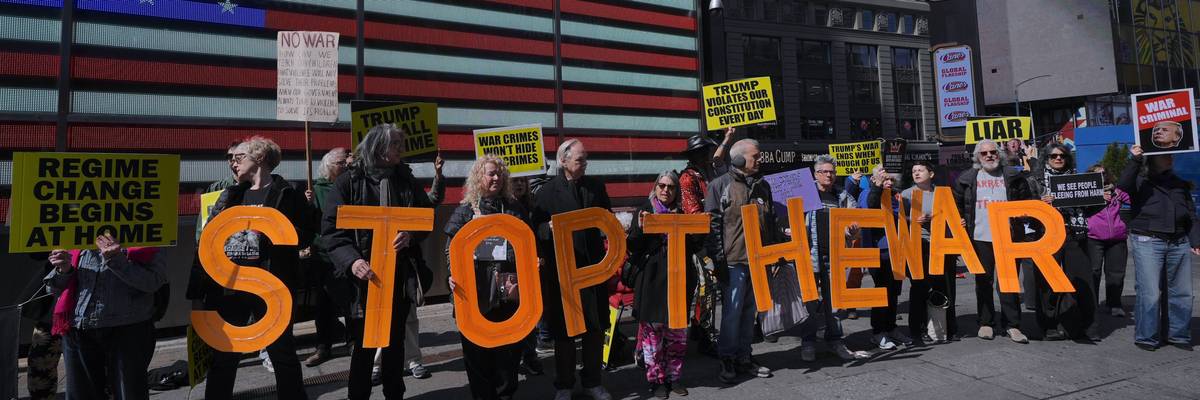
Demonstrators hold a protest against the war on Iran next to a military recruiting station in New York City on March 22, 2026.
Trump is considering putting US troops on the ground in Iran. Only 12% of Americans want that to happen, according to a new Associated Press-NORC poll.
Nearly six in ten Americans say President Donald Trump's war in Iran has gone too far, according to a poll out Wednesday from the Associated Press-NORC Center for Public Affairs Research.
The war launched late last month by the US and Israel has led to the deaths of more than 1,400 Iranian civilians, according to the Human Rights Activist News Agency (HRANA), and the displacement of more than 3 million. It has spiraled out across the region while creating a global economic crisis that has caused gas prices to spike to nearly $4 per gallon in the US.
Now, 59% of American adults say it's "gone too far," compared to just 26% who say it's "been about right" and 13% who say it's "not gone far enough," according to the survey of 1,150 people.
Those opposed to continuing the president's war of choice include 90% of Democrats and 63% of independents. Most Republicans, 52%, say the amount of force used by Trump has been “about right.” Just 20% want him to go further, while 26% say he’s gone too far.
In recent days, as Iran's closure of the Strait of Hormuz has wreaked havoc on global oil prices, Trump has sent thousands more servicemembers to the region and reportedly mulled deploying American ground troops in hopes of reopening the crucial waterway.
Experts have warned that a ground deployment could turn the war into an even greater quagmire. Already, 13 US soldiers have been killed since February 28.
An even larger share of Americans, 62%, said they oppose the idea of deploying US troops on the ground in Iran, while just 12% say they support it and 26% say they have no opinion.
While a minority says it is very important for the US to stop Iran from threatening Israel or to replace its government with one more favorable to the US, Americans are prioritizing issues at home.
Ninety-three percent said it was very or somewhat important for the US to keep oil and gas prices low, which has so far not happened—in less than a month, they have spiked by about a dollar and have not shown signs of coming down, even as Trump has deployed emergency fuel reserves and lifted sanctions on some Iranian oil to juice supply.
A majority of Americans, 65%, also said they felt that preventing Iran from obtaining a nuclear weapon—one of Trump's stated objectives for the war—was a very important foreign policy goal.
However, as journalist and commentator Adam Johnson pointed out in a piece for The Real News on Tuesday, the US public is "grossly misinformed" about the subject—25% wrongly believe Iran already possesses a nuke while 45% believe they are working towards developing one, which has been refuted by US intelligence assessments and reporting based on the testimony of US officials.
The unpopularity of the war with Iran is in line with previous polls showing that the majority of Americans believe the war benefits Israel more than the US and want the war to end quickly.
With Trump having returned to office on the explicit pledge to avoid war with Iran and the cost of living already at the center of the president's near-historic unpopularity, Republicans' outlook for this year's midterm elections looks as grim as ever.
Polling aggregators predict Democrats will easily flip the House, and the Senate is now a toss-up, though Republicans still hold a slight edge.
According to polls, Republicans’ midterm chances truly began to tank in January amid outrage over federal immigration agents' killings of two US citizens in Minneapolis. Though surveys haven't shown GOP numbers getting markedly worse since the war began, recent opinion polling suggests it is not a non-factor.
A poll last week from the Institute of Middle East Understanding found that 43% of voters said they're less likely to support Republicans in the midterms as a result of the war, compared to 31% who said they're more likely.
Dear Common Dreams reader, It’s been nearly 30 years since I co-founded Common Dreams with my late wife, Lina Newhouser. We had the radical notion that journalism should serve the public good, not corporate profits. It was clear to us from the outset what it would take to build such a project. No paid advertisements. No corporate sponsors. No millionaire publisher telling us what to think or do. Many people said we wouldn't last a year, but we proved those doubters wrong. Together with a tremendous team of journalists and dedicated staff, we built an independent media outlet free from the constraints of profits and corporate control. Our mission has always been simple: To inform. To inspire. To ignite change for the common good. Building Common Dreams was not easy. Our survival was never guaranteed. When you take on the most powerful forces—Wall Street greed, fossil fuel industry destruction, Big Tech lobbyists, and uber-rich oligarchs who have spent billions upon billions rigging the economy and democracy in their favor—the only bulwark you have is supporters who believe in your work. But here’s the urgent message from me today. It's never been this bad out there. And it's never been this hard to keep us going. At the very moment Common Dreams is most needed, the threats we face are intensifying. We need your support now more than ever. We don't accept corporate advertising and never will. We don't have a paywall because we don't think people should be blocked from critical news based on their ability to pay. Everything we do is funded by the donations of readers like you. When everyone does the little they can afford, we are strong. But if that support retreats or dries up, so do we. Will you donate now to make sure Common Dreams not only survives but thrives? —Craig Brown, Co-founder |
Nearly six in ten Americans say President Donald Trump's war in Iran has gone too far, according to a poll out Wednesday from the Associated Press-NORC Center for Public Affairs Research.
The war launched late last month by the US and Israel has led to the deaths of more than 1,400 Iranian civilians, according to the Human Rights Activist News Agency (HRANA), and the displacement of more than 3 million. It has spiraled out across the region while creating a global economic crisis that has caused gas prices to spike to nearly $4 per gallon in the US.
Now, 59% of American adults say it's "gone too far," compared to just 26% who say it's "been about right" and 13% who say it's "not gone far enough," according to the survey of 1,150 people.
Those opposed to continuing the president's war of choice include 90% of Democrats and 63% of independents. Most Republicans, 52%, say the amount of force used by Trump has been “about right.” Just 20% want him to go further, while 26% say he’s gone too far.
In recent days, as Iran's closure of the Strait of Hormuz has wreaked havoc on global oil prices, Trump has sent thousands more servicemembers to the region and reportedly mulled deploying American ground troops in hopes of reopening the crucial waterway.
Experts have warned that a ground deployment could turn the war into an even greater quagmire. Already, 13 US soldiers have been killed since February 28.
An even larger share of Americans, 62%, said they oppose the idea of deploying US troops on the ground in Iran, while just 12% say they support it and 26% say they have no opinion.
While a minority says it is very important for the US to stop Iran from threatening Israel or to replace its government with one more favorable to the US, Americans are prioritizing issues at home.
Ninety-three percent said it was very or somewhat important for the US to keep oil and gas prices low, which has so far not happened—in less than a month, they have spiked by about a dollar and have not shown signs of coming down, even as Trump has deployed emergency fuel reserves and lifted sanctions on some Iranian oil to juice supply.
A majority of Americans, 65%, also said they felt that preventing Iran from obtaining a nuclear weapon—one of Trump's stated objectives for the war—was a very important foreign policy goal.
However, as journalist and commentator Adam Johnson pointed out in a piece for The Real News on Tuesday, the US public is "grossly misinformed" about the subject—25% wrongly believe Iran already possesses a nuke while 45% believe they are working towards developing one, which has been refuted by US intelligence assessments and reporting based on the testimony of US officials.
The unpopularity of the war with Iran is in line with previous polls showing that the majority of Americans believe the war benefits Israel more than the US and want the war to end quickly.
With Trump having returned to office on the explicit pledge to avoid war with Iran and the cost of living already at the center of the president's near-historic unpopularity, Republicans' outlook for this year's midterm elections looks as grim as ever.
Polling aggregators predict Democrats will easily flip the House, and the Senate is now a toss-up, though Republicans still hold a slight edge.
According to polls, Republicans’ midterm chances truly began to tank in January amid outrage over federal immigration agents' killings of two US citizens in Minneapolis. Though surveys haven't shown GOP numbers getting markedly worse since the war began, recent opinion polling suggests it is not a non-factor.
A poll last week from the Institute of Middle East Understanding found that 43% of voters said they're less likely to support Republicans in the midterms as a result of the war, compared to 31% who said they're more likely.
Nearly six in ten Americans say President Donald Trump's war in Iran has gone too far, according to a poll out Wednesday from the Associated Press-NORC Center for Public Affairs Research.
The war launched late last month by the US and Israel has led to the deaths of more than 1,400 Iranian civilians, according to the Human Rights Activist News Agency (HRANA), and the displacement of more than 3 million. It has spiraled out across the region while creating a global economic crisis that has caused gas prices to spike to nearly $4 per gallon in the US.
Now, 59% of American adults say it's "gone too far," compared to just 26% who say it's "been about right" and 13% who say it's "not gone far enough," according to the survey of 1,150 people.
Those opposed to continuing the president's war of choice include 90% of Democrats and 63% of independents. Most Republicans, 52%, say the amount of force used by Trump has been “about right.” Just 20% want him to go further, while 26% say he’s gone too far.
In recent days, as Iran's closure of the Strait of Hormuz has wreaked havoc on global oil prices, Trump has sent thousands more servicemembers to the region and reportedly mulled deploying American ground troops in hopes of reopening the crucial waterway.
Experts have warned that a ground deployment could turn the war into an even greater quagmire. Already, 13 US soldiers have been killed since February 28.
An even larger share of Americans, 62%, said they oppose the idea of deploying US troops on the ground in Iran, while just 12% say they support it and 26% say they have no opinion.
While a minority says it is very important for the US to stop Iran from threatening Israel or to replace its government with one more favorable to the US, Americans are prioritizing issues at home.
Ninety-three percent said it was very or somewhat important for the US to keep oil and gas prices low, which has so far not happened—in less than a month, they have spiked by about a dollar and have not shown signs of coming down, even as Trump has deployed emergency fuel reserves and lifted sanctions on some Iranian oil to juice supply.
A majority of Americans, 65%, also said they felt that preventing Iran from obtaining a nuclear weapon—one of Trump's stated objectives for the war—was a very important foreign policy goal.
However, as journalist and commentator Adam Johnson pointed out in a piece for The Real News on Tuesday, the US public is "grossly misinformed" about the subject—25% wrongly believe Iran already possesses a nuke while 45% believe they are working towards developing one, which has been refuted by US intelligence assessments and reporting based on the testimony of US officials.
The unpopularity of the war with Iran is in line with previous polls showing that the majority of Americans believe the war benefits Israel more than the US and want the war to end quickly.
With Trump having returned to office on the explicit pledge to avoid war with Iran and the cost of living already at the center of the president's near-historic unpopularity, Republicans' outlook for this year's midterm elections looks as grim as ever.
Polling aggregators predict Democrats will easily flip the House, and the Senate is now a toss-up, though Republicans still hold a slight edge.
According to polls, Republicans’ midterm chances truly began to tank in January amid outrage over federal immigration agents' killings of two US citizens in Minneapolis. Though surveys haven't shown GOP numbers getting markedly worse since the war began, recent opinion polling suggests it is not a non-factor.
A poll last week from the Institute of Middle East Understanding found that 43% of voters said they're less likely to support Republicans in the midterms as a result of the war, compared to 31% who said they're more likely.