

SUBSCRIBE TO OUR FREE NEWSLETTER
Daily news & progressive opinion—funded by the people, not the corporations—delivered straight to your inbox.
5
#000000
#FFFFFF
To donate by check, phone, or other method, see our More Ways to Give page.
Daily news & progressive opinion—funded by the people, not the corporations—delivered straight to your inbox.
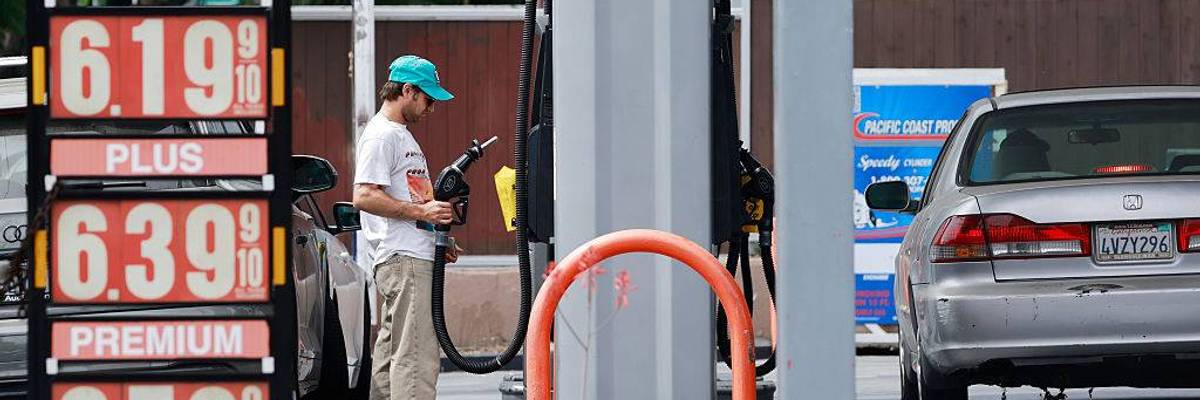
Gas prices are displayed at a Shell gas station on March 30, 2026 in Los Angeles, California.
"Talk to or read energy experts—people who focus on the physical side of the oil crisis—and their hair is on fire."
Gas prices in the US have surged to a four-year high, and Nobel Prize-winning economist Paul Krugman is warning that the worst is likely yet to come.
Amid a Tuesday projection from AAA that average US gas prices had hit $4 per gallon for the first time since 2022, Krugman published an analysis of the petroleum market in which he projected that the price of oil will go even higher in the coming weeks as the global economy runs into supply shortages caused by President Donald Trump's war against Iran.
Krugman argued that oil price hikes have actually been tame so far because physical supplies have remained steady in recent weeks, as tankers that had already passed through the Strait of Hormuz before the start of the war have continued making scheduled deliveries.
That "grace period," as Krugman described it, is about to end as speculative market prices run into the hard realities of physical shortages.
What this fundamentally means, wrote Krugman, is "you should be alarmed."
"Once the crisis gets physical, there will no longer be room for jawboning the markets," Krugman wrote. "Since the war began there have been several occasions on which Donald Trump has been able to talk prices down by asserting that meaningful negotiations are underway... but that won’t work once the oil runs out. So prices will have to rise."
As for how far prices will go up, Krugman calculated that with only medium disruption to global oil production and medium demand elasticity, the price of oil would rise to $152 per barrel, which would push US gas prices well over $4.50 per gallon.
Making matters worse, Krugman found that it wouldn't take much additional disruption to push the price of oil into worse-case scenarios where it would top $200 per barrel.
"If oil really does go to $200 or more, it’s all too easy to envisage a full-blown global economic crisis, with an inflation surge and quite likely a recession," Krugman commented. "Ever since this war began I’ve noticed a sharp divide in sentiment among experts. Finance and macroeconomics experts have been relatively sanguine about our ability to ride out this storm. But talk to or read energy experts—people who focus on the physical side of the oil crisis—and their hair is on fire."
Petroleum industry analyst Patrick De Haan on Tuesday highlighted the major increases in the price of diesel fuel since the start of the Iran war, which could add even more pain to the US economy in the form of higher shipping costs for goods.
"Can't overstate the impact that's coming down the pipeline to truckers, farmers, logistics, and beyond," De Haan wrote in a social media post. "The US economy runs on diesel with several states setting new all-time highs for diesel, while others are seeing largest monthly increases of all time."
De Haan also posted a chart highlighting the states with the biggest diesel price increases since late February, and it showed swing states Arizona, Nevada, and North Carolina faced the largest surges, with prices up more than 57% in just one month in each state.
Dear Common Dreams reader, It’s been nearly 30 years since I co-founded Common Dreams with my late wife, Lina Newhouser. We had the radical notion that journalism should serve the public good, not corporate profits. It was clear to us from the outset what it would take to build such a project. No paid advertisements. No corporate sponsors. No millionaire publisher telling us what to think or do. Many people said we wouldn't last a year, but we proved those doubters wrong. Together with a tremendous team of journalists and dedicated staff, we built an independent media outlet free from the constraints of profits and corporate control. Our mission has always been simple: To inform. To inspire. To ignite change for the common good. Building Common Dreams was not easy. Our survival was never guaranteed. When you take on the most powerful forces—Wall Street greed, fossil fuel industry destruction, Big Tech lobbyists, and uber-rich oligarchs who have spent billions upon billions rigging the economy and democracy in their favor—the only bulwark you have is supporters who believe in your work. But here’s the urgent message from me today. It's never been this bad out there. And it's never been this hard to keep us going. At the very moment Common Dreams is most needed, the threats we face are intensifying. We need your support now more than ever. We don't accept corporate advertising and never will. We don't have a paywall because we don't think people should be blocked from critical news based on their ability to pay. Everything we do is funded by the donations of readers like you. When everyone does the little they can afford, we are strong. But if that support retreats or dries up, so do we. Will you donate now to make sure Common Dreams not only survives but thrives? —Craig Brown, Co-founder |
Gas prices in the US have surged to a four-year high, and Nobel Prize-winning economist Paul Krugman is warning that the worst is likely yet to come.
Amid a Tuesday projection from AAA that average US gas prices had hit $4 per gallon for the first time since 2022, Krugman published an analysis of the petroleum market in which he projected that the price of oil will go even higher in the coming weeks as the global economy runs into supply shortages caused by President Donald Trump's war against Iran.
Krugman argued that oil price hikes have actually been tame so far because physical supplies have remained steady in recent weeks, as tankers that had already passed through the Strait of Hormuz before the start of the war have continued making scheduled deliveries.
That "grace period," as Krugman described it, is about to end as speculative market prices run into the hard realities of physical shortages.
What this fundamentally means, wrote Krugman, is "you should be alarmed."
"Once the crisis gets physical, there will no longer be room for jawboning the markets," Krugman wrote. "Since the war began there have been several occasions on which Donald Trump has been able to talk prices down by asserting that meaningful negotiations are underway... but that won’t work once the oil runs out. So prices will have to rise."
As for how far prices will go up, Krugman calculated that with only medium disruption to global oil production and medium demand elasticity, the price of oil would rise to $152 per barrel, which would push US gas prices well over $4.50 per gallon.
Making matters worse, Krugman found that it wouldn't take much additional disruption to push the price of oil into worse-case scenarios where it would top $200 per barrel.
"If oil really does go to $200 or more, it’s all too easy to envisage a full-blown global economic crisis, with an inflation surge and quite likely a recession," Krugman commented. "Ever since this war began I’ve noticed a sharp divide in sentiment among experts. Finance and macroeconomics experts have been relatively sanguine about our ability to ride out this storm. But talk to or read energy experts—people who focus on the physical side of the oil crisis—and their hair is on fire."
Petroleum industry analyst Patrick De Haan on Tuesday highlighted the major increases in the price of diesel fuel since the start of the Iran war, which could add even more pain to the US economy in the form of higher shipping costs for goods.
"Can't overstate the impact that's coming down the pipeline to truckers, farmers, logistics, and beyond," De Haan wrote in a social media post. "The US economy runs on diesel with several states setting new all-time highs for diesel, while others are seeing largest monthly increases of all time."
De Haan also posted a chart highlighting the states with the biggest diesel price increases since late February, and it showed swing states Arizona, Nevada, and North Carolina faced the largest surges, with prices up more than 57% in just one month in each state.
Gas prices in the US have surged to a four-year high, and Nobel Prize-winning economist Paul Krugman is warning that the worst is likely yet to come.
Amid a Tuesday projection from AAA that average US gas prices had hit $4 per gallon for the first time since 2022, Krugman published an analysis of the petroleum market in which he projected that the price of oil will go even higher in the coming weeks as the global economy runs into supply shortages caused by President Donald Trump's war against Iran.
Krugman argued that oil price hikes have actually been tame so far because physical supplies have remained steady in recent weeks, as tankers that had already passed through the Strait of Hormuz before the start of the war have continued making scheduled deliveries.
That "grace period," as Krugman described it, is about to end as speculative market prices run into the hard realities of physical shortages.
What this fundamentally means, wrote Krugman, is "you should be alarmed."
"Once the crisis gets physical, there will no longer be room for jawboning the markets," Krugman wrote. "Since the war began there have been several occasions on which Donald Trump has been able to talk prices down by asserting that meaningful negotiations are underway... but that won’t work once the oil runs out. So prices will have to rise."
As for how far prices will go up, Krugman calculated that with only medium disruption to global oil production and medium demand elasticity, the price of oil would rise to $152 per barrel, which would push US gas prices well over $4.50 per gallon.
Making matters worse, Krugman found that it wouldn't take much additional disruption to push the price of oil into worse-case scenarios where it would top $200 per barrel.
"If oil really does go to $200 or more, it’s all too easy to envisage a full-blown global economic crisis, with an inflation surge and quite likely a recession," Krugman commented. "Ever since this war began I’ve noticed a sharp divide in sentiment among experts. Finance and macroeconomics experts have been relatively sanguine about our ability to ride out this storm. But talk to or read energy experts—people who focus on the physical side of the oil crisis—and their hair is on fire."
Petroleum industry analyst Patrick De Haan on Tuesday highlighted the major increases in the price of diesel fuel since the start of the Iran war, which could add even more pain to the US economy in the form of higher shipping costs for goods.
"Can't overstate the impact that's coming down the pipeline to truckers, farmers, logistics, and beyond," De Haan wrote in a social media post. "The US economy runs on diesel with several states setting new all-time highs for diesel, while others are seeing largest monthly increases of all time."
De Haan also posted a chart highlighting the states with the biggest diesel price increases since late February, and it showed swing states Arizona, Nevada, and North Carolina faced the largest surges, with prices up more than 57% in just one month in each state.

