SUBSCRIBE TO OUR FREE NEWSLETTER
Daily news & progressive opinion—funded by the people, not the corporations—delivered straight to your inbox.
5
#000000
#FFFFFF
To donate by check, phone, or other method, see our More Ways to Give page.
Daily news & progressive opinion—funded by the people, not the corporations—delivered straight to your inbox.
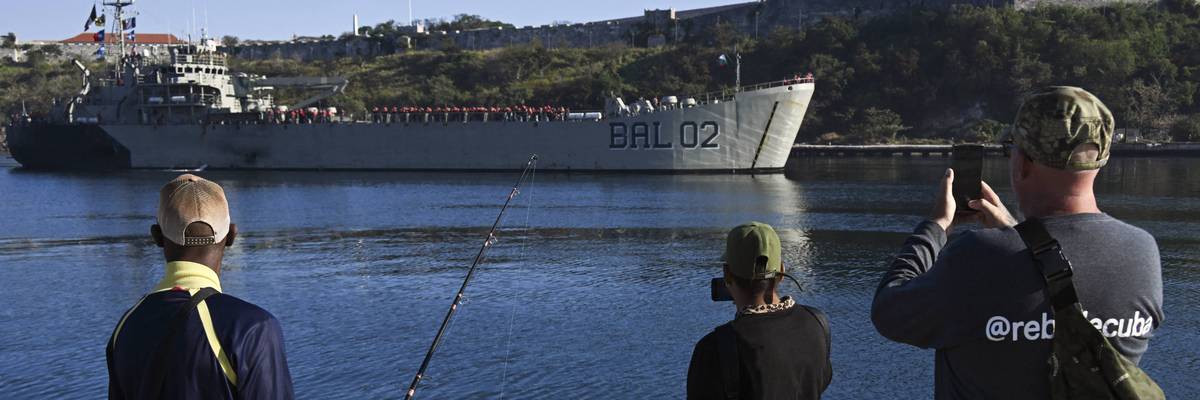
A Mexican Navy ship arrives at Havana Bay with humanitarian aid on February 12, 2026.
The demand came after a group of United Nations experts condemned the embargo as "a serious violation of international law and a grave threat to a democratic and equitable international order."
The United Nations' human rights chief on Friday called on the Trump administration to lift its oil embargo against Cuba as the humanitarian crisis on the island deepens, with fuel shortages disrupting critical functions on the island and food and medicine shortages leaving families desperate for relief.
Marta Hurtado, a spokesperson for UN High Commissioner for Human Rights Volker Türk, said in a statement that "we are extremely worried about Cuba’s deepening socio-economic crisis—amid a decades-long financial and trade embargo, extreme weather events, and the recent US measures restricting oil shipments."
"This is having an increasingly severe impact on the human rights of people in Cuba," Hurtado said. "Given the dependence of health, food, and water systems on imported fossil fuels, the current oil scarcity has put the availability of essential services at risk nationwide. Intensive care units and emergency rooms are compromised, as are the production, delivery, and storage of vaccines, blood products, and other temperature-sensitive medications."
The spokesperson noted that more than 80% of Cuba's water-pumping equipment depends on electricity, which has been undermined by widespread power cuts stemming from fuel shortages.
"The fuel shortage has disrupted the rationing system and the regulated basic food basket, and has affected social protection networks—school feeding, maternity homes, and nursing homes—with the most vulnerable groups being disproportionately impacted," said Hurtado. "Access to essential goods and services, including food, water, medicine, and adequate fuel and electricity, should always be safeguarded, as they are fundamental in modern societies to the right to life and the ability to enjoy many other rights."
In the face of the growing humanitarian catastrophe, Turk "reiterates his call on all states to lift unilateral sectoral measures, given their broad and indiscriminate impact on the population," Hurtado said.
"Policy goals cannot justify actions that in themselves violate human rights," she added.
The US has been economically suffocating Cuba for decades, but the Trump administration intensified the assault last month by cutting the island off from its primary source of oil—Venezuela—and threatening to slap tariffs on countries that send fuel to the beleaguered Caribbean nation, which has long been in the crosshairs of Secretary of State Marco Rubio and other right-wing supporters of regime change.
"Cuba is ready to fall," US President Donald Trump declared in early January after his administration kidnapped Venezuelan President Nicolás Maduro.
In a statement on Thursday, a group of UN human rights experts said that Trump's January 29 executive order imposing a fuel blockade on Cuba represents "a serious violation of international law and a grave threat to a democratic and equitable international order."
“It is an extreme form of unilateral economic coercion with extraterritorial effects, through which the United States seeks to exert coercion on the sovereign state of Cuba and compel other sovereign third States to alter their lawful commercial relations, under threat of punitive trade measures,” the experts said. "A democratic international order cannot be reconciled with practices whereby one State claims the authority to dictate the internal policies and economic relations of others through threats and coercion."
Dear Common Dreams reader, It’s been nearly 30 years since I co-founded Common Dreams with my late wife, Lina Newhouser. We had the radical notion that journalism should serve the public good, not corporate profits. It was clear to us from the outset what it would take to build such a project. No paid advertisements. No corporate sponsors. No millionaire publisher telling us what to think or do. Many people said we wouldn't last a year, but we proved those doubters wrong. Together with a tremendous team of journalists and dedicated staff, we built an independent media outlet free from the constraints of profits and corporate control. Our mission has always been simple: To inform. To inspire. To ignite change for the common good. Building Common Dreams was not easy. Our survival was never guaranteed. When you take on the most powerful forces—Wall Street greed, fossil fuel industry destruction, Big Tech lobbyists, and uber-rich oligarchs who have spent billions upon billions rigging the economy and democracy in their favor—the only bulwark you have is supporters who believe in your work. But here’s the urgent message from me today. It's never been this bad out there. And it's never been this hard to keep us going. At the very moment Common Dreams is most needed, the threats we face are intensifying. We need your support now more than ever. We don't accept corporate advertising and never will. We don't have a paywall because we don't think people should be blocked from critical news based on their ability to pay. Everything we do is funded by the donations of readers like you. When everyone does the little they can afford, we are strong. But if that support retreats or dries up, so do we. Will you donate now to make sure Common Dreams not only survives but thrives? —Craig Brown, Co-founder |
The United Nations' human rights chief on Friday called on the Trump administration to lift its oil embargo against Cuba as the humanitarian crisis on the island deepens, with fuel shortages disrupting critical functions on the island and food and medicine shortages leaving families desperate for relief.
Marta Hurtado, a spokesperson for UN High Commissioner for Human Rights Volker Türk, said in a statement that "we are extremely worried about Cuba’s deepening socio-economic crisis—amid a decades-long financial and trade embargo, extreme weather events, and the recent US measures restricting oil shipments."
"This is having an increasingly severe impact on the human rights of people in Cuba," Hurtado said. "Given the dependence of health, food, and water systems on imported fossil fuels, the current oil scarcity has put the availability of essential services at risk nationwide. Intensive care units and emergency rooms are compromised, as are the production, delivery, and storage of vaccines, blood products, and other temperature-sensitive medications."
The spokesperson noted that more than 80% of Cuba's water-pumping equipment depends on electricity, which has been undermined by widespread power cuts stemming from fuel shortages.
"The fuel shortage has disrupted the rationing system and the regulated basic food basket, and has affected social protection networks—school feeding, maternity homes, and nursing homes—with the most vulnerable groups being disproportionately impacted," said Hurtado. "Access to essential goods and services, including food, water, medicine, and adequate fuel and electricity, should always be safeguarded, as they are fundamental in modern societies to the right to life and the ability to enjoy many other rights."
In the face of the growing humanitarian catastrophe, Turk "reiterates his call on all states to lift unilateral sectoral measures, given their broad and indiscriminate impact on the population," Hurtado said.
"Policy goals cannot justify actions that in themselves violate human rights," she added.
The US has been economically suffocating Cuba for decades, but the Trump administration intensified the assault last month by cutting the island off from its primary source of oil—Venezuela—and threatening to slap tariffs on countries that send fuel to the beleaguered Caribbean nation, which has long been in the crosshairs of Secretary of State Marco Rubio and other right-wing supporters of regime change.
"Cuba is ready to fall," US President Donald Trump declared in early January after his administration kidnapped Venezuelan President Nicolás Maduro.
In a statement on Thursday, a group of UN human rights experts said that Trump's January 29 executive order imposing a fuel blockade on Cuba represents "a serious violation of international law and a grave threat to a democratic and equitable international order."
“It is an extreme form of unilateral economic coercion with extraterritorial effects, through which the United States seeks to exert coercion on the sovereign state of Cuba and compel other sovereign third States to alter their lawful commercial relations, under threat of punitive trade measures,” the experts said. "A democratic international order cannot be reconciled with practices whereby one State claims the authority to dictate the internal policies and economic relations of others through threats and coercion."
The United Nations' human rights chief on Friday called on the Trump administration to lift its oil embargo against Cuba as the humanitarian crisis on the island deepens, with fuel shortages disrupting critical functions on the island and food and medicine shortages leaving families desperate for relief.
Marta Hurtado, a spokesperson for UN High Commissioner for Human Rights Volker Türk, said in a statement that "we are extremely worried about Cuba’s deepening socio-economic crisis—amid a decades-long financial and trade embargo, extreme weather events, and the recent US measures restricting oil shipments."
"This is having an increasingly severe impact on the human rights of people in Cuba," Hurtado said. "Given the dependence of health, food, and water systems on imported fossil fuels, the current oil scarcity has put the availability of essential services at risk nationwide. Intensive care units and emergency rooms are compromised, as are the production, delivery, and storage of vaccines, blood products, and other temperature-sensitive medications."
The spokesperson noted that more than 80% of Cuba's water-pumping equipment depends on electricity, which has been undermined by widespread power cuts stemming from fuel shortages.
"The fuel shortage has disrupted the rationing system and the regulated basic food basket, and has affected social protection networks—school feeding, maternity homes, and nursing homes—with the most vulnerable groups being disproportionately impacted," said Hurtado. "Access to essential goods and services, including food, water, medicine, and adequate fuel and electricity, should always be safeguarded, as they are fundamental in modern societies to the right to life and the ability to enjoy many other rights."
In the face of the growing humanitarian catastrophe, Turk "reiterates his call on all states to lift unilateral sectoral measures, given their broad and indiscriminate impact on the population," Hurtado said.
"Policy goals cannot justify actions that in themselves violate human rights," she added.
The US has been economically suffocating Cuba for decades, but the Trump administration intensified the assault last month by cutting the island off from its primary source of oil—Venezuela—and threatening to slap tariffs on countries that send fuel to the beleaguered Caribbean nation, which has long been in the crosshairs of Secretary of State Marco Rubio and other right-wing supporters of regime change.
"Cuba is ready to fall," US President Donald Trump declared in early January after his administration kidnapped Venezuelan President Nicolás Maduro.
In a statement on Thursday, a group of UN human rights experts said that Trump's January 29 executive order imposing a fuel blockade on Cuba represents "a serious violation of international law and a grave threat to a democratic and equitable international order."
“It is an extreme form of unilateral economic coercion with extraterritorial effects, through which the United States seeks to exert coercion on the sovereign state of Cuba and compel other sovereign third States to alter their lawful commercial relations, under threat of punitive trade measures,” the experts said. "A democratic international order cannot be reconciled with practices whereby one State claims the authority to dictate the internal policies and economic relations of others through threats and coercion."