SUBSCRIBE TO OUR FREE NEWSLETTER
Daily news & progressive opinion—funded by the people, not the corporations—delivered straight to your inbox.
5
#000000
#FFFFFF
To donate by check, phone, or other method, see our More Ways to Give page.
Daily news & progressive opinion—funded by the people, not the corporations—delivered straight to your inbox.
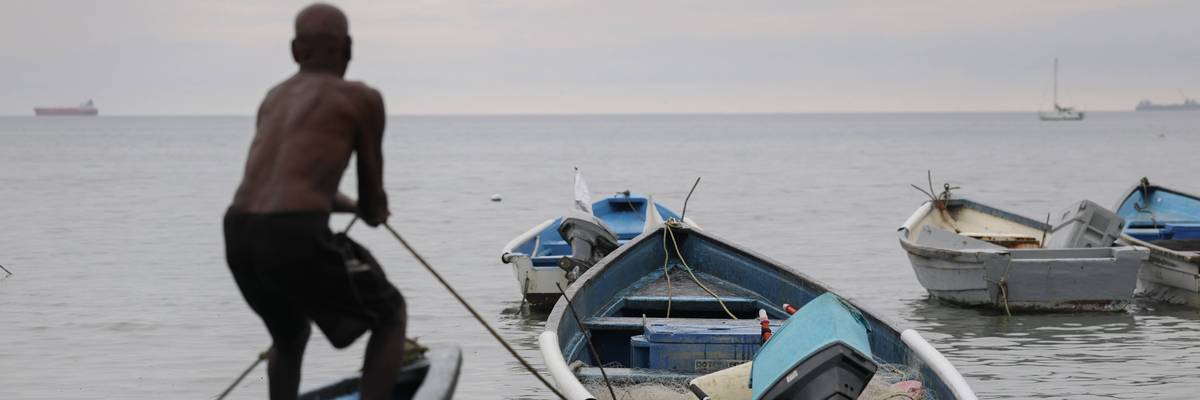
A fisherman moves his fishing boat in a harbor in the Gulf of Paria, an inlet of the Caribbean Sea, on November 4, 2025, in Port of Spain, Trinidad and Tobago.
"When unlawful force is repeated over time, it risks becoming normalized."
The Trump administration's most recent attack on a boat in the Caribbean, which killed four people last week, "highlights a sustained pattern of unlawful use of lethal force outside any context of armed conflict, amounting to extrajudicial executions," Human Rights Watch said on Tuesday.
The US military announced last Wednesday that it had conducted its 47th attack on boats in the Caribbean and eastern Pacific. The Trump administration has presented little evidence for its claim that the targeted boats have been engaged in trafficking drugs to the United States. At least 163 people have been killed in these attacks since September 2025, all of them without trial.
Human Rights Watch is part of a chorus of international organizations and observers that have condemned the boat bombing campaign as acts of murder in flagrant violation of international law.
“These strikes aren’t one-off incidents, they’re part of a pattern of using military force where the law does not permit it, over and over again,” said Sarah Yager, Washington director at Human Rights Watch. “The fact that these strikes have faded from public attention does not make these violations any less grave or unlawful.”
The organization noted that there is no ongoing military conflict in the Caribbean or eastern Pacific that would make those traveling by boat legitimate targets.
And while the US government has provided scant evidence that those it has killed were trafficking drugs, Human Rights Watch said that even if evidence of drug trafficking existed, suspected criminals are still not lawful targets of lethal force unless they pose an imminent threat to the lives of others.
The boat strikes have continued in the background as President Donald Trump has launched attacks against Venezuela and Iran, both of which international organizations have described as acts of aggression that violate the laws of war.
Trump has also enacted a crippling economic blockade of Cuba with the explicit goal of toppling its government so the US can "take" the island, and has previously threatened to use economic leverage or the US military to forcibly annex Greenland.
“When unlawful force is repeated over time, it risks becoming normalized,” Yager said. “That’s dangerous because it opens the door to using lethal force whenever and wherever a government wishes and without constraints.”
Dear Common Dreams reader, It’s been nearly 30 years since I co-founded Common Dreams with my late wife, Lina Newhouser. We had the radical notion that journalism should serve the public good, not corporate profits. It was clear to us from the outset what it would take to build such a project. No paid advertisements. No corporate sponsors. No millionaire publisher telling us what to think or do. Many people said we wouldn't last a year, but we proved those doubters wrong. Together with a tremendous team of journalists and dedicated staff, we built an independent media outlet free from the constraints of profits and corporate control. Our mission has always been simple: To inform. To inspire. To ignite change for the common good. Building Common Dreams was not easy. Our survival was never guaranteed. When you take on the most powerful forces—Wall Street greed, fossil fuel industry destruction, Big Tech lobbyists, and uber-rich oligarchs who have spent billions upon billions rigging the economy and democracy in their favor—the only bulwark you have is supporters who believe in your work. But here’s the urgent message from me today. It's never been this bad out there. And it's never been this hard to keep us going. At the very moment Common Dreams is most needed, the threats we face are intensifying. We need your support now more than ever. We don't accept corporate advertising and never will. We don't have a paywall because we don't think people should be blocked from critical news based on their ability to pay. Everything we do is funded by the donations of readers like you. When everyone does the little they can afford, we are strong. But if that support retreats or dries up, so do we. Will you donate now to make sure Common Dreams not only survives but thrives? —Craig Brown, Co-founder |
The Trump administration's most recent attack on a boat in the Caribbean, which killed four people last week, "highlights a sustained pattern of unlawful use of lethal force outside any context of armed conflict, amounting to extrajudicial executions," Human Rights Watch said on Tuesday.
The US military announced last Wednesday that it had conducted its 47th attack on boats in the Caribbean and eastern Pacific. The Trump administration has presented little evidence for its claim that the targeted boats have been engaged in trafficking drugs to the United States. At least 163 people have been killed in these attacks since September 2025, all of them without trial.
Human Rights Watch is part of a chorus of international organizations and observers that have condemned the boat bombing campaign as acts of murder in flagrant violation of international law.
“These strikes aren’t one-off incidents, they’re part of a pattern of using military force where the law does not permit it, over and over again,” said Sarah Yager, Washington director at Human Rights Watch. “The fact that these strikes have faded from public attention does not make these violations any less grave or unlawful.”
The organization noted that there is no ongoing military conflict in the Caribbean or eastern Pacific that would make those traveling by boat legitimate targets.
And while the US government has provided scant evidence that those it has killed were trafficking drugs, Human Rights Watch said that even if evidence of drug trafficking existed, suspected criminals are still not lawful targets of lethal force unless they pose an imminent threat to the lives of others.
The boat strikes have continued in the background as President Donald Trump has launched attacks against Venezuela and Iran, both of which international organizations have described as acts of aggression that violate the laws of war.
Trump has also enacted a crippling economic blockade of Cuba with the explicit goal of toppling its government so the US can "take" the island, and has previously threatened to use economic leverage or the US military to forcibly annex Greenland.
“When unlawful force is repeated over time, it risks becoming normalized,” Yager said. “That’s dangerous because it opens the door to using lethal force whenever and wherever a government wishes and without constraints.”
The Trump administration's most recent attack on a boat in the Caribbean, which killed four people last week, "highlights a sustained pattern of unlawful use of lethal force outside any context of armed conflict, amounting to extrajudicial executions," Human Rights Watch said on Tuesday.
The US military announced last Wednesday that it had conducted its 47th attack on boats in the Caribbean and eastern Pacific. The Trump administration has presented little evidence for its claim that the targeted boats have been engaged in trafficking drugs to the United States. At least 163 people have been killed in these attacks since September 2025, all of them without trial.
Human Rights Watch is part of a chorus of international organizations and observers that have condemned the boat bombing campaign as acts of murder in flagrant violation of international law.
“These strikes aren’t one-off incidents, they’re part of a pattern of using military force where the law does not permit it, over and over again,” said Sarah Yager, Washington director at Human Rights Watch. “The fact that these strikes have faded from public attention does not make these violations any less grave or unlawful.”
The organization noted that there is no ongoing military conflict in the Caribbean or eastern Pacific that would make those traveling by boat legitimate targets.
And while the US government has provided scant evidence that those it has killed were trafficking drugs, Human Rights Watch said that even if evidence of drug trafficking existed, suspected criminals are still not lawful targets of lethal force unless they pose an imminent threat to the lives of others.
The boat strikes have continued in the background as President Donald Trump has launched attacks against Venezuela and Iran, both of which international organizations have described as acts of aggression that violate the laws of war.
Trump has also enacted a crippling economic blockade of Cuba with the explicit goal of toppling its government so the US can "take" the island, and has previously threatened to use economic leverage or the US military to forcibly annex Greenland.
“When unlawful force is repeated over time, it risks becoming normalized,” Yager said. “That’s dangerous because it opens the door to using lethal force whenever and wherever a government wishes and without constraints.”