SUBSCRIBE TO OUR FREE NEWSLETTER
Daily news & progressive opinion—funded by the people, not the corporations—delivered straight to your inbox.
5
#000000
#FFFFFF
To donate by check, phone, or other method, see our More Ways to Give page.

Daily news & progressive opinion—funded by the people, not the corporations—delivered straight to your inbox.
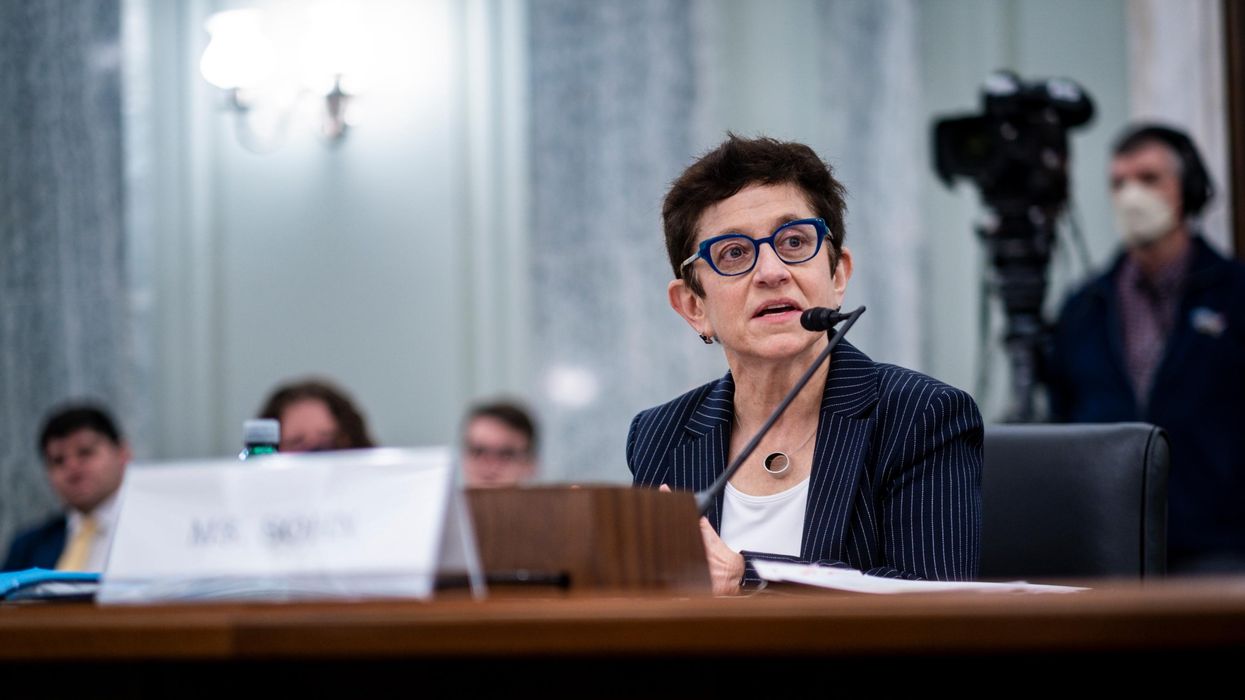
Supporters of Federal Communications Commission nominee Gigi Sohn and other critics of the telecommunications industry's efforts to thwart her U.S. Senate confirmation this week called out not only those behind the smear campaign but also Democratic leaders.
"Dem leadership is nowhere to be found defending their nominee."
The digital rights group Fight for the Future tweeted late Thursday that President Joe Biden and Senate Majority Chuck Schumer (D-N.Y.) promised to restore Obama-era net neutrality rules, of which Sohn was a chief architect.
"But instead they're sitting on the sidelines while Big Telecom mounts a massive dark money-funded smear campaign against their nominee to the FCC, Gigi Sohn," Fight for the Future added. "Where's the leadership? Do what you said you would do."
Fight for the Future director Evan Greer said Thursday that "it is absolutely absurd that millions of people from across the political spectrum fought for and won net neutrality at the FCC."
Ajit Pai, who chaired the FCC during the Trump administration, "repealed it, Dems promised to restore it, and they've so far failed to do so by caving to industry pressure and slow-walking" Sohn's nomination, Greer added.
"The only reason for this is corruption. Plain and simple," she charged, adding that it is a "good time to remember that Comcast, AT&T, Verizon etc. are huge donors to Democratic leadership and candidates. They've got their hands all up in there."
The campaigner also said that while the telecom sector and others--including the Fraternal Order of Police (FOP)--attack Sohn, "Dem leadership is nowhere to be found defending their nominee."
Greer pointed to a piece that Scott Roberts, senior director of criminal justice campaigns for Color of Change, wrote for The Root last year, declaring that the FOP is "one of the largest and most powerful hate groups in the country" and "acts as the guardian, enforcer, and perpetuator" of "racist police culture."
The FOP has openly opposed Sohn, citing her "forceful advocacy of end-to-end encryption and 'user-only-access'" and claiming that her employment history, public policy stances, and social media activity "indicated serious animus towards law enforcement officers and the rule of law."
The FOP on Wednesday released polling it commissioned from Morning Consult, which asked U.S. registered voters various questions, including some about Sohn.
"In the poll, 65% of voters had no opinion on this nominee. But after seeing information and social media posts about her extreme positions on policing issues, 6 in 10 said they would be less likely to support the nomination," said FOP national president Patrick Yoes. "For those who say Ms. Sohn's nomination will impact their vote in the Senate's midterm elections, 60% say they are more likely to vote for a Republican candidate--which is very significant in states like Arizona, Colorado, Georgia, Nevada, and Washington."
Critics framed the FOP polling as part of the ongoing efforts to tank Sohn's nomination.
"The smear campaign against [Sohn] has been beyond ridiculous," said Techdirt founder Mike Masnick. "Everyone who knows anything about her knows that it's pure nonsense, that she's beyond qualified, and that she will do an amazing job."
"The smear merchants are doing it *because* they know she'll do a good job," added Masnick, who was responding on Twitter to similar comments from technology writer Karl Bode.
Bode had tweeted of the FOP polling that "this is part of a manufactured smear campaign being run by AT&T and Comcast against a highly qualified and extremely popular FCC nominee literally everyone in the telecom/media space knows would be great on telecom monopolization, broadband affordability, and media consolidation."
Related Content

Writing for Techdirt on Friday, Bode blasted the FOP's "not-at-all-scientific poll" as well as the "grotesque campaign" by telecom giants to "spread harmful gibberish in a bid to either flip or provide flimsy justification" for right-wing Democratic senators opposing her nomination.
He also wrote:
The Biden team isn't faultless here either. It took the Biden administration nine months to even nominate Sohn, giving the telecom industry... ample time to galvanize opposition. Team Biden also hasn't done anything to defend Sohn publicly, or apply any meaningful pressure on the Senate confirmation voting process. Nor have Sohn's future FCC colleagues voiced any public support, despite the shamelessness of the attacks.
Which, in turn, is fairly reflective of how the federal government doesn't really take stuff like telecom monopolization and telecom consolidation seriously, especially in an era where "Big Tech" has sucked all the oxygen out of the D.C. policy room. And again, this is all occurring in an era when D.C. pretends to be interested in "bipartisan antitrust reform," revealing the hollowness of the gambit.
In a series of tweets Friday, Bode warned that "it is going to be an EXTREMELY long and painful decade if Democratic strategists don't start pulling their heads out of their asses and start displaying something vaguely resembling urgency, passion, and creativity."
"The phony appeal of authoritarianism can only be defeated if the [Democratic National Committee] shakes off corruption and truly represents the public interest," Bode added. "You don't accomplish this by letting a hugely popular media and telecom reformer drown under unopposed GOP/telecom propaganda attacks."
As current and former employees, media colleagues, and labor rights advocates on Thursday celebrated an announcement that MSNBC's workers have decided to form a union, the cable news channel's president made clear that leadership won't voluntarily recognize the effort.
"At a time when journalists and journalism itself are under siege, we want to join our peers who have paved the road before us in standing up for our rights."
--MSNBC bargaining unit
MSNBC is owned by a division of NBCUniversal, which is a subsidiary of Comcast. In a series of tweets, the editorial staff of MSNBC and The Choice--a news channel on the streaming service Peacock--said that over 200 workers have signed a union petition to join the Writers Guild of America, East (WGAE).
"We are organizing to advocate for equal pay for equal work; diversity at every level of production; clear job descriptions and access to career development; a say in the post-Covid-19 workplace; and fair compensation for the hours we all spend to deliver the news," organizers said.
"We are standing up for each other and our work--because this is who we are," organizers added. "After 10 months of organizing, we are asking for voluntary recognition of our union and look forward to constructive negotiations with MSNBC and Comcast for a fair contract. #ThisIsWhoWeAre."
The tweets echoed a lengthy statement from the MSNBC bargaining unit shared by WGAE, which said in part that "at a time when journalists and journalism itself are under siege, we want to join our peers who have paved the road before us in standing up for our rights."
"We are proud that the hard-working newsroom employees at MSNBC decided to unionize with the WGAE," said Lowell Peterson, the union's executive director. "They join thousands of their colleagues in the news and entertainment industries who recognize that collective bargaining is the most effective way to win a voice at work and to build sustainable careers."
WGAE represents about 7,000 workers, including newsrooms at ABC News, Bustle, CBS News, Fast Company, HuffPost, The Intercept, Salon, Slate, VICE, and Vox as well as Gizmodo Media Group and Hearst Magazines.
"We hope and expect MSNBC to remain true to its commitment to progressive values by respecting its employees' decision and recognizing our union promptly."
Rashida Jones, president of MSNBC, said Thursday in a statement to the New York Times that "we're looking forward to continuing the type of direct, open, and honest communication that has already resulted in meaningful change at the network."
In a message to employees that circulated on social media, Jones said that the network will not recognize the union without a secret ballot election supervised by the National Labor Relations Board (NLRB.)
"I respect our employees' right to decide whether they want to be represented by a union, and I believe our employees should be able to make such an important decision through a standard election process," she said.
"An election supervised by the government allows all affected employees the chance to express their view on unionizing through a secret ballot," Jones added. "It is important to give everyone who would be included the chance to understand what this would mean before making their choice."
The Hill noted that "unions have long criticized requests for NLRB secret ballot elections as being designed to give management opportunities to dissuade employees from joining the union."
MSNBC show hosts Chris Hayes and Joy-Ann Reid expressed support for the union effort on Twitter:
Others in the media industry, including former MSNBC employees, highlighted pay concerns among off-camera workers and called the union effort "overdue."
The American Federation of Teachers--the nation's second-largest education union--and the Labor Caucus in the U.S. House of Representatives also expressed support for the organizing at MSNBC:
Andrew Joyce, a segment producer at "The Rachel Maddow Show" who helped lead the MSNBC union effort, told the Times that "we as journalists believe that democracy works, as a nation, state, country, city or in a workplace; things work better when policies are made with input from the people."
The developments came as The New Yorker, Pitchfork, and Ars Technica unions announced that after more than two years of negotiations between the NewsGuild of New York and Conde Nast, they averted a strike and reached an agreement in principle on first contracts.
Congratulating the unions on "accomplishing a groundbreaking agreement that sets new standards for fair compensation, equity, and job security in our industry," president Susan DeCarava said that the NewsGuild of New York "is immensely proud of all that our members have achieved due to their unflinching solidarity and resolve in addressing long-standing inequities at Conde Nast."
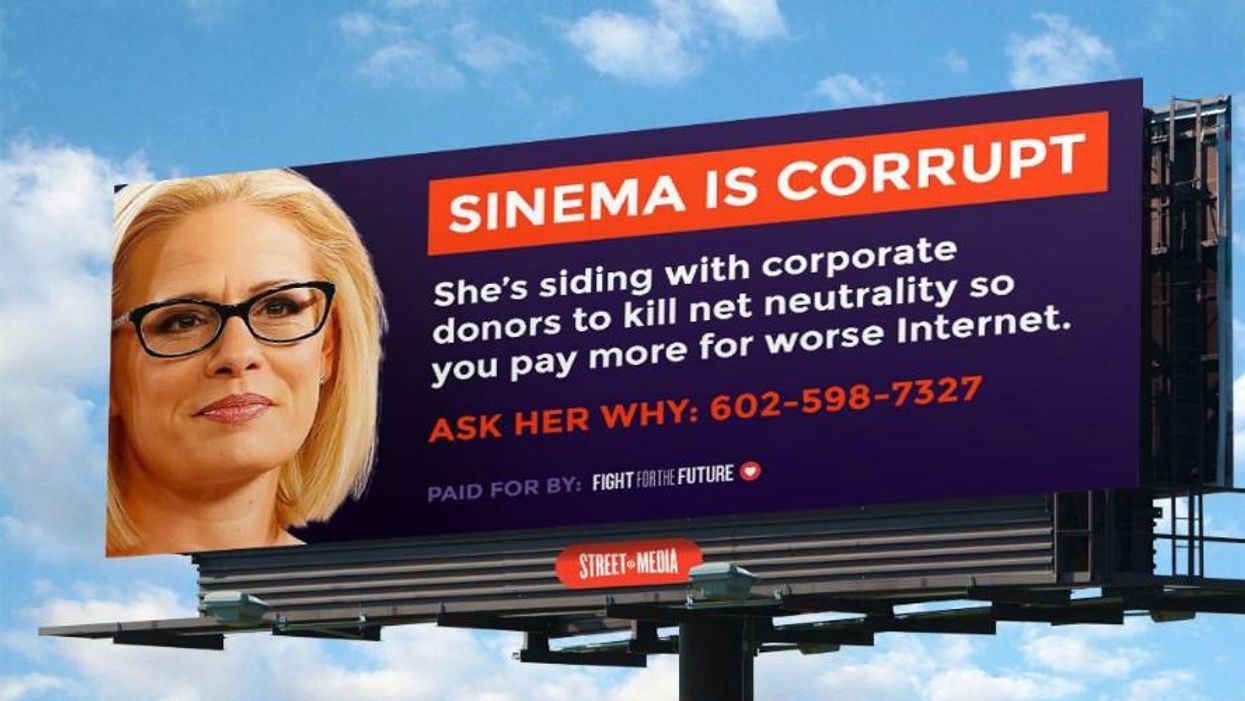
Sen. Kyrsten Sinema, the only Senate Democrat who has not co-sponsored legislation to restore net neutrality, reportedly has financial ties to a super PAC directed by a lobbyist for Comcast, a fervent opponent of open internet protections.
Sludge's Donald Shaw reported Thursday that a possible reason behind Sinema's refusal to join her Democratic colleagues in backing the Save the Internet Act "may be her relationship with a 'dark money' nonprofit called Center Forward that receives substantial funding from cable and telecom industry trade groups and its affiliated super PAC, Center Forward Committee, which is run by a Comcast lobbyist."
"Sinema directed a six-figure donation to Center Forward Committee through a centrist PAC that she used to chair just weeks before the group made big independent expenditures to support Sinema's campaigns," according to Shaw.
"I have zero questions about why Sinema is doing what she's doing. It's all about the money. She could score easy political points with her constituents by supporting net neutrality, but she's made a calculated decision to appease her big cable donors instead."
--Evan Greer, Fight for the Future
Telecom industry lobbying groups have given Center Forward "substantial and consistent donations," Sludge found in a review of tax documents.
Sinema has also benefited from direct campaign contributions from the telecom industry.
"So far this year, Sinema's campaign has received contributions from the PACs of AT&T ($2,000), Verizon ($1,000), and Cox ($2,500), as well as $1,500 from Comcast vice president of federal government affairs Melissa Maxfield," Shaw reported. "She also received $5,000 each from the PACs of Comcast, NCTA, and Charter through her 'Getting Stuff Done' leadership PAC in the second quarter of 2019."
News of Sinema's industry connections came as no surprise to Evan Greer, deputy director of Fight for the Future, a digital rights group that targeted the Arizona Democrat earlier this year over her opposition to the Save the Internet Act.
In March, Fight for the Future crowdfunded a billboard in Phoenix, Arizona that accused Sinema of "siding with corporate donors to kill net neutrality."
"Sinema is arguably the single member of Congress who is carrying the most water for the telecom industry right now and standing in the way of restoring basic net neutrality protections," Greer told Sludge. "By refusing to support the Save the Internet Act she is providing cover for Republicans and kneecapping grassroots efforts to advance legislation that--if we had a functioning democracy--would enjoy widespread bipartisan support."
Greer condemned the bipartisan "net neutrality working group" Sinema formed with Sen. Roger Wicker (R-Miss.) as a "total joke" and "nothing but a smokescreen intended to muddy the waters and confuse the public."
"I have zero questions about why Sinema is doing what she's doing," said Greer. "It's all about the money. She could score easy political points with her constituents by supporting net neutrality, but she's made a calculated decision to appease her big cable donors instead."
The Save the Internet Act, which would reverse the FCC's deeply unpopular 2017 repeal of net neutrality protections, passed the Democrat-controlled House in April with a 232-190 vote. The legislation has stalled in the Senate as Majority Leader Mitch McConnell (R-Ky.) refuses to bring it to the floor.
In a letter to her constituents earlier this year, Sinema attempted to explain her refusal to co-sponsor the Save the Internet Act.
"Regulation of the internet must be done with the utmost care," Sinema wrote, "and reclassifying broadband providers under laws designed in the 1930s for utilities may have serious unintended consequences, including the limitation of certain consumer protections."
Fight for the Future, which obtained the letter in May and published it online, said Sinema's argument "could've been written by Comcast."
They don't get it.
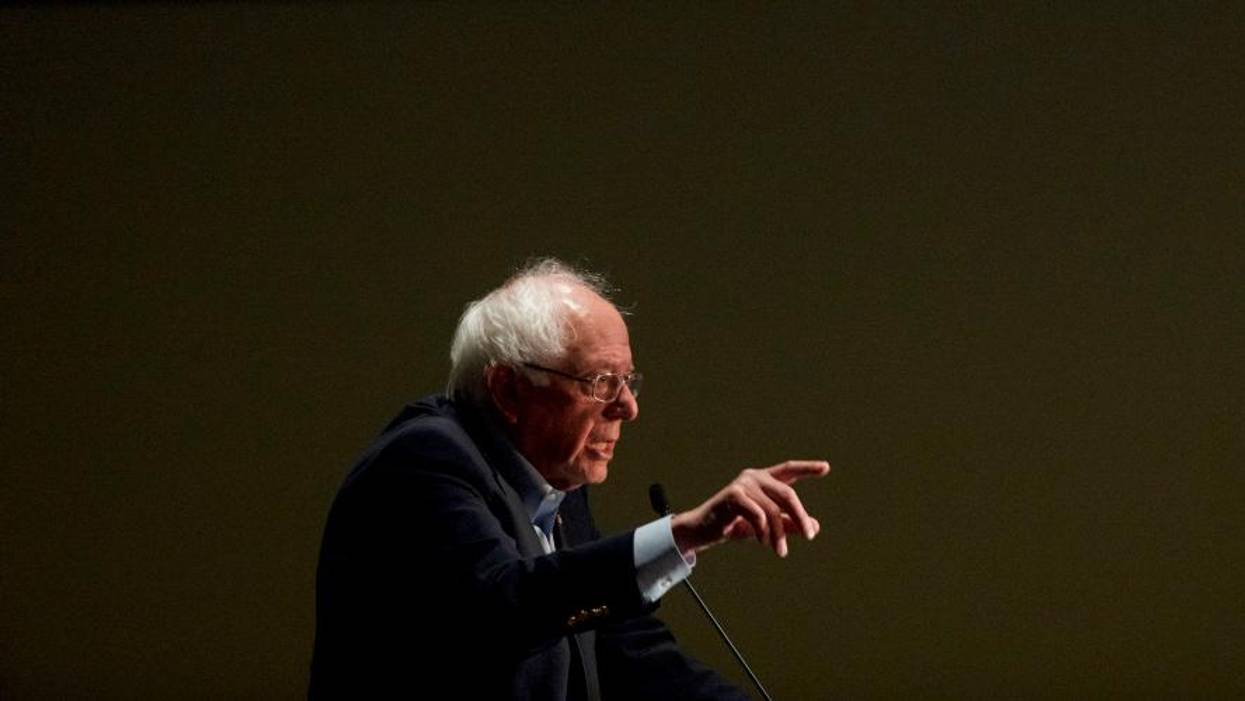
Mainstream journalists routinely ignore the essential core of the Bernie 2020 campaign. As far as they're concerned, when Bernie Sanders talks about the crucial importance of grassroots organizing, he might as well be speaking in tongues.
Frequently using the word "unprecedented"--in phrases like "our unprecedented grassroots effort to take on the powerful special interests and billionaire class"--Sanders emphasizes the vast extent of organizing necessary for him to win the Democratic nomination and the presidency next year. For an extraordinary campaign, that could be attainable. For mainline media, it's virtually inconceivable.
The conformist political reporters are akin to inept topside oceanographers who stay away from the depths while scrutinizing the surface and speculating on future waves. Time and again, the sea changes that come from below take them by surprise.
"While there's a journalistic spirit of tolerance toward Biden on such matters as his vile Senate record of pandering to racism and his more recent indications of openness toward cutting Social Security and Medicare, corporate media are overall far more negative toward what Bernie Sanders has done and continues to advocate."
Four years ago, the media wisdom was that the 2016 Sanders campaign would scarcely get out of single digits. Media savants dismissed him--and the political program that he championed--as fringe. In timeworn fashion, when reporters and pundits made reference to any policy issues, the context was usually horseracing, which is what most campaign coverage boils down to.
Yet policy issues--and the passions they tap into--are central to what propels the Sanders 2020 campaign, along with the powerful fuel of wide recognition that Bernie Sanders has not bent to the winds of expediency. That goes a long way toward explaining the strength of his current campaign.
Sanders has retained the enthusiastic support of a big majority of his delegates to the 2016 Democratic National Convention. Last winter, when more than 400 of those delegates participated in a vote on whether to revive the independent Bernie Delegates Network, 95 percent said yes. (I'm a coordinator of the relaunched network.)
Unlike his "evolving" rivals who have blown hither and yon with political gusts, Sanders is not a wind sock. During 38 years as an elected official, he has remained part of progressive social movements to change the direction of prevailing winds. That orientation continues to inform his approach to elections.
"At the end of the day," Sanders told a New York Times reporter in late April, "I believe now--and I've always believed--that grassroots activism is more important and more effective than 30-second television ads." Such an outlook has been a perplexing concept for many political reporters, who routinely see the bottom-up activism of social movements as distinctly minor compared to the top-down mechanisms and poll-driven strategies that can boost a campaign to victory.
Right now, the conventional media wisdom is gaga over Joe Biden's big lift in national polls since he announced for president a week ago. The former vice president was barely ahead of Sanders in polling before he formally threw his hat in the ring on April 25. The normal upward spike after a major candidate's formal announcement rollout was made spikier by the lavish and largely reverential coverage from the many journalists who seem quite fond of him.
Retrospective looks at his treatment of Anita Hill during the Senate Judiciary Committee confirmation hearings for Clarence Thomas that he chaired in 1991 caused Biden some bad media moments during the last week. But--surprise!--he got little corporate media flak for his high-dollar campaign kickoff fundraiser hosted by top executives at Comcast and Blue Cross, which epitomized his flagrant embrace of corporate power throughout a long political career.
"It is not remarkable in the least for Joe Biden to come right out of the gate by filling his coffers with money from telecom and health insurance executives," Hamilton Nolan wrote for the Guardian. "Who is going to tell him that he shouldn't? The lobbyists advising his campaign? The zillionaire media executives feting him in a Hollywood mansion? The superstructure of Obama administration functionaries who see him as the most established of the establishment brand names? For the people who matter, Joe Biden is doing just what he is expected to do."
As he tries to gain support from liberal voters, Biden is benefiting from the ties that bind him to corporate power. So, he can be grateful that--as the media watch group FAIR has reported--the Comcast-owned MSNBC quickly showed itself to be "in the tank for Joe Biden's presidential run."
It's likely that the Biden balloon will lose altitude as the burst of hot-air publicity fades--and as more information about his actual record comes to wider light. Biden vs. Bernie offers a huge contrast between a corporatist whose biggest constituencies can be found on Wall Street and in corporate media vs. a progressive populist whose biggest constituencies can be found among those being ripped off by Wall Street and discounted by corporate media.
While there's a journalistic spirit of tolerance toward Biden on such matters as his vile Senate record of pandering to racism and his more recent indications of openness toward cutting Social Security and Medicare, corporate media are overall far more negative toward what Bernie Sanders has done and continues to advocate.
For instance, this sentence from the speech that Sanders gave for the launch of his campaign a few weeks ago at Brooklyn College conveys a bit of what is antithetical to the assumptions of many in mainstream media: "Today, we say to the military-industrial-complex that we will not continue to spend $700 billion a year on the military--more than the next 10 nations combined. We're going to invest in affordable housing, we're going to invest in public education, we're going to invest in rebuilding our crumbling infrastructure--not more nuclear weapons and never-ending wars."
And Sanders' next words also went against the grain of mainstream political assumptions. "Brothers and sisters: We're going to win this election not because we have a super PAC funded by billionaires. We're going to win this election because we will put together the strongest grassroots coalition in the history of American politics."
A notable step toward the "unprecedented" goal came last Saturday, when about 5,000 house parties and other gatherings watched a video that featured talks from Sanders and campaign leaders who were both inspirational and practical, encouraging supporters to do methodical outreach in local communities. The process is now being aided by the campaign's just-unveiled organizing app called Bern.
The elite-oriented atmosphere of media aversion to Sanders is in sync with media disregard for the power of community-based activism that could result in a Sanders presidency. For the establishment press corps, the idea of grassroots progressive populism as a pathway to the White House is very strange. But for people who want genuine progressive change, it's the only path.
Joe Biden finally announced on Thursday what everyone already knew. With the release of a three-and-a-half minute promotional video, the former vice president officially threw his name in the ever-expanding ring of Democratic primary contenders seeking to win the opportunity to challenge Donald Trump for the presidency in 2020.
Joe Biden finally announced on Thursday what everyone already knew. With the release of a three-and-a-half minute promotional video, the former vice president officially threw his name in the ever-expanding ring of Democratic primary contenders seeking to win the opportunity to challenge Donald Trump for the presidency in 2020. Biden has already seen his share of coverage, and was the second-most-mentioned Democratic candidate on cable news during the first three months of 2019.
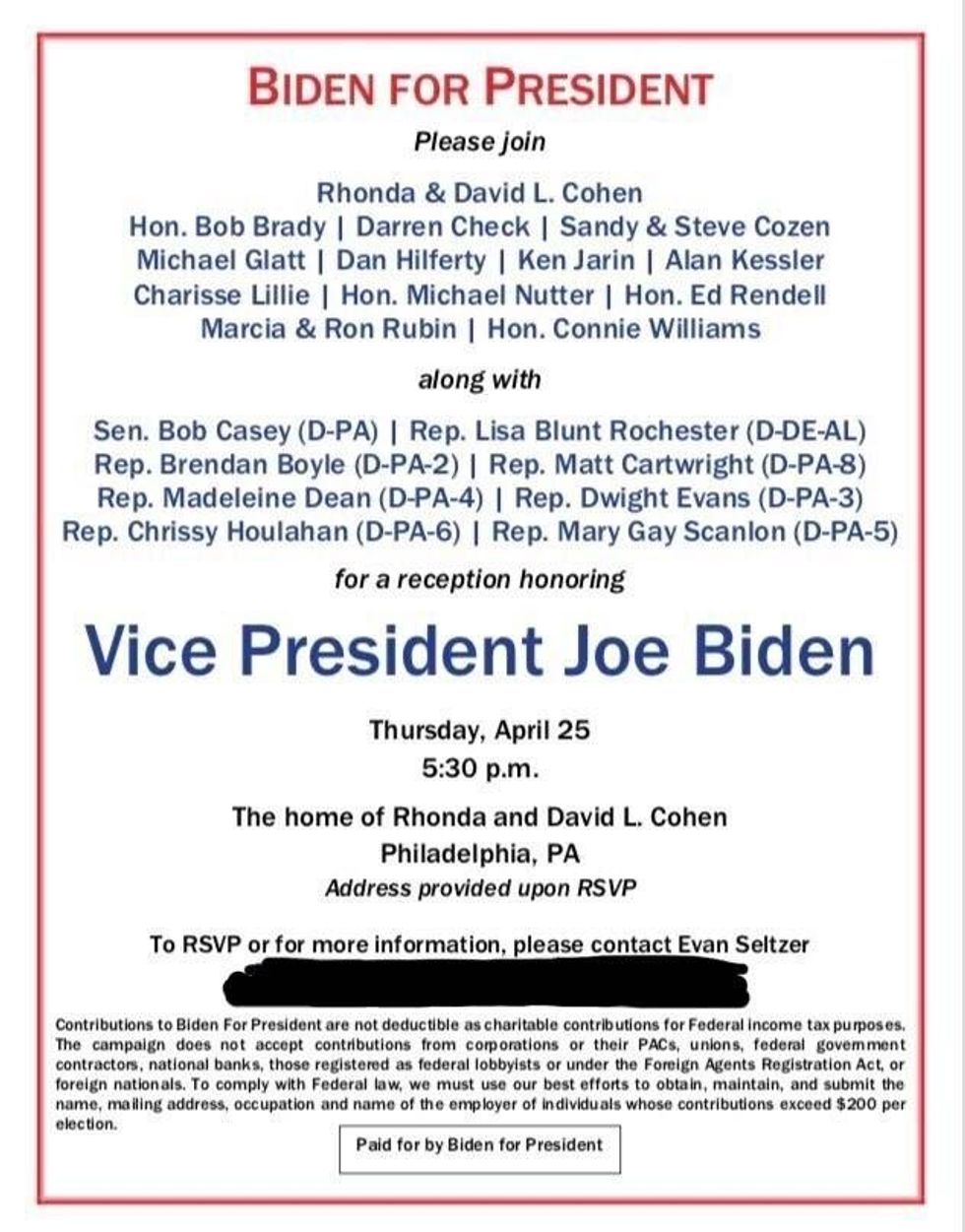
Biden has pledged that his 2020 campaign won't take in any direct donations from lobbyists. But on the first night of his official candidacy, Biden hit the suburbs of Philadelphia to attend a $2,800 per person fundraiser at the home of David L. Cohen, the executive vice president and chief of lobbying for Comcast.
Comcast, one of the biggest lobbying spenders in Washington, also owns MSNBC, which has showered Biden with favorable coverage both before and since his announcement.
In March, Nevada lieutenant gubernatorial candidate Lucy Flores published an article in New York Magazine (3/29/19) that described how Biden inappropriately kissed her at a campaign event. Biden has quite a long history of awkward and inappropriate touching, kissing or groping of women and girls.
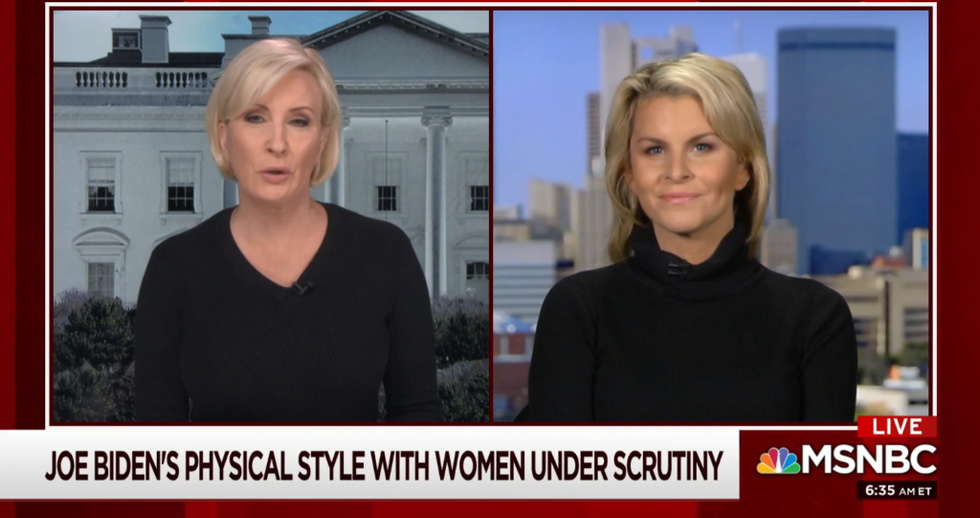
Mika Brzezinski (MSNBC, 4/1/19) defends Biden's "physical style with women" with former DCCC staffer Adrienne Elrod.
Mika Brzezinski, co-host of MSNBC's Morning Joe, was one of the first to defend Biden (4/1/19). Brzezinski suggested that Flores' allegation was politically motivated, citing Flores as a "huge Bernie person," and asking, "Are we just supposed to take all the words and the fact she said she was violated at face value?" Her guests later that day (4/1/19), former DCCC chief of staff Adrienne Elrod and former CIA and DoD chief of staff Jeremy Bash, seemed to agree that such #MeToo accusations against Biden were "meaningless moments," and merely baseless finger-pointing from Biden's political opponents.
Brzezinski continued her defense of Biden the following day and later in the week on Morning Joe, after another woman came forward with allegations of inappropriate behavior (4/2/19, 4/5/19). Brzezinski said that the allegations were "sad," and that Biden is a "nice guy" and "not a predator." She continued:
This is ridiculous. The conversation has gotten out of control, and Democrats and those on the left who want to tweet me today and go nuts and get all woke, you're eating your young. You're eating those who can beat Trump. You're killing the very people who have been pushing women ahead, who've been fighting for equal pay, who have been doing everything they can to respect women in their lives. We're going to after Joe Biden for being affectionate to women of all ages, and to men as well? It's ridiculous.
While he is indeed a frontrunner, defense of Biden as supposedly the only candidate with the ability to beat Trump is frequently parroted by many corporate Democrats (and by totally, definitely well-meaning Republican Party figures as well). MSNBC contributor Mike Barnicle recently re-upped this trope (4/24/19) on the day of Biden's announcement, though to his credit, Axios' Jim Vandehei did push back on this narrative.
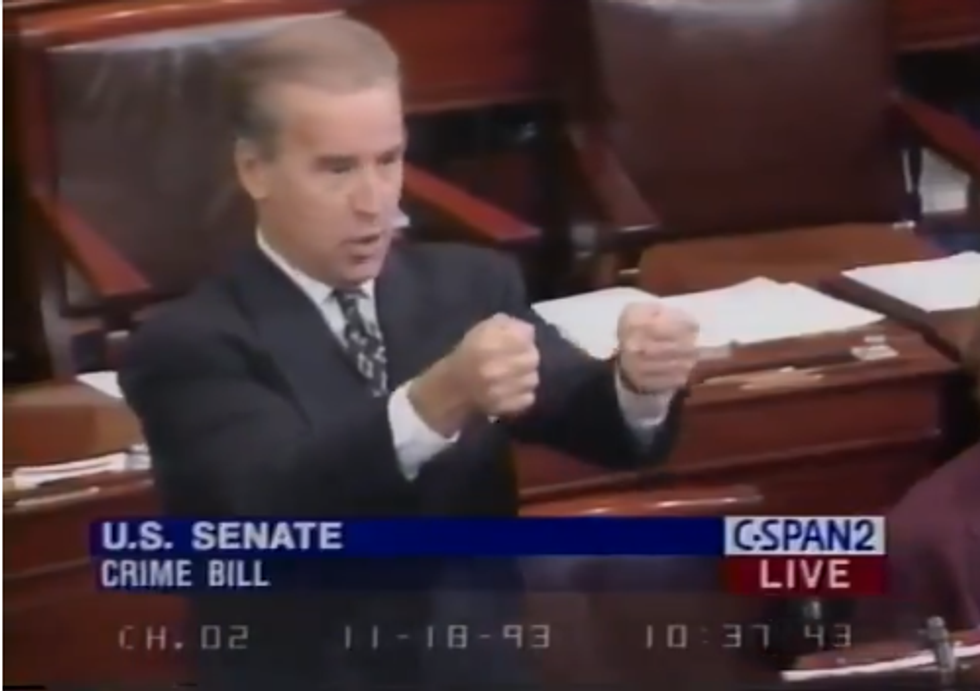
Joe Biden (11/18/93) assures the Senate: "It doesn't matter whether or not they're the victims of society. The end result is they're about to knock my mother on the head with a lead pipe, shoot my sister, beat up my wife, take on my sons."
On another Morning Joe panel (4/26/19), MSNBC correspondent Rev. Al Sharpton criticized Biden's role in drafting and sponsoring the 1984, 1986, 1988 and 1994 crime bills, and his treatment of Anita Hill during the Clarence Thomas confirmation hearings. Biden recently issued a half-apology phone call 28 years after the fact to Hill, who told the New York Times (4/25/19) that the call "left her feeling deeply unsatisfied." (Biden continued to dance around giving a full-throated apology to Hill in an appearance on The View--4/26/19.) But despite Sharpton's misgivings about Biden's history, he maintained that Biden somehow had the "equipment despite the hurdles" to appeal to both "blue collar white workers" and "black and brown communities."
On the same program, Joe Scarborough castigated Biden detractors, maintaining that they failed to understand the context of Biden's past support for harsh drug laws, opposition to school integration and support for the Iraq War. He later added that "it's easy for you to sit there behind your laptop, drinking your soy lattes in 2019 judging [him] for trying to make the country better." Sharpton chimed in with further attacks on so-called "latte liberators" and "limousine liberals."
But despite his folksiness (Extra!, 4/13), if there is anyone who serves the interests of financial giants who spend most of their time in limousines, it's Joe Biden. Since the late 1970s, Biden has been the chief defender of the Delaware-based credit card industry in Congress, and played a crucial role in the passage of the 2005 bankruptcy law, which made it harder for Americans to wipe out and restructure unreasonable debts through Chapter 7 bankruptcy. Indeed, credit card company MBNA (formerly owned by Bank of America) was Biden's second-largest donor throughout his Senate career. When Biden drafted the original version of the bankruptcy bill in 2000, he was strongly opposed by then-Harvard Law professor Elizabeth Warren, who was integral in getting the Clinton administration to block its passage. Biden has also been a consistent supporter of further financial deregulation, such as the Gramm-Bliley-Leach Act, which has been pointed to as a partial cause of the 2008 financial collapse.
Yet Biden's extremely checkered political history, where he was consistently on the wrong sides of issues like women's rights, racial equality, financial regulation, drugs and criminal justice, surveillance, and war, still doesn't seem to be enough for the media to deem him damaged goods. In fact, outlets like MSNBC still play up Biden as the most viable candidate, despite the fact that there are others with similarly long tenures in politics who didn't make Biden's same mistakes.
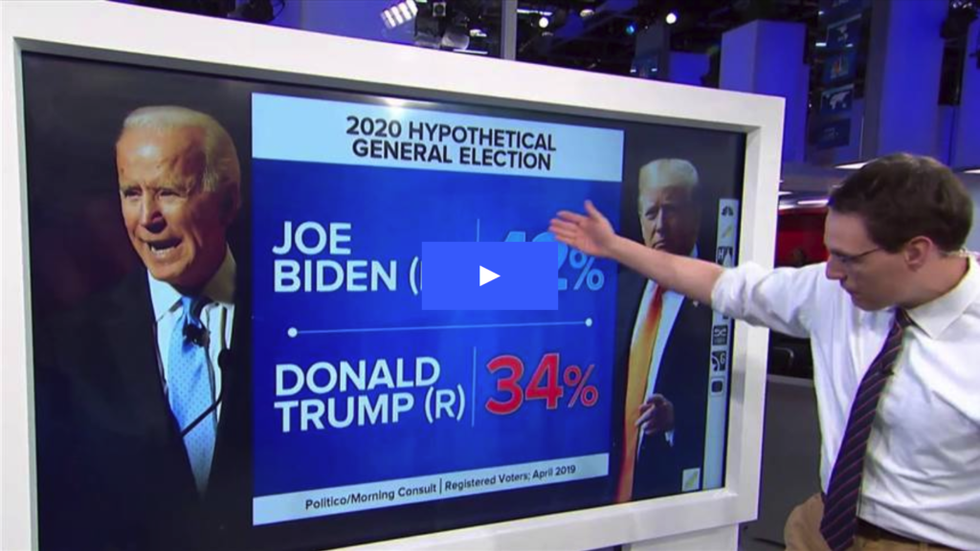
Earlier in the year, Alex Altman came on MSNBC to praise Biden's "electability" (2/21/19), while this week Steve Kornacki devoted a whole segment to prove just how "electable" Joe Biden is for the Democrats in a 2020 matchup against Trump (4/25/19). No other candidate, not even the other front runners, received such a segment from the network.
Indeed, calling Biden the most "electable" candidate is really just code for the most "moderate" or white candidate. Such a designation for Biden discounts the appeal of candidates who are left-wing, female or people of color. In particular, left-wing candidates like Bernie Sanders (the other frontrunner) and Elizabeth Warren are each frequently dogged in corporate media by accusations that they are somehow not "electable" enough.
There is perhaps an underlying logic to these attacks. Warren and Sanders have each called for heightened antitrust regulation. (Amy Klobuchar and Corey Booker have also called for increased antitrust enforcement, but are a bit more tepid on the issue than Sanders and Warren.) Big tech companies, agricultural conglomerates, food and beverage companies, banks and telecom companies like Comcast would surely come under the antitrust microscope and be targeted for breakups if one of these candidates were to win the Democratic nomination. Comcast, in particular, stands out as a major target, considering they have interests in both media content production as well as distribution.
Comcast, along with other internet service providers (ISPs) like Verizon and AT&T, holds what are essentially regional monopolies, where they very rarely directly compete with one another in a given area. As of 2017, almost 80 percent of US households have access to just a single ISP that offers broadband speeds of over 100 Mbps. This has a striking impact on US internet users: The nation has just the 20th fastest average internet speed in the world, and, according to the FCC, US consumers pay more for broadband than most other comparable countries. Of course, ISPs are also famous for their unmatched customer service record-Comcast ranks as one of America's most hated companies year in and year out, along with many other ISPs.
Much of the power of Comcast and other telecom companies to maintain their monopolies can be attributed to the revolving door that shuffles telecom lobbyists in and out of government positions. The current FCC chair, Ajit Pai, is the former general counsel for Verizon, while its past chair, Tom Wheeler, was a longtime telecom industry lobbyist for trade groups with connections to Comcast. Meredeth Attwell Baker, a former FCC commissioner under Obama, joined Comcast just four months after giving the greenlight for Comcast's merger with NBC Universal. The acquisition marked the beginning of other vertical mergers between content distributors and content producers, including AT&T's acquisition of Time Warner, which owns CNN.
During his Senate career, Biden was far from a hawk on antitrust, supporting antitrust exemptions for the soda industry after receiving donations from Coca-Cola. Judging by the Obama administration's extremely lax antitrust approach, a hypothetical Biden administration would follow the same friendly approach towards corporate interests. Biden hasn't stayed away from discussing the issue of antitrust so far in his campaign, but he has remarked that big corporations shouldn't be "singled out." At a speech last year to the Brookings Institution, he remarked, "I don't think 500 billionaires are the reason we're in trouble. The folks at the top aren't bad guys."
Such deference to massive and unpopular corporate monopolies is anathema to both a healthy economy and contrary to the views of most Americans. But potential antitrust targets like Comcast and AT&T have the ability to manufacture positive press for pro-corporate water carriers like Biden through their news properties. Powerful executives like Comcast's David Cohen might not be shooting out daily emails to MSNBC staff ordering them to promote Biden's candidacy, but employees will often gravitate towards what their employers want. After all, they are well aware of who signs the checks.
Likewise, top MSNBC news personalities exist within the same elite circle of Washington insiders that Biden has inhabited for the past 40 years-in just about every one of the aforementioned segments, one host or guest remarked on their personal relationship with Joe Biden. The insider DC cocktail party circuit doesn't contain very many people who want to attack their corporate benefactors.
It's notable that even before its acquisition by Comcast, MSNBC had a history of tacking to the right and a distinct reluctance to challenge entrenched corporate interests. What's more, the network devotes little interest to economic policy, let alone antitrust, preferring to spend most of its time covering Russiagate.
However, this could change. Since entering the race, Biden has been subject to criticism from his left flank, and will likely remain a target. Sanders recently fired shots at Biden in a fundraising email, calling out his fundraiser with Cohen. Warren added to her long history of criticizing Biden by attacking him for his support of banks and credit card companies during the financial crisis.
However, MSNBC has failed to even mention Biden's fundraiser with Cohen. I can't imagine why.
Hours after officially entering the 2020 Democratic presidential field Thursday morning, former Vice President Joe Biden is expected to head to the Philadelphia home of Comcast executive David Cohen for a big-dollar fundraiser that will reportedly be attended by Democratic lawmakers, the CEO of insurance giant Independence Blue Cross, and other high-powered party players.
Biden launched his presidential bid with a video condemning President Donald Trump's response to the 2017 neo-Nazi rally in Charlottesville and calling the 2020 election "a battle for the soul of this nation."
"The core values of this nation, our standing in the world, our very democracy, everything that has made America America is at stake," Biden said. "That's why today I'm announcing my candidacy for president of the United States."
As Politico reported on the eve of Biden's 2020 announcement, the former vice president "raised the alarm about fundraising" in a conference call with top donors, expressing the need to have a big first-day haul.
"The money's important," Biden reportedly said during the call, according to a anonymous participant who recounted the remarks to Politico. "We're going to be judged by what we can do in the first 24 hours, the first week."
While Biden has vowed to join most other 2020 Democratic candidates in rejecting campaign contributions from lobbyists, HuffPost's Kevin Robillard pointed out that Biden's planned fundraiser with corporate executives Thursday evening "shows the limitations of such a pledge."
Though Cohen is technically not a registered lobbyist, he directs Comcast's lobbying operations--a distinction that critics said allows him to skirt federal lobbying regulations.
According to the Philadelphia Business Journal, "Cohen sent an email to potential contributors Wednesday soliciting donations of $2,800, the maximum federal primary contribution for the event."
Politico first published the invitation for the large-dollar fundraiser:
As Sludge's Donald Shaw reported, Comcast "has been a leading voice in the telecommunication industry's efforts to oppose net neutrality rules, spending millions on lobbying against laws at the federal and state levels that would prohibit internet service providers (ISPs) from giving priority treatment to certain types of traffic."
"In 2006, when he was a senator from Delaware serving on the Judiciary Committee, Biden said that he did not think net neutrality rules were needed," Shaw noted.
The list of executives and other wealthy donors expected to attend Biden's first fundraiser as a 2020 presidential candidate sparked concern:
While Biden clearly joins the crowded race with top name recognition, the status as the last-serving Democratic vice president, and the frontrunner in most national polling, it has been widely noted that he also begins his third campaign for the presidency--he ran unsuccessfully in both 1988 and 2008--with an enormous amount of political baggage.
As columnist Jim Newell detailed at Slate on Thursday:
Biden's biggest challenge in the primary will be a compromised past spanning nearly 50 years. The vetting process he'll face in the Democratic Party of 2019 will not be even close to the vetting he faced during his last campaign in 2008--and, let's face it, as a middling-to-lower-tier candidate then, he didn't face much vetting at all. The crime bill that he authored in 1994 is considered by the modern iteration of the party to have been an embarrassment, as is his handling of the Clarence Thomas Supreme Court nomination. Some of his anti-busing rhetoric from the 1970s was, even by the standards of 1970s anti-busing rhetoric, astonishing. As a senator who for 36 years represented Delaware, a small fiefdom run by banks, his economic record has more than a few blemishes, such as his support for the 2005 bankruptcy reform bill, one of the slimiest pieces of legislation passed this century. In the first presidential primary since 2004 where past votes regarding the Iraq war shouldn't be an issue among major candidates, simply because it was so long ago, there's Joe Biden, with a vote for the Iraq War on his record.
The size of the field is a representation of the candidates' belief that all of this will sink Biden, unlocking the tentative support of roughly one-third of the party for the taking. The field's bet on Biden's fallibility is now shared among the punditry too. Everything Biden does will be interpreted through the same knowing lens that he's out of his element and it's a pity no one was able to dissuade him from launching this last, egotistical crusade. That was the interpretation when, in his first public appearance after allegations of inappropriate touching, he cracked a couple of jokes about how he had gotten permission to give hugs. Even the delay in his launch this week prompted another round of head-shaking, when his initial plan to kick off the campaign on Wednesday in Charlottesville, Virginia, followed by a couple of rallies in Pennsylvania, was scrapped.
Biden's campaign launch comes as most early polls show the former vice president with a slight lead over Sen. Bernie Sanders (I-Vt.) for the Democratic nomination.
The former vice president addressed the allegations of inappropriate touching in a video earlier this month, vowing to "be more mindful and respectful of people's personal space" in the future.
"That's my responsibility and I will meet it," Biden said.
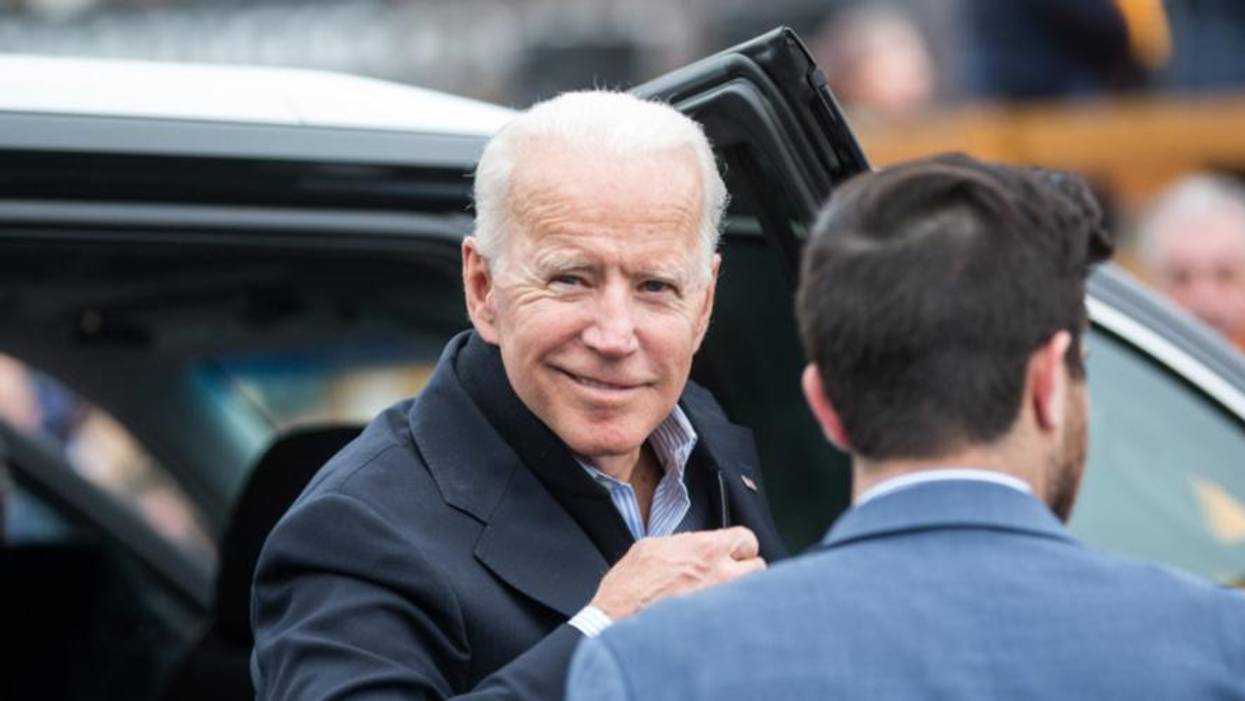
Let's be blunt: As a supposed friend of American workers, Joe Biden is a phony. And now that he's running for president, Biden's huge task is to hide his phoniness.
From the outset, with dim prospects from small donors, the Biden campaign is depending on big checks from the rich and corporate elites who greatly appreciate his services rendered. "He must rely heavily, at least at first, upon an old-fashioned network of money bundlers--political insiders, former ambassadors and business executives," the New York Times reported on Tuesday.
Biden has a media image that exudes down-to-earth caring and advocacy for regular folks. But his actual record is a very different story.
During the 1970s, in his first Senate term, Biden spouted white backlash rhetoric, used tropes pandering to racism and teamed up with arch segregationists against measures like busing for school integration. He went on to be a fount of racially charged appeals and "predators on our streets" oratory on the Senate floor as he led the successful effort to pass the now-notorious 1994 crime bill.
"Joe Biden has arrived as a presidential candidate to rescue the Democratic Party from Bernie Sanders."
A gavel in Biden's hand repeatedly proved to be dangerous. In 1991, as chair of the Judiciary Committee, Biden prevented key witnesses from testifying to corroborate Anita Hill's accusations of sexual harassment during the Clarence Thomas confirmation hearings for the Supreme Court. In 2002, as chair of the Foreign Relations Committee, Biden was the Senate's most crucial supporter of the Iraq invasion.
Meanwhile, for well over four decades--while corporate media preened his image as "Lunch Bucket Joe" fighting for the middle class--Biden continued his assist for strengthening oligarchy as a powerful champion of legalizing corporate plunder on a mind-boggling scale.
Now, Joe Biden has arrived as a presidential candidate to rescue the Democratic Party from Bernie Sanders.
Urgency is in the media air. Last week, the New York Times told readers that "Stop Sanders" Democrats were "agonizing over his momentum." The story was front-page news. At the Washington Post, a two-sentence headline appeared just above a nice photo of Biden: "Far-Left Policies Will Drive a 2020 Defeat, Centrist Democrats Fear. So They're Floating Alternatives."
Biden is the most reliable alternative for corporate America. He has what Sanders completely lacks--vast experience as an elected official serving the interests of credit-card companies, big banks, insurance firms and other parts of the financial services industry. His alignment with corporate interests has been comprehensive. It was a fulcrum of his entire political career when, in 1993, Sen. Biden voted yes while most Democrats in Congress voted against NAFTA.
In recent months, from his pro-corporate vantage point, Biden has been taking potshots at the progressive populism of Bernie Sanders. At a gathering in Alabama last fall, Biden said: "Guys, the wealthy are as patriotic as the poor. I know Bernie doesn't like me saying that, but they are." Later, Biden elaborated on the theme when he told an audience at the Brookings Institution, "I don't think five hundred billionaires are the reason we're in trouble. The folks at the top aren't bad guys."
Overall, in sharp contrast to the longstanding and continuing negative coverage of Sanders, mainstream media treatment of Biden often borders on reverential. The affection from so many high-profile political journalists toward Biden emerged yet again a few weeks ago during the uproar about his persistent pattern of intrusively touching women and girls. During one cable news show after another, reporters and pundits were at pains to emphasize his essential decency and fine qualities.
But lately, some independent-minded journalists have been exhuming what "Lunch Bucket Joe" is eager to keep buried. For instance:
One of Biden's illuminating actions came last year in Michigan when he gave a speech--for a fee of $200,000 including "travel allowance"--that praised the local Republican congressman, Fred Upton, just three weeks before the mid-term election. From the podium, the former vice president lauded Upton as "one of the finest guys I've ever worked with." For good measure, Biden refused to endorse Upton's Democratic opponent, who went on to lose by less than 5 percent.
"Indications of being a 'moderate' and a 'centrist' play well with the Washington press corps and corporate media, but amount to a surefire way to undermine enthusiasm and voter turnout from the base of the Democratic Party."
Biden likes to present himself as a protector of the elderly. Campaigning for Sen. Bill Nelson in Florida last autumn, Biden denounced Republicans for aiming to "cut Social Security, Medicare and Medicaid." Yet five months earlier, speaking to the Brookings Institution on May 8, Biden spoke favorably of means testing that would go a long way toward damaging political support for Social Security and Medicare and smoothing the way for such cuts.
Indications of being a "moderate" and a "centrist" play well with the Washington press corps and corporate media, but amount to a surefire way to undermine enthusiasm and voter turnout from the base of the Democratic Party. The consequences have been catastrophic, and the danger of the party's deference to corporate power looms ahead. Much touted by the same kind of insular punditry that insisted Hillary Clinton was an ideal candidate to defeat Donald Trump, the ostensible "electability" of Joe Biden has been refuted by careful analysis of data.
As a former Sanders delegate to the 2016 Democratic National Convention and a current coordinator of the relaunched independent Bernie Delegates Network for 2019, I remain convinced that the media meme about choosing between strong progressive commitments and capacity to defeat Trump is a false choice. On the contrary, Biden exemplifies a disastrous approach of jettisoning progressive principles and failing to provide a progressive populist alternative to right-wing populism. That's the history of 2016. It should not be repeated.
With a full House vote on the Save the Internet Act scheduled for Tuesday, open internet campaigners urged members of the public to call their representatives to demand they pass the bill cleanly--without any telecom-friendly amendments attached--to restore net neutrality.
"Any lawmaker who doesn't want to invoke the wrath of their constituents should vote for its clean passage on the House floor."
--Evan Greer, Fight for the Future
"Despite the terrible decision from Trump-appointed FCC Chairman Ajit Pai--a former Verizon lawyer--it's clear that people all across the political spectrum want net neutrality," wrote Mary Alice Crim, field director for Free Press Action. "But we'll win only if all of us take action and contact our reps. Are you in? Could you make a call today--and help make history?"
"Call your rep at 202-751-4622. Tell your lawmaker to pass the Save the Internet Act with no loopholes," Crim added. "This legislation would restore real net neutrality protections."
The Save the Internet Act needs at least 218 votes to pass the House. As of this writing, the bill has 197 co-sponsors in the House.
"Call your freakin reps," tweeted digital rights group Fight for the Future.
The vote comes after the legislation cleared two crucial committee hurdles unscathed, despite the GOP's last-minute attempts to ram through telecom-friendly amendments that would have gutted the legislation.
"Telecom lobbyists should just give up now. Despite ISP giants like Comcast, Verizon, and AT&T spending hundreds of millions of dollars on lobbying, misinformation campaigns, and buying influence through campaign contributions, they've failed to fool the public and efforts to restore net neutrality are moving forward," Evan Greer, deputy director of Fight for the Future, said after the Save the Internet Act passed out of the House Energy and Commerce Committee last week.
In an effort to replicate its recent success livestreaming committee hearings on net neutrality--which attracted hundreds of thousands of viewers--Fight for the Future is planning to livestream the House vote to ensure that lawmakers know the internet is watching:
According to a Comparitech survey published last month, 80 percent of the U.S. public--including 77 percent of Republicans--support net neutrality protections.
"The overwhelming majority of voters from across the political spectrum want Congress to do their jobs and restore these basic protections that never should have been taken away in the first place," Greer said. "The Save the Internet Act would do exactly that, and any lawmaker who doesn't want to invoke the wrath of their constituents should vote for its clean passage on the House floor."
Defending Net Neutrality in the media is like an endless game of Whack-a-Mole.
So many Op-Eds and letters to the editor that oppose the Save the Internet Act are written by people with financial ties to the broadband industry. And far too few of these ties are disclosed in the media.
Time to get the hammer!
The latest mole to emerge takes the form of a misleading letter to the editor in the New York Times. Its author is Ev Ehrlich, who's affiliated with the ESC Company and the so-called Progressive Policy Institute. But you wouldn't know that from reading his letter in the Times, as neither he nor the newspaper acknowledges these ties.
It's a concerning oversight because both of these organizations have financial relationships with the phone and cable lobby, which is doing whatever it can to torpedo the Save the Internet Act.
In Ehrlich's 2015 letter to the editor, the Times partially disclosed as much, noting in his bio that he "is president of ESC Company, an economics consulting firm that has telecom clients."
But it doesn't disclose his affiliation with the Progressive Policy Institute, which as part of the nonprofit Third Way Foundation has received five- and six-figure contributions from the major trade associations representing AT&T, Comcast, Verizon and other large firms.
And the misinformation doesn't end at nondisclosure. In his new letter, Ehrlich claims that the Save the Internet Act isn't bipartisan.
That all depends on your viewpoint.
It's true that on Capitol Hill, only Democrats -- so far -- support the bill. But if you turn around and face the rest of the country, you're seeing something entirely different.
Public polling shows overwhelming bipartisan support for the Save the Internet Act's legal approach. A 2018 University of Maryland poll found that 86 percent of voters opposed the FCC's repeal of the Title II Net Neutrality rules, including 82 percent of Republicans and 90 percent of Democrats.
If Republican members of Congress were genuinely interested in being bipartisan, they'd follow the good counsel of their constituents and support the Save the Internet Act.
At the moment, however, they and Ehrlich are looking the wrong way: toward the broadband industry and its checkbook and not the people of the United States.
Ehrlich also claims that a so-called "light touch approach" is to credit for the alleged "gusher" of investment and innovation across the sector. In this, he's echoing much of the anti-Net Neutrality rhetoric emanating from the Trump FCC, and Chairman Ajit Pai in particular.
Ehrlich wants you to think that Net Neutrality rules have had the opposite effect -- that they turned off the investment spigot. This is far from the truth, as we at Free Press Action have demonstrated time and again, and again, and again.
To cap it off, Ehrlich suggests that support for the Save the Internet Act is merely a ploy from advocates like Free Press Action -- that we're just trying to stir up hysteria and raise more money from our base.
That last doozy is a laugh when you compare the modest budget of an organization like ours to the hundreds of millions of dollars the phone and cable lobby spends on campaign contributions, lobbyists, lawyers, think tanks and PR firms.
This industry money has turned far too many decision-makers in Washington against the interests of the people they're supposed to represent, people who support Net Neutrality in large numbers.
And it's money that's also found its way into Ehrlich's bank account -- inspiring today's shady letter to the editor at the New York Times.
Whack!
The House Communications and Technology Subcommittee Tuesday passed the Save the Internet Act and overcame the telecom industry's last-minute efforts to gut the bill--all as more than 300,000 internet users watched the proceedings throughout the day.
"Politicians are slowly learning that they can't get away with shilling for big telecom anymore."
--Evan Greer, Fight for the Future
"So many people were watching an obscure subcommittee hearing on the Save the Net Act today that it broke the counter," tweeted the digital rights group Fight for the Future.
The subcommittee vote came as major websites, individual internet users, and online communities all spread the livestream of the hearing across the web to stop telecom-backed lawmakers from weakening the Save the Internet Act.
"The eruption of grassroots support had an impact, and the bill passed the subcommittee vote without issue," Fight for the Future, which spearheaded the online campaign, said in a statement. "In the end, only one amendment was introduced, and it was withdrawn after pushback from the majority, emboldened by the swell in activism."
Evan Greer, deputy director of Fight for the Future, told Vice that online attention on the hearing "really emboldened the Democrats and shored up the ones that were wobbling."
The Save the Internet Act, "unscathed" by telecom amendments, now heads to the House Energy and Commerce Committee before reaching the full House for a vote as early as next month. If passed, the legislation would fully restore the net neutrality protections repealed by the Republican-controlled FCC in 2017.
" Net neutrality is coming back with a vengeance," Evan Greer, deputy director of Fight for the Future, said in a statement. "Politicians are slowly learning that they can't get away with shilling for big telecom anymore. We're harnessing the power of the internet to save it, and any lawmaker who stands in our way will soon face the wrath of their constituents."
In a statement, Candace Clement--campaign director at Free Press Action--applauded the House subcommittee for "taking the first step toward restoring net neutrality."
"Support for this bill is growing every day, and it's easy to see why," Clement said.
According to Comparitech poll released last week, 80 percent of Americans--including 77 percent of Republicans--support net neutrality protections.
"Companies like Comcast, of course, don't care about any of that. Industry lobbyists are resorting to their usual tricks to torpedo this bill," Clement said. "We thank the subcommittee majority for rejecting any industry-friendly amendments that might have undermined the Save the Internet Act, and we call on lawmakers to keep listening to their constituents and moving a clean bill forward."