

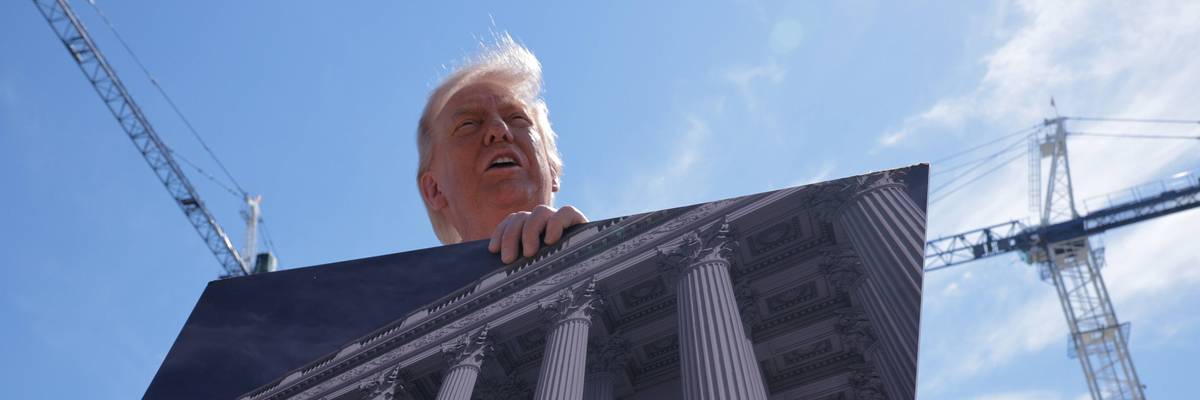
US President Donald Trump holds artists' renderings as he talks to reporters about his proposed White House ballroom next to the worksite on May 19, 2026 in Washington, DC.
'Pay-to-Play Loyalty Program': Trump Ballroom Donors Have Been Handed $50 Billion in Federal Contracts
"Corporations wrote big checks to build Trump’s golden ballroom," said Rep. Jason Crow. "Now they’re receiving billions of dollars in kickbacks—paid for by your tax dollars."
Sen. Elizabeth Warren suggested President Donald Trump is running a "pay-to-play loyalty program for wealthy donors" after a report on Thursday revealed that more than half the companies that contributed to his White House ballroom project have been awarded government contracts over the last six months, totaling over $50 billion.
Examining the 27 publicly known corporate donors to the president’s $400 million gold-plated vanity project, the watchdog group Public Citizen found that 14 of them—more than half—had received either new or expanded contracts over the past six months after donating millions to the ballroom and appearing at a lavish White House banquet in October as Trump prepared to demolish the building's East Wing.
Over two-thirds, 19 of the 27 companies, received government contracts since fiscal year 2021, totaling over $338 billion. At least 16 out of 27 are also either facing federal enforcement actions and/or have had them suspended by the Trump administration.
“These giant corporations aren’t funding the Trump ballroom fiasco out of the goodness of their hearts. They have massive interests before the federal government, and they hope to curry favor with, and receive favorable treatment from, the Trump administration,” said Public Citizen democracy advocate Jon Golinger, an author of the report.
By far the biggest monetary beneficiary has been the military contractor Lockheed Martin, which received a $43.8 billion in new or expanded contract funding over the past six months after it pledged $10 million to fund the dance hall last fall.
Booz Allen Hamilton, a consulting company that serves military and intelligence agencies and pledged at least $5 million to the project, received $4 billion in contracts over the same period.
Meanwhile, Palantir—the data-mining surveillance giant with deep ties to the Trump administration—reaped over $1 billion in contracts after giving its own $5 million donation.
"Millions to fund Trump’s bizarre fever dreams are nothing compared to the billions they’re getting back in contracts and favorable government enforcement decisions," Golinger said. "The American people are paying the price.”
Other ballroom benefactors that have brought in more than $100 million worth of contracts over the past six months include Microsoft, Amazon, HP, and Caterpillar, while T-Mobile, Google, NextEra Energy, and Comcast have all brought in more than $10 million.
Public Citizen noted that while the White House has publicized some of the ballroom donors and others have been revealed by news organizations, not all of the companies that have contributed to the project are publicly known, since the secret funding agreement obtained by the group through a Freedom of Information Act request allows their identities to remain private.
In a statement to The Washington Post, White House spokesperson Davis Ingle suggested that critics should be grateful that Trump was soliciting donations from the wealthy for this very important undertaking.
“The same critics who are alleging fake conflicts of interest would also complain if American taxpayers were footing the bill for these long-overdue renovations,” he said, ignoring the fact that Trump has previously pressured Republicans in Congress to appropriate hundreds of millions in taxpayer funding to secure the ballroom.
Ingle added that “the donors for the White House ballroom project represent a wide array of great American companies and generous individuals, all of whom are contributing to make the People’s House better for generations to come.”
But several Democratic members of Congress have pointed to it as evidence of Trump selling out the government "to the highest bidder."
“Corporations wrote big checks to build Trump’s golden ballroom,” said Rep. Jason Crow (D-Col.). “Now they’re receiving billions of dollars in kickbacks—paid for by your tax dollars.”
“Wild coincidence or taxpayer-funded corruption?” said Sen. Chris Van Hollen (D-Md.). “You be the judge.”
Rep. Mike Levin (D-Calif.) said that “the part that should make your blood boil” is the fact that many of the companies identified in the report “were facing federal enforcement actions, antitrust reviews, labor cases, [or] securities charges.”
"Many of those cases have been quietly dropped or scaled back since Trump took office. You write a check, your legal problems disappear," Levin said. "That’s not a coincidence."
“You cannot afford to donate to Trump’s ballroom, so he does nothing to improve the quality of your life,” said Sen. Adam Schiff (D-Calif.). “But for those who can, there are billions in government contracts.”
We are at a crossroads
This country and this world are at a monumental crossroads. In a few short weeks, US voters will have an opportunity to beat back the forces of fascism and confront the billionaires who are rigging the economy, our media system, and our democracy, making it increasingly impossible for ordinary people to get by. We’re not just talking about the election. We’re talking about what must be done once these fascist elements are vanquished from power. We need a bolder set of solutions than what either major party has so far been willing to offer and a working-class movement ready to fight like hell for it. Trump didn't emerge from nowhere. The conditions that fueled MAGA authoritarianism were created by decades of radical neoliberal economic policies and a corrupt political system dominated by corporate interests. They slashed taxes on the super-rich, promising that the benefits would trickle down. They said giveaways to the corporate titans would make life more affordable for the rest of us. It was all bullshit. And when a bitter, betrayed populace searches for someone to blame, right-wing demagogues have little trouble finding scapegoats. People know when they're being lied to, but you won't hear any of this from the corporate media. Only independent journalism—powered and funded by people who believe in building a better world—can deliver truly trustworthy daily news. Our Fall Campaign is underway, and we need your help. To power our newsroom through the rest of the year, we need to raise $125,000 by midnight on October 31. So if you share our vision, please contribute whatever you can to sustain our work. |
Sen. Elizabeth Warren suggested President Donald Trump is running a "pay-to-play loyalty program for wealthy donors" after a report on Thursday revealed that more than half the companies that contributed to his White House ballroom project have been awarded government contracts over the last six months, totaling over $50 billion.
Examining the 27 publicly known corporate donors to the president’s $400 million gold-plated vanity project, the watchdog group Public Citizen found that 14 of them—more than half—had received either new or expanded contracts over the past six months after donating millions to the ballroom and appearing at a lavish White House banquet in October as Trump prepared to demolish the building's East Wing.
Over two-thirds, 19 of the 27 companies, received government contracts since fiscal year 2021, totaling over $338 billion. At least 16 out of 27 are also either facing federal enforcement actions and/or have had them suspended by the Trump administration.
“These giant corporations aren’t funding the Trump ballroom fiasco out of the goodness of their hearts. They have massive interests before the federal government, and they hope to curry favor with, and receive favorable treatment from, the Trump administration,” said Public Citizen democracy advocate Jon Golinger, an author of the report.
By far the biggest monetary beneficiary has been the military contractor Lockheed Martin, which received a $43.8 billion in new or expanded contract funding over the past six months after it pledged $10 million to fund the dance hall last fall.
Booz Allen Hamilton, a consulting company that serves military and intelligence agencies and pledged at least $5 million to the project, received $4 billion in contracts over the same period.
Meanwhile, Palantir—the data-mining surveillance giant with deep ties to the Trump administration—reaped over $1 billion in contracts after giving its own $5 million donation.
"Millions to fund Trump’s bizarre fever dreams are nothing compared to the billions they’re getting back in contracts and favorable government enforcement decisions," Golinger said. "The American people are paying the price.”
Other ballroom benefactors that have brought in more than $100 million worth of contracts over the past six months include Microsoft, Amazon, HP, and Caterpillar, while T-Mobile, Google, NextEra Energy, and Comcast have all brought in more than $10 million.
Public Citizen noted that while the White House has publicized some of the ballroom donors and others have been revealed by news organizations, not all of the companies that have contributed to the project are publicly known, since the secret funding agreement obtained by the group through a Freedom of Information Act request allows their identities to remain private.
In a statement to The Washington Post, White House spokesperson Davis Ingle suggested that critics should be grateful that Trump was soliciting donations from the wealthy for this very important undertaking.
“The same critics who are alleging fake conflicts of interest would also complain if American taxpayers were footing the bill for these long-overdue renovations,” he said, ignoring the fact that Trump has previously pressured Republicans in Congress to appropriate hundreds of millions in taxpayer funding to secure the ballroom.
Ingle added that “the donors for the White House ballroom project represent a wide array of great American companies and generous individuals, all of whom are contributing to make the People’s House better for generations to come.”
But several Democratic members of Congress have pointed to it as evidence of Trump selling out the government "to the highest bidder."
“Corporations wrote big checks to build Trump’s golden ballroom,” said Rep. Jason Crow (D-Col.). “Now they’re receiving billions of dollars in kickbacks—paid for by your tax dollars.”
“Wild coincidence or taxpayer-funded corruption?” said Sen. Chris Van Hollen (D-Md.). “You be the judge.”
Rep. Mike Levin (D-Calif.) said that “the part that should make your blood boil” is the fact that many of the companies identified in the report “were facing federal enforcement actions, antitrust reviews, labor cases, [or] securities charges.”
"Many of those cases have been quietly dropped or scaled back since Trump took office. You write a check, your legal problems disappear," Levin said. "That’s not a coincidence."
“You cannot afford to donate to Trump’s ballroom, so he does nothing to improve the quality of your life,” said Sen. Adam Schiff (D-Calif.). “But for those who can, there are billions in government contracts.”
Sen. Elizabeth Warren suggested President Donald Trump is running a "pay-to-play loyalty program for wealthy donors" after a report on Thursday revealed that more than half the companies that contributed to his White House ballroom project have been awarded government contracts over the last six months, totaling over $50 billion.
Examining the 27 publicly known corporate donors to the president’s $400 million gold-plated vanity project, the watchdog group Public Citizen found that 14 of them—more than half—had received either new or expanded contracts over the past six months after donating millions to the ballroom and appearing at a lavish White House banquet in October as Trump prepared to demolish the building's East Wing.
Over two-thirds, 19 of the 27 companies, received government contracts since fiscal year 2021, totaling over $338 billion. At least 16 out of 27 are also either facing federal enforcement actions and/or have had them suspended by the Trump administration.
“These giant corporations aren’t funding the Trump ballroom fiasco out of the goodness of their hearts. They have massive interests before the federal government, and they hope to curry favor with, and receive favorable treatment from, the Trump administration,” said Public Citizen democracy advocate Jon Golinger, an author of the report.
By far the biggest monetary beneficiary has been the military contractor Lockheed Martin, which received a $43.8 billion in new or expanded contract funding over the past six months after it pledged $10 million to fund the dance hall last fall.
Booz Allen Hamilton, a consulting company that serves military and intelligence agencies and pledged at least $5 million to the project, received $4 billion in contracts over the same period.
Meanwhile, Palantir—the data-mining surveillance giant with deep ties to the Trump administration—reaped over $1 billion in contracts after giving its own $5 million donation.
"Millions to fund Trump’s bizarre fever dreams are nothing compared to the billions they’re getting back in contracts and favorable government enforcement decisions," Golinger said. "The American people are paying the price.”
Other ballroom benefactors that have brought in more than $100 million worth of contracts over the past six months include Microsoft, Amazon, HP, and Caterpillar, while T-Mobile, Google, NextEra Energy, and Comcast have all brought in more than $10 million.
Public Citizen noted that while the White House has publicized some of the ballroom donors and others have been revealed by news organizations, not all of the companies that have contributed to the project are publicly known, since the secret funding agreement obtained by the group through a Freedom of Information Act request allows their identities to remain private.
In a statement to The Washington Post, White House spokesperson Davis Ingle suggested that critics should be grateful that Trump was soliciting donations from the wealthy for this very important undertaking.
“The same critics who are alleging fake conflicts of interest would also complain if American taxpayers were footing the bill for these long-overdue renovations,” he said, ignoring the fact that Trump has previously pressured Republicans in Congress to appropriate hundreds of millions in taxpayer funding to secure the ballroom.
Ingle added that “the donors for the White House ballroom project represent a wide array of great American companies and generous individuals, all of whom are contributing to make the People’s House better for generations to come.”
But several Democratic members of Congress have pointed to it as evidence of Trump selling out the government "to the highest bidder."
“Corporations wrote big checks to build Trump’s golden ballroom,” said Rep. Jason Crow (D-Col.). “Now they’re receiving billions of dollars in kickbacks—paid for by your tax dollars.”
“Wild coincidence or taxpayer-funded corruption?” said Sen. Chris Van Hollen (D-Md.). “You be the judge.”
Rep. Mike Levin (D-Calif.) said that “the part that should make your blood boil” is the fact that many of the companies identified in the report “were facing federal enforcement actions, antitrust reviews, labor cases, [or] securities charges.”
"Many of those cases have been quietly dropped or scaled back since Trump took office. You write a check, your legal problems disappear," Levin said. "That’s not a coincidence."
“You cannot afford to donate to Trump’s ballroom, so he does nothing to improve the quality of your life,” said Sen. Adam Schiff (D-Calif.). “But for those who can, there are billions in government contracts.”