

SUBSCRIBE TO OUR FREE NEWSLETTER
Daily news & progressive opinion—funded by the people, not the corporations—delivered straight to your inbox.
5
#000000
#FFFFFF
To donate by check, phone, or other method, see our More Ways to Give page.
Daily news & progressive opinion—funded by the people, not the corporations—delivered straight to your inbox.

"It looks like the paraquat maker has adopted nearly every strategy we outlined in our book about bending science," said one author and former EPA legal adviser.
Internal documents published Friday by The Guardian and The New Lede shed new light on how multinational chemical giant Syngenta worked to conceal the link between its popular pesticide paraquat and Parkinson's disease.
According to the internal documents, Syngenta sought to "create an international scientific consensus against the hypothesis that paraquat is a risk factor for Parkinson's disease," in part by launching what company officials called a "SWAT team" to counter research that could threaten the corporation's "freedom to sell" the pesticide.
"It looks like the paraquat maker has adopted nearly every strategy we outlined in our book about bending science," Thomas McGarity, a former U.S. Environmental Protection Agency legal adviser and co-author of the 2008 book Bending Science: How Special Interests Corrupt Public Health Research, told The Guardian.
"Science matters. We have to be able to depend on science," McGarity added. "When it is perverted, when it is manipulated, then we get bad results. And one result is that pesticides that cause terrible things like Parkinson's remain on the market."
While a 2006 study found that rats administered paraquat exhibited neural degeneration similar to Parkinson's, a definitive link between paraquat and Parkinson's disease was discovered in 2011, when National Institutes of Health researchers concluded that the brain disorder is "positively associated" with the pesticide. A 2013 paper published in the peer-reviewed journal Neurology found that exposure to paraquat roughly doubled the risk of developing Parkinson's. In 2020, four of the world's leading neurologists published a book citing paraquat as a cause of Parkinson's.
More than 50 countries have banned paraquat, including Brazil, China, and the United Kingdom. The European Union has also banned the pesticide.
Syngenta argues that the evidence showing paraquat causes Parkinson's is "fragmentary and insufficient to establish" a link between the pesticide and the brain disorder.
"Recent thorough reviews performed by the most advanced and science-based regulatory authorities, including the United States and Australia, continue to support the view that paraquat is safe," the company told The Guardian for an October 2022 article showing internal Syngenta documents confirmed that corporate officials worried about the pesticide's link to Parkinson's.
However, as The Guardian reports in the new article:
The scientific record [Syngenta points] to as proof of paraquat's safety is the same one that Syngenta officials, scientists, and lawyers in the U.S. and the U.K. have worked over decades to create and at times, covertly manipulate...
The files reveal an array of tactics, including enlisting a prominent U.K. scientist and other outside researchers who authored scientific literature that did not disclose any involvement with Syngenta; misleading regulators about the existence of unfavorable research conducted by its own scientists; and engaging lawyers to review and suggest edits for scientific reports in ways that downplayed worrisome findings.
McGarity also said that when he worked at the EPA, pesticide lobbyists were known as "hall crawlers" for their incessant efforts to influence government officials.
Additionally, a revolving door between the chemical industry and government at all levels, from EPA bureaucrats all the way up to the Supreme Court—Justice Clarence Thomas is a former Monsanto attorney who refused to recuse himself from a case involving his former employer—helps corporations conceal the harms caused by their products.
In 2021, a coalition of groups sued the EPA over its decision to renew its approval of paraquat.
The new documents were published amid a raft of over 2,000 product liability lawsuits filed by farmers and others against Syngenta and Chevron, paraquat's former distributor. The first federal bellwether paraquat trial is set to begin in October.
Despite the abundance of scientific studies documenting the rapid and dangerous decline of pollinator populations, state and federal lawmakers have yet to pass any meaningful protections for bees.
The reason, according to the findings of a new investigation, is that pesticide giants such as Bayer, Monsanto, and Syngenta have deployed an aggressive lobbying campaign to dilute and suppress attempts to regulate their multi-billion dollar industry--with great success.
Published by environmental watchdog Friends of the Earth, the report (pdf) exposes "how the pesticide industry has weakened and delayed pesticide reforms and is shaping new pollinator 'protection' plans nationwide that do little to protect bees, but a lot to protect industry profits."
The agrochemical industry has spent hundreds of thousands of dollars on state and federal lobbying efforts, which the report says have effectively pushed lawmakers to pass so-called "pollinator protection plans" that "lack metrics to measure effectiveness, improvement, or failure" and often "provide more protections for pesticides and pesticide users than for bee keepers and bee colonies."
What's more, the ever-present "revolving door" between the public and private sector has allowed the pesticide industry to "infiltrate" regulatory agencies. "In hundreds of documented cases, employees of the U.S. Department of Agriculture and the Environmental Protection Agency have shuffled between regulatory agencies and companies including Bayer, Syngenta and Monsanto," the study notes.
The pesticide industry has peddled influence in other ways, as well. By cultivating strategic partnerships with public agencies and academic groups, and by funding science and education initiatives, Big Biotech supports research efforts that sow doubt about the extent of their products' toxic impact.
"Pesticide companies are successfully pulling the wool over the eyes of our policy makers, which has resulted in a patchwork of initiatives by our state and federal government to that do little to curb or restrict pesticides," said Tiffany Finck-Haynes, food futures campaigner with Friends of the Earth.
"Our government is giving more weight to the pesticide industry than to protecting bees, beekeepers, our food supply and environment," Finck-Haynes added. "It is critical for policymakers to stand up for the long-term health of our food system, not the short-term profits of companies that manufacture a leading cause of bee declines."
To spread public awareness about how bee colony collapse is threatening the nation's food supply--and the role that chemicals play in their demise--a truck driven by Minnesota beekeeper James Cook is currently hauling 2.5 million dead bees across the country.
The Keep Hives Alive tour, organized by Friends of the Earth and other advocacy groups, will make stops in South Dakota, Minnesota, Michigan, Pennsylvania, and North Carolina before reaching its final destination in Washington D.C., for a rally outside the U.S. Environmental Protection Agency on June 22-23.
"It's far past time for the EPA to take urgent action to halt the use of bee-killing pesticides," said Jeff Anderson, owner of Minnesota Honey Farms. "We hope that this dramatic presentation will raise awareness of this urgent problem."
Many consumers and food activists use social media platforms to stay informed and engage in important debates about the future of our food system. But increasing corporate influence in these spaces requires us to differentiate fact from spin as we encounter hundreds of posts and tweets per day. Big Ag's attempts to shape social media debates expose its fear of criticism from a growing food movement demanding corporate transparency, regulation, and sustainable alternatives to industrial agriculture. With 284 million monthly active users, Twitter has become a battleground for Big Ag's credibility.
Half of social media users share news stories and discuss current events on social media, and all of the "Big Six" agribusiness companies--Bayer, BASF, Dow, Syngenta, DuPont, and Monsanto--maintain active social media presences. Searching for terms like GMO, agriculture, or farming on Twitter yields thousands of tweets from the Big Six. While I knew agribusiness companies used PR campaigns, I became more acutely aware of their social media tactics through an exchange I had with Bayer CropScience (@Bayer4Crops). It began when Bayer tweeted a UN Food and Agriculture Organization video on the impact of food waste:
I tweeted back that if we could stop wasting one third of food, the focus on increasing yields with biotech would become even less defensible:
I thought that would be the end of the interaction: a big company tweeted something, and I replied as a concerned citizen. To my surprise, @Bayer4Crops not only responded to me personally, but, as I describe below, engaged in a multi-pronged attempt to change my mind--or at least the minds of others who might encounter our tweets.
Bayer's reaction reflects an economic reality: with Big Ag's bottom line at stake, public perception matters. Monsanto, for instance, reported sales of $2.87 billion in the quarter ending November 30, 2014, alone. Agribusiness sales require a regulatory environment allowing GM foods and crops on the market, as well as the widespread application of pesticide, herbicide, and synthetic fertilizer. As consumers, farmers, and voters question the safety and necessity of these products and methods, Big Ag is waging a fight for credibility on multiple fronts.
While in theory social media platforms like Twitter provide a democratic forum--anyone with internet access can tweet anyone else--they are still subject to the distortions of financial influence. In the face of corporate attempts to manipulate discussion, tweets may rise to prominence because they offer new, compelling information--or because groups with vested interests pour significant resources into making tweets appear authoritative.
Big Ag's assault on social media reveals an anti-democratic push to stifle informed debate and quash individual criticisms before they gain traction in the court of public opinion. Indeed, Big Ag, including Bayer, manipulates social media exchanges with a variety of obfuscating tactics: moving critics to corporate-controlled internet forums; downplaying the implications of the GMO debate; claiming they're doing humanitarian (as opposed to profit-seeking) work that is either vilified or misunderstood; green-washing their image by appropriating activist language; and intentionally sowing doubt about the credibility of anyone who questions the safety of GMOs or industrial agriculture.
Tactic #1: Take the conversation off Twitter and into a biotech-controlled forum
As Gary Ruskin outlines in Seedy Business: What Big Food is hiding with its slick PR campaign on GMOs, a new report published by the nonprofit US Right to Know, Big Ag companies have hired public relations firms like Ketchum and Fleishman Hillard to mitigate criticism with industry-created websites. For instance, the American Farm Bureau Federation reports that its PR firm "seeks out negative tweets on Twitter" relating to biotech and then directs the authors of those tweets to a website called GMOAnswers.com. Funding for the site comes from The Council for Biotechnology Information, which includes the Big Six. The Farm Bureau reports that since launching its Twitter campaign last year, "there's been about an 80 percent reduction in negative Twitter traffic as it relates to GMOs."
Sure enough, in my exchange with Bayer, @Bayer4Crops tweeted back to encourage me to join the discussion in the company's online forum.
Tactic #2: Downplay what's at stake
Moving to the corporate forum would have taken me out of the searchable free-for-all of Twitter and into a Bayer-moderated space. But more than that, Bayer's invitation to discuss implies that our fundamental disagreement about the impacts of industrial agriculture--with potentially life-altering consequences for humans and the biosphere--can be resolved through a friendly chat.
Monsanto uses the same strategy of minimization in its recent controversial ad set to appear in Oprah's O Magazine. The ad shows smiling people sitting down to share a healthy and bountiful meal with the tag line "Grab a seat and let's dig in: The best dinners are the ones with lively conversation." The ad implies that organic and industrial practices can coexist, and the conflicts between Big Ag and its detractors are no more fraught than a spirited dinner conversation. In fact, there are irreconcilable contradictions between the approaches in question that preclude collaboration. Unlike biotech/chemical methods that seek to subjugate nature and human welfare to profit, organic agroecology works with nature to rebuild soil--and communities--over generations.
What's really at stake is nothing less than our democracy: whether producers and consumers have meaningful control over shaping our own food and agriculture systems, a concept known around the world as food sovereignty. Big Ag methods extract more from the soil--and the communities that work the soil--than they return. Industrial agriculture relies on mechanization, monoculture, pesticide, herbicide, fossil-fuel intensive synthetic fertilizer, and patented seed. These methods deplete the soil and favor large corporate farms, while putting small farmers into debt--or pushing them off their land entirely.
There are viable alternatives to Big Ag: small-scale, biodiverse, agroecological systems have the potential to produce safe, quality food in sufficient volume to feed the world. What's really at stake is a robust debate examining the root causes of hunger and the full range of solutions, as well as the human and environmental impacts of those solutions. That's not a trivial subject to relegate to casual speculation in the private sphere. The debate should take place publicly, in policymaking spaces, without the manipulative tactics of agribusiness lobbyists and PR firms.
Tactic #3: Pretend you're just misunderstood
Big Ag ads like Monsanto's imply that critics are misinformed or worse, lashing out at companies' valuable efforts to solve global hunger. In my exchange with @Bayer4Crops, I asserted that the GMO production model starts from an inaccurate premise of hunger caused by scarcity rather than poverty and inequality. In response, the Bayer tweeter feigned surprise, implying that I had misunderstood, or even willfully misrepresented, the company's real interests.
Bayer may, in fact, be "very committed" to helping farmers use their proprietary products. But alleviating poverty and inequality requires addressing inequitable access to wealth, resources, and food system decisions--i.e., political solutions--not a one-size-fits-all model of techno-fixes. Bayer's tweet sidesteps the complexity of the issue and the scope of systemic change required to support farmers, while asserting a benign humanitarian goal.
Tactic #4: Green-wash language and assert a common interest
In addition to asserting (false) alliances with small farmers, Big Ag hopes to coopt grassroots causes. If everyone appears to be fighting hunger and promoting sustainability, consumers see no reason for protest, which recasts the conflicting players as needing to work together.
In this spirit of false alliance, BASF--whose work diametrically opposes Food First's support of agroecology and food sovereignty--tweeted a Food First link, making it seem as though they share common cause in the fight against hunger:
In another example of green-washing and false alliance, Monsanto recently released a YouTube video narrated by Jerry Hayes, titled "How Monsanto Helps Keep the Bees Buzzin'." Hayes says "it takes all of us working together" to protect honeybees, which have been "impacted negatively by...pests, predators, and diseases," as well as by climate change. Hayes implies that individual citizens planting bee-attracting flowers in their backyards have the same responsibility and impact as Monsanto, which sells neonicotinoid-treated seeds. He never mentions the primary concern with regard to bee populations, colony collapse disorder, which is tied to using neonicotinoids (manufactured by Bayer and Syngenta and used on Monsanto seed). Thus the video argues that Monsanto cares about the environment, too, but banning these chemicals isn't the solution; rather, ordinary citizens have to step up and do their part.
One of the video's many unaddressed weaknesses includes blaming climate change for decimating bee populations without acknowledging that industrial agriculture is a leading contributor to climate change. But passing the buck helps Monsanto assert a common interest with its detractors: Monsanto and environmentalists united against climate change! Blaming external forces also opens the market for profitable pseudo-solutions, like proprietary drought-tolerant GMO seeds.
Similarly, when I pointed out the connection between biotech and monoculture, @Bayer4Crops asserted Bayer shared my point of view, as evidenced by its "Respect the Rotation" initiative:
Promoting the rotation of enormous GMO monocultures, and rotating the chemicals sprayed on them, in no way indicates a "shared view." The lead image on Bayer's Respect the Rotation page shows a large-scale, chemical-intensive monoculture--not the sustainable, diversified farming systems to which I was referring.
During the course of this exchange @Bayer4Crops also followed me on Twitter. When I tweeted that Bayer did not share my point of view, @Bayer4Crops unfollowed me and deleted its "Respect the Rotation" tweet.
Tactic #5: Sow doubt
PR campaigns like "Respect the Rotation" want consumers to question criticism of agribusiness: If Bayer promotes crop rotation, then is industrial agriculture really so bad? Doesn't crop rotation demonstrate a commitment to sustainability? Indeed, "sustainability" is subject to a wide range of definitions.
In December 2014, for instance, BASF hosted a Sustainable Brands conference in New Jersey, and BASF participates in other "sustainability" conferences around the globe. Again, though BASF's products are inherently unsustainable, appropriating activist language encourages consumer doubt: how can critics call the host of a sustainability conference unsustainable?
The food sovereignty vs. monopoly agribusiness fight is asymmetrical: corporations have millions of dollars to coordinate advertising, PR campaigns, and political lobbying. By contrast, individual consumers, advocacy nonprofits, and academic researchers operate with far less funding.
Further complicating matters, a significant portion of scientific research on GMOs comes from agribusiness itself. Big Ag companies restrict access to their products for testing and actively seek to prevent the publication of criticism. For instance, Food & Water Watch found:
When an Ohio State University professor produced research that questioned the biological safety of biotech sunflowers, Dow AgroSciences and [DuPont's] Pioneer Hi-Bred blocked her research privileges to their seeds, barring her from conducting additional research. Similarly, when other Pioneer Hi-Bred-funded professors found a new [genetically engineered] corn variety to be deadly to beneficial beetles, the company barred the scientists from publishing their findings. Pioneer Hi-Bred subsequently hired new scientists who produced the necessary results to secure regulatory approval.
And Big Ag may not stop at withholding research material, as the case of University of California Berkeley Professor Tyrone Hayes and Syngenta illustrates. Originally hired by Novartis Agribusiness (later Syngenta) to study the effects of atrazine, Hayes found that the herbicide caused hermaphroditism in frogs. The company responded by pursuing a campaign to discredit Hayes both professionally and personally, prying into his professional speaking engagements and private life. U.S. industrial corn crops widely use atrazine, and despite research indicating reproductive harm to humans as well as frogs, repeated EPA reviews have not resulted in a ban.
Thus, sowing doubt among consumers and voters about the validity of criticism, even from respected scientists in peer-reviewed journals, is a tactic to neutralize opponents and downplay concerns over human and environmental risks.
Becoming More Critical (Social) Media Consumers
Though Twitter is a relatively new forum, Big Ag's highly funded PR tactics are not new (pdf). The same PR companies and front groups now representing biotech interests previously defended Big Tobacco companies and continue to spread confusion about human-caused climate change. In This Changes Everything, Naomi Klein describes The Heartland Institute, which has received funding from the Koch brothers, historically defended Big Tobacco, denies the human role in climate change, and attacks critics of GMOs.
In an age of intentional misinformation campaigns, critical consumption of media is imperative. We must ask: who is writing or speaking, who funds them, and what do they and their funders have to gain? Big Ag has responded to grassroots social movements by manipulating conversations on social media, which undermines public debate and erodes the democratic process. Food and environmental activists should respond by actively encouraging informed analysis among consumers. Green-washed websites, corporate-controlled discussion forums, and concerned-sounding tweets must not undermine the growing movement for healthy, culturally appropriate, and ecologically produced food.
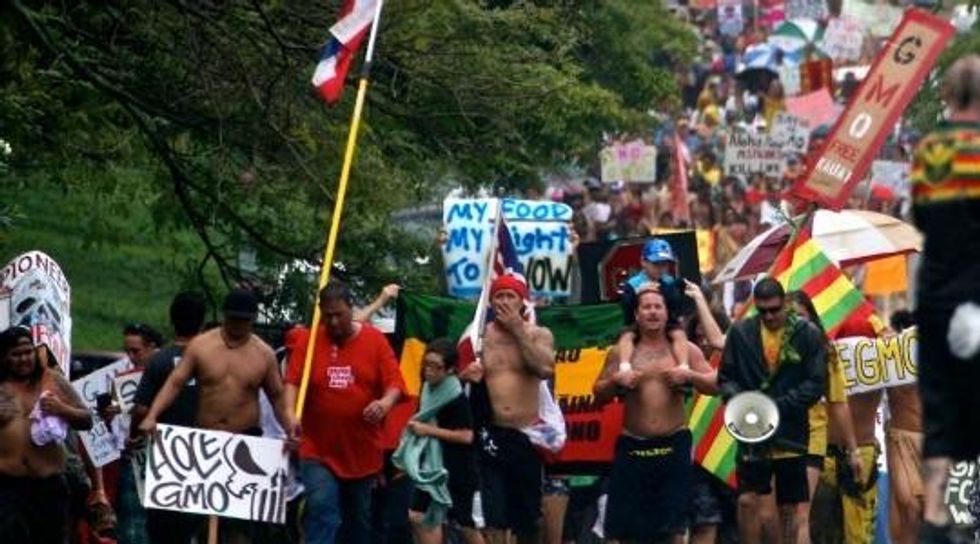
In our struggle, we are connected in solidarity with people around the world who are facing varied forms of exploitation and devastation stemming from the corporate capitalist food system. From land-grabbing and hunger, to farmer debt and agricultural slave-labor, to deforestation and climate change, our struggles are connected by a common root -- a food system driven by the logics of commodification, profit-maximization and concentration of wealth and power. We resist and build together, inspired by our knowing that a more democratic, sustainable and equitable food system is not only possible, but that it is what the vast majority of us want.
We share our story as part of this rising awareness of our common struggle.
Since GMO testing began in Hawaii, over 3,000 permits have been granted for open-air field trials, more than in any other state in the nation. In 2012 alone, there were 160 such permits issued on 740 sites. Kauai, the fourth largest of the main islands and known as the "Garden Isle," has the highest number of these experimental sites. On Kauai alone these sites are associated with the use of 22 "restricted-use pesticides" (RUPs) in the amount of approximately 18 tons of concentrate each year, as well as perhaps 5 times that amount of non-restricted pesticides such as glyphosate.
We know, from information obtained solely due to a lawsuit, that Pioneer DuPont alone has used 90 pesticide formulations with 63 active ingredients in the past 6 years. They apply these pesticides around 250 (sometimes 300) days each year, with 10-16 applications per day on average. For a small island ecosystem, these numbers are astounding. We have no similar information from any of the other companies -- Dow, Syngenta or BASF.
The agrochemical-GMO industry occupies nearly all of the leased agricultural lands on the west side of Kauai -- in total over 15,000 acres in close proximity to schools, residences, hospitals and waterways. More than half of these lands are State Lands, disputed lands that were usurped in the overthrow and following US annexation of the independent Kingdom of Hawaii. At the very least, according to the State's own laws, these lands are to be managed for the common good of Hawaii's people, and especially for the betterment of the conditions of Native Hawaiians.
The industry often states that they came to Hawaii because we have a year-round growing season. But it's not just our good weather they were after. They came because they saw us as an exploitable community, left with an economic void when the sugar plantations hastily exited. Our state was challenged to think outside of the box of plantation agriculture after 150 years of it. The agrochemical-GMO companies saw a community of mostly working-class people, already conditioned to accept an industry that exports all of its profits and leaves behind nothing but pollution, health bills and unsafe, low-paying jobs. They came because, despite our enlightened state motto -- Ua Mau ke Ea o ka 'Aina i ka Pono (the life of the land is perpetuated in righteousness) -- we allow them to get away with doing things that they wouldn't be allowed to do in many other places.
Residents of Kauai currently do not have the right to know what is happening on our agricultural lands, nor how these activities are affecting our common air, water and soil. We do not know which pesticides are being used, where, in what amounts, how they are being mixed, or what their cumulative impacts might be. We also know nothing about the experimental GMO crops being tested. Even when the federal government determines that new pesticide-GMO crop combos significantly affect the quality of the human environment -- as the USDA did in the recent case of 2,4-D and dicamba resistant crops -- we have no way of knowing whether they were tested here and what their impacts might have been.
We are currently struggling to pass a Kauai County bill that would require pesticide disclosure and set-up a buffer zone between the spraying and residential areas. The bill would require that the county conduct an Environmental Impact Statement, and in the meantime put a moratorium on new operations. It would also mandate that experimental pesticides and GMOs be tested in containment rather than in the open-air.
The pesticides the bill pertains to are not the type you purchase at Ace Hardware. They are "restricted-use pesticides" (RUPs) because they are recognized as extremely dangerous. Atrazine (produced by Syngenta), for example, is known to cause birth defects, cancer and reproductive issues. Lorsban (produced by Dow) is known to cause impaired brain and nervous system functions in children and fetuses, even in minute amounts. The EPA has determined that the risks to children are so severe, Lorsban should not be used anywhere they could be exposed. Studies show that other RUPs being used are linked to brain cancer, autism, and heart and liver problems.
Despite national laws that prohibit RUP drift, atrazine, chlorpyrifos (Lorsban) and bifenthrin have made it into the drinking water or air at Waimea Canyon Middle School, almost certainly the result of spraying by the chemical-GMO operations around the school. On several occasions children and teachers have become very ill. In one incident at least 10 children collapsed and were sent to the hospital. An investigation into the matter was strikingly incomplete, testing for only 6 of the 63 active pesticide ingredients used on just one of several neighboring operations, and completely neglecting acute exposure.
It is morally abhorrent that the companies have refused to disclose even the most basic information we need to protect our health, and are now fighting our very reasonable attempt for more transparency. The severity of their backlash and the massive resources they are pouring into subverting our efforts is clear indication that they consider transparency a real threat. These corporations are accustomed to externalizing all of their costs onto workers, communities and the environment. The prospect of being held accountable is an alarming one because their massive profits come at the expense of forcing the rest of us to pick up their health and environmental remediation bills.
Their tactics have been predictably vile. As they are doing to farmers, communities and nations across the globe, they are threatening to sue us. They are claiming that under Hawaii's "Right to Farm Act" they are not responsible for any off-sight impacts. At the same time they are marketing themselves publicly as "responsible community members" and "stewards of the land." They are buying local lobbyists with connections. They are breaking national laws and then claiming they are already over-regulated. They are slandering scientists who raise questions. They are outright lying, deceiving and offending our intelligence.
Most upsetting for our community, these corporations are threatening to take away the jobs of our friends and neighbors if we force them to disclose their chemical use. Syngenta has had the audacity to tell their workers that they may decide to close shop on July 31, the day of the bill's public hearing. They paid their workers to attend the first hearing, and it is likely that they will fly people in for the second. Similar to many other environmental justice issues, the west side community is one of the most economically disadvantaged in the State. It also has one of the highest Native Hawaiian populations. Workers are being told that their only option is to support the long-term poisoning of their families and the land many of them have inhabited for generations, or risk loosing their livelihoods. While the industry's scare tactics are somewhat transparent, they invoke very real and legitimate fear.
According to the industry's own high (undocumented) claims, they provide roughly 2% of jobs on the island. At least half of these are part-time, seasonal jobs. They bring in temporary cheaper labor from other countries, undercutting the ability of local workers to push for better wages and working conditions. Foreign "guest-workers" are amongst the most vulnerable for workplace abuses. Most, if not all, of the well-paying, managerial and "high-tech" jobs go to people from the mainland.
The people of Kauai are building an alternative vision. One in which our economy is more equitable and resilient, and not dependent on the whims of transnational corporations who can leave at any moment. One in which we grow healthy food for ourselves, in a way that is consistent with the value of malama `aina (care for the land). One in which our agricultural jobs are safe and long-term, and benefits accrue to the workers rather than transnational corporations. As an island dependent on barges coming from at least 2500 miles away for 85% of our food, there are huge possibilities.
Locally and globally, we do face real structural challenges to building a more fair and sustainable food system. However, possibilities are already present that can begin to move us in the right direction. At a local level in Hawaii, just a few examples include: making state lands available and affordable for real farmers, upholding the public trust doctrine in water law, workers' cooperatives, research and subsidy support for sustainable regional food systems, food hubs for cooperative processing and distribution, supporting soil and water remediation, state ag parks, food assistance programs, local food procurement policies, waste reduction and recycling programs, stronger labor protections, and regulations that prohibit pollution of the finite resources we depend upon.
Critically, these steps must be part of the global movement to change the underlying logics of the system. We must resist the structural conditions that create a radically immoral food system, while we build towards vantage points that allow us to imagine other possibilities. Perhaps, acting in solidarity, the constraints are not as great as we think them to be, and what we need above all is to believe that we are actually capable of creating a more equitable, sustainable and democratic food system. And so we share our story, as part of the rising global movement that does indeed believe.
Frances Moore Lappe and Vandana Shiva, noted figures in the food sovereignty movement, added their voices to the chorus blasting the 2013 World Food Prize going to GMO scientists with the biotechnology giants Monsanto and Syngenta.
The GMO scientists' work contributes to hunger and ecological devastation while not advancing nutrition, said the two Right Livelihood Laureates, also Councillors on the World Future Council. The pair noted the irony of Monsanto being awarded at a time of rising worldwide opposition to the seed giant.
Lappe and Shiva's remarks echo those of the U.S. Food Sovereignty Alliance, which stated that the prize going to the biotech giants "sends precisely the wrong message about sustainable solutions to hunger and poverty."
"Never mind that Monsanto is a sponsor of the prize (and that the list of other backers reads like a who's who of big ag and big food), or that we never get to know the names of either the nominees or the nominators," New York Times' Mark Bittman noted.
Still, the GMO work by the winning scientists "betrays the mandate of the very World Food Prize," explains Lappe, "which is all about focus on the importance of nutritious food and food for all, whereas GMO seeds, their design and the way they are spread to the world has nothing to do with better nutrition."
"In fact, to take advantage of these seeds, small farmers who are among the hungriest people in the world, have to take out loans to buy the costly products that are required--the seeds, the fertilizers... and the pesticides that are required" for the GMO seeds.
"So in fact the honorees ... are actually contributing the problems that keep us locked... in hundreds of millions of people in a world where there is plenty of food," concluded Lappe.
The World Food Prize explained that the GMO work by the new winners has "contributed significantly to increasing the quantity and availability of food."
Not so, says Shiva.
"The evidence is so clear," she says, that "GMOs have not increased production, there's a failure to yield." In addition, "they have not reduced use of chemicals. Worse, they have increased the use of chemicals because they have created superpests and superweeds."
To reward this "failed technology... in 2013, at a time when the world is waking up to the scientific evidence that biodiverse systems, ecological systems produce more food. We could be having enough food for two to three times the world's population by conserving and intensifying our biodiversity, saving our water, rejuvenating our soils. That's agro-ecology The new science of agriculture, of working with nature, and not against her . It's also the science that small farmers practice to bring 80% of the food to the world. It's not the gene giants."
"In a way," she continues, "the award being given to Monsanto is attempt to try and divert the public's attention" away from rising global opposition.
The real future is "GMO-free food, patent-free food, seed freedom, food freedom."
Therefore, "the award for food security and food sovereignty belongs to the millions of women, the millions of small farmers, the millions of market gardeners" who bring true food security to the world, says Shiva.
* * *
Video of Lappe and Shiva expressing their outrage at the biotech scientists' receipt of the prize was posted by the World Future Council:
World Food Prize 2013 - Vandana Shiva and Frances Moore Lappe condemn selection of winnerVandana Shiva and Frances Moore Lappé, members of the World Future Council and laureates of the Right Livelihood Award, ...
__________________