SUBSCRIBE TO OUR FREE NEWSLETTER
Daily news & progressive opinion—funded by the people, not the corporations—delivered straight to your inbox.
5
#000000
#FFFFFF
To donate by check, phone, or other method, see our More Ways to Give page.

Daily news & progressive opinion—funded by the people, not the corporations—delivered straight to your inbox.
Only with democracy—specifically a living democracy—can we transform our wasteful, destructive food system to ensure everyone’s fair access to healthy, ecologically grown food.
"Planetarian. What’s that?”
I am eager to explain. In the late sixties, as I struggled to find my path, Paul Ehrlich’s Population Bomb had just exploded, admonishing humanity for overpopulating the Earth and creating food scarcity. Soon, several friends even pledged never to have kids.
So, I had to know: Was Ehrlich right?
I dug in at U.C. Berkeley’s agricultural library with my dad’s slide rule in hand, asking: Is it true that we’re running out of food?
No. Emphatically no, I soon learned.
We did then—and do now—produce enough food for all. Yet decade after decade we turn abundance into scarcity for too many: Today, 1.3 billion people—1 in 6 of us—lack consistent access to the calories we need. And safe and healthy diets? They’re out of reach for almost 40 percent of humanity, and the crisis is predicted to worsen.
Why?
Simply put, our world’s gross power inequities—political and economic—are the root cause. As the richest 1 percent control about half the world’s wealth, food policies serve elite interests, not commonsense or our planet’s health.
When our dietary habits incorporate environmental, justice, and health awareness as well as animal welfare, might we be "planetarians"?
One result? Staggering inefficiency.
Humans directly eat only about half the calories we produce. And the other half? While some become biofuel, in the U.S. we devote three-fourths of agricultural land to livestock production. And, of every 100 feed calories that cows eat, we get only three calories back in that burger or steak on our plate. With dairy cows, we get less than half the calories they’re fed.
The big picture?
Worldwide, almost 80 percent of our agricultural land produces livestock that give us only 18 percent of our calories.
Other costs include vast environmental harms: Producing animal foods generates greenhouse gas emissions 10 to 60 times greater than producing plant-based foods. Plus, 60 percent of biodiversity loss worldwide is caused by livestock. Moreover, livestock grazing is responsible for almost 40 percent of global deforestation, worsening the climate and biodiversity crises. Natural historian David Attenborough warns us we are facing the 6th great species extinction, which requires a dietary shift toward plant food.
Plus, “industrialized livestock” generate 85 percent of soil erosion, also a major threat.
Next, water. Our heating climate diminishes fresh water supplies; yet to produce just one pound of beef we use 1,800 gallons of water. Globally, “animal agriculture” accounts for nearly a fifth of all freshwater use. Here in the U.S. cattle farming uses more than half the water drawn from the Colorado River, for example, even as area’s current water crisis already threatens many farms and puts dozens of fish species at risk.
Meat-centered diets also directly damage our health: In 2015, the WHO declared red meat a probable carcinogen and processed meat a carcinogen.
In sharp contrast, plant-centered diets have been shown to lower body weight, boost the immune system, and decrease cancer risk, coronary heart disease, and Type 2 diabetes. So, no surprise: A plant-centered diet is associated with “lower risk of all-cause mortality” in U.S. adults.
It makes no sense. Why would we humans—supposedly the brightest species—actively shrink our food supply?
Why?
Because the deeper scarcity we’ve failed to address is that of democracy. On political rights and civil liberties, Freedom House—confounded by Eleanor Roosevelt—ranks us way behind nations we think of as peers. The U.S. comes in 59th between Panama and Samoa. Yet, only with democracy can we transform our wasteful, destructive food system to ensure everyone’s fair access to healthy, ecologically grown food.
Thus, much of my life energies have gone toward what I call “living democracy” in which we each have both economic and political power.
So, how does shifting my diet serve democracy?
In nourishing ourselves we make multiple choices daily. That alone gives food special power. With each choice I know I am sending signals back through the food chain for sane, fair use of our Earth.
Suddenly, my every bite has delicious purpose. As a vegetarian, I’ve loved knowing I was protecting animals and avoiding massive waste. But now I wonder whether “vegetarian” captures the full impact of such food choices. So, what if we reconceive good eating as not just “plant-based,” but “planet-healing”?
When our dietary habits incorporate environmental, justice, and health awareness as well as animal welfare, might we be "planetarians"?
I believe that with every step aligning our lives with our deepest truths, we become more convincing to ourselves and thus to others—and more likely to take our next step and the next…with ever greater courage. And that’s exactly what our planet needs now more than ever.
So, “planetarian” feels great.
How often I hear that in "polarized" America rural voters will reject a green agenda out of hand. For them, green means liberal, tree-hugging snobs, unconcerned about the struggles of real working people.
But last week that frame busted for me when I had a chance to speak with Chloe Maxmin, a 27 year-old Maine legislator.
Never heard of Chloe Maxmin?
How often I hear that in "polarized" America rural voters will reject a green agenda out of hand. For them, green means liberal, tree-hugging snobs, unconcerned about the struggles of real working people.
But last week that frame busted for me when I had a chance to speak with Chloe Maxmin, a 27 year-old Maine legislator.
Never heard of Chloe Maxmin?
Well, keep reading, and maybe you'll agree with me that the story she and colleagues are writing bring many surprises and lessons worth spreading.
"From the beginning, I was very clear in our messaging that my [Green New Deal] bill was by and for Maine, by and for my community, that was specific and targeted legislation to lift up the voices of rural and working Maine."
--Maine State Rep. Chloe MaxminMaxmin grew up on her parents' farm in Nobleboro, a Maine town of about 1,600. Describing herself as an activist since age 12, in 2015 she earned a degree at Harvard while making time to co-found Divest Harvard, a campaign to push the university's divestment from fossil fuels.
The battle to make Harvard divest is still unresolved, but Maxmin's run for a seat in Maine's House of Representatives in 2018 had a decisive outcome.
First, she won the Democratic primary for District 88 with almost 80 percent of the vote. Then, she took on Republican Michael Lemelin, a local businessman and retired pilot. Though her district had never chosen a Democrat, she received 52.5 percent of the vote.
Given her youth, it's striking that Maxmin now represents a district with one of the oldest populations of any district in the country. Three quarters of her district lies in Lincoln County, where roughly 28 percent of residents are older than 65--a share exceeding the national average by 75 percent.
And how did she win against all odds?
First, Maxmin was helped by Maine's 1996 "Clean Elections" law entitling candidates for the state legislature to receive public financing--if they first collect from voters in their district a certain number of small contributions. For a seat in Maine's House, it's sixty $5.00 contributions. They also agree not to raise or spend any private money. Maine's "Clean Elections" law levels the campaign-playing field, making running for office accessible to anyone regardless of income or background. It helps to hold candidates accountable to the voters, not to their funders.
While 14 states offer some kind public campaign financing for some offices, only two other states offer full public funding for state legislative offices (Connecticut and Arizona), and in Arizona the program has been seriously undermined.
While Clean Elections helped to make Maxmin's campaign possible, her success reflects core messages and a campaigning approach that resonate with voters. "Whenever people ask me how we won, and how we did it, my answer, quite frankly, is just to listen to people, pay attention." She stressed that "once you get through differing opinions on policy issues, below that... we all share an incredibly deep frustration with our government."
She sees the state level as offering "opportunity to really rebuild our humanity and rebuild our faith in each other and politics."
One encounter with a gentleman living in trailer home at the end of a narrow dirt road seemed to capture her point. He was surprised "to see me," as "I was the first political candidate to come to his door and listen." At the end of their talk, he told Maxmin, "You're the first person to listen to me. Everyone judges what my house looks like. They don't bother to knock. I'm grateful that you came. I'm going to vote for you. Thank you."
In all, her campaign team knocked on at least 10,000 doors...and listened.
Once in office, Maxmin quickly moved on her commitment to helping her district by passing Green New Deal legislation.
"From the beginning, I was very clear in our messaging that my [Green New Deal] bill was by and for Maine, by and for my community, that was specific and targeted legislation to lift up the voices of rural and working Maine. I called it the Green New Deal so everyone would pay attention to it and a different way of talking about climate change. Most people got it and also understood that it was different from what's going on in D.C."
Fortunately, five colleagues--including two Republicans--in the state's House and Senate shared Chloe's values enough to introduce their own complementary legislation. "We had to make up for eight years," of Republican governor, and climate-change denier, Paul LePage who had blocked every climate initiative whatsoever.
Despite finding allies, it wasn't always easy. When, after only six months in office, Maxmin stood at the chamber podium to introduce her Green New Deal for Maine Act, Republican colleagues immediately interrupted her, not once but four times in quick succession.
Maxmin remained undeterred, and ultimately her Green New Deal bill passed by a hefty margin: 84 to 55.
In all, seven green bills passed between February and June, including a state "renewable energy portfolio standard" and a goal of 80 percent renewable energy by 2030 and 100 percent by 2050. Maine also set the goal of reducing the state's greenhouse gas emissions by 80 percent by 2050.
With this success, Maine became the third state after California and New Mexico to pass a Green New Deal and a carbon-reduction goal.
Maxmin is especially proud that her Green New Deal was endorsed by a state AFL-CIO affiliate, the first such bill at the state-level to receive labor's support. Why? Her bill specifically mandates that a share--beginning with 10 percent and rising to 25 percent by 2027--of jobs in major solar installations have to be filled by those in apprentice programs registered with the Department of Labor.
Maxmin's strong positions on climate and economic justice impress me, but what also makes her a great leader for our time is her commitment to democracy itself.
Though leadership clearly focuses on the "big questions," Maxmin is also finding time to attend to her district's immediate needs including passing bills, for example, to improve transportation for seniors, as well as hosting monthly coffees at the local diner to talk with constituents about their concerns.
Maxmin's strong positions on climate and economic justice impress me, but what also makes her a great leader for our time is her commitment to democracy itself. "Everything in our lives depends on our political system, and we need to figure out different ways of running campaigns, figure out how to actually represent the people--with respect and dignity for everybody," she told the Times Record.
Talking with Maxmin it was clear to me that her passion for the environment and democracy were not rooted in abstract principle but in deep connection to her home. "I love Maine. I love my town and I want to protect it," she told us more than once.
So, if this piece reads like an "Ode to Chloe Maxmin," I cop to it.
In my view, Chloe Maxmin and her bold colleagues offer the tonic we most need now. It is called "hope"--not blind optimism but hope grounded in courageous action. Thank you, Maine. It sure tastes good.
More than one in five Americans--that's over 70 million of us--now live in a place committed to 100 percent carbon-neutral electricity--including 131 towns and cities, seven states and Puerto Rico.
With a Republican-controlled Senate and White House making federal action on climate change look less likely by the day, many hope that states and cities can help pick up the slack.
And such hope is not in vain.
The seven states already committed to carbon-neutral electricity--including two of the top nine carbon-emitters, California and New York--representing 14 percent of national emissions in 2016. With new clean-electricity bills being introduced in blue states such as Massachusetts, New Jersey and Illinois, further progress is expected soon.
Moreover, the clean-electricity transition is hardly limited to liberal bastions.
Pennsylvania, a purple state with a Republican-controlled legislature for the last eight years, is expected to have a 100 percent renewable-electricity bill introduced in its Senate for the second session in a row. The bill's sponsor is Republican state Senator Thomas Killion, and among co-sponsors are four more Republicans also breaking rank.
All states with legislation now on the books have set mid-century targets; and New York, the state with the most expeditious transition plan, is not only mandating victory by 2040 for 100 percent carbon-neutral electricity, but has committed to its whole economy being carbon-neutral by 2050.
Alongside this progress, across America, local governments are leading the way with some of the most progressive transitions in the nation. And with cities producing over 70 percent of carbon emissions globally , and just 100 cities contributing almost 20 percent of emissions, local municipalities can have a remarkable impact.
Currently, out of the 131 cities and towns that have passed 100 percent carbon-neutral electricity legislation--many in states that are not taking action--80, including Washington, D.C., and Chicago, have pledged to meet this goal before 2040.
What's more, there are already a handful of trailblazing cities and towns currently 100 percent powered by carbon-neutral electricity. This group of pioneers includes Aspen, Colorado; Burlington, Vermont; Georgetown, Texas; Greensburg, Kansas; Rock Port, Missouri; and Kodiak Island off the coast of Alaska.
And, surprisingly, Republican mayors led two of these advances.
Georgetown, Texas, population 70,000, sits in the center of a red state, and wind and solar provide most of its carbon-neutral electricity. Last month, a new solar farm the size of roughly 950 football fields began electrifying the town. Interviewed by Frontline, Mayor Dale Ross, who marshalled the renewable transition, explained the city's motivation to move to 100 percent renewable electricity. It was for "long-term cost certainty," he stressed. The move was "first and foremost...a business decision."
Greensburg, Kansas--another red city making a green transition--suffered tornado devastation in 2007, causing roughly half of the city's 1,500 residents to flee. But, amid destruction, Mayor Bob Dixson saw opportunity. The U.S. Department of Energy's National Renewable Energy Laboratory estimates that Kansas offers the "third highest potential for wind energy in the U.S." So, Mayor Dixson took action, and soon Greensburg was the second city in the country, after Burlington, Vermont, to achieve 100 percent renewable electricity.
At the national level, climate action has, tragically, become a political litmus test. So, let us spread the word that at the state and local level--fortunately--Americans across party lines are acting with courage and commonsense to save money, their health, and our planet.
Note to readers: It's important to take care in not equating "100% renewable energy" and "carbon free" energy. Some states consider forms of biomass, e.g., wood and trash burning, to be renewable, but biomass produce carbon emissions. On the flip side, some count nuclear as "carbon free," but it is not renewable.
Each month tens of thousands of migrants cross our southern border. They're "seeking a better life"...right? Isn't that why families leave loved ones to trek vast distances facing untold dangers?
Certainly, it's the story that fits our cherished image of our nation as a land of opportunity like none other.
Recently, though, I felt ashamed that I--someone who wants to believe she's well informed--had overlooked a key piece of my own responsibility, or, more precisely, my own and my nation's culpability.
Certainly, I'd long been aware of numerous US policies that have long hindered positive development in the region to our south. In Guatemala in 1954, for example, the CIA deposed democratically elected president Jacobo Arbenz. In Nicaragua, from the '50s through the '70s, the U.S. backed the Somoza family dictatorship, and then in the '80s we funded right-wing forces attempting to overthrow a government enjoying wide popular support.
I'd also known that immigrants' hopes of escaping desperate poverty weren't the whole story. I knew that many arriving at our southern border were fleeing threats of violence against them and their children. For some, it's guns in the hands of gangs that make staying put impossible. "Even suspicion of being loyal to a rival gang is a death sentence," reported The Associated Press earlier this month.
The link between homicide and migration is captured in this startling ratio from the Inter-American Dialogue in 2018: In Honduras, a 1 percent increase in homicides drives up migration by 120 percent.
On some level, I had grasped that fear--legitimate fear--was a driver of migration.
But what I had not, and certainly should have, grasped is our nation's central role in generating fear by allowing a flood of US weapons to continue across our southern border. The flood into Mexico alone includes "[m]ore than 212,000 illegal firearms" from the U.S. each year owing to "straw purchases," observes the Los Angeles Times.
Central America is hardest hit.
There, gun laws are comparatively strict, yet "homicide rates are among the highest on earth." In El Salvador, with the world's highest rate, almost half of weapons found at the country's crime scenes are from the U.S. officials here estimate.
During the 1980s, El Salvador was "the single largest recipient of U.S. military hardware and weaponry in the Western Hemisphere," and, after its civil war ended in 1992, "the guns, grenades and bullets linger, as do their murderous effects," write Robert Muggah and Steven Dudley in the Los Angeles Times.
And Mexico?
The country has only one gun store. Located in Mexico City, it is guarded by the army. Seventy percent of guns seized in Mexico were originally sold in the U.S.--most of them in Texas, California, and Arizona according to the Department of Justice's Bureau of Alcohol, Tobacco, Firearms and Explosives.
"Once in Mexico, these weapons end up in the hands of drug cartels or get shipped to gangs in Honduras, Guatemala and El Salvador," says The Associated Press. In Honduras, "armed holdups on public transportation are a regular occurrence, where nearly half of the unregistered weapons originated in the U.S.," reports the federal Bureau of Alcohol, Tobacco, Firearms and Explosives..
"The number of firearms smuggled from the United States was so significant that nearly half of American gun dealers rely on that business to stay afloat," reported the University of San Diego in 2013.
Yes, this horrific story is being reported, but where is the public outrage?
We hear endless calls for more resources to stop illegal entry at our border. But where are the calls to stop the massive illegal transfer of weapons fueling the very violence that drives innocent people to leave their homes?
In 2016, the National Rifle Association (NRA) spent nearly $70 million to help elect Donald Trump and other Republicans, a sum much larger than the group reported to the Federal Election Commission. " As gun-industry money directly benefits our politicians, they have little incentive to reduce the industry's power and its harm to innocent people.
Only we citizens have the power to stop money-driven politics and its deadly consequences. We each can use our voices to spread the word of our nation's culpability in this horrific violence. And, we can use our votes to move forward reforms loosening money's grip, including NRA dollars, on our democracy.
Unless we do, we all have blood on our hands.
It's easy to feel fatalistic, accepting as "just the way things are" an America in which the top one-tenth of 1 percent controls as much wealth as the bottom 90 percent, while roughly a fifth of American children live in poverty, and half of American infants are so poor they depend on public aid to eat.
But wait.
What if we were to acknowledge -- to really let sink in -- that we have arrived at this tragic place in no time at all, historically speaking? Might we even feel entitled to hope and thus motivated to work for transformational shift of the kind the Green New Deal now envisions? One in which we effectively address climate change as we also tackle economic inequity?
First, though, check out the chart below:
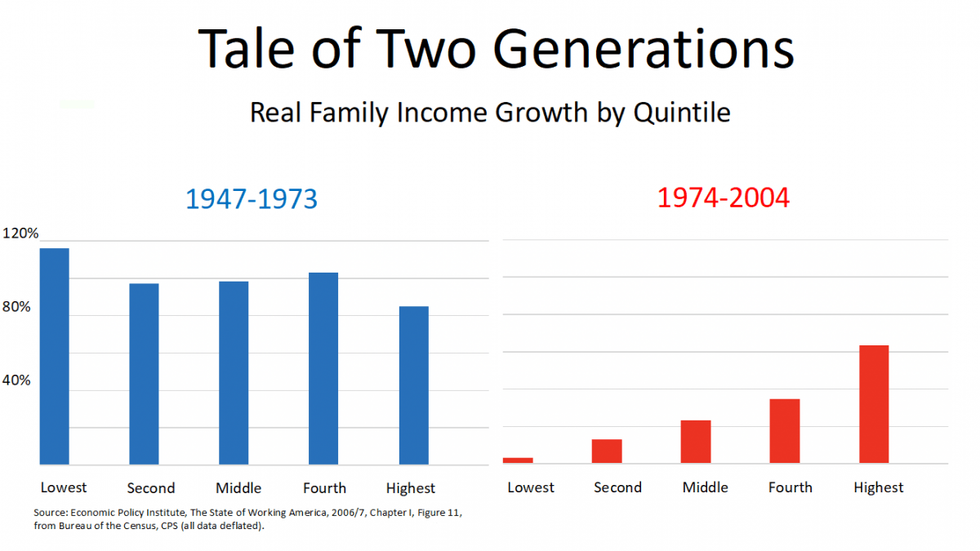
In ten columns is the tale of two generations. The blue bars capture the late 1940s through the early '70s when real family income roughly doubled for every income quintile, with the poor gaining the most.
Then...whoa! From the early '70s through the early 2000s, progress slows radically and the pattern of who gains most reverses: The richest score big time, while the poorest advance virtually not at all. Such dramatically deepening inequality has continued to worsen, not only reducing economic opportunities but shortening lives as well: The life-span gap between the richest and poorest American males is 15 years, and in recent years, overall longevity has declined.
The contrasts between these two generations is staggering; but now consider an international comparison that might strike some as yet more shocking. America, long-perceived as a paragon of "middle class" prosperity, now ranks by family income as more extreme than over 100 countries, from Russia to Bangladesh to the Democratic Republic of the Congo, according to the CIA World Factbook.
These contrasts alone should signal the truth that there is nothing inevitable about this disgrace. Not long ago we experienced more equitable income growth, linked to much greater prosperity. So, what happened to us?
Most important, our beliefs changed -- or rather, they were changed. We humans are creatures of the mind. We create our world according to what we believe is both right and possible, and our ideas, absorbed via story, create filters through which we see. So "believing is seeing," not the other way around. Both Plato and the Hopi Indians are credited with noting, "those who tell the story rule the world"; and in these two periods, different storytellers told very different stories.
In the first period (blue bars), Americans absorbed the notion that we could all advance together -- that government was established to support the "general welfare." After all, that is what our constitution's preamble affirms as a purpose of our government.
The first period benefited from FDR's New Deal that catalyzed sweeping gains for all Americans -- from establishing the minimum wage and Social Security, to strengthening workers' rights to organize, to bolstering banking industry rules. Well into mid-century, both Republicans and Democrats embraced government as a partner in setting standards and expanding opportunity.
Republican Dwight Eisenhower ran on a platform that included the pledge to "more effectively protect the rights of labor unions" and to "assure equal pay for equal work regardless of sex"; Democrat Lyndon Johnson launched the War on Poverty, which helped cut the poverty rate almost in half between 1959 and 1969; and Republican Richard Nixon signed the Clean Air act into law in 1970.
But soon, the business community feared it was losing ground and began actively, and effectively, putting forth an opposing story, as laid out in Jane Mayer's Dark Money. In 1971, the Chamber of Commerce commissioned a corporate lawyer, Lewis Powell, to prepare a game plan, known now as the "Powell Memo," for regaining ground for business. Soon thereafter, in 1977, Ronald Reagan warned Americans to "use the vitality and the magic of the marketplace to save this way of life." And by 1981, he famously declared, "in this present crisis, government is not the solution to our problem; government is the problem."
In the ensuing decades, the story that a market freed from government tampering would bring prosperity for all was propagated through big-money-funded think tanks, politicians, the media, and educational materials, from grade school to graduate school.
Legislation and court decisions have weakened protections, making it harder, for example, for labor to organize. In the 1960s, about a third of workers were union members, but today this figure is less than 10 percent. And since 1968, when our minimum wage was $8.68 (in 2016 adjusted dollars), its purchasing power has fallen by 16 percent. Safety nets were tattered, too, as Bill Clinton's welfare reform ended "welfare as we know it."
We often hear the reversal of the second period blamed on job-killing technology and "globalization" in which corporations shift operations, and thus jobs, to low-wage countries where workers have few, if any, protections. So, of course, American workers' bargaining power eroded.
But, if true, other industrial nations' labor markets would have seen a shift of wealth to the top similar to ours. But no. Western Europe saw only a modest increase in inequality.
Today we are also told that fighting for transformative change is naive, that the Green New Deal, for example, is unrealistic because it prioritizes economic equity as integral to confronting climate change. However, Representative Alexandria Ocasio-Cortez's brilliant video message, set in an imagined future in which we look back on successes achieved today, asks us to believe we can change this story. Showing us possibilities that can arise from a Green New Deal, she declares, "we can be anything we have the power to see."
Looking back now on the "tale of two generations," it's clear that when we Americans have acted from the premise of connected fates and have stayed true to our constitution's mandate to promote the "general welfare," we have accomplished what was before believed to be impossible.
Indeed, given America's revolutionary birth, isn't transformational change our very birthright?
My headline poses a question I struggle with.
" Capitalism" refers to an economy driven by owners of private capital, typically with the aim of bringing the highest possible return to themselves, and I am sure that is not what Senator Elizabeth Warren stands for.
Warren has made clear that what she wants (and I do, too!) is "accountable capitalism," a market economy that works for all of us because it responds to all of us--a market that's truly competitive and always open to newcomers. Not what we have now.
Today in the US, just two companies control more than half the market in twelve major industries. Four control nearly 90 percent of the total global grain trade. Six control 90 percent of American media, and four control over 80 percent of air travel.
What Warren lauds are "fair markets, markets with rules." Without them, she explains, it's "about the rich tak[ing] it all... And that's what's gone wrong in America."
So, I wonder, why call oneself a capitalist?
Capitalism and a market economy are not to be conflated. A market is made more vital by including many enterprises that are not owned by capital. They include cooperative, community-owned, and publicly owned enterprises. Plus, there are B Corporations and "Benefit Corporations," owned by private capital but committing to serve social ends. In these forms of enterprise, accountability is built into their DNA, and it's working.
The US is home to over 64,000 cooperatives; and worldwide total sales of co-ops come to about $3 trillion, a sum equal to the total equity ownership of the five global tech giants: Apple, Google, Microsoft, Amazon, and Facebook. Globally, 10 percent of those employed work for a co-op.
Also, contributing to a healthy market economy are publicly owned entities, not held by private corporations. Of the 3,175 US electric utilities, about 63 percent are publicly owned, and 29 percent are rural electric cooperatives.
900 electric cooperatives provide electricity to more than half of our nation's landmass in forty-seven states, and their customers typically pay less: On average, US public power customers pay rates 6.9 percent lower than paid by those of investor-owned utilities.
Surprisingly, in the red state of Nebraska, all electricity is supplied by cooperatives and public utilities.
Another example of a competitive, publicly owned enterprise is the Bank of North Dakota, founded nearly 100 years ago. Mainly, it serves the state's financial firms and state agencies, but it also helps citizens directly by serving those without access to private banking.
Yet another approach is community ownership, businesses financed solely by locals. For example, in Walsh, Colorado, population 600, a community-owned grocery store saves people a 40-mile roundtrip drive to the nearest supermarket. Community ownership is not unique to the US. The UK is home to a couple dozen towns with community owned stores, including pubs!
And "B" and "Benefit Corporations"? The first is a company certified as having positive social impact-- on employees, customers, the planet. Scores are published for the public to see. Currently, almost 3,000 US companies are B Corp-accredited across 150 industries. A Benefit Corporation also commits to serving broad, social betterment but is not independently certified.
A vibrant market economy, welcoming all these forms of ownership, needs a polity creating values boundaries in which it operates. As noted, Warren made this point strongly. A "fair market," as opposed to the fictional "free market," requires a democracy enforcing rules already on the books--those, for example, preventing monopoly and protecting health and safety--and creating new rules as needed.
If "capitalism" is inaccurate, what term does best capture the goal of such a vibrant, fair market economy? One with more accountable forms of ownership and protected from private, monopoly power or bureaucratic overreach?
" Socialism" can mislead because it's often equated with top-down government control.
So, I vote for "economic democracy" enabling a "fair market".
It suggests a market economy promoting and protecting life--human and otherwise--because it is accountable to promoting "general welfare." After all, that is what our constitution's preamble established as a goal of our new nation.
And to have such an economy requires accountable political democracy, answering to us, not to big donors. Fortunately, a bold and welcoming Democracy Movement is emerging today to achieve just that.
So, let's drop the dead-end debate of capitalism versus socialism and focus on choosing terms that capture what we really mean--an open, fair, and accountable market essential to real democracy. Thank you, Sen. Elizabeth Warren, for your courage in opening this dialogue.
Here's my question for you. If your child were dying of a disease that only a costly drug could cure, would you not go to any lengths to get it? Of course, you would. And that's exactly what we face today, as our children's future is dying, not to mention a habitable planet for all.
Inaction is not a choice.
This realization changes everything: With a do-or-die mindset, suddenly we begin to see possibilities that before we'd totally missed. It's a shift that now seems to be galvanizing - with remarkable speed - diverse forces behind Congresswoman Alexandria Ocasio-Cortez's and Senator Ed Markey's ambitious Green New Deal. With Justice Democrats and the youthful Sunrise Movement, they've tailored a bill (H.R. 109) to address a crisis that almost 60 percent of Americans consider a "significant threat to our country."
Though nonbinding, the Green New Deal calls us to a ten-year mobilization to reach net-zero greenhouse gas emissions, generating millions of new jobs in clean energy and putting us on the road to 100 percent renewable power.
Unfortunately, this existential threat isn't opening everyone's eyes. Despite 89 House and 11 Senate co-sponsors and over 80 percent support among registered voters, Republicans mock the Green New Deal as "radical" and "socialist". Some key Democrats dismiss it as well. Senator Dianne Feinstein admonished child environmental activists that "there's no way to pay for the [Green New Deal]." (My granddaughters watched that scold five times!) West Virginia's Senator Joseph Manchin also derided the bill as the "Green New Deal is a dream. I have to work with reality."
But what's seen unrealistic is shifting fast for many Americans.
Instead of being turned off by the resolution because it is multi-faceted and ambitious, many embrace it for precisely these reasons. Our entire economy and its infrastructure are implicated in the climate crisis; so, of course, the challenge can only be addressed holistically and in ways that engage us all. Thus, the Green New Deal would create good jobs for those most excluded; and with infrastructure investment would meet the basic human right to clean air and water. On this, note that nearly in 4,000 neighborhoods nationwide, childhood lead-poisoning rates have been found to be at least double those in Flint, Michigan, during the peak of its contamination.
Holistic economic transformation is not only essential but well underway, both abroad and here at home.
The E.U.'s record is proof of what's possible. Its per capita greenhouse gas emissions are approximately half of ours, and a handful of E.U. countries, including France and Italy, are only about one-third.
Here at home, too, we've seen striking evidence of possibility.
Take oil-rich Texas. If it were a country, Texas would rank as the world's sixth largest wind-energy producer, and ten states already get a fifth of their electricity from solar and wind. In Iowa, make that 37 percent; and in Kansas, Oklahoma, and South Dakota, the share is 30 percent.
A premise of the Green New Deal is that economic equity is essential to environmental health, so what do we know about the jobs' potential for good jobs as we leave carbon behind?
With little national leadership or mobilization, already roughly 3.2 million Americans work in the clean energy sector, outnumbering fossil fuel jobs about 3-to 1. These jobs typically pay very well, too--with energy-efficiency workers earning about $5,000 more than the national medium, and solar workers averaging above our $17 national hourly median. Another positive? These jobs are being created across the whole country, from the coasts to rural communities, and in the Rust Belt, too.
Note also that in some states, energized (and worried) citizens have already pushed legislators to act boldly, showing the way.
Take Illinois. After two years of citizen advocacy, that state passed Solar for All just a month after Trump's election. It aims to massively expand solar installations, prioritizing low-cost energy for low-income families. The legislation also includes funds for solar-installation job training, particularly for formerly incarcerated people and foster care alumni.
Doubling down on efficiency investments in Illinois could create more than 7,000 jobs per year, reports the Natural Resources Defense Council. In fact, the state's existing energy-efficiency programs are the foremost reason why Illinois has the lowest electricity bills in the Midwest. This bill will redouble those investments, yielding billions in energy-cost savings by 2030.
New York is also moving forward to show the country what's possible. Its Climate and Community Protection Act is backed by NYRENEWS - a coalition of 150-organizations. Not only does the bill mandate a fossil-free New York state by 2050, but it ensures that resources for the state's green transition are invested in historically disadvantaged communities, potentially producing thousands of new, high-paying jobs for New Yorkers who need them most.
Across the country "Buy Clean California" is taking the offensive against climate change. In 2017, California became the first state (although the Army was already there) to mandate a simple rule: Materials, such as glass and steel, used in the state's billions infrastructure projects, like bridges, must be purchased from sources using low-carbon-impact production processes; and organized labor is behind the scheme.
Overall, the US achieved a 14 percent drop in carbon emissions over the eleven years after 2005, taking us halfway to our 2025 emissions goals set in the Paris Agreement. My point is simple. Even without national leadership focusing us on the crisis, we're making strides, and now we're getting serious: Youth are jumping in via the Sunrise Movement and twenty-one young people have brought a lawsuit to force the federal government to act.
So the Green New Deal and the Sunrise Movement deserve our gratitude not our gripes. We know that throughout human history it is not the magnitude of a challenge that has crushed the human spirit, it's feeling futile that does us in. Please don't let the naysayers dim our confidence in our power to step up in this do-or-die moment.
Americans may disagree about many things, but most of us come together in loathing the Supreme Court's 2010 Citizens United. We know it helped degrade our democracy as it opened the floodgates to independent, corporate campaign spending and enabled additional rulings that have led to Super PACs, along with ever-more "dark money."
Three-fourths of us want Citizens United overturned. I'm certainly one, and I'd long assumed I knew everything I needed to know about this unfortunate ruling. But I was in for a big surprise.
Buried in the 1976 Supreme Court decision that first equated political spending and speech, unleashing "big money" in politics--and cited one hundred times in Citizens United--is an argument against the Court's own findings, and one that crystalizes a key purpose of the First Amendment.
That opinion is Buckley v. Valeo.
In it, the Court makes clear, citing two earlier rulings, that the First Amendment's intent is not just to protect individuals against government control of speech. It is also to serve a vital public function: "to assure [the] unfettered interchange of ideas for the bringing about of political and social changes desired by the people"; and "to secure 'the widest possible dissemination of information from diverse and antagonistic sources.'"
Yet, the Roberts Court has continued to betray this public function, as legal scholar Tim Kuhner makes clear in "The Market Metaphor, Radicalized." Reclaiming it begins with grasping the consequences of the Court's move to interpret free speech narrowly as an individual or group right to spend unlimited sums blasting viewpoints across the political airwaves.
One result is that little bandwidth remains for those without big bucks--thus, denying the First Amendment right, defined in Buckley, to free exchange of ideas using information from diverse and opposing sources in order to achieve the policies we citizens want. In stressing "interchange" and "diverse" sources, here the Court captures what I conceive as the essential "conversation of democracy." In it, as in all conversation, participants must not only be able to speak but also to be heard.
Sadly, however, in both Buckley and Citizens United the Court's decisions belie its own articulation of these precepts.
The Court argues in Buckley that capping individual or group political spending "necessarily reduces the quantity of expression by restricting the number of issues discussed, the depth of their exploration, and the size of the audience reached."
But, think for a moment, isn't the opposite true?
Take the "number of issues discussed."
In 2016, one-half of 1 percent of donors contributed two-thirds of funding in federal elections. With most campaign messaging financed by such a tiny minority, the "number of issues discussed" is likely to be more "restricted," not less, narrowed to matters this elite can leverage for political outcomes in its interest.
And as to the "depth" of issues' "exploration"?
In 2016, with money flooding the electoral process, campaigns spent almost $9.8 billion on advertising alone, shrinking complex issues to emotional sound bites. Shallowness, not "depth," is the result--especially in a campaign's final days when ads can become misleading or worse.
And the size of the "audience reached"?
Surely $9.8 billion can buy large audiences, but the term "audience" connotes one-way communication, not "interchange." Thus, we Americans end up with the right to speak but zero right to be heard.
I feel as if I'm invited to an auditorium for a political dialogue, but only a few of those assembled can afford pricey, electronic megaphones. Quickly I get it. Yes, I can speak, but only the handful with megaphones can be heard. Feeling useless and belittled, I head home.
Clearly, without both the right to speak and to be heard we cannot attain the "changes desired by the people," a goal of the First Amendment embedded in Buckley.
Yet, despite this huge, Court-imposed, boulder in the path of democracy, millions of citizens are uniting their voices to make themselves heard. Pursuing democracy-strengthening reforms--including victories in the 2018 midterms--they are building a political framework for robust "interchange" to realize "political and social changes desired by the people." In leading the charge on such reforms as fair voting districts and elections funded by the public and small-donors, citizens are fostering the essential conversation of democracy--one not drowned out by megaphones of great wealth.
Ironically, these engaged citizens are being faithful to our First Amendment rights as once spelled out in the Court's own logic.
It's 1970. In my VW bug, I pull up in front of the Durant Hotel on the edge of the UC Berkeley campus and sit. I'm waiting for Betty Ballantine, and all I know is that she's a big-time New York publisher. So, of course, I imagine her appearing in sleek suit, high heels, and full-on makeup. But soon, approaching my car with a smile is a slightly graying gal in sneakers and flowered cotton pants. Her warmth immediately puts me at ease.
Little did I know that this person, who passed away February 12th, would set the course of my life. Her obituary appeared today in the New York Times.
Betty had asked if she could meet with me on her way to Stanford to talk with Paul Ehrlich about his recent book The Population Bomb. Wow, I'd thought. He was already famous, and me? I'd had never published even so much as a letter to the editor, and, truth be told, I'd gotten a D on my first college English paper.
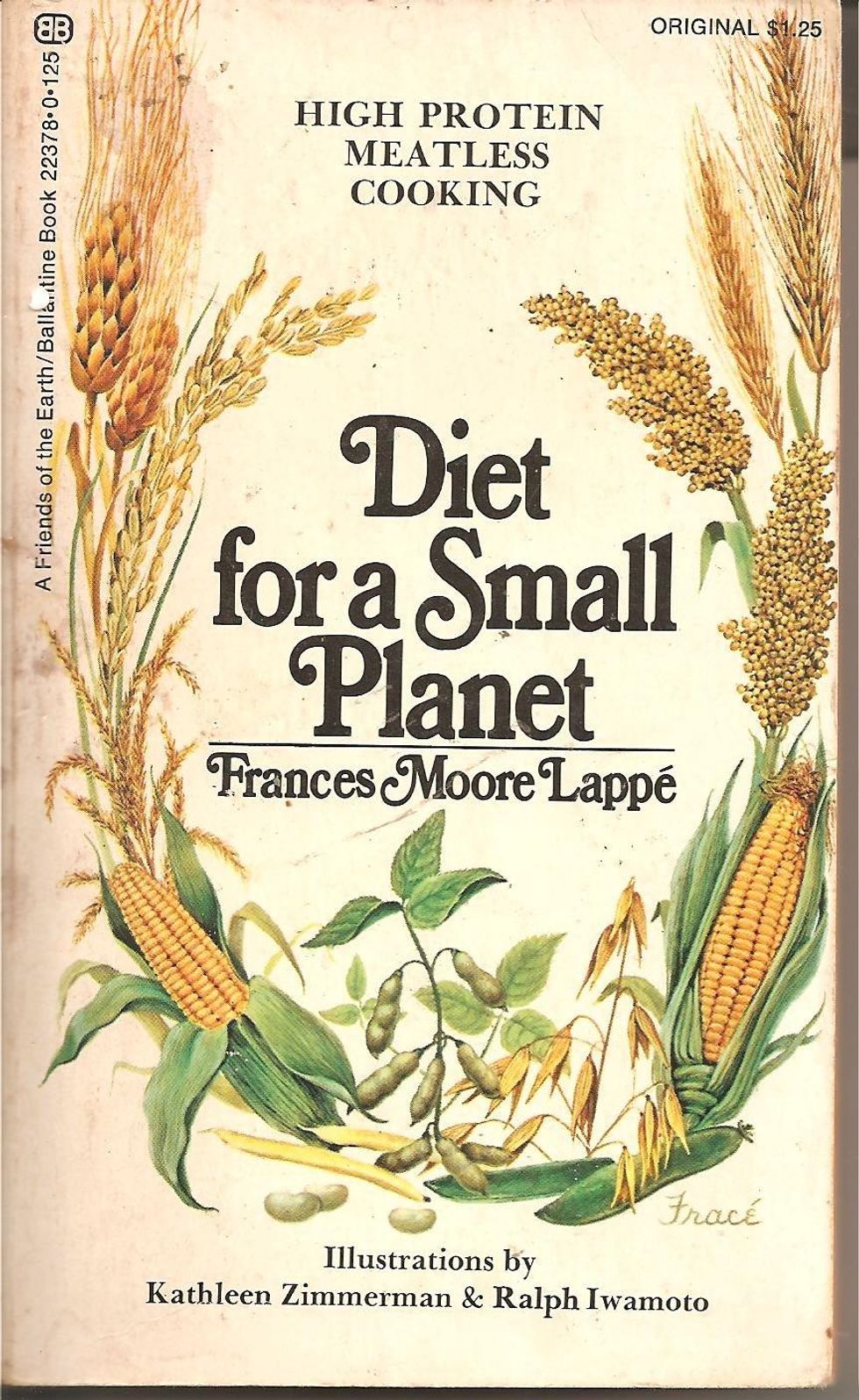
But curiosity had gotten the best of me, and soon, leaving behind my doubts, I knew I had to answer a huge question: Why are so many people going hungry in our world? I dug in at the university agriculture library and drafted a little booklet to share with friends in the Bay Area. I was excited that my search had unearthed some great news: Hunger is not inevitable. There's more than enough food for all. I called the booklet Diet for a Small Planet.
Earlier, I'd been approached by a local "politically correct" alternative publishing group who'd tried to scare me, telling me that Ballantine was mafia connected and would shred any book remainders and dump them into the Bay.
That morning, we drove to my home in Pt. Richmond, where I prepared a simple vegetarian lunch for us. All I remember is her sincere interest in my research, and her final words at the door: "Frankie, whoever publishes your work, I'll buy it."
Note that Betty and her husband Ian Ballantine are considered among the founders of paperback publishing in America, making books vastly more accessible. After their marriage in 1939, the two were sent to New York by Penguin in the UK to create its US arm. Six years later they helped create Bantam Books. Then, in 1952 the couple formed Ballantine Books, known for the Lord of the Rings trilogy, and so much more.
Betty was pure heart, no hard sell. After meeting Betty, the warnings of the other publishing house seemed highly implausible, even ridiculous. So, my choice had been easy, and soon I was under contract with Ballantine for a 1971 release. It was Betty's brilliant idea to add recipes illustrative of my lessons about the personal and planet-advantages of a plant-centered diet. And soon I was at work with gram scales in my kitchen weighing ingredients for the best balance of protein sources and then enlisting friends to test my results.
Jump forward to a few years ago, and I'm on way from Boston to visit Betty at her long-time residence in Bearsville, New York. I'd not seen her in decades, but we'd stayed in touch as the book continued to sell, ultimately millions in multiple languages and three editions. I'd decided it was high time for a formal expression of gratitude, so I brought along a bouquet and carefully pondered my words of thanks.
After hours of talk and laughter, finally I had the nerve to ask, "Betty, why did you take a chance on me? I've never published a thing." Without a moment's hesitation and grinning big, Betty said: "Frankie, it was the ideas! I figure if you couldn't write it, I could do that." And, I believed her. Such confidence in me (and herself!) had opened the way for a lifetime of work: I recently published my nineteenth book. (To heck with that "D"!)
Clearly, Betty Ballantine was a publisher for one reason: She believed ideas could change the world for the better. Over the years, to make this point about her, I'd mention that the Ballantines in 1970 had published Defoliation, describing US actions creating long-lasting harm in Vietnam. Never meant to be a big seller, I'm sure.
So, let's take a moment to celebrate Betty Ballantine and all who believe in the power of ideas, and are willing to take risks to bring new ones to light. Thank you.
In our capitalist economy, business enterprise is controlled by capitalists, of course, and structured to bring highest return to shareholders. We're all supposed to love this set-up because competition among companies gives us ever cooler products and always better deals. Right?
But, wait a minute...where is the competition?
Over just the last 15 years, mergers have proliferated so quickly that in twelve major industries just two companies now control more than half the market. Economists warn us this level of concentration kills competition -- not to mention bringing with it an erosion of wages, as monopoly weakens competition for workers too.
Since monopoly power compromises capitalism's supposed virtues, it's time we ask: Are there better ways to structure business? Clearly, business driven by highest return to existing wealth leads inevitably to concentration and, consequently, to ever-worsening inequality. In America today, three people control as much wealth as the bottom half of us, says Forbes.
So, are we stuck in this deadly spiral toward ever greater concentration of economic power?
No, we can do better. We know we can because some of us already are.
Americans in all walks of life are creating companies with business models driven by social purpose, not just their own pocketbook priorities.
Sixty-four thousand companies in the U.S., for example, are structured as "cooperatives" set up to benefit workers, members, consumers, and the broader society.
In early 1993, for example, I interviewed one such "cooperator," Florinda DeLeon, who just a few years earlier had been a single parent raising three children in the Bronx on welfare benefits. Then, her life changed radically: DeLeon became one of 170 co-owners of a then-new cooperative called Community Home Care Associates (CHCA). Soon thereafter she enjoyed decent pay, health benefits, and paid vacation.
"Being a worker-owner means we decide what's best for us," she told me.
I've never forgotten DeLeon's story, and certainly have hoped all these years that her coop had survived. Then, last week in Wisconsin I was treated to a huge surprise.
At a gathering focused on the value of cooperatives, I met CHCA's current director, Adria Powell. I learned that her home care coop now has over 2,000 workers, making it the largest worker-owned cooperative in the country. I was amazed.
Other CHCA brag points?
Not only do CHCA's workers earn superior wages (roughly twice the market rate) compared to employees of private home-care agencies, but they hold on to their jobs longer, as turnover is only 15 percent, compared to the industry average of 40 percent. Clearly, home health care is a tough job, especially without adequate pay and benefits.
At the same gathering in rural Wisconsin, I was reminded a second time of my failure to foresee the breakthrough success of another non-capitalist enterprise: Organic Valley dairy cooperative, the organizer for the event.
In the 1980s, many Midwest farms were going under and there had been a rash of farmer-suicides. In 1988, near where we were meeting last week, I'd huddled with a handful of farmers who wanted to help themselves and their struggling neighbors. The goal? A dairy cooperative that could help extend organic farming practices while helping buffer farm families from the ravages of the farm economy.
I thought, "Oh, how sweet...these guys care enough to help their neighbors in trouble."
A bit condescending? Yeah, I'll admit it.
Now, three decades later, I feel downright silly. I failed to imagine what this cooperative would become. The courage, compassion, and vision of these determined dairy farmers would build a billion-dollar business, today benefiting more than 2,000 family farms in thirty-five U.S. states, and beyond.
Many people reading this might think that cooperatives are positive but almost irrelevant in light of the power of the dominant capitalist model. To those people, I urge you: Don't fall into the trap I did.
Worldwide, one in ten employed people works in coops; and one billion in ninety-six countries are members of coops--no doubt a number greater worldwide than those who own shares in publicly traded companies. Or consider that the total sales of co-operatives worldwide comes to about $3 trillion, a sum that is equal to the total equity ownership of the five global tech giants: Apple, Google, Microsoft, Amazon, and Facebook.
In one of Italy's most prosperous regions, Emilia Romagna, roughly 30 percent of the economy is generated by cooperatives. With almost 4.4 million people, this region enjoys one of the highest per capita GDPs in Italy.
Co-ops are hardly niche.
Beyond cooperatives, US entrepreneurs are creating additional forms of values-driven enterprise. For instance, roughly 5,400 companies are now incorporated under a new legal structure, the "Benefit Corporation," committed to generating a public benefit beyond profit -- from environmental sustainability to employee healthcare.
Outdoor clothing giant Patagonia is an example. While Americans throw out 81 pounds of clothing each year--almost all of which could be reused--Patagonia commits to repairing and taking back any item it sells.
Of course, I'm not suggesting that these emerging businesses will end the devastation of brutal capitalism, now leaving 1 in 5 Americans with no net worth to fall back on. We must reclaim the lost tradition of "trust busting" and enforce other anti-monopoly rules, remove obstacles to union organizing, seriously address tax-law injustices and much, much more.
What I am suggesting is that we celebrate that the profit-driven-only capitalist enterprise is not the only game in town. And, in our economic lives, we can actively support those enterprises accountable not to wealthy shareholders, but to their workers, the environment, and the community. As citizens we can step up to ensure changes in the rules that govern our economy, enabling the possibility of an economic democracy.