

SUBSCRIBE TO OUR FREE NEWSLETTER
Daily news & progressive opinion—funded by the people, not the corporations—delivered straight to your inbox.
5
#000000
#FFFFFF
To donate by check, phone, or other method, see our More Ways to Give page.
Daily news & progressive opinion—funded by the people, not the corporations—delivered straight to your inbox.
C. J. Polychroniou speaks with progressive economist Gerald Epstein about why alternative banking is possible and urgently needed.
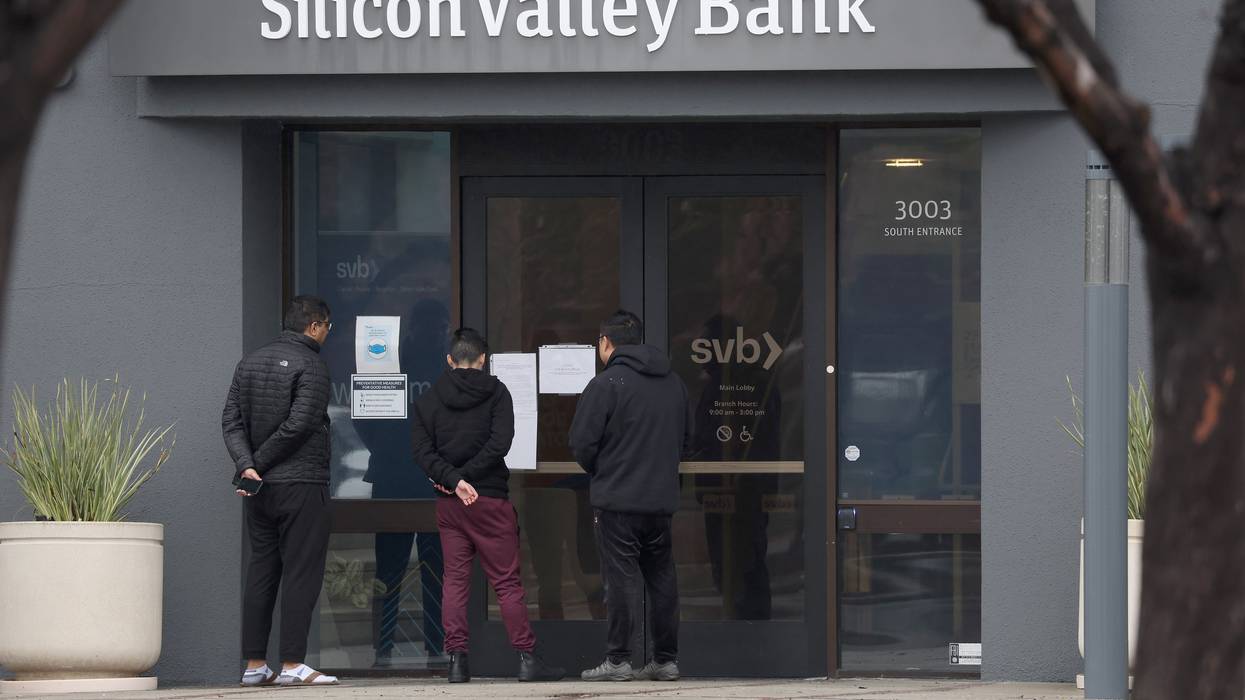
It’s been almost a year since the banking crisis kicked off last March. On Friday, March 10, 2023, Silicon Valley Bank, or SVB, a state-chartered commercial bank based in Santa Clara, California, collapsed after facing a sudden bank run and capital crisis. SVB’s collapse was the second largest bank failure in U.S. history since Washington Mutual in 2008. Two days later, New York-based Signature Bank also collapsed due to yet another bank run. But that was not the end of bank failures in 2023. On May 1, the San Francisco-based First Republic Bank, plagued by many of the same problems as those that doomed SVB and Signature Bank, also went under and was seized in turn by regulators who promptly sold all of its deposits and most assets to JP Morgan Chase. Two more banks would go on to declare insolvency later in the year, bringing the number of failed banks to a total of five.
Indeed, 2023 was the worst year for U.S. banks since 2008. But why do U.S. banks continue to fail after the reforms that were implemented in the aftermath of the 2008 global financial crisis? Why does the business model of commercial banks remain so fragile? World renowned progressive economist Gerald Epstein, author of the recently published book
Busting the Bankers’ Club: Finance for the Rest of Us, tackles these questions in the interview that follows. Epstein is professor of economics and co-director of the Political Economy Research Institute (PERI) at the University of Massachusetts Amherst.
C. J. Polychroniou: Jerry, in your new book Busting the Bankers’ Club, you describe the business model of commercial banks in the age of neoliberalism as “roaring banking” and you juxtapose it with that of “boring banking,” which prevailed from the New Deal era right through the Reagan era. Under “boring banking,” banks were prohibited from many of today’s financial engineering practices and financial shenanigans. The result was relative financial stability and economic growth. Obviously, bankers hated this business model, but what factors made possible the transition from “boring banking” to “roaring banking?” Was it simply because of the “logic” of the free-enterprise system at work, or did it happen because of actual intervention in the realm of policymaking?
Gerald Epstein: Like much historical change, the evolution from “boring banking” to “roaring banking” was the outcome of the underlying dynamics and pressures of the economic system and specific historical conjunctures, all with plenty of involvement of actual human beings and classes.
The major Wall Street bankers were never happy with the New Deal financial regulatory rules that made it harder for them to charge excessively high interest rates, make highly leveraged bets, or engineer fraudulent Ponzi or “pump and dump” frauds against customers. The numbers on Wall Street bankers’ incomes show why. As The Bankers’ Club reports, prior to 1929, bankers scarfed down incomes almost twice as high as the average wage in the economy; but after the Depression and up until the late 1970s, their incomes were about average for the whole economy. As my colleague James Crotty put it, these bankers wanted to break out of their New Deal cages to restore their superior incomes and power.
So, starting in the 1960s the major Wall Street banks organized “the Bankers’ Club,” an army of politicians, lawyers, economists, regulators, and fellow business associates to incrementally poke holes, then ditches and finally massive canals through the wall of New Deal financial regulations. According to Robert Weissman, now president of Public Citizen, these financial firms spent over $5 billion, just counting from the early 80s, on the club and its activities. This effort led, most famously, to the repeal of the Glass-Steagall Act in 1999 under the Clinton administration, which then officially ended the separation of commercial from investment banking.
The Bankers’ Club had a different idea: Tear down the New Deal model and usher in a new era in banking, the “roaring banking” system of mega financial institutions and high-risk banking strategies.
These efforts, carried out by real (mostly) men, were aided by underlying dynamic changes in the U.S. and world economies. The U.S. experienced phenomenal economic growth in the aftermath of World War II, and the world also witnessed the resurrection of the European and Asian economies. In due time, competition facing the U.S. in trade and finance intensified, leading to the demise of the Bretton Woods system of fixed exchange rates and relatively stable interest rates. Massive military spending by the U.S. government on the war in Vietnam from 1964 to 1973 combined with the effects of the geopolitics of energy driven by the formation of OPEC led in the 1970s to large increases in commodity prices and inflation, again putting upward pressure on interest rates to keep up with inflation. Then-Fed Chair Paul Volcker jacked up interest rates in an attempt to break the inflationary pressure, once again destabilizing the interest rate structure in banking. All of these forces put enormous pressure on the New Deal framework, partly because the system depended on relatively stable interest rates. The New Deal model chose to stabilize interest rates in order to try to stabilize bank profits and promote borrowing and investment in non-speculative activities.
Thus, something had to give. In principle, the government could have reformed the system. But the Bankers’ Club had a different idea: Tear down the New Deal model and usher in a new era in banking, the “roaring banking” system of mega financial institutions and high-risk banking strategies.
CJP: The neoliberal era is replete with financial crises and bank failures. In 2008, the world experienced the worst economic disaster since the Great Depression because of a financial crisis that originated in the U.S. There was a sharp decline in economic activity which led to a loss of more than $2 trillion from the global economy while millions of people lost their homes and unemployment skyrocketed. Yet, the regulations that followed in the aftermath of the 2008 global financial crisis were essentially cosmetic, as evidenced by the collapse of five major banks in 2023. What were the reasons that SVB, Signature Bank, and First Republic Bank failed, especially since the Board of Governors of the Federal Reserve System insisted at the time that the banking system was “sound and resilient”?
GE: It is good that you bring up the collapse of SVB and the failures of Signature Bank and First Republic, since we are about to reach the one-year anniversary of these important events which occurred in early March 2023.
The Dodd-Frank Act, signed into law by then-President Barack Obama in 2010, was supposed to bring about the end of the “too-big-to-fail” (TBTF) banks and government bailouts. But a year ago when these banks got into trouble, the turmoil threatened to spread panic into the broader U.S. financial markets, signaling a possible series of bank runs in It’s a Wonderful Life style throughout the system. The Dodd-Frank Act had tried to forestall these types of events by making larger banks (those with assets of at least $50 billion) be subject to more careful monitoring by the Federal Reserve, requiring them to hold more capital of their own so that they could withstand larger shocks, and have greater liquidity (cash or cash-like assets) in order to help forestall bank runs. But during the Trump administration, these “medium-sized banks” lobbied to be exempt from the tougher rules. A major player in the fight was Silicon Valley Bank.
The Fed was still acting as chairman of the Bankers’ Club rather than steward of the public interest.
But on March 10, 2023, after a major bank run hit Silicon Valley Bank, it was forced to close. The Fed did not bail out the bank’s executives, but guaranteed the deposits of its remaining depositors even when these were far above the $250,000 amount covered by Federal Deposit Insurance Corporation insurance. When contagion spread to other banks in the U.S., the Fed guaranteed all deposits, no matter how big.
In April, the Federal Reserve published a major exercise of “self-crit” in its handling of SVB, prior to and after the crisis. It’s pretty accurate assessment included the following four problems:
Though accurate as far as they go, these criticisms miss a crucial point: These are essentially the same problems that allowed bigger banks to instigate the Great Financial Crisis in 2008-2009. The Fed itself had done much to block more fundamental reforms during the Dodd-Frank negotiations and afterward as the rules were finalized. And the Fed under Jerome Powell supported the weakening of rules for the medium-sized banks.
In other words, the Fed was still acting as chairman of the Bankers’ Club rather than steward of the public interest. This, the Fed’s post-mortem would not admit.
CJP: Speaking of the Federal Reserve, in your book you do label it as the “chairman” of the Bankers’ Club. Briefly explain what you mean by that, and does the Fed actually have any input in regulatory reforms proposed by lawmakers?
GE: The Federal Reserve, the central bank of the United States, has two main functions. It is in charge of U.S. monetary policy, which includes trying to manage short-term interest rates and the overall supply of money and credit in the economy. And it also has a major role to play in regulating and supervising banks, including the mega banks or what I call the “roaring banks.” The Federal Reserve has been delegated these powers by the U.S. Congress, which, along with the president, establishes the mandates, or major goals, which the Federal Reserve is supposed to try to achieve. The question of the Fed’s mandates or goals has been a subject of long-term political fights in the United States, which explains why the Federal Reserve is a “contested terrain.” I say that the Fed is the “chairman” of the Bankers’ Club because history shows that, for most of the time, the big banks and the capitalist class at large win the contest for dominance of the Fed, both with respect to its monetary policy and regulatory policy. For example, after a long political battle, the Federal Reserve was given by Congress a dual mandate: to achieve high employment and stable prices (steady and low inflation). In addition, more recently, the Federal Reserve was given a mandate to maintain financial stability. But if one studies the Fed’s record, we find that when there is a conflict between keeping inflation very low (which finance normally prefers) and achieving full employment (which workers tend to prefer) the Fed almost always chooses low inflation. And when it comes to regulating banks tightly in order to maintain financial stability, or bailing them out after they get into trouble, the Fed has preferred to simply bail them out. More generally, the Fed offers significant favors to the banks, and in return expects the banks to protect its operations from the intrusive hands of Congress and the president.
To answer your question more directly, the Fed has a big influence on the regulations that Congress eventually passes, as one can see from the inordinate influence that Alan Greenspan had in the legislation to gut Glass-Steagall, and the inordinate role that Ben Bernanke and the Fed had in ensuring that Dodd-Frank regulations were riddled with loopholes.
CJP: The Dodd-Frank Wall Street Reform and Consumer Protection Act has been treated as one of the most significant U.S. regulatory reforms since the Great Depression. But it does remain a highly flawed regulatory framework, and even plugging all the holes in it won’t do the job, you argue in your book. What are the strategic shortcomings of the Dodd-Frank approach to financial regulation?
GE: To identify the flaws in Dodd-Frank, one can start by identifying the causes of the major financial crises we have experienced as well as the rocks and hard places the regulators found themselves between in responding to these crises. These causes are:
Dodd-Frank did not really address these problems, and the Trump administration weakened the Dodd-Frank rules even further. As such, these problems are still very much with us.
CJP: What measures do you propose for improving financial regulation, so we won’t have bank failures and severe recessions triggered by financial crises?
GE: At a minimum, we must address these “causes” of the problems that I identified above:
This last point touches on an important and more general issue. Financial regulation, at least since the New Deal, has been a negative screen: a list of things banks should NOT do. However, we have many crucial societal problems that the financial system should be taking a more proactive role to help solve. These include, for example, helping to build a green energy economy and ending our reliance on fossil fuels. Also, and this is equally important, contributing to the economic development of marginalized communities. Financial institutions that get government support—and that means ALL of them—should not only avoid crashing our economy but also contribute to our society’s important needs.
CJP: In Busting the Bankers’ Club, you advocate the establishment of banks without bankers because financial regulation alone will not be sufficient to address the plethora of problems (poverty, inequality, discrimination, climate change) facing the contemporary United States. How far can public banking go in addressing these problems, and how do we overcome the resistance of the political system to radical proposals that aim toward the making of a democratic economy?
GE: Yes. Private banks, no matter how regulated, or how incentivized to do socially useful activities, will not be sufficiently motivated to provide many of the key long-term social goods that we need: green energy, healthy communities for all, sufficient financial resources for the development of our rural areas. The reason is that these banks focus on maximizing profits in the short to medium term. Many of these other activities are socially profitable but might not be sufficiently privately profitable, at least in the short to medium term. As a result, we need more publicly oriented financial institutions, such as public banks that are dedicated to broader social goals.
There are activist groups in more than 20 states across the U.S. who are pushing for public banks of various kinds. The most successful ones so far are located in California, but New Jersey is also moving closer to establishing a public bank and there is a strong public bank campaign underway in Massachusetts.
The Federal Reserve should give the same level of support to public banking organizations as it has to private banks.
Still, there are several general obstacles to implementing an ecosystem of public banks adequate to face the problems we have. One is the intense opposition of the Bankers’ Club even though most of these public bank initiatives are structured to minimize competition with the private banks. For example, they do not take deposits; they do not lend directly to customers but rather to other banks who then lend to final customers, etc. Apparently, the Bankers’ Club simply does not want to legitimize any competitive sources of finance that could undercut their power.
Moreover, even if you add up all the public banking initiatives, they would still not be large enough or widespread enough to make a huge dent in the problems we are facing. What we need are national public banking institutions. For example, the Inflation Reduction Act (IRA) created a small Green Development Bank that, with support, could grow and thrive. A more activist and socially oriented Federal Reserve could play an important role here. The Federal Reserve should give the same level of support to public banking organizations as it has to private banks. And it should broaden its tools to promote key social goals: For example, the Fed could buy Green Bonds. It has already bought asset backed securities to bailout the banks.
How do we overcome resistance from the Bankers’ Club and right-wingers to these kinds of reforms? Two things: Join the Club Busters, those activists who are trying to block the Bankers’ Club and promote more socially useful institutions; and protect democracy by helping to get money out of the financial system (eg. repeal
Citizen’s United), expand voting rights, and fight against fascism.
In the last chapter of my book, I suggest that we all bite off what we can chew. Look around and join others who are fighting one of more of these battles. Join them and pitch in. As our forces gather, we will have impacts that build on each other. If some of our initiatives get blocked, other initiatives will move forward.
There are many Club Busters around the country, and indeed the world. In the U.S. we have public banking organizations,
Americans for Financial Reform, Better Markets, Rainforest Action Network, and many others. Support politicians who fight for these issues, including Elizabeth Warren, Sherrod Brown, Jeff Merkley, and Alexandria Ocasio-Cortez.
There are plenty of places to join others and take a stand. That’s how we fight the Bankers’ Club.
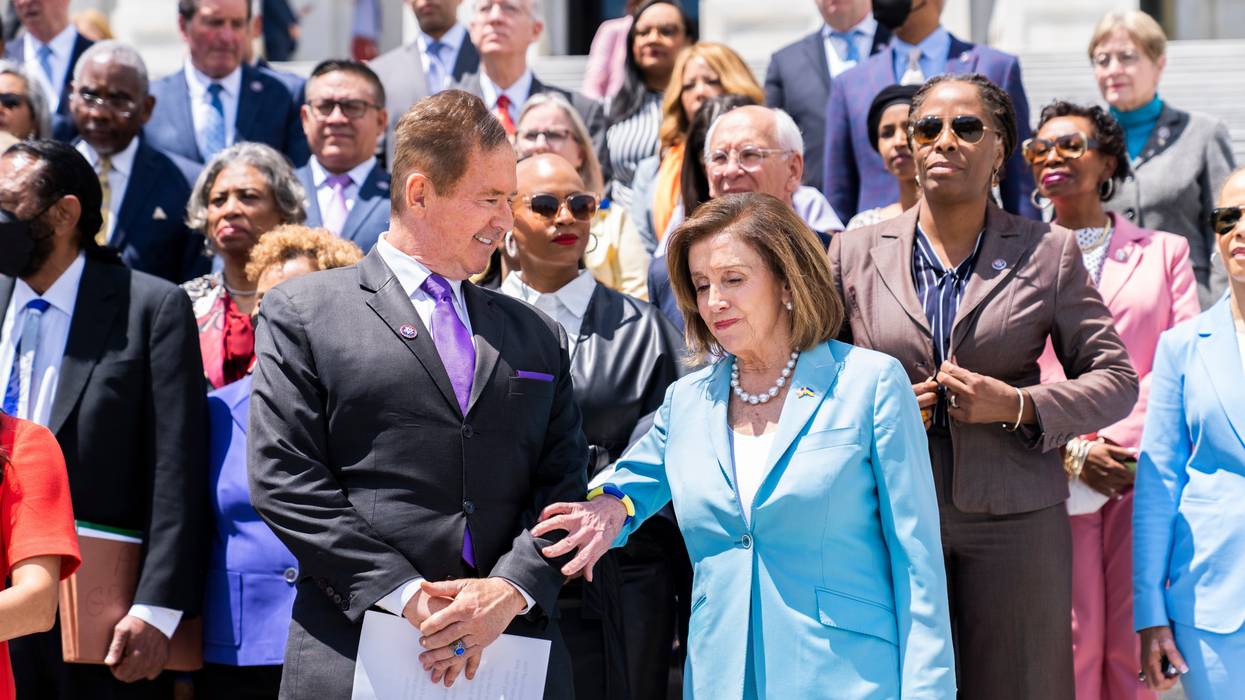
"Members of Congress should not be allowed to trade stock," said one former congressional candidate. "It's corruption."
A financial watchdog group on Tuesday released its annual report on congressional stock trading, which shows that "Congress blew the market out of the water" in 2023, fueling fresh calls for a ban targeting U.S. lawmakers and their immediate family members.
"Members of Congress shouldn't be allowed to trade stocks of the companies they regulate for the same reasons referees aren't allowed to bet on the games they officiate," Melanie D'Arrigo, a former Democratic congressional candidate who is now executive director of the Campaign for New York Health, said in response to the Unusual Whales report.
Nina Turner, who also previously ran for Congress and is now a senior fellow at the Institute on Race, Power, and Political Economy, agreed. As Turner put it: "Members of Congress should not be allowed to trade stock. It's corruption."
While the Stop Trading on Congressional Knowledge (STOCK) Act of 2012 was intended to ban insider trading by members of Congress, lawmakers are still permitted to buy and sell stocks, even those of companies impacted by their work on Capitol Hill.
Revelations about lawmakers' stock market gains over the past few years, including previous reports from Unusual Whales, have bolstered efforts to pass legislation barring members of Congress, their spouses, and their dependent children from trading individual stocks—such as the Bipartisan Restoring Faith in Government Act introduced in May.
U.S. Congressman Ken Buck (R-Colo.) responded to the latest Unusual Whales report by promoting the Bipartisan Ban on Congressional Stock Ownership Act, which he introduced last year with Reps. Matt Rosendale (R-Mont.) and Pramila Jayapal (D-Wash.), chair of the Congressional Progressive Caucus.
"Members of both parties have misused their influence to buy and trade stocks. This is an issue which hurts all Americans," Buck said Tuesday. "The Bipartisan Ban on Congressional Stock Ownership Act will ensure that Congress is voting to represent their constituents instead of their wallets."
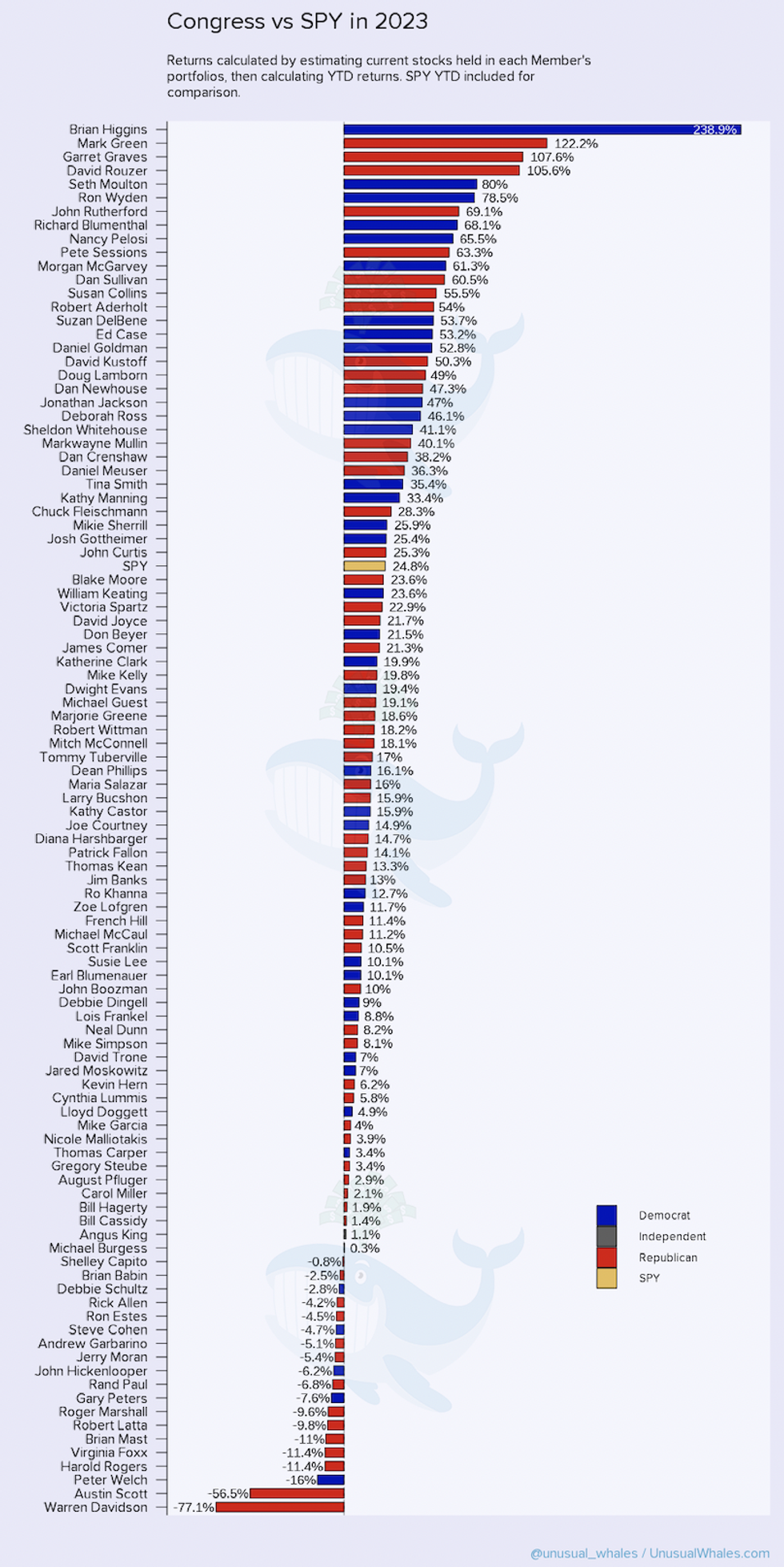
Unusual Whales' new report includes a graph comparing lawmakers' estimated returns for 2023—based on the current stocks in their portfolios—with the SPDR S&P 500 ETF (SPY), an exchange-traded fund that tracks the performance of the S&P 500 Index.
Thirty-two members of Congress—evenly split among Democrats and Republicans—fared better than SPY, which was up 24.81%. Overall, Democratic lawmakers were up 31.18% last year while their GOP colleagues were up 17.99%. At the top was U.S. Rep. Brian Higgins (D-N.Y.) at 238.9%.
Joining him in the top 10 were: Rep. Mark Green (R-Tenn.), 122.2%; Rep. Garret Graves (R-La.), 107.6%; David Rouzer (R-N.C.), 105.6%; Seth Moulton (D-Mass.), 80%; Sen. Ron Wyden (D-Ore.), 78.5%; Rep. John Rutherford (R-Fla.), 69.1%; Sen. Richard Blumenthal (D-Conn.), 68.1%; former House Speaker Nancy Pelosi (D-Calif.), 65.5%; and Pete Sessions (R-Texas), 63.3%.
"Numerous members in Congress traded war stocks before the Israel-Gaza-Palestine conflict," Unusual Whales noted.
As Common Dreams has reported, after Israel declared war in response to a Hamas-led attack on October 7, the stock of defense companies soared and weapons giants have continued to cash in on the conflict.
Unusual Whales also highlighted that "the banking crisis saw numerous mergers and unusually timed transactions, both by banking executives and politicians."
The person behind Unusual Whales granted ABC News an anonymous interview about such trades back in November:
"One thing people always say is that members are very good at picking stocks, that's often assumed… but to be quite frank, members were also quite good at avoiding losses," he told ABC News in his first television interview.
He pointed ABC News to the collapse of Silicon Valley Bank (SVB) and the regional banking crisis. He tracked trades showing several members of Congress, who sit on the House and Senate committees that regulate the financial industry, who sold SVB and other bank stocks before they experienced their sharpest decline.
"I can't know the intent, if that was what they were aiming to do," he told ABC News. "But many of the members who were trading banking stocks during that time performed very, very well."
In the Tuesday report, Unusual Whales also flagged unusual trades by Pelosi, whose husband is a trader, and Sen. Tommy Tuberville (R-Ala.), "one of the most active traders in Congress."
"We hope this will be our final report, and this report (with the history of our previous research) will be good enough to end the argument about Congress and trading," concluded Unusual Whales, which has also launched a tool so members of the public can track the portfolios of individual lawmakers.
Fox News host Jesse Watters on Tuesday asked U.S. Rep. Marjorie Taylor Greene (R-Ga.) about the report, which shows that she was up 18.6% last year. She responded, "I actually asked my team about that today—why my name was on the list—because I don't even own any stocks and I haven't all of 2023."
"As a matter of fact, we have to report everything, including children who are dependents of ours. And I think what was reported was actually related to my son's account that his father and I had set up for him years ago," added Greene, who shares three children with her ex-husband.
Newsweek reported that a clip of the interview "sparked questions and mockery from social media users, some of whom accused Greene of using her son as an excuse to cover up her own trading."
"We urge the commission to continue to focus on its vital work preserving market integrity and protecting the public, uphold the letter and spirit of the Dodd-Frank Act, and withdraw the proposed rule."
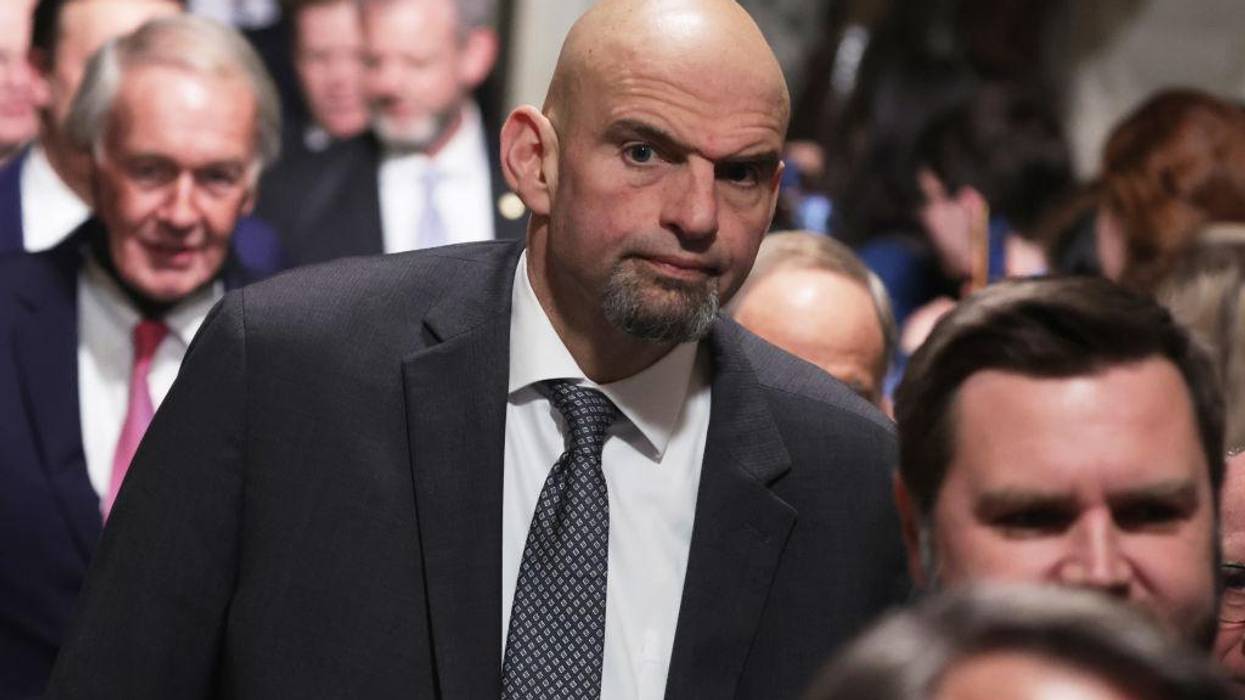
A trio of Democratic U.S. senators on Monday wrote to Commodity Futures Trading Commission Chair Rostin Behnam expressing their "serious reservations" with the agency's proposed rule on seeded funds and money market funds, a policy the lawmakers warned would "undermine the goals of Dodd-Frank" by rolling back the already weakened financial oversight law.
Passed in the wake of the 2008 global financial meltdown, the Dodd-Frank Wall Street Reform and Consumer Protection Act—which was partially rolled back during the Trump administration—overhauled federal financial regulation. In a letter to Behnam, Sens. John Fetterman (Pa.), Sherrod Brown (Ohio), and Tina Smith (Minn.) assert that the CFTC's proposed rule is a "step in the wrong direction" that would increase market instability by decreasing collateral requirements for certain transactions.
The Global Markets Advisory Committee, largely made up of finance industry insiders, recommended the proposed rule in 2020 during the Trump administration.
As the letter explains:
The proposed rule would reduce or eliminate initial margin requirements for up to three years for a subset of swap market participants. "Initial margin" is the collateral that participants must set aside when entering swap agreements. Initial margin requirements, along with "variation margin" and other capital requirements, protect counterparties to a swap in the event of a default. Dodd-Frank set up comprehensive rules for swap agreements after they significantly contributed to the 2008 financial crisis and the federal government was forced to bail out Wall Street.
"The 2008 financial crisis showed the dangers that swaps can pose to economic stability, and Dodd-Frank directed regulators, including the CFTC, to require initial margin for uncleared swaps specifically to reduce those risks," the senators wrote. "It is vital for the CFTC to continue upholding its Dodd-Frank mandate and to maintain high standards and safeguards for this important market."
"We urge the commission to continue to focus on its vital work preserving market integrity and protecting the public, uphold the letter and spirit of the Dodd-Frank Act, and withdraw the proposed rule," the lawmakers added.
The collapse earlier this year of Silicon Valley Bank and Signature Bank—both of which benefited from regulatory relief thanks to the 2018 rollback—brought renewed scrutiny on Dodd-Frank's Republican-engineered shortcomings. Sen. Mike Crapo (R-Idaho), who wrote the 2018 banking deregulation law, insisted in March that "there is no need for regulatory reform" in the wake of the banks' failures.
Robert Weissman, president of the consumer advocacy group Public Citizen, responded to Crapo's assertion by writing that "you have to be hard-core committed to mindless free-market fundamentalism—or truly in thrall to your donors—to insist there's no need for new regulations after Silicon Valley Bank."
Last month, Sen. Elizabeth Warren (D-Mass.) also wrote a letter to Behman sharing her concerns about the proposed rule. Noting the policy's 2020 introduction, Warren said in her October 10 letter that "it is unclear why the commission is choosing to propose these rules now, three years later, without conducting its own additional analyses of whether the changes are necessary or will strengthen the stability of the domestic financial system."
"I strongly urge the commission not to loosen the existing rules and not to roll back important Dodd-Frank Act reforms," Warren added.

The Office of Strategic Capital appears to be giving its consultants "an opportunity to refresh their rolodexes without having appropriate guardrails in place to protect the public interest," said the senator.
Warning that a U.S. Department of Defense office created by Defense Secretary Lloyd Austin has created "clear conflicts" of interest as the agency works to finance technological advances, Sen. Elizabeth Warren on Sunday evening wrote to the department with a number of questions about how the Office of Strategic Capital operates and what officials are doing to ensure a separation between the Pentagon and investment firms vying to capitalize on the agency's work.
Austin announced the creation of the Office of Strategic Capital (OSC) in 2022, saying it would help the U.S. win "a global competition for leadership in critical technologies...and build enduring national security advantages."
As Warren noted on Sunday, the office provides "investment priorities in the form of an investment prospectus" to the Strategic Capital Advisory Council, which includes Under Secretary of Defense for Research and Engineering Heidi Shyu, to whom the Massachusetts Democrat addressed her letter.
The senator warned that at least two advisers at the OSC have maintained their senior positions at their consulting and venture capital firms, creating the appearance of multiple conflicts of interest.
"While some experts see this office supporting the development of key national security capacities, others have called it merely 'good innovation theater.' I am concerned that this office is already too cozy with private investment firms."
OSC consultant Linda Lourie works as a senior adviser for WestExec Advisors, which has helped technology startups with defense contracts, while OSC policy adviser Kirsten Bartok Touw has remained in her role as a managing partner at venture capital firm New Vista Capital.
Both Lourie and Touk were hired as special government employees (SGEs), exempting them from many of the ethics rules that apply to most federal employees.
SGEs are prohibited from "participating personally and substantially in any particular matter that has a direct and predictable effect on their own financial interests" and are subject to fines or imprisonment if they violate those rules, but, Warren noted, they are "not barred from lobbying on behalf of or representing outside entities to federal agencies in all cases, and may continue to receive outcome income."
While the DOD has said consultants including Lourie and Touk are only involved in "broad policy discussions" and not decisions about investments the OSC becomes involved in, Warren cited a Government Accountability Office report that said the employees can access "non-public political intelligence information" via "briefings, meetings, committee hearings, public or non-public documents, personal conversations, and other communications" at the Pentagon or on Capitol Hill.
"The OSC appears to be providing these consultants an opportunity to refresh their rolodexes without having appropriate guardrails in place to protect the public interest. As one of the consultants has observed, winning defense contracts is 'about relationships and connectivity,'" wrote Warren, quoting a comment Touk made in 2022.
The senator further noted that SGEs who serve for less than 60 days are not subject to a typical one-year "cooling-off period" during which they are barred from contacting their former agency regarding official matters.
The OSC and its reliance on SGEs seems "perfectly designed to generate conflicts of interest," said Jonathan Cohn of the advocacy group Progressive Massachusetts.
Warren wrote that the creation of the OSC by Austin—a former board member of defense contractor Raytheon—serves as an argument for the passage of her proposed legislation, the Anti-Corruption and Public Integrity Act. The bill would require all federal ethics laws to apply to SGEs and would require such employees to recuse themselves from "matters that might financially benefit themselves, a previous employer, or client from the preceding four years."
As it stands, Jeff Hauser of the Revolving Door Project told Vox in April, "it would take Herculean firewalls in one's brain—that human beings are not capable of—to ignore the fact that you continue to be employed at an entity that has ongoing interest in certain outcomes on decisions you're working on in government."
In her letter, Warren also pointed to reporting in The Intercept in April which said that as Silicon Valley Bank (SVB), which served as a lender to several tech startups, neared collapse in March, the OSC sent an internal email saying it was "assessing impacts to national security" that could arise from the bank's failure.
Because the OSC has "moved to provide loans, guarantees, and other financial instruments to technology companies it considers crucial to national security," reported The Intercept, "the defense agency advocated for government intervention to insure the investments. The Pentagon had even scrambled to prepare multiple plans to get cash to affected companies if necessary."
Warren on Sunday called on Shyu to disclose which companies contacted OSC about SVB's collapse and asked if "any of the companies that contacted OSC about SVB's collapse [were] current or former employers or clients of OSC personnel."
"While some experts see this office supporting the development of key national security capacities, others have called it merely 'good innovation theater,'" said Warren. "I am concerned that this office is already too cozy with private investment firms."
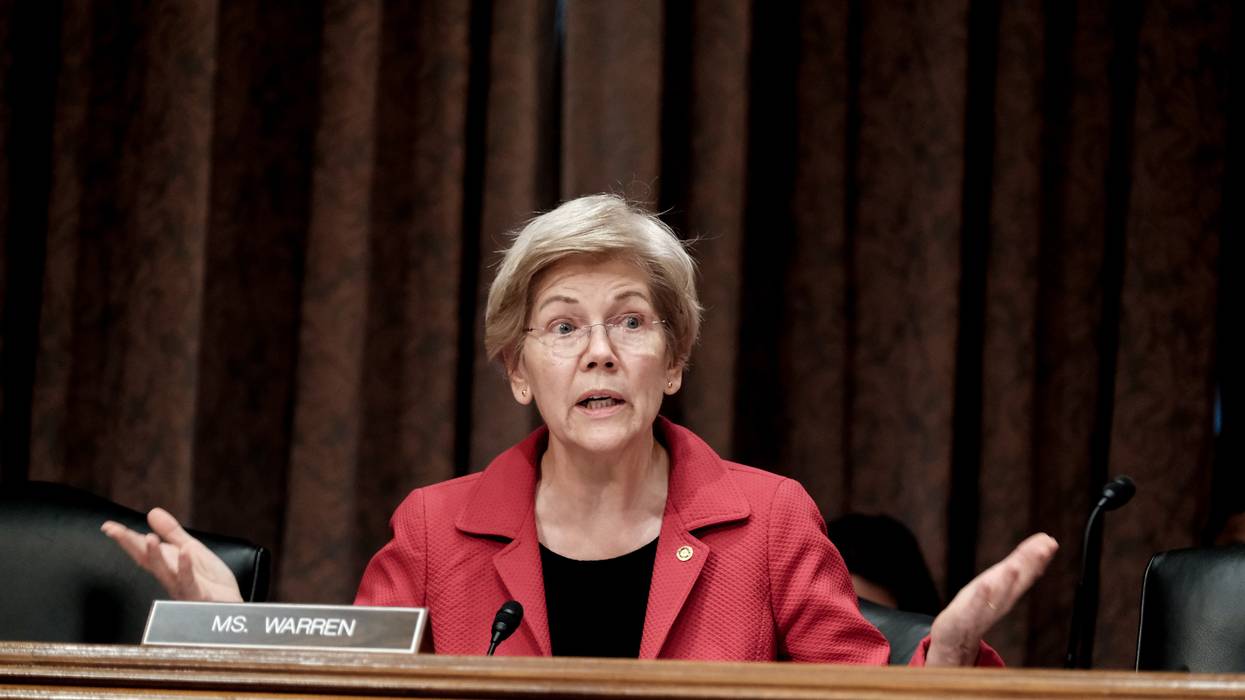
"The recent bank crisis underscores the urgency of strengthening the merger review process and reversing the dangerous trend of bank consolidation."
In the wake of three recent bank failures, U.S. Sen. Elizabeth Warren on Tuesday urged financial regulators to promote competition rather than further consolidation in the industry and improve merger guidelines.
The Massachusetts Democrat's call for action came in a letter to Assistant Attorney General Jonathan Kanter, Federal Deposit Investment Corporation (FDIC) Chairman Gruenberg, Acting Comptroller of the Currency Michael Hsu, Federal Reserve Vice Chair for Supervision Michael Barr, and Treasury Secretary Janet Yellen.
"Earlier this year, a series of fatal errors—poor risk management by bank executives, corporate greed, deregulation, and the lack of sufficient federal supervision—led to the implosion of Silicon Valley Bank, which was shortly followed by the collapses of Signature Bank, and First Republic," she wrote. "Unfortunately, Secretary Yellen and Acting Comptroller Hsu have recently indicated that they appear to be taking the wrong lessons from these bank failures, suggesting that they would like to see more bank consolidation."
"The number of commercial banks in the U.S. has fallen by 70% over the past two decades, and the trend is accelerating."
The letter references reporting from Politico's "Morning Money" (MM) earlier this month. As the outlet detailed:
A top lobbyist for big U.S. banks is hearing more openness from government officials on the topic of mergers for midsize lenders in the wake of banking stress earlier this year. But the industry wants more than just talk.
"There's been something of a sea change in Washington over the last two months," Bank Policy Institute CEO Greg Baer told MM in an interview this week. "I do think, at the highest level, and at the highest levels, there is a recognition that midsize banks need to be allowed to merge and be acquired potentially by larger banks."
"The problem, though, is that's easy to say," he added. "But you have to convince banks that in fact, you mean what you say."
Warren argued to Yellen and the letter's other recipients that "while your agencies are working to update the guidelines under which you evaluate bank mergers, which were last published in 1995, the recent bank crisis underscores the urgency of strengthening the merger review process and reversing the dangerous trend of bank consolidation."
"I have long been concerned with bank concentration and your agencies' failures to curb the proliferation of banks that are 'too big to fail,'" the senator acknowledged, noting that none of the federal banking agencies have formally denied a bank merger application in over 15 years, and the U.S. Department of Justice has not challenged one in more than 35 years.
"Meanwhile, the number of commercial banks in the U.S. has fallen by 70% over the past two decades, and the trend is accelerating with $77 billion in bank mergers and acquisitions in 2021 alone—the 'highest yearly deal volume since the 2008 financial crisis,'" she continued. Such consolidation not only harms consumers and small businesses but also heightens "systemic risk in the financial system, reducing the number of smaller banks and creating even more too-big-to-fail banks."
After highlighting President Joe Biden's 2021 executive order directing financial regulators and the attorney general to review and strengthen bank merger oversight, the senator asserted that allowing additional industry consolidation "would be a dereliction of your responsibilities" as well as a betrayal of the White House's "commitment to promoting competition in the economy."
"Shoring up our banking system will require stronger regulation and more vigorous oversight of big banks to keep them from failing in the first place," Warren contended, "and stronger merger guidelines and rules that significantly check consolidation and limit the size and number of too-big-to-fail banks that put taxpayers at risk."
One of the senator's proposed solutions is the Bank Merger Review Modernization Act, which would limit consolidation in the sector with various policies, including a requirement that mergers are in the public interest.
Her new letter concludes with a series of questions about ongoing work to update bank merger review guidelines—including when those guidelines will be released. She requested responses by July 10.
Warren has recently pressed financial regulators not only via letters but also at congressional hearings—including in May, when she grilled Hsu about the sale of First Republic to JPMorgan Chase, which made the nation's biggest bank even bigger. During that event, the senator declared that "the single biggest threat to the U.S. banking system is concentration."
Risk was at the center of every financial upheaval since the 1980s. What can be done to keep history from repeating itself and threatening the banking system, economy, and jobs of everyday people?
First Republic Bank became the second-biggest bank failure in U.S. history after the lender was seized by the Federal Deposit Insurance Corp. and sold to JPMorgan Chase on May 1, 2023. First Republic is the latest victim of the panic that has roiled small and midsize banks since the failure of Silicon Valley Bank in March 2023.
The collapse of SVB and now First Republic underscores how the impact of risky decisions at one bank can quickly spread into the broader financial system. It should also provide the impetus for policymakers and regulators to address a systemic problem that has plagued the banking industry from the savings and loan crisis of the 1980s to the financial crisis of 2008 to the recent turmoil following SVB’s demise: incentive structures that encourage excessive risk-taking.
The Federal Reserve’s top regulator seems to agree. On April 28, the central bank’s vice chair for supervision delivered a stinging report on the collapse of Silicon Valley Bank, blaming its failures on its weak risk management, as well as supervisory missteps.
In each of the financial upheavals since the 1980s, the common denominator was risk.
We are professors of economics who study and teach the history of financial crises. In each of the financial upheavals since the 1980s, the common denominator was risk. Banks provided incentives that encouraged executives to take big risks to boost profits, with few consequences if their bets turned bad. In other words, all carrot and no stick.
One question we are grappling with now is what can be done to keep history from repeating itself and threatening the banking system, economy, and jobs of everyday people.
The precursor to the banking crises of the 21st century was the savings and loan crisis of the 1980s.
The so-called S&L crisis, like the collapse of SVB, began in a rapidly changing interest rate environment. Savings and loan banks, also known as thrifts, provided home loans at attractive interest rates. When the Federal Reserve under Chairman Paul Volcker aggressively raised rates in the late 1970s to fight raging inflation, S&Ls were suddenly earning less on fixed-rate mortgages while having to pay higher interest to attract depositors. At one point, their losses topped US$100 billion.
S&L executives were often paid based on the size of their institutions’ assets, and they aggressively lent to commercial real estate projects, taking on riskier loans to grow their loan portfolios quickly.
To help the teetering banks, the federal government deregulated the thrift industry, allowing S&Ls to expand beyond home loans to commercial real estate. S&L executives were often paid based on the size of their institutions’ assets, and they aggressively lent to commercial real estate projects, taking on riskier loans to grow their loan portfolios quickly.
In the late 1980s, the commercial real estate boom turned bust. S&Ls, burdened by bad loans, failed in droves, requiring the federal government take over banks and delinquent commercial properties and sell the assets to recover money paid to insured depositors. Ultimately, the bailout cost taxpayers more than $100 billion.
The 2008 crisis is another obvious example of incentive structures that encourage risky strategies.
At all levels of mortgage financing–from Main Street lenders to Wall Street investment firms–executives prospered by taking excessive risks and passing them to someone else. Lenders passed mortgages made to people who could not afford them onto Wall Street firms, which in turn bundled those into securities to sell to investors. It all came crashing down when the housing bubble burst, followed by a wave of foreclosures.
Incentives rewarded short-term performance, and executives responded by taking bigger risks for immediate gains. At the Wall Street investment banks Bear Stearns and Lehman Brothers, profits grew as the firms bundled increasingly risky loans into mortgage-backed securities to sell, buy, and hold.
Incentives rewarded short-term performance, and executives responded by taking bigger risks for immediate gains.
As foreclosures spread, the value of these securities plummeted, and Bear Stearns collapsed in early 2008, providing the spark of the financial crisis. Lehman failed in September of that year, paralyzing the global financial system and plunging the U.S. economy into the worst recession since the Great Depression.
Executives at the banks, however, had already cashed in, and none were held accountable. Researchers at Harvard University estimated that top executive teams at Bear Stearns and Lehman pocketed a combined $2.4 billion in cash bonuses and stock sales from 2000 to 2008.
That brings us back to Silicon Valley Bank.
Executives tied up the bank’s assets in long-term Treasury and mortgage-backed securities, failing to protect against rising interest rates that would undermine the value of these assets. The interest rate risk was particularly acute for SVB, since a large share of depositors were startups, whose finances depend on investors’ access to cheap money.
When the Fed began raising interest rates last year, SVB was doubly exposed. As startups’ fundraising slowed, they withdrew money, which required SVB to sell long-term holdings at a loss to cover the withdrawals. When the extent of SVB’s losses became known, depositors lost trust, spurring a run that ended with SVB’s collapse.
For executives, however, there was little downside in discounting or even ignoring the risk of rising rates.
For executives, however, there was little downside in discounting or even ignoring the risk of rising rates. The cash bonus of SVB CEO Greg Becker more than doubled to $3 million in 2021 from $1.4 million in 2017, lifting his total earnings to $10 million, up 60% from four years earlier. Becker also sold nearly $30 million in stock over the past two years, including some $3.6 million in the days leading up to his bank’s failure.
The impact of the failure was not contained to SVB. Share prices of many midsize banks tumbled. Another American bank, Signature, collapsed days after SVB did.
First Republic survived the initial panic in March after it was rescued by a consortium of major banks led by JPMorgan Chase, but the damage was already done. First Republic recently reported that depositors withdrew more than $100 billion in the six weeks following SVB’s collapse, and on May 1, the FDIC seized control of the bank and engineered a sale to JPMorgan Chase.
The crisis isn’t over yet. Banks had over $620 billion in unrealized losses at the end of 2022, largely due to rapidly rising interest rates.
So, what’s to be done?
We believe the bipartisan bill recently filed in Congress, the Failed Bank Executives Clawback, would be a good start. In the event of a bank failure, the legislation would empower regulators to claw back compensation received by bank executives in the five-year period preceding the failure.
Clawbacks, however, kick in only after the fact. To prevent risky behavior, regulators could require executive compensation to prioritize long-term performance over short-term gains. And new rules could restrict the ability of bank executives to take the money and run, including requiring executives to hold substantial portions of their stock and options until they retire.
To prevent risky behavior, regulators could require executive compensation to prioritize long-term performance over short-term gains.
The Fed’s new report on what led to SVB’s failure points in this direction. The 102-page report recommends new limits on executive compensation, saying leaders “were not compensated to manage the bank’s risk,” as well as stronger stress-testing and higher liquidity requirements.
We believe these are also good steps, but probably not enough.
It comes down to this: Financial crises are less likely to happen if banks and bank executives consider the interest of the entire banking system, not just themselves, their institutions, and shareholders.
"Ultimately taxpayers will be on the hook," said the Democratic senator from Massachusetts.
Sen. Elizabeth Warren said Monday that the latest government bailout of a failing Wall Street institution shows how much the financial system remains rigged in favor of powerful banks and that it is beyond time for Congress to step up with increased oversight and reforms.
Federal regulators Monday announced they had seized the entirety of First Republic Bank and sold it to JPMorgan Chase for an undisclosed price—the latest fallout from a deregulated banking system in which the U.S. government has stepped in to backstop Wall Street.
"The failure of First Republic Bank shows how deregulation has made the too big to fail problem even worse," said Warren in response to the news. "A poorly supervised bank was snapped up by an even bigger bank—ultimately taxpayers will be on the hook. Congress needs to make major reforms to fix a broken banking system."
"Once again, we're reaping the bitter harvest of financial deregulation." —Lisa Gilbert, Public Citizen
Last week, as Common Dreams reported, the Federal Reserve issued the results of an internal investigation which showed the collapse of Silicon Valley Bank earlier this year was at least partly due to the 2018 deregulation of mid-sized banks that was approved by Congress and signed into law by former President Donald Trump.
In an early morning statement, the Federal Deposit Insurance Corporation (FDIC) said First Republic—which has been teetering on collapse for weeks—was first closed before being sold to banking giant JPMorgan following a bidding process for the smaller bank's assets.
"As part of the transaction," said the FDIC, "First Republic Bank's 84 offices in eight states will reopen as branches of JPMorgan Chase Bank, National Association, today during normal business hours. All depositors of First Republic Bank will become depositors of JPMorgan Chase Bank, National Association, and will have full access to all of their deposits."
According to the Washington Post:
The acquisition makes JPMorgan, already the nation’s largest bank, even bigger and could draw political scrutiny from progressive Democrats in Washington.
First Republic failed despite having received a $30 billion lifeline from 11 of the country's largest banks in March. JPMorgan said the $30 billion would be repaid after the deal closes. Overall, First Republic will go down in history as the second largest U.S. bank by assets to collapse after Washington Mutual, which failed during the financial crisis of 2008.
FDIC said the cost of the deal to the Deposit Insurance Fund which it manages will be approximately $13 billion.
"In other words, good banks and their customers pay to insure bad banks," said Richard Painter, law professor and former White House ethics chief. "How much did First Republic's execs who created this mess have to pay? If we made them pay, First Republic might not have failed."
In a statement on Friday in anticipation of First Republic's collapse, Lisa Gilbert, executive vice president of Public Citizen, said, "Once again, we're reaping the bitter harvest of financial deregulation."
Gilbert's colleague, financial policy expert Bart Naylor, said, "Bankers at First Republic make reckless decisions, encouraged by bad pay-related incentives."
"Lawmakers understood this was a problem throughout the industry following the 2008 financial crash and required a rule to stop it," Naylor added. "But dangerously, that rule has not yet been implemented. With the failure of First Republic following the failure of Silicon Valley Bank, regulators must reform banker pay immediately."

Sen. Elizabeth Warren said the Federal Reserve chair "failed in his responsibility to supervise and regulate banks that posed a systemic risk to our economy."
Sen. Elizabeth Warren said Friday that Federal Reserve Chair Jerome Powell and other officials "must be held accountable" after an internal Fed investigation found that deregulation and major supervisory lapses were partly to blame for the market-rattling failure of Silicon Valley Bank last month.
The findings of the investigation led by Fed Vice Chair for Supervision Michael Barr were detailed in a 118-page report that Warren (D-Mass.) applauded as "an unflinching assessment of SVB's implosion."
"The investigation clearly identifies how the 2018 legislation that weakened our bank rules and the Fed's 'tailoring' in response to that legislation were major contributors to SVB's failure," said Warren, who has introduced a bill that would repeal the GOP-authored deregulation law.
"The report reveals failures at every level: by SVB's executives and board, bank supervisors, and the Federal Reserve Board itself," the senator added. "Those responsible for these failures must be held accountable, including Chair Powell who failed in his responsibility to supervise and regulate banks that posed a systemic risk to our economy."
Powell, who presided over the Fed's weakening of regulations for mid-sized banks such as SVB in 2019, welcomed the Barr report in a statement and said he agrees with its call to enhance the central bank's regulatory practices, even though the chair has previously resisted efforts to connect SVB's collapse to deregulation.
The report describes the failure of SVB, which prompted an extraordinary federal rescue effort, as a textbook case of mismanagement by the bank and chastised its leadership's failure to "manage basic interest rate and liquidity risk."
But Barr also argues that SVB's collapse highlighted "weaknesses in regulation and supervision that must be addressed," an implicit criticism of Randal Quarles, Barr's Trump-appointed predecessor.
"Regulatory standards for SVB were too low, the supervision of SVB did not work with sufficient force and urgency, and contagion from the firm's failure posed systemic consequences not contemplated by the Federal Reserve's tailoring framework," the report reads.
Barr specifically singles out the 2018 Economic Growth, Regulatory Relief, and Consumer Protection Act, which loosened post-financial crisis regulations for banks with between $50 billion and $250 billion in assets—a category that included SVB. Powell publicly endorsed the changes, which Congress approved with bipartisan support.
Following the passage of the 2018 measure, the Fed enacted rules ostensibly aimed at "tailoring" the central bank's "regulations for domestic and foreign banks to more closely match their risk profiles."
But as then-Fed Governor Lael Brainard warned at the time, the central bank's changes went well beyond what the 2018 law required and weakened "safeguards at the core of the system," threatening the stability of the banking sector.
Barr's report notes that "over the same period that Silicon Valley Bank was growing rapidly in size and complexity, the Federal Reserve shifted its regulatory and supervisory policies due to a combination of external statutory changes and internal policy choices."
"For Silicon Valley Bank, this resulted in lower supervisory and regulatory requirements, including lower capital and liquidity requirements," the report states. "While higher supervisory and regulatory requirements may not have prevented the firm's failure, they would likely have bolstered the resilience of Silicon Valley Bank."
The report makes a number of broad policy recommendations, including calling for a "simpler and stronger oversight program and tailoring framework."
"We plan to revisit the tailoring framework, including to reevaluate a range of rules for banks with $100 billion or more in assets," Barr writes.
Liz Zelnick, director of the Economic Security and Corporate Power program at Accountable.US, said in response to Barr's report that "the rash of recent mid-sized bank troubles is a story that can't be told without one of its main characters, former Trump Fed official Randal Quarles, who instilled a culture of hands-off banking supervision that invited banks to make risky bets beyond their means."
"Congressional Republicans in the pocket of the financial industry played their part when they watered down risk assessment rules and shifted oversight powers to the Trump administration that shared their loyalties to Wall Street," Zelnick said. "Trump officials like Mr. Quarles used their newfound 'discretion' to assure mid-size banks there were no federal consequences to worry about if they gambled with other peoples' money in pursuit of profit—even if they couldn't afford to lose."
"Letting the financial industry write their own rules has led to instability and economic harm time and again, yet alarmingly, the MAGA House Majority sees the latest consequences of right-wing deregulation as an excuse to gut financial safeguards even further," she added.
Revolving Door Project executive director Jeff Hauser, for his part, faulted the new report for not specifically naming the individual Fed officials responsible for decisions that contributed to SVB's collapse.
"If there is a problem coming from the top, an independent, thorough report would have named who at the top is to blame," Hauser said. "Readers can strongly infer that former Vice Chair for Supervision Randal Quarles was a major player, and we echo Accountable.US's calls for him to testify before Congress. But the vice chair for supervision does not manage the staff of the Federal Reserve without the chair's approval, meaning Jerome Powell is ultimately responsible."

"We need to ban trading in individual stocks by members of Congress to begin to restore the public's faith in elected officials," said one critic.
As Democratic lawmakers renew their push for a stock trading ban on Capitol Hill, an analysis released Wednesday found that several members of Congress or their close relatives sold bank equities last month as fears of a financial crisis spread in the wake of Silicon Valley Bank's collapse.
On March 10, the day SVB failed, Rep. Jared Moskowitz (D-Fla.) sold $65,000 to $150,000 worth of Seacoast Banking Corporation shares, according to disclosure data compiled by Capitol Trades.
The New York Times reported Wednesday that 48 hours after the Florida Democrat's stock sale, he "said in a television interview that he had attended a bipartisan congressional briefing on the tumult."
"And on March 13, as investors fretted over the failure of Silicon Valley Bank and two other, smaller banks, Seacoast Banking shares fell nearly 20%," the Times noted. "A spokesman for Mr. Moskowitz said in an email that the Seacoast share sales had been suggested by the congressman's financial adviser as a means to diversify his young children's holdings. Mr. Moskowitz said the congressional briefing on the bank crisis had taken place just before the television interview and after the shares were sold."
Moskowitz wasn't alone in selling his bank holdings as the run on SVB and its subsequent fall sparked concerns of contagion, prompting federal regulators to bail out the California-based firm—as well as Signature Bank—and effectively backstop the entire banking sector.
Citing Capitol Trades, the Times reported that Rep. Dan Goldman (D-N.Y.) "sold shares of First Republic Bank, the large depositor that was rapidly losing both cash and clients, on March 15, the day before it received an industry bailout of $30 million."
"The wife and children of Rep. Ro Khanna, Democrat of California, sold First Republic shares that same day," the Times continued. "Rep. John Curtis, Republican of Utah, sold shares in First Republic from a joint account with his spouse on March 16, the day the industry bailout occurred. By that time, First Republic shares had already fallen nearly 80 percent from a February peak. The timing of the sales by those three lawmakers or their relatives meant that the sellers averted an additional price swoon that was still to come."
"People need to have confidence that policymakers are making decisions based on what's best for the country, not what's best for their stock portfolios."
Details of the lawmakers' suspiciously well-timed transactions came a day after Sen. Jeff Merkley (D-Ore.) led a group of House and Senate members in introducing the Ending Trading and Holdings in Congressional Stocks (ETHICS) Act, legislation that would prohibit members of Congress, their spouses, and their dependent children from trading individual stocks.
Just one Republican, Rep. Michael Cloud of Texas, has cosponsored the new bill.
Sen. Sherrod Brown (D-Ohio), a longtime proponent of banning stock trading in Congress and a cosponsor of the ETHICS Act, said during a Tuesday press conference that lawmakers "were trading bank stocks" amid widespread turmoil in the financial sector last month.
"We know what position members of Congress can be in, and we know that the temptations are too great for some members of Congress to resist," said Brown, the chair of the Senate Banking Committee. "That's why this legislation is so important. People need to have confidence that policymakers are making decisions based on what's best for the country, not what's best for their stock portfolios."
Earlier this month, The Wall Street Journal reported that two lawmakers—Reps. Nicole Malliotakis (R-N.Y.) and Earl Blumenauer (D-Ore.)—"reported trades in bank stocks last month as they worked on government efforts to address fallout from two of the largest bank failures in American history."
"Malliotakis... bought stock in a regional bank before a subsidiary agreed to take over Signature Bank's deposits following its closure," the Journal reported. "Days before she bought the stock, she said she met with financial regulators to discuss the bank’s closure."
Blumenauer, who signed onto legislation that would impose stricter regulations on mid-sized banks, "reported selling between $1,001 and $15,000 in Bank of America stock on March 9, as panic was spreading and shares of the four biggest U.S. banks—including Bank of America—slid," the newspaper added. "A week after the sale, the stock was down 5%."
Adam Smith, vice president for democracy initiatives at Citizens for Responsibility and Ethics in Washington, tweeted Wednesday that "corrupt or not, stories like this make the institution look bad."
"We need to ban trading in individual stocks by members of Congress to begin to restore the public's faith in elected officials," Smith wrote.

Democrats have an opportunity "to raise the volume on bank reform and accountability—and be seen as challenging power on behalf of everyday people," the poll showed.
The largest U.S. bank collapse since the 2008 financial meltdown has left Americans especially eager for Congress to rein in Wall Street—and impatient with the power the financial sector has over lawmakers, according to polling released Monday.
A month after Silicon Valley Bank (SVB) failed following its decision to invest $91 billion of its deposits in long-term Treasury bonds before their value plummeted as the Federal Reserve raised interest rates, progressive think tank Data for Progress joined the Progressive Change Institute in polling 1,215 likely voters about the bank and banking regulations.
Nearly 7 in 10 respondents said they were "very" or "somewhat" concerned about the health of the banking industry following SVB's collapse, and 82% said they supported Congress taking action to strengthen banking rules in order to avoid another failure.
More than 70% said they would support the reinstatement of "critical banking rules" that were rolled back in 2018. Those rules weakened regulations for banks with between $50 billion to $250 billion in assets, and Sen. Elizabeth Warren (D-Mass.) and Rep. Katie Porter (D-Calif.) said last month that their repeal was a major driver of SVB's collapse as they introduced the Secure Viable Banking Act to impose the rules once again.
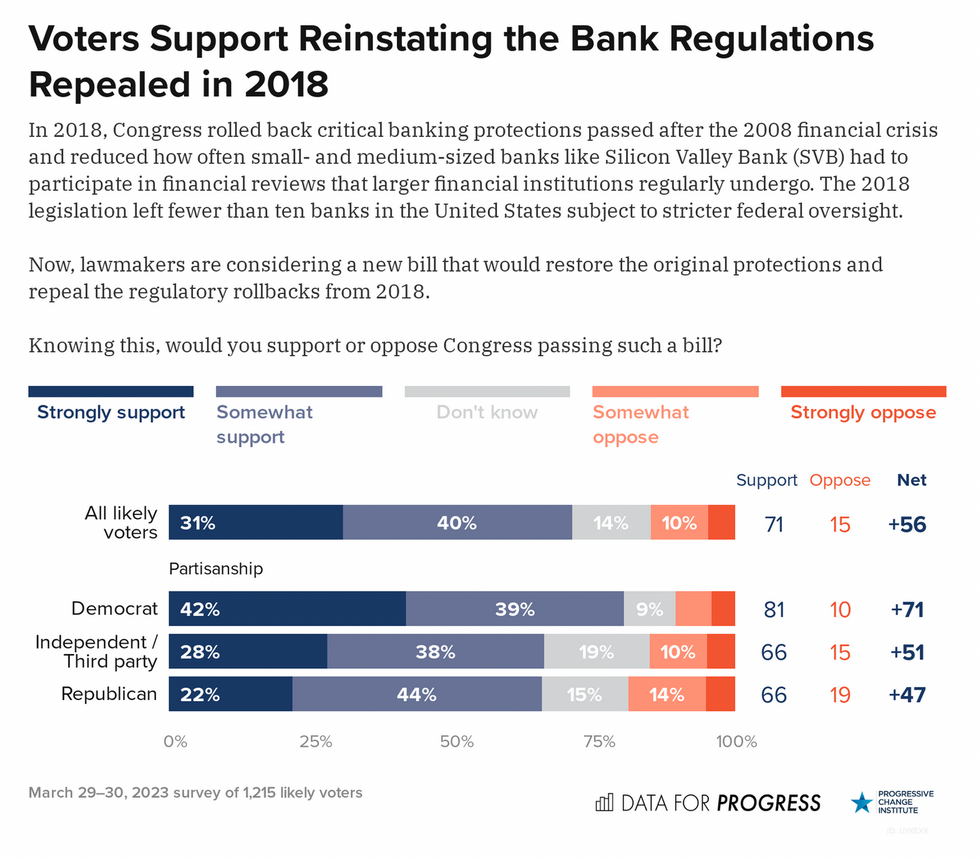
The Biden administration said after the collapse that it would take steps including creating an emergency fund to make sure all SVB deposits were covered and demanded that executives be held accountable for bonuses that were handed out in the hours before the bank failed, but 90% of respondents told Data for Progress that they had heard little or nothing about the proposed reforms.
"While voters strongly support reforms in the banking sector and the actions taken by the Biden administration in the wake of SVB's collapse, these results signal that the administration has room to expand communication on the subject and claim this issue for Democrats," said Data for Progress.
The organization noted that likely voters were more supportive of President Joe Biden's plan when told the administration had created an "emergency fund" than when the fund was described as a "bailout" and when they were told that SVB's client base, made up largely of "billionaire tech investors and multimillion-dollar companies," had been helped by the fund.
The poll indicates, said the Progressive Change Campaign Committee, that Democratic leaders have an opportunity "to raise the volume on bank reform and accountability—and be seen as challenging power on behalf of everyday people."