
SUBSCRIBE TO OUR FREE NEWSLETTER
Daily news & progressive opinion—funded by the people, not the corporations—delivered straight to your inbox.
5
#000000
#FFFFFF
To donate by check, phone, or other method, see our More Ways to Give page.


Daily news & progressive opinion—funded by the people, not the corporations—delivered straight to your inbox.
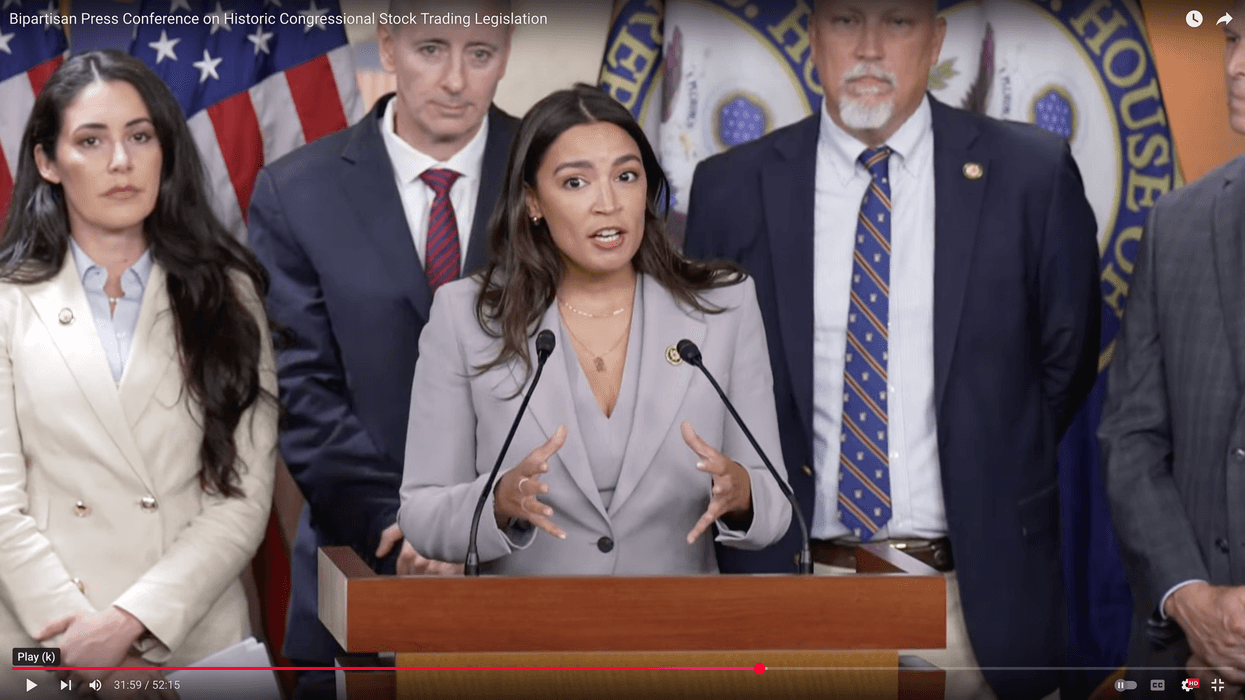
"Any bill that still allows members of Congress to own and trade stocks falls far short of what the American people want and deserve," said Reps. Pramila Jayapal, Seth Magaziner, and Alexandria Ocasio-Cortez.
A trio of Democrats in the US House of Representatives leading the fight for a congressional stock trading ban ripped Republican leadership's proposal as an inadequate replacement in a Monday statement released ahead of a scheduled committee markup.
Politico reported last month that House Speaker Mike Johnson (R-La.) and Administration Committee Chair Bryan Steil (R-Wis.) briefed GOP lawmakers on their plan for a bill that would ban members of Congress from buying new stocks but let them keep what they already have.
Steil introduced the Stop Insider Trading Act on Monday and announced a Wednesday markup. Backed by Johnson and other GOP leaders, the legislation would also apply to lawmakers' spouses and dependent children, and require public notice a week before any of them sell stock.
However, Reps. Pramila Jayapal (D-Wash.), Seth Magaziner (D-RI), and Alexandria Ocasio-Cortez (D-NY) argued in a joint statement that "any bill that still allows members of Congress to own and trade stocks falls far short of what the American people want and deserve."
"We are disappointed that the bill introduced by Republican leadership today fails to deliver the reform that is needed and instead protects the wealthiest members of Congress by allowing them to continue to hold and sell stock," said the original co-sponsors of the bipartisan Restore Trust in Congress Act.
House Republicans’ new legislation on Congressional stock trading falls far short of what the American people want and deserve. The House must move forward on our bipartisan consensus bill, the Restore Trust in Congress Act.My full statement with @magaziner.house.gov and @ocasio-cortez.house.gov:
[image or embed]
— Congresswoman Pramila Jayapal (@jayapal.house.gov) January 12, 2026 at 12:23 PM
The Democrats stressed that "while this bill prohibits members from buying new stocks, it does nothing to remove the conflict of interest that arises from owning or selling existing stocks. Members can still act on legislation, investigations, and briefings that directly influence the value of their stocks for personal benefit."
"The American public deserves to know that members of Congress are making decisions in the public interest, not in the interest of their own pocketbooks. The only way to restore Americans' trust is to ban members of Congress from owning and trading stocks," the trio continued.
"We hope that Speaker Johnson will find the courage to move the Restore Trust in Congress Act, a bipartisan consensus bill that has wide support from members of both parties and will end the practice of members of Congress owning and trading stocks once and for all," they concluded.
The Restore Trust in Congress Act would ban members of Congress, plus spouses and children, from trading individual stocks. It would give them 180 days to sell anything they hold and require divestment before newly elected lawmakers are sworn in.
When that bill was introduced in September, Jamie Neikrie, legislative director at the political reform group Issue One, said that "members of Congress have a responsibility to hold themselves to the highest ethical standards, and passing the Restore Trust in Congress Act is how Congress shows it's serious about restoring trust and integrity in government."
As Politico detailed Monday:
Johnson and GOP leaders have been searching for a legislative compromise to appease Rep. Anna Paulina Luna (R-Fla.) and other rank-and-file House Republicans, who have for months been threatening to launch a discharge petition effort to circumvent leadership and force a floor vote on a full congressional stock trading ban.
Luna, in a promising sign for Johnson, said in an interview last week she supports the current legislation pending before the House Administration Committee because it would force a "disgorgement" period.
However, even if the new bill is able to get through the Republican-controlled House, it would face a GOP Senate majority so narrow that at least some Democratic support is required to advance most legislation to a final vote.
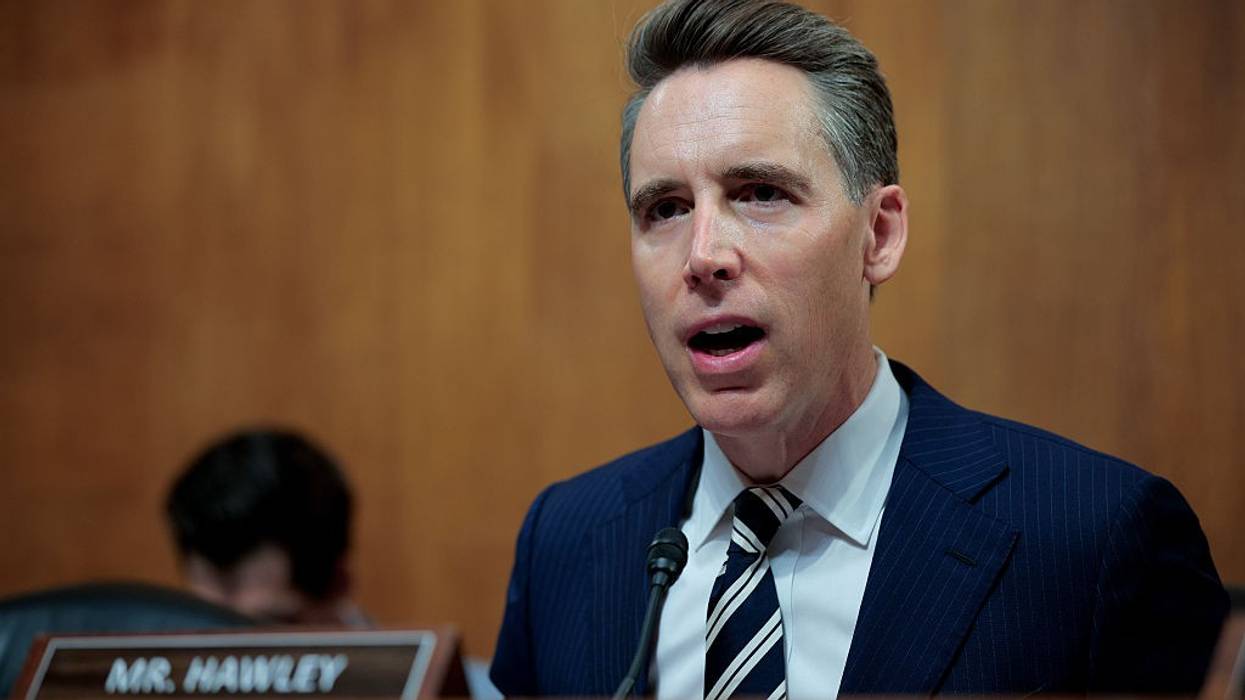
Last July, Sen. Josh Hawley (R-Mo.) voted with all Democrats on the Senate Homeland Security and Governmental Affairs Committee to advance another bill that would bar federal politicians from holding or trading stocks. To win over Hawley, Democrats had to agree to a carveout for President Donald Trump. As Business Insider noted Monday, "It has yet to receive a floor vote."
Like the House Democrats, Christina Harvey, executive director of the progressive advocacy group Stand Up America, was critical of the lower chamber's GOP leadership on Monday, saying that "Speaker Johnson is trying to trick the American people into thinking House Republicans are actually doing something to stop corruption in Washington, but this proposal is a congressional stock trading ban in name only."
"If Speaker Johnson really cared about stopping members of Congress from using their offices for financial gain, he would bring the comprehensive, bipartisan Restore Trust in Congress Act to the floor," Harvey declared. "The American people should have confidence that their leaders are serving the public’s interests in every vote—not their wallets."
Campaign Legal Center vice president, general counsel, and senior director for ethics Kedric Payne similarly said that "any legislation that allows lawmakers to hold onto their existing stocks is too narrow to address Americans' real concern that elected lawmakers may make official decisions to benefit their pocketbooks instead of the public good. A bill that also bans trading by the president and vice president, meanwhile, is too broad because it undermines the chances of passing the reform voters care most about: stock trading by members of Congress."
"Thankfully, there is a proposal on the table that strikes the balance for this moment: the Restore Trust in Congress Act," Payne added. "This consensus legislation was crafted during months of negotiations by lawmakers on both sides of the aisle. It has more than enough support to pass, and it would make a significant improvement to our nation’s government ethics laws. Campaign Legal Center calls on Congress to return its focus to this bipartisan bill and set an example for the other branches of our government."
This article was updated with comment from Stand Up America and the Campaign Legal Center.
"As long as sitting lawmakers are allowed to trade stocks connected to the industries they oversee, the public will question whether they are prioritizing their own personal profits," said one campaigner.
Government watchdog groups on Wednesday cheered the bipartisan introduction of the Restore Trust in Congress Act, which would ban federal lawmakers, along with their spouses and children, from trading individual stocks.
"The legislation would require lawmakers to sell all individual stocks within 180 days," according to NPR. "Newly elected members of Congress would also have to divest of individual stock holdings before being sworn in. Members who fail to divest would face a fine equivalent to 10% of the value of the stock."
The bill's lead supporters in the House of Representatives span the full ideological spectrum: Reps. Tim Burchett (R-Tenn.), Brian Fitzpatrick (R-Pa.), Pramila Jayapal (D-Wash.), Anna Paulina Luna (R-Fla.), Seth Magaziner (D-Pa.), Alexandria Ocasio-Cortez (D-N.Y.), and Chip Roy (R-Texas).
"In a strong display of bipartisanship, leaders from both sides of the aisle in the House have worked together to produce a comprehensive and commonsense legislative measure to ban congressional stock trading," said Craig Holman, government affairs lobbyist with the group Public Citizen, which is endorsing the bill.
"These members worked for months in drafting a strong consensus bill that addresses all the key elements of an effective ban on congressional stock trading," he continued, welcoming that the prohibition applies to immediate family members and "covers a wide range of investments, including cryptocurrency, and is fortified with strong enforcement measures."
Brett Edkins, managing director of policy and political affairs at the progressive advocacy group Stand Up America, also applauded the bill, highlighting that "our representatives in Washington have access to an enormous amount of information about our economy that isn't available to the public."
"They should not be allowed to use what they learn in the course of their legislative duties to gain an unfair advantage and enrich themselves," he said. "It's time to ban sitting members of Congress from buying and selling stocks. Members of Congress cannot be trusted to police themselves, and existing ethics laws do not go far enough to prevent members from using their insider knowledge for personal gain."
Lawmakers behind this new proposal have long advocated for a full ban, arguing that existing protections—including those in the Stop Trading on Congressional Knowledge (STOCK) Act of 2012—are inadequate.
Advocacy groups, including the Campaign Legal Center, have also "been fighting for years to improve laws regulating the way members of Congress trade stocks," noted Kedric Payne, CLC's vice president, general counsel, and senior director for ethics.
"As long as sitting lawmakers are allowed to trade stocks connected to the industries they oversee, the public will question whether they are prioritizing their own personal profits over the public interest," Payne said. "We applaud this bipartisan legislation that incorporates the key provisions of stock act reform CLC has fought to advance—a ban on stock ownership that is enforceable and holds lawmakers accountable."
Jamie Neikrie, legislative director at the political reform group Issue One, pointed out Wednesday that "three years have passed since House leadership made a commitment to bring a congressional stock trading ban bill to the floor for a vote."
"It's time to get this much-needed reform across the finish line—no more excuses," Neikrie declared. "Members of Congress have a responsibility to hold themselves to the highest ethical standards, and passing the Restore Trust in Congress Act is how Congress shows it's serious about restoring trust and integrity in government."
"Today is a critical step for a more transparent and stronger institution," he added, urging "leadership in both chambers to seize this moment" and send the bill to President Donald Trump's desk.
Earlier this summer, Trump lashed out at Sen. Josh Hawley (R-Mo.), who worked with Democrats to advance out of committee a stock trading ban, claiming that "he is playing right into the dirty hands of the Democrats."
Hawley initially called his proposal the Preventing Elected Leaders from Owning Securities and Investments (PELOSI) Act—a nod to former House Speaker Nancy Pelosi (D-Calif.), whose husband's stock trading has drawn scrutiny. After Hawley worked with Democrats on the bill, it was renamed the Halting Ownership and Non-Ethical Stock Transactions (HONEST) Act.
After the Senate Homeland Security and Governmental Affairs Committee's July vote, Pelosi said that "while I appreciate the creativity of my Republican colleagues in drafting legislative acronyms, I welcome any serious effort to raise ethical standards in public service. The HONEST Act, as amended, rightly applies its stock trading ban not only to Members of Congress, but now to the president and vice president as well. I strongly support this legislation and look forward to voting for it on the floor of the House."
Meanwhile, Fox News' Jesse Watters at the time asked Hawley about Trump lashing out at him. The Senate Republican responded, "I had a good chat with the president earlier this evening, and he reiterated to me he wants to see a ban on stock trading by people like Nancy Pelosi and members of Congress, which is what we passed today."
"Congressman Bresnahan didn't just vote to gut Pennsylvania hospitals. He looked out for his own bottom line before doing it," said one advocate.
Congressman Rob Bresnahan, a Republican who campaigned on banning stock trading by lawmakers only to make at least 626 stock trades since taking office in January, was under scrutiny Monday for a particular sale he made just before he voted for the largest Medicaid cut in US history.
Soon after a report showed that 10 rural hospitals in Bresnahan's state of Pennsylvania were at risk of being shut down, the congressman sold between $100,001 and $250,000 in bonds issued by the Allegheny County Hospital Development Authority for the University of Pittsburgh Medical Center.
The New York Times reported on the sale a month after it was revealed that Bresnahan sold up to $15,000 of stock he held in Centene Corporation, the largest Medicaid provider in the country. When President Donald Trump signed the so-called One Big Beautiful Bill Act into law last month, Centene's stock plummeted by 40%.
Bresnahan repeatedly said he would not vote to cut the safety net before he voted in favor of the bill.
The law is expected to cut $1 trillion from Medicaid over the next decade, with 10-15 million people projected to lose health coverage through the safety net program, according to one recent analysis. More than 700 hospitals, particularly those in rural areas, are likely to close due to a loss of Medicaid funding.
"His prolific stock trading is more than just a broken promise," said Cousin. "It's political malpractice and a scandal of his own making."
The economic justice group Unrig the Economy said that despite Bresnahan's introduction of a bill in May to bar members of Congress from buying and selling stocks—with the caveat that they could keep stocks they held before starting their terms in a blind trust—the congressman is "the one doing the selling... out of Pennsylvania hospitals."
"Congressman Bresnahan didn't just vote to gut Pennsylvania hospitals. He looked out for his own bottom line before doing it," said Unrig Our Economy campaign director Leor Tal. "Hospitals across Pennsylvania could close thanks to his vote, forcing families to drive long distances and experience longer wait times for critical care."
"Not everyone has a secret helicopter they can use whenever they want," added Tal, referring to recent reports that the multi-millionaire congressman owns a helicopter worth as much as $1.5 million, which he purchased through a limited liability company he set up.
Eli Cousin, a spokesperson for the Democratic Congressional Campaign Committee, told the Times that Bresnahan's stock trading "will define his time in Washington and be a major reason why he will lose his seat."
"His prolific stock trading is more than just a broken promise," said Cousin. "It's political malpractice and a scandal of his own making."