

SUBSCRIBE TO OUR FREE NEWSLETTER
Daily news & progressive opinion—funded by the people, not the corporations—delivered straight to your inbox.
5
#000000
#FFFFFF
To donate by check, phone, or other method, see our More Ways to Give page.
Daily news & progressive opinion—funded by the people, not the corporations—delivered straight to your inbox.
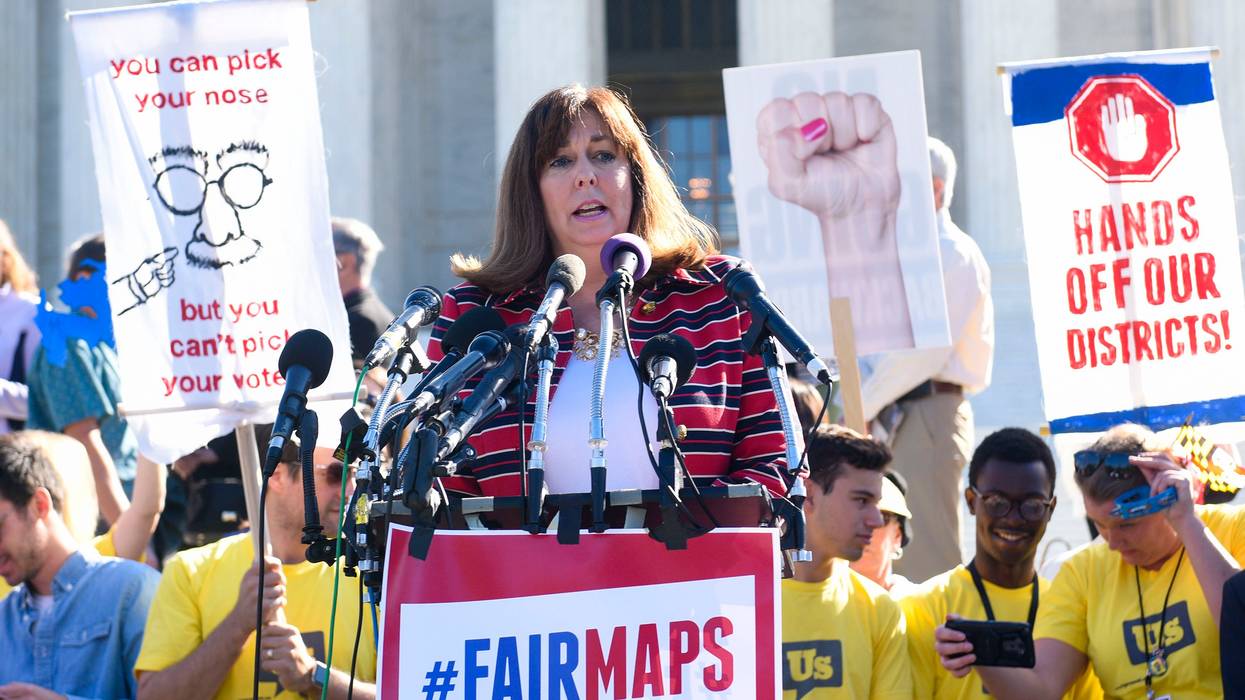
"Her tireless work on behalf of women, workers, and marginalized communities will have a lasting impact," said End Citizens United.
Progressive groups and activists showed an outpouring of love and admiration for Karen Hobert Flynn, the president of Common Cause, after her death from an undisclosed cause was reported by the pro-democracy group on Friday.
Hobert Flynn, who joined Common Cause in 1985 as an organizer and program director, was named president of the watchdog in 2016 after serving as executive director and chair of the group's Connecticut branch.
"Today, democracy lost one of its fiercest defenders: Karen Hobert Flynn," Common Cause board chair Martha Tierney said in a statement.
"A trailblazer and powerful advocate, Karen dedicated her career to reforming our government so it served everyone," Tierney noted. "Under her leadership of Common Cause in Connecticut, she secured landmark reforms—including winning Connecticut's groundbreaking full public finance system, numerous ethics laws, and disclosure laws."
Tierney continued:
During turbulent times for our country and our organization, she led Common Cause with tenacity and grace, never backing down from holding the White House accountable and never losing sight of the non-partisan vision for a more inclusive and representative democracy...
In her last year of life, she led a national coalition in the fight to protect and strengthen the right to vote for all and oversaw the largest national non-partisan election protection program for the 2022 midterms. Within Common Cause, she started the 50-year-old organization's process to become a more equitable workplace and doubled down on the commitment to secure an inclusive democracy for all.
"May her memory give us strength as together we carry forward her legacy of fighting for a government that lives up to the ideals of its people," Tierney added.
Other progressives also remembered Hobert Flynn's life and work.
"Such devastating news today with the loss of Common Cause's Karen Hobert Flynn," wrote Citizens for Responsibility and Ethics in Washington president Noah Bookbinder. "A great person and a fierce leader in the fight for democracy. Heartbreaking."
The Leadership Conference on Civil and Human Rights tweeted that "we're so deeply saddened to learn of the passing of Karen Hobert Flynn—a brilliant leader, dedicated advocate, and fierce defender of our democracy."
The National Disability Rights Network hailed Hobert Flynn as "a fierce civic advocate" who "will be missed by friends, family, and all who fight to make our democracy stronger."
End Citizens United remembered a "remarkable individual who touched the lives of so many in the fight to protect democracy."
"Her tireless work on behalf of women, workers, and marginalized communities will have a lasting impact," the group added.
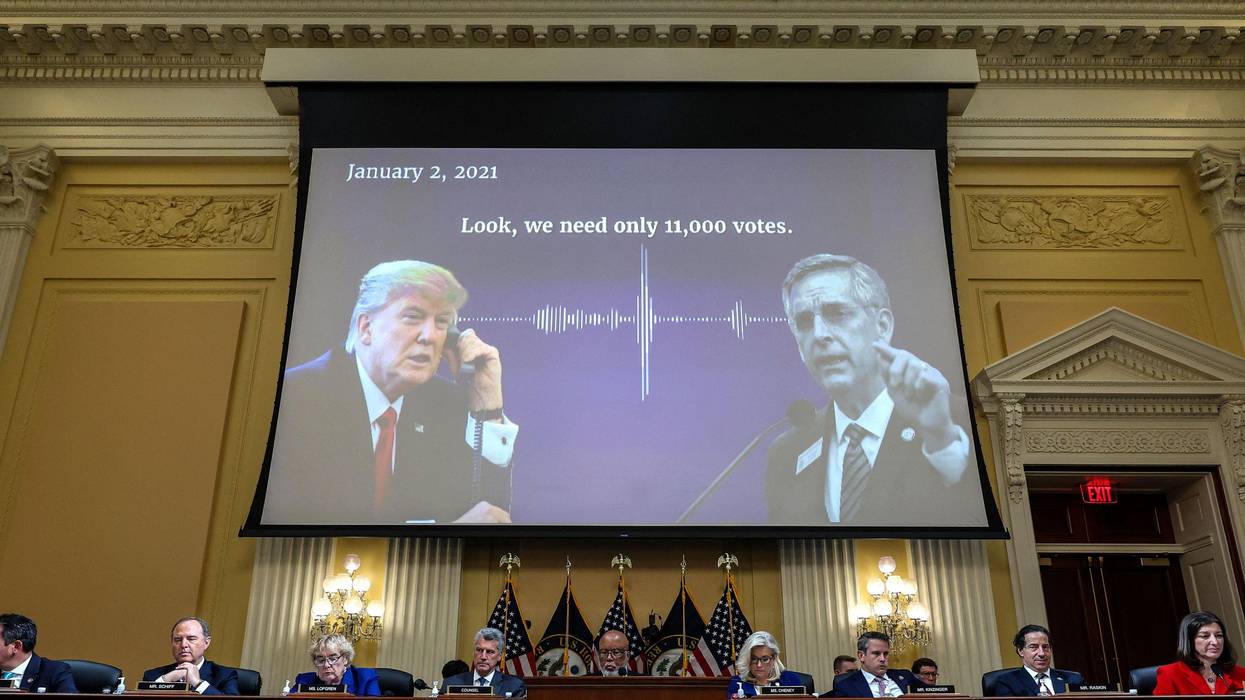
The U.S. House panel probing the January 6, 2021 attack on the U.S. Capitol unanimously voted Thursday to subpoena former President Donald Trump "to provide evidence as part of the committee's investigation."
The panel's hearing--expected to be the last before next month's midterm elections--largely focused on Trump's role in the attack. In what critics now call his "Big Lie," the former president repeatedly claimed, including in a speech the day of the insurrection, that Democrats stole the 2020 election.
Plans for the subpoena vote--which were initially reported by NBC News and Politico--and the result were welcomed by defenders of U.S. democracy.
"A subpoena of a former president shouldn't be taken lightly. Neither should staging an attempted coup to change the outcome of an election," said University of California, Berkeley professor and former U.S. Labor Secretary Robert Reich.
Along with the subpoena vote, the committee showed that "Trump Secret Service was warned that a mob was coming to the Capitol on January 6th to 'kill people' and did nothing to stop it," noted Stand Up America executive director Christina Harvey. "Instead, Trump sicced the violent, armed mob on Congress and his own vice president."
"As shocking as these revelations were, they were also just a reminder of what we've known from the beginning: President Trump was the ringleader of the conspiracy to overturn the 2020 election. He and his allies did everything they could to hold onto power... strong-arming state officials, the Justice Department, and Trump's own vice president," she said.
"Everyone involved in this national embarrassment must be held accountable, and the committee took the first step toward that goal with its subpoena of the former president," Harvey added. "Though it is still unknown if this is the final time we hear from the committee, their work over the past year has proved the threat that Trump and his MAGA followers pose to our democracy and the importance of defeating them in November and beyond."
Common Cause president Karen Hobert Flynn declared following the vote that "Donald Trump remains a clear and present danger to our democracy. The January 6th select committee is right to subpoena the former president. But the committee has shown clearly that the then-president violated his oath of office and committed crimes for which he must be held accountable."
"Trump and his associates waged a weekslong campaign, that appears to have amounted to a criminal conspiracy, to overturn the will of the people and ignore the results of the 2020 election so that he could remain in power," she continued. "Trump and those who participated in this plot must be held accountable to the fullest extent of the law."
She stressed that "Trump must comply with the subpoena from the January 6th select committee because no one, including a former president, is above the law."
Lisa Gilbert, executive vice president of Public Citizen and co-chair of the Not Above the Law Coalition, said that Thursday's hearing "shows more clearly than ever that Trump was the mastermind of the insurrection and the multitudinous efforts to sabotage our democracy."
"The committee's subpoena is an important step to hold Trump accountable for the thwarted coup that he personally led," she added. "He must comply."
The Nation's Elie Mystal was among those who suggested that Trump's compliance is unlikely:
While not directly addressing the subpoena, just after the vote Trump took aim at the select committee and Cassidy Hutchinson--an ex-aide to his former chief of staff who testified to the panel in June--on his Truth Social platform.
Earlier Thursday, Gilbert had highlighted that "thousands of pieces of evidence and testimony from Trump's own staffers and foot soldiers have clearly laid out, fact by fact, what only those closest to him knew to be true: Trump engaged in a criminal conspiracy, knowingly made false claims--including claiming victory in the election--and incited a violent attack on the Capitol in order to overturn the 2020 election."
"Perhaps the most important fact to focus on now is that without accountability for these crimes, these attacks on our country will continue," she warned, noting that "MAGA politicians in state houses across the country are attempting to pass laws that will make future elections easier to steal, election officials are entering the November elections under the specter of harassment, and more and more proponents of the 'Big Lie' are on the ballot nationwide."
After praising the panel for its "admirable job laying out the facts of the unconstitutional threat posed by Trump and his allies," Gilbert argued that "it's time for action. That's why people are joining more than 75 events across the country to amplify the hearing revelations, and fight ongoing threats to our freedoms and our vote. America can't afford more election interference, lies, and sabotage. It's time to take a stand."
The watchdog group Citizens for Responsibility and Ethics in Washington (CREW) tweeted in response to the hearing Thursday that "the evidence of criminal conduct by Trump is so strong that the only option left is for the Department of Justice to indict him."
This post was updated after the committee voted to subpoena the former president.
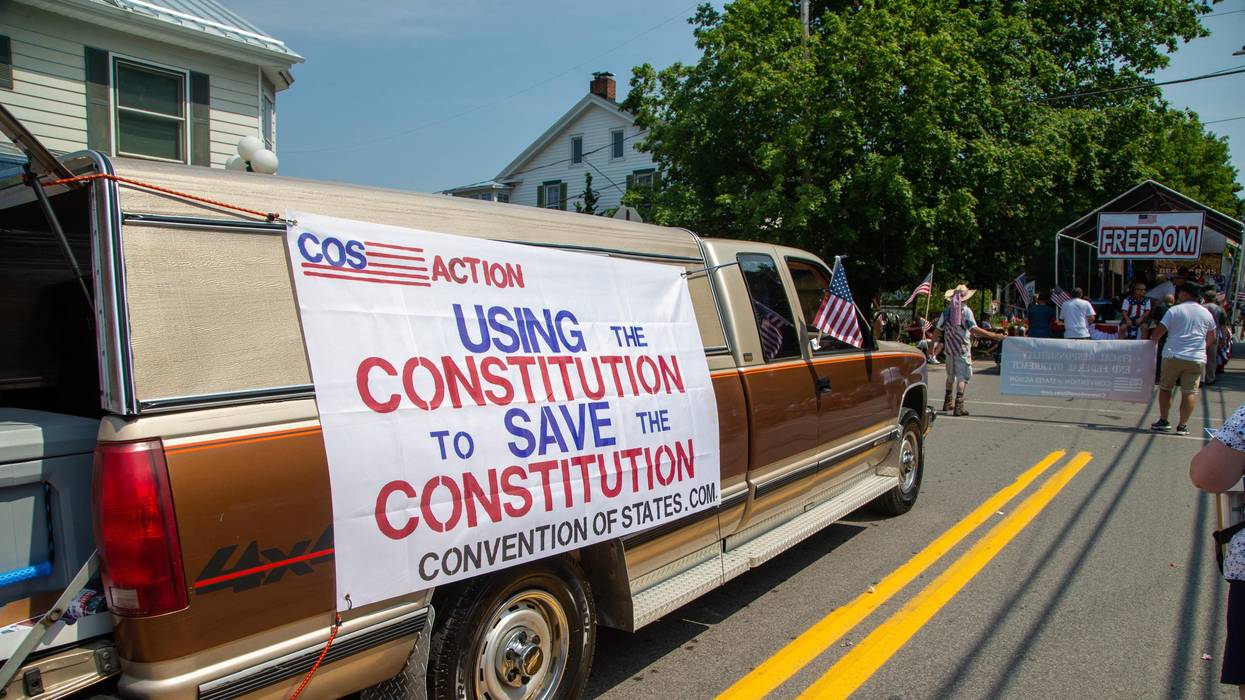
Government watchdogs are warning that the Republican takeover of state legislatures in recent years could imminently have major implications for the United States, as a right-wing effort to hold a new constitutional convention appears closer than ever to being realized.
" Republicans always tell us what they want to do. We should believe them and think broadly and in the long term of where we should be working to stop this from happening."
On Monday, former Democratic U.S. Sen. Russ Feingold wrote in an op-ed at The Guardian that Article 5 of the U.S. Constitution allows the document to be amended, either with amendments being proposed by two-thirds of Congress and ratified by three-quarters of the states, or through a method that has never been tested: the establishment of a new constitutional convention.
To hold a new convention, two-thirds of all state legislatures--34 total--must apply to hold the gathering, where lawmakers would have broad freedom to change the Constitution however they saw fit. Three-quarters of states would have to ratify their proposed amendments.
"The right has already packed the Supreme Court and is reaping the rewards, with decisions from Dobbs to Bruen that radically reinterpret the Constitution in defiance of precedent and sound legal reasoning," wrote Feingold, referencing recent rulings on abortion rights and gun control. "But factions of the right are not satisfied to wait for the court to reinterpret the constitution. Instead, they have set their sights on literally rewriting our foundational document."
Feingold--now president of the American Constitution Society--is among those warning that a new constitutional convention is "closer to reality than most people realize," as The New York Times reported earlier this month.
As the Democratic Party expended considerable effort on passing federal legislation during the Obama administration, ACLU communications strategist Rotimi Adeoye wrote at The Daily Beast last month, Republicans focused on taking control at the state and local level, with Democrats losing 13 governorships and 816 legislative seats between 2008 and 2016.
As a result, Republicans now just need control of four more states to reach the threshold needed to call a second constitutional convention.
Feingold noted that if right-wing advocates for a new convention like the Convention of States Project and the American Legislative Exchange Council (ALEC) get their way, there would be few limits on how Republicans could change the constitution:
There is nothing in the Constitution about how delegates would be selected, how they would be apportioned, or how amendments would be proposed or agreed to by delegates. And there is little useful historical precedent that lends insight to these important questions. This means that nearly any amendment could be proposed at such a convention, giving delegates enormous power to engage in political and constitutional redrafting.
"The framers left no rules," wrote Feingold in his new book, The Constitution in Jeopardy. "In this uncertainty lies great danger and, possibly, great power."
The former Wisconsin senator wrote at The Guardian that Republicans could use a new convention to craft an amendment banning abortion care, strip Americans of voting rights, gut federal anti-poverty programs, and further threaten people's right to be safe from gun violence by enshrining "their interpretation of the Second Amendment."
On Sunday, Common Cause president Karen Hobert Flynn told MSNBC that in the hands of Republicans, a second constitutional convention could "put all of our constitutional rights up for grabs."
Feingold noted that a national policy discussion regarding the "founding failures of the Constitution" is warranted.
"That said, any conversation about how to go about amending the Constitution needs to be transparent, inclusive, and informed," he wrote at The Guardian. "What factions of the right are pursuing is anything but. They are pursuing exclusively partisan outcomes and have sought to keep their efforts opaque. They do not seem interested in a representative, democratic process."
The Convention of States Project has received millions of dollars from the right-wing Donors Capital Fund and has been endorsed by Republican Govs. Ron DeSantis of Florida and Greg Abbott of Texas, Sens. Rand Paul (R-Ky.) and Marco Rubio (R-Fla.), and influential conservative commentators Sean Hannity and Ben Shapiro.
Rep. Jodey Arrington (R-Texas), a strong proponent of a new constitutional convention, recently proposed legislation to direct the National Archives to conduct an official count of all the states that have called for a convention at various times.
"Democrats should take the threat seriously," Amanda Litman, co-founder of progressive group Run for Something, told The Daily Beast. "Republicans always tell us what they want to do. We should believe them and think broadly and in the long term of where we should be working to stop this from happening."
With the midterm elections fast approaching, wrote Adeoye, "Democrats must emphasize to voters that Republicans still control most state legislatures, and if they remain in power, they can drastically change the Constitution."
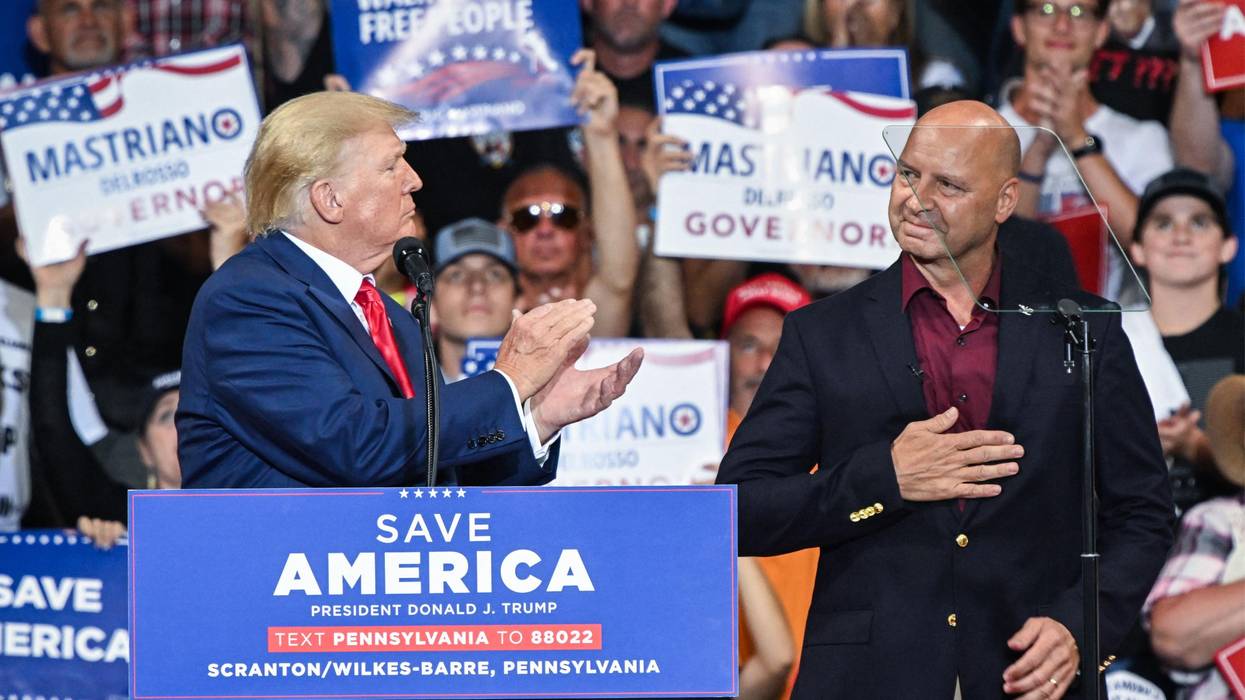
As political voices--including U.S. President Joe Biden--sound the alarm about the state of American democracy nine weeks away from the midterms, FiveThirtyEight on Tuesday published an analysis highlighting election deniers on the ballot.
"A political party that falsely tells supporters that a free and fair election was illegitimate is bad for American democracy."
To determine which candidates bought into former President Donald Trump's "Big Lie" that the 2020 presidential election was stolen from him, FiveThirtyEight examined campaign materials, debates, reporting, and social media, and contacted every Republican nominee for the U.S. House and Senate as well as governor, secretary of state, and attorney general.
The review revealed that of all 529 GOP candidates analyzed, 195 "either clearly stated that the election was stolen from Trump or took legal action to overturn the results, such as voting not to certify election results or joining lawsuits that sought to overturn the election."
Another 61 nominees haven't explicitly claimed the election was stolen or taken related legal action but also haven't said it was legitimate and even "raised doubts about potential fraud."
Additionally, the position of 115 candidates could not be determined. As FiveThirtyEight explained, "They either had no comment on the 2020 election or avoided answering when asked directly."
Only 71 nominees fully accepted the 2020 results and another 87 "accepted with reservations," meaning they believe President Joe Biden won "but still raised concerns about the integrity of the election." In other words, just 30% of the GOP candidates accept the election in some form.
Many election deniers and "doubters" are expected to win their races, according to FiveThirtyEight's midterm elections forecast.
Among Republican House candidates, "118 election deniers and eight election doubters have at least a 95% chance of winning." While only three Senate candidates have those odds--and seven senators who objected to the election certification are not up for reelection this year--there are a few others who "still have a real shot at winning."
At the state level, at least two election deniers and four doubters have a 95% chance of being elected governor. FiveThirtyEight doesn't forecast elections for the other positions but pointed out that "there are also seven election deniers running for attorney general and six for secretary of state, the post that oversees election administration in most states."
The analysis--part of the ABC News series "Democracy in Peril"--features a drop-down list that allows readers to input each state to review the GOP nominees along with their 2020 election positions, the sources of that information, and their chances of winning.
Along with the "terrific resource" from FiveThirtyEight, the group Common Cause on Tuesday released a scorecard showing how members of the 117th Congress voted on various democracy-related pieces of legislation, including the resolution for Trump's historic second impeachment and conviction.
As the organization's president, Karen Hobert Flynn, wrote in the scorecard's introduction, "Never has it been more important for voters to stand together and demand candidates tell them what they will do to strengthen our march toward a multiracial, multicultural, and multiethnic democracy that respects and works for everyone."
Both projects come as the Senate was back in session Tuesday and House members are set to return to Washington, D.C. next week--after which the House Select Committee to Investigate the January 6th Attack on the United States Capitol is expected to continue public hearings.
Speaking in Philadelphia late last week, Biden referenced the Capitol attack while arguing that "MAGA Republicans," including Trump, pose "a 'clear and present danger' to our democracy" and "now America must choose: to move forward or to move backward."
FiveThirtyEight's findings provoked similar warnings, with Georgetown University professor Donald Moynihan tweeting Tuesday that "a political party that falsely tells supporters that a free and fair election was illegitimate is bad for American democracy."

Democracy advocates on Wednesday welcomed as important progress the introduction of legislation to reform and modernize the Electoral Count Act, a 19th-century law that former President Donald Trump attempted to invoke in his failed attempt to overturn the 2020 presidential election.
" January 6 was a warning, and one that cannot be ignored. Failure to act is not an option and imperils the country's future."
"Modernizing the century-old Electoral Count Act is an essential first step toward meaningfully protecting our democracy from future attempts to overthrow the will of voters," Christina Harvey, executive director of the advocacy group Stand Up America, said in a statement. "This bipartisan effort would help safeguard against bad actors in Congress and state legislatures who would seek to sabotage our elections, and it further clarifies the vice president's solely ceremonial role in the electoral vote count."
"The Senate Republican Caucus should follow the lead of the nine Republican co-sponsors and negotiators of the ECA fix and work with Democrats to swiftly pass this legislation," Harvey added.
The new bill follows months of negotiations led by Sens. Joe Manchin (D-W.Va.) and Susan Collins (R-Maine). With nine Republicans currently supporting the proposed legislation in the upper chamber, it needs the backing of just one more GOP senator to meet the 60-vote passage threshold.
According to The New York Times:
The legislation aims to guarantee a peaceful transition from one president to the next, after the January 6 attack on the Capitol demonstrated how the current law could be manipulated to disrupt the process. One measure would make it more difficult for lawmakers to challenge a state's electoral votes when Congress meets to make its official count. It would also clarify that the vice president has no discretion over the results and set out the steps to begin a presidential transition. A second bill would increase penalties for threats and intimidation of election officials and encourage steps to improve the handling of mail-in ballots by the Postal Service.
Common Cause president Karen Hobert Flynn urged senators to "carefully vet the proposal introduced by a bipartisan group of senators today."
"Americans deserve to know their votes will be counted and their voices heard in our elections. Reform of the antiquated Electoral Count Act is an important step to safeguard the results of free and fair elections," she asserted, adding that then-President Donald Trump and his associates "came exceptionally close to engineering an overthrow of the 2020 election, as the January 6th select committee's hearings have made clear."
"They did so in part by making bogus assertions about how the Congress should discharge its certification duties of the presidential election, inciting a violent mob, and convincing 147 Congressional Republicans to vote to overturn the election," Hobert Flynn added. "Part of this plot included testing arcane provisions of the law that must be modernized and clarified before it happens again."
She continued:
Reform of the Electoral Count Act--as important and necessary as it is--does not fully address the threats to an inclusive and representative democracy, including the wave of racially discriminatory voting laws that have been introduced throughout the country, and this bill is no substitute for comprehensive voting rights legislation. Congress must also pass legislation to secure every American's freedom to vote--including legislation to repair and strengthen the Voting Rights Act and to set fair national election administration standards.
"January 6 was a warning, and one that cannot be ignored. Failure to act is not an option and imperils the country's future," Hobert Flynn stressed. "We learned from Trump that the peaceful transfer of power from a candidate who loses an election can never again be taken for granted. Congress must move to guarantee that in America the voters--and only the voters--decide the outcome of our elections."
Other democracy defenders had another idea for electoral reform. MainStreet Law founder Tristan Snell tweeted: "While we're updating the Electoral Count Act, how about we update the Electoral College--by abolishing it?"

Democracy defenders responded to Tuesday's testimony by a former Trump administration aide before the January 6 committee by demanding that the former president and his co-conspirators be held to account in the face of increasingly incriminating evidence of their culpability for the 2021 insurrection.
"Hutchinson's testimony blows any notion of plausible deniability surrounding January 6 out of the water."
Cassidy Hutchinson, who served as a special assistant to Mark Meadows, former President Donald Trump's last chief of staff, revealed what the consumer advocacy group Public Citizen described as "bombshell after bombshell" during her in-person testimony to members of the House Select Committee to Investigate the January 6th Attack on the United States Capitol.
Lisa Gilbert, executive vice president of Public Citizen and co-chair of the Not Above the Law Coalition, said in a statement that "in the reams of evidence against Trump and his allies, Hutchinson's testimony of the deeply detailed plans of January 6 and the inaction of those in the White House in response to the violence show just how close we came to a coup."
"Her testimony comes at a critical point in the hearings, showing the conspirators knew what they were doing was illegal, and knew it could result in violence, yet they proceeded anyway," she added. "And that once the violence was ongoing, the president refused to act."
Among other things, Hutchinson testified that:
"Trump and his chief of staff Mark Meadows were warned repeatedly of anticipated violence on January 6th yet did nothing," Common Cause president Karen Hobert Flynn said in response to Hutchinson's testimony. "They were informed of semi-automatic rifles and pistols--AR-15s and Glocks--being carried by members of the audience on the Ellipse, hours before his speech, yet Trump incited the crowd and called on his heavily armed audience to march on the Capitol and 'fight like hell.'"
Hobert Flynn continued:
The armed and vicious mob he sent to the Capitol on January 6th was the final desperate act in a monthslong, multi-layered criminal conspiracy by former President Trump and his henchmen to ignore the will of the American people and overturn the legitimate results of the 2020 election by any means.
His actions and inaction as the insurrection unfolded, outlined in sworn testimony to the January 6 select committee, [are] jaw-dropping, un-American, and yet another warning to us all. Just when we think accounts of the actions of the former president and his inner circle can get no worse, we learn that in fact it can.
Gilbert of Public Citizen said that "Hutchinson's testimony blows any notion of plausible deniability surrounding January 6 out of the water. She said Trump knew his rally crowd was armed, but said they weren't there to hurt him. He encouraged an armed crowd to go to the Capitol, and told them that he would be with them."
Progressives said Tuesday's testimony underscored the imperative for accountability for Trump and members of his inner circle.
Rep. Mark Pocan (D-Wis.) tweeted that Trump "knew dangerous weapons were headed to the Capitol. He knew Congress was the target. He said the VP deserved to be hung for upholding the Constitution. He attacked a member of his Secret Service. He incited an insurrection."
Common Cause's Hobert Flynn asserted that "the former president and his co-conspirators must be held accountable by the Justice Department and any other authority with jurisdiction, including by state or local officials where parts of this scheme were plotted and carried out."
Echoing Hobert Flynn, Gilbert said that Hutchinson's testimony "makes it absolutely clear that Donald Trump remains a danger to our democracy and to our nation."
She added, "There must be accountability for the criminal conspiracy to steal our votes that ultimately led to the violence on January 6 that we now know the administration anticipated, and that Trump encouraged."

Progressives expressed outrage Friday after the Republican National Committee formally declared the deadly January 6, 2021 attack on the United States Capitol by supporters of former President Donald Trump seeking to overturn the 2020 presidential election "legitimate political discourse."
"Mark this day for future reference."
"January 6th was not "legitimate political discourse"--it was a violent insurrection on our Capitol," Congressional Progressive Caucus Chair Pramila Jayapal (D-Wash.) tweeted in response to the RNC declaration.
"I didn't know if I'd make it out alive," she added. "Some didn't. We cannot let the GOP whitewash what happened."
The New York Times reports the Republican National Committee (RNC) voted overwhelmingly Friday to censure Reps. Liz Cheney (R-Wy.) and Adam Kinzinger (R-Ill.) for their participation in the Democrat-led bipartisan commission investigating the January 6 attack.
The RNC censure resolution accuses Cheney and Kinzinger of "participating in a Democrat-led persecution of ordinary citizens engaged in legitimate political discourse," and of "utilizing their past professed affiliation to mask Democrat abuse of prosecutorial power for partisan purposes."
Rep. Jamie Raskin (D-Md.)--a member of the special House committee investigating the January 6 attack--told the Times that "The Republican Party is so off the deep end now that they are describing an attempted coup and a deadly insurrection as political expression."
"It is a scandal that historians will be aghast at, to think that a major political party would be denouncing Liz Cheney for standing up for the Constitution and not saying anything about Donald Trump's involvement in the insurrection."
Karen Hobert Flynn, president of the progressive advocacy group Common Cause, said in a statement that "January 6 was an insurrection that left people dead and scores of seriously injured in its wake. It was not legitimate political discourse no matter what the GOP says."
"It was a violent attempt to overturn the legitimate results of the 2020 presidential election and ignore the will of the people," she continued. "It was a dangerous and irresponsible attempt to try to intimidate Congress with an angry racist mob assembled and then set loose by a man who had just lost the presidential election."
"With today's vote, the Republican Party has just endorsed violence as a legitimate form of political expression," Hobert Flynn added. "Their vote to legitimize violence is anti-democratic. There is no room for ambiguity when it comes to an attack on the peaceful transfer of power and our democratic system of government."
Cheney responded to the censure by posting a video showing supporters of Trump's "Big Lie"--the fallacious belief that the 2020 presidential election was stolen--savagely assaulting Capitol police officers and violently storming the U.S. Congress in a bid to stop lawmakers from certifying President Joe Biden's Electoral College victory.
Daniel Ziblatt, a professor at Harvard University and author of How Democracies Die, tweeted: "I have spent a lot of my career studying what happens when conservatives fully go off the rails. This is one of those moments."

Amid continued GOP obstruction of Democrats' voting rights legislation, a coalition of civil rights groups on Monday issued a joint statement pushing back against a bipartisan plan to reform the Electoral Count Act, calling the proposal woefully insufficient to address nationwide voter suppression efforts.
"Bipartisanship for bipartisanship's sake does nothing for a citizen whose right to vote has been compromised by partisan extremists in states."
The core of the issue, the groups said, is that the plan to tweak the law, while offering some "important and needed protections to ensure the integrity of the presidential election of 2024," simply "does not address the ongoing pernicious and pervasive racial discrimination in voting nor does it make voting more accessible."
Issued by organizations including the National Coalition on Black Civic Participation, the Leadership Conference on Civil and Human Rights, and the NAACP, the statement calls pursuit of the bipartisan plan alone--without passage of the more sweeping John Lewis Voting Rights Advancement Act and the Freedom to Vote Act--"offensive to voters, especially voters of color, and the generations who bled and died for the franchise since our nation's founding."
"Bipartisanship for bipartisanship's sake does nothing for a citizen whose right to vote has been compromised by partisan extremists in states," they continued. "Worse, some might view this effort as a cynical attempt to fool the American people into believing meaningful action has been taken on voting rights when none has been taken. We won't participate in that charade."
"Compromise is a worthy goal, but any compromise on voting rights must center on tearing down barriers to the ballot for Black people and other people of color, Native Americans and Alaskan Natives, people with disabilities, senior citizens, veterans, new Americans, and young people," the groups stated, and warned the nation's "democracy remains on the line."
The statement further calls on Congress to "include the John Lewis Voting Rights Advancement Act and key provisions of the Freedom to Vote Act in any legislation that is considered to safeguard our democracy."
Earlier this month, the plan to enact reforms to the Electoral Count Act also elicited concerns from progressives, especially as Senate Minority Leader Mitch McConnell (R-Ky.) expressed openness to the proposal and since the bipartisan group of senators involved in the effort includes Sens. Joe Manchin (D-W.Va.) and Kyrsten Sinema (D-Ariz.), who joined with Republicans to block the Freedom to Vote: John R. Lewis Act.
As Politico reported last week:
While tackling the outdated Electoral Count Act is popular among scholars after Republicans challenged the election results last year and a pro-Trump mob stormed the Capitol, both parties have used the arcane text to force votes on election certifications. The upper-chamber negotiators are now aiming to make it harder for senators to object to those certifications, and to clarify that the vice president cannot unilaterally overturn the election...
Before the group developed, most Democrats had dismissed the more narrow electoral discussions that took off in recent weeks, trying to downplay them as a politically motivated off-ramp for Republicans to avoid blame ahead of the failed vote on a Senate rules change.
In a letter to senators earlier this month, the advocacy group Common Cause said that looking at changes to the Electoral Count Act and legislative proposals to tackle voter suppression as an either-or scenario represents "a false choice."
"Reforms to how the score is counted will not unrig the rules that are stacked against voters and their participation," the group said.
In a statement, Common Cause president Karen Hobert Flynn expressed concern that "voting rights in states across the country are under siege as legislators write and pass a new generation of Jim Crow laws to determine who can and cannot vote."
"The Electoral Count Act does in fact need fixing," she said, "but first the Senate must pass legislation to protect the voting rights of every American--particularly Black and Brown Americans targeted by the wave of 21st Century Jim Crow laws being passed in the states."

Leading up to U.S. President Joe Biden's so-called Summit for Democracy this week, critics suggested Wednesday that the two-day virtual event will show how the American leader and congressional Democrats have failed to address relevant issues at home while pointing fingers abroad.
"While the notion of advancing democracy around the world is noble, America's democracy is in a state of emergency and demands our attention and focus just as urgently."
"The Biden administration's commitment to human rights and advancing democracy globally is commendable leadership, but saving democracy starts at home and we must also address threats to democracy domestically," said Taifa Smith Butler, president of the think tank Demos, in a statement.
Smith Butler noted that "a new Texas law makes it harder for people with limited English proficiency and seniors with disabilities to get help at the polls. Florida law prohibits local and state officials from providing a mail-in ballot unless a voter specifically requests one. And in Georgia, counties, now, can decide not to allow early voting on Sundays--a conspicuous attack on Black churches' 'souls to the polls' tradition of voting after service."
"This kind of voter suppression, unfortunately, isn't isolated to these three states," she said. "Dozens of laws passed since the 2020 election are aimed at making it harder for millions of Americans to vote. From laws reducing polling place availability to laws that eliminate mail ballot drop boxes, voters in this country simply face too many barriers to making their voices heard. While the notion of advancing democracy around the world is noble, America's democracy is in a state of emergency and demands our attention and focus just as urgently."
Demos has three suggestions for Democrats to improve American democracy:
Both the Freedom to Vote Act--compromise legislation that followed the bolder For the People Act--and the House-approved bill named for the late Georgia congressman were blocked by the Senate GOP as Republican state legislators and governors ramped up attacks on voting rights.
Common Cause president Karen Hobert Flynn also put out a statement in anticipation of the summit that calls on Biden "to use his bully pulpit" to ensure both bills get through Congress.
Biden "faces a crisis of democracy here at home," she said. "Bolstering international democracy is critically important, but we must also get our own house in order."
The Common Cause leader acknowledged key events of the past year--including former President Donald Trump's misinformation campaign that the 2020 presidential election was stolen from him, a myth that led a right-wing mob to storm the halls of Congress on January 6.
"Our crisis did not begin with the insurrection at the U.S. Capitol, nor did it end there," Hobert Flynn said. "Parroting Donald Trump's Big Lie and aided and abetted by the U.S. Supreme Court's gutting of the Voting Rights Act under Chief Justice John Roberts, GOP-controlled legislatures across the country have ushered in a new Jim Crow era."
"Americans expect and deserve elected representatives who reflect the will of the people," she continued, "but the anti-voter laws and outrageous gerrymanders being passed around the country today are designed to silence the voices of millions of citizens often because of their race, their background, or their zip code."
While applauding Biden for "following through on his commitment" to hold this week's event, she pointed out that people around the world are noting with concern the current conditions--such as a recent analysis that dubbed the United States a "backsliding" democracy--and warned that if the two voting rights bills aren't soon enacted, "this may be the last Summit for Democracy that our nation hosts."
Politico reports that "on Thursday--at the appalling hour of 6 am, to accommodate a global audience--Biden will open the Summit for Democracy, reduced by the pandemic to a giant, two-day Zoom conference. Leaders of 110 countries will make public commitments to fortify their own, in some cases rather notional, democracies."
The White House said earlier this year that the invitation-only summit will focus on "defending against authoritarianism, fighting corruption, and promoting respect for human rights."
Bruce Jentleson, a public policy and political science professor at Duke University who served in former President Barack Obama's State Department, told Al Jazeera that he expects some nations to draw attention to U.S. domestic issues during the summit.
"Some countries will say, 'Wait a second, United States--who are you to make us accountable on democracy?" according to Jentleson. "Some of us have problems, but your problems are much worse than ours. Yours are challenging the fundamentals of your system, with restricting voting rights, political violence, death threats to not only prominent people but school board members and local elections officials."
"So where's your credibility?" he added of the anticipated pushback. "That's not just Chinese or Russian or Iranian propaganda; there's real legitimacy to that criticism."
In a Wednesday column for The Washington Post, Greg Sargent noted that "Biden's advisers are grappling with this problem. But judging by an illuminating new Politico report on Biden's preparations for the summit, they're not adequately wrestling with the precise dimensions of it."
As Sargent wrote:
If Biden tells the truth to the world, it might sound like this: Our homegrown threat to democracy comes primarily from a dangerously radicalized right wing and from the cynical, antidemocratic accommodation of it by only one of our major political parties, the GOP.
Biden would say his own party has proved utterly unable--or even unwilling--to take the actions necessary to safeguard against that threat. And he would admit the problems are also structural: That safeguarding is frustrated by anti-majoritarian features of the system itself, and his own party is failing to correct those as well.
Sargent pointed out that when asked what the United States could get out of the summit, U.S. Secretary of State Antony Blinken told Politico that "there is a call-to-action aspect of this that also is part of our summoning of our better angels, which the president strongly believes continues to resonate powerfully with most Americans. Things have gotten lost along the way. This is a moment to try to refocus our fellow citizens on what makes us exceptional. It does speak to something that continues to unite us, and that people aspire to, even despite the frustrations."
The Post columnist argued that "this treats the problem as a failure of persuasion, as opposed to a failure grounded in inaction.
"No amount of 'summoning of our better angels' or 'refocusing' on what's 'exceptional' about U.S. democracy will change what's happening," he wrote. "This seems to presume Republicans can be persuaded to reverse their current course, whether by Biden's soaring rhetoric or by public pressure that would materialize from it."
Progressives within and beyond Congress don't expect right-wing attacks on American democracy to subside, especially with the midterms approaching. Over 75 advocacy groups based in Republican-led states on Wednesday highlighted how GOP lawmakers have pushed through voter suppression measures and gerrymandered political maps this year, and urged U.S. Senate Democrats to do whatever it takes to fight back with federal legislation.
In addition to facing scrutiny for domestic policy failures, especially on voting rights, Biden has recently come under fire for inviting Venezuela's right-wing coup leader, Juan Guaido, to the summit, and he faces pressure to examine how U.S. foreign policy is at odds with the stated intentions of the event.
Ryan Costello of the National Iranian American Council wrote Wednesday for Responsible Statecraft that "to be a meaningful rather than a self-congratulatory exercise will require the Biden administration--and the foreign policy establishment writ large--to ask some hard questions. At the top of the list should be why the United States actively supports so many authoritarian governments while imposing crushing sanctions on many of the rest."
Writing just a day after the U.S. Senate voted down a resolution that would have blocked a widely condemned $650 million arms sale to bolster the Saudi-led war on Yemen, Costello made the case that "the United States should be able to engage both the kingdom of Saudi Arabia and the theocracy in Iran--as well as other governments--to hold them accountable and seek to affect their behavior without undermining civil society or liberal values."
"Not only is the United States under serious risk of democratic backsliding due to threats from within, but it must carefully balance competition with coordination to address some of the biggest threats of our time, like climate change," he added. "However, even an honest conversation risks missing how U.S. foreign policy has sustained, rather than undermined, authoritarian governance across the globe."

The U.S. House of Representatives voted Thursday to hold Steve Bannon, the former top political advisor to President Donald Trump, in criminal contempt over his refusal to submit to a subpoena issued by the congressional panel investigating the MAGA insurrection that took place on January 6, 2021.
"It is disgraceful how few Republicans voted to enforce congressional subpoena power and hold Steve Bannon in contempt for refusing to comply with subpoenas about his role in, and knowledge of, the bloody attempt to topple our government."
The final vote was 229 to 202, with just 9 Republicans joining with nearly every Democrat in favor of the resolution to recommend the Justice Department for prosecution. See the full roll call here.
According to the Associated Press:
The House vote sends the matter to the U.S. attorney's office in Washington, where it will now be up to prosecutors in that office to decide whether to present the case to a grand jury for possible criminal charges.
The partisan split over Bannon's subpoena--and over the committee's investigation in general--is emblematic of the raw tensions that still grip Congress nine months after the Capitol attack. Democrats have vowed to comprehensively probe the assault in which hundreds of Trump's supporters battered their way past police, injured dozens of officers and interrupted the electoral count certifying President Joe Biden's victory.
Responding to the vote, Karen Hobert Flynn, president of Common Cause, said that while the approval by the House will "ensure we learn the truth about the events of that bloody attempt to overturn the legitimate results of the 2020 election," it was shameful that only nine members of the Republican caucus voted in favor to uphold the committee's subpoena authority.
"It is disgraceful how few Republicans voted to enforce congressional subpoena power and hold Steve Bannon in contempt for refusing to comply with subpoenas about his role in, and knowledge of, the bloody attempt to topple our government," said Hobert Flynn.
"This is not a partisan issue," she continued. "This is an investigation of a day when a racist, armed, and angry mob stormed the United States Capitol and set about searching the halls for Members of Congress. That insurrectionist mob left dead and wounded in their wake, yet House Republicans today voted against getting to the truth behind that terrible day."
Ahead of the vote, Rep. Jamie Raskin (D-Md.), a member of the Select Committee to Investigate the January 6th Attack on the U.S. Capitol, argued that Bannon's refusal to submit to the subpoena was no trivial deal.
Asked Thursday how the DOJ would handle such a referral, U.S. Attorney General Merrick Garland said during a hearing before the House Judiciary Commitee that it would "do what it always does in such circumstances--it will apply the facts and the law."
Calling it a sad event, Hobert Flynn said the vote "reveals just how far the Republican Party has fallen" since Trump took over as the de facto leader of the party.
"Congressional Republicans proved again," she said, "that they would rather parrot the baseless lies about the 2020 election by former-President Trump than risk incurring his wrath--regardless of the damage."