SUBSCRIBE TO OUR FREE NEWSLETTER
Daily news & progressive opinion—funded by the people, not the corporations—delivered straight to your inbox.
5
#000000
#FFFFFF
To donate by check, phone, or other method, see our More Ways to Give page.


Daily news & progressive opinion—funded by the people, not the corporations—delivered straight to your inbox.
Mexican President Andres Manuel Lopez Obrador said Sunday that no nation in the Western Hemisphere should be left out of the upcoming Summit of the Americas, directly refuting Washington's attempt to bar Cuba, Nicaragua, and Venezuela from the U.S.-hosted meeting.
"Nobody should exclude anyone," Lopez Obrador said during a public event in Cuba, according to Reuters.
The Mexican leader's remarks come as the U.S. State Department has indicated that government representatives from three Latin American countries are unlikely to be invited to the June summit in Los Angeles.
"Cuba, Nicaragua, the [Nicolas] Maduro regime [in Venezuela] do not respect the Inter-American Democratic Charter, and therefore I don't expect their presence," Western Hemisphere Assistant Secretary of State Brian Nichols said in an interview last week.
"It's [U.S. President Joe Biden's] decision," Nichols added, "but I think the president has been very clear about the presence of countries that by their actions do not respect democracy--they will not receive invitations."
Following Obama-era efforts to normalize relations with Cuba, the Trump administration adopted more than 200 policies designed to punish the Caribbean island. Despite Democratic lawmakers' pleas and Biden's own campaign pledge to reverse his predecessor's "failed" approach, the White House has implemented additional sanctions in recent months.
Speaking from Havana on Sunday, Lopez Obrador vowed to continue pushing the U.S. to lift its 60-year embargo on Cuba.
Meanwhile, Biden has described the 2021 reelection of Nicaraguan President Daniel Ortega and his wife, Vice President Rosario Murillo, as fraudulent.
U.S. President Joe Biden was nearly the victim of a right-wing coup on January 6, but that didn't stop him from inviting Venezuela's right-wing coup leader Juan Guaido to the United States' so-called "Summit for Democracy"--a development that critics say illustrates the "cynical, hypocritical, and completely counter-productive" nature of the upcoming meeting.
On Tuesday afternoon, David Adler, general coordinator of Progressive International, argued during an appearance on Al Jazeera that the Biden administration lacks the credibility to lead an international effort to protect democracy for a variety of reasons, including the United States' past and present support for authoritarian leaders who further capitalist class interests.
Around the same time, Biden, whose 2020 electoral victory was almost overturned by a pro-Trump mob and lawmakers from the increasingly anti-democratic GOP, invited Guaido, a key player in the unsuccessful Trump-backed effort to overthrow Venezuelan President Nicolas Maduro in 2019, to the Summit for Democracy hosted virtually by the White House from December 9-10.
"Surreal," is how Adler responded after news broke that Biden had asked Guaido--an unelected and unpopular opposition figure who participated in a failed coup attempt--to represent Venezuela at an ostensibly pro-democracy gathering, just weeks after Venezuelans reelected Maduro in a contest that U.S. legal observers called fair.
Notably, in the wake of the deadly January 6 insurrection, Maduro's government issued a public statement that condemned then-U.S. President Donald Trump's brazen attempt to hold onto power, expressed sympathy for victims of the assault, and criticized Washington for routinely supporting efforts to subvert democracy abroad.
U.S. lawmakers from both major parties, by contrast, gave Guaido a standing ovation when Trump, during his 2020 State of the Union Address, erroneously described the self-anointed leader as the "true and legitimate president of Venezuela."
Related Content

The U.S. has an extensive history of imperialism, and in his Al Jazeera appearance Tuesday, Adler pointed to its ongoing abuses of power throughout the world, as well as the fact that its policies rarely reflect the will of the majority, to explain why Biden's summit is "cynical, hypocritical, and completely counter-productive."
Although U.S. Secretary of State Antony Blinken has promoted the Summit for Democracy, he plays a key role in facilitating corruption in countries across the globe, said Adler. "We are the central node, for example, in a network of illegal, kleptocratic finance that passes through our financial system en route to financing those autocratic regimes... rising around the world."
In addition, Adler questioned why only 100 world leaders were invited to Biden's table. "We've been here before," Adler said, alluding to the fact that the world was divided into supposedly good and bad camps during the Cold War, with disastrous effects that persist today.
In a co-authored essay published by The Guardian in December 2020, Adler and Stephen Wertheim, deputy director of research and policy at the Quincy Institute for Responsible Statecraft and research scholar at the Saltzman Institute of War and Peace Studies at Columbia University, argued that because it is "animated by an antagonistic impulse, the Summit for Democracy is liable to make the world less safe."
"It risks hardening antagonism with those outside the summit, reducing prospects for truly broad collaboration," the pair wrote. "The coronavirus, this generation's deadliest foe to date, pays no heed to whom the U.S. deems its ally or its adversary. The same is true of a changing climate."
In addition, Adler said Tuesday, the U.S. has a "systematic inability to pick good allies abroad."
Adler went on to repeat points that he and Guillaume Long, a senior policy analyst at the Center for Economic and Policy Research and former foreign minister of Ecuador, made last month in an essay introducing Progressive International's new global observatory to defend democracy.
"The Biden administration continues to put the U.S. on the wrong side" of what Blinken has called a "democratic reckoning" in the Americas, the pair wrote in The Guardian.
For example, the pair noted, Blinken recently "lavished praise" on the right-wing presidents of Ecuador and Colombia, who have engaged in anti-democratic repression. Moreover, the U.S. remains a "leading member" of the Organization of American States, which has facilitated multiple anti-democratic interventions in Haiti and played a decisive role in the far-right coup in Bolivia in 2019.
On top of those foreign policy failures, Adler said Tuesday that Biden's "betrayed campaign promises" at home exemplify the absence of substantive democracy in the U.S.
Many voters cast ballots for the president based on his pledge to ban the sale of new fossil fuel leases on public lands and waters, Adler pointed out, and yet his administration has approved drilling permits at a faster rate than its two immediate predecessors and last month held the largest offshore oil and gas lease sale in U.S. history, just days after Biden vowed at COP26 that he would address the climate crisis.
In light of the current barrage of voter suppression laws being enacted and gerrymandered maps being drawn by state-level Republicans nationwide, an annual study published last week for the first time characterized the U.S. as a "backsliding" democracy.
Although Biden has acknowledged that U.S. democracy is under threat, he has yet to make a strong public push for repealing or reforming the Senate's 60-vote filibuster rule, a prerequisite to passing voting rights legislation.
In their essay, Adler and Wertheim argued that "rather than fixate on the symptoms of democratic discontent--the 'populists, nationalists, and demagogues' whom Biden has pledged to confront--his administration should attack the disease."
"He can start with political and economic reforms to make democratic government respond again to the popular will," they wrote. "Second, the United States should make peace in the world, rather than wage its endless wars... Finally, the United States should reinvent a system of international cooperation undivided by the 'democratic' fault line that the summit seeks to impose."
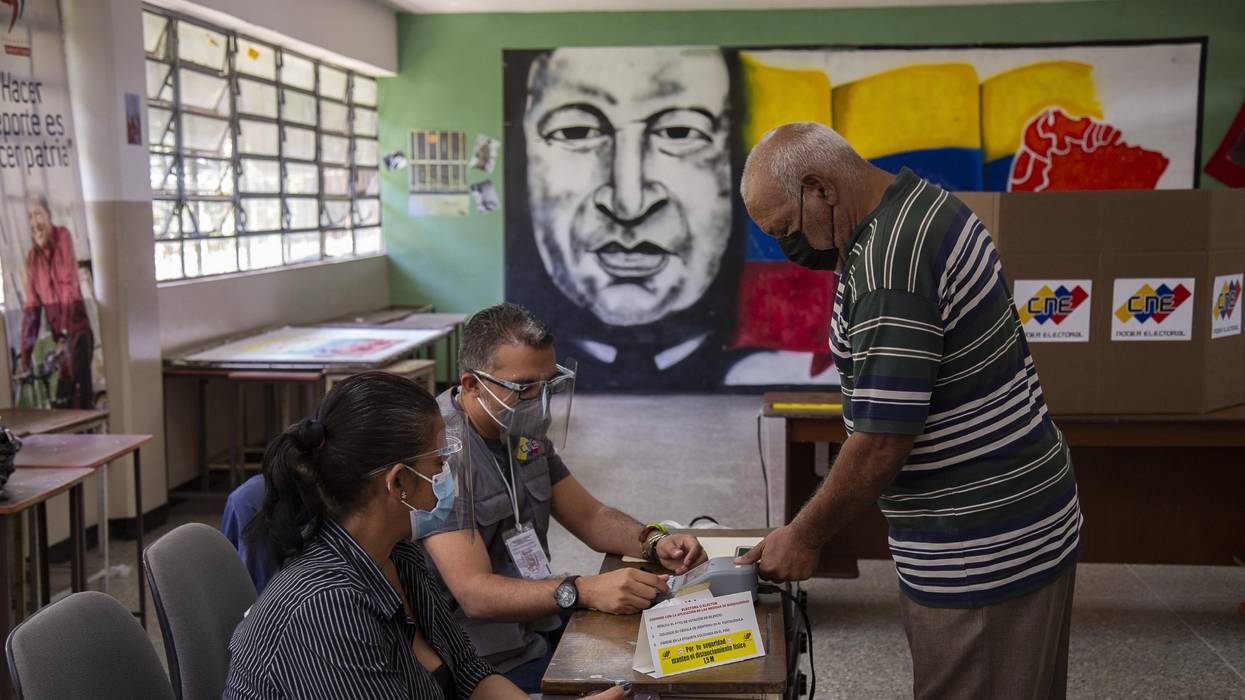
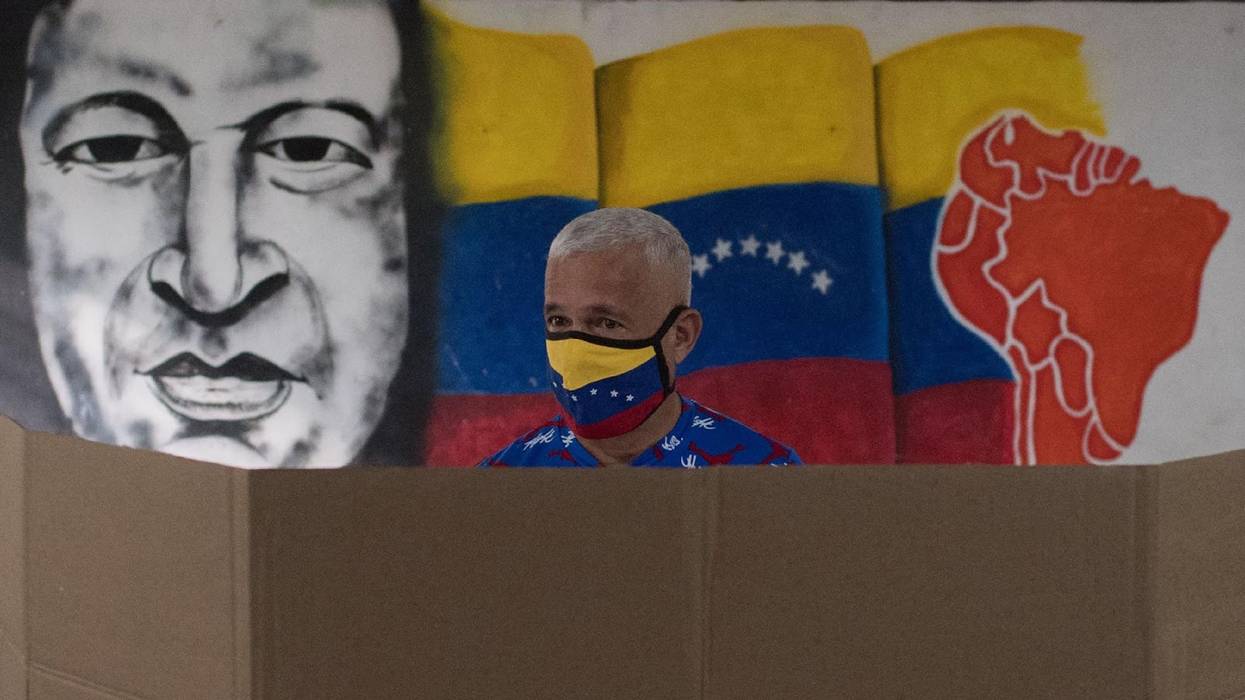
A delegation of observers from a New York City-based progressive legal group on Wednesday pushed back against the Biden administration's claims about Venezuela's recent regional elections in which allies of President Nicolas Maduro's socialist party were largely victorious.
"We observed a balanced and transparent voting process which voters expressed confidence in."
Allies of Maduro and his United Socialist Party of Venezuela (PSUV) secured 20 out of 23 governorships in the November 21 elections. The opposition coalition United Democratic Table (MUD) candidates succeeded in the Cojedes and Zulia states while Neighbors Force (FV) won in the Nueva Esparta State.
The National Lawyers Guild (NLG) delegation--among various international observers who traveled to Venezuela for the elections--shared its findings in a statement that began, "We observed a balanced and transparent voting process which voters expressed confidence in."
Founded in 1937 as an alternative to the more conservative American Bar Association, the NLG sent eight observers to 12 sites in the Venezeulan capital Caracas as well as provinces in Miranda and La Guaira states.
"Overall we observed a climate of political energy grounded in an understanding that the voting day process, regardless of one's individual political ideology, functions fairly and is received as legitimate," the group said. "Also, we observed that the level of voter participation--almost 42% of registered voters in the context of a nonpresidential election, Covid-19, and severe economic sanctions--is significant and worthy of note."
The NLG said that "from a technical point of view, we observed an electoral system that was fundamentally transparent and facilitated by a workforce (poll workers, coordinators, table presidents) with strong technical competence regarding the functioning of the machines and the integrated election systems."
After speaking with voters at all sites, the NLG observers found that those "aligned with opposition parties also expressed confidence in the voting system. Additionally, the participation of opposition parties at polling sites, including as witnesses in opening and closing processes, strengthened the process and underscored the legitimacy of election results."
The NLG statement continued:
At a number of points throughout the day we witnessed voters frustrated with the heat, "wait times," some technical malfunctions, and occasionally with some confusion finding themselves on the voter rolls. These instances were not the norm at the sites we visited and therefore do not find that these incidents amount to systemic flaws or election "irregularities." Instead, they appear to be part of a complex, far-reaching, and broad election system intended to be accessible in all corners of a country of almost 29 million people, while under U.S. sanctions.
"We are clear that in all parts of the world, including in the United States, there exist Election Day dynamics which can complicate the electoral process, but which do not undermine or delegitimize an open and free process such as this," said NLG delegate Vladimir Martinez.
The European Union also sent election monitors to Venezuela. They expressed concerns about the disqualification of some opposition candidates and the death of a voter in a shooting near a polling station but also highlighted improvements, according to the Associated Press.
"The regional and municipal elections of November 21 were a first and crucial test for the return of most of the opposition parties to the elections in Venezuela," the E.U.'s initial report said. "The electoral process showed the persistence of structural deficiencies, although electoral conditions improved compared to the three previous national elections."
In a lengthy statement Monday, U.S. Secretary of State Antony Blinken claimed that "the Maduro regime deprived Venezuelans yet again of their right to participate in a free and fair electoral process."
"Fearful of the voice and vote of Venezuelans, the regime grossly skewed the process to determine the result of this election long before any ballots had been cast," Blinken said. "Arbitrary arrests and harassment of political and civil society actors, criminalization of opposition parties' activities, bans on candidates across the political spectrum, manipulation of voter registration rolls, persistent media censorship, and other authoritarian tactics all but quashed political pluralism and ensured the elections would not reflect the will of the Venezuelan people."
The NLG delegates said they "reject" the Biden administration's characterization of the elections in Venezuela, which is enduring an economic crisis exacerbated by U.S. sanctions.
NLG President Suzanne Adely, a member of the delegation, suggested Blinken's comments were motivated by justifying the administration's policies, which include maintaining sanctions imposed under former President Donald Trump and continuing to recognize opposition leader Juan Guaido as the South American country's "interim president."
"The U.S.'s consistently false narrative of elections in Venezuela is formulated to legitimize the continuation of U.S. sanctions, which are violations of international law and amount to economic warfare," said Adely. "The U.S. sanctions harm the Venezuelan people and aim to undermine and destabilize Venezuela in order to further U.S. interests in the region."
Sunday's elections were the first since 2017 in which main opposition parties participated. Voters elected not only governors but also 253 state legislators, 335 mayors, and 2,471 municipal councilors.
Writing Monday for Common Dreams, Leonardo Flores, a Latin American policy expert and campaigner with the anti-war group CodePink, outlined five reasons for the Venezuelan left's success over the weekend:
According to Flores, "These elections should put the Biden administration on notice that continuing to support the MUD, and in particular, the fiction of Guaido as 'interim president,' is a failed policy."
For the first time in four years, every major opposition party in Venezuela participated in elections. For the fifth time in four years, the left won in a landslide. Voters elected 23 governors, 335 mayors, 253 state legislators and 2,471 municipal councilors. The governing United Socialist Party of Venezuela (PSUV) won at least 19 of 23 governorships (one race remains too close to call) and the Caracas mayoralty in the November 21 "mega-elections." Of the 335 mayoral races, the vote count has been completed in 322 of them, with PSUV and its coalition taking 205, opposition coalitions 96 and other parties 21. Over 70,000 candidates ran for these 3,082 offices, and 90% of the vote was counted and verified within hours of polls closing. Turnout was 42.2%, eleven points higher than last year's parliamentary elections.
Here's why chavismo, the movement behind the Venezuela's Bolivarian Revolution, won:
1. Good governance in health, housing and food. Venezuela's health policies in response to Covid-19 have been exemplary. The expectation in the U.S. was that the coronavirus would overwhelm Venezuela's healthcare system, which has been devastated by years of sanctions. And yet, per million population, Venezuela registered 15,000 cases and 180 deaths. For the sake of comparison, the figures in the U.S. are 146,000 cases/million and 2,378 deaths/million, Brazil's are 103,000 and 2854, and Colombia's are 98,000 and 2,481. Unlike images we saw in Ecuador or Bolivia, there were no bodies of victims left on the streets, nor were there overflowing morgues like in New York.
In terms of housing, the Venezuelan government has built 3.7 million homes for working class families over the past ten years, the majority of which were built and delivered by the Maduro administration while under sanctions.
As deadly as the sanctions have been, things would be significantly worse were it not for Venezuela's most important social program in the past five years: the CLAPs. These consist of boxes of food and other necessities, some of which are produced locally, which are packaged and distributed by communities themselves. Seven million Venezuelans families receive CLAP boxes every month, out of a country of 30 million people. Not only has this program been instrumental in keeping people fed, it has invigorated the base of chavismo and reconnected the government with grassroots after the PSUV's defeat in the 2015 legislative elections.
2. The economic situation is improving. According to an August 2021 survey by opposition pollster Datanalisis, 50% of Venezuelans consider that their lives have improved compared to the previous year or two. Despite sanctions that have caused a 99% drop in government income, the Venezuelan economy is stabilizing. Inflation is down to single digits for the first time in four years. Credit Suisse projected 5.5% growth in 2021 and 4.5% growth in 2022. Oil production hit an 18-month high in October, helped by a trade deal with Iran.
3. The left is united (mostly). The PSUV didn't win the elections alone, they were united with 8 other left parties in a coalition known as the GPP (Great Patriotic Pole). The PSUV itself held internal primaries in August, the only party to do so. Over half the GPP candidates were women, 52%, while another 43% were youth. Overall, 90% of the candidates hadn't held office before, suggesting a renewal of the party from the grassroots. However, this marked the second election in a row in which the left wasn't completely united. A coalition that included Venezuela's Communist Party ran its own ticket. These parties got less than 3% of the vote in the 2020 parliamentary elections and their decision to run separately appears to have had no impact on the gubernatorial races.
4. The opposition is divided. Never known for their unity, the Venezuelan opposition suffered a major split as a result of some parties opting for boycotting elections and attempting to overthrow the government, while others preferred a democratic path. Despite all the major parties participating in these elections, the opposition was split into two main coalitions, the MUD (Democratic Unity Roundtable) and the Democratic Alliance. The vast majority of the 70,000 candidates are in the opposition and they were running candidates against each other in almost every race. Of the 23 gubernatorial races, six were won by PSUV candidates with less than 50% of the vote and by less than six points - more unity between the MUD and Democratic Alliance could have made the difference.
A count of the votes in the gubernatorial and Caracas mayoral races show the PSUV coalition taking 46% of the total vote, with the rest split between the various oppositions. A united opposition could win in Venezuela, but "united opposition" is an oxymoron.
5. The opposition is deeply unpopular. While much is made about the alleged lack of support for President Maduro (the millions of votes his party got will never be acknowledged by the U.S.), it's less known that the opposition is deeply unpopular. Here are the disapproval ratings for some of the opposition's key figures: Juan Guaido, 83% disapproval; Julio Borges (Guaido's "Foreign Minister), 81%; Leopoldo Lopez (Guaido's mentor and mastermind of coup attempts), 80%; Henry Ramos Allup (longtime opposition leader), 79%; Henrique Capriles (2012 & 2013 presidential election loser), 77%; and Henri Falcon (2018 presidential election loser), 66%. All of these but Falcon are part of the MUD.
The MUD coalition spent years claiming they represented a majority, a claim which couldn't be verified by their strategy of electoral boycotts. However, their return to the electoral process only marked a ten point increase in voter turnout compared to 2020. Moreover, the MUD placed below other opposition parties in 9 of 23 states and in Caracas. The MUD only won one of the three governorships taken by the opposition. This might be due in part to widespread rejection of U.S. sanctions. The MUD has repeatedly endorsed deadly sanctions despite the fact that 76% of Venezuelans reject them.
The MUD enjoys the political, financial and logistical support of the United States and the EU, while members of other opposition parties have been denounced and sanctioned by the U.S. for negotiating with the Maduro administration. These elections should put the Biden administration on notice that continuing to support the MUD, and in particular, the fiction of Guaido as "interim president", is a failed policy.
Progressive observers of United States foreign policy in Latin America were unsurprised yet still expressed alarm Thursday over details in a new report from the U.S. Agency for International Development that shows the Trump administration's humanitarian aid to Venezuela was at least partially motivated by a desire for regime change in Caracas.
"You didn't need to be a genius to see the U.S. was trying to force a dramatic confrontation, rather than trying to efficiently help needy Venezuelans."
--Vincent Bevins, journalist
The report (pdf) published earlier this month by the USAID inspector general's office states that "the U.S. government's key foreign policy goals" in Venezuela following President Nicolas Maduro's 2018 reelection were to "increase pressure on Maduro to step down" and "support Guaido's legitimacy as the interim president," a reference to the unelected opposition leader Juan Guaido, who has also received a show of support from President Joe Biden.
"Accordingly, USAID prioritized aid to the Venezuelan people in coordination with the interim president, including issuing in-kind grants to distribute humanitarian commodities inside Venezuela," the report says. This included supporting an unnamed Venezuelan NGO perceived as aligned with U.S. foreign policy objectives despite not knowing "whether the organization had the capacity to comply with USAID's legal and financial requirements."
The IG investigation found that out of 368 metric tons of humanitarian aid designated for delivery to Venezuela by the agency, only eight metric tons arrived in the country, with the rest going to Colombia and Somalia. Aid that was sent to Venezuela arrived in military transport planes, a move the report says "was not justified by operational needs as commercial transportation was available and less expensive."
The report also acknowledges that the failed February 2019 aid convoy organized by U.S. special representative Elliott Abrams--whose history in the region includes using humanitarian aid flights to arm Contra terrorists in Nicaragua and covering up massacres committed by U.S.-backed death squads in Guatemala and El Salvador--"contributed to a tense environment for humanitarian assistance funded by or associated with the U.S. government, as the Maduro regime publicly rejected pre-positioned commodities and initiated security crackdowns in Venezuela."
Additionally, it states that USAID's own officials determined that food aid purportedly sent to alleviate child hunger "was unnecessary because the nutritional status of Venezuelan children did not warrant its use at the time."
USAID, "concerned that the United Nations supported the Maduro regime," also minimized funding for U.N. agencies even though some of them "had infrastructure in Venezuela to deliver humanitarian commodities."
This, at a time when a combination of increasing U.S. economic sanctions, corruption and mismanagement, low oil prices, and natural disasters reversed some of the tremendous progress made by the Bolivarian Revolution--which began with former President Hugo Chavez and continued under Maduro--in improving the lives of poor Venezuelans.
The new report surprised few seasoned observers of the more than 100-year history of U.S. meddling in Venezuelan affairs, a timeline that includes hundreds of millions of dollars in USAID funding--including nine-figure spending on groups opposing the Bolivarian Revolution. Still, the USAID IG report raised eyebrows.
"This was incredibly obvious at the time, but it's shocking to see the details," said U.S. journalist and author Vincent Bevins of the report's contents.
USAID itself has a long history of foreign interference and subversion around the world. The agency funded death squads in El Salvador and Guatemala's genocidal army during the 1980s, the forced sterilization of Indigenous Peruvian women in the 1990s, Laotian heroin traffickers during the Vietnam War--to name but a handful of examples. USAID operatives also taught torture and democracy suppression to security forces in Latin American dictatorships including Brazil, the Dominican Republic, and Uruguay in the 1960s and 1970s.
More recently, USAID in 2010 launched a social media campaign with the goal of sparking civil unrest against the Fidel Castro-led government in Cuba. Around the same time, the agency infiltrated Cuba's burgeoning hip-hop scene in a bid to foment a youth uprising.
The January 6th raid on the Capitol and the pandemic that has upended the lives of every American seemingly have nothing to do with Venezuela. But the effects they had on U.S. political and economic stability offer a glimpse into what Venezuelans have been going through for the past several years of failed coups and sanctions.
Remember how January 6th felt? The shock, confusion and fear. The constant refreshing of Twitter feeds or eyes glued to cable news, watching a bunch of extremists attempt to overthrow the government. The not knowing what was going to happen next and whether it would impact our daily lives.
For Venezuelans, there is no one "January 6." There are at least half a dozen. An equivalent date could be January 23, 2019, when little-known opposition figure Juan Guaido, who only weeks earlier had been appointed president of the National Assembly seemingly out of nowhere, declared himself "interim president" of the country with U.S. backing.
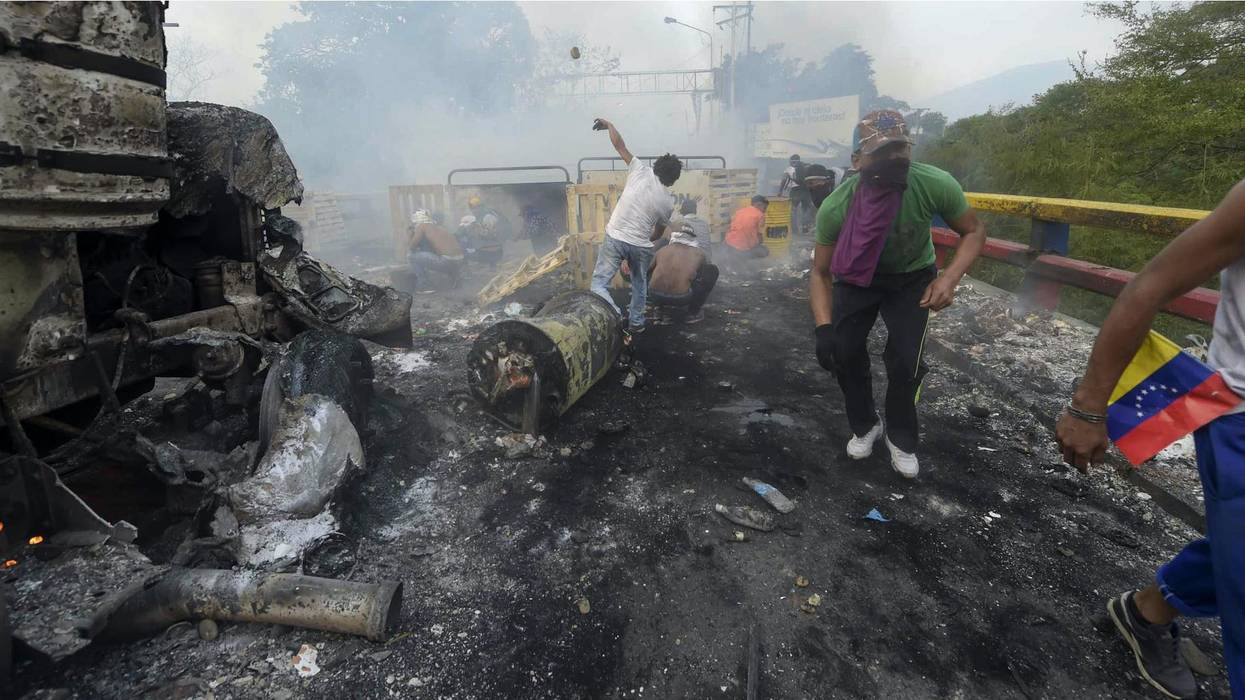
Or it could be February 23, 2019, when extremist Venezuelans, operating out of Colombia, attempted to push "humanitarian aid" through the border (the aid included riot equipment for government opponents, who then burned the trucks themselves to destroy the evidence). Or perhaps March 7, 2019, when there was a week-long nationwide blackout, allegedly the result of a covert operation that included a cyberattack on the nation's most important hydroelectric dam. Or April 30, 2019, when Guaido attempted a military uprising (he and a dozen or so soldiers only managed to hold a highway overpass for a few hours). Or April 1, 2020, when the Trump administration deployed warships just off Venezuelan water. Or May 3, 2020, when mercenaries attempted to sneak into the country to kidnap President Nicolas Maduro (an operation that Guaido likely authorized).
Attempts at regime change in Venezuela didn't start with the Trump administration, but they certainly intensified during his term. Employing a "maximum pressure campaign", the former president sought to empower an extremist faction of the country's opposition, while destroying the economy with sanctions.
The strategy was simple: pressure the Maduro government in every way possible (including with threats of war), drive ordinary citizens to despair so they or the military would rise up, and set up a parallel government ready to step in after the coup.
This approach failed so spectacularly that Senator Chris Murphy called it "a case study in international relations malpractice." The U.S. anointed "interim president," Juan Guaido, now has a disapproval rating of 88%. The Venezuelan people are sick of the entire ordeal: 82% oppose the sanctions and 83% reject a military intervention.
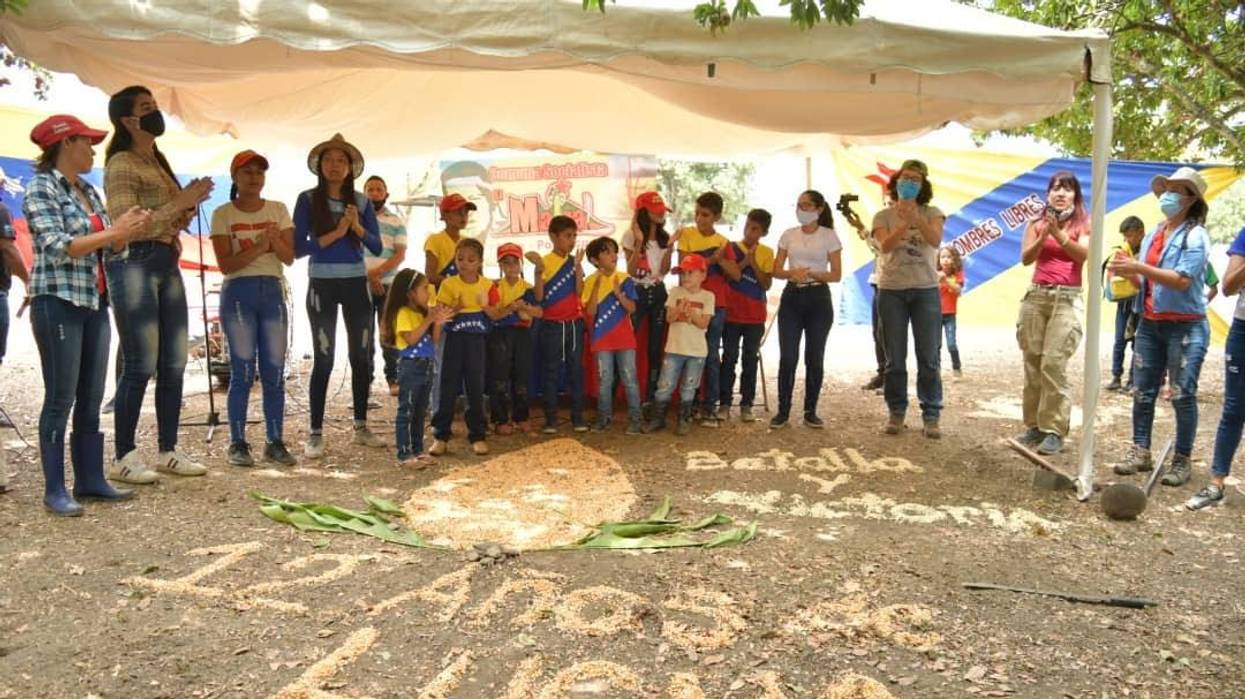
While the Biden administration ruled out an invasion, Venezuelans feel besieged nonetheless. Angel Prado, a grassroots leader and spokesperson for El Maizal, one of over 3,200 communes or self-governing communities in Venezuela, laments the human and economic toll of U.S. policy.
"It's like a war... the first bomb hasn't fallen here--although President [Maduro] had a drone almost explode in his face--it's a different sort of war, but it's still a war that affects us," Prado said. (The explosion he references was an attempted assassination of President Maduro and most of his cabinet using drones laden with C-4 explosives - another potential January 6.) Calling it a war might sound like an exaggeration to Americans, but even a cursory examination of recent events in Venezuela bears out his claim.
U.S. aggression towards Venezuela 2013-2020
It's impossible to understand what's going on in Venezuela without a clear picture of how the United States has been involved in regime change. The Bush administration infamously backed a coup against then-President Hugo Chavez in 2002--a coup that lasted 48 hours before thousands of people took to the streets to demand, and win, the reinstallation of the Chavez administration.
More recently, Senators Bob Menendez and Marco Rubio have been spearheading the bipartisan effort to overthrow the Venezuelan government since March 2013, when President Hugo Chavez died. He had easily won a presidential election in late 2012, beating his opponent by eleven points. Two months after his death, Nicolas Maduro, a former Vice President and Foreign Minister, squeaked by that same opponent by one and a half points. Rubio, Menendez, their allies in the Cuba lobby and the State Department smelled blood in the water. Secretary of State John Kerry initially refused to recognize the election results, foreshadowing a tactic the Trump administration would employ over and over again.
In 2014, Congress passed a law sponsored by Menendez and Rubio calling on the White House to sanction Venezuela. In 2015, President Obama declared a national emergency in the United States, arguing that Venezuela was an "unusual and extraordinary threat."
In 2017, the Trump administration put the military option on the table and sanctioned PDVSA, the state oil company. This sanction ended up being a death sentence for thousands of Venezuelans.
The sanction and threat occurred two months before nationwide gubernatorial elections that the Venezuelan opposition had high hopes of sweeping. Their pollsters had them winning in 18 of 23 states, and opposition leaders crowed that the elections should be interpreted as a referendum on President Maduro. His socialist party ended up winning in 19 states; there were no credible claims of fraud.
These elections are worth highlighting because it was the last time the opposition would fully participate. Following the embarrassment of the gubernatorial elections, an important faction decided that a democratic path to power was unobtainable. Since then, this faction boycotted a presidential election in 2018 to set the stage for January 2019, when a little-known legislator, Juan Guaido, was appointed president of the National Assembly and then declared himself "interim president" of the country with the backing of the U.S. Then, in 2020, this faction boycotted legislative elections because it didn't not want to risk losing the presidency of the legislature, which would have dealt a fatal blow to their entire argument for an interim presidency.
The boycotts were conducted in coordination with the Trump administration, which denounced both elections as fraudulent before they were even held. The Biden administration continues the Trump policy of refusing to recognize the results.
The Trump administration went beyond blatant electoral interference. It also sabotaged two promising attempts at finding a political solution to the multiple crises in Venezuela. The first time it happened was in early 2018. After months of talks in the Dominican Republic produced a draft agreement, negotiators returned to Venezuela for final consultation. During this interim, the State Department threatened an oil embargo, implied the U.S. would welcome a military coup and said it would not recognize upcoming elections--the very ones that were still being negotiated.
The second time was in August 2019, when Trump imposed what the Wall Street Journal characterized as a "full economic embargo" and said the "time for dialogue was over." On cue, the faction of the opposition left the negotiating table.
Economic war on Venezuela
Over the past four years, the United States has imposed over 150 sanctions on Venezuela. These include broad economic sanctions, such as on Venezuela's ability to issue bonds, on its oil and gold industries, and even on its newly launched cryptocurrency, the Petro. Most of the sanctions are on individuals, businesses, even ships and airplanes. They raise the cost of doing business: insurance premiums go up, risk ratings worsen, interest rates go up, among other cost increases. On top of that, companies, including financial institutions, stopped doing businesses with Venezuela out of fear of being sanctioned.
Then there are the billions of dollars of Venezuelan funds that are frozen abroad, unable to be accessed even for humanitarian supplies. This includes 34 tons of gold held by the Bank of England, which refused a request by the Venezuelan government to release it to the United Nations, which would then sell the gold to purchase food and medicine for the Venezuelan people. The Bank--which claims to be independent of the British government--says it cannot give the gold to the Maduro government because the U.K recognizes Juan Guaido.
Not to be outdone by the British, the Trump administration committed piracy on the high seas. In August 2020, U.S. Navy ships seized a tanker carrying fuel purchased by Venezuela from Iran. The fuel was then sold on the open market for $40 million, the money went to a U.S. fund for victims of state-sponsored terrorism, none of whom are Venezuelan. This wasn't the first time the U.S. spent Venezuelan funds on completely unrelated expenses. In June 2020, it was reported that the Trump administration used $601 million in assets seized from allegedly corrupt Venezuelan businesses in the U.S. to help pay for his border wall in Mexico.
The act of piracy raises questions as to why Venezuela, the country with the world's largest oil reserves, needs to buy fuel. The answer is simple: the sanctions have devastated its oil industry and its ability to refine oil into gasoline. In August 2017, the Trump administration issued an executive order targeting PDVSA, the state oil company. This decree prevented the company from restructuring its debts and from repatriating profits from Citgo, its U.S. based subsidiary. Eventually the sanctions came to impede the import of spare parts for maintenance and chemical additives necessary to transform oil into gasoline and diesel.
Citgo, once considered the crown jewel of PDVSA's assets abroad, is now about to be stripped down and sold off to Venezuela's creditors. Prior to the sanctions, Venezuela paid its debts on time, or at least came to terms with creditors. Now though, the sanctions forbid repaying those creditors, and a U.S. court ruling allowed Crystallex, a Canadian gold mining company, to collect by selling parts of Citgo. Anticipating that Venezuela might seek to sell Citgo to avoid exactly this scenario, Senators Rubio and Menendez pressured the Trump administration to prevent such a sale, which he quickly did.
The economic aggression from the United States contributed significantly to government revenues falling from $56.6 billion per year in 2013 to $477 million in 2020--a drop of 99%. Venezuelan economist Pasqualina Curcio estimates that the economic war has cost Venezuela $194 billion.
While the true economic cost may be up for debate, the fact that the sanctions have caused severe harm to the economy should be considered settled. Even U.S. government institutions agree on this point. A February 2021 investigation by the Government Accountability Office found that the Venezuelan economy "has fallen steeply since the imposition of U.S. sanctions."
Sanctions as deadly as a pandemic
It would be hard for people in the United States to understand the emotional toll caused by having the economy upended if we weren't living through a pandemic that has upended everything. The Venezuela sanctions are like a pandemic that's been going on for seven years.
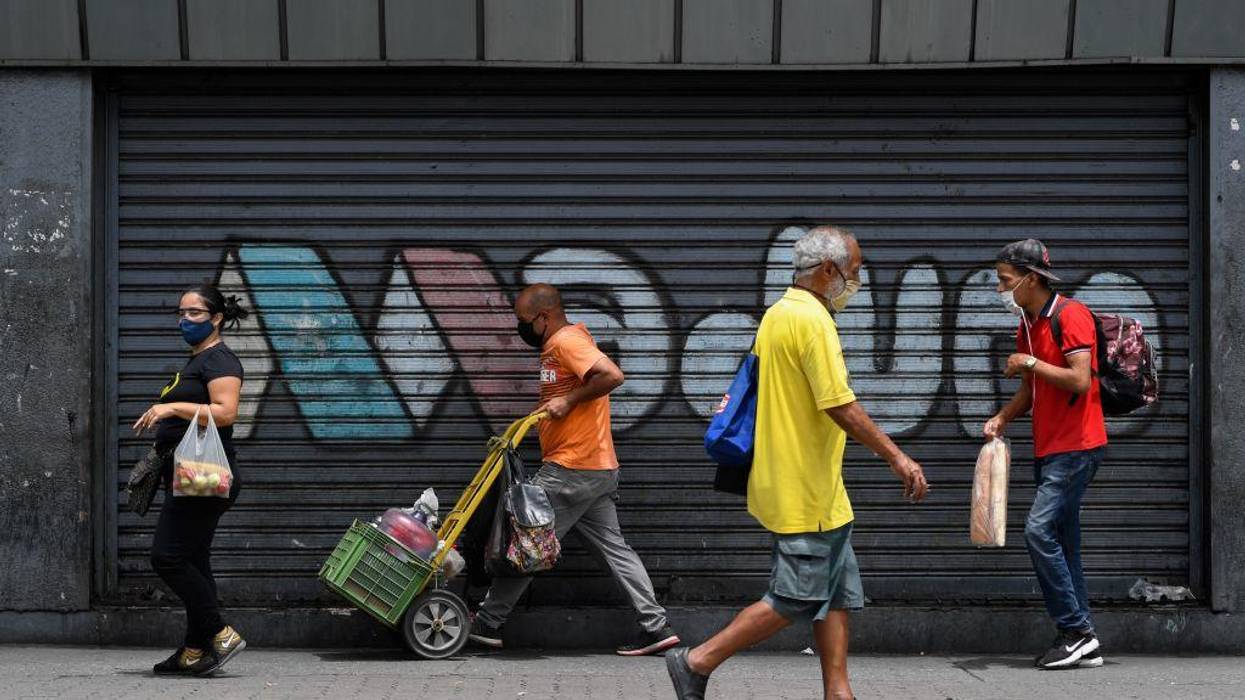
The precipitous drop in government revenue, the difficulties in importing food, medicine and other essential supplies, and the increased cost of living have a profound effect on ordinary Venezuelans.
"Finding food, finding medicine, it's really hard to live, finding gas, finding sources of livelihood--that puts a lot of pressure on people," said Lorena Gimenez of feminist human rights organization Genero con Clase (Gender with Class). She explains how women have borne the brunt of the sanctions, which have even affected the availability and cost of contraceptives. Her organization commissioned a survey last year that found that the sanctions cause "psychological violence" and impacted their human rights.
The sanctions should be thought of as a massive violation of human rights. United Nations Special Rapporteur Alena Douhan said as much following a fact-finding mission to Venezuela in February:
"The Special Rapporteur notes with concern that sectoral sanctions on the oil, gold and mining industries, the economic blockade of Venezuela and the freezing of Central Bank assets have exacerbated pre-existing economic and humanitarian situation by preventing the earning of revenues and the use of resources to develop and maintain infrastructure and for social support programs, which has a devastating effect on the whole population of Venezuela, especially those in extreme poverty, women, children, medical workers, people with disabilities or life-threatening or chronic diseases, and the indigenous population." (Emphasis added)
Douhan also laid out the case that sanctions, the Obama administration's declaration of a national emergency and the Trump administration's maximum pressure campaign violate international law, including the UN charter and other treaties the U.S. has signed onto.
A 2019 report by the Center for Economic and Policy Research (CEPR) argued that "sanctions would fit the definition of collective punishment of the civilian population as described in both the Geneva and Hague international conventions, to which the U.S. is a signatory." Collective punishment is the right way to put it, as every single person in Venezuela is affected by the U.S. sanctions.
The most troubling thing to come of the CEPR analysis was the conclusion that sanctions caused more than 40,000 deaths in 2017-2018. By March 2020, a former UN Special Rapporteur, Alfred de Zayas, estimated that the sanctions killed 100,000 people. It's mass murder through economic strangulation.
Resilience
"Despite the economic situation and the blockade we have in the country, we are a people that builds, very optimistic and very hopeful in what we're doing," emphasized Prado. This resilience comes through in conversations with Venezuelans like Prado and Gimenez. In the face of the cruelty of U.S. policy, these aren't people who are despairing.
They, like every other Venezuelan, viscerally experience the impacts of sanctions on a daily basis, yet they're committed to finding solutions. Prado speaks of preserving the country's sovereignty and independence, of ensuring "supreme happiness for our people." He notes how El Maizal commune was forced to switch to organic farming, as it became impossible to import pesticides and chemical fertilizers. The commune has also begun technical cooperation with peasant movements in Latin America.
"We're not prepared to resolve everything, the blockade affects us. Although it has awoken in us a level of creativity, of inventing things, it will always affect us," Prado said. Yet he cautioned that creativity can only go so far. His biggest worry these days is the shortage of diesel fuel, just as planting season is set to begin. Three million liters of milk and 20 tons of food are being lost every week, spoiling in farms and warehouses, unable to be delivered to consumers.
The Trump administration gave a parting blow to Venezuelans when it banned diesel swaps in October 2020. Through these swaps, PDVSA, the state oil company, was able to provide crude oil to foreign companies in exchange for diesel fuel. The country's diesel reserves began to be stretched in January. Diesel is needed for agriculture, hospital generators and the distribution of food, medicine and other necessary goods. The Biden administration has given no indication it will lift this--or any other--sanction.
Recent statements made by US officials suggest that Washington will continue to pursue a hardline policy on Venezuela. The new Biden Administration, however, needs to urgently rethink its approach.
US State Department spokesperson, Ned Price, remarked on February 3 that he "certainly" does not "expect this administration to be engaging directly with (President) Maduro." Namely, Price expects that the Biden Administration will adhere to the strategy of its predecessor, which is predicated on completely ignoring the current government in Caracas.
Moreover, the Biden government will also continue to dialogue with Venezuela's opposition leader, Juan Guaido. On March 2, Guaido conversed with the new American Secretary of State, Antony Blinken. It was the highest-level US contact with the increasingly-discredited and isolated Guaido since Biden's inauguration last January. In their exchange, Blinken and Guaido agreed on the "importance of a return to democracy in Venezuela through free and fair elections."
Washington's futile sanctions-based approach to Venezuela has proved not only immensely harmful to the welfare of the Venezuelan people but also to Washington's own regional interests.
It would be rational, therefore, to conclude that no significant change regarding US foreign policy in Venezuela will occur under the Biden Administration, at least imminently. However, such a conclusion would be hasty, as it fails to appreciate the numerous changes that have transpired in and around Venezuela in recent years, especially since Washington strengthened its economic sanctions on the South American country in 2015 and again, in 2017, 2019 and, finally, February 2020.
Washington's agenda in Venezuela has unmistakably failed, and no amount of additional sanctions is likely to change the political outcome. Not only did the Maduro government, ruling party, regional and international allies prove durable and capable of withstanding immense political and economic pressures, Washington's allies are no longer united, neither about Venezuela nor anywhere else.
Guaido, who arrived on the scene in 2015, was elevated from being a little known politician to the anti-socialism hero designated by Washington to reclaim Venezuela in the name of liberal democracy. Guaido's legitimacy was largely derived from the Venezuelan opposition's victory in the elections of that same year.
Since then, however, Guaido's own legitimacy has slowly eroded. By disproportionately investing in Washington's ability to oust Maduro through severe sanctions, diplomatic delegitimization and political pressure, Guaido slowly abandoned his initial Venezuela-centric approach, thus delegitimizing himself instead, even among his own supporters. Frustrated by Guaido's self-serving priorities, and knowing that the man's current strategy would not lead to any substantive political reordering in the country, Venezuela's opposition disintegrated into small factions.
In January 2020, another opposition lawmaker, Luis Parra, attempted to claim the position of Speaker of Parliament. This led the parliament security to block Guaido's access to the Palacio Federal Legislativo for he, too, was claiming the same chair. Images of the chaotic scene were beamed across the globe.
Venezuela's most recent legislative elections last December have also reflected the deep divisions among the country's opposition parties, where some strictly adhered to the boycott of the elections while others participated. The outcome was a decisive victory for Maduro's United Socialist Party, which now has complete control over the country's political institutions. France24 news agency captured this new reality in this headline: "New Venezuela Parliament leaves Western-backed Guaido out in cold."
Actually, Blinken's call to Guaido, whose moment has faded, is unlikely to change much on the ground. His usefulness now lies in the fact that Washington has no other 'strong man' in Caracas. Additionally, Washington has invested tremendous financial resources and political credit which allowed Guaido to claim the title of the country's interim president. Completely divesting from Guaido is also a risky maneuver.
Of note is the shift in language in the US political discourse, following the Blinken-Guaido telephone conversation: the "importance of a return to democracy in Venezuela through free and fair elections." The change is, perhaps, subtle but still significant, as it is no longer a decisive demand to remove Maduro from power.
It seems that the distance between the US and Venezuela's position is shrinking. In August 2019, the Washington Post reported that Venezuelan negotiators, speaking on behalf of Maduro's government, made a "startling offer" during mediated talks with the country's opposition in Norway two months earlier, where the government "signaled (its) willingness to hold such a vote within nine to 12 months," referring to the opposition's demand for fresh presidential elections.
Nevertheless, it behooves Washington to engage Caracas in civil political conversations, away from threats and sanctions, for two main reasons:
First, despite claims that the majority of Venezuelans living in the US support Washington's hardline policies, 46 percent of them also "support a removal of oil sanctions if the Maduro government agrees to hold internationally recognized free and fair elections," according to a recent opinion poll published by the right-wing Atlantic Council.
Second, Washington's futile sanctions-based approach to Venezuela has proved not only immensely harmful to the welfare of the Venezuelan people but also to Washington's own regional interests. Washington's obstinacy allowed its global rivals, Russia and China, to unprecedentedly cement their economic and strategic interests in that country.
In their 2019 report, the Center for Economic Policy Research (CEPR) revealed that, in the 2017-18 year, US-led sanctions on Venezuela "have inflicted--and increasingly inflict--very serious harm to human life and health, including an estimated more than 40,000 deaths."
Certainly, there can be no political logic or moral justification for this ongoing calamity.
Alena Douhan, the UN special rapporteur on the negative impact of unilateral coercive measures on the enjoyment of human rights, published her preliminary report on February 12 on the impact of US and European sanctions on Venezuela.
The report laid bare how a years-long campaign of economic warfare has asphyxiated Venezuela's economy, crushing the government's ability to provide basic services both before and during the Covid-19 pandemic.
"The [Venezuelan] government's revenue was reported to shrink by 99%, with the country currently living on 1% of its pre-sanctions income," Douhan found, impeding "the ability of Venezuela to respond to the Covid-19 emergency."
Douhan thus urged
the governments of the United Kingdom, Portugal and the United States and corresponding banks to unfreeze assets of the Venezuela Central Bank to purchase medicine, vaccines, food, medical and other equipment.
The campaign to overthrow the Venezuelan government, Douhan added, "violates the principle of sovereign equality of states and constitutes an intervention in domestic affairs of Venezuela that also affects its regional relations."
Douhan's report follows a Center for Economic and Policy Research (CEPR) paper that estimated that sanctions were responsible for over 40,000 deaths in Venezuela in 2017-18 (FAIR.org, 6/14/19). Though sanctions were not the only factor driving economic hardship, CEPR found that they
exacerbated Venezuela's economic crisis and made it nearly impossible to stabilize the economy, contributing further to excess deaths. All of these impacts disproportionately harmed the poorest and most vulnerable Venezuelans.
Like the CEPR study, Douhan's report has been categorically ignored across establishment media.
By omitting the devastating impact of sanctions, corporate media attribute sole responsibility for economic and humanitarian conditions to the Venezuelan government, thereby using the misery provoked by sanctions to validate the infliction of even more misery.

US and European officials have long admitted that the sanctions regime against Venezuela is collective punishment by design. Speaking to G20 foreign ministers in May 2018, then-British Foreign Secretary Boris Johnson announced:
The feeling I get from talking to my counterparts is that they see no alternative to economic pressure--and it's very sad, because obviously the downside of sanctions is that they can affect the population that you don't want to suffer. But in the end things have got to get worse before they get better--and we may have to tighten the economic screw on Venezuela.
On March 22, 2019, a senior US government official bragged:
The effect of the sanctions [against Venezuela] is continuing and cumulative. It's sort of like in Star Wars when Darth Vader constricts somebody's throat, that's what we are doing to the regime economically.
A year later, as the Covid-19 virus spread globally, US Attorney General William Barr gloatedthat the pandemic was
good timing, actually.... The [Trump] administration is taking a kind of "kick them while they're down" approach, seemingly with the hope that by piling on sanctions and other actions, the administration can capitalize on the virus in Iran and Venezuela to spur greater public opposition to the incumbent governments and perhaps regime change.
"Although sanctions do not seem to be physical warfare weapons," the Lancet (3/18/20) noted, "they are just as deadly, if not more so. Jeopardising the health of populations for political ends is not only illegal but also barbaric."
Many Western journalists, however, appear not to have seen these overt declarations of collective punishment against the Venezuelan population--a crime against humanity under Article 7 of the Statute of the International Criminal Court, according to former UN Expert Alfred de Zayas.
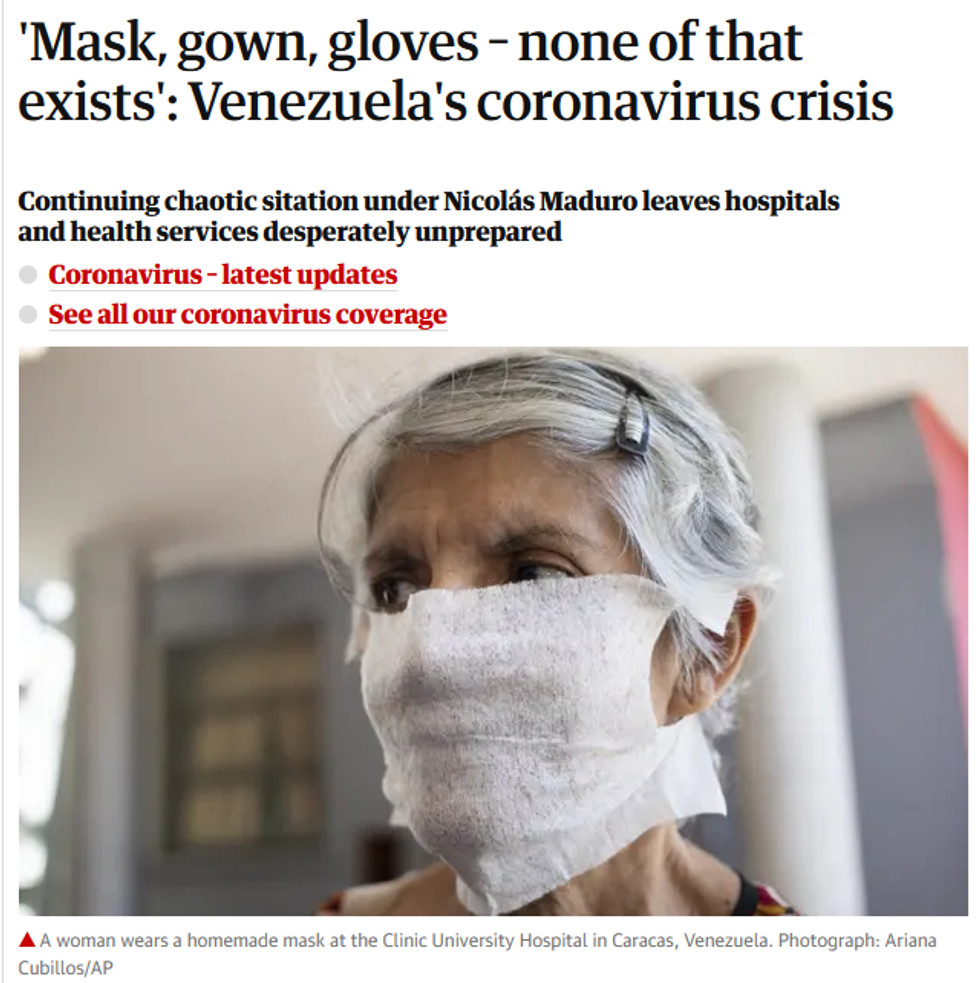
Loath to abandon belief in the fundamentally benign nature of Western foreign policy, corporate scribes have typically presented the devastating effects of sanctions as a mere accusation of Nicolas Maduro. "Maduro...said US sanctions were hurting his administration's ability to buy medicines and foodstuffs" was the next-to-last paragraph of a Guardian piece (3/17/20) on Covid in Venezuela whose subhead read, "Continuing chaotic situation under Nicolas Maduro leaves hospitals and health services desperately unprepared."
Often, they fail to mention sanctions at all. In June 2019, for instance, the Guardian's Tom Phillips reported that "more than 4 million Venezuelans have now fled economic and humanitarian chaos," citing would-be coup leader Juan Guaido's claim that the country's economic collapse "was caused by the corruption of this regime," without making any reference to Washington's campaign of economic warfare.
Keeping with tradition, Douhan's damning report has been met with stunning silence by establishment media outlets. Neither the Guardian, New York Times, Washington Post nor BBC reported on Douhan's findings, leaving the task primarily to alternative media (Venezuelanalysis, 2/15/21; Canary, 2/13/21). (CNN--2/13/21--had an exceptional report focused on the UN report, which noted Douhan's statement that sanctions "constitute violations of international law.")
The issue is not that Western media are uninterested in Venezuela. In February 2019, the month after Juan Guaido declared himself president, the Guardian published 67 separate articles about Venezuela, regularly citing the UN on Venezuela's economic and humanitarian conditions--signaling Maduro's sole responsibility for a crisis about which something must surely be done.
For example, the Guardian (2/27/19) reported in 2019, "The UN's political and peace building chief, Rosemary DiCarlo, depicted a devastating collapse in Venezuela's health system"--while making no reference to sanctions.
Similarly, the New York Times, whose editorial board had supported 10 out of 12 US-backed coups in Latin America since 1954, has regularly covered the deteriorating economic situation in Venezuela with--at best--only fleeting reference to US and European sanctions.
The New York Times (12/5/20), for instance, described how "Yajaira Paz, 35, has lost nearly everything" to the Venezuelan economic crisis: "her mother, dead from a heart problem she could not afford to treat; her brothers, to migration; her faith in democracy, to the nation's crippled institutions"--omitting any mention of sanctions.
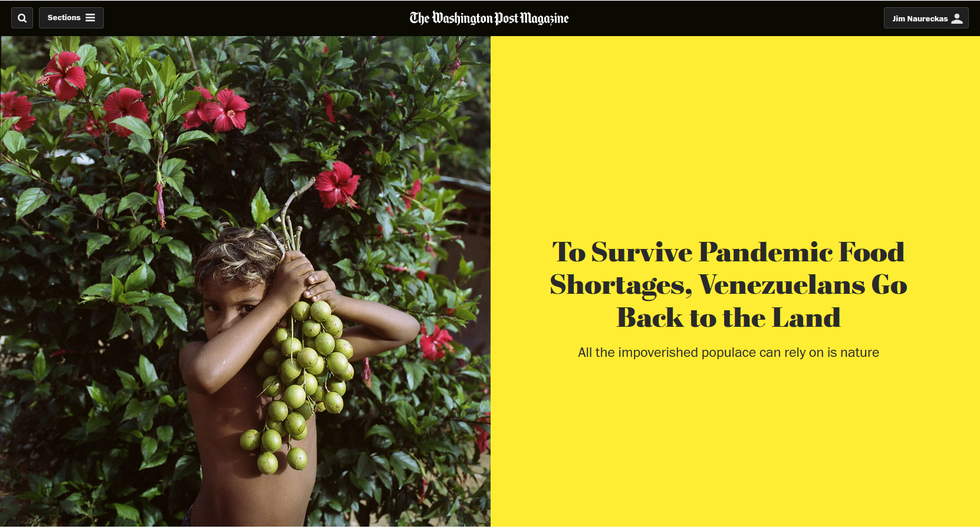
The Washington Post Magazine (3/3/21) ran a similarly emotive article, noting how "the pandemic wore away even more access to basic necessities in a country racked by deepening poverty and crisis," blaming "the national mismanagement of resources" and, again, ignoring the existence of sanctions.
Corporate media thus consistently emphasizes the gravity of Venezuela's humanitarian situation while overlooking crucial evidence on the catastrophic impact of sanctions, fortifying the very narratives deployed to justify the economic siege against Venezuela.
The collective silence over Douhan's report is only the most recent case of propaganda by omission on Venezuela. By refusing to acknowledge Washington and London's fundamental role in making Venezuela's "economy scream," corporate media play a key part in manufacturing consent for regime change.
In a perpetuation of Trump administration policy and nearly two centuries of U.S. imperialism in Latin America, Antony Blinken, President Joe Biden's nominee for secretary of state, told senators Tuesday that the United States will continue to recognize the coup leader Juan Guaido as legitimate president of Venezuela.
Reuters reports Blinken told senators during his confirmation hearing that Venezuela needs "an effective policy that can restore... democracy" to the nation of 28 million people.
Although Venezuelan President Nicolas Maduro has alienated allies and adversaries alike with his government's numerous and serious human rights violations, he was democratically elected in 2013, and reelected in 2018.
Blinken also told the senators that the Biden administration would seek to "more effectively target" Venezuela with economic sanctions, which have been described as a form of "economic terrorism."
The sanctions are largely responsible for the crippling of Venezuela's once-thriving economy and have caused tremendous suffering for the poor and working-class people whose dramatic uplift was once hailed as the great success of the Bolivarian Revolution launched under the late President Hugo Chavez.
According to a 2019 report from the Center for Economic and Policy Research, a progressive think tank based in Washington, D.C., as many as 40,000 Venezuelans have died due to sanctions, which have made it much more difficult for everyday people to obtain food, medicine, and other necessities.
Common Dreams reported Wednesday that the global left-wing activist group Progressive International called on the Biden administration to end sanctions on countries including Cuba, Iran, and Venezuela, which the group said are targeted because "they don't fall in line" with Washington's "global political and economic agenda."
Blinken's remarks to the senators were one of a series of recent signs that the United States--which has been supporting coups and dictators in Venezuela for over a century--would stay the imperialist course under Biden.
During the contentious and sometimes calamitous transition between administrations, Republicans and Democrats alike took comfort in a policy meeting between Elliott Abrams, former President Donald Trump's special representative for Venezuelan affairs, and members of the Biden transition team.
Abrams, whose history in the region includes involvement in the Iran-Contra scandal and covering up massacres committed by U.S.-backed death squads in Central America, called the meeting "pleasant" and left assured that he did not foresee any "major changes" in American policy toward Venezuela under Biden.
The inter-administration continuity was also on display in the person of Carlos Vecchio, Guaido's ambassador to the United States, who was feted by Trump and who was Biden's inaugural guest on Wednesday.
In 2014, Vecchio--one of the masterminds of the Guaido coup--was charged in Caracas with public incitement, property damage, arson, and conspiracy for an attack on the Venezuelan attorney general's office. His appearance at the U.S. Capitol two weeks after Biden condemned the deadly Trump-inspired mob attack on the building did not go unnoticed.
"Vecchio's presence at the presidential swearing-in ceremony was filled with irony," wrote journalist Anya Parampil. "In the days following the Capitol riot, Biden and his allies have denounced the violent takeover of Congress as an assault on democracy, with the incoming president himself declaring the rioters to be domestic terrorists.'"
"Yet," she added, "Carlos Vecchio, the Guaido ally with a fresh ticket to Biden's inauguration, is responsible for leading his own assault on his home country's democracy."
While Democratic and Republican lawmakers, political pundits, and angered U.S. citizens of all stripes rightly condemned Wednesday's violent coup attempt by a pro-Trump mob in the nation's capital, at least one foreign government offered its sympathy to the victims of the assault while also pointing out that U.S.-backed efforts to subvert democracy abroad are all too common.
In the wake of the day's deadly mayhem at the U.S. Capitol building, the Venezuelan government issued a public statement expressing "concern with the acts of violence that are taking [place] in the city of Washington, D.C."
" Venezuela condemns the political polarization and the spiral of violence that only reflects the deep crisis that the political and social system of the United States is currently going through," the statement continues. "With this unfortunate episode, the United States is suffering the same thing that it has generated in other countries with its policies of aggression."
Juan Guaido, Venezuela's right-wing opposition figure who in 2019 oversaw a failed U.S.-backed coup attempt after the reelection of Venezuelan President Nicolas Maduro, became a flashpoint for commentators eager to shed light on the hypocrisy of U.S. lawmakers from both major parties who gave Guaido a standing ovation when the self-anointed leader was erroneously described by President Donald Trump during his 2020 State of the Union address as the "true and legitimate president of Venezuela."
Alluding to a viral photo of a Trump supporter triumphantly raising his fist in the U.S. Senate Chamber during Wednesday's anti-democratic insurrection, journalist Max Blumenthal of The Grayzone News said, "Imagine if a foreign power recognized this guy as president and you'll know how Venezuelans feel."
The Grayzone's Anya Parampil noted that Maduro opponent Carlos Vecchio "was welcomed in D.C. as Juan Guaido's ambassador," not long after "encouraging violence and attacks on government buildings in Venezuela."
The main difference between the Venezuelan opposition that has tried to violently overthrow Maduro since he was reelected and the so-called #StopTheSteal rioters who stormed the U.S. Capitol on Wednesday in an attempt to strip President-elect Joe Biden of his legitimate victory, Parampil added, is that corporate media "recognizes the danger in these actions when they're taking place in their own capital."
Others also drew links between the efforts of the pro-Trump mob and Washington's anti-Maduro forces, sardonically suggesting that some of Wednesday's actions may have been inspired by Guaido.
Critics lambasted Guaido for having the audacity to denounce Wednesday's attack on democracy in D.C., reminding the "self-proclaimed puppet" of Washington of the similarities between his unsuccessful, anti-democratic power grab in Venezuela and the chaotic events that unfolded in the U.S. on Wednesday.
Like Guaido, right-wing pundit Yascha Mounk also deemed it appropriate to opine on the coup attempt in D.C., denouncing "groups of armed nihilists attempt[ing] to destroy federal buildings that are key to the maintenance of the rule of law."
The only problem, journalist Ollie Vargas pointed out, is that when "this exact set of events (fascist mobs seizing public institutions) took place in Bolivia," Mounk celebrated the military coup that replaced then-president Evo Morales with a brutal right-wing regime, calling it--in true Orwellian fashion--a victory for democracy.
In an interview with teleSUR, political analyst Arnold August explained that while Wednesday's terrible events are relatively unprecedented in the U.S., "unfortunately, these scenes are not unprecedented when it comes to U.S. foreign policy."
"The chickens have come home to roost," August said. "It is not unprecedented in U.S. foreign policy to carry out coups far more violent than the one that is going on in Washington, D.C. at the moment." He listed several recent examples of countries, including Paraguay, Brazil, Venezuela, and Bolivia, whose leaders were overthrown after pursuing policies that run counter to the interests of the U.S. ruling class.
August suggested that U.S. lawmakers disturbed by the attempt of pro-Trump forces to undermine the democratic process in this nation should not support regime change "elsewhere in the world."
Officials in the Maduro administration concluded their statement by saying that "Venezuela hopes that soon the violence will cease and the American people can finally open a new path towards stability and peace."