

SUBSCRIBE TO OUR FREE NEWSLETTER
Daily news & progressive opinion—funded by the people, not the corporations—delivered straight to your inbox.
5
#000000
#FFFFFF
To donate by check, phone, or other method, see our More Ways to Give page.
Daily news & progressive opinion—funded by the people, not the corporations—delivered straight to your inbox.
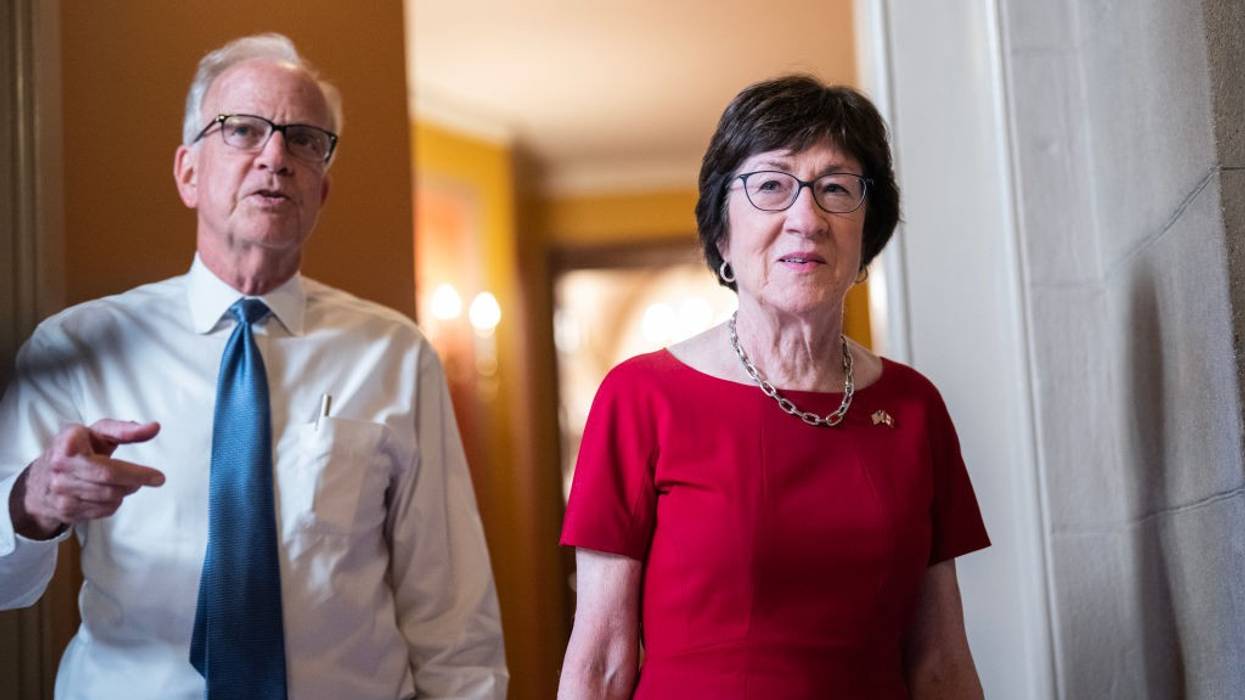
"It's abjectly terrifying that the personal benefit of any member of Congress is factored into decisions about how to wield and fund the largest military in the world," said one critic.
At least 50 U.S. lawmakers or members of their households are financially invested in companies that make military weapons and equipment—even as these firms "receive hundreds of billions of dollars annually from congressionally-crafted Pentagon appropriations legislation," a report published Thursday revealed.
Sludge's David Moore analyzed 2023 financial disclosures and stock trades disclosed in other reports and found that "the total value of the federal lawmakers' defense contractors stock holdings could be as much as $10.9 million."
According to the report:
The spouse of Sen. Susan Collins (R-Maine), the ranking member of the Defense Appropriations subcommittee, holds between $15,000 and $50,000 worth of shares in each of Boeing and RTX, as well as holdings in two other defense manufacturers. Sen. Jerry Moran (R-Kansas), another Defense Appropriations subcommittee member, holds up to $50,000 in the stock of Boeing, which received nearly $33 billion in defense contracts last year. On the Democratic side of the aisle, Sen. John Hickenlooper (Colo.) holds up to a quarter of a million dollars' worth of stock in RTX...
The most widely held defense contractor stock among senators and representatives is Honeywell, an American company that makes sensors and guiding devices that are being used by the Israeli military in its airstrikes in Gaza. The second most commonly held defense stock by Congress is RTX, formerly known as Raytheon, the company that makes missiles for Israel's Iron Dome, among other weapons systems.
All 13 senators whose households disclosed military stock holdings voted for the most recent National Defense Authorization Act, which, as Common Dreams reported, allocated a record $886.3 billion for the U.S. military while many lawmakers' constituents struggled to meet their basic needs.
"It is an obvious conflict of interest when a member of Congress owns significant stock investments in a company and then votes to award the same company lucrative federal contracts," Craig Holman, government affairs lobbyist at the consumer advocacy group Public Citizen, told Sludge.
"Whether or not the official action is taken for actual self-enrichment purposes is beside the point. There is at least an appearance of self-enrichment and that appearance is just as damaging to the integrity of Congress," Holman added. "This type of conflict of interest is already banned for executive branch officials and so should be for Congress as well. The ETHICS Act would justly avoid that conflict of interest by prohibiting members of Congress and their spouses from owning stock investments altogether."
Holman was referring to the Ending Trading and Holdings In Congressional Stocks (ETHICS) Act, introduced earlier this year by Sens. Jeff Merkley (D-Ore.), Jon Ossoff (D-Ga.), Gary Peters (D-Mich.), and Josh Hawley (R-Mo.).
In the House of Representatives—where the 2024 NDAA passed 310-118, with the approval of over two dozen members who own shares in military companies—House Foreign Affairs Committee Chair Michael McCaul's (R-Texas) household owns up to $2.6 million in General Electric, Oshkosh Corporation, and Woodward shares. Rep. Dave Joyce (R-Ohio), who sits on the Defense Appropriations subcommittee, owns as much as $100,000 worth of Boeing and General Electric stock.
Other House lawmakers with potential conflicts of interest include Rep. Gerry Connolly (D-Va.), a member of the Foreign Affairs Committee, who owns Leidos shares worth as much as $248,000; Rep. Debbie Dingell (D-Mich.), who owns up to $100,000 worth of RTX stock; and Rep. Patrick Fallon (R-Texas), a member of the Armed Services Committee who holds Boeing stock worth between $100,000 and $250,000.
"Every American should take a long, hard look at these holdings to conceptualize the scope of Congress' entanglement with defense contractors," Public Citizen People Over Pentagon advocate Savannah Wooten told Sludge. "It's abjectly terrifying that the personal benefit of any member of Congress is factored into decisions about how to wield and fund the largest military in the world."
"Requiring elected officials to divest from the military-industrial complex before stepping into public service would create a safer and more secure world from the outset," she added.

The world's largest pension fund recently adopted new ethics rules that could preclude it from owning shares in several U.S. arms firms.
Norway's $1.76 trillion sovereign wealth fund—the world's largest—could soon be forced to divest from companies including linchpins of the U.S. military-industrial complex due to updated ethics standards for businesses complicit in Israeli human rights violations in occupied Palestine.
Reuters reported Wednesday that the Government Pension Fund Global Council of Ethics informed the Norwegian Ministry of Finance on August 30 that it "believes the ethical guidelines provide a basis for excluding a few more companies" to its divestment list, "in addition to those already excluded."
The ethics council has been investigating whether to blacklist more companies ever since Israel began its bombardment, siege, and invasion of Gaza 334 days ago in response to the Hamas-led October 7 attack.
Since then, Israeli forces have killed or maimed more than 145,000 Palestinians, while forcibly displacing, starving, and sickening millions more and obliterating the Gaza Strip. Israel is currently
on trial for genocide at the International Court of Justice (ICJ) in The Hague.
Also under the council's consideration is Israel's conduct in the illegally occupied West Bank, where occupation forces have killed hundreds more Palestinians and settlers have carried out deadly pogroms under the protection—and sometimes with the participation—of Israel Defense Forces troops.
The fund's ethics rules—which are made by Norway's parliament, the Storting—were updated partly due to the ICJ's July advisory opinion that Israel's 57-year occupation is an illegal form of apartheid that must immediately end.
Companies under consideration include U.S.-based RTX (formerly Raytheon), General Electric, and General Dynamics.
Under its previous policy, the fund divested from nine companies operating in the occupied West Bank. Targeted businesses build homes and roads in illegal Israeli settler colonies, as well as provide surveillance systems for the Israeli separation wall, often called the "apartheid wall," along the Green Line boundary and inside parts of the West Bank.
In June, another Norwegian pension fund, Kommunal Landspensjonskasse (KLP), divested its nearly $70 million stake in Texas-based Caterpillar, citing the use of its bulldozers in ethnic cleansing in the West Bank.
"For a long time, Caterpillar has supplied bulldozers and other equipment that has been used to demolish Palestinian homes and infrastructure to clear the way for Israeli settlements," KLP head of responsible investments Kiran Aziz said at the time. "It has also been alleged that the company's equipment is being used by the Israeli Defence Forces in connection with its military campaign in Gaza."
Norway is one of several nations including Spain, Ireland, Slovenia, and
Armenia that have recently joined the nearly 150 countries that have formally recognized Palestinian statehood.
"In the midst of a war, with tens of thousands killed and injured, we must keep alive the only alternative that offers a political solution for Israelis and Palestinians alike: Two states, living side by side, in peace and security," Norwegian Prime Minister Jonas Gahr Støre said in late May.
Israeli Foreign Minister Israel Katz threatened "severe consequences" for Norway, Spain, and Ireland after they announced they would recognize Palestine.
In a move that the Palestinian Ministry of Foreign Affairs
called an "alarming precedent," Israel last month revoked the accreditation and visas of eight Norwegian diplomats over the Nordic nation's support for Palestine.
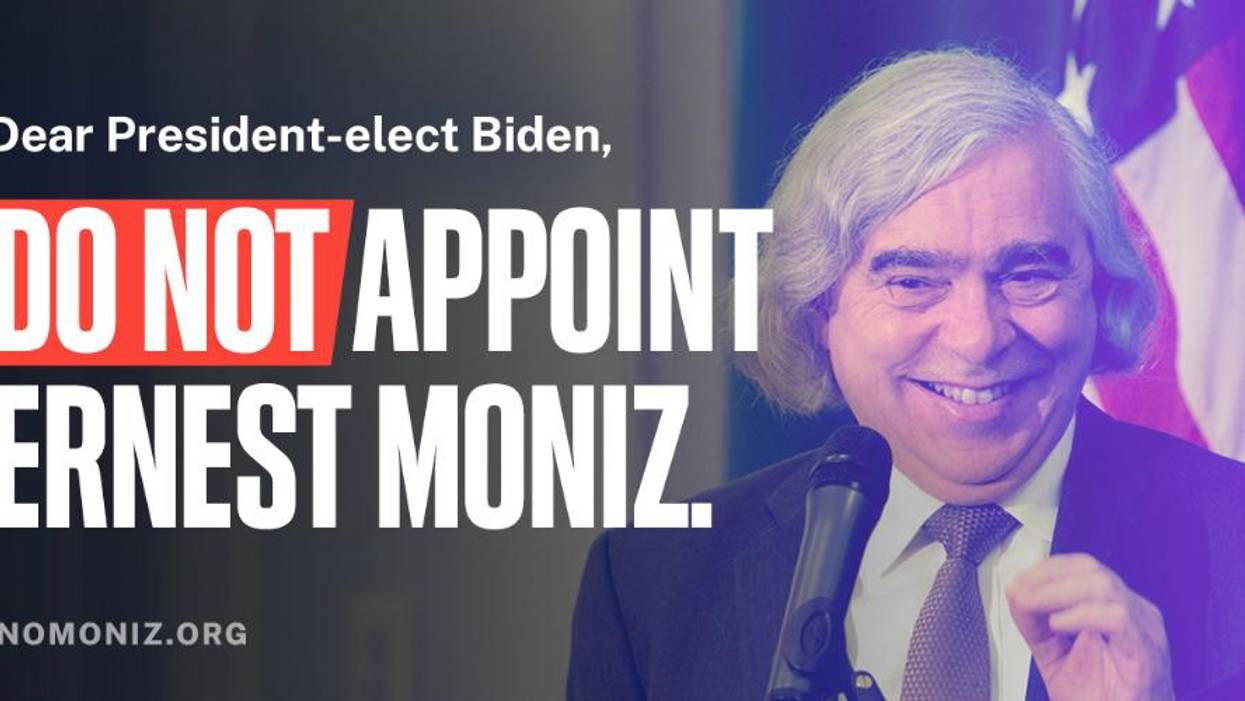
Amid reports that oil industry-friendly former Energy Secretary Ernest Moniz remains under consideration to return to his old post in the incoming Biden administration, a diverse coalition of environmental groups is mobilizing for an "all-out push" to keep Moniz away from the White House and demand a cabinet willing to boldly confront the corporations responsible for the climate emergency.
On Tuesday night, climate campaigners projected onto the primary Department of Energy building messages urging President-elect Joe Biden to say "yes to a sustainable future" and no to Moniz, who currently serves on the board of the polluting utility giant Southern Company.
"The Department of Energy must be led by someone open to concrete ideas for a fossil-free future, not continued dominance by a corrupt, heavily-subsidized industry."
--Anthony Rogers-Wright, Climate Justice Alliance
Following the demonstration, the coalition on Wednesday morning debuted NoMoniz.org, a website that warns the policies of Obama's former energy secretary "might be good for his friends in the coal, oil, and gas industries, but they're a death sentence for us and our planet."
"It's unacceptable that Ernest Moniz is being considered for a role in the Biden administration--his policies, his financial ties to fossil fuel companies, his contempt for youth climate activists, and his overall unwillingness to do what it takes to protect our future should disqualify him immediately," reads the site, which was launched by Oil Change U.S., Greenpeace USA, Sunrise Movement, the Climate Justice Alliance, Center for Biological Diversity, Friends of the Earth U.S., and dozens of other groups.
Previously an adviser to major companies such as BP and General Electric, Moniz's tenure as head of Obama's energy department as well as his public statements since leaving office make clear that he is opposed to the kind of sweeping climate action that environmentalists and scientists say is necessary to avert planetary catastrophe.
Speaking to the U.S. Chamber of Commerce last year, Moniz endorsed what he dubbed a "Green Real Deal" that would welcome a "broad coalition" of supporters--including the fossil fuel industry. In an interview months earlier, Moniz--a proponent of natural gas as a bridge to a clean energy future--denounced what he described as "often completely unrealistic proposals for the pace at which we can decarbonize."
"With his deep ties to the fossil fuel industry and promotion of false solutions like carbon capture and sequestration, Ernest Moniz is not a forward-thinking choice for the cabinet," Anthony Rogers-Wright, policy coordinator for the Climate Justice Alliance, said in a statement Wednesday. "The Department of Energy must be led by someone open to concrete ideas for a fossil-free future, not continued dominance by a corrupt, heavily-subsidized industry whose existence hinges on maintaining an antiquated all-of-the-above strategy."
Janet Redman, climate campaign director at Greenpeace USA, warned that Moniz's fossil fuel connections "spell danger for the nation's efforts to mitigate the climate crisis" as atmospheric carbon dioxide continues to rise in 2020 despite widespread coronavirus lockdowns.
"We need a true climate leader who understands that we must phase out fossil fuels, not a corporate shill with 'all of the above energy' policies who wants to prop up fracked gas and pipelines," said Redman. "The American people have given Joe Biden a mandate to take bold action in service of climate justice, public health, economic prosperity, and racial equity. Moniz would only be holding him back."
Dear Readers:
In the fall of 2001, in the aftermath of 9/11, as families grieved and the nation mourned, Washington swarmed with locusts of the human kind: wartime opportunists, lobbyists, lawyers, ex-members of Congress, bagmen for big donors: all of them determined to grab what they could for their corporate clients and rich donors while no one was looking.
Across the land, the faces of Americans of every stripe were stained with tears. Here in New York, we still were attending memorial services for our firemen and police. But in the nation's capital, within sight of a smoldering Pentagon that had been struck by one of the hijacked planes, the predator class was hard at work pursuing private plunder at public expense, gold-diggers in the ashes of tragedy exploiting our fear, sorrow, and loss.
What did they want? The usual: tax cuts for the wealthy and big breaks for corporations. They even made an effort to repeal the alternative minimum tax that for fifteen years had prevented companies from taking so many credits and deductions that they owed little if any taxes. And it wasn't only repeal the mercenaries sought; they wanted those corporations to get back all the minimum tax they had ever been assessed.
They sought a special tax break for mighty General Electric, although you would never have heard about it if you were watching GE's news divisions -- NBC News, CNBC, or MSNBC, all made sure to look the other way.
They wanted to give coal producers more freedom to pollute, open the Alaskan wilderness to drilling, empower the president to keep trade favors for corporations a secret while enabling many of those same corporations to run roughshod over local communities trying the protect the environment and their citizens' health.
It was a disgusting bipartisan spectacle. With words reminding us of Harry Truman's description of the GOP as "guardians of privilege," the Republican majority leader of the House dared to declare that "it wouldn't be commensurate with the American spirit" to provide unemployment and other benefits to laid-off airline workers. As for post 9/11 Democrats, their national committee used the crisis to call for widening the soft-money loophole in our election laws.
America had just endured a sneak attack that killed thousands of our citizens, was about to go to war against terror, and would soon send an invading army to the Middle East. If ever there was a moment for shared sacrifice, for putting patriotism over profits, this was it. But that fall, operating deep within the shadows of Washington's Beltway, American business and political mercenaries wrapped themselves in red, white and blue and went about ripping off a country in crisis. H.L. Mencken got it right: "Whenever you hear a man speak of his love for his country, it is a sign that he expects to be paid for it."
Fourteen years later, we can see more clearly the implications. After three decades of engineering a winner-take-all economy, and buying the political power to consummate their hold on the wealth created by the system they had rigged in their favor, they were taking the final and irrevocable step of separating themselves permanently from the common course of American life. They would occupy a gated stratosphere far above the madding crowd while their political hirelings below look after their earthly interests.
The $1.15 trillion spending bill passed by Congress last Friday and quickly signed by President Obama is just the latest triumph in the plutocratic management of politics that has accelerated since 9/11. As Michael Winship and I described here last Thursday, the bill is a bonanza for the donor class - that powerful combine of corporate executives and superrich individuals whose money drives our electoral process. Within minutes of its passage, congressional leaders of both parties and the president rushed to the television cameras to praise each other for a bipartisan bill that they claimed signaled the end of dysfunction; proof that Washington can work. Mainstream media (including public television and radio), especially the networks and cable channels owned and operated by the conglomerates, didn't stop to ask: "Yes, but work for whom?" Instead, the anchors acted as amplifiers for official spin -- repeating the mantra-of-the-hour that while this is not "a perfect bill," it does a lot of good things. "But for whom? At what price?" went unasked.
Now we're learning. Like the drip-drip-drip of a faucet, over the weekend other provisions in the more than 2000-page bill began to leak. Many of the bad ones we mentioned on Thursday are there -- those extended tax breaks for big business, more gratuities to the fossil fuel industry, the provision to forbid the Securities & Exchange Commission from requiring corporations to disclose their political spending, even to their own shareholders. That one's a slap in the face even to Anthony Kennedy, the justice who wrote the Supreme Court's majority opinion in Citizens United. He said: "With the advent of the Internet, prompt disclosure of expenditures can provide shareholders and citizens with the information needed to hold corporations and elected officials accountable for their positions."
Over our dead body, Congress declared last Friday, proclaiming instead: Secrecy today. Secrecy tomorrow. Secrecy forever. They are determined that we not know who owns them.
The horrors mount. As Eric Lipton and Liz Moyer reported for The New York Times on Sunday, in the last days before the bill's passage "lobbyists swooped in" to save, at least for now, a loophole worth more than $1 billion to Wall Street investors and the hotel, restaurant and gambling industries. Lobbyists even helped draft crucial language that the Senate Democratic leader Harry Reid furtively inserted into the bill. Lipton and Moyer wrote that, "The small changes, and the enormous windfall they generated, show the power of connected corporate lobbyists to alter a huge bill that is being put together with little time for lawmakers to consider. Throughout the legislation, there were thousands of other add-ons and hard to decipher tax changes."
No surprise to read that "some executives at companies with the most at stake are also big campaign donors." The Times reports that "the family of David Bonderman, a co-founder of TPG Capital, has donated $1.2 million since 2014 to the Senate Majority PAC, a campaign fund with close ties to Mr. Reid and other Senate Democrats." Senator Reid, lest we forget, is from Nevada. As he approaches retirement at the end of 2016, perhaps he's hedging his bets at taxpayer expense.
Consider just two other provisions: One, insisted upon by Republican Senator Thad Cochran, directs the Coast Guard to build a $640 million National Security Cutter in Cochran's home state of Mississippi, a ship that the Coast Guard says it does not need. The other: A demand by Maine Republican Senator Susan Collins for an extra $1 billion for a Navy destroyer that probably will be built at her state's Bath Iron Works - again, a vessel our military says is unnecessary.
So it goes: The selling off of the Republic, piece by piece. What was it Mark Twain said? "There is no distinctive native American criminal class except Congress."
Can we at least face the truth? The plutocrats and oligarchs are winning. The vast inequality they are creating is a death sentence for government by consent of the people at large. Did any voter in any district or state in the last Congressional election vote to give that billion dollar loophole to a handful of billionaires? To allow corporations to hide their political contributions? To add $1.4 trillion to the national debt? Of course not. It is now the game: Candidates ask citizens for their votes, then go to Washington to do the bidding of their donors. And since one expectation is that they will cut the taxes of those donors, we now have a permanent class that is afforded representation without taxation.
A plutocracy, says my old friend, the historian Bernard Weisberger, "has a natural instinct to perpetuate and enlarge its own powers and by doing so slams the door of opportunity to challengers and reduces elections to theatrical duels between politicians who are marionettes worked by invisible strings."
Where does it end?
By coincidence, this past weekend I watched the final episode of the British television series Secret State, a 2012 remake of an earlier version based on the popular novel A Very British Coup. This is white-knuckle political drama. Gabriel Byrne plays an accidental prime minister - thrust into office by the death of the incumbent, only to discover himself facing something he never imagined: a shadowy coalition of forces, some within his own government, working against him. With some of his own ministers secretly in the service of powerful corporations and bankers, his own party falling away from him, press lords daily maligning him, the opposition emboldened, and a public confused by misinformation, deceit, and vicious political rhetoric, the prime minister is told by Parliament to immediately invade Iran (on unproven, even false premises) or resign. In the climactic scene, he defies the "Secret State" that is manipulating all this and confronts Parliament with this challenge:
Let's forget party allegiance, forget vested interests, forget votes of confidence. Let each and every one of us think only of this: Is this war justified? Is it what the people of this country want? Is it going to achieve what we want it to achieve? And if not, then what next?
Well, I tell you what I think we should do. We should represent the people of this country. Not the lobby companies that wine and dine us. Or the banks and the big businesses that tell us how the world goes 'round. Or the trade unions that try and call the shots. Not the civil servants nor the war-mongering generals or the security chiefs. Not the press magnates and multibillion dollar donors... [We must return] democracy to this House and the country it represents.
Do they? The movie doesn't tell us. We are left to imagine how the crisis -- the struggle for democracy -- will end.
As we are reminded by this season, there is more to life than politics. There are families, friends, music, worship, sports, the arts, reading, conversation, laughter, celebrations of love and fellowship and partridges in pear trees. But without healthy democratic politics serving a moral order, all these are imperiled by the ferocious appetites of private power and greed.
So enjoy the holidays, including Star Wars. Then come back after New Year's and find a place for yourself, at whatever level, wherever you are, in the struggle for democracy. This is the fight of our lives and how it ends is up to us.
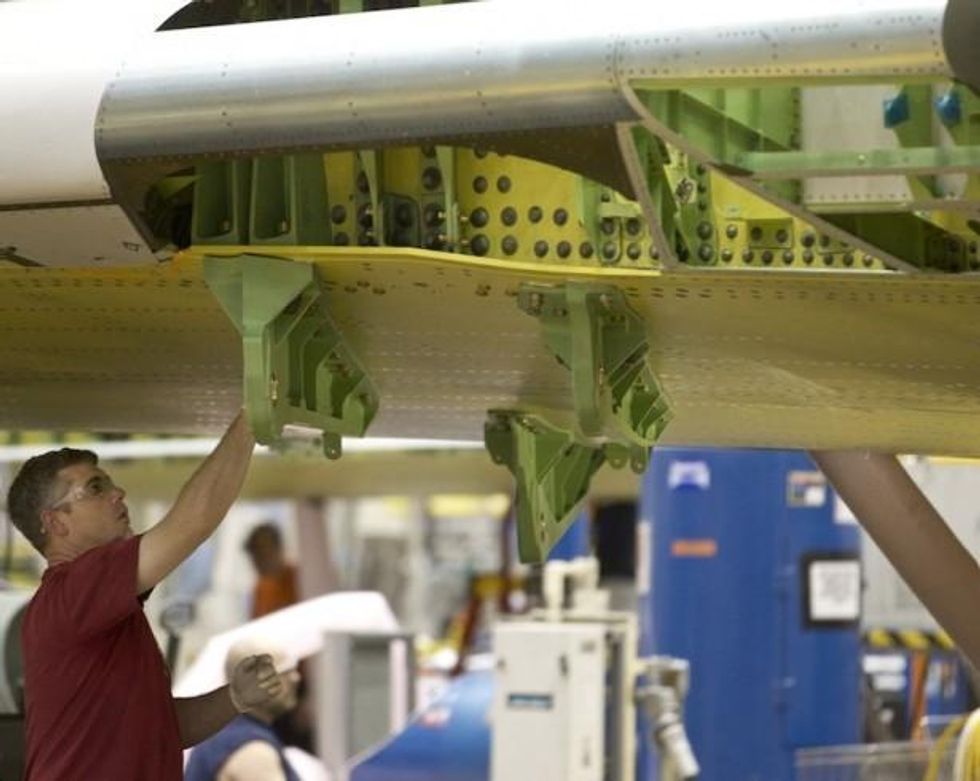
Boeing is one of the few remaining major corporations in the United States that still offers defined-benefit pensions. But on Friday, 30,000 union Boeing workers in Washington state voted to give up the pensions for new hires and to let the company freeze the plans for all workers in 2016.
"I don't see a way forward on pensions. I don't see what it is that we can do," says Ross Eisenbrey, vice president of EPI, which advocates for low- and middle-income workers. "Retirement security right now is wishful thinking."
The vote by members of the International Association of Machinists (IAM) Lodge 751 came after Boeing threatened to move production of the 777X jet line, along with potentially thousands of jobs, out of Washington state unless workers agreed to the contract. The workers voted down a similar contract in November, but Boeing refused to budge--even though the company is doing well, with over $400 billion dollars in back orders and a program to buy back more than $10 billion in its own stock.
In December, the international stepped in and forced the local, which opposed the deal, to hold another vote. In a bid to keep their jobs, the workers voted 51-to-49 percent on Friday to ratify the slightly revised contract, which ends defined-benefit pensions and bans workers from striking for eight years.
"Boeing is one more point in a long trend of employers shedding their pension liability," says Eisenbrey. "Looking ahead, they don't want to be in a situation where we go through another stock market plunge and they wind up having to put a lot of money in the pensions' problem. From an employer's point of view, a defined-contribution plan is the easiest thing, you just put in 3 percent from an employee's paycheck and they invest. If the employee invests badly, then it's their tough luck. Its just simpler."
The loss of pensions at Boeing marks a major setback for unions, as employers typically follow the example of other employers at the bargaining table in terms of what constitutes a reasonable demand. Since the financial crash, unions have given up pensions for new hires at large, profitable, industry trendsetters such as General Electric, Verizon, Honeywell and now, Boeing.
Though this marks a sea change toward retirement insecurity for tens of thousands of U.S. workers during Obama's tenure, thus far the president has said nothing about the trend.
Dean Baker, co-director of the Center for Economic and Policy Research, says the president could use his bully pulpit on the issue. "Certainly he could say something about preserving DB pensions," says Baker. "That wouldn't cost him anything, but apparently it is not even on his radar screen."
Indeed, U.S. presidents have occasionally weighed in on or intervened in labor struggles, as when President Richard Nixon stepped into mediate the 1971 Bituminous Coal Strike. In 2008, then President-elect Obama spoke in support of the laid-off workers who occupied the Republic Windows and Doors plant in Chicago. Obama also publicly praised the United Auto Workers for making concessions as part of the auto bailout.
So why hasn't the Obama administration said anything about an issue that affects so many Americans?
"They don't give a damn and don't want to piss anyone off over it," says Baker. "It's pretty obvious that Obama doesn't feel the same obligation towards supporting unions as he does towards pushing the agenda of major corporations."
While President Obama did not speak out on behalf of Boeing workers, the President is quite open about being a major public advocate for Boeing.
Speaking to the Export Council last September, President Obama said, "I think Jim [McNerney, Chairman and CEO of Boeing], at least, will confirm that I'm happy to go out and make sales. I'm expecting a gold watch--(laughter)--from Boeing at the end of my presidency, because I know that I'm on the list of top salesmen at Boeing. And that applies to all of you."
EPI's Eisenbrey says that the Obama administration has been much more focused on cutting Social Security than shoring up American's retirement security. Last spring, the Obama Administration announced its support for a proposal to amend Social Security known as "chained CPI," which the AFL-CIO opposes because it entails lower benefits for retirees. "We should be increasing benefits and their proposal was to have a technical adjustment which was a benefit cut," says Eisenbrey.
Working In These Times reached out to the White House for a reaction to the Boeing vote, but did not receive a response. As with many labor issues, the President has once again remained silent while union workers have taken a hit.
Meanwhile, Boeing workers are adjusting to less secure retirement futures. John Kleiboeker, a Boeing worker of 16 years and the president of the Machinists Local Lodge 63, told The Oregonian, "I've got 15 years to retirement. ... I'm looking at a loss of $250,000."
Full disclosure: The IAM and UAW are website sponsors of In These Times. Sponsors have no role in editorial content.