SUBSCRIBE TO OUR FREE NEWSLETTER
Daily news & progressive opinion—funded by the people, not the corporations—delivered straight to your inbox.
5
#000000
#FFFFFF
To donate by check, phone, or other method, see our More Ways to Give page.


Daily news & progressive opinion—funded by the people, not the corporations—delivered straight to your inbox.
"The institutions of world finance have lost their muscle," wrote more than 100 activists, celebrities, and political leaders. "You can be the leaders who bring them into the 21st century."
Quoting the economist John Maynard Keynes at the time of the founding of the modern global finance system in 1944, more than 100 signatories on Tuesday called on the world's largest economies to allow the world "to taste hope again" by pouring resources into solving the global debt and climate crises.
Keynes remarked after the historic Bretton Woods meeting in New Hampshire that the summit offered new hope to everyone from "our businessmen and our manufacturers and our unemployed" as world leaders established the World Bank and the International Monetary Fund (IMF).
But with the world now "rocked by conflict, food insecurity, biodiversity loss, and spiraling inflation," said the signers of an open letter organized by communications and campaign group Project Everyone, the global community needs "another Bretton Woods moment"—one that would correct the "imperfect" system hammered out 80 years ago and live up to the ideals that were centered at the original meeting, including "prosperity as a means of peace" and wealth as a means of serving "the common good."
The letter states that global inequality is "compounded by the devastation wrought by climate change," which is disproportionately likely to impact the Global South even as developing countries contribute a mere fraction of the planet-heating emissions of wealthy nations.
The signatories—including International Rescue Committee CEO David Miliband, philanthropist Abigail Disney, and singer and activist Annie Lennox—called on G20 countries to take steps including tripling their investment in the World Bank and IMF, canceling developing countries' debt to the institutions, and reforming tax codes to ensure big polluters and the wealthiest people contribute to efforts to mitigate inequality.
"This is your chance," reads the letter, which was released as world leaders met in Washington, D.C. for the World Bank and IMF's Spring Meetings. "The institutions of world finance have lost their muscle. You can be the leaders who bring them into the 21st century. You can unlock the colossal public and private investment potential of renewable energy, sustainable agriculture, and climate adaptation."
Under the status quo, the signatories noted, the United Nations Sustainable Development Goals are "way off track," with $3 trillion still needed achieve the objective of a "greener, fairer, better world by 2030," as agreed to by 193 U.N. member states.
Project Everyone and its supporters reiterated a demand made by Oxfam International Monday to cancel debts owed by countries in the Global South that are facing rising inequality, as their debt obligations to the IMF and the World Bank have left them unable to invest in education, climate adaptation, housing, and other public services.
"Removing burdensome debt allows countries to invest in their people and their future: in resilience, education, health, and nutrition," wrote the signatories. "This drives growth and creates string partners to trade with... Each of us stands to gain from stability, lower food and energy costs, and nature protection."
The wealthiest countries in the world, said Project Everyone, must look to the leaders who met at Bretton Woods and "fulfill their promise: to transform these instruments for peace and prosperity and truly set them to work in our common interest."
The idea that a liberal, rule-based world order has been inclusive and fair is more fantasy than reality
Pundits are struggling to comprehend President Joe Biden’s industrial policy.
Whether it’s the extensive subsidies for American firms to engage in renewable energy production in the Inflation Reduction Act, or the combination of export controls and support for companies in the U.S. and Europe to make semiconductors, fears abound that the rule-based, multilateral global world order is in its death throes as the U.S. has made excluding China principal among its economic policy objectives.
Yet looking at history, we see that the rules of this order often featured America forging alliances to exclude some and privilege others.
The rules of the post-war economic order were premised on U.S. domination and hierarchy. This is the history that Biden is working with and that his new industrial policies repeat.
In fact, the idea that a liberal, rule-based world order has been inclusive and fair is more fantasy than reality. Recognizing this is key if we really want to create economic institutions that are equitable and truly global, instead of exploitative and hierarchical.
The institutional pillars of what we consider central to the liberal world order—the International Monetary Fund (IMF) and World Bank—were created in 1944 at Bretton Woods, New Hampshire, where delegates from 44 countries met to discuss what the world economy should look like after World War II.
Participants created the IMF with the purpose that the institution would finance countries with debt problems to avoid the pitfalls of inflation, while the World Bank would invest in particular development projects such as building dams or expanding literacy. For even more stability, it was also determined that one ounce of gold would equal $35, making the U.S. dollar the default currency of world commerce.
Meanwhile, the initial moves concerning economic development in the immediate post-war period came with the Marshall Plan, which ran from 1948 to 1951 and took its name from the U.S. Secretary of State George Marshall.
But here’s the catch—these post-war developments excluded the Soviet Union as they saw to grow U.S. power.
Concerning Bretton Woods institutions, while the Soviets attended the conference in 1944, Joseph Stalin ultimately decided against joining the IMF and World Bank. As the Cold War heated up, they were excluded for the next forty years.
The Soviets were not given any chance with the Marshall Plan, as the investment was explicitly crafted to halt the spread of communism and challenge Soviet influence. While ostensibly the Marshall Plan intended to get war-torn Europe back on its feet through distributing grants and loans, this U.S.-led initiative came with a series of strings attached, including creating markets for U.S. products and ideologically pressuring European labor leaders to reject communism.
Then, with the Marshall Plan winding down, the IMF and World Bank went to work—but with the U.S. and its allies. International development policy took on an explicit anti-communist approach, concretized by the economist and advisor to multiple U.S. presidents, W.W. Rostow, whose perspective was crystallized in his book, The Stages of Economic Growth: A Non-Communist Manifesto.
You don’t need to be a geographer to see how for most of the 20th century, significant sections of the world were systematically excluded from the liberal world order. Just as apparent is how the economic system championed was what the U.S. promoted.
The IMF and World Bank expanded in the 80s and 90s as countries with Soviet-style political and economic institutions embraced liberal democracy, apparently bringing the entire world together. The World Trade Organization (WTO) was created in 1994 with the intention to have countries meet periodically to discuss how to lower tariffs and facilitate trade. China’s inclusion in 2001 was heralded for the hope that every country would finally participate in the same system.
Yet this expansion came at a tremendous cost, particularly in terms of national sovereignty and public welfare.
Such costs were found in the application around the world of economic “shock therapy” programs where, in a short period of time, governments had to slash public spending and promote privatization. Countries made such changes, otherwise known as structural adjustment programs, which the IMF and World Bank teamed up to impose on impoverished, often debt-ridden countries.
Throughout, the U.S. has enjoyed more decision-making power than any other country in both the IMF and the World Bank. This is seen in the financial contributions that countries make to these institutions, which are set according to the size of a state’s respective economy. The WTO, on paper, is meant to make decisions by consensus. Yet, even here, the U.S. has wielded disproportionate power with its ability to call for negotiations and also end them.
It is true that the WTO has been stalled since 2003 due to opposition from developing economies such as Brazil and India. It is also the case that, despite negotiations stopped, the WTO’s dispute settlement mechanism continued to promote American-style free trade and hogtie different states from making economic decisions on their own.
A fairer, more inclusive economic world order would recognize the harm that colonialism has inflicted on countries in Africa and Latin America. Structural adjustment would not mean force feeding free markets to desperate governments, but negotiating ways for countries such as France to pay reparations to formerly dominated, subjected states like Haiti. Reforms made to the World Bank and the IMF, or entirely other institutions with global reach, would ensure that developing countries would have more decision-making in development projects that affect them instead of being dictated to on what to do by the U.S. and its allies.
The rules of the post-war economic order were premised on U.S. domination and hierarchy. This is the history that Biden is working with and that his new industrial policies repeat. Let’s remember this, for if we want a more just and inclusive world economic order, we need to make significant changes that will run up against decades of hierarchy and exclusion.
"After years of David Malpass in the president's office, we cannot afford another second of climate denial leading the bank," said one campaigner.
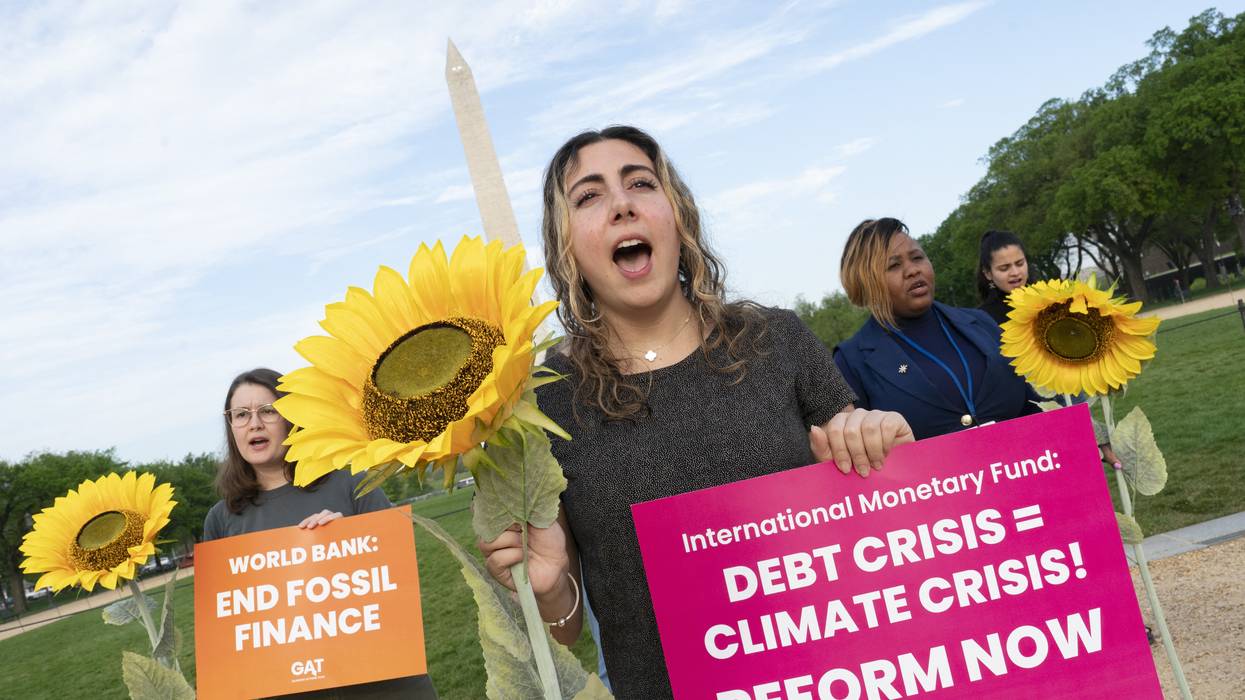
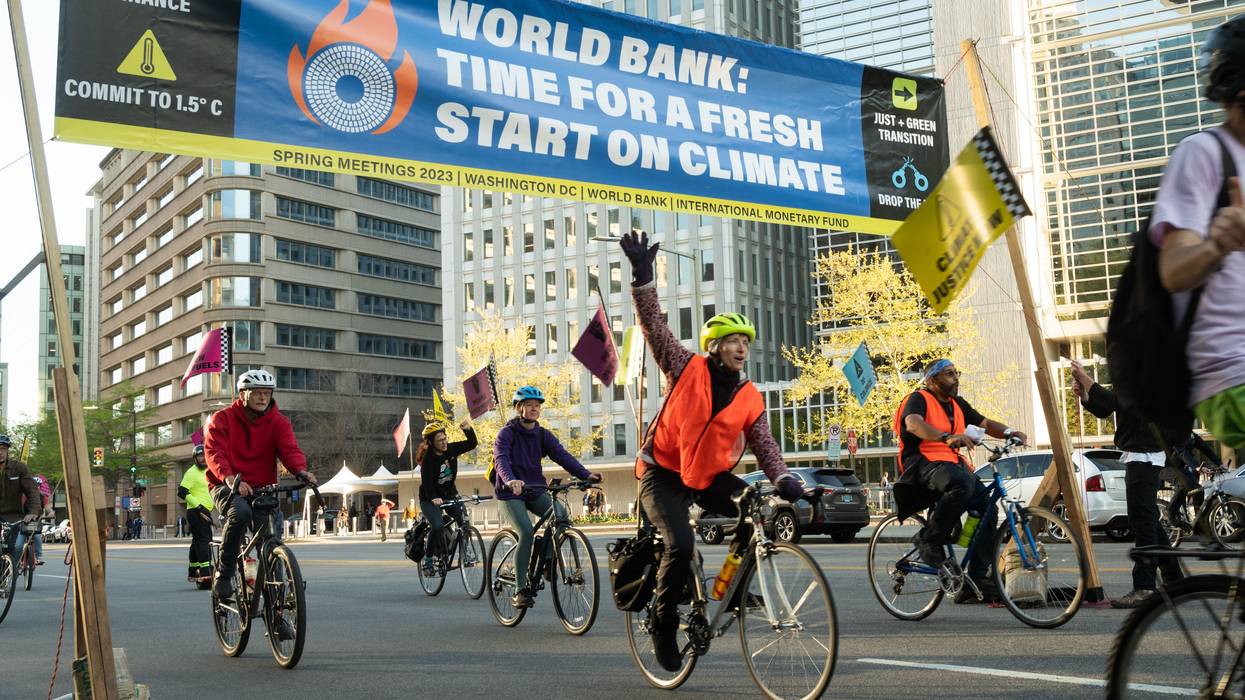
Roughly 100 activists marked the opening day of the World Bank Group spring meetings by riding bicycles through the streets of Washington, D.C. on Monday night, calling on incoming bank president Ajay Banga to halt fossil fuel financing and ramp up clean energy and climate justice investments.
While demanding a turnaround on green funding in developing countries, the "Wrong Way on Climate" bike protest blocked rush-hour traffic outside World Bank headquarters as finance ministers traveled to dinner parties and backroom meetings.
"Bikes are very literally people-powered," Hope Neyer, a public health student and organizer with Shutdown D.C., said in a statement. "They're the ultimate zero-emission vehicles. We chose to gather on bikes tonight to remind the World Bank of the potential we have as individuals and communities to show up for what we believe in—the need to protect our planet, the international right to make healthy choices for our families, and a future that is just and livable for us all."
The action took place on the first day of the bank's 2023 spring meetings, which are being run this week by outgoing World Bank President David Malpass. Climate advocates cheered in February when Malpass, tapped to lead the bank by then-U.S. President Donald Trump in 2019, said that he plans to step down by the end of June, nearly a year ahead of schedule. The early resignation announcement followed a sustained pressure campaign against Malpass, who was condemned as a "climate denier" after refusing to acknowledge that burning fossil fuels causes the planet-heating pollution underlying increasingly frequent and intense extreme weather disasters around the globe.
Activists—whose bike ride started under a banner that reads, "World Bank: Time for a Fresh Start on Climate"—are now looking to Malpass' replacement, Banga, to reverse course and scale up decarbonization efforts. Progressives in February denounced U.S. President Joe Biden for nominating the private equity executive and former Mastercard CEO to the role, arguing that he's likely to advance the powerful international financial institution's historically pro-corporate and pro-fossil fuel agenda. Campaigners are wasting no time in pressuring Banga to make the World Bank an instrument for genuinely sustainable development.
"Nominee Banga has the opportunity of a lifetime, if he can rise to the climate challenge."
"After years of David Malpass in the president's office, we cannot afford another second of climate denial leading the bank," Andrew Nazdin, director of the Glasgow Actions Team, said Monday. "Nominee Banga has the opportunity of a lifetime, if he can rise to the climate challenge—ending financing oil or gas, ramping up investment in renewables, and becoming the transformative leader the world is begging for."
In an attempt to defend his record amid criticism last September, Malpass said the World Bank allocated $31.7 billion to climate finance in 2021, with half of it aimed at bolstering adaptation efforts. Not only is that a tiny fraction of the trillions of dollars in green investment the Intergovernmental Panel on Climate Change (IPCC) says is needed each year to maintain a habitable planet, but according to reporting by the Financial Times, Malpass was directly involved in weakening multilateral development banks' (MDBs) joint announcement on climate lending at COP26.
After the World Bank described itself last year as "the largest multilateral funder of climate investments in developing countries," Bronwen Tucker of Oil Change International pointed out that "the World Bank Group still funds more fossil fuels than any other MDB, and they continue to lock Global South countries into expensive and volatile fossil fuel contracts through their heavy-handed policy lending programs."
The Big Shift Global coalition showed in a recent report that the World Bank has directly financed at least $14.8 billion in fossil fuel production since the signing of the Paris agreement in 2015—negating its 2017 pledge to stop supporting oil and gas projects within two years.
The IPCC and the International Energy Agency have made clear that fossil fuel expansion is incompatible with limiting global warming to 1.5°C above preindustrial levels, beyond which the climate emergency's consequences will grow even deadlier, especially for humanity's poorest members who have done the least to cause the crisis.
"As the World Bank and IMF meet behind closed doors to advance the agenda of concentrated corporate and political power, a coalition of D.C.-area activists in solidarity with movements worldwide, especially in the Global South, manifested a very different vision outside," Basav Sen, member of the For People For Planet coalition, said Monday. "We encircled the meetings on bicycle and on foot, to assert the power of organized people."
Concerned citizens from around the globe are demonstrating throughout the week to demand that the World Bank stop financing fossil fuels. They also plan to call for an overhaul of both Bretton Woods institutions—the World Bank and the International Monetary Fund—to "prioritize justice, helping developing countries to green to follow a 1.5°C roadmap with poverty alleviation at its heart," according to the Glasgow Actions Team. "They will also call to end the 'gentlemen's agreement' that has thus far allowed only the U.S. to nominate the World Bank president."
On Tuesday morning, activists held a "First 100 Days" protest outside World Bank headquarters. They unveiled a first 100 days checklist that outlines what they want incoming bank president Banga to achieve at the start of his five-year term.
Campaigners also plan to gather outside the World Bank on Wednesday for a "Stop Fossil Gas" demonstration, where they will draw attention to the bank's continued funding of a worldwide expansion of gas pipelines.
Activists plan to cap off the week of action with a large march and rally on Friday that features a "Trojan Horse" of debt impacts on low-income nations the World Bank works with.
Bretton Woods was the system of global financial management set up at the end of the second World War to ensure the interests of capital did not smother wider social concerns in post-war democracies. It was hated by the US neoliberals - the very people who created the banking crisis
THE SIMULTANEOUS unfolding of the US presidential campaign and unraveling of the financial markets presents one of those occasions where the political and economic systems starkly reveal their nature.
Passion about the campaign may not be universally shared but almost everybody can feel the anxiety from the foreclosure of a million homes, and concerns about jobs, savings and healthcare at risk.
The initial Bush proposals to deal with the crisis so reeked of totalitarianism that they were quickly modified. Under intense lobbyist pressure, they were reshaped as "a clear win for the largest institutions in the system . . . a way of dumping assets without having to fail or close", as described by James Rickards, who negotiated the federal bailout for the hedge fund Long Term Capital Management in 1998, reminding us that we are treading familiar turf. The immediate origins of the current meltdown lie in the collapse of the housing bubble supervised by Federal Reserve chairman Alan Greenspan, which sustained the struggling economy through the Bush years by debt-based consumer spending along with borrowing from abroad. But the roots are deeper. In part they lie in the triumph of financial liberalisation in the past 30 years - that is, freeing the markets as much as possible from government regulation.
These steps predictably increased the frequency and depth of severe reversals, which now threaten to bring about the worst crisis since the Great Depression.
Also predictably, the narrow sectors that reaped enormous profits from liberalisation are calling for massive state intervention to rescue collapsing financial institutions.
Such interventionism is a regular feature of state capitalism, though the scale today is unusual. A study by international economists Winfried Ruigrok and Rob van Tulder 15 years ago found that at least 20 companies in the Fortune 100 would not have survived if they had not been saved by their respective governments, and that many of the rest gained substantially by demanding that governments "socialise their losses," as in today's taxpayer-financed bailout. Such government intervention "has been the rule rather than the exception over the past two centuries", they conclude.
In a functioning democratic society, a political campaign would address such fundamental issues, looking into root causes and cures, and proposing the means by which people suffering the consequences can take effective control.
The financial market "underprices risk" and is "systematically inefficient", as economists John Eatwell and Lance Taylor wrote a decade ago, warning of the extreme dangers of financial liberalisation and reviewing the substantial costs already incurred - and proposing solutions, which have been ignored. One factor is failure to calculate the costs to those who do not participate in transactions. These "externalities" can be huge. Ignoring systemic risk leads to more risk-taking than would take place in an efficient economy, even by the narrowest measures.
The task of financial institutions is to take risks and, if well-managed, to ensure that potential losses to themselves will be covered. The emphasis is on "to themselves". Under state capitalist rules, it is not their business to consider the cost to others - the "externalities" of decent survival - if their practices lead to financial crisis, as they regularly do.
Financial liberalisation has effects well beyond the economy. It has long been understood that it is a powerful weapon against democracy. Free capital movement creates what some have called a "virtual parliament" of investors and lenders, who closely monitor government programmes and "vote" against them if they are considered irrational: for the benefit of people, rather than concentrated private power.
Investors and lenders can "vote" by capital flight, attacks on currencies and other devices offered by financial liberalisation. That is one reason why the Bretton Woods system established by the United States and Britain after the second World War instituted capital controls and regulated currencies.*
The Great Depression and the war had aroused powerful radical democratic currents, ranging from the anti-fascist resistance to working class organisation. These pressures made it necessary to permit social democratic policies. The Bretton Woods system was designed in part to create a space for government action responding to public will - for some measure of democracy.
John Maynard Keynes, the British negotiator, considered the most important achievement of Bretton Woods to be the establishment of the right of governments to restrict capital movement.
In dramatic contrast, in the neoliberal phase after the breakdown of the Bretton Woods system in the 1970s, the US treasury now regards free capital mobility as a "fundamental right", unlike such alleged "rights" as those guaranteed by the Universal Declaration of Human Rights: health, education, decent employment, security and other rights that the Reagan and Bush administrations have dismissed as "letters to Santa Claus", "preposterous", mere "myths".
In earlier years, the public had not been much of a problem. The reasons are reviewed by Barry Eichengreen in his standard scholarly history of the international monetary system. He explains that in the 19th century, governments had not yet been "politicised by universal male suffrage and the rise of trade unionism and parliamentary labour parties". Therefore, the severe costs imposed by the virtual parliament could be transferred to the general population.
But with the radicalisation of the general public during the Great Depression and the anti-fascist war, that luxury was no longer available to private power and wealth. Hence in the Bretton Woods system, "limits on capital mobility substituted for limits on democracy as a source of insulation from market pressures".
The obvious corollary is that after the dismantling of the postwar system, democracy is restricted. It has therefore become necessary to control and marginalise the public in some fashion, processes particularly evident in the more business-run societies like the United States. The management of electoral extravaganzas by the public relations industry is one illustration.
"Politics is the shadow cast on society by big business," concluded America's leading 20th century social philosopher John Dewey, and will remain so as long as power resides in "business for private profit through private control of banking, land, industry, reinforced by command of the press, press agents and other means of publicity and propaganda".
The United States effectively has a one-party system, the business party, with two factions, Republicans and Democrats. There are differences between them. In his study Unequal Democracy: The Political Economy of the New Gilded Age, Larry Bartels shows that during the past six decades "real incomes of middle-class families have grown twice as fast under Democrats as they have under Republicans, while the real incomes of working-poor families have grown six times as fast under Democrats as they have under Republicans".
Differences can be detected in the current election as well. Voters should consider them, but without illusions about the political parties, and with the recognition that consistently over the centuries, progressive legislation and social welfare have been won by popular struggles, not gifts from above.
Those struggles follow a cycle of success and setback. They must be waged every day, not just once every four years, always with the goal of creating a genuinely responsive democratic society, from the voting booth to the workplace.
* The Bretton Woods system of global financial management was created by 730 delegates from all 44 Allied second World War nations who attended a UN-hosted Monetary and Financial Conference at the Mount Washington Hotel in Bretton Woods in New Hampshire in 1944.
Bretton Woods, which collapsed in 1971, was the system of rules, institutions, and procedures that regulated the international monetary system, under which were set up the International Bank for Reconstruction and Development (IBRD) (now one of five institutions in the World Bank Group) and the International Monetary Fund (IMF), which came into effect in 1945.
The chief feature of Bretton Woods was an obligation for each country to adopt a monetary policy that maintained the exchange rate of its currency within a fixed value.
The system collapsed when the US suspended convertibility from dollars to gold. This created the unique situation whereby the US dollar became the "reserve currency" for the other countries within Bretton Woods.