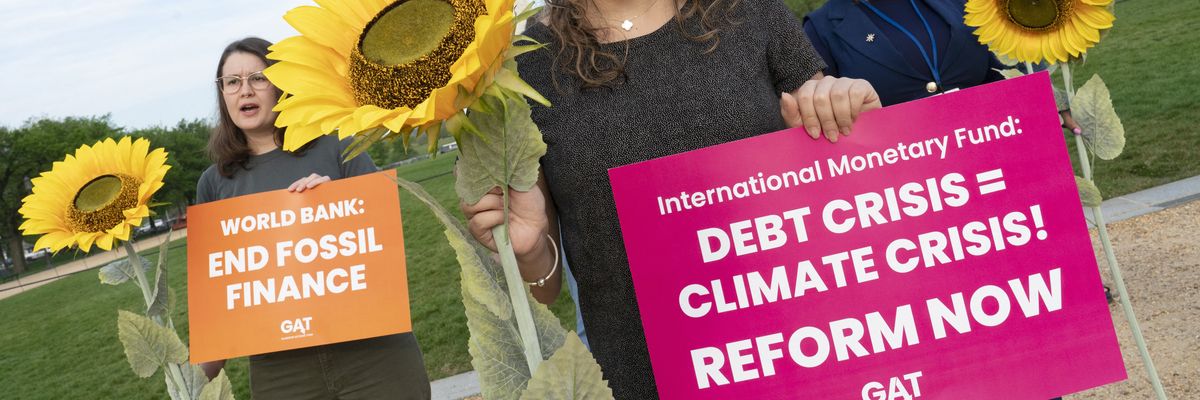
Global activists demonstrate on the first day of the IMF-World Bank Group spring meetings, near the Washington Monument in Washington, D.C. on April 15, 2024.
Open Letter Demands Global Finance Overhaul to Fight Climate and Debt Crises
"The institutions of world finance have lost their muscle," wrote more than 100 activists, celebrities, and political leaders. "You can be the leaders who bring them into the 21st century."
Quoting the economist John Maynard Keynes at the time of the founding of the modern global finance system in 1944, more than 100 signatories on Tuesday called on the world's largest economies to allow the world "to taste hope again" by pouring resources into solving the global debt and climate crises.
Keynes remarked after the historic Bretton Woods meeting in New Hampshire that the summit offered new hope to everyone from "our businessmen and our manufacturers and our unemployed" as world leaders established the World Bank and the International Monetary Fund (IMF).
But with the world now "rocked by conflict, food insecurity, biodiversity loss, and spiraling inflation," said the signers of an open letter organized by communications and campaign group Project Everyone, the global community needs "another Bretton Woods moment"—one that would correct the "imperfect" system hammered out 80 years ago and live up to the ideals that were centered at the original meeting, including "prosperity as a means of peace" and wealth as a means of serving "the common good."
The letter states that global inequality is "compounded by the devastation wrought by climate change," which is disproportionately likely to impact the Global South even as developing countries contribute a mere fraction of the planet-heating emissions of wealthy nations.
The signatories—including International Rescue Committee CEO David Miliband, philanthropist Abigail Disney, and singer and activist Annie Lennox—called on G20 countries to take steps including tripling their investment in the World Bank and IMF, canceling developing countries' debt to the institutions, and reforming tax codes to ensure big polluters and the wealthiest people contribute to efforts to mitigate inequality.
"This is your chance," reads the letter, which was released as world leaders met in Washington, D.C. for the World Bank and IMF's Spring Meetings. "The institutions of world finance have lost their muscle. You can be the leaders who bring them into the 21st century. You can unlock the colossal public and private investment potential of renewable energy, sustainable agriculture, and climate adaptation."
Under the status quo, the signatories noted, the United Nations Sustainable Development Goals are "way off track," with $3 trillion still needed achieve the objective of a "greener, fairer, better world by 2030," as agreed to by 193 U.N. member states.
Project Everyone and its supporters reiterated a demand made by Oxfam International Monday to cancel debts owed by countries in the Global South that are facing rising inequality, as their debt obligations to the IMF and the World Bank have left them unable to invest in education, climate adaptation, housing, and other public services.
"Removing burdensome debt allows countries to invest in their people and their future: in resilience, education, health, and nutrition," wrote the signatories. "This drives growth and creates string partners to trade with... Each of us stands to gain from stability, lower food and energy costs, and nature protection."
The wealthiest countries in the world, said Project Everyone, must look to the leaders who met at Bretton Woods and "fulfill their promise: to transform these instruments for peace and prosperity and truly set them to work in our common interest."
We are at a crossroads
This country and this world are at a monumental crossroads. In a few short weeks, US voters will have an opportunity to beat back the forces of fascism and confront the billionaires who are rigging the economy, our media system, and our democracy, making it increasingly impossible for ordinary people to get by. We’re not just talking about the election. We’re talking about what must be done once these fascist elements are vanquished from power. We need a bolder set of solutions than what either major party has so far been willing to offer and a working-class movement ready to fight like hell for it. Trump didn't emerge from nowhere. The conditions that fueled MAGA authoritarianism were created by decades of radical neoliberal economic policies and a corrupt political system dominated by corporate interests. They slashed taxes on the super-rich, promising that the benefits would trickle down. They said giveaways to the corporate titans would make life more affordable for the rest of us. It was all bullshit. And when a bitter, betrayed populace searches for someone to blame, right-wing demagogues have little trouble finding scapegoats. People know when they're being lied to, but you won't hear any of this from the corporate media. Only independent journalism—powered and funded by people who believe in building a better world—can deliver truly trustworthy daily news. Our Fall Campaign is underway, and we need your help. To power our newsroom through the rest of the year, we need to raise $125,000 by midnight on October 31. So if you share our vision, please contribute whatever you can to sustain our work. |
Quoting the economist John Maynard Keynes at the time of the founding of the modern global finance system in 1944, more than 100 signatories on Tuesday called on the world's largest economies to allow the world "to taste hope again" by pouring resources into solving the global debt and climate crises.
Keynes remarked after the historic Bretton Woods meeting in New Hampshire that the summit offered new hope to everyone from "our businessmen and our manufacturers and our unemployed" as world leaders established the World Bank and the International Monetary Fund (IMF).
But with the world now "rocked by conflict, food insecurity, biodiversity loss, and spiraling inflation," said the signers of an open letter organized by communications and campaign group Project Everyone, the global community needs "another Bretton Woods moment"—one that would correct the "imperfect" system hammered out 80 years ago and live up to the ideals that were centered at the original meeting, including "prosperity as a means of peace" and wealth as a means of serving "the common good."
The letter states that global inequality is "compounded by the devastation wrought by climate change," which is disproportionately likely to impact the Global South even as developing countries contribute a mere fraction of the planet-heating emissions of wealthy nations.
The signatories—including International Rescue Committee CEO David Miliband, philanthropist Abigail Disney, and singer and activist Annie Lennox—called on G20 countries to take steps including tripling their investment in the World Bank and IMF, canceling developing countries' debt to the institutions, and reforming tax codes to ensure big polluters and the wealthiest people contribute to efforts to mitigate inequality.
"This is your chance," reads the letter, which was released as world leaders met in Washington, D.C. for the World Bank and IMF's Spring Meetings. "The institutions of world finance have lost their muscle. You can be the leaders who bring them into the 21st century. You can unlock the colossal public and private investment potential of renewable energy, sustainable agriculture, and climate adaptation."
Under the status quo, the signatories noted, the United Nations Sustainable Development Goals are "way off track," with $3 trillion still needed achieve the objective of a "greener, fairer, better world by 2030," as agreed to by 193 U.N. member states.
Project Everyone and its supporters reiterated a demand made by Oxfam International Monday to cancel debts owed by countries in the Global South that are facing rising inequality, as their debt obligations to the IMF and the World Bank have left them unable to invest in education, climate adaptation, housing, and other public services.
"Removing burdensome debt allows countries to invest in their people and their future: in resilience, education, health, and nutrition," wrote the signatories. "This drives growth and creates string partners to trade with... Each of us stands to gain from stability, lower food and energy costs, and nature protection."
The wealthiest countries in the world, said Project Everyone, must look to the leaders who met at Bretton Woods and "fulfill their promise: to transform these instruments for peace and prosperity and truly set them to work in our common interest."
- After Dumping $15 Billion Into Fossil Fuels, World Bank Urged to Stop 'Investing in Climate Disaster' ›
- 'Terrifying': War and Pandemic Could Push 263 Million Into Extreme Poverty This Year ›
Quoting the economist John Maynard Keynes at the time of the founding of the modern global finance system in 1944, more than 100 signatories on Tuesday called on the world's largest economies to allow the world "to taste hope again" by pouring resources into solving the global debt and climate crises.
Keynes remarked after the historic Bretton Woods meeting in New Hampshire that the summit offered new hope to everyone from "our businessmen and our manufacturers and our unemployed" as world leaders established the World Bank and the International Monetary Fund (IMF).
But with the world now "rocked by conflict, food insecurity, biodiversity loss, and spiraling inflation," said the signers of an open letter organized by communications and campaign group Project Everyone, the global community needs "another Bretton Woods moment"—one that would correct the "imperfect" system hammered out 80 years ago and live up to the ideals that were centered at the original meeting, including "prosperity as a means of peace" and wealth as a means of serving "the common good."
The letter states that global inequality is "compounded by the devastation wrought by climate change," which is disproportionately likely to impact the Global South even as developing countries contribute a mere fraction of the planet-heating emissions of wealthy nations.
The signatories—including International Rescue Committee CEO David Miliband, philanthropist Abigail Disney, and singer and activist Annie Lennox—called on G20 countries to take steps including tripling their investment in the World Bank and IMF, canceling developing countries' debt to the institutions, and reforming tax codes to ensure big polluters and the wealthiest people contribute to efforts to mitigate inequality.
"This is your chance," reads the letter, which was released as world leaders met in Washington, D.C. for the World Bank and IMF's Spring Meetings. "The institutions of world finance have lost their muscle. You can be the leaders who bring them into the 21st century. You can unlock the colossal public and private investment potential of renewable energy, sustainable agriculture, and climate adaptation."
Under the status quo, the signatories noted, the United Nations Sustainable Development Goals are "way off track," with $3 trillion still needed achieve the objective of a "greener, fairer, better world by 2030," as agreed to by 193 U.N. member states.
Project Everyone and its supporters reiterated a demand made by Oxfam International Monday to cancel debts owed by countries in the Global South that are facing rising inequality, as their debt obligations to the IMF and the World Bank have left them unable to invest in education, climate adaptation, housing, and other public services.
"Removing burdensome debt allows countries to invest in their people and their future: in resilience, education, health, and nutrition," wrote the signatories. "This drives growth and creates string partners to trade with... Each of us stands to gain from stability, lower food and energy costs, and nature protection."
The wealthiest countries in the world, said Project Everyone, must look to the leaders who met at Bretton Woods and "fulfill their promise: to transform these instruments for peace and prosperity and truly set them to work in our common interest."
- After Dumping $15 Billion Into Fossil Fuels, World Bank Urged to Stop 'Investing in Climate Disaster' ›
- 'Terrifying': War and Pandemic Could Push 263 Million Into Extreme Poverty This Year ›