SUBSCRIBE TO OUR FREE NEWSLETTER
Daily news & progressive opinion—funded by the people, not the corporations—delivered straight to your inbox.
5
#000000
#FFFFFF
To donate by check, phone, or other method, see our More Ways to Give page.
Daily news & progressive opinion—funded by the people, not the corporations—delivered straight to your inbox.
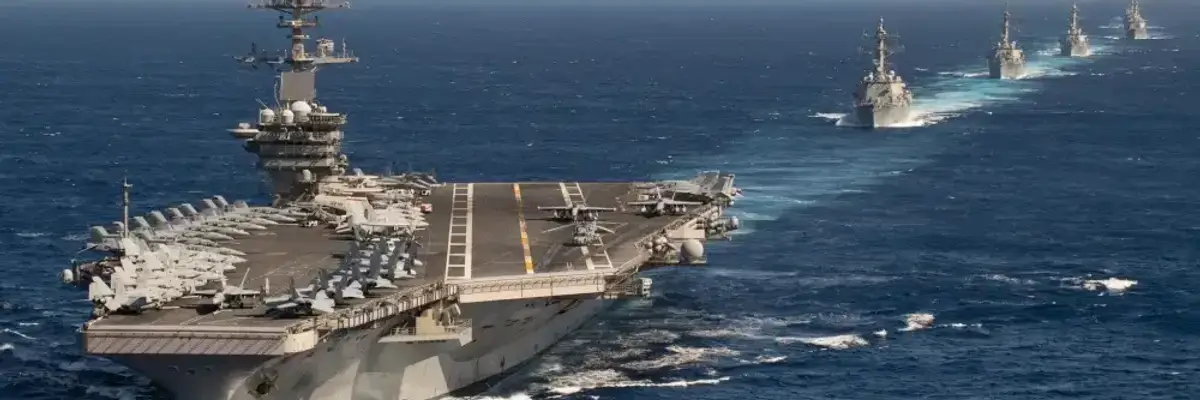
The aircraft carrier USS Theodore Roosevelt and its accompanying strike group are seen in a January 25, 2020 photo.
"Either they'll do something very proper and smart, or they won't be around very long," Trump said of Iran's government.
The Pentagon is preparing to dramatically expand the American military presence in the Middle East as President Donald Trump weighs renewed attacks on Iran, with thousands of additional troops and a third aircraft carrier being readied for deployment, even as the conflict he has repeatedly declared "over" or "won" threatens to erupt into a new and potentially broader phase.
The Washington Post reported Thursday that the Pentagon is preparing options that could put as many as three US aircraft carriers and their accompanying warships in the Middle East.
According to The Associated Press, around 9,000 additional sailors and Marines are being dispatched aboard the USS Theodore Roosevelt carrier strike group and the USS Makin Island amphibious readiness group. The buildup could push the number of US personnel in the region above 20,000 by late October.
The Roosevelt is being sent to relieve the USS George Washington, while a third carrier, the USS George HW Bush, is also already in the region.
The new deployment plans come as diplomacy between Washington and Tehran remains stalled, and as Trump has repeatedly threatened to resume large-scale military action—including the total annihilation of the nation of over 90 million people—after the November midterm elections.
"Either they'll do something very proper and smart, or they won't be around very long," Trump said of the Iranian government Thursday in Denton, Texas. "Frankly, I hate to see that, but they won't be around very long."
Iran, meanwhile, has reportedly begun preparing for a more expansive retaliation should the United States launch another major attack in the illegal US-Israeli war of choice against the Middle East nation.
Hamidreza Azizi, a senior Iran analyst at the International Crisis Group, told Reuters Thursday that the Iranian government seems "determined not to respond symbolically to a symbolic move and instead to escalate in the hope of reestablishing deterrence."
Republican National Committee Co-Chair Lara Trump—the president's daughter-in-law—warned during a Wednesday interview with British journalist Harry Cole that the increasingly protracted Iran War could not only tarnish Trump's legacy, but could also cost Republicans next month's midterm elections.
"Well, it's possible," Trump—who campaigned as the "peace president" on a promise of no new wars—said of the midterm risks Thursday on his way to Texas, before adding that “it should help because Iran will not have a nuclear weapon."
The intelligence consensus of every US administration since former President George W. Bush—including during both of Trump's terms—has been that Iran has not been trying to develop nuclear weapons.
Dear Common Dreams reader, It’s been nearly 30 years since I co-founded Common Dreams with my late wife, Lina Newhouser. We had the radical notion that journalism should serve the public good, not corporate profits. It was clear to us from the outset what it would take to build such a project. No paid advertisements. No corporate sponsors. No millionaire publisher telling us what to think or do. Many people said we wouldn't last a year, but we proved those doubters wrong. Together with a tremendous team of journalists and dedicated staff, we built an independent media outlet free from the constraints of profits and corporate control. Our mission has always been simple: To inform. To inspire. To ignite change for the common good. Building Common Dreams was not easy. Our survival was never guaranteed. When you take on the most powerful forces—Wall Street greed, fossil fuel industry destruction, Big Tech lobbyists, and uber-rich oligarchs who have spent billions upon billions rigging the economy and democracy in their favor—the only bulwark you have is supporters who believe in your work. But here’s the urgent message from me today. It's never been this bad out there. And it's never been this hard to keep us going. At the very moment Common Dreams is most needed, the threats we face are intensifying. We need your support now more than ever. We don't accept corporate advertising and never will. We don't have a paywall because we don't think people should be blocked from critical news based on their ability to pay. Everything we do is funded by the donations of readers like you. When everyone does the little they can afford, we are strong. But if that support retreats or dries up, so do we. Will you donate now to make sure Common Dreams not only survives but thrives? —Craig Brown, Co-founder |
The Pentagon is preparing to dramatically expand the American military presence in the Middle East as President Donald Trump weighs renewed attacks on Iran, with thousands of additional troops and a third aircraft carrier being readied for deployment, even as the conflict he has repeatedly declared "over" or "won" threatens to erupt into a new and potentially broader phase.
The Washington Post reported Thursday that the Pentagon is preparing options that could put as many as three US aircraft carriers and their accompanying warships in the Middle East.
According to The Associated Press, around 9,000 additional sailors and Marines are being dispatched aboard the USS Theodore Roosevelt carrier strike group and the USS Makin Island amphibious readiness group. The buildup could push the number of US personnel in the region above 20,000 by late October.
The Roosevelt is being sent to relieve the USS George Washington, while a third carrier, the USS George HW Bush, is also already in the region.
The new deployment plans come as diplomacy between Washington and Tehran remains stalled, and as Trump has repeatedly threatened to resume large-scale military action—including the total annihilation of the nation of over 90 million people—after the November midterm elections.
"Either they'll do something very proper and smart, or they won't be around very long," Trump said of the Iranian government Thursday in Denton, Texas. "Frankly, I hate to see that, but they won't be around very long."
Iran, meanwhile, has reportedly begun preparing for a more expansive retaliation should the United States launch another major attack in the illegal US-Israeli war of choice against the Middle East nation.
Hamidreza Azizi, a senior Iran analyst at the International Crisis Group, told Reuters Thursday that the Iranian government seems "determined not to respond symbolically to a symbolic move and instead to escalate in the hope of reestablishing deterrence."
Republican National Committee Co-Chair Lara Trump—the president's daughter-in-law—warned during a Wednesday interview with British journalist Harry Cole that the increasingly protracted Iran War could not only tarnish Trump's legacy, but could also cost Republicans next month's midterm elections.
"Well, it's possible," Trump—who campaigned as the "peace president" on a promise of no new wars—said of the midterm risks Thursday on his way to Texas, before adding that “it should help because Iran will not have a nuclear weapon."
The intelligence consensus of every US administration since former President George W. Bush—including during both of Trump's terms—has been that Iran has not been trying to develop nuclear weapons.
The Pentagon is preparing to dramatically expand the American military presence in the Middle East as President Donald Trump weighs renewed attacks on Iran, with thousands of additional troops and a third aircraft carrier being readied for deployment, even as the conflict he has repeatedly declared "over" or "won" threatens to erupt into a new and potentially broader phase.
The Washington Post reported Thursday that the Pentagon is preparing options that could put as many as three US aircraft carriers and their accompanying warships in the Middle East.
According to The Associated Press, around 9,000 additional sailors and Marines are being dispatched aboard the USS Theodore Roosevelt carrier strike group and the USS Makin Island amphibious readiness group. The buildup could push the number of US personnel in the region above 20,000 by late October.
The Roosevelt is being sent to relieve the USS George Washington, while a third carrier, the USS George HW Bush, is also already in the region.
The new deployment plans come as diplomacy between Washington and Tehran remains stalled, and as Trump has repeatedly threatened to resume large-scale military action—including the total annihilation of the nation of over 90 million people—after the November midterm elections.
"Either they'll do something very proper and smart, or they won't be around very long," Trump said of the Iranian government Thursday in Denton, Texas. "Frankly, I hate to see that, but they won't be around very long."
Iran, meanwhile, has reportedly begun preparing for a more expansive retaliation should the United States launch another major attack in the illegal US-Israeli war of choice against the Middle East nation.
Hamidreza Azizi, a senior Iran analyst at the International Crisis Group, told Reuters Thursday that the Iranian government seems "determined not to respond symbolically to a symbolic move and instead to escalate in the hope of reestablishing deterrence."
Republican National Committee Co-Chair Lara Trump—the president's daughter-in-law—warned during a Wednesday interview with British journalist Harry Cole that the increasingly protracted Iran War could not only tarnish Trump's legacy, but could also cost Republicans next month's midterm elections.
"Well, it's possible," Trump—who campaigned as the "peace president" on a promise of no new wars—said of the midterm risks Thursday on his way to Texas, before adding that “it should help because Iran will not have a nuclear weapon."
The intelligence consensus of every US administration since former President George W. Bush—including during both of Trump's terms—has been that Iran has not been trying to develop nuclear weapons.