

SUBSCRIBE TO OUR FREE NEWSLETTER
Daily news & progressive opinion—funded by the people, not the corporations—delivered straight to your inbox.
5
#000000
#FFFFFF
To donate by check, phone, or other method, see our More Ways to Give page.
Daily news & progressive opinion—funded by the people, not the corporations—delivered straight to your inbox.
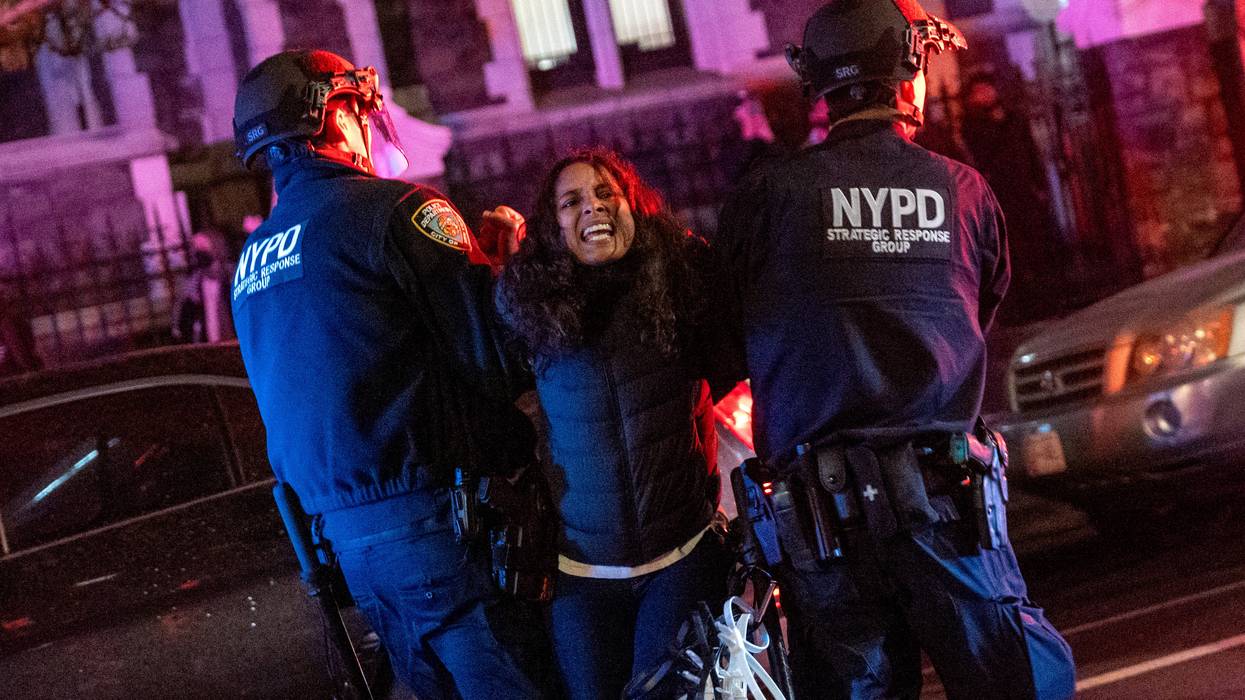
The future envisioned for America’s college campuses by the partisans of Repress U is a future where order prevails over inquiry, and where counterinsurgency comes before community.
The academic year that just ended left America’s college campuses in quite a state: with snipers on the rooftops and checkpoints at the gates; quads overrun by riot squads, state troopers, and federal agents; and even the scent of gunpowder in the air.
In short, in the spring semester of 2024, many of our campuses came to resemble armed camps.
What’s more, alongside such brute displays of force, there have been congressional inquisitions into constitutionally protected speech; federal investigations into the movement for divestment; and students suspended, evicted, and expelled, not to speak of faculty disciplined or simply dismissed.
Over the course of the academic year, the student movement has been elevated, at least rhetorically speaking, to the level of a national security threat.
Welcome to Repress U., class of 2024: a homeland security campus for the ages.
But don’t think it all only happened this spring. In reality, it’s an edifice that’s been decades in the making, spanning the George W. Bush, Barack Obama, Donald Trump, and Joe Biden administrations. Some years ago, in the wake of Occupy Wall Street, I wrote a step-by-step guide to how the original homeland security campus was created. Let me now offer an updated manual on the workings of Repress U. in a newly oppressive era.
Consider the building of just such a homeland security campus a seven-step process. Here they are, one by one.
As a start, unconditional government support for the state of Israel triggered a growing movement of student dissent. That, in turn, came to focus on the imperial entanglements and institutional investments of this country’s institutions of higher learning. Yet, instead of negotiating in good faith, university administrators have, with a few exceptions, responded by threatening and even inviting state violence on campus.
Nor, in a number of cases, did this offensive against the student left start, or end, at the campus gates. For instance, a targeted campaign against Students for Justice in Palestine (SJP) kicked off in October, when the State University System of Florida, working with Republican Governor Ron DeSantis, announced that “based on the National SJP’s support of terrorism… the student chapters must be deactivated.”
Private universities would soon join in with their own public displays of intolerance. Brandeis, Rutgers, George Washington, and Harvard all imposed similar sanctions on student groups. Columbia broke new ground by suspending not only SJP but also Jewish Voice for Peace after its student chapter held “an unauthorized event… that included threatening rhetoric.”
By far the greater part of the threatening rhetoric overheard in recent weeks has been directed not by the movement, but at the movement.
Over the course of the academic year, the student movement has been elevated, at least rhetorically speaking, to the level of a national security threat—one which has figured prominently in White House briefings and House Republican hearings. And by far the greater part of the threatening rhetoric overheard in recent weeks has been directed not by the movement, but at the movement.
“We have a clear message,” said House Committee on Education and Labor Chair Virginia Foxx (R-N.C.) in announcing the latest round of congressional inquisitions. “American universities are officially put on notice that we have come to take our universities back. No stone must go unturned while buildings are being defaced, campus greens are being captured, or graduations are being ruined.” Held on May 23rd, the hearings were an exercise in 21st-century McCarthyism, with House Republicans going on the warpath against “radicalized students” and “so-called university leaders.”
President Biden, when speaking of the student movement, has struck a hardly less belligerent tone, declaring that “vandalism, trespassing… shutting down campuses, forcing the cancellation of classes and graduations—none of this is a peaceful protest” and that “order must prevail.”
For all the talk of free speech and the right to protest, pro-Palestinian advocacy and antiwar activism have, in these last months, come to represent a notable exception to the rule. From the words of commencement speakers to the expressive acts of student occupiers, outright censorship has become the order of the day.
Take the case of Asna Tabassum, a graduating senior scheduled to give this month’s valedictorian address at the University of Southern California. When, on social media, Tabassum dared link to a page denouncing “racist settler-colonial ideology,” she was subjected to an organized smear campaign and ultimately barred from speaking at commencement.
Across the country, the cancellations have piled up. The Palestinian writer Mohammed El-Kurd was banned from speaking at the University of Vermont. The artist Samia Halaby saw her first American retrospective cancelled by the Eskenazi Museum of Art at Indiana University. And a group of Jewish students seeking to screen a film critical of Israel were denied space at the University of Pennsylvania.
Again, the trail of repression leads all the way back to Washington, D.C. Over the course of the past year, since the White House released its “National Strategy to Counter Antisemitism,” the Department of Homeland Security (DHS) and the Federal Bureau of Investigation (FBI) have shown an increasingly active interest in policing what can and can’t be said on campus.
According to the latest White House fact sheet, dated May 7, “FBI and DHS have taken steps to expand and deepen engagements with campus law enforcement and others.” Such “engagement” has been evident for all to see in the recent crackdowns on campuses like Columbia’s, where the administration bragged, in a leaked internal memo, about “coordinating with the FBI.”
It was not enough, however, for certain university administrators to ban Students for Justice in Palestine or censor pro-Palestinian speech. It was also imperative that they make students pay. The punishments have varied, ranging from interim suspensions to permanent expulsions to evictions from campus housing. What they have in common is a logic of retribution for even distinctly nonviolent student protests.
It became common practice for administrations to demand that students leave their on-campus encampments or be barred from graduating. In Harvard’s case, the Corporation went ahead and struck 13 pro-Palestinian students from the rolls anyway, just days before commencement.
In the face of sustained student protest, universities have converted themselves into heavily guarded, gated communities, each with its private security force, and each with its own laws to enforce.
Expulsions have also proliferated in the wake of the occupation of administration buildings, from Columbia’s Hamilton Hall to Vanderbilt’s Kirkland Hall. In justifying the expulsions, Vanderbilt’s chancellor helpfully explained, “My point of view had nothing to do with free speech.”
Last but not least, student dissidents have been the victims of doxxing, with their names and faces prominently displayed under the banner of “Leading Antisemites” on billboards in public places and on websites belonging to a far-right organization, Accuracy in Media. The group was recently revealed to be bankrolled to the tune of nearly $1.9 million by top Republican megadonors.
Students have not been the only targets of such repression. They have been joined by faculty and other employees of colleges and universities, who have also faced disciplinary action for standing up for the rights of Palestinians. By one count, more than 50 faculty members have been arrested, while hundreds more have been disciplined by their employers.
The backlash began last fall with the suspension of two educators at the University of Arizona, then ramped up with the summary firing of two teaching assistants at the University of Texas at Austin. Their offenses? Sharing mental health resources with Palestinian, Muslim, and Arab students, who had specifically requested them in the wake of October 7.
Further controversy attended the suspension of a tenured political science professor, Abdulkader Sinno, at Indiana University following an “unauthorized event” held by the school’s Palestine Solidarity Committee (which Sinno advised). Then came the removal of a noted Palestinian-American artist and activist, Amin Husain, from his adjunct position at New York University.
The University of Florida, for its part, circulated a directive threatening that “employees will be… separated from employment” should they be “found responsible for engaging in prohibited activities,” including “disruption,” indoor demonstrations, or outdoor encampments.
And Washington University in St. Louis, in April, placed six employees on leave after they were accused of participating in a Gaza solidarity protest and allowing “unauthorized persons” onto campus. That same day, another Palestinian-American professor, Steve Tamari, of Southern Illinois University, had nine ribs fractured and one of his hands broken while exercising his right to film the police.
In the face of sustained student protest, universities have converted themselves into heavily guarded, gated communities, each with its private security force, and each with its own laws to enforce. “Harvard Yard will be closed today,” read a typical text, in bold red letters hanging from Johnston Gate. “Harvard affiliates must produce their ID card when requested.”
Other schools have responded to the encampments with a new architecture of control, extending from the metal barricades erected around George Washington’s University Yard to the plywood walls now surrounding New York University’s Stern School of Business. Still others, like Columbia, went as far as to cancel their major commencement ceremonies, given “security concerns.”
At the same time, the private firms entrusted with the public’s safety on college campuses have failed to intervene to keep far-right agitators out. Instead, as seen at the University of California, Los Angeles, and elsewhere, they have allowed vigilante violence to run wild.
In calling the riot squads out on their own students, they have launched the most wide-reaching crackdown on campus protest in more than half a century, with some 3,000 arrests and still counting.
At UCLA, on the night of April 30, a gang of anti-Palestinian militants, wearing white masks and bearing blunt instruments and incendiary devices, were permitted to terrorize the school’s Palestine Solidarity Encampment for more than three hours before public officials felt compelled to take action. At least 16 serious injuries were reported. Not one of the attackers was detained.
“At first, I couldn’t understand why,” reported one eyewitness to the bloodshed. “But an hour in, and then two hours in, and then three hours in, it just reached the point where I was like, ‘UCLA knows this is happening, and they don’t care enough to protect their students.’”
“I thought I was going to die,” recalled another. “I thought I’d never see my family again.”
Again and again, administrators have turned to the baton-wielding arm of the law to sweep Gaza solidarity encampments off school grounds. In calling the riot squads out on their own students, they have launched the most wide-reaching crackdown on campus protest in more than half a century, with some 3,000 arrests and still counting.
The military-style raid on Columbia’s Morningside campus, on April 30, was just one case in point. It was one I watched unfold with my own eyes a few paces from occupied Hamilton Hall (or “Hind’s Hall“). It started with a group of students linking arms and singing “We Shall Not Be Moved,” and ended with 112 arrests and one gunshot fired from an officer’s Glock 19.
First, I watched three drones surveil the protesters from above, while a veritable army of beat cops, clad in riot gear, surrounded them on all sides. Next, I saw paramilitary squads with names like Emergency Service Unit and Strategic Response Group, backed by an armored BearCat, stage an invasion of the Columbia campus, while their counterparts laid siege to nearby City College.
In the end, law enforcement unleashed a full “use-of-force continuum” on students and workers, including that live bullet that “unintentionally” discharged from a sergeant’s service weapon “into the office they were attempting to gain access to.” Said one officer to another: “Thought we fucking shot someone.”
And Columbia was but the tip of the spear. A similar pattern has played out on campuses across the country. At Emory University, a Gaza solidarity camp was met with stun guns and rubber bullets; at Indiana and Ohio State universities, the police response included snipers on the rooftops of campus buildings; and at the University of Texas, gun-toting troopers enforced Governor Greg Abbott’s directive that “no encampments will be allowed.”
In most, if not all, American cities and college towns with such protests, the police, pundits, and elected officials alike have doubled down on their defense of Repress U., while vilifying the student movement in the media. In doing so, they’ve engaged in the kinds of “coordinated information activities” typical of a classical counterinsurgency campaign.
It began with House Republicans like Representative Elise Stefanik (R-N.Y.), who dubbed the student protesters a “pro-Hamas mob,” and Speaker Mike Johnson (R-La.), who called them “lawless agitators and radicals.” Donald Trump took it a step further, claiming that “many of them aren’t even students, and many of them come from foreign countries. Thousands and thousands are from foreign countries… I’m like, ‘Where did these people come from?'”
Novel conspiracy theories, blaming the outbreak of campus protests on groups ranging from Hamas to Antifa (or even Jewish billionaire George Soros), have reverberated across the echo chambers of the right. But the agitprop didn’t stop at the far-right fringe. Democratic officials have since taken it up, too, with New York Mayor Eric Adams leading the charge: “What should have been a peaceful protest has been coopted by professional outside agitators.”
Within 24 hours of the raids on Columbia and CCNY, the New York Police Department had, in fact, produced its own live-action propaganda from the scene of the crime, concluding with these words of warning: “To any other individuals that wanna protest… If you’re thinking about setting up tents anyplace else… think again. We’ll come there. We’ll strike you. Take you to jail like we did over here.”
This is the future envisioned for America’s college campuses by the partisans of Repress U. It’s a future where what passes for “homeland security” takes precedence over higher learning, where order prevails over inquiry, and where counterinsurgency comes before community. Then again, the next generation—the one behind the “People’s University” protests—may well have other plans.
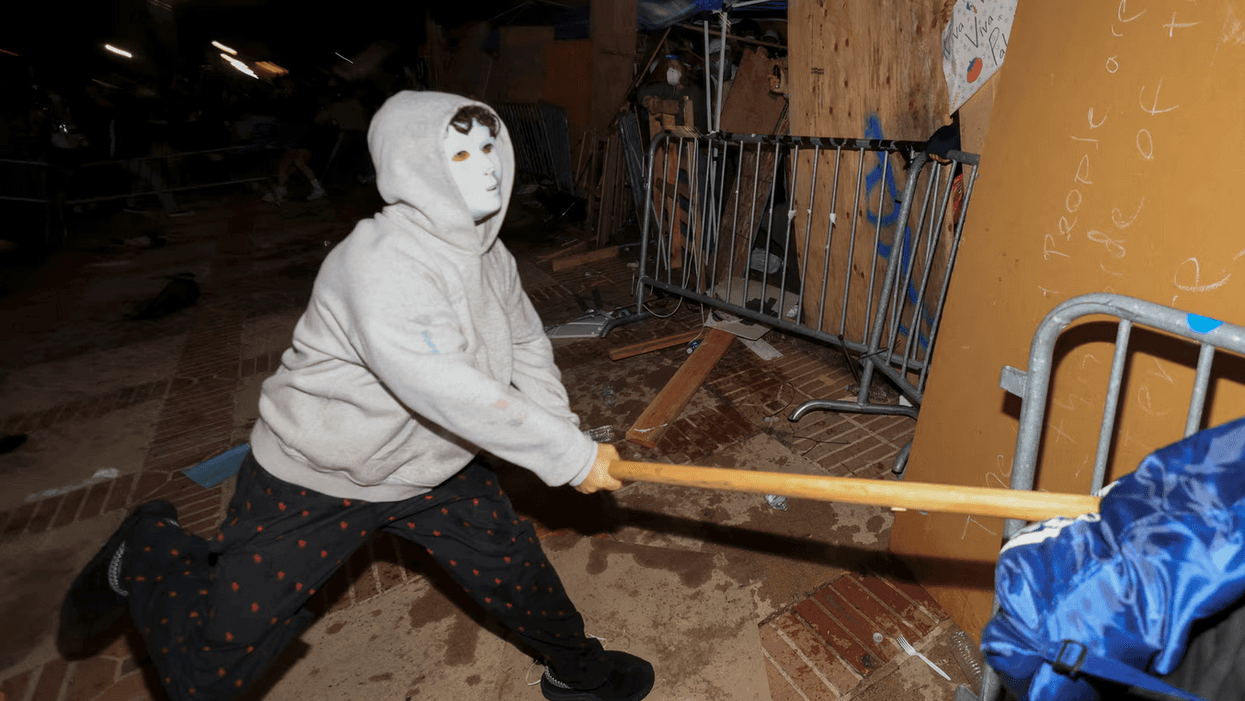
The arrest followed a CNN investigation that documented the hourslong attack and identified key perpetrators from the pro-Israel mob.
University of California, Los Angeles police on Thursday made their first arrest in the case of a violent mob attack on protestors at a peaceful pro-Palestine encampment at the university on April 30 and May 1.
The police charged Edan On, an 18-year-old high school senior, with felony assault for attacking at least one person with a wooden pole. He was remanded to a Los Angeles jail, where he's being held on a $30,000 bond, according to The Guardian. On was first identified for his role in the mob attack, led by so-called counterprotestors, in a CNN investigation published May 16.
"Video shows On joining the counterprotesters while waving a long white pole," CNN reported. "At one point, he strikes a pro-Palestinian protester with the pole, and appears to continue to strike him even when he was down, as fellow counterprotesters piled on."
"The footage appears to show Edan On, in the white hoodie, and others striking at a pro-Palestinian protester on the ground," CNN reported. (Source: CNN/Key News Network)
The pro-Israel mob caused more than 25 protestors to be sent to the hospital with "fractures, severe lacerations, and chemical-induced injuries," and more than 150 were assaulted with bear and pepper spray, CNN reported.
Thistle Boosinger, a 23-year-old member of the encampment, had her hand smashed. "My bone is broken totally in half below my knuckle… [which is] shattered into a bunch of pieces and jumbled up," she told CNN. In another incident during the attack, a fourth-year UCLA student suffered two head injuries in a matter of minutes. After being hit in the forehead with a traffic cone, he was hit in the back of the head with a wooden plank, video shows.
The CNN investigation identified some of the other assailants and documented the violence from the attack, which lasted for seven hours. Videos captured not just violence but also hateful rhetoric. An unidentified person in a hoodie, who like On attacked a pro-Palestine protester with a pole at one point, yelled, "You guys are about to get fucked up," and "Fuck you, fucking terrorists," as well as, "The score is 30,000"—a reference to the death toll in Gaza.
The mob also shouted "Second Nakba!" at the protestors, referring to the forced displacement of Palestinians from their homeland in the late 1940s, according to a Los Angeles Times reporter.
On's mother, who had previously described UCLA student protesters as "human animals," bragged about his role in the attack on social media, even circling an image of him. "Edan went to bully the Palestinian students in the tents at UCLA and played the song that they played to the Nukhba terrorists in prison!" she wrote in Hebrew, CNN reported. When the outlet sought an interview with On, his mother claimed that he was in Israel and planned to join the Israel Defense Forces.
"Video footage shows that some counterprotesters instigated the fighting," CNN reported. "Then police did little as a large group of counterprotesters calmly walked away, leaving behind bloody, bruised students and other protesters."
The hands-off approach was criticized in light of the heavy-handed tactics that police have used against campus protesters across the country, in spite of the fact that the protests have been overwhelmingly nonviolent. More than 800 UCLA faculty and staff signed a letter calling for university Chancellor Gene Block to resign—and to adhere to students' demands to divest from military weapons production companies and supporting systems—but the academic senate narrowly voted not to censure him.
News of On's arrest followed other events Thursday related to pro-Palestine activism at UCLA. Block testified before the Republican-led U.S. House Committee on Education and the Workforce, some of whose members grilled him for being inattentive to antisemitism on campus. Taking an opposing position, Rep. Ilhan Omar (D-Minn.) asked why no one had been held to account for the mob attack, the Los Angeles Times reported.
As Block was testifying, student activists took the opportunity to form a new encampment, amassing a group of about 300 people in an academic hall at one point, but the group had to move twice and they were removed by police in riot gear relatively quickly, according to The New York Times. This may have marked a new approach to protests by the Block administration.
Block told the House committee on Thursday that "with the benefit of hindsight, we should have been prepared to immediately remove the encampment if and when the safety of our community was put at risk."
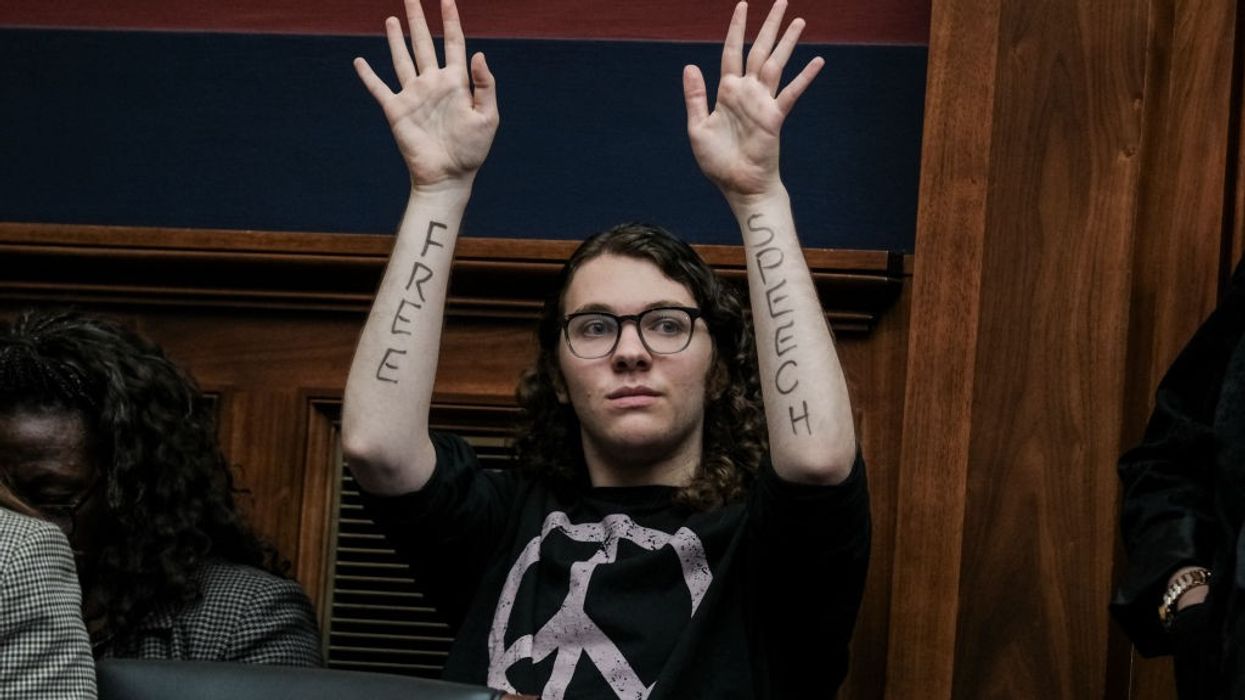
"These hearings are designed to stoke divisions so that we forget who is actually unsafe—the students of Gaza where every university has been destroyed," said one Jewish student who protested at UCLA.
As U.S. House Republicans held yet another hearing about antisemitism and higher education on Thursday, Jewish students and advocacy groups aimed to set the record straight on the threats they face and the largely peaceful protests against genocide.
"This hearing has nothing to do with keeping Jewish students on campus safe, and is solely designed as part of a broader campaign to silence anti-war activism and dissent on college campuses," declared Beth Miller, political director of Jewish Voice for Peace (JVP) Action. "MAGA Republicans are merging attempts to censor students and faculty speaking out for Palestinian rights with a broader culture war campaign against [diversity, equity, and inclusion], critical race theory, LGBTQ rights, and more."
Since Israel launched its U.S.-backed assault of the Gaza Strip in retaliation for the Hamas-led October 7 attack, students and faculty—many of them Jewish—have held demonstrations and set up encampments across the country, demanding that their colleges and universities divest from what critics call a genocidal war against Palestinians.
In addition to enduring violent crackdowns by law enforcement called in by administrators, campus protesters have faced consequences including suspension, expulsion, and not being allowed to graduate—as was the case for 13 seniors at Harvard University, which sparked a commencement walkout by hundreds of students on Thursday.
"I felt completely safe in the encampment until we were attacked by pro-genocide counterprotesters and the police."
The GOP-controlled House Committee on Ways and Means held a hearing on antisemitism and colleges in November—after which House Committee on Education and the Workforce Chair Virginia Foxx (R-N.C.) hosted one December, another last month, and a third on Thursday.
The latest hearing featured testimony from Gene Block, chancellor of the University of California, Los Angeles; Jonathan Holloway, president of Rutgers University; Michael Schill, president of Northwestern University; and Frederick M. Lawrence, secretary and CEO of the Phi Beta Kappa Society.
After students were injured and arrested when Los Angeles police in riot gear attacked a pro-Palestinian encampment at UCLA early this month, Graeme Blair, an associate professor of political science and member of Faculty for Justice in Palestine, said that "their blood is on Gene Block and the UC administration's hands."
Benjamin Kersten, a JVP member pursuing a Ph.D. in Jewish art history, said Thursday that "I am a Jewish student at UCLA who proudly participated in the protest calling on our university to divest from genocide. I felt completely safe in the encampment until we were attacked by pro-genocide counterprotesters and the police. These hearings are designed to stoke divisions so that we forget who is actually unsafe—the students of Gaza where every university has been destroyed."
CNN reported that during Thursday's hearing, Rep. Pramila Jayapal (D-Wash.) took aim at her Republican colleagues.
"Instead of using these hearings for political bullying purposes, which is what the majority seems to do—and if you want to be embarrassed about something, perhaps be embarrassed about the fact that this majority has not been able to govern in this cycle without being
saved by Democrats—I for one am interested in hearing and learning about what successful negotiation and de-escalation looks like in the context of protecting students and free speech," Jayapal said.
Unlike UCLA, Northwestern and Rutgers ended their encampments through negotiations with student protesters. According to The Associated Press, while Foxx said, "Mr. Schill and Dr. Holloway, you should be doubly ashamed for capitulating to the antisemitic rule breakers," the Northwestern president explained that "the police solution was not going to be available to us to keep people safe, and also may not be the wisest solution as we've seen at other campuses across the country."
Paz Baum, a JVP member set to graduate from Northwestern next year, said that "I joined the protests calling out Northwestern's complicity in the Israeli military's destruction of Gaza because as the descendant of people who fled genocide I understand that never again must mean never again for anyone."
"Despite attacks from counterprotests and condemnation from Congress, I will keep calling for an end to genocide," Baum added. "It is what Jewish tradition requires of me."
As of Thursday, Israel's assault on Gaza has killed at least 35,800 people and injured another 80,011, according to Palestinian officials. The war has also devastated civilian infrastructure and left survivors—many displaced multiple times over the past seven months—struggling to find food, water, and medical care.
The International Court of Justice has taken up a South Africa-led genocide case against Israel and International Criminal Court Prosecutor Karim Khan has applied for arrest warrants targeting Israeli Prime Minister Benjamin Netanyahu and Defense Minister Yoav Gallant as well as Hamas leaders Yahya Sinwar, Ismail Haniyeh, and Mohammed Deif.
As the international community and some progressive U.S. political leaders have increasingly expressed alarm about the war and accused Israel of genocide, many other politicians in the United States—across party lines—have backed Netanyahu's assault on Gaza, including with billions of dollars in military support. They have also repeatedly conflated antisemitism and criticism of the Israeli government, despite Jewish Americans' objections.
"It is offensive and dangerous that right-wing Republicans are putting on a show hearing under the pretense of protecting Jewish safety when in fact the only thing they are protecting are the profits of weapons companies and ongoing U.S. complicity in Israeli war crimes," JVP executive director Stefanie Fox said Thursday.
She argued that "Congress is using these hearings to distract from the very point of the principled anti-genocide student movement: The U.S. and Israeli governments continue this genocide despite mass opposition."

Officers in military gear fired flash-bang munitions and used batons to clear a nonviolent encampment calling for an end to Israel's U.S.-backed war on Gaza.
Los Angeles police wearing riot gear launched a violent attack on a pro-Palestinian encampment at UCLA early Thursday, using flash bangs and firing impact munitions at students demanding an end to their university's complicity in Israel's war on Gaza.
Video footage posted to social media by reporters present at the scene shows officers firing multiple "less lethal" munitions and sound-concussive devices at student demonstrators as they closed in on the encampment, which UCLA's leadership has declared unlawful.
Police reportedly arrested dozens of students as they advanced on the encampment.
"They'd rather shoot kids than stop this genocide," said one observer.
Police fire multiple impact munitions at protestors. 4:38am pic.twitter.com/960I4iVMtt
— Sergio Olmos (@MrOlmos) May 2, 2024
Graeme Blair, an associate professor of political science and member of Faculty for Justice in Palestine at UCLA, told the university's student newspaper early Thursday that police officers "violently dragged" students from the Gaza solidarity encampment and that some demonstrators were "visibly injured."
"Their blood is on Gene Block and the UC administration's hands for a series of catastrophic decisions over the last two days," said Blair, referring to UCLA's chancellor. "It did not need to be this way."
Blair said UCLA professors inside the encampment "plan to be arrested alongside students who have done nothing but talk about a genocide taking place in Palestine."
Matt Barreto, a professor of Chicano studies and political science, told the Los Angeles Times that "our job is to stand up for their First Amendment rights, their rights on their own campus."
Police arrest protestor 4:55am pic.twitter.com/udgS0Terc9
— Sergio Olmos (@MrOlmos) May 2, 2024
The police raid came 24 hours after Los Angeles officers and campus security stood by as a pro-Israel mob violently attacked pro-Palestinian demonstrators. Dozens of students were reportedly taken to hospitals for treatment following the assault.
The Daily Bruin, whose student journalists were on the scene, reported Thursday that police "continued to detain protesters in the encampment as the clock struck 4:00 am, marking one week since the initial erection of the solidarity encampment by the UC Divest Coalition and Students for Justice in Palestine at UCLA."
"At 4:05 am, a slew of loud noises presumed to be flash bangs went off," the newspaper added. "Dozens of protesters exited the encampment by climbing through the bushes near Powell Library onto the Janss Steps lawn. Protesters chanted, 'Gene Block, you can't hide, we charge you with genocide' and, 'We are students' as smoke from the presumed flash bangs thickened above Dickson Plaza."
The police crackdown at UCLA is part of a broader wave of police repression on campuses nationwide as universities refuse to grant their student's calls for divestment from companies profiting off Israel's assault on Gaza. More than 1,000 student demonstrators have reportedly been arrested across the U.S. so far.
"It is no accident that this indefensible police crackdown comes in service of an indefensible war," The Intercept's Natasha Lennard wrote in a column Wednesday following the violent police raid at Columbia University in New York. "The very extremity of protest repression speaks to desperation on the part of institutions of the American establishment."
"Israel's decimation of Gaza has—at least for millions more people—given lie to the redemptive myths of the post-World War II political liberal order," Lennard added. "Young people, even the children of the elite, even children of Zionists, are standing with Palestine. Their peaceful acts of protest count as disruptive because they count as un-American—which should be a badge of honor amid a U.S.-backed genocide."

Encampment organizers called the assault "nothing less than a horrifying, despicable act of terror."
A pro-Israel mob violently attacked a Gaza solidarity encampment at the University of California, Los Angeles overnight Tuesday, hurling fireworks at the structure and beating demonstrators as campus security and city police stood by.
Los Angeles Times higher education journalist Teresa Watanabe reported that members of the pro-Israel mob used explicitly genocidal language as they ripped down encampment barriers, yelling, "Second Nakba!"—a reference to the forced displacement of hundreds of thousands of Palestinians from their homes in 1948.
Pro-Israel counterprotestors started tearing down @UCLA encampment barriers and screamed "Second nakba!" referring to the mass displacement & dispossession of Palestinians during the 1948 Arab-Israeli war. Per @latimes @safinazzal on the scene with another video: pic.twitter.com/zSplnd1bYO
— Teresa Watanabe (@TeresaWatanabe) May 1, 2024
At one point, a student stepped out from behind the encampment walls to confront the mob, which quickly swarmed the student and brutally attacked him while he was on the ground attempting to shield his face from the blows.
200+ pro-Israel counterprotestors are attacking the @UCLA pro-Palestinian encampment. They started beating on one student and stomped another under a plywood board per @latimes @safinazzal on the scene. Where is UCLA security? pic.twitter.com/zjYNFWSK7r
— Teresa Watanabe (@TeresaWatanabe) May 1, 2024
Organizers of the UCLA encampment, which—like others on campuses across the U.S.—is aimed at pressuring the university to divest from companies profiting off Israel's war on Gaza, said in a statement that the attack was "nothing less than a horrifying, despicable act of terror" and condemned the university for doing nothing to keep students safe.
UCLA administrators have deemed the encampment "unlawful" and threatened participants with suspension or expulsion.
"For over seven hours, Zionist aggressors hurled gas canisters, sprayed pepper spray, and threw fireworks and bricks into our encampment," organizers said. "They broke our barriers repeatedly, clearly in an attempt to kill our community."
They added that campus security officers left the scene of the violence "within minutes" and "external security the university hired for 'backup' watched, filmed, and laughed on the side as the immediate danger inflicted upon us escalated."
"Law enforcement simply stood at the edge of the lawn and refused to budge as we screamed for their help," the statement continued. "The only means of protection we had was each other. We keep each other safe."
The passivity of campus security and Los Angeles police in the face of violence from the pro-Israel mob at UCLA drew comparisons to the occupied West Bank, where Palestinians are regularly harassed and attacked by settlers as Israeli soldiers watch—and often participate.
The Daily Bruin, which had student reporters on the scene, reported that "security and UCPD both retreated as pro-Israel counter-protesters and other groups attacked protesters in the encampment."
"There has been a minimal police presence on campus despite multiple events of counter-protesters antagonizing the encampment since Thursday," the newspaper added. "UCPD Chief of Police John Thomas said to The Daily Bruin that the force only had around five to six officers on duty. Officers came under attack while trying to help an injured person, and so they left."
The inaction of UCLA security and local police contrasts sharply with the vicious crackdowns on nonviolent pro-Palestinian demonstrators at universities across the country, including Columbia University in New York City late Tuesday.
Early Wednesday, The Daily Bruin published an editorial denouncing Chancellor Gene Block for doing so little "to ensure the protection of students who exercise their rights."
"The world is watching. As helicopters fly over Royce Hall, we have a question. Will someone have to die on our campus tonight for you to intervene, Gene Block?" the editorial asks. "The blood would be on your hands."

Will someone have to die on our campus tonight for you to intervene, Gene Block?
Note: The following from The Daily Bruin editorial board was published in the early hours of May 1, 2024 amidst a violent attack by a right-wing mob on a student encampment on the UCLA campus calling for a ceasefire in Gaza and university divestment from companies profiting from Israeli apartheid.
It began with ear-piercing screams of wailing babies loudly emitting from speakers.
Counter-protesters tearing down the barricades. Laser pointers flashing into the encampment. People in masks waving strobe lights.
Tear gas. Pepper spray. Violent beatings.
Fireworks sparked at the border of the encampment, raining down on tents and the individuals inside.
At around 5 p.m. yesterday, Chancellor Gene Block sent an email to the UCLA student body claiming that security presence in the area had been increased. That was not visible in the midst of escalating violence. And even with the security present, there was no mediation far into the night.
UC President Michael Drake expressed support for Block’s decision to declare the encampment “unlawful” Tuesday evening, adding that action was needed when the safety of students was being threatened. And yet, in spite of official statements from the university and the UC, we witness little being done on the university’s part to ensure the protection of students who exercise their rights.
Mary Osako, vice chancellor of UCLA Strategic Communications, released a statement at 12:40 a.m. acknowledging the violence, adding that the fire department and medical personnel were involved.
“We are sickened by this senseless violence and it must end,” Osako said.
This came after a source in the encampment told the Daily Bruin that at least five protestors have been injured.
But for hours, UCLA administration stood by and watched as the violence escalated. LAPD did not arrive on the scene until slightly after 1 a.m. – once Los Angeles mayor Karen Bass sent them in for assistance at Block’s request.
Daily Bruin reporters on the scene were slapped and indirectly sprayed with irritants. Despite also being students, they were offered no protection.
The world is watching. As helicopters fly over Royce Hall, we have a question.
Will someone have to die on our campus tonight for you to intervene, Gene Block?
The blood would be on your hands.