SUBSCRIBE TO OUR FREE NEWSLETTER
Daily news & progressive opinion—funded by the people, not the corporations—delivered straight to your inbox.
5
#000000
#FFFFFF
To donate by check, phone, or other method, see our More Ways to Give page.

Daily news & progressive opinion—funded by the people, not the corporations—delivered straight to your inbox.
"This week for the first time in history, older student debtors have gone to Washington to demand our student loan debts get canceled in our lifetime, not at our funerals," one older debtor said.
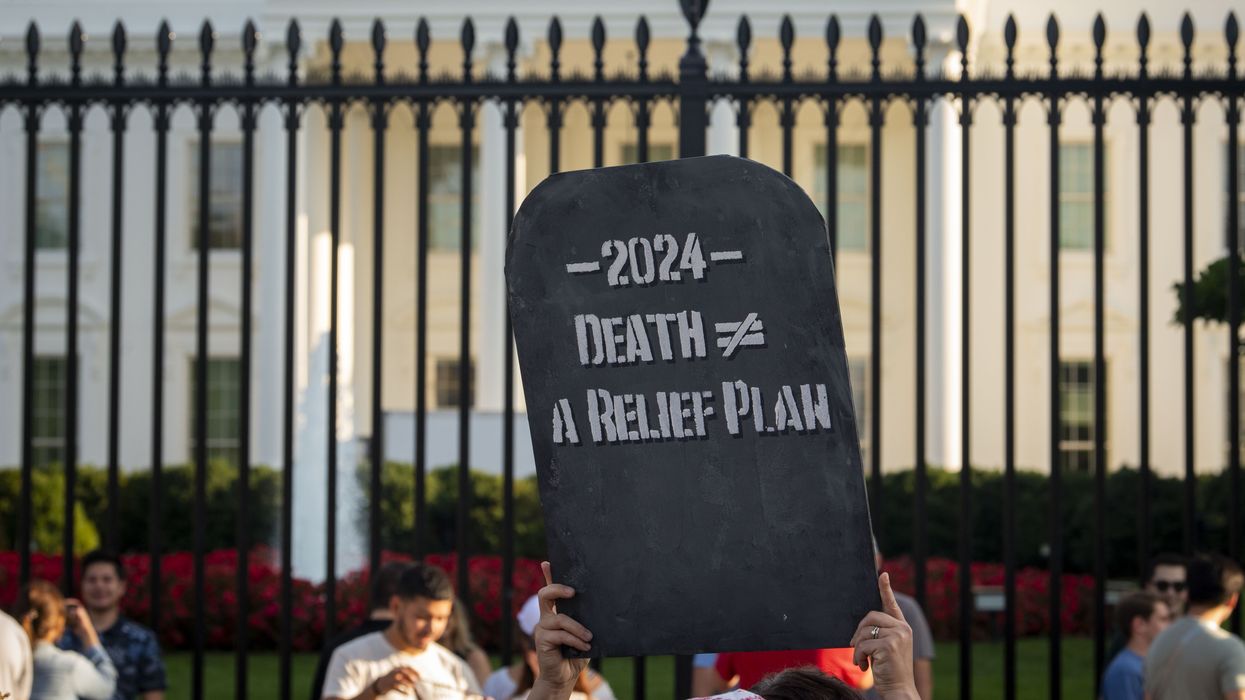
Carrying mock tombstones reading, "Death is not a relief plan" and "Stop burying us in debt," a group of older debtors held the first-ever senior-led mass action for student debt relief outside the White House on Thursday.
Borrowers over 50 are the fastest-growing demographic of student debtors, and some of them are calling on the Biden-Harris administration to take advantage of federal regulations that empower the Department of Education to cancel debt based on age.
"The only comprehensive student debt relief plan that the federal government offers right now is death," Debt Collective creative media strategist Maddie Clifford said in front of the White House. "That is the only way people can escape from these student loan payments."
The participants in the vigil, who collectively owe more than $1 million in student loans and include members of the Debt Collective's "50 Over 50" caucus, shared their stories as they demanded relief.
"I would have never imagined approaching my 60th birthday with $211,388 worth of student debt," said Renita Walker, a Debt Collective member from Sandy Springs, Georgia. "The idea itself is paralyzing. It is the realization that I will probably work myself to death, literally."
Walker took out loans both to continue her education as a single mother after her husband died and to help her two children pay for school. The loan payments ballooned to the point that she was paying $1,800 a month until she took money out of her 401(k) to bring the payment down to around $1,300 a month, still more than her mortgage.
"I just want to say like many of the people here standing behind me, this was not something we asked for," Walker said. "Unfortunately, the system is broken and we have to live with the results of that."
"For decades, millions of older debtors have crouched in shame, imagining ourselves as failures when in reality the system has failed us. But we will no longer be duped into suffering alone."
Fellow Debt-Collective member and Georgia resident Athena Blue, a 67-year-old retired nurse, also took out Parent Plus loans to pay for her children's education.
Blue spoke of overcoming the shame of indebtedness by learning the history of how former U.S. President Ronald Reagan had pushed for the current student loan system in order to make it more difficult for working-class Americans to attend university as a backlash to campus protests in the 1960s and 70s.
"The debt that I'm in isn't my fault," Blue said. "It was created purposely by people like former President Ronald Reagan who believed that only certain people should have the right to higher education."
Blue said she had managed to pay off all of her interest on her loan in 2020 when it was transferred to another provider and she had to start over.
"This burden of a loan threatens my retirement," Blue said, "So how can you, Congress, the Department of Education, and the White House allow this to continue? How can you allow seniors to be subject to predators like this? Have you no moral compass? No shame?"
Debt Collective member Alicia Barnes, who joined the Navy to avoid taking on any more debt, said she had discovered in a meeting with the Department of Education that day that her service provider had illegally placed her debt into default while she was deployed.
"Instead of including a Suicide Hotline for veterans on every piece of communication we receive, the causes of these tragedies should be met with real solutions including absolving some of the debt we accrued during our service because of this compounded interest and illegal activity by these debt collectors," Barnes said.
Every speaker at Thursday's vigil was a woman, as are the majority of student loan debtors. A disproportionate number of student debtors are Black women in particular.
Many of the speakers went into debt to pursue careers in public service fields like education, pastoral counseling, and social work.
"We are caring human beings that wanted to help out the world," said Debt Collective member Mary Donahue of Maryland. "We just need a little help."
The Debt Collective insists that "death should not be the only relief plan for their old, unpayable student loans."
"Decades of broken student relief programs, corrupt loan services, and government neglect have meant that millions of older Americans dragged decadesold student debts into their retirement," said Gail Gardner, who is 77 years old and owes $549,497.20. "Absent swift, bold policy change, and clear political leadership, this crisis will only deepen. The debtors will get older. The debts will get bigger."
That is why she said she had joined with other older debtors to "demand the White House and the Department of Education finally take responsibility for clearing the student debts burdening myself and millions of older Americans."
Both Gardner and Clifford pointed out that discharging debts based on age was something that the Biden-Harris administration could do without running afoul of right-wing attempts to block President Joe Biden's other attempts at student debt relief.
"We are urging the Biden Harris administration to work as fast and as hard as Republicans are working to keep us in debt to free borrowers from these loans, and they can do it today," Clifford said.
Gardner concluded: "For decades, millions of older debtors have crouched in shame, imagining ourselves as failures when in reality the system has failed us. But we will no longer be duped into suffering alone. This week for the first time in history, older student debtors have gone to Washington to demand our student loan debts get canceled in our lifetime, not at our funerals. We can't afford to wait."
"It would be political malpractice to have students repay student loans under Biden when Trump provided the relief. This is not rocket science," said Rep. Ro Khanna.
Progressive Reps. Ro Khanna, Ayanna Pressley, and Alexandria Ocasio-Cortez have reportedly urged Biden administration officials to prepare a backup plan to relieve the student debt burden of tens of millions of Americans in case the U.S. Supreme Court strikes down the White House's cancellation plan.
Such an outcome, paired with the looming end of the student loan repayment moratorium, would be an economic disaster with huge political implications.
Khanna (D-Calif.) told The Washington Post that "it would be political malpractice to have students repay student loans under Biden when Trump provided the relief," noting that the repayment freeze began under the former president—though the Trump administration also attempted to preemptively sabotage any effort by the Biden Education Department to unilaterally cancel student debt.
"The White House must figure out how to make sure there is an extension on the moratorium," Khanna said.
The Post's Jeff Stein reported Friday that Khanna "has told Biden administration officials, including Education Secretary Miguel Cardona, to press forward with a new plan to cancel student debt should the court invalidate Biden's existing plan," which would wipe out up to $20,000 in federal student loan debt per borrower.
Khanna confirmed to the Post that he has made such a push. Stein reported that Pressley (D-Mass.) and Ocasio-Cortez (D-N.Y.) have "privately made similar remarks to administration officials."
"Spokespeople for Sens. Elizabeth Warren (D-Mass.) and Bernie Sanders (I-Vt.)—two outspoken advocates for student debt relief — declined to comment on if they are urging the White House to prepare a backup plan," Stein wrote. "Ocasio-Cortez and Pressley also declined to comment."
Heightening the urgency of calls for a backup plan is the fact that, under newly passed debt ceiling law negotiated by House Republican leaders and the Biden White House, the student debt repayment pause is set to end in late August.
The law, which could complicate any future effort by the Biden administration to implement a new moratorium, sets the stage for a nightmare scenario the Supreme Court blocks student debt cancellation and payments resume, leaving already struggling borrowers with hundreds of dollars in additional obligations each month.
The Consumer Financial Protection Bureau warned earlier this week that millions of student loan borrowers are behind on other debt payments and "have risk factors that suggest they could struggle when scheduled payments resume."
During oral arguments earlier this year, the Supreme Court's conservative supermajority signaled it is poised to side with right-wing challengers and strike down the Biden administration's debt cancellation program.
A decision from the high court is expected before the end of the month, but the White House has yet to provide any indication that it has an alternative plan.
In a statement to the Post, White House spokesman Abdullah Hasan said the administration remains "confident in our legal authority to provide relief under the HEROES Act."
Student debt campaigners have outlined what a viable backup plan could look like.
For months, advocates have criticized the Biden administration for opting to use more limited emergency authority under the Higher Education Relief Opportunities for Students (HEROES) Act of 2003 instead of invoking the Higher Education Act of 1965 to cancel federal student loan debt, which is carried by more than 40 million people in the U.S.
"Biden could have directed the education secretary to cancel people's debts using the 'compromise and settlement' authority granted in the Higher Education Act of 1965, but instead his administration invoked a different and more limited legal authority," Astra Taylor, a co-founder of the Debt Collective, wrote for The Guardian late last year.
"They also chose to make borrowers apply for the program, instead of automatically issuing cancellation—a slow-moving process that bought their billionaire-backed opponents valuable time to cook up legal arguments, find plaintiffs, and line their cases up with sympathetic, Trump-appointed judges poised to toe the conservative line," Taylor added. "The White House needs to learn from its mistakes and play hardball."
In June 2021, more than a year before Biden unveiled his debt relief plan, the Debt Collective released a draft executive order that would cancel all outstanding federal student loan debt using Higher Education Act authority.
"President Biden can cancel all federal student loan debt with a simple executive order. So, we wrote the entire executive order for him," the group said at the time. "It's not a magic trick. With the flick of his pen, he can make all federal student loan debt disappear."
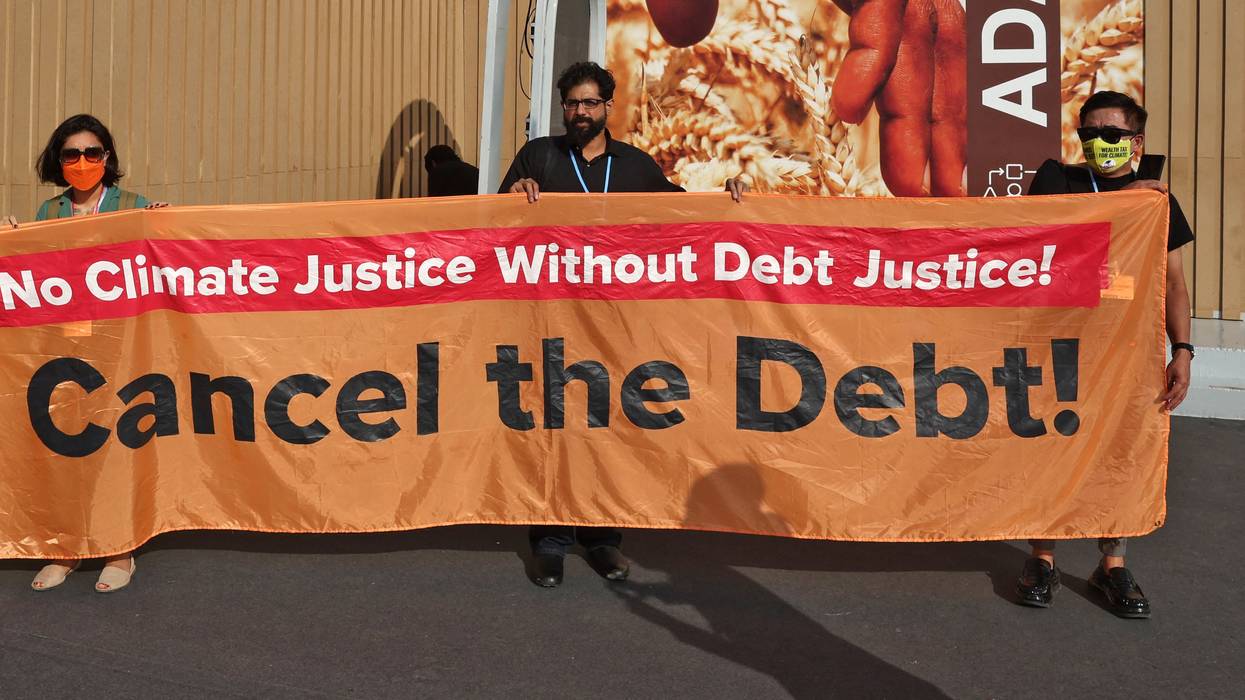
Extortionate debt forces nations to pursue climate-unfriendly policies in the hope of repaying loans. Until the next crisis strikes.
As climate activists, we are used to banging our heads against brick walls.
Amid the need to rapidly move away from fossil fuels, deforestation and destructive export agriculture, we’re used to marshalling the full weight of scientific evidence, moving testimony, ethical arguments, persuasive advocacy and creative campaigning to pushing for changes needed to save the planet. Unfortunately, we’re also accustomed to governments ignoring us, and scaling up climate-harming activities instead.
But why do so many governments make such apparently irrational decisions when the climate crisis is on their doorstep, their own citizens are losing out, and the weight of evidence is telling them to act?
The answer might surprise you.
One of the biggest factors preventing governments in the Global South from taking climate action is barely discussed at conferences and debates meant to find solutions to the planet’s existential crisis.
It is time for us to talk about debt. Especially now, with the Spring Meetings of the World Bank and the International Monetary Fund (IMF) held recently and economic policy options for Global South countries under the spotlight. If we want countries to have the freedom to take action that is in their interests, we must understand that the World Bank, the IMF and private banks based in wealthy countries are preventing climate progress.
How? Because of their unhealthy obsession with debt repayments from the Global South at any cost.
This extortionate debt which hangs over the heads of many countries is forcing them to make difficult choices in order to pay that debt back. Indonesia, for example, is paying back loans equivalent to more than 40 percent of its gross domestic product (GDP), a key factor leading it to cut down rainforests to make way for money-making palm oil plantations. The need to repay external debt worth more than 80 percent of GDP has also been a factor in Brazil’s prioritising of soybean exports over the protection of the Amazon. And an external debt equivalent to 101 percent of GDP is why Mozambique has been trying to expand its coal and gas production in recent years.
This type of external debt almost always needs to be repaid in US dollars or other foreign currencies. So even when countries would benefit from supporting smallholder farmers, agroecology and small and medium-sized businesses, many have been forced to shape their economies around destructive fossil fuel and large-scale industrial agribusiness exports, in order to earn the dollars needed for debt repayment.
And the difficult decisions continue, with many countries spending more on servicing their debt than on education and health. Even though many have paid back their original loan amounts, a combination of rising interest rates, successive currency devaluations, fluctuating global commodity prices and the destructive impacts of climate change have kept the debt repayment finish line perpetually out of reach.
Indeed, sometimes the climate crisis has forced countries to take on more loans at even higher interest rates.
Even worse, loans from the World Bank and the IMF almost always come with rules attached – that countries privatise their public services, cut public spending, and go gung-ho into producing export commodities. These “conditionalities” and the power wielded by these institutions are worsening the climate crisis, and undermining countries’ capacity to take climate action through investing in green technologies, resilience or recovery from disasters.
Sniffing the climate winds of change, the IMF and the World Bank are now desperately attempting a makeover, and trying to present themselves as responsible climate leaders. But in reality, the IMF has advised more than 100 countries to expand their fossil fuel infrastructure, while the World Bank has spent $14.8bn supporting fossil fuel projects and policies since the Paris Agreement was signed. Their claims of being responsible climate leaders do not hold up to any scrutiny.
New research by ActionAid finds that 93 percent of countries most vulnerable to the climate crisis are in debt distress, or at significant risk of debt distress. This reflects a vicious cycle in which climate impacts put countries into debt, but that debt accelerates the climate crisis and leaves countries even more exposed to its impacts. And so the cycle continues.
All this points us towards a clear conclusion: that the global debt crisis is a major barrier to climate action and that debt cancellation can be a highly effective climate solution.
A proposal from last year called the Bridgetown Initiative, conceived by the prime minister of Barbados, Mia Mottley, is gathering momentum and putting the climate spotlight on debt and the role of international finance institutions. This initiative was initially seen as a progressive opportunity to overhaul the global financial system and put a stop to the harm that the World Bank and the IMF are doing to the climate and climate-vulnerable countries.
The agenda is still evolving, but there are concerns that despite some progressive elements, other components would drive countries deeper into debt. Proposals on the table suggest that these international financial institutions could merely tweak their ways, and channel even more loans to climate-affected countries while branding this as “climate finance” for adaptation and mitigation.
Given that rich countries have the greatest historical responsibility for causing the climate crisis, it is only right that they contribute their fair share of funds as grants, to support lower-income countries that are already suffering from the impact of climate change.
International loans must not be allowed to masquerade as “climate finance”, and rich countries must not be enabled to wriggle out of their own obligations to contribute real funds. If we want to address the climate crisis, debt cancellation — rather than yet more spiralling debt — must be at the top of the agenda.
High levels of global debt are likely to turn what could be a controllable shift from expansion to contraction into a blowout of unfulfilled expectations and obligations, leading to widespread suffering.
An enormous debt bomb threatens the U.S. federal government and the nation's financial system unless warring politicians can agree on a plan to defuse it. However, there are even bigger debt bombs ticking away beneath us all, of which fewer people are aware. It may be impossible to disarm all of them, but action is required to minimize the casualties.
Let's start by focusing on the immediate U.S. debt threat, then widen our view to take in longer-term and more serious liabilities that have the potential to bring down the entire global industrial economy.
The United States government reached its congressionally mandated legal debt limit, $31.4 trillion, on January 19th. This debt represents past spending: Cutting the budget now won't make the debt go away. If Congress fails to raise the debt limit, the federal government could default on its debt payments—something it has never done before.
The federal debt limit was created by Congress in 1917. In recent decades, there have been periodic standoffs (in 1985, 1997, 2011, and 2013), in which Republicans threatened to let the deadline to increase the limit pass unless Democrats agreed to spending cuts in social programs. Neither side actually wanted the federal government to default, but brinksmanship served partisan interests. This time, some Republican House Freedom Caucus members appear to regard an actual debt default (not just the threat of one) as a useful tool to force major government spending cuts.
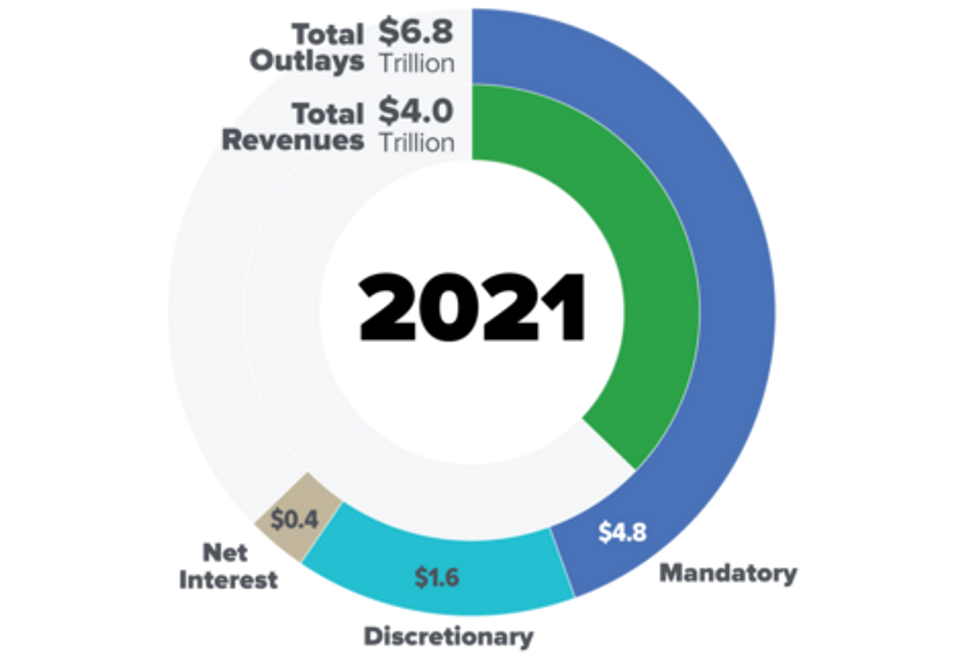
Government spending comes in three large categories—mandatory, discretionary, and interest payments. Most federal spending is mandatory, including Social Security and Medicare payments. Of discretionary spending, defense accounts for more than half. Interest payments on U.S. debt comprise the smallest of the three categories of spending, but it is growing fast and may overtake the military budget by 2025 or 2026.
Some pundits equate debt ceiling fights with hostage negotiations. In this instance, House Speaker Kevin McCarthy (R-Calif.) may have limited ability to prevent his more radical colleagues from metaphorically shooting their captive. McCarthy's leadership is fragile and in order to gain it, he agreed to rules that will give extremists outsized influence in upcoming negotiations. A single member will be able to force a vote on the speakership, possibly plunging the entire body back into days of voting to establish a new leader.
Since U.S. debt (in the form of bonds and other securities) anchors the global financial system, a default could rattle economies across the globe. Americans could face a recession, and stock and bond markets would likely plunge. Still, exactly how a default would play out is uncertain. Since the U.S. government's payment of its financial obligations is mandated in the U.S. Constitution, it is conceivable that a default could be averted by the courts. Nevertheless, there is a very real possibility that not only Americans but millions or billions around the globe could face hardship as a result of political hardball tactics playing out in Washington, D.C.
The debt ceiling standoff in America is unquestionably a volatile situation, but it's only one aspect of the larger debt crisis facing humanity.
According to the late anthropologist David Graeber, debt has been around for about five thousand years. Debt is the flipside of money: Especially in the modern world, where almost all money is created via bank loans, it's impossible to have one without the other. In societies that use money, a pattern has played out again and again. At first, debt and money enable the expansion of trade and the creation of wealth. Then debt begins to accumulate faster than the ability to repay it, simply because it's physically easier to borrow and spend than it is to extract resources and transform them with labor. Finally, a round of debt defaults destroys money and real wealth, leading to widespread misery. Eventually, the cycle begins again.
Over the past two centuries, and especially since 1950, the world has seen the highest rate of production of goods and services in all of history. While technology played a role, the key enabler was cheap, abundant energy from fossil fuels. During this period, GDP was generally adopted as a measure of economic success, and growth became normalized. Because it was assumed that the economy would continue to grow, it was generally believed that most debt incurred now could be repaid in the future. Further, increasing household debt (including credit card debt, mortgages, and student loans) enabled most people to consume now and pay later, and helped expand the whole economy.
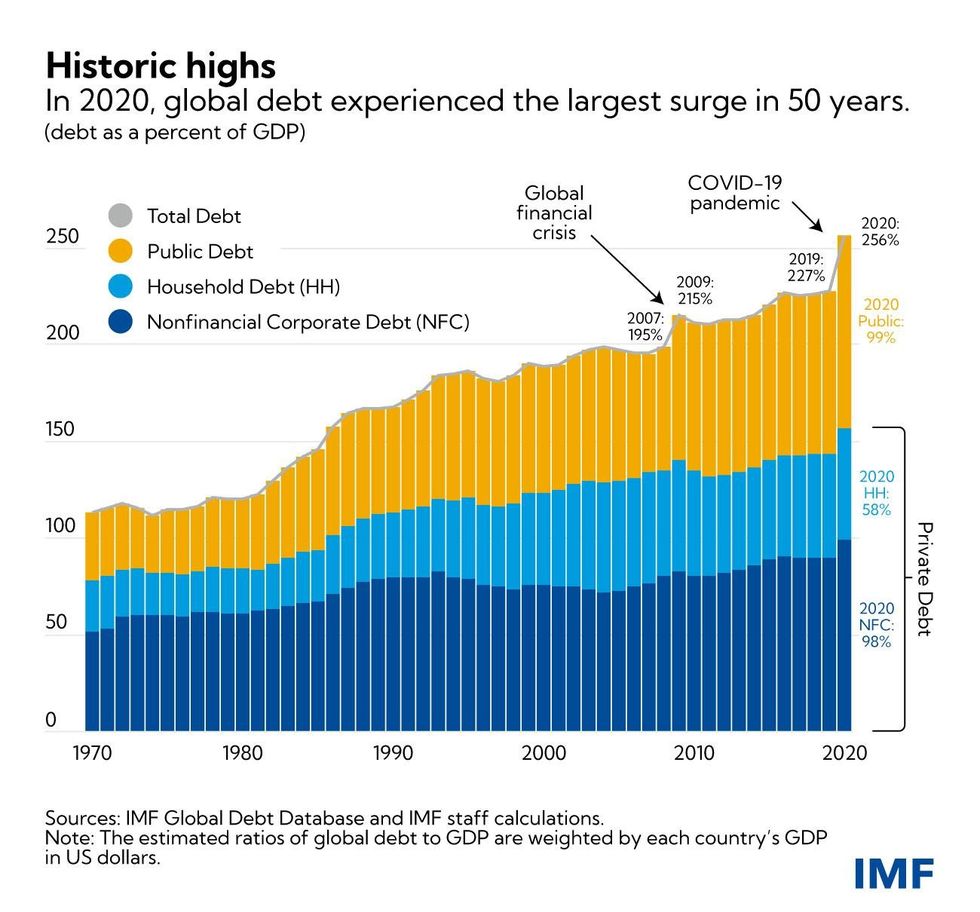
This IMF graph breaks total debt into three categories: government (also called "public"), corporate, and household. It also measures debt not simply in terms of money owed, but by the debt-to-GDP ratio. Not only has debt grown in raw numerical terms, but it has also grown in comparison with GDP. Many economists believe that high debt-to-GDP ratios can be cause for concern, since they are often associated with debt bubbles—which usually end in debt deflation, causing bank runs or a currency crisis. Examples include the 1920s stock market bubble (which triggered the Great Depression) and the U.S. housing bubble (which caused the Great Recession).
Most current debt is, in effect, a bet on future growth. But future growth is increasingly problematic. As I have explained elsewhere (in this book and in this article), global growth is coming to an end in the first decades of the current century due to the depletion of fossil fuels and other resources, rising pollution levels, and declining population growth. China, whose population has started shrinking and whose recently spectacular levels of economic growth are now rapidly tapering off, is a global bellwether. High levels of global debt are likely to turn what could be a controllable shift from expansion to contraction into a blowout of unfulfilled expectations and obligations, leading to widespread suffering.
Debt is typically defined as a formal or informal agreement in which one party gives another something of value now, with the expectation of repayment (often with interest) at a later date. If no repayment is wanted or expected, we call the transfer a gift. But sometimes value is taken without agreement between the parties involved. Stealing and looting aren't accompanied by negotiations over interest rates, or by mutual record-keeping. There are legal forms of taking, such as taxes and fines. But where there is no legal basis for taking something of value, societies around the world through history have recognized a moral responsibility on the part of the taker to make restitution, either symbolic or in kind, or both.
For theft debt there can be no default in the legal sense, since default is the breaking of an agreement to repay a debt, and here there has been no agreement. However, there can indeed be consequences of unrepaid theft debt. Indeed, if theft occurs on a large enough scale, those consequences may include the breakdown and collapse of societies and ecosystems.
Three categories of theft debt are relevant here: the debt of high-consuming nations to low-consuming nations, the debt of recent generations to future generations, and the debt of humanity to other species.
Especially since the start of European exploration and colonization 500 years ago, rich nations have derived most of their wealth from natural resources and cheap labor in poor nations (indeed, in many cases the latter nations were made poor by this predatory relationship, which was often militarily enforced). As economic anthropologist Jason Hickel points out, today the Global South contributes about 80% of the labor and resources for the world economy, yet the people who render that labor and those resources receive about 5% of the income the global economy generates each year. Eventually, the deliberate impoverishment of a population by wealthy exploiters tends to lead to resentment and rebellion among those exploited, and corruption and moral decline among the exploiters.
The transfer of wealth also occurs intergenerationally. When people today use or degrade renewable resources (such as forests, fish, aquifers, and soil) faster than nature can regenerate them, this makes it more difficult for people in the future to enjoy equivalent levels of wealth. Nonrenewable resources, such as minerals and metals, can be recycled to a certain extent, but are typically just dispersed into the environment as we use them, making it difficult or impossible for the next generation to access them. We are leaving our grandchildren a depleted and more polluted world, with global ecosystems now stewing in thousands of human-produced chemicals of varying degrees of toxicity. Since natural resources are the ultimate basis of all wealth creation, this means we are, in effect, stealing from the future. Young people are starting to get the message: Surveys say that more than two- thirds of Americans believe today's children will be financially worse off than their parents.
Humanity also, in effect, takes from other species by degrading or transforming habitat. Animals and plants are always jostling amongst themselves within ecosystems, now cooperating, now competing, with some expanding their populations and others losing out. However, humanity, with its astounding fossil-fueled success at population expansion, is taking over habitable space to a degree that threatens not only other species, but our own as well—since humanity depends on healthy and diverse ecosystems for a range of free services such as pollination, pest management, and flood control. Nonhuman animal species have lost, on average, 70% of their members in the past 50 years, marking a nearly unprecedented transfer of habitat from millions of species to just a handful—Homo sapiens and the animals and plants it has domesticated.
These three forms of taking are often perfectly legal, because it is usually the beneficiaries (i.e., privileged humans alive today) who make the laws. But legal theft is still theft, and there will be consequences.
Debt buildups are often likened to soap bubbles. When a soap bubble bursts, a tiny hole expands during a brief fraction of a second, then suddenly the bubble is gone. As the bubble initially inflates, there's no reason (other than past experience and complex calculations having to do with fluid mechanics) to expect that this magical shiny sphere will soon disappear. Debt bubbles are like that too: They can take some time to inflate, and during that period, there may be little apparent cause for worry (except among historians or ecologists). Then suddenly, financial hell breaks loose. People who understand the mechanics of bubbles, physical or metaphoric, say that the only way to avoid a nasty bursting is somehow to deflate the bubble harmlessly before it pops.
That's often easier in theory than in practice. What about the U.S. federal government's debt bubble? If the government were to rein in its spending significantly, there would be consequences—perhaps including lost jobs in the defense industry and reductions in the security or health of those who receive support payments of various kinds. Modern monetary theorists say it is possible to avoid both potential defaults and the need to make severe spending cuts simply by empowering government to create the money it needs without having to borrow it at interest. But while money may theoretically be easy to create, resources and energy are different matters altogether. And, in the end, money works only when it reliably represents access to energy and resources. If the money supply grows but resources don't, the result can be runaway inflation. For the U.S., modern monetary theory could provide some temporary and partial relief from the government debt crisis, but over the long run there is no getting past the requirement to reduce overall national consumption—and that is likely to provoke a political crisis. That political crisis could be headed off in part by developing rationing systems and by shifting the aim of economic policy away from GDP growth and toward general happiness and cooperation.
The world's vast increase in financial debt over the past few decades ultimately can be resolved only by a round of defaults, or by a deliberate process of debt forgiveness and deleveraging, like the debt jubilees that ancient societies held on a regular basis. The former would lead to widespread bankruptcies and would endanger the entire economy; the latter would, in effect, constitute a destruction of some existing wealth and a transfer of much of what's left of that wealth from the rich to the poor. Such a process might best begin with a redistribution of most of the wealth of the billionaire class.
Theft debt cannot be "forgiven"; there are only two possible outcomes: repayment or consequences.
For international theft debt, repayment would require wealth transfers from rich to poor nations, starting with the cancellation of poor nations' debts. Reparations for slavery and land theft might constitute a key part of this much larger process of global leveling.
Generational theft debt cannot be repaid by somehow replacing nonrenewable resources already depleted: We can't put ores back in the ground (though with renewable resources, we could help forests and fisheries recover). More meaningfully, we could make a start at easing the lives of those who will come after us by creating a way of life that's peaceful, sustainable, cooperative, and beautiful. In many respects, that would be a more valuable legacy than material abundance. And the sooner we start, the more of a legacy we leave them.
Our theft debts to other species likewise probably cannot be repaid in kind, at least not entirely: There is little likelihood, for example, that we will be able to use modern genetics to revive large numbers of species we've already driven into extinction, unless we can provide those revived species with appropriate habitat. But we can stop running up our tab on nature. That might mean ceding half the Earth to ecosystem recovery.
Absent such efforts, bubbles will continue to inflate until they burst. In that case, the worst outcomes can be averted only by starting now to build personal, household, ecosystem, and community resilience.
More austerity, more cuts, or no deal.
That's the message the International Monetary Fund threw back at the Greek government after negotiators on Wednesday rejected the latest reform proposals submitted by the Syriza government.
According to reporting on the ground, there were a "flurry of proposals, counter-proposals, leaks and verbal attacks" in Brussels as Greek Prime Minister Alexis Tsipras continued to try to hash out an acceptable bail-out plan with his creditors ahead of a critical June 30 payment deadline.
Though Syriza supporters and those within the leftist government say that Greece's most recent offer is too austere and abandons pledges made during the election campaign, European creditors still rejected the deal. Instead, the IMF submitted a list of counter-reforms which Greek negotiators described as "absurd" and "not acceptable."
On Monday, the Greek government submitted an offer that would raise the country's VAT (Value-Added Tax) and slash the country's pension system, gradually raising the retirement age to 67.
Following the bank's rejection of that offer, Tsipras accused the lenders of suspiciously holding the country to a different standard than other indebted nations.
"The repeated rejection of equivalent measures by certain institutions never occurred before-neither in Ireland nor Portugal," he wrote on Twitter. "This odd stance seems to indicate that either there is no interest in an agreement or that special interests are being backed."
The IMF's counter proposal, which was leaked Wednesday, showed that the Greek government "has been pushed to raise more from VAT and also make sweeping changes to its pensions system, including raising the retirement age faster and eliminating benefits for the poorest pensioners," the Guardian reports.
BBC economics correspondent Duncan Weldon summarized the two drafts in a Tweet, noting their different approach to so-called "red-line" deal-breakers:
Across Europe this week, anti-austerity activists and other supporters are holding a week of rallies in vigils in solidarity with Greece as it faces off with Europe's financial elite. Campaigners have also launched a petition calling on creditors to cancel Greece's debt and discontinue the punishing austerity agenda.
If a deal is not reached and creditors refuse to release bail-out funds by the end of the month, Greece risks defaulting on its debts, possibly spurring an exit from the European Union.
The Guardian is hosting a live blog as Eurogroup finance ministers meet in Belgium on Wednesday evening to continue discussions.