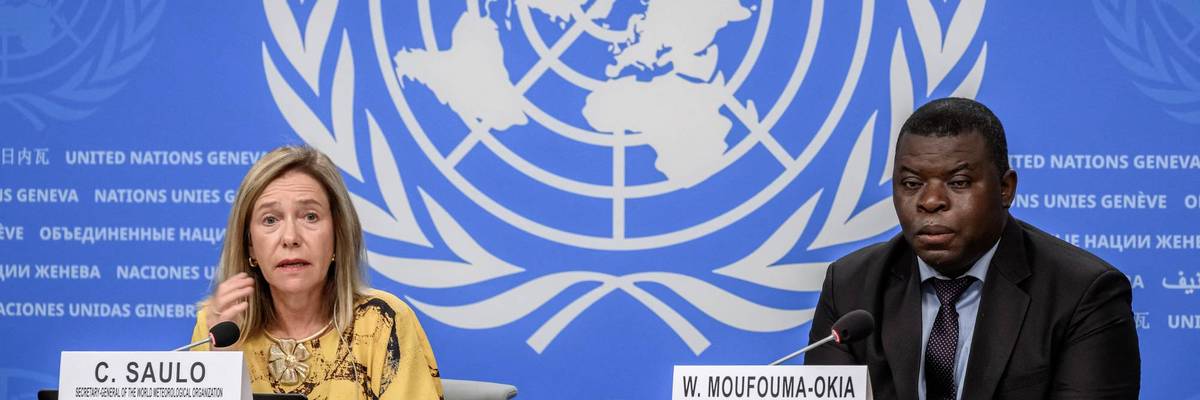
World Meteorological Organization Secretary-General Celeste Saulo and chief of climate prediction Wilfran Moufouma-Okia attend a press conference in Geneva, Switzerland on September 3, 2026.
Urgent Global Response Needed to Prepare for 'Literally Off the Charts' Supersized El Niño, Says UN
"The science leaves no room for doubt: the planet is in uncharted waters, and those waters are heating up."
Officials at the United Nations are warning that governments around the world must urgently prepare for the impacts of an El Niño climate pattern that is being "supersized before our eyes."
The UN's World Meteorological Organization (WMO) on Thursday provided an update on El Niño, projecting with near certainty that it would persist at least through Februrary 2027.
El Niño is a phenomenon that produces above-average temperatures in the Pacific Ocean, which then disrupt weather patterns elsewhere in the world. In its update, WMO said that this year's El Niño projects to be historically intense.
"Forecasts indicate further strengthening of El Niño in the coming months, with the event forecast to reach very strong intensity before peaking towards the end of the year," WMO said. "A very strong El Niño increases the likelihood of significant shifts in temperature and rainfall patterns in many parts of the world."
The organization emphasized, however, that El Niño's impacts are not predictable and vary widely by region.
WMO Secretary-General Celeste Saulo said the latest projections show that El Niño "has the potential to deliver a massive blow to communities and economies across the world" in the form of droughts, floods, and other climate-related disasters made more intense by the continued extraction and burning of fossil fuels.
"This exceptional El Niño demands exceptional preparation and response," Saulo said. "Never before in the 50-year history of the World Meteorological Organization have we launched such a major mobilization with National Meteorological and Hydrological Services who are on the frontline of delivering the forecasts and services to save lives and livelihoods."
While speaking with reporters in Geneva, Switzerland on Thursday, Saulo noted that the current El Niño "may be stronger than anything since our monitoring began," making it "literally off the charts we have used for the past four decades."
UN Secretary-General António Guterres warned that "El Niño is being supersized before our eyes," and said the ramifications could be severe.
"The science leaves no room for doubt: the planet is in uncharted waters, and those waters are heating up," said Guterres. "Sea surface temperatures are rising, temperatures keep climbing, and the world is in the danger zone of extreme weather."
Daniel Swain, climate scientist at the University of California Agriculture and Natural Resources, echoed UN officials' warning about El Niño in an interview with Wired published Thursday.
“This is probably one of the larger, if not the largest, climate events... that anybody alive is potentially ever experiencing,” said Swain. "That's a very big deal. And I think there’s certainly going to be dramatic outcomes from this.”
We are at a crossroads
This country and this world are at a monumental crossroads. In a few short weeks, US voters will have an opportunity to beat back the forces of fascism and confront the billionaires who are rigging the economy, our media system, and our democracy, making it increasingly impossible for ordinary people to get by. We’re not just talking about the election. We’re talking about what must be done once these fascist elements are vanquished from power. We need a bolder set of solutions than what either major party has so far been willing to offer and a working-class movement ready to fight like hell for it. Trump didn't emerge from nowhere. The conditions that fueled MAGA authoritarianism were created by decades of radical neoliberal economic policies and a corrupt political system dominated by corporate interests. They slashed taxes on the super-rich, promising that the benefits would trickle down. They said giveaways to the corporate titans would make life more affordable for the rest of us. It was all bullshit. And when a bitter, betrayed populace searches for someone to blame, right-wing demagogues have little trouble finding scapegoats. People know when they're being lied to, but you won't hear any of this from the corporate media. Only independent journalism—powered and funded by people who believe in building a better world—can deliver truly trustworthy daily news. Our Fall Campaign is underway, and we need your help. To power our newsroom through the rest of the year, we need to raise $125,000 by midnight on October 31. So if you share our vision, please contribute whatever you can to sustain our work. |
Officials at the United Nations are warning that governments around the world must urgently prepare for the impacts of an El Niño climate pattern that is being "supersized before our eyes."
The UN's World Meteorological Organization (WMO) on Thursday provided an update on El Niño, projecting with near certainty that it would persist at least through Februrary 2027.
El Niño is a phenomenon that produces above-average temperatures in the Pacific Ocean, which then disrupt weather patterns elsewhere in the world. In its update, WMO said that this year's El Niño projects to be historically intense.
"Forecasts indicate further strengthening of El Niño in the coming months, with the event forecast to reach very strong intensity before peaking towards the end of the year," WMO said. "A very strong El Niño increases the likelihood of significant shifts in temperature and rainfall patterns in many parts of the world."
The organization emphasized, however, that El Niño's impacts are not predictable and vary widely by region.
WMO Secretary-General Celeste Saulo said the latest projections show that El Niño "has the potential to deliver a massive blow to communities and economies across the world" in the form of droughts, floods, and other climate-related disasters made more intense by the continued extraction and burning of fossil fuels.
"This exceptional El Niño demands exceptional preparation and response," Saulo said. "Never before in the 50-year history of the World Meteorological Organization have we launched such a major mobilization with National Meteorological and Hydrological Services who are on the frontline of delivering the forecasts and services to save lives and livelihoods."
While speaking with reporters in Geneva, Switzerland on Thursday, Saulo noted that the current El Niño "may be stronger than anything since our monitoring began," making it "literally off the charts we have used for the past four decades."
UN Secretary-General António Guterres warned that "El Niño is being supersized before our eyes," and said the ramifications could be severe.
"The science leaves no room for doubt: the planet is in uncharted waters, and those waters are heating up," said Guterres. "Sea surface temperatures are rising, temperatures keep climbing, and the world is in the danger zone of extreme weather."
Daniel Swain, climate scientist at the University of California Agriculture and Natural Resources, echoed UN officials' warning about El Niño in an interview with Wired published Thursday.
“This is probably one of the larger, if not the largest, climate events... that anybody alive is potentially ever experiencing,” said Swain. "That's a very big deal. And I think there’s certainly going to be dramatic outcomes from this.”
- New El Niño Warning Compounded by Trump’s Attacks on Climate, Disaster Preparedness ›
- 'It Is a Warning': Super El Niño Pushed Ocean Temps to Hottest on Record for July ›
- Nearly 50 Million More People to Face 'Massive Threat' of Acute Hunger Due to El Niño, UN Warns ›
- Intensified by Fossil Fuel-Driven Climate Crisis, 'Godzilla-Level' El Niño Smashing Records Ahead of Peak | Common Dreams ›
- Guterres Hailed for Fiery Outgoing Speech Demanding Polluters Pay for Climate Crisis | Common Dreams ›
Officials at the United Nations are warning that governments around the world must urgently prepare for the impacts of an El Niño climate pattern that is being "supersized before our eyes."
The UN's World Meteorological Organization (WMO) on Thursday provided an update on El Niño, projecting with near certainty that it would persist at least through Februrary 2027.
El Niño is a phenomenon that produces above-average temperatures in the Pacific Ocean, which then disrupt weather patterns elsewhere in the world. In its update, WMO said that this year's El Niño projects to be historically intense.
"Forecasts indicate further strengthening of El Niño in the coming months, with the event forecast to reach very strong intensity before peaking towards the end of the year," WMO said. "A very strong El Niño increases the likelihood of significant shifts in temperature and rainfall patterns in many parts of the world."
The organization emphasized, however, that El Niño's impacts are not predictable and vary widely by region.
WMO Secretary-General Celeste Saulo said the latest projections show that El Niño "has the potential to deliver a massive blow to communities and economies across the world" in the form of droughts, floods, and other climate-related disasters made more intense by the continued extraction and burning of fossil fuels.
"This exceptional El Niño demands exceptional preparation and response," Saulo said. "Never before in the 50-year history of the World Meteorological Organization have we launched such a major mobilization with National Meteorological and Hydrological Services who are on the frontline of delivering the forecasts and services to save lives and livelihoods."
While speaking with reporters in Geneva, Switzerland on Thursday, Saulo noted that the current El Niño "may be stronger than anything since our monitoring began," making it "literally off the charts we have used for the past four decades."
UN Secretary-General António Guterres warned that "El Niño is being supersized before our eyes," and said the ramifications could be severe.
"The science leaves no room for doubt: the planet is in uncharted waters, and those waters are heating up," said Guterres. "Sea surface temperatures are rising, temperatures keep climbing, and the world is in the danger zone of extreme weather."
Daniel Swain, climate scientist at the University of California Agriculture and Natural Resources, echoed UN officials' warning about El Niño in an interview with Wired published Thursday.
“This is probably one of the larger, if not the largest, climate events... that anybody alive is potentially ever experiencing,” said Swain. "That's a very big deal. And I think there’s certainly going to be dramatic outcomes from this.”
- New El Niño Warning Compounded by Trump’s Attacks on Climate, Disaster Preparedness ›
- 'It Is a Warning': Super El Niño Pushed Ocean Temps to Hottest on Record for July ›
- Nearly 50 Million More People to Face 'Massive Threat' of Acute Hunger Due to El Niño, UN Warns ›
- Intensified by Fossil Fuel-Driven Climate Crisis, 'Godzilla-Level' El Niño Smashing Records Ahead of Peak | Common Dreams ›
- Guterres Hailed for Fiery Outgoing Speech Demanding Polluters Pay for Climate Crisis | Common Dreams ›