

SUBSCRIBE TO OUR FREE NEWSLETTER
Daily news & progressive opinion—funded by the people, not the corporations—delivered straight to your inbox.
5
#000000
#FFFFFF
To donate by check, phone, or other method, see our More Ways to Give page.
Daily news & progressive opinion—funded by the people, not the corporations—delivered straight to your inbox.
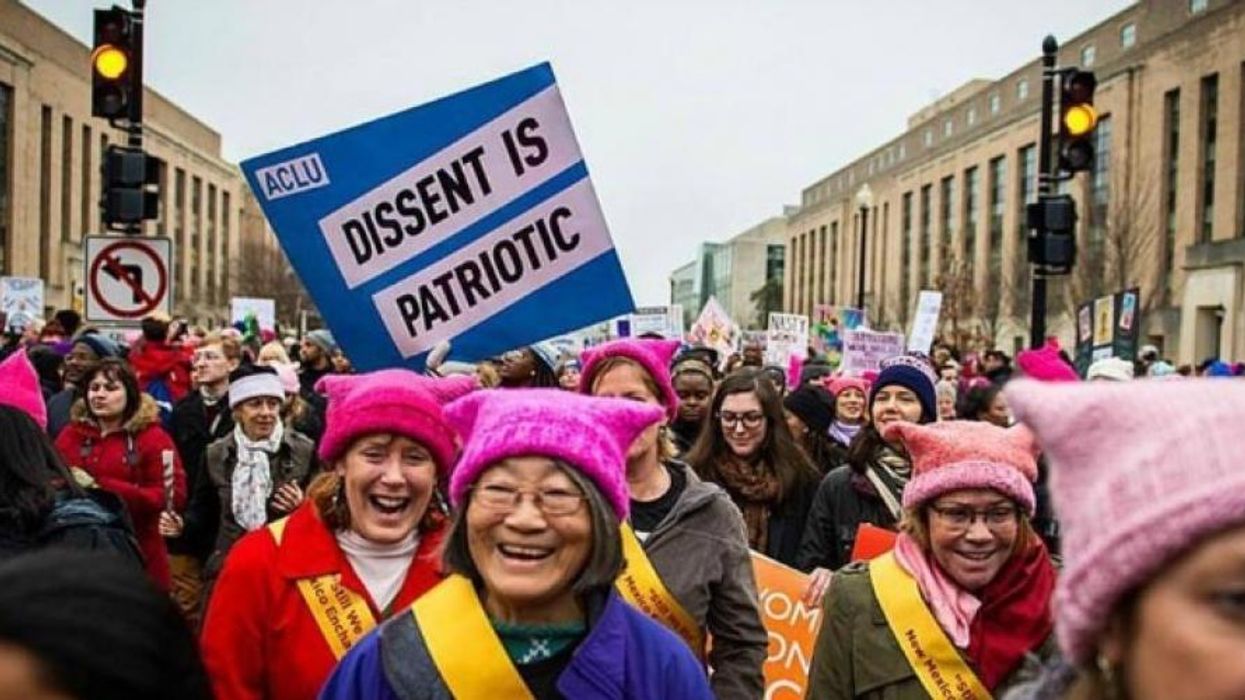
HR 9495 seems designed for political purposes, to limit debate about the most pressing issues—war, climate, economic access—our country faces today.
On November 21, 2024, the House of Representatives passed bill H.R. 9495, the “Stop Terror-Financing and Tax Penalties on American Hostages Act” and passed it to the Senate for consideration.
The bill contains two separate elements, one of which is not controversial and another which is highly controversial.
The first part of the legislation proposes to postpone the tax obligations of Americans being held hostage overseas. It seems fair and right and has almost universal bipartisan support.
It’s already illegal for NGOs in this country to support terrorism, so one intent of HR 9495 must be to limit democratic participation that makes legislators uncomfortable.
The second piece of the bill would allow the Secretary of the Treasury to, unilaterally and with no concrete justification, designate nonprofits as “terrorist supporting organizations.” These organizations would then lose their nonprofit status. As the ACLU has pointed out, any community news outfit, university, or civil association targeted by this law would be required to prove Treasury’s error in order to reclaim their tax-exempt status. By then, of course, the damage would have been done. The scarlet letter “T” would likely haunt the organization for as long as it attempted to act in the world. The potential effects of HR 9495, however, extend far beyond the fates of a handful of nonprofits.
This bill echoes one passed near the end of President Richard Nixon’s first year as president. President Nixon and his surrogates pitched their Tax Reform Act of 1969 in populist terms. It would, they said, prevent millionaires from squirreling away money in foundations and nonprofits in order to dodge paying their fair share to the common good. What really drove the passage of the bill, however, was another concern. Major foundations, including the Ford Foundation, had been contributing to President Lyndon Johnson’s “War on Poverty” and his mission to bring the nation’s poor in from the “outskirts of hope.” President Johnson had called for the “maximum feasible participation” of poor people in the democratic politics of their localities, states, and the nation. With funding from the Office of Economic Opportunity and Ford, the voices of the poor and marginalized were being heard. Cleveland elected its first Black mayor. Parents in Bedford Stuyvesant took control of the public schools. And in Durham and Greensboro, as well as in rural North Carolina counties, foundation-funded organizers were helping poor and working people, Black and white, to make coherent demands that would improve their lives and the lives of their children.
Threatened political and business bosses saw in Nixon an ally who could help them maintain their grip on power, as they reinforced the president’s grievance-driven “silent majority” with race-baiting and red-baiting tactics. Meanwhile, Roy Wilkins, the director of the NAACP, saw the Tax Reform Act of 1969 for what it was. “Negro citizens,” he wrote in a New York Times op-ed, “are not deceived by the ‘tax reform’ label. They view the move (and rightly so) as an attempt to halt the increase of Negro voting strength.”
After the passage of the Tax Reform Act, over 200,000 people lost nonprofit jobs funded by the OEO and private foundations. Beyond the economic impact of the law, powerful government and private institutions cut ties with committed activists, causing many of these activists to lose faith in the country’s commitment to broadening our democracy. This pushed some of them to imagine ever-more radical solutions beyond the voting booth, even stirring in a few dreams of overthrowing the American government.
When Alexis de Tocqueville visited America in 1831 and 1832, he saw American associations as “fundamental” to our democracy. They give voice to our citizens’ myriad thoughts, concerns, and creative ideas for improving lives and the laws that govern them; nonprofits inspire and improve democratic debate.
As the Tax Reform Act of 1969 siphoned the political power from associations, HR 9495 seems designed for political purposes, to limit debate about the most pressing issues—war, climate, economic access—our country faces today. It’s already illegal for NGOs in this country to support terrorism, so one intent of HR 9495 must be to limit democratic participation that makes legislators uncomfortable.
Before they vote, we should make sure our Senators realize that by shutting people up, they will damage our democracy. They may even push some to more desperate, provocative, and unruly attempts to be heard. Instead of reducing social conflict, passing HR 9495 could well increase it.

"All signs point to the Pentagon developing 'killer robots' via Replicator, despite deflections from Pentagon representatives themselves," according to Public Citizen.
A report from the government watchdog Public Citizen released Friday gives the who, what, when, where, and why of the Pentagon's flagship Replicator initiative—a program to increase the number of weapons, particularly drones, in the hands of the U.S. military.
In the report, Public Citizen re-ups concerns about one particular aspect of the program. According to the report's author, Savannah Wooten, the Defense Department has remained ambiguous on the question of whether it is developing artificial intelligence weapons that can "deploy lethal force autonomously—without a human authorizing the specific use of force in a specific context." These types of weapons are also known as "killer robots."
"It is not yet clear whether or not these technologies are designed, tested, or intended for killing," according to the report.
"All signs point to the Pentagon developing 'killer robots' via Replicator, despite deflections from Pentagon representatives themselves," wrote Wooten in the summary of the report.
The program, which was announced last year, is part of the Department of Defense's plan to deter China.
"Replicator is meant to help us overcome [China's] biggest advantage, which is mass. More ships. More missiles. More people," said Deputy Secretary of Defense Kathleen Hicks in a speech announcing the project last year. That mission will be achieved specifically by "mastering the technology of tomorrow," Hicks said.
There will soon be a "Replicator 2.0" that will focus on counter-drone technologies—per a memo from the defense secretary released in September—according to Public Citizen's report.
In a letter sent in March, Public Citizen and 13 other civil society groups highlighted remarks Hicks made in 2023 as an example of the ambiguity the Pentagon has created around the issue.
"Autonomous weapons are inherently dehumanizing and unethical, no matter whether a human is 'ultimately' responsible for the use of force or not. Deploying lethal artificial intelligence weapons in battlefield conditions necessarily means inserting them into novel conditions for which they have not been programmed, an invitation for disastrous outcomes," the organizations wrote to Hicks and Secretary of Defense Lloyd Austin.
Wooten's report reiterates that same call: "The Pentagon owes Americans clarity about its own role in advancing the autonomous weapons arms race via Replicator, as well as a detailed plan for ensuring it does not open a Pandora’s Box of new, lethal weapons on the world by refusing to hold its own operations accountable."
Additionally, "'Artificial intelligence' should not be used as a catchall justification to summon billions more in Pentagon spending, especially when the existing annual budget for the U.S. military already dwarfs every other U.S. agency and is careening towards the $1 trillion mark," Wooten wrote.
The fear that these types of weapons would open a Pandora's Box—and set off a "reckless, dangerous arms race," as Public Citizen warned of Friday—is not new. Back in 2017, dozens of artificial intelligence and robotics experts published a letter urging the United Nations to ban the development and use of so-called killer robots. As drone warfare has grown, those calls have continued.
The report also highlights the public statements of the head of one defense contractor that has been selected to produce for the Replicator initiative as a hint that the program is aimed at creating weapons that are capable of autonomous lethal force.
In early October, CEO of Anduril Palmer Luckey said that, "societies have always needed a warrior class that is enthused and excited about enacting violence on others in pursuit of good aims."
"You need people like me who are sick in that way and who don't lose any sleep making tools of violence in order to preserve freedom," he said.

"Every nonprofit across the spectrum of human rights and progressive values is up in arms, begging Democrats to overcome their greed and their spite, and not to hand President-elect Trump the ability to destroy any nonprofit he dislikes with the flick of a pen," wrote one campaigner.
House Republicans have revived an effort to pass the so-called "nonprofit killer" bill—a piece of legislation that, if passed, would hand U.S. President-elect Donald Trump the ability to sanction civil society groups, including government watchdogs, news outlets, and humanitarian organizations.
A vote on the Stop Terror-Financing and Tax Penalties on American Hostages Act (H.R. 9495), which would allow the Treasury Department to remove tax-exempt status from nonprofits deemed "terrorist supporting organizations," is expected on Thursday.
But a wide coalition of organizations and individuals have voiced their opposition to the bill, including multiple groups that have mobilized to pressure House members to vote against it, particularly the 52 Democrats who previously voted in favor of it.
The controversial bill was blocked last week when 144 Democrats and one Republican voted against the bill after it was fast-tracked under a procedure that requires two-thirds majority support for passage. Republicans then brought it back through the House Rules Committee, teeing it up for a simple majority floor vote.
The 52 Democrats who voted in favor of the bill include Reps. Adam Schiff (D-Calif.), Henry Cuellar (D-Texas), and Ritchie Torres (D-N.Y.).
Groups including Muslims for Progressive Values, Fight for the Future, Council on American-Islamic Relations, and the union The NewsGuild-CWA have launched an advocacy effort to pressure those 52 Democrats to flip their votes and urge all members of the House to vote no on the bill.
"H.R. 9495 is a threat to our basic right to free speech, dissent, and advocacy. Democrats who claim to defend democracy must be called out for their SUPPORT of this bill. This bill will silence non-profits who speak up for human rights of Palestinians, reproductive rights, against deportations or ANY government policies," wrote Muslims for Progressive Values.
Some of Democrats who voted in favor have since said they will no longer support the bill.
Rep. Gabe Vasquez (D-N.M.) released the following statement on Monday: "I have heard loud and clear from folks in my district and understand the concerns of my constituents, non-profit leaders and their staff. The incoming administration's recent Cabinet nominations give me little faith that this tool would be used as originally intended. Therefore, I have decided to vote against H.R. 9495 and will continue acting in our district's and nation's best interests."
There is fear that the bill would, in particular, have a chilling impact on Palestinian rights organizations and pro-Palestine speech.
"This bill was designed to criminalize organizations and activists who oppose the U.S.'s unconditional support of Israel's genocide of Palestinians and the slaughter of Lebanese civilians. Such legislation threatened the constitutional rights of American nonprofits, houses of worship, and advocacy organizations—regardless of political orientation. Lawmakers must understand the serious, long-term dangers of advancing bills or investigations that seek to suppress lawful activism and silence dissent," according to a joint statement issued by Arab and Muslim American groups last week.
Lia Holland, the campaigns and communications director at Fight for the Future, said in a statement that "it's a disappointment but not a surprise to find Democrats voting for a bill to punish student protests against genocide on the wrong side of their entire values system. Over and over again, we've seen how legislative efforts designed to oppress dissent and silence speech end up burning their progenitors."
"H.R. 9495 is no exception—now, every nonprofit across the spectrum of human rights and progressive values is up in arms, begging Democrats to overcome their greed and their spite, and not to hand President-elect Trump the ability to destroy any nonprofit he dislikes with the flick of a pen," Holland added.
Others have also critiqued the proposed legislation on broader civil rights and free speech grounds.
"H.R. 9495 provides no due process or oversight, creating a tool for political retaliation under the guise of 'fighting terrorism.' Trump would abuse this power to retaliate against any [organization] that challenges his agenda. The 52 Dems who initially supported it must reverse course," wrote former Labor Secretary Robert Reich.
Kia Hamadanchy, senior federal policy counsel at the ACLU, said that "every time we give the president new powers and more authority to act alone, we create an open invitation for abuse by the executive branch."
"While the ACLU would oppose this legislation no matter who the president is, and there is no question it could be weaponized against groups on both ends of the ideological spectrum," Hamadanchy added, "the rhetoric we saw on the campaign trail from the president-elect is even more reason for Congress to reject this bill."
In a major setback for net neutrality, the European Parliament passed widely-maligned internet regulations without the amendments that rights groups said were crucial to protect free speech, democracy, and innovation online.
Wide loopholes in the rules allow Internet Service Providers (ISPs) to discriminate against networks, speed up or slow down Internet traffic, charge companies for faster loading times, and strip users of protections. The legislation passed 500-163.
"Today, Europe took a giant step away from its vision of becoming a world leader in the digital economy," said Anne Jellema, CEO of the digital rights group World Wide Web Foundation. "These weak and unclear net neutrality regulations threaten innovation and free speech. Now, European start-ups may have to compete on an uneven playing field against industry titans, while small civil society groups risk having their voices overwhelmed by well-funded giants."
The Paris-based advocacy organization La Quadrature Du Net described the vote as "a profound disillusion for all those who, throughout the years, battled to ensure net neutrality in Europe."
"Today [members of Parliament] had the chance to stand their ground against the Council and the Commission, but they only showed timid faces in front of threats to abandon the text or prolong the negotiations. By voting this incomplete and non-protective text, they sell off citizens' rights and liberties and hamper small and innovative companies in favor of big telecommunication companies," said La Quadrature legal and policy analysis coordinator Agnes de Cornulier. "They also give a bad signal on their weakness, thus endangering all future negotiations."
Following the vote, the Body of European Regulators for Electronic Communications (BEREC) will have nine months to develop guidelines for state-based agencies, like Ofcom in the United Kingdom, to implement the new rules.
Advocacy groups said those guidelines could help consumers and companies regain some of their power amid the rejection of wider net neutrality protections, even if it comes through future court rulings on those regulations.
"All is not lost," Jellema said. "The European Parliament is essentially tossing a hot potato to the Body of European Regulators, national regulators and the courts, who will have to decide how these spectacularly unclear rules will be implemented. The onus is now on these groups to heed the call of hundreds of thousands of concerned citizens and prevent a two-speed Internet."
De Cornulier added, "The task to mend the text's loopholes left by the MEPs now rests on governments deprived of transparency, at the risk of widening them even more, until Justice intervenes and long-lasting judiciary procedures set out an uncertain precedence."
The U.S. and other wealthy nations are not pulling their weight in the climate change fight and may be setting the world on an even more devastating climate track, a new report published Monday reveals.
Globally, governments' pledges to limit greenhouse gas emissions are not adequate to stave off an average surface temperature warming of 2degC, the agreed threshold to prevent irreparable global warming and extreme weather events, according to the report (pdf), Fair Shares: A Civil Society Equity Review of Intended Nationally Determined Contributions (INDCs), crafted by 18 civil society groups.
The groups, which include Friends of the Earth International and Oxfam, analyzed the pledges made ahead of time in early negotiations in Bonn, Germany, this week by about 150 United Nations (UN) member states participating in this year's COP21 climate talks in Paris and determined that the "ambition of all major developed countries falls well short of their fair shares."
While there is no official method of determining a nation's climate obligations, the civil society groups weighed the pledges against individual countries' economic wealth and historical contribution to global warming.
The coalition said the U.S. and the European Union (EU) can afford to switch from fossil fuels to renewable energy. Because they have benefited financially from burning coal, oil, and natural gas for centuries, their pledges amount to roughly a fifth of what they owe on climate action. Japan has pledged a tenth, according to the same metrics.
Meanwhile, emerging nations were found to "exceed or broadly meet" their obligations. Kenya, China, India, Brazil, Indonesia, and the Marshall Islands are among the developing economies going beyond the call of duty.
"Emission cut pledges made by rich countries so far are less than half of what we need to avoid runaway climate change," said Susann Scherbarth, climate justice and energy campaigner at Friends of the Earth Europe. "The draft Paris agreement on the negotiating table this week shows that many seem ready to accept irreversible and devastating consequences for people and the planet."
The talks in Bonn, which will continue until Friday, are the last chance for nations to finalize their climate pledges before COP21 talks commence on November 30. The civil society groups' full report will be published next month.
Brandon Wu of ActionAid added, "Across the board, rich countries are failing to bring the two most important ingredients to the negotiating table--emission cuts and money."
The coalition found more than the so-called "action gap." According to Friends of the Earth Scotland (FOES), wealthy nations may even be purposefully shirking their duties and shifting climate obligations onto their developing neighbors.
FOES head of campaigns Mary Church said, "What we are seeing as the Bonn talks open is rich countries setting the stage for a great climate getaway in which they shift the burden of responsibility for tackling the climate crisis onto the shoulders of the poor."
"If the deal that world leaders sign in Paris looks anything like the Bonn negotiating text, then world leaders will have wholly failed to respond to the urgency of climate science, let alone climate justice," Church said.
"Wealthy countries understand the need to tackle the climate crisis but are stubbornly unwilling to respond fairly and equitably," Church continued. "As they stand, combined pledges put us on track for 3oC warming, devastating impacts for billions of the world's poorest people. Not only are developed countries delaying urgent action to curb climate emissions at home, they are also failing to provide necessary support and finance to developing countries to adapt to the impacts of climate crisis that are already being felt."