

SUBSCRIBE TO OUR FREE NEWSLETTER
Daily news & progressive opinion—funded by the people, not the corporations—delivered straight to your inbox.
5
#000000
#FFFFFF
To donate by check, phone, or other method, see our More Ways to Give page.
Daily news & progressive opinion—funded by the people, not the corporations—delivered straight to your inbox.

"This is not simply the result of bad weather," said a regional director at Save the Children. "This is a choice."
As severe floods ravage Gaza, Israel is continuing to block the entry of tents, repair materials, and mobile homes despite the aid provisions of the October 2025 “ceasefire” agreement.
The United Nations Office for the Coordination of Humanitarian Affairs (OCHA) reported Monday that more than 150,000 tents are ready to be sent to Gaza, where it said more vacuum trucks and mobile dewatering pumps were urgently needed.
At least 70,000 tents were flooded in a single day this weekend. At least one infant reportedly drowned. A mother and her two children, along with three other children from the same family, were killed when a sandbank collapsed onto their tents.
“Over the weekend, while families slept, water flooded their tents and engulfed entire camps,” said Ahmad Alhendawi, Save the Children’s regional director for the Middle East and North Africa. “Children shivered in the bitter cold without winter clothing, and families lost the few belongings they had left. It is heartbreaking, and it was entirely foreseeable.”
“Israel is restricting access to shelter materials and has rendered 65% of Gaza off-limits. People have no safe place to go,” said Wassem Mushtaha, who leads Oxfam’s response in Gaza. The group has performed emergency maintenance on rainwater drainage networks and supplied tools for repairs.
He said that “urgent access is needed for spare parts, engine oil, pipes, and heavy machinery, in addition to shelter materials, to avoid more people being killed this winter.”
Most buildings in the territory were destroyed in Israel's genocidal war over the past three years. Of the Gaza residents who are living in makeshift shelters, according to Save the Children, about 1.2 million people, including over 560,000 children, are living in “critical or catastrophic” conditions, including flimsy tents and improvised structures that are often ill-equipped to handle the elements.
“Tents and tarpaulins are not the answer to Gaza’s winter,” said Jan Egeland, secretary-general of the Norwegian Refugee Council. “They cannot withstand heavy rain and strong winds, and many are already worn out after months of use far beyond their intended lifespan.”
OCHA reported Friday that no emergency shelter kits were available in Gaza because Israeli authorities had rejected timber shipments.
“Palestinians have the right to receive the assistance they need,” Egeland said. “States must press Israeli authorities to uphold their obligations and facilitate the entry of humanitarian aid and essential materials. Palestinians must not face another winter without adequate shelter. They cannot wait.”
The ceasefire agreement called for 60,000 mobile homes and prefabricated shelters to be allowed into Gaza to house displaced families, but Israel has allowed almost none to enter.
“All the tents are now damaged, torn, and covered in mud,” said Jaber al-Kaseeh, a man in his 70s whose family was forced to flee their tent in central Gaza’s az-Zawayda area this weekend after floodwaters began rushing in.
“We urgently need tents, tarpaulins, plastic sheets, mattresses, blankets, and carpets to protect us from the difficult days ahead,” he told Al Jazeera.
“We keep hearing about tents and tarpaulins being distributed, but we have received nothing,” he added. “We had hoped the mobile homes and temporary housing units promised under the ceasefire deal would allow us to rest and return to a life of safety and peace. But it was all just words in the air. We have seen nothing.”
Over the past two winters in Gaza, dozens of people—among them at least 26 children, including newborns—have died from hypothermia due to a lack of adequate shelter.
“This is not simply the result of bad weather,” Alhendawi said. “Tents, shelter kits, and fuel are waiting at Gaza’s borders while children sleep in floodwater because the Israeli authorities are blocking their entry. This is a choice, and children are paying the price.”
“As the occupying power, Israel has a legal obligation to ensure civilians receive the supplies they need to survive,” he added. “Instead, it is depriving families of the most basic means to protect their children, and it must be held accountable for any child deaths that result.”
“Israel’s ongoing genocide has resulted in the near collapse of all functioning systems in Gaza,” Mushtaha said. “Governments must insist that Israel allows for unimpeded access to recovery and repair materials to restore essential infrastructure and ensure Palestinian-led reconstruction efforts across Gaza.”

"All this dealmaking leads to staggering amounts of cash."
Forbes reporter Dan Alexander on Sunday thoroughly debunked claims made by President Donald Trump that his net worth grew by $3 billion since his return to office solely due to gains in the stock market.
During an interview with CBS News' "60 Minutes," Trump was asked by Ross Douthat about a Forbes estimate showing that Trump's net worth had grown from $3.9 billion in 2024 to $7 billion in 2026.
"Your net worth went up by $3 billion..." Douthat began.
"So did everyone's!" Trump replied.
Ross Douthat asks the President how his net worth rose by nearly $3 billion, according to a Forbes estimate, since he returned to office. Watch the interview Sunday at 7 p.m. ET/PT on 60 Minutes.
[image or embed]
— 60 Minutes (@60minutes.bsky.social) November 8, 2026 at 10:37 AM
"My net worth did not go up by $3 billion," Douthat shot back.
"Well, you should have had stock," Trump said.
Trump then claimed that he didn't pay too much attention to his net worth and said, "I guess it's gone up" over the last two years.
Alexander responded to Trump's claims in a social media post, giving detailed breakdown of how Trump's net worth grew by $3 billion, and emphasizing that "the president's answer here is nonsense."
Alexander began the story in 2024, when Trump grew his net worth by $1.8 billion while running for president when the Trump Media and Technology Group became a publicly traded company after a merger with Digital World Acquisition Corp.
The Forbes reporter emphasized that this was just the start of Trump's political profiteering, which he would really kick into high gear in the latter half of 2024.
"Just before the election, Trump kicked off a venture named World Liberty Financial, selling a crypto token and offering vague promises of a 'financial revolution,'" Alexander explained. "For Trump, the proposition was clearer: a 52.5% cut of every dollar investors put in after the initial $30 million."
Twenty days after Trump's triumph in the election, Chinese billionaire Justin Sun invested $30 million into World Liberty Financial, which ensured that the Trump family "would collect," wrote Alexander.
"The crypto community went wild, and money started pouring in, especially as the inauguration approached," Alexander continued. "One day before Trump took office, Sun announced another $45 million investment."
During this period, Trump also launched his official meme coin, which quickly shot up in value before crashing back down, leaving most of its investors billions of dollars underwater.
Alexander noted that foreign investments into World Liberty Financial continued pouring in after the election, especially from firms located in the United Arab Emirates.
The Wall Street Journal would later report that many of these investments were made by associates of an Abu Dhabi royal family member who "secretly signed a deal with the Trump family to purchase a 49% stake in their fledgling cryptocurrency venture for" $500 million.
"All this dealmaking leads to staggering amounts of cash by the end of 2025," Alexander explained, with World Liberty Financial and the Trump meme coin producing "$1,425,000,000 of liquidity... in one year."
In addition to crypto schemes, Trump also vastly expanded his overseas licensing empire, which in 2025 generated 10 times more income than it did just two years prior, Alexander wrote.
Summing up his findings, Alexander wrote that Trump over the last two years had made $1 billion off World Liberty Financial dealings, $1 billion from the sale of crypto tokens, $400 million in branding ventures, and $500 million after an appeals court wiped out a fine he had been ordered to pay as part of a civil financial fraud case.
This means that Trump's vast enrichment over the last two years has come from his own personal business dealings, not just gains in the stock market.
"In fact, almost none of Trump's $3 billion in gains from the fall of 2024 to the fall of 2025 came from stock," wrote Alexander. "In the fall of 2024, we estimated that the president's liquid assets totaled about $415 million. After analyzing his financial disclosure, we pegged about 10% of that in stock."

Sen. Elizabeth Warren is reportedly preparing to grill bank CEOs and push for a cap on credit card interest rates, among other policies.
Poised to take over as head of the Senate Banking Committee in the new Congress starting in January, progressive US Sen. Elizabeth Warren of Massachusetts is reportedly preparing to use her powerful role to investigate Wall Street banks and other big corporations accused of profiteering at the expense of working-class Americans.
An unnamed aide to Warren on the banking panel told Politico that "Big Tech CEOs, administration officials, Trump family crypto businesses, Wall Street executives, and giant corporations should preserve their documents and prepare to answer tough questions."
In addition to Warren's planned "oversight blitz," the senator also intends to "pursue affordability-centered policies," including "capping credit card interest rates, cracking down on what she calls 'corporate profiteering,' and pursuing a new bipartisan housing bill with soon-to-be ranking member Tim Scott (R-SC)."
"She’s also planning to continue teaming up with Republican China hawks to restrict exports of advanced AI chips, the aide said," according to Politico. "Nvidia CEO Jensen Huang, a key figure in that push, is also expected to be a top oversight target."
In a social media post on Sunday, Warren argued that Democrats won historic midterm victories "by recognizing Americans’ economic pain, denouncing Washington corruption that has made a rigged economy worse by favoring giant corporations over working people, and by pledging to upend this system."
"Americans need Democrats to deliver now," the senator wrote.
As head of the Senate Banking Committee, Warren would have significant power to demand testimony from corporate executives and advance subpoenas to force companies to hand over documents.
Reuters reported late last week that Warren "will likely probe the Office of the Comptroller of the Currency's August decision to approve a bank charter for President Donald Trump-backed World Liberty Financial."
"She is also likely to investigate the administration's mass firings of financial agency workers and its attempts to shut down the Consumer Financial Protection Bureau, an agency she helped create," Reuters added.
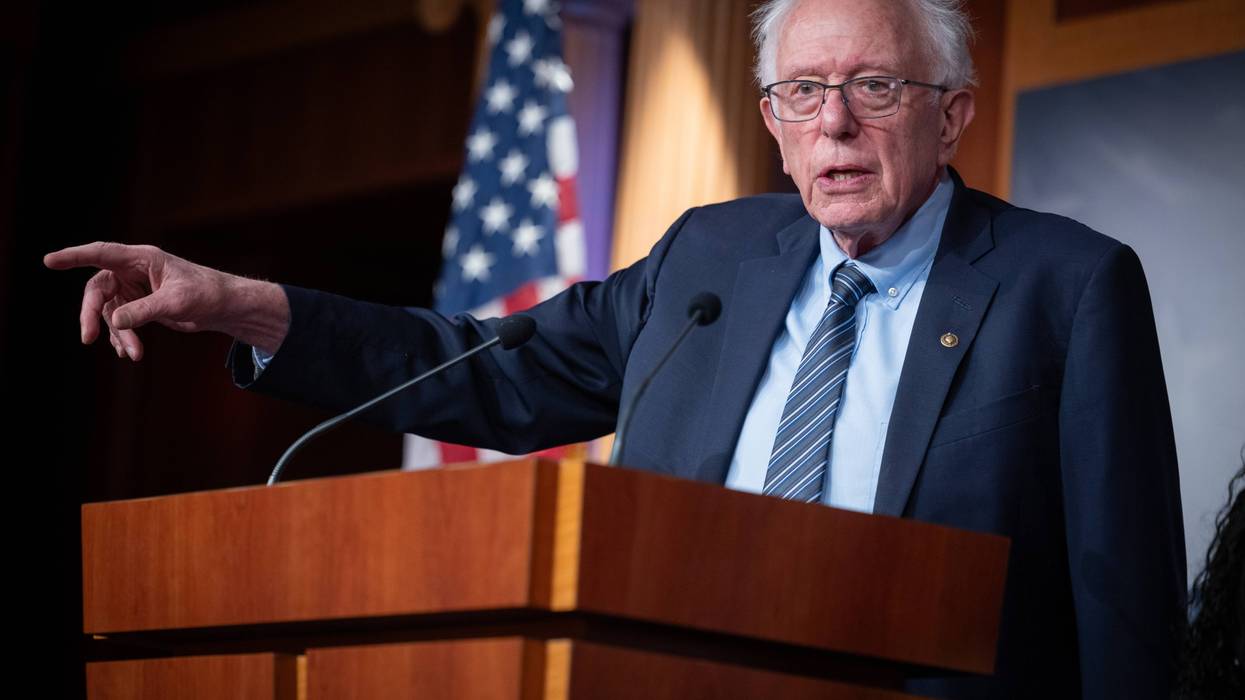
Once Democrats take power in the new Congress, Sen. Bernie Sanders argued they should pass legislation to lower the Medicare eligibility age and expand the program to children.
US Sen. Bernie Sanders on Sunday urged Democrats to use their new congressional majorities to lower the Medicare eligibility age by 10 years, expand the program to children, and add dental, vision, and hearing coverage—steps that the progressive senator said would put the country on a path toward a Medicare for All system.
Sanders (I-Vt.), the leading proponent of Medicare for All in the Senate, argued that each proposal he outlined "can be passed with 51 votes in the Senate through reconciliation," a filibuster-proof budget process that would allow Democrats in the upper chamber to approve legislation without Republican support. Any Democratic bill would still face President Donald Trump's veto pen.
"Let's do it," the Vermont senator wrote on social media, calling his plan "an immediate first step toward Medicare for All."
In recent years, Sanders has repeatedly pushed Democrats to incrementally expand Medicare as part of a broader effort to ultimately provide every person in the US with comprehensive health coverage as a right.
The senator's past efforts, including during the Covid-19 pandemic, focused largely on lowering the Medicare eligibility age to 55, but some policy experts have argued that Medicare expansion should begin with children.
"This would move the ball forward on Medicare for All in a serious way by bringing a large group of people who are already not expected to pay for their own insurance into the system," Matt Bruenig, founder of the People's Policy Project, wrote in 2020. "It's easy to come up with many different combinations of ways to pay for it. Medicare for Kids is not a technically complicated proposal or even a very 'expensive' proposal in terms of fiscal cost. The question is only whether elected officials can summon the will to do it."
Sanders' proposal came amid a debate within the Democratic Party on how to approach healthcare in the new Congress after voters delivered a clear rebuke of the GOP agenda. As STAT reported on Monday, "There has been broad agreement among congressional Democrats that they should roll back the historic Medicaid cuts championed by President Trump, and restore the additional Affordable Care Act health insurance tax credits that, upon expiring, put coverage out of reach for many."
"For those debating whether the new Congress should consider big and bold reforms or pass practical help for people right away, the answer is yes."
But many in the public—and some newly elected Democrats—want the party to go much further and embrace Medicare for All, which research shows would save more than 100,000 lives and over $1 trillion per year. Rep. Pramila Jayapal (D-Wash.), the lead sponsor of Medicare for All legislation in the House, has said she plans to reintroduce her bill in the new Congress.
Sen. Chuck Schumer (D-NY) and Rep. Hakeem Jeffries (D-NY), who are widely expected to lead Democrats in the new Congress despite burgeoning opposition, don't support Medicare for All—though Schumer has previously backed proposals to lower the Medicare eligibility age.
Anthony Wright, executive director of the advocacy group Families USA, said following last week's midterms that "for those debating whether the new Congress should consider big and bold reforms or pass practical help for people right away, the answer is yes."
"Voters can and should expect action on multiple fronts: Congress' new majorities must use their oversight and investigative power to check this administration’s attack on our public health infrastructure," said Wright. "They should pass an affordability agenda of price reforms with bipartisan support. They can push to restore the tax credits and reverse, delay, or mitigate the Medicaid cuts before millions lose coverage."
"And beyond repealing and rebuilding," Wright added, "they should develop and pass policies to reimagine and reclaim our health system. Even if they face a veto, those proposals will set the stage for the next phase of health reform.”

"Too bad the US media can't find out about this," said one American critic recognizing that such displays of opposition to Israel's violent campaign of ethnic cleansing and forced displacement are rarely given much coverage.
An estimated 200,000 or more people—a sea of protesters dressed in red—marched and rallied in Amsterdam on Sunday to denounce Israel's ongoing genocide in Gaza, castigate the Dutch government and others in Europe for not doing enough to end the suffering and bloodshed after more than 3 years of US-back bombing, intentional starvation, and endless displacement in the world's largest open-air prison.
Organizers behind the "Red Line" rally—including The Rights Forum, Amnesty International Netherlands, Oxfam Novib, and others—celebrated the extraordinary turnout as they called for the Dutch government to do more to stop an Israeli government that "continues to kill, displace, and starve people in Gaza and the West Bank."
“What is happening there is inhumane,” said one protester, Mike van Dongen, who spoke to the Associated Press while he marched among the enormous crowd near the city's Museumplein. “As far as I’m concerned, [the Dutch authorities] are doing nothing. They don’t dare take any serious steps.”
As Al Jazeera reports, the protesters "called for tighter trade restrictions on Israel and a halt to all arms sales" to help bring an end to violence in Gaza and the occupied West Bank.
Large crowds join Red Line Gaza protest in Amsterdam
Signs in the crowd read "Stop the Killing in Gaza," "End the Genocide," and "Free Palestine" as speakers at the rally demanded much tougher actions and global solidarity with those suffering in Gaza, including tens of thousands of people who lost their temporary tents and shelters over the weekend to rainstorms and flooding.
According to AP:
The campaign in Gaza has strained relations between the Netherlands and Israel. The Dutch foreign minister resigned last year after failing to secure new sanctions against Israel.
Since then, a new minority coalition government has taken power and introduced an import ban on products from Israeli settlements, which the Dutch government and most of the international community consider illegal — a move that provoked a diplomatic spat with Israel.
Agence France-Presse spoke with Steven Eisinger, a 33-year-old robotics engineer born in the United States who marched with a red scarf around his neck.
Eisinger, who is Jewish and has family living in Israel, said he wanted all arms shipments to Israel to end and that he attended the rally, according to AFP, "to voice his backing for Palestinians and his opposition to genocide."

Last week's election results, says the Independent from Vermont, show that voters are done with "tinkering around the edges."
Sen. Bernie Sanders this weekend continued to hammer away at the idea that Democrats in Congress—following sweeping gains in last week's midterm elections—must embrace and push for bold policies that match the economic populist hunger voters have shown.
Having won new majorities in both the US House and Senate, Sanders issued a public missive Thursday telling Democrats that winning the midterm "is not enough" and that "we have got to do more" to fulfill the mandate provided by an electorate that has strongly signaled its desire for a Democratic Party that goes beyond incrementalism, corporate-friendly triangulation, and tepid solutions to the hardships the nation's working class has long endured.
"No more excuses," Sanders said in a social media post on Saturday. "Democrats must deliver."
In his argument last week, Sanders said, "Whether we like it or not, we are living in an unprecedented moment in American history where our country faces extraordinary crises. We cannot and must not run away from them when Democrats assume power in January. These crises must be dealt with."
Appearing Sunday on Meet the Press with NBC News' Kristen Welker, Sanders repeated his argument by saying the election results showed that people are sick of the Trump era, but also ready to go much further in terms of solving the nation's problems.
"What I think this election was about was the American not only expressing disgust with Trump and his policies, but also demanding real change," said Sanders. "No more tinkering around the edges."
This election showed that the American people want BOLD change: - Medicare for All- A wealth tax on billionaires so that we can build affordable housing, have universal childcare and free tuition at public colleges and universities. - Raise the minimum wage to $20 an hour.- End the war in Iran and U.S. military aid to IsraelLET’S DO IT
— Bernie Sanders (@BernieSanders) November 8, 2026
"Now is the moment when Democrats have got to stand up to big money, create an economy and government that works for all of us," said Sanders, who added that his two top priorities when the new Congress is sworn in will be working to enact a Medicare for All healthcare system and taxing billionaires who for too long have avoided paying their fair share.
In his post on Saturday, Sanders listed other specific policy items Democrats must embrace, alongside polling numbers showing how popular those policies are—not just among Democrats and progressives, but among American voters overall.
"Let us do what the American people want," said Sanders on Meet the Press. "Create an economy that works for everybody. Stand up to the billionaire class."
With both Sen. Chuck Schumer (D-NY) and Rep. Hakeem Jeffries (D-NY) under pressure to recognize that the base of the Democratic Party is moving away from the kind of leadership the pair of New York lawmakers represent as key members of the Establishment wing, Sanders' message—which he has been railing on since his 2016 presidential run—is resonating among those seeking bigger and transformative change.
"Democrats won by recognizing Americans’ economic pain, denouncing Washington corruption that has made a rigged economy worse by favoring giant corporations over working people, and by pledging to upend this system," said Sen. Elizabeth Warren (D-Mass.) on Sunday. "Americans need Democrats to deliver now."

"Handing Stephen Miller a loaded howitzer is not something any senator should even contemplate. Period."
With a vote expected as soon as Monday on a far-reaching permitting reform bill in the US Senate, opponents to the legislation are raising the alarm over legislation they warn represents the worst kind of bipartisanship: the kind where corporate interests have twisted enough arms in each party to get what they want while the public and the common good get the short end of the stick.
The looming vote to advance S.5653, the so-called Bipartisan American Affordability and Jobs Act, BAAJA for short, has largely been overshadowed by the midterm elections, but coming on the heels of the Democratic Party's routing of Republicans last Tuesday, it is being pitched as one final chance for the current Congress to pass at least one piece of legislation before President Donald Trump becomes a truly lame duck president come January.
The Democratic co-sponsors in the Senate—Sens. Sheldon Whitehouse of Rhode Island and Martin Heinrich of New Mexico—have tried to thread the bipartisan needle by arguing that the benefits of their proposal outweigh what Republicans demanded in exchange.
“We need a fast, fair transition to clean energy, but not one built on the backs of communities that live next to mines and pipelines. These communities are the ones drinking the water and breathing the air and this bill gives them fewer protections."
But the problem, according to critics, is that it's a horrible and counterproductive bill that will empower utility conglomerates, mining companies, data center operators, and oil and gas behemoths to extract huge concessions on the future buildout of polluting projects while hiding behind the promise of a more efficient permitting process for clean energy infrastructure—a noble goal.
The crux, as summarized by The Verge, is that while the legislation, if passed, "could be a catalyst for lots of clean energy, it could also speed up polluting projects and limit oversight of new data centers."
Green groups in the days leading up to Monday have intensified their opposition, even as lawmakers have introduced changes to make the bill more palatable. On Saturday, the Senate Democratic Caucus met in Washington, DC to discuss the bill and offer "manager's amendments" in hopes of garnering enough votes for passage.
According to Elizabeth Bast, executive director of Oil Change International, however, “No amount of last-minute tinkering can disguise that this bill is a massive giveaway to fossil fuel companies and Big Tech at the expense of communities, the climate, and people’s energy bills."
The bill, Bast added, "is exactly what the fossil fuel industry has been asking for years" and called on all lawmakers to vote against it.
Earthworks, one of the hundreds of advocacy groups lining up against BAAJA, warns that the legislation would give the public and Tribes less say in major energy projects, creating conditions that are a giveaway to the mining, data center, and fossil fuel industries.
"The bill would expand the 1872 Mining Law so companies could claim nearly unlimited public land for waste dumps, roads, pipelines and power lines," Earthworks said in a statement. "The demand for minerals for the energy transition is real, but it is no excuse to let mining companies take more public land with fewer safeguards, under a law that already prioritizes mining ahead of other land use."
The group's policy director, Lauren Pagel, said, “We need a fast, fair transition to clean energy, but not one built on the backs of communities that live next to mines and pipelines. These communities are the ones drinking the water and breathing the air, and this bill gives them fewer protections."
Veteran climate organizer Bill McKibben, writing about the legislation on Saturday, also pointed out the fundamental problem with legislation that treats permitting reform for clean energy projects and dirty energy projects as an equal endeavor.
While acknowledging that currently it remains "too hard to build stuff we badly need—housing, transit, energy," when it comes to building energy infrastructure, "there’s a problem, and that problem (as so often) is climate change. Building more housing produces…more housing. But if you take climate change seriously, you have to build more clean energy and less dirty energy, or otherwise you don’t get anywhere."
It's a similar argument made by groups like Public Citizen, who said Friday that while some of the bill's provisions—like those related to transmission lines and ratepayer protections from data centers—are "strong and sorely needed," the problem remains that "the bill’s drawbacks are greater, more immediate, and more certain."
Whatever benefits the legislation might secure, explained David Arkush, director of Public Citizen’s Climate Program, the downsides will be far worse, undercutting existing laws designed to protect public lands, endangered species, and the nation's natural resources, including clean air and water.
BAAJA, said Arkush, "seriously weakens the Clean Water Act and Endangered Species Act and guts the National Environmental Policy Act and the National Historic Preservation Act. It fast-tracks the permitting of all manner of projects, then makes it virtually impossible to regulate or arguably even enforce existing rules against them, without an act of Congress."
"Among other effects," he continued, "the bill will open the door to a vast increase in exports of liquefied natural gas and facilitate a hasty and reckless buildout of data centers powered by fossil gas. And the bill would make it significantly more difficult to moderate, regulate, or alter these actions later, regardless of what public health, climate destruction, or public sentiment demand."
As far as McKibben is concerned, "I think that if this deal had been made 30 years ago, it might have made sense—we’d be reaping the benefits now. But the fossil fuel industry made sure we didn’t. And this bill, which they’re backing with great enthusiasm, seems an awful lot like a hedge to make sure they can string their business model out for a few more decades—a way to lock in the fruits of their decades of political obstructionism."
With Democrats soon returning to power, opponents of the permitting reform bill said it makes no sense to bend to Republicans now to pass a bill that falls short in such fundamental ways.
“In the November 3 elections, voters across the country resoundingly rejected data centers," said Arkush. "This is not the time to pass a bill that enables Big Tech to charge forward with them, powered by fossil fuels, over the objection of local communities."
Come January, he said, "the makeup of Congress will change substantially," making it likely that a significantly "better deal can be reached then—one that enacts the laudable and important provisions in this bill, and more, without so many sacrifices."
In October, veteran Democratic operator John Podesta warned that providing legislation like BAAJA to the Trump administration would be like giving the president and his party a "loaded howitzer" with which to attack environmental protections.
With Trump's appointment on Friday of Stephen Miller to be his new White House chief of staff, McKibben connected that choice of the "single most vile character I've ever seen on our national scene" with Podesta's comments and offered this guidance: "Handing Stephen Miller a loaded howitzer is not something any senator should even contemplate. Period."

"How? By scrapping the cap and demanding that the wealthy pay their fair share of taxes."
Sen. Bernie Sanders (I-Vt.) said Saturday that one of his top priorities, once he takes control of the chamber's Social Security Subcommittee in January, will be to lift the cap on taxable income that funds the program and increase benefit payments by at least $2400 per year.
Vowing to extend "Social Security’s solvency for generations" to come, Sanders explained that the way to do that is to raise the limit at which wealthy people stop paying into the program—currently set at $184,500—so that extremely wealthy individuals pay in at the same rate as working-class taxpayers.
By "demanding that the wealthy pay their fair share of taxes," Sanders said the government could pay out higher benefits each month and strengthen the program long into the future.
In the wake of Tuesday's massive midterm defeat of the Republican Party, Nancy Altman, executive director of the advocacy group Social Security Works, said the outcome was a major win for Social Security, the nation's most successful anti-poverty program.
With Social Security "on the ballot" in the midterms, Altman said the message sent by US voters was "resoundingly clear: Hands off our earned benefits!"
"Democrats ran on making the wealthy pay their fair share into Social Security," she said, and now they have a chance to show the American people what that looks like.
"In the next two years," Altman said, "lawmakers should vote on legislation that expands benefits with no cuts. This legislation should restore Social Security to long-range balance by requiring the wealthiest Americans, like Elon Musk, to finally start paying their fair share."
Altman also called on Democrats to use their new power in Congress to "investigate Musk and his henchmen in the so-called 'Department of Government Efficiency,' who committed the largest data theft in American history by stealing all of our most personal and private Social Security data."
"Democrats should seek to reverse all the damage that Donald Trump and his cronies have done to the Social Security Administration," she concluded, "so that the American people can get the first-rate service they have paid for and deserve."

“We are poor people in Gaza," said one man whose family of our lost their makeshift home to the storm water. "We want to live. We do not want to die from the bombing or the cold."
The suffering of the people of Gaza went from horrific and beyond comprehension to something worse on Saturday after storm waters overnight destroyed tens of thousands of tents and flooded tens of thousands of people into further desperation, all while the US and Israeli governments continue to maintain a cruel blockade on life-saving supplies despite a fast-approaching winter and a military occupation with no end in sight.
"At least 70,000 tents have been flooded & blown away by the torrential downpour and tempestuous wind in Gaza since last night," reported Palestinian journalist Abubaker Abed, citing statements from health and media officials. "Families are shelterless. Food prices are soaring. Children are starving and shivering with cold. Caravans and mobile homes must enter Gaza now to avert this cataclysm."
Gaza’s Government Media Office on Saturday, holding Israel wholly responsible for the disaster, said initial losses from flooded and destroyed tents were estimated at $3 million and that dozens of walls of homes had collapsed, resulting in injuries, while the threat of broader building collapse remained a serious risk.
In a statement, Palestinian Health Minister Dr. Majed Abu Ramadan said, “What is happening in Gaza is not a passing winter crisis. I urgently call on the international community, the United Nations, and health, humanitarian, and relief organizations to intervene immediately to save the lives of hundreds of thousands of displaced people in the Gaza Strip, following the flooding of thousands of tents with rainwater and the absence of basic safe shelter conditions."
Al-Jazeera reports:
According to the United Nations Office for the Coordination of Humanitarian Affairs (OCHA), about 950,000 displaced people in Gaza are living in areas exposed to flooding. Low-lying locations and sites near the coast are particularly vulnerable, with more than 400,000 people living in areas considered at high risk of flooding.
About 44,000 Palestinians are living in structurally unsafe buildings, while more than 4,000 buildings across the territory are estimated to require full or partial demolition due to damage caused by Israeli air strikes. About 294,250 families need shelter assistance ahead of winter, but the available supplies cover only 18 percent of their needs.
Ramadan further warned of "a catastrophic deterioration in health and environmental conditions, alongside growing risks of the spread of diseases and epidemics" if an emergency response was not rapidly and comprehensively deployed.
Video footage and eyewitness accounts offered a heartbreaking picture of those hit by the floods.
“We woke up and found ourselves surrounded by water," a man named Mansour al-Sakni, 33, told the Middle East Eye. "The children were crying. I did not know what to do, and I started crying too."
“We stood inside the tarpaulin shelter waiting for the rain to stop so we could try to push the water out of the room,” he said. “We are poor people in Gaza. We want to live. We do not want to die from the bombing or the cold. Enough. Have mercy on us.”
According to NBC News:
The territory’s civil defence service said it had received 1,500 distress calls from displaced residents. Three abandoned houses collapsed without causing injuries, it added.
At a tent encampment in Gaza City, some people tried to repair their tents, while others used sand to reinforce them and prevent water from entering. Some were busy getting their children out of flooded tents.
Olfat Magdoub, a Gaza resident, tried in vain to sweep water away from her tent.
“This is the first day of rain, and of course we are already flooded. What will happen if it rains again the next day? This is only the first day and we’re already overwhelmed,” said the woman.
“Two weeks ago when it rained, I swear to God, I spent four days sleeping on blankets spread on the floor because the rainwater had flooded the bedding. Same now, the mattresses are wet so we sleep on the ground.”
While the flooding devastated the people and families trapped by the blockade of life-saving aid and shelter, fresh ire was pointed at the US government for refusing to rebuke the Israeli government for its wanton disregard for human life and suffering.
On the ground in Gaza, the anguish of Palestinians, including children, was on display in videos of the devastation and ongoing catastrophe posted to social media:
🚨 CATASTROPHIC SCENES IN GAZA RIGHT NOW.Heavy rainfall is flooding displaced Palestinians’ tents, leaving families exposed to the harsh winter with no alternative shelter.This is their fourth winter since Israel destroyed their homes and continues to block essential materials from entering Gaza.
— Gaza Notifications (@gazanotice) November 7, 2026
"How long are we supposed to live like this?" declares the young boy featured in the video. "I swear I don't know what to do. Have mercy on us for God's sake! For the sake of God, have mercy on us!"
Rain is worsening the suffering of Gaza’s children as water pours into homes damaged by Israeli bombardment, soaking bedding and clothes. With no shelter repair materials or tarpaulins available, families are left unable to protect their children from the flooding. https://t.co/OzVMGHzssI
— Government Communication Center (@pal_gcc_en) November 7, 2026
Children are particularly impacted by the rainwater and vulnerable to the increasingly dangerous conditions imposed by the floods
The image of a little girl in Gaza standing in the rain captures a stark, painful contrast: the innocence of childhood set against the harsh reality of life in Gaza. 🍉 The winter rain has transformed the scene into a tableau that blends spontaneous, childlike joy with profound human suffering. Our tattered tents—and everything we own—have been completely submerged today. 🥹💔 Please, speak about us; be our voice to the world. Please share, or leave a comment—even just a dot—to help boost this post. Thank you, from Gaza.
— Sondos Gaza 🍉🇵🇸 (@SondosMurtaja) November 7, 2026
"What remains of Gaza’s homes is collapsing under heavy rain, amid the ongoing genocide and deafening silence," said Ramy Abdul, chairman of the human rights group Euro-Med Monitor.
"For the fourth consecutive year," Abdul added, "Gaza remains under a suffocating Israeli siege that prevents even the recovery of victims’ bodies from beneath the rubble."

"We are calling on every member of the incoming 120th Congress to vote against Hakeem Jeffries for Speaker in January 2027 and choose a different candidate."
An online petition demanding that Rep. Hakeem Jeffries (D-NY) not be the next Democratic Speaker of the House surpassed one million signatories on Saturday as the clamor for a leadership change within the party exploded after historic midterm wins driven by populist demands.
As of this writing, the Change.org petition—titled "House Democrats: CHOOSE A NEW SPEAKER"—has 1,004,752 verified signatories, with the number rapidly rising.
While the final totals are not yet established, Democrats emerged from Tuesday's elections with at least 254 seats in the next Congress, reclaiming the majority from the Republicans, who currently can count on just 162 seats when new members are sworn in come January.
While Jeffries is clearly the presumptive choice for Democrats, and he formally put himself in the running on Wednesday with a letter to all members, outside progressives have voiced serious opposition given his failure to embrace many of the positions—including backing Medicare for All, taking on entrenched corporate power, and restricting military assistance to Israel over its genocide in Gaza—that have animated voters nationwide this election cycle.
According to the petition:
We believe the Speaker should represent the Democratic voters, not just the Democratic establishment.
The Speaker has enormous influence over the House's direction, including its legislative priorities and agenda. Before casting their votes, representatives should closely examine Jeffries's public record, policy positions, campaign donor record, and leadership...and listen to constituents who do not want him elevated to Speaker.
This is not a foregone conclusion. There is still time for other Democratic members of the House to step forward and seek the nomination for Speaker, someone whose priorities more closely reflect the voters who hope to elect the Democratic majority.
We are calling on every member of the incoming 120th Congress to vote against Hakeem Jeffries for Speaker in January 2027 and choose a different candidate.
Axios reported Friday that members of Congress have been "inundated" with calls urging them not to elect Jeffries and suggested that some of the hesitations are not just among progressives.
The outlet reported, interviewing "nearly a half-dozen incoming House Democrats in deeply red seats Thursday who declined to state a firm position one way or another on voting for him."
As Corbin Trent, the former top aide to Rep. Alexandria Ocasio-Cortez (D-NY) who now runs a progressive organizing outfit called A Fight Worth Having, wrote in a column published at Common Dreams on Friday, "the Democratic leadership we have today is completely ill-suited for this moment. They do not have the vision for what it’s going to take to rebuild the trust the American people have lost in their government, their institutions, and the Democratic Party itself."
"Democrats have spoken loudly and clearly that they want new leadership," Trent said of the election. "Unfortunately, too many of the people in Washington aren’t listening."
While the large Democratic majority in the House makes it easier for Jeffries to maneuver leading up to the leadership vote, and given that no challenger has stepped forward to take him on directly, the betting money is still safe that Jeffries will be the next Speaker of the House.
But the public push denouncing him as the wrong choice of leadership at a moment when Democratic voters are clearly demanding—and expecting—a much bolder agenda may still affect his calculations.

"Donald, if you're watching, we'll put your name on it. You get to be the American president who finally guaranteed health care for every single American."
Dr. Abdul El-Sayed, the Democratic Senator-elect from Michigan who ran on a progressive platform with Medicare for All at its center, said Friday that he doesn't care what the policy is called as long as it passes, even during President Donald Trump's lame-duck term, which begins in January.
Appearing on Zeteo with editor-in-chief Mehdi Hasan, El-Sayed was asked whether he agreed with Sen. Bernie Sanders (I-Vt.), who the night before said he wasn't so sure that if Democratic majorities in the US House and Senate passed a Medicare for All bill, Trump wouldn't sign it.
"If he wants to pass Trumpcare-for-All, I'm ok with it. He seems to like to put his name on things," said El-Sayed.
"That's a pretty good compromise—that's bipartisan," Hasan quipped. "You'll offer him the name, and everyone gets healthcare?"
"Yeah," responded El-Sayed. "Donald, if you're watching, we'll put your name on it. You get to be the American president who finally guaranteed health care for every single American—met the unmet promise of America. You get to be that guy, so let's talk about it."
“If he wants to pass Trumpcare-for-All, I'm ok with it.. Donald, if you're watching, we'll put your name on it. You get to be the American president who finally guaranteed health care for every single American."@AbdulElSayed to me today, lol.Full intv: https://t.co/W8g8V0efSF https://t.co/m4QC14saNE
— Mehdi Hasan (@mehdirhasan) November 7, 2026
In Sanders' remarks Thursday, which he made on MS-NOW with Chris Hayes, the Independent Senator from Vermont interrupted when Hayes said the chances of Trump ever signing Medicare for All into law were extremely low.
"Hold it, hold it, hooooold it," Sanders said, waving his hand. "Two points. Trump has the constitutional right to veto—if he wants to. But we have the constitutional right to represent the American people and to pass the damn thing and to show the American people that we are sick and tired of maintaining a broken [healthcare] system."
Hayes on Medicare for All: "The odds of Donald Trump signing that into law, pretty small--"Sen. Sanders: "Hold it, hold it, hold it... Our job is to produce it. He wants to veto it, Republicans want to sustain that veto, that is their responsibility, the American people will see it."
— NewsNewsNews (@RealCrookedNews) November 6, 2026
"Number two," Sanders continued. "Donald Trump may be a bit crazy, but he is not stupid. And he is a good politician. I mean this guy looks out all over the country, and he says, 'Everyone knows this system is broken. You know what, what do I gotta lose?' So I am not absolutely certain that Trump wouldn't sign it. But whether he would or not, our job is to produce it. He wants to veto it, and Republicans want to sustain that veto—that is their responsibility and the American people will see it."
Poll after poll have shown that Medicare for All—which would cover everyone in the country for less money overall than the current system dominated by for-profit insurers—is incredibly popular, not just among Democrats but also independents and increasing numbers of those who identify as Republican or conservative.
Many social media users applauded the idea. "I just had this discussion with someone," said one user in response to comments separate Sanders made about the subject earlier in the week. "Call it Trumpcare-for-All, who cares as long as we get it. People around him have been taking advantage of his narcissism for years; he doesn't have any real beliefs himself, it's worth a shot."
In response to El-Sayed's strategic idea of renaming "Medicare for All" to "Trumpcare-for-All," Hasan admitted that while he thought it was a "good move," he'd have a hard time seeking care if it meant invoking Trump's name at the doctor's office.
"I just want people to have healthcare," said El-Sayed.