5
#000000
#FFFFFF
To donate by check, phone, or other method, see our More Ways to Give page.
Daily news & progressive opinion—funded by the people, not the corporations—delivered straight to your inbox.
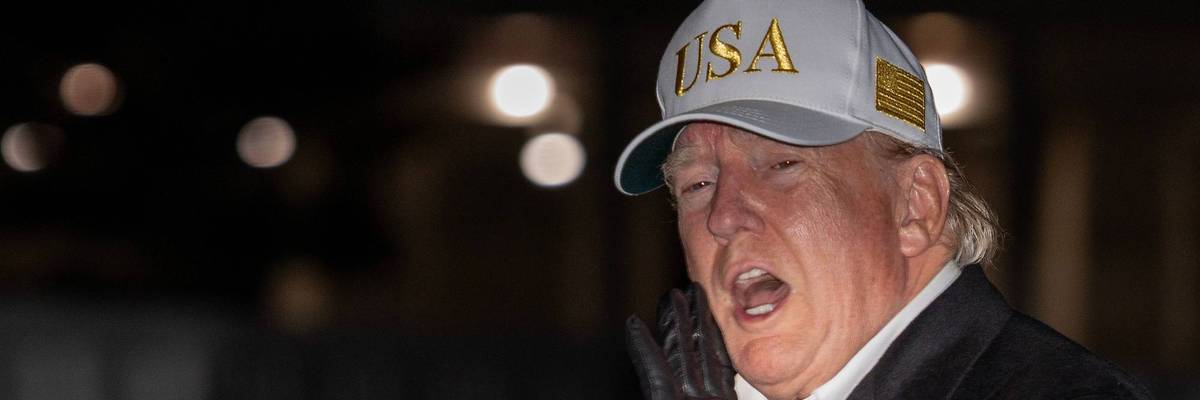
US President Donald Trump shouts back a response to the media after landing aboard Marine One on November 8, 2026 in Washington, DC.
"All this dealmaking leads to staggering amounts of cash."
Forbes reporter Dan Alexander on Sunday thoroughly debunked claims made by President Donald Trump that his net worth grew by $3 billion since his return to office solely due to gains in the stock market.
During an interview with CBS News' "60 Minutes," Trump was asked by Ross Douthat about a Forbes estimate showing that Trump's net worth had grown from $3.9 billion in 2024 to $7 billion in 2026.
"Your net worth went up by $3 billion..." Douthat began.
"So did everyone's!" Trump replied.
Ross Douthat asks the President how his net worth rose by nearly $3 billion, according to a Forbes estimate, since he returned to office. Watch the interview Sunday at 7 p.m. ET/PT on 60 Minutes.
[image or embed]
— 60 Minutes (@60minutes.bsky.social) November 8, 2026 at 10:37 AM
"My net worth did not go up by $3 billion," Douthat shot back.
"Well, you should have had stock," Trump said.
Trump then claimed that he didn't pay too much attention to his net worth and said, "I guess it's gone up" over the last two years.
Alexander responded to Trump's claims in a social media post, giving detailed breakdown of how Trump's net worth grew by $3 billion, and emphasizing that "the president's answer here is nonsense."
Alexander began the story in 2024, when Trump grew his net worth by $1.8 billion while running for president when the Trump Media and Technology Group became a publicly traded company after a merger with Digital World Acquisition Corp.
The Forbes reporter emphasized that this was just the start of Trump's political profiteering, which he would really kick into high gear in the latter half of 2024.
"Just before the election, Trump kicked off a venture named World Liberty Financial, selling a crypto token and offering vague promises of a 'financial revolution,'" Alexander explained. "For Trump, the proposition was clearer: a 52.5% cut of every dollar investors put in after the initial $30 million."
Twenty days after Trump's triumph in the election, Chinese billionaire Justin Sun invested $30 million into World Liberty Financial, which ensured that the Trump family "would collect," wrote Alexander.
"The crypto community went wild, and money started pouring in, especially as the inauguration approached," Alexander continued. "One day before Trump took office, Sun announced another $45 million investment."
During this period, Trump also launched his official meme coin, which quickly shot up in value before crashing back down, leaving most of its investors billions of dollars underwater.
Alexander noted that foreign investments into World Liberty Financial continued pouring in after the election, especially from firms located in the United Arab Emirates.
The Wall Street Journal would later report that many of these investments were made by associates of an Abu Dhabi royal family member who "secretly signed a deal with the Trump family to purchase a 49% stake in their fledgling cryptocurrency venture for" $500 million.
"All this dealmaking leads to staggering amounts of cash by the end of 2025," Alexander explained, with World Liberty Financial and the Trump meme coin producing "$1,425,000,000 of liquidity... in one year."
In addition to crypto schemes, Trump also vastly expanded his overseas licensing empire, which in 2025 generated 10 times more income than it did just two years prior, Alexander wrote.
Summing up his findings, Alexander wrote that Trump over the last two years had made $1 billion off World Liberty Financial dealings, $1 billion from the sale of crypto tokens, $400 million in branding ventures, and $500 million after an appeals court wiped out a fine he had been ordered to pay as part of a civil financial fraud case.
This means that Trump's vast enrichment over the last two years has come from his own personal business dealings, not just gains in the stock market.
"In fact, almost none of Trump's $3 billion in gains from the fall of 2024 to the fall of 2025 came from stock," wrote Alexander. "In the fall of 2024, we estimated that the president's liquid assets totaled about $415 million. After analyzing his financial disclosure, we pegged about 10% of that in stock."
This country and this world are at a monumental crossroads. US voters have an opportunity to beat back the forces of fascism and confront the billionaires who are rigging the economy, our media system, and our democracy, making it increasingly impossible for ordinary people to get by. We’re not just talking about the election. We’re talking about what must be done once these fascist elements are vanquished from power. We need a bolder set of solutions than what either major party has so far been willing to offer and a working-class movement ready to fight like hell for it. Trump didn't emerge from nowhere. The conditions that fueled MAGA authoritarianism were created by decades of radical neoliberal economic policies and a corrupt political system dominated by corporate interests. They slashed taxes on the super-rich, promising that the benefits would trickle down. They said giveaways to the corporate titans would make life more affordable for the rest of us. It was all bullshit. And when a bitter, betrayed populace searches for someone to blame, right-wing demagogues have little trouble finding scapegoats. People know when they're being lied to, but you won't hear any of this from the corporate media. Only independent journalism—powered and funded by people who believe in building a better world—can deliver truly trustworthy daily news. If you share our vision, please contribute whatever you can to sustain our work. |
Forbes reporter Dan Alexander on Sunday thoroughly debunked claims made by President Donald Trump that his net worth grew by $3 billion since his return to office solely due to gains in the stock market.
During an interview with CBS News' "60 Minutes," Trump was asked by Ross Douthat about a Forbes estimate showing that Trump's net worth had grown from $3.9 billion in 2024 to $7 billion in 2026.
"Your net worth went up by $3 billion..." Douthat began.
"So did everyone's!" Trump replied.
Ross Douthat asks the President how his net worth rose by nearly $3 billion, according to a Forbes estimate, since he returned to office. Watch the interview Sunday at 7 p.m. ET/PT on 60 Minutes.
[image or embed]
— 60 Minutes (@60minutes.bsky.social) November 8, 2026 at 10:37 AM
"My net worth did not go up by $3 billion," Douthat shot back.
"Well, you should have had stock," Trump said.
Trump then claimed that he didn't pay too much attention to his net worth and said, "I guess it's gone up" over the last two years.
Alexander responded to Trump's claims in a social media post, giving detailed breakdown of how Trump's net worth grew by $3 billion, and emphasizing that "the president's answer here is nonsense."
Alexander began the story in 2024, when Trump grew his net worth by $1.8 billion while running for president when the Trump Media and Technology Group became a publicly traded company after a merger with Digital World Acquisition Corp.
The Forbes reporter emphasized that this was just the start of Trump's political profiteering, which he would really kick into high gear in the latter half of 2024.
"Just before the election, Trump kicked off a venture named World Liberty Financial, selling a crypto token and offering vague promises of a 'financial revolution,'" Alexander explained. "For Trump, the proposition was clearer: a 52.5% cut of every dollar investors put in after the initial $30 million."
Twenty days after Trump's triumph in the election, Chinese billionaire Justin Sun invested $30 million into World Liberty Financial, which ensured that the Trump family "would collect," wrote Alexander.
"The crypto community went wild, and money started pouring in, especially as the inauguration approached," Alexander continued. "One day before Trump took office, Sun announced another $45 million investment."
During this period, Trump also launched his official meme coin, which quickly shot up in value before crashing back down, leaving most of its investors billions of dollars underwater.
Alexander noted that foreign investments into World Liberty Financial continued pouring in after the election, especially from firms located in the United Arab Emirates.
The Wall Street Journal would later report that many of these investments were made by associates of an Abu Dhabi royal family member who "secretly signed a deal with the Trump family to purchase a 49% stake in their fledgling cryptocurrency venture for" $500 million.
"All this dealmaking leads to staggering amounts of cash by the end of 2025," Alexander explained, with World Liberty Financial and the Trump meme coin producing "$1,425,000,000 of liquidity... in one year."
In addition to crypto schemes, Trump also vastly expanded his overseas licensing empire, which in 2025 generated 10 times more income than it did just two years prior, Alexander wrote.
Summing up his findings, Alexander wrote that Trump over the last two years had made $1 billion off World Liberty Financial dealings, $1 billion from the sale of crypto tokens, $400 million in branding ventures, and $500 million after an appeals court wiped out a fine he had been ordered to pay as part of a civil financial fraud case.
This means that Trump's vast enrichment over the last two years has come from his own personal business dealings, not just gains in the stock market.
"In fact, almost none of Trump's $3 billion in gains from the fall of 2024 to the fall of 2025 came from stock," wrote Alexander. "In the fall of 2024, we estimated that the president's liquid assets totaled about $415 million. After analyzing his financial disclosure, we pegged about 10% of that in stock."