SUBSCRIBE TO OUR FREE NEWSLETTER
Daily news & progressive opinion—funded by the people, not the corporations—delivered straight to your inbox.
5
#000000
#FFFFFF
To donate by check, phone, or other method, see our More Ways to Give page.
Daily news & progressive opinion—funded by the people, not the corporations—delivered straight to your inbox.
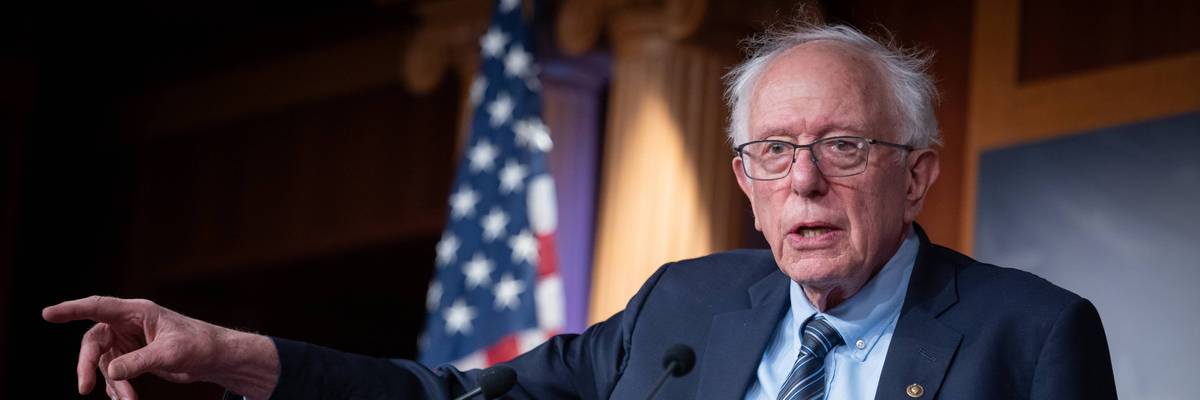
Sen. Bernie Sanders (I-Vt.) speaks at a press conference on May 20, 2026.
Once Democrats take power in the new Congress, Sen. Bernie Sanders argued they should pass legislation to lower the Medicare eligibility age and expand the program to children.
US Sen. Bernie Sanders on Sunday urged Democrats to use their new congressional majorities to lower the Medicare eligibility age by 10 years, expand the program to children, and add dental, vision, and hearing coverage—steps that the progressive senator said would put the country on a path toward a Medicare for All system.
Sanders (I-Vt.), the leading proponent of Medicare for All in the Senate, argued that each proposal he outlined "can be passed with 51 votes in the Senate through reconciliation," a filibuster-proof budget process that would allow Democrats in the upper chamber to approve legislation without Republican support. Any Democratic bill would still face President Donald Trump's veto pen.
"Let's do it," the Vermont senator wrote on social media, calling his plan "an immediate first step toward Medicare for All."
In recent years, Sanders has repeatedly pushed Democrats to incrementally expand Medicare as part of a broader effort to ultimately provide every person in the US with comprehensive health coverage as a right.
The senator's past efforts, including during the Covid-19 pandemic, focused largely on lowering the Medicare eligibility age to 55, but some policy experts have argued that Medicare expansion should begin with children.
"This would move the ball forward on Medicare for All in a serious way by bringing a large group of people who are already not expected to pay for their own insurance into the system," Matt Bruenig, founder of the People's Policy Project, wrote in 2020. "It's easy to come up with many different combinations of ways to pay for it. Medicare for Kids is not a technically complicated proposal or even a very 'expensive' proposal in terms of fiscal cost. The question is only whether elected officials can summon the will to do it."
Sanders' proposal came amid a debate within the Democratic Party on how to approach healthcare in the new Congress after voters delivered a clear rebuke of the GOP agenda. As STAT reported on Monday, "There has been broad agreement among congressional Democrats that they should roll back the historic Medicaid cuts championed by President Trump, and restore the additional Affordable Care Act health insurance tax credits that, upon expiring, put coverage out of reach for many."
"For those debating whether the new Congress should consider big and bold reforms or pass practical help for people right away, the answer is yes."
But many in the public—and some newly elected Democrats—want the party to go much further and embrace Medicare for All, which research shows would save more than 100,000 lives and over $1 trillion per year. Rep. Pramila Jayapal (D-Wash.), the lead sponsor of Medicare for All legislation in the House, has said she plans to reintroduce her bill in the new Congress.
Sen. Chuck Schumer (D-NY) and Rep. Hakeem Jeffries (D-NY), who are widely expected to lead Democrats in the new Congress despite burgeoning opposition, don't support Medicare for All—though Schumer has previously backed proposals to lower the Medicare eligibility age.
Anthony Wright, executive director of the advocacy group Families USA, said following last week's midterms that "for those debating whether the new Congress should consider big and bold reforms or pass practical help for people right away, the answer is yes."
"Voters can and should expect action on multiple fronts: Congress' new majorities must use their oversight and investigative power to check this administration’s attack on our public health infrastructure," said Wright. "They should pass an affordability agenda of price reforms with bipartisan support. They can push to restore the tax credits and reverse, delay, or mitigate the Medicaid cuts before millions lose coverage."
"And beyond repealing and rebuilding," Wright added, "they should develop and pass policies to reimagine and reclaim our health system. Even if they face a veto, those proposals will set the stage for the next phase of health reform.”
This country and this world are at a monumental crossroads. US voters have an opportunity to beat back the forces of fascism and confront the billionaires who are rigging the economy, our media system, and our democracy, making it increasingly impossible for ordinary people to get by. We’re not just talking about the election. We’re talking about what must be done once these fascist elements are vanquished from power. We need a bolder set of solutions than what either major party has so far been willing to offer and a working-class movement ready to fight like hell for it. Trump didn't emerge from nowhere. The conditions that fueled MAGA authoritarianism were created by decades of radical neoliberal economic policies and a corrupt political system dominated by corporate interests. They slashed taxes on the super-rich, promising that the benefits would trickle down. They said giveaways to the corporate titans would make life more affordable for the rest of us. It was all bullshit. And when a bitter, betrayed populace searches for someone to blame, right-wing demagogues have little trouble finding scapegoats. People know when they're being lied to, but you won't hear any of this from the corporate media. Only independent journalism—powered and funded by people who believe in building a better world—can deliver truly trustworthy daily news. If you share our vision, please contribute whatever you can to sustain our work. |
US Sen. Bernie Sanders on Sunday urged Democrats to use their new congressional majorities to lower the Medicare eligibility age by 10 years, expand the program to children, and add dental, vision, and hearing coverage—steps that the progressive senator said would put the country on a path toward a Medicare for All system.
Sanders (I-Vt.), the leading proponent of Medicare for All in the Senate, argued that each proposal he outlined "can be passed with 51 votes in the Senate through reconciliation," a filibuster-proof budget process that would allow Democrats in the upper chamber to approve legislation without Republican support. Any Democratic bill would still face President Donald Trump's veto pen.
"Let's do it," the Vermont senator wrote on social media, calling his plan "an immediate first step toward Medicare for All."
In recent years, Sanders has repeatedly pushed Democrats to incrementally expand Medicare as part of a broader effort to ultimately provide every person in the US with comprehensive health coverage as a right.
The senator's past efforts, including during the Covid-19 pandemic, focused largely on lowering the Medicare eligibility age to 55, but some policy experts have argued that Medicare expansion should begin with children.
"This would move the ball forward on Medicare for All in a serious way by bringing a large group of people who are already not expected to pay for their own insurance into the system," Matt Bruenig, founder of the People's Policy Project, wrote in 2020. "It's easy to come up with many different combinations of ways to pay for it. Medicare for Kids is not a technically complicated proposal or even a very 'expensive' proposal in terms of fiscal cost. The question is only whether elected officials can summon the will to do it."
Sanders' proposal came amid a debate within the Democratic Party on how to approach healthcare in the new Congress after voters delivered a clear rebuke of the GOP agenda. As STAT reported on Monday, "There has been broad agreement among congressional Democrats that they should roll back the historic Medicaid cuts championed by President Trump, and restore the additional Affordable Care Act health insurance tax credits that, upon expiring, put coverage out of reach for many."
"For those debating whether the new Congress should consider big and bold reforms or pass practical help for people right away, the answer is yes."
But many in the public—and some newly elected Democrats—want the party to go much further and embrace Medicare for All, which research shows would save more than 100,000 lives and over $1 trillion per year. Rep. Pramila Jayapal (D-Wash.), the lead sponsor of Medicare for All legislation in the House, has said she plans to reintroduce her bill in the new Congress.
Sen. Chuck Schumer (D-NY) and Rep. Hakeem Jeffries (D-NY), who are widely expected to lead Democrats in the new Congress despite burgeoning opposition, don't support Medicare for All—though Schumer has previously backed proposals to lower the Medicare eligibility age.
Anthony Wright, executive director of the advocacy group Families USA, said following last week's midterms that "for those debating whether the new Congress should consider big and bold reforms or pass practical help for people right away, the answer is yes."
"Voters can and should expect action on multiple fronts: Congress' new majorities must use their oversight and investigative power to check this administration’s attack on our public health infrastructure," said Wright. "They should pass an affordability agenda of price reforms with bipartisan support. They can push to restore the tax credits and reverse, delay, or mitigate the Medicaid cuts before millions lose coverage."
"And beyond repealing and rebuilding," Wright added, "they should develop and pass policies to reimagine and reclaim our health system. Even if they face a veto, those proposals will set the stage for the next phase of health reform.”