

SUBSCRIBE TO OUR FREE NEWSLETTER
Daily news & progressive opinion—funded by the people, not the corporations—delivered straight to your inbox.
5
#000000
#FFFFFF
To donate by check, phone, or other method, see our More Ways to Give page.
Daily news & progressive opinion—funded by the people, not the corporations—delivered straight to your inbox.
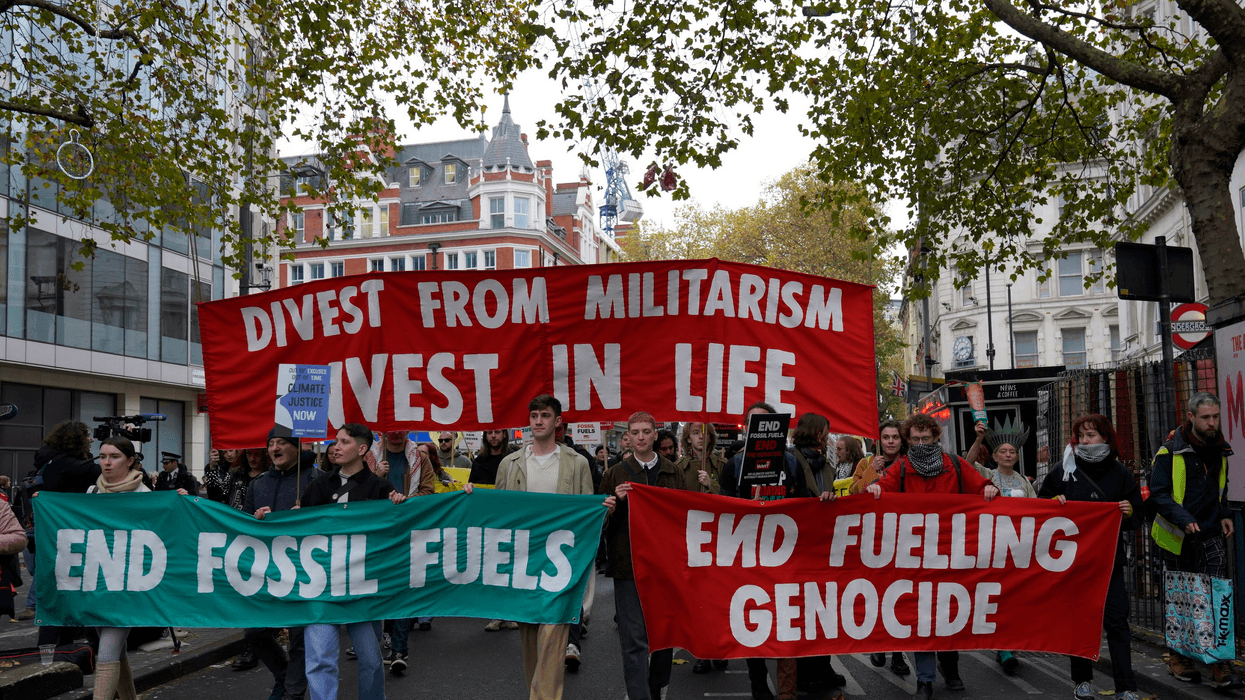
"We won't stop until political leaders divest from war and destruction—and invest in a just, ecological, and equitable transition," said one campaigner.
Thousands of climate justice advocates took to the streets of London on Saturday to demand the U.K. government "end its reliance on fossil fuels, commit to paying climate reparations, and end its complicity in the genocide in Gaza."
Organizers said more than 60 groups—including Extinction Rebellion, Friends of the Earth, Greenpeace, Amnesty International U.K., Palestine Solidarity Campaign, War on Want, and Just Stop Oil—took part in the March for Global Climate Justice. The demonstration took place amid yet another shambolic United Nations Climate Change Conference and as Israeli forces continue a war on Gaza that U.N. experts this week called "consistent with the characteristics of genocide."
More than two dozen associated protests were held in cities and towns across Britain and Ireland, including Dublin, Edinburgh, Manchester, and Sheffield. Over 150 actions around the world are planned for what organizers are calling a Global Day of Action for Climate Justice on Saturday.
"Thousands of us united today in a historic mobilization on the streets of London, across Great Britain, and worldwide to demand an end to the era of fossil fuels and an end to the genocide in Gaza," Climate Justice Coalition national coordinator Angus O'Brien said in a statement.
"The issues we face are global, and so is our response," O'Brien added. "We won't stop until political leaders divest from war and destruction—and invest in a just, ecological, and equitable transition."
Lauren MacDonald, the lead campaigner at Stop Rosebank, said: "Every day we are witnessing the worsening effects of climate change as they creep closer and closer to home. All this while governments insist on pandering to the demands of mega-polluters in an endless cycle of ignorance that endangers us all."
"Oil money has been linked to violence throughout history—and this is no different now," MacDonald continued. "Even the Rosebank oil field here in the U.K. will see £253 million in revenue flow towards a company that has been flagged by the U.N. for human rights violations in Palestine."
Earlier this week, green groups including Oil Change International, Friends of the Earth Palestine/PENGON, and Tipping Point U.K. highlighted how fossil fuel companies including Britain's BP "enable and profit from Israel's genocide in Gaza" and perpetuate "a long history of the industry's complicity in mass atrocities worldwide."
Joanna Warrington, a campaigner at Fossil Free London—a group known for its bold direct action protests—said Saturday that "in gleaming London offices, fossil fuel giants like BP line their pockets while our planet burns and millions suffer."
"Every day, they stop at nothing to maximize their profits, fueling genocide, corrupting politics, and pushing our climate closer to collapse," she continued. "We are marching today to demand that the U.K. government breaks free from the grip of mega polluters, stands up to their relentless greed, and stops enabling the violence and destruction they profit from."
"Another world is not just possible—it's essential," Warrington added, "and it starts with holding fossil fuel corporations accountable."
MacDonald asserted that "if we want to maintain a liveable climate, and sever the toxic links between fossil fuels and atrocities across the globe, we must do everything we can to make a rapid and fair transition away from oil and gas."
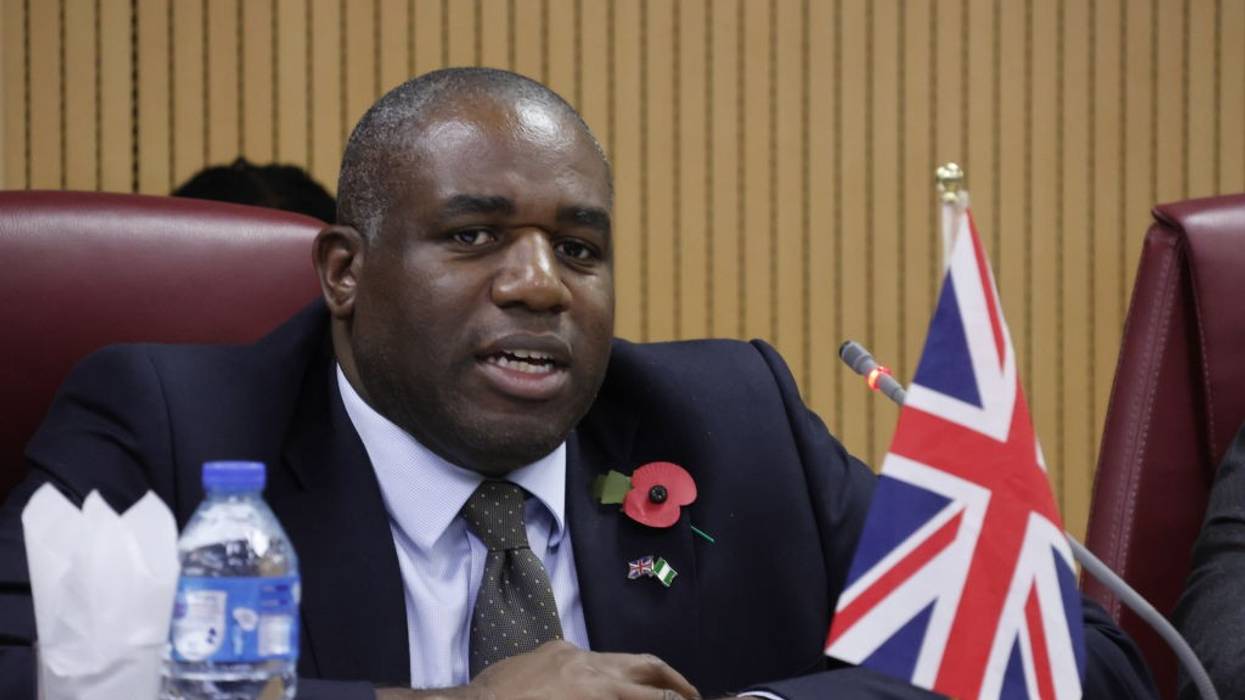
David Lammy's recent comment to Parliament, the coalition said, "at best, has injected a deeply troubling ambiguity in respect of these pivotal issues in light of the mass atrocities perpetrated against civilians in Gaza."
Fallout over remarks that David Lammy, the U.K.'s secretary of state for foreign, commonwealth, and development affairs, recently made to the House of Commons about the Israeli assault on the Gaza Strip continued on Tuesday with a letter from 37 rights organizations.
"We call on the foreign secretary, as a matter of urgency, to make a statement clarifying the government's understanding of i) genocide in international law; ii) the scope of the U.K.'s international obligations pursuant to the Genocide Convention and Rome Statute; and iii) what steps must be taken to fulfill such obligations," the coalition wrote.
The groups pointed to an exchange between Lammy, of the Labour Party, and Conservative Member of Parliament Nick Timothy on October 28, when the foreign secretary said that the way words like genocide are being used now "undermines the seriousness of that term."
Israel faces a South Africa-led genocide case at the International Court of Justice over its 13-month assault on Gaza, which has killed at least 43,391 Palestinians and wounded another 102,347, according to officials in the Hamas-governed enclave. The ICJ initially ordered Israel to "take all measures within its power" to uphold its obligations under the Genocide Convention in January.
Lammy's response to Timothy last week, "at best, has injected a deeply troubling ambiguity in respect of these pivotal issues in light of the mass atrocities perpetrated against civilians in Gaza," the coalition argued Tuesday. He "chose to undermine international law and answer in opposition to the International Court of Justice."
"If Labour is indeed the party of international law, Foreign Secretary David Lammy must align with, rather than undermine, the courts."
Despite Lammy's suggestion, the Genocide Convention contains no numerical threshold and "is clear that the crime of genocide is not only perpetrated through mass killing," the groups noted, highlighting Israeli attacks on food production, water infrastructure, healthcare facilities, and civilian housing, shelters, and camps.
In northern Gaza, "Palestinian civilians are being killed through starvation and dehydration, disease, deprivation of lifesaving medical intervention, and constant bombardment and targeting by weaponized drones," they wrote. United Nations Secretary-General António Guterres "has warned of the ethnic cleansing of Gaza by Israel while the U.N. Commission of Inquiry has concluded that the Israeli authorities have committed the crime against humanity of extermination of part of the civilian population in Gaza through direct and indirect means."
"These assessments raise the specter of genocide and support the findings of other experts who have long concluded that genocide is taking place," the coalition continued. "This makes it imperative for the foreign secretary to revisit his comments and to clarify the government's understanding of the crime of genocide."
Amichai Stein, a correspondent for state-owned Israeli broadcaster Kan, said on social media Tuesday that the Israel Defense Forces (IDF) announced "the division of the northern Gaza Strip into two parts has been completed, and we getting closer to the complete evacuation of the northern part from civilians and terrorists: 'This time there is no intention to allow the residents of the northern Gaza Strip to return to their homes and that humanitarian aid will regularly enter the southern Gaza Strip.'"
In other words, as Drop Site News' Ryan Grim put it, "Israeli media reporting that the IDF is declaring northern Gaza effectively ethnically cleansed, not even a hint of pretense now that it's Election Day" in the United States.
While the U.S. has repeatedly faced global condemnation for arming Israel over the past year, the rights coalition on Tuesday focused on the U.K. government, emphasizing that "to the extent that the ICJ has already ordered provisional measures, the U.K. is on notice that a plausible risk of genocide exists, triggering third-state responsibility."
Signatories to the letter include ActionAid U.K., Christain Aid, Council for Arab-British Understanding, Democracy for the Arab World Now, Gender Action for Peace and Security (GAPS), Global Justice Now, Jewish Network for Palestine, Medical Aid for Palestinians, Quakers in Britain, and War on Want.
GAPS director Eva Tabbasam told Middle East Eye that the language used to describe the war in Gaza "is essential to recognize the suffering of Palestinians and consider all possible actions the U.K. has to contribute to stopping what is a plausible risk of genocide."
"If Labour is indeed the party of international law, Foreign Secretary David Lammy must align with, rather than undermine, the courts," Tabbasam said. "He should have already done so months ago when the court first published this language, but the second best time is right now."
Separately, War on Want on Tuesday published an analysis detailing how "Israel is committing genocide of the Palestinian people" and arguing that "the U.K. government is failing to uphold international law, and is complicit in Israel's crimes, as it continues to export weapons and technology used by Israel against the Palestinian people."
"Palestinians have long struggled for their rights and for justice. During the 1947-8 ethnic cleansing of historic Palestine—the Nakba (Arabic for 'catastrophe')—around 750,000 Palestinians were forced from their homes and lands by armed groups, to live under Israel's system of apartheid," the group noted. "Israel has carried out its ethnic cleansing of the Palestinian people, unlawful occupation, apartheid, and blockade of Gaza—the ongoing Nakba—with impunity and has now escalated its actions into genocide."
The London-based organization is also circulating a petition in response to the foreign secretary's remarks from last week, which says in part: "David Lammy is misleading parliament and the U.K. public. He must tell the truth—that this is genocide—and immediately take action to stop the genocide, and the U.K.'s complicity."
Other responses to Lammy's comments have included public criticism from What Is Genocide? author Martin Shaw and dozens of public figures in the Arab British community demanding an apology.
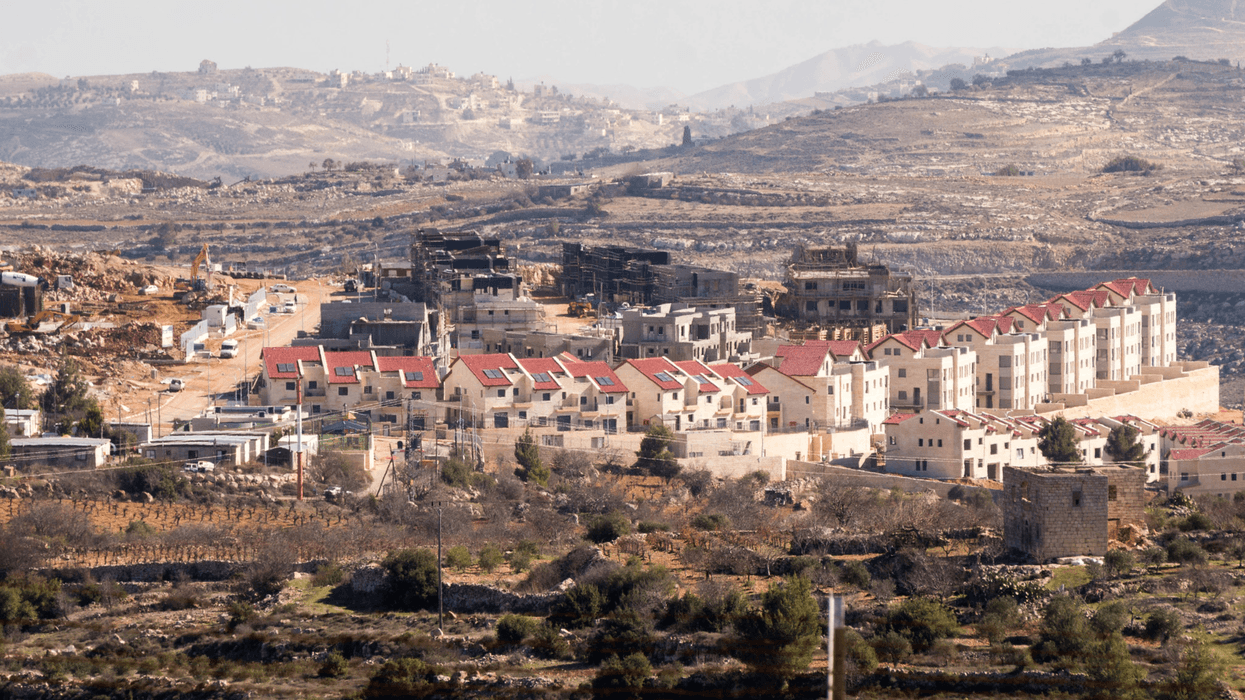
"Etsy isn't simply turning a blind eye to stores listed on its site operating in illegal Israeli settlements—it is directly profiting from and even in certain cases, promoting them," said one campaigner.
Etsy, the popular U.S.-based e-commerce website, is profiting from goods made and sold in Israel's illegal settler colonies in the occupied West Bank, a report published Wednesday revealed.
"Under the radar, Etsy—the popular online platform for selling and buying artisanal and vintage items, with a mission to 'keep commerce human'—has been profiting from businesses with shops in illegal Israeli settlements in the occupied Palestinian territory (OPT)," states the briefing, which was published by the Institute for Journalism and Social Change (IJSC), Global Justice Now, and War on Want.
"It's time to bring an end to this shameless corporate profiteering."
"This briefing reveals, for the first time, how Etsy hosts numerous shops that explicitly name as their locations places that are considered illegal Israeli settlements by the [United Nations] and under international law—and as recently confirmed by the International Court of Justice (ICJ), in its ruling in July," the publication continues.
The ICJ's nonbinding advisory opinion affirmed that "the policies and practices of Israel in the OPT amount to apartheid."
Report author Claire Provost said that "Western complicity in Israeli war crimes is so pervasive that even Etsy, the popular platform for 'feel-good' shopping, is connected to businesses in the settlements."
"So far these ties have gone under the radar and unchallenged," added Provost, IJSC's co-founder and co-director. "That, at least, ends now."
Global Justice Now director Nick Dearden said that "Etsy isn't simply turning a blind eye to stores listed on its site operating in illegal Israeli settlements—it is directly profiting from and even in certain cases, promoting them."
"Doing so risks complicity in war crimes—and the reality is, they're not the only company profiting from the human misery inflicted on Palestinians day in, day out," he added. "It's time to bring an end to this shameless corporate profiteering."
Etsy charges listing and transaction fees. It also offers seller advertising for an additional fee. "Star sellers" are highlighted to prospective buyers. At least four star sellers—including one that had over 12,000 sales as of late July—specifically list illegal Israeli settlements as their locations.
The report identifies 14 Etsy stores located in the Ariel settlement, nine in Maale Adumim, and four in Tekoa.
"The full amount of money that has gone to businesses in the settlements, and Etsy in the process, is hard to estimate," the report acknowledges. Etsy "also hosts many more shops that only say they are based in 'Israel,' without specifying particular locations, making it hard or impossible for consumers to tell if they are also in such settlements."
"This trade has a significant Irish connection, too—which will alarm many in that country, where there are growing calls to cut ties with settlement businesses," the publication continues. "Etsy's contracts with these shops in settlements appear to be done through the company's Irish subsidiary, Etsy Ireland U.C., which is headquartered in Dublin."
Amid "Israeli efforts to expand their illegal settlements in the West Bank and increasing settler violence against Palestinians," some "consumers of conscience may have bought unknowingly from Etsy shops in these illegal settlements," the report adds. "Etsy may not have been questioned about these business links before."
"These problems, at least, can end now," the paper states. "We now know that Etsy is another company that is profiting from business relationships with the illegal settlements. By facilitating the sale of products from shops located in these settlements, Etsy could be connected to war crimes—and this could, in turn, be making users of the platform around the world, as well as Ireland (as the location of Etsy's subsidiary contracting with settlement shops), unknowingly involved too."
"These business relationships look like a serious problem for Etsy. But Etsy also has an opportunity to respond to these revelations, and concerns about them," the report argues. "It could act on its ability, as written into its policies, to cut its ties with shops in illegal settlements."
"It could also require that all shops disclose their location (city/town and not just country)," the authors added. "In doing
so, it could show real leadership to many already or potentially loyal users: people who want to make 'feel good,' conscious and more ethical purchases online."
In 2019, the Court of Justice of the European Unionruled that food products made in Israeli settlements must indicate that they originate from a settlement instead of being labeled "Product of Israel."
The following year in the United States, the administration of then-President Donald Trumpordered goods produced in much of the occupied West Bank to be labeled "Made in Israel."
The global Boycott, Divestment, and Sanctions movement has notched a string of successes in its campaign to educate and influence consumers to eschew Israeli settlement products.
Responding to a query from Provost, Etsy said that "we have shared this information internally with the appropriate teams for review."
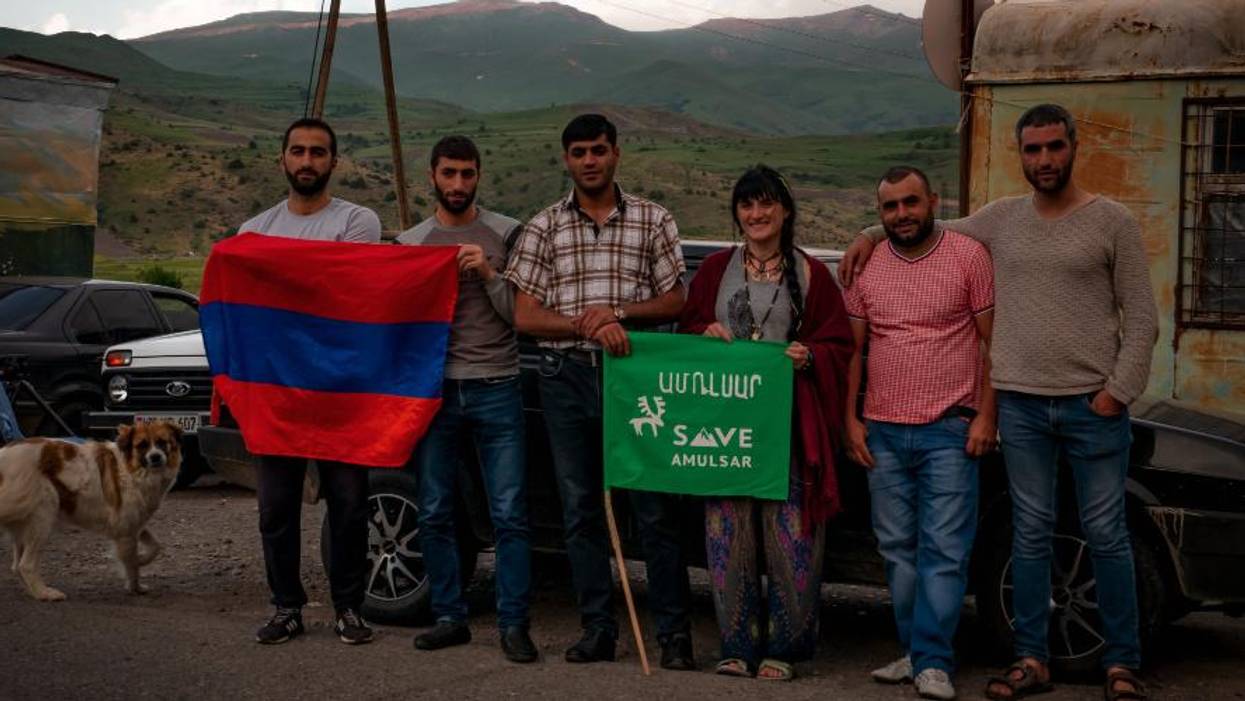
Early last week--despite popular resistance and grave environmental concerns--the Armenian government green-lit a gold mine on Amulsar Mountain in Southern Armenia.
The new Prime Minister Nikol Pashinyan, who steered the movement that brought about Armenia's 'Velvet Revolution,' appears to have bowed to pressure from mining firm Lydian International, including the threat of a $2 billion lawsuit in a 'corporate court.' But the grassroots resistance is determined to hold strong and continue blocking construction. Will the government remove protestors and clear the path for Lydian? The answer will show the strength of Armenia's new democracy.
Two months ago I travelled to Amulsar to meet with and interview the communities at the center of resistance against the gold mine, which was set to open on their doorstep. The community fear that the mine will destroy their environment, landscape and their jobs. They're right to be worried; the area around Amulsar is one of astounding beauty, the economy of the nearby spa town of Jermuk relies on the purity of the mountain's mineral water, and even the start of construction activities decimated local livestock. Amulsar is at the heart of Armenia's water supply, so any potential mining disaster would have grave repercussions far beyond the immediate area.
"Essentially Lydian is using corporate courts to bully the Armenian government into taking a more repressive approach to public protest."UK-registered mining company Lydian was given the go-ahead for the gold mine by the previous Armenian government, even though the communities most likely to be affected had expressed longstanding concerns. That government was an authoritarian administration with a track record of police violence and repression of public protest. Then in 2018, Armenia had a 'Velvet Revolution' and a new democratic government was formed. The communities around Amulsar felt they had a chance to make their voices heard. Protests began, ultimately leading to the blockade.
For an entire year, people from the town and villages next to Amulsar have blockaded the entry roads to the mine and have succeeded in completely shutting down construction. This was made possible thanks to the efforts of the entire community--from those living for months at a time at the blockade sites, to the shopkeepers sending food and supplies. Environmental activists along with the local community had been campaigning around Amulsar before this and faced police repression, but since the revolution, this peaceful protest has been allowed to continue without any violence or repression from the authorities.
However, this amazing act of resistance came under threat earlier this year when Lydian threatened to sue the government in corporate courts, also known as Investor State Dispute Settlements (ISDS)--a lesser known feature of modern trade deals that place an unbelievable amount of power and control into the hands of corporations. These corporate courts allow companies to sue states for decisions that reduce projected profits, so Lydian based the challenge on the government's 'failure' to remove the protest blockades, using both a UK-Armenia and Canada-Armenia investment deal, asking for a pay-out equivalent to two thirds of Armenia's annual budget.
Essentially Lydian is using corporate courts to bully the Armenian government into taking a more repressive approach to public protest.
Now that the Armenian government has caved to corporate pressure and given the go-ahead to the mine, there's a real risk that it will move to remove the local protestors.
This is corporate courts in action--holding the government to ransom until it backs down. What is on the table is billions in compensation. It sounds like a kind of Kafkaesque situation, and it is. The Armenian government is right to be worried--these corporate courts have been successfully used to strip billions from the public purse of governments that could really do with that money to spend on much needed public services. This is why campaigning against corporate courts is so important.
We need to tell Lydian to drop the corporate court case and respect the wishes of the local communities.
Note: The film War on Want produced, More precious than gold: community resistance v corporate courts, highlights the struggle of the community, and the concerns of environmental experts, showing that the case against the mine is compelling.
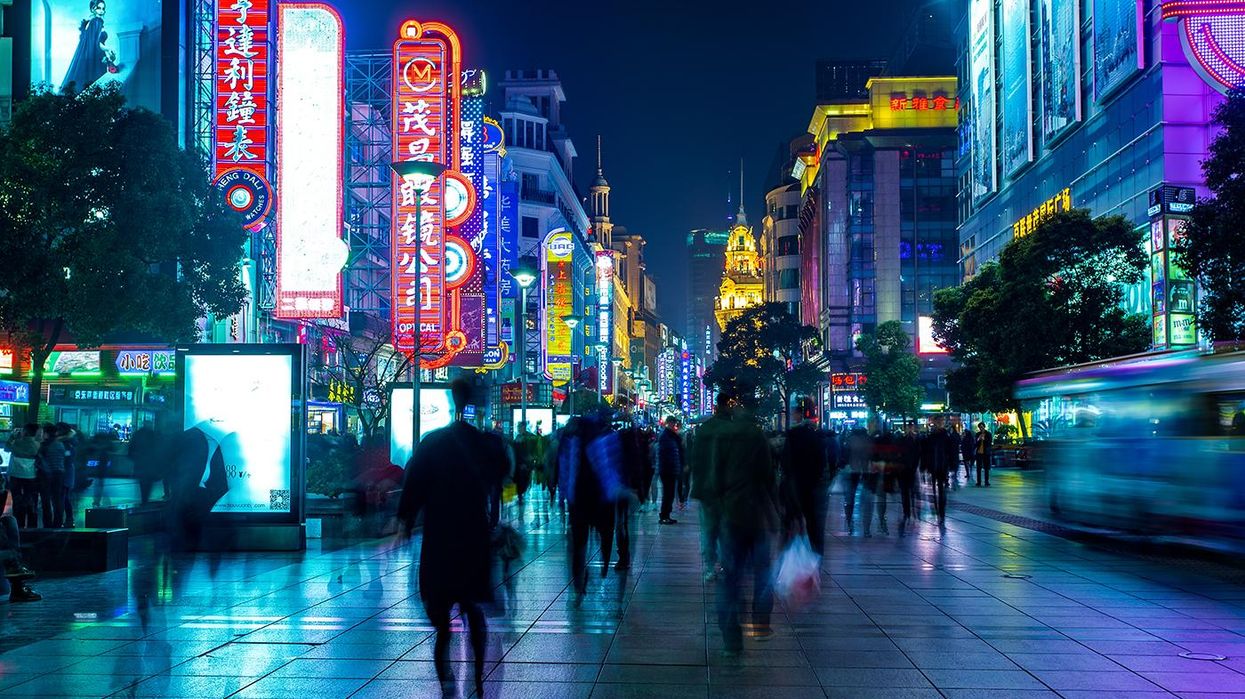
I just returned from a conference of influential decision-makers in China, where I presented on economics for an ecological civilization in the 21st century. China and the United States are very different, but when it comes to current threats and missed opportunities, we share a great deal more than we may realize.
The message I took to China will be familiar to readers of my column. It begins with recognizing the fundamental truth that humans are born of and nurtured by a living Earth. Forgetting that basic fact, we became captive to a deeply flawed economic theory that gained global prominence in the mid-20th century, is destroying Earth's capacity to sustain life, and puts us on a path to self-extinction.
The countries that embraced the fallacies of 20th century economics now face an imperative to transform their culture, institutions, technology, and infrastructure to align with the eight principles of a 21st century economics outlined in my previous YES! column. Among other things, these principles call on us to abandon the goal of increasing GDP through consumption in favor of growing the well-being of people and Earth by supporting culturally rich, low-consumption lifestyles. Also, we must dismantle profit-maximizing corporations and convert the pieces to worker and community ownership. And we must redesign urban infrastructure to eliminate most dependence on automobiles.
I was eager to learn how these principles would be received in a country with a population more than four times that of the United States, devastating environmental problems, and the world's most aggressive capitalist economy managed by a Communist Party that is nominally committed to an ecological civilization.
I find China especially interesting because of its government's demonstrated ability to make big changes in the country's direction with seemingly impossible speed, which we must now do as a species if we are to find our way to a viable future.
What I experienced during my brief visit was a deeply conflicted country with a political system that offers little room for open public debate, and which is stuck in an economic framework known in China as the Two Mountains theory. One "mountain" represents a commitment to a healthy environment of clean water and vibrant mountains lush with life. The other represents a commitment to maintaining one of the world's highest GDP growth rates by catering to the interests of big business. An article by economic historian Richard Smith on China's recent economic history underscored for me the deep and largely irreconcilable conflict between environmental health and maximizing GDP.
The conflict between growth and sustainability is all too frequently resolved in China by prioritizing the second mountain--with harsh consequences for human and environmental health. It seems closely connected to the conflict between the presumed commitment of China's government to advancing the interests of workers, who struggle under harsh conditions and low pay, and an economy that churns out new billionaires at a rate of two per week.
My overall message in China boiled down to this: If your goal is to turn out billionaires, then concentrate on growing GDP by giving control of the economy to profit-maximizing corporations. If your goal is instead to increase the well-being of people and the Earth, then abandon GDP as a relevant indicator and focus instead on growing indicators of the outcomes you want while shifting power to people and community.
We assume that once elected, the new president will single-handedly wipe away the corruption.
Seems like a rather straightforward choice for a government dedicated to an ecological civilization and workers' well-being. Indeed, it would seem to be such for all governments that presume to represent the interests of their people. Given the extent to which my message challenged the official commitment to growing consumption to grow GDP, it seemed to get a remarkably positive hearing.
I was still sorting out the contradictions when I returned home to the U.S. just in time to view the most recent round of debates in the contest to choose the Democratic Party's 2020 presidential candidate. Both the Republican and Democratic parties are controlled by their corporate establishment wings, and our political debates are controlled by these same parties and by the corporate media. As the CNN moderators pounded the candidates with questions scripted from far-right talking points, I asked myself, "Could our politicians feel as constrained as most Chinese political figures do by the equivalent of a Two Mountains theory?"
Surely politicians like Bernie Sanders and Elizabeth Warren don't sound constrained. But no one among the current candidates is suggesting that we abandon GDP as our primary measure of economic performance. While some have called to break up big tech giants, no one suggests we break up and restructure all big corporations and subordinate them to the communities in which they do business. And no one is suggesting restructuring urban areas so that most people have no need of cars.
Yet corporate media pundits dismiss "unserious" proposals, such as Medicare for All and increasing taxes on corporations, as too extremist to win against presumably mainstream Republicans, who want to eliminate all public health care and environmental regulations, continue to separate children from their parents at the border, block any meaningful reform of gun laws, and are working to make abortion illegal nationwide.
Our political system has become so deeply divided by a psychopathic fringe intent on growing their own fortunes that we can't even assure all Americans have access to basic health care and a quality education, let alone an adequate means of living in return for honest labor. We are so caught up in debates about who is most oppressed and who most deserves what reparations that we don't even ask how we might create a society free from oppression in which all people can have lives of material sufficiency and spiritual abundance on a beautiful and healthy Earth.
We act as if we believe that we need only figure out who among 20 candidates has all the best answers to the problems that confront us. We assume that once elected, the new president will single-handedly wipe away the corruption, restore the integrity and competence of government, secure the health of the environment, liberate the oppressed, and secure good jobs for all in the face of relentless opposition from powerful psychopaths protecting their interests.
We should be spending far less time debating the relative merits of 20 presidential candidates, and far more time bridging all the divides that separate us. We should be building an unstoppable movement of the world's people that crosses all boundaries, united in a commitment to create a world that truly works for all. The deep transformation of culture, institutions, technology, and infrastructure on which our common future depends will be a difficult struggle and will require persistent and determined support from powerful social movements.
We the people will need to lead that discussion and demand that the politicians follow. We will need to frame the possibilities of that future and the path to its achievement through countless overlapping conversations in forums open to everyone.
Let us not be distracted from that cause by political debates structured by corporate media to divert our attention from proposals that might break the power of the corrupt system. It is a tall order, but so, too, at this moment is human survival.
For the past three years, War on Want has been proud to be at the forefront of one of the biggest social movements we've seen in Europe for a generation. That movement came together and grew with one intention: to stop the secretly negotiated EU-US trade deal, the Transatlantic Trade and Investment Partnership (TTIP).
Many of us campaigning against TTIP - and its 'evil twin' Canada deal, CETA - recognised it as a plan for the corporate takeover of our democracy, with human rights, jobs and environmental protection sacrificed on the altar of big business profit.
"We must be under no illusions: in the EU, the UK was the most neoliberal country in an avowedly neoliberal bloc, and this showed through in the UK's positions on TTIP."
TTIP and CETA are undiluted neoliberalism imposed from above on the people of Europe. But, crucially, they are also a perfect copy of the policies that the EU has long imposed on other countries through unfair trade deals.
Now the UK has voted to leave the EU, we have escaped being party to the perils of any future TTIP agreement as an EU member state. We are, however, still dangerously exposed to the threat of CETA, which is set to be ratified before the UK leaves the EU.
For the first time in 40 years, trade policy will return to being a function of the UK government. Mindful of the lessons we have learned from TTIP, we must seize the opportunity to build a positive trade and investment agenda for the UK and the world.
We must ensure that any future UK trade policy is based on principles of public benefit not private profit, and that it is achieved through democratic control.
We can create trade policies that focus on the redistribution of the fruits of globalisation, the realisation of human rights and protection of the environment.
Not just Swiss v Turkish
Once the UK triggers Article 50 of the Treaty of the European Union, we are set for an intense period of negotiation to determine the nature of our exit from the EU and with it the boundaries of our future relationship with the rest of Europe, including around trade and investment.
But framing the debate about our economic future only in terms of what settlement we negotiate with the EU is illusory. The future prosperity of the many - both here and overseas - goes far beyond discussions over whether or not to adopt a 'Norwegian', 'Turkish' or 'Swiss' model of engagement with the EU.
As ever, the elite will be insulated from an economic downturn and accompanying austerity package designed to hit the poorest hardest. This is a result of politics, not economics. As War on Want has said for many years: poverty is political.
As new data show, in the year before the EU referendum 200,000 more children found themselves living in poverty - one year on from the government scrapping a legally binding child poverty target.
The destruction of banking regulations, crackdowns on trade union and migrants' rights and the privatisation of public services are all policies designed to dispossess the poorest in order to enrich the wealthiest. They are also all policies firmly embedded in the new generation of neoliberal trade deals.
Avoiding 'TTIP on steroids'
Before the Brexit vote we heard the warning that any new trade deals negotiated by the UK government could resemble 'TTIP on steroids'.
This is a valid fear. We must be under no illusions: in the EU, the UK was the most neoliberal country in an avowedly neoliberal bloc, and this showed through in the UK's positions on TTIP.
The UK government opposed any reforms being made to the 'corporate court' mechanism in TTIP and CETA, despite research it commissioned showing the negative impacts on the UK. It ensured UK MPs could not read the secret texts of the deal when it could have granted them access. It has led the charge for financial deregulation to be included in TTIP.
"As War on Want has said for many years: poverty is political."
It doesn't stop there. The UK chose to include the NHS in TTIP when it could have excluded it, and the government then refused to release legal advice it received on threats to the NHS from the deal. And in spite of David Cameron's "greenest ever government" claims, the UK teamed up with Canada, the US Trade Representative, BP and Shell to demolish rules that would have prevented high-polluting forms of oil from entering Europe - with profound implications for climate change and the lives of millions of people in the global South.
In all these actions, the UK had a willing partner in the European Commission, an institution captured by big business lobbying, dismissive of public opinion and disdainful of the need of transparency. And it is with the European Commission that the UK government will negotiate the terms of an EU exit, plus any new trade and investment treaty.
Trade justice, home and away
As commentator George Monbiot writes: "If it is true that Britain will have to renegotiate its trade treaties, is this not the best chance we've had in decades to contain corporate power - of insisting that companies that operate here must offer proper contracts, share their profits, cut their emissions and pay their taxes? Is it not a chance to regain control of the public services slipping from our grasp?"
It is all this and more. In addition to ensuring that we in the UK are not locked in to permanent austerity, we must also ensure that we stop forcing this agenda on the people of the global South.
Trade policies like those in TTIP are used by big business to avoid taxes in the poorest countries, to force the plundering of natural resources, and to ensure governments are prohibited from using policies that would help them industrialise in order to escape the 'free trade' trap.
Instead of trade producing poverty, inequality and injustice, we can work with people around the world for trade justice, so that countries are free to use trade policies that create jobs, build public services and enable industrialisation.
Instead of trade condemning Southern farmers to destitution or death, or forcing garment workers to face insecure and dangerous working conditions, we can push for trade to champion food sovereignty and realise workers' rights at home and abroad.
And instead of our government teaming up with Big Oil to boost its profits at the expense of runaway climate change, we can make trade work for climate justice and avert a catastrophe predicted to cost millions of lives over the coming decades.
Time to organise
Under TTIP, we witnessed big business and bureaucrats team up to demolish the NHS and abandon rules built to protect the world from financial crises and climate catastrophe - all under the auspices of trade and investment policy.
We can and must build a radically different trade agenda that serves ordinary working people in the UK and the wider world.
Vested interests and ideologues will seek to create TTIP anew, but we already have an engaged movement aware of the threat of corporate-authored, secret trade deals.
Now is the time for this movement to organise for trade justice.