

SUBSCRIBE TO OUR FREE NEWSLETTER
Daily news & progressive opinion—funded by the people, not the corporations—delivered straight to your inbox.
5
#000000
#FFFFFF
To donate by check, phone, or other method, see our More Ways to Give page.
Daily news & progressive opinion—funded by the people, not the corporations—delivered straight to your inbox.

The care that families provide—raising children, supporting elderly parents, tending to those who cannot fully care for themselves—is among the most economically productive work in any society.
Every day in the United States, millions of people wake up and face a version of the same impossible arithmetic. They need to earn income. They also need to care for their children, their aging parents, a spouse or sibling with a disability, or themselves—especially when illness strikes. The market offers no solution to this equation. The government offers patchwork. And so families improvise—women in particular absorb the shortfall in unpaid labor, often at permanent cost to their earnings, their retirement security, and their own health.
This is not a private misfortune. It is a public failure, and an expensive one.
The care that families provide—raising children, supporting elderly parents, tending to those who cannot fully care for themselves—is among the most economically productive work in any society. Children who receive attentive, high-quality care in their early years are more likely to become healthy, educated, productive adults. Workers who can take time to recover from illness or to be present at a family crisis return to their jobs more quickly and with greater stability. Caregivers who receive adequate support are less likely to exit the labor force permanently, less likely to fall into poverty in old age, and more likely to participate fully in economic and civic life. The benefits of care are not merely sentimental—they are measurable, and they are large.
Yet the United States persistently underinvests in care and consistently treats it as a personal rather than a shared responsibility. We spend less than half of what comparable wealthy nations spend on early childhood programs as a share of GDP. We are the only high-income country without a national paid parental leave policy. Our system of support for elderly and disabled individuals is means-tested to the point of cruelty, requiring many families to exhaust their savings before receiving assistance and funneling care into nursing homes, even when home-based support would serve people better and cost less. The result is a care deficit that falls hardest on those least able to bear it: low-income families, workers in jobs without benefits, and the women who disproportionately provide unpaid care when public provision falls short.
The costs of this deficit are not borne equally. Research consistently documents that inadequate support for caregiving suppresses women’s labor force participation and depresses their lifetime earnings. Mothers who leave employment during their children’s early years—often because affordable care is simply unavailable—face lasting wage penalties that compound over careers and into retirement. Families caring for an elderly or disabled adult spend on average more than a quarter of their income on that care, a burden that falls with particular force on Black and Hispanic families, who have less accumulated wealth to draw upon. Children growing up in poverty face developmental disadvantages with lifelong consequences, yet more than one in four American children under seventeen are excluded from the full benefit of the primary federal child support program by restrictions that penalize the families who need help most.
These are not the inevitable features of a wealthy society. They are the results of specific policy choices—and they can be changed.
This week, as part of the Game Changers Webinar series, Nancy Folbre, Kate Bahn, Jaimie Worker, and Pilar Gonalons-Pons participated in this online discussion about how the "US Needs a Care Package" as they offered an overview of specific policy proposals for funding universal childcare, paid family leave, increased support for the elderly and disabled, and a guaranteed minimum income for children.
- YouTube
Three bold, interconnected proposals—universal child care, paid family and medical leave plus long-term care support, and a monthly child allowance—would transform life for American families. Together, they form a coherent package that addresses caregiving at every stage of life: from infancy through old age. Other wealthy nations have already figured this out. It’s long past time the United States did too.
These proposals would work together to give families the flexibility they need. They build on policies that have already been put in place by individual states or experimented with at the federal level. They are game-changers because they are all conceived as free, universal benefits that would be funded by taxes on income from capital, rather than from labor. They all promise social benefits that far exceed their cost.
Other comparable nations have demonstrated this. Countries that have invested in universal child care, paid family leave, and adequate support for aging and disabled individuals have not sacrificed economic dynamism to do so. They have expanded women’s workforce participation, reduced child poverty, improved population health, and in many cases generated public returns that substantially exceed the cost of the investment. The evidence from states within the United States that have implemented paid family leave programs, expanded child care access, and shifted long-term care toward home- and community-based services confirms the same pattern: these policies pay for themselves in reduced poverty, improved health outcomes, and increased labor supply, while also producing something harder to measure but no less real—a reduction in the daily stress and insecurity that care gaps impose on ordinary families.
The three proposals developed in this Game Changers Care Package—universal child care, paid family and medical leave combined with expanded long-term care support, and a universal monthly child allowance—form a coherent response to this failure. They address caregiving across the full life course, from infancy through old age. They are designed to work together, with each reinforcing the others: affordable child care enables parents to work and earn; paid leave allows them to respond to family needs without permanent economic penalty; a child allowance provides a universal floor of support that no family falls below. Taken together, they represent not an expansion of welfare as it is conventionally understood, but a fundamental reorientation of how we value and support the work of care—recognizing it, at last, as the indispensable foundation of everything else the economy produces.
The time for modest adjustments has passed. The following pages make the case for something bolder.
Important synergies between the elements of this portfolio of proposed policies can
help overcome potential tensions between reducing child poverty, advancing gender equality, and rewarding family and community care provision in the U.S. Fully universal child care services address an immediate problem for parents of small children seeking to earn sufficient income to support their families and have long-run implications for women’s lifetime earnings trajectories. Paid family and medical leave, like home and community based long-term care for disabled individuals and the elderly, provides support for in-home care of dependents. A universal basic income for children in the U.S., which could also be referred to as a family allowance, builds on and expands current tax subsidies in ways that could dramatically reduce child poverty in the short run.
Advancing these policies in concert leads to a more complicated picture than choosing to prioritize one or the other (especially in terms of funding details) but it is more likely to help us achieve important common goals.[1] All three policy proposals emphasize the public-good argument for financing, and refer, where relevant, to social-cost-benefit analysis. Public expenditures on care provision are often interpreted as a drag on economic growth because growth is defined almost entirely in terms of Gross Domestic Product (the final value of all goods and services purchased in a country), and investment is defined in ways that largely exclude investments in the production, development, and maintenance of human capabilities.[2]
Policy issues vital to the care economy extend well beyond the three proposals here, inviting collaboration with other game-changing policy groups. The two most direct overlaps lie with the health care working group, and the labor working group. Out of respect for an initial division of labor we have omitted consideration of the health care system as a whole, policies regarding job flexibility, penalties for part-time employment, and rights to remote access to employment from home.
Note: The author is grateful for the assistance of Kate Bahn, Jennifer Glass, James Heintz, Julie Kashen, Katherine Moos, Laura Valle-Gutierrez and Jaimie Worker
In the real world, stronger international economic linkages can be mutually beneficial—but only if managed through sensible rules, macroeconomic planning, and economic democracy.
Editor’s Note: The following is part of new series for Common Dreams based on “Game Changers: Economic Policies for a Working America,” a project spearheaded by the Political Economy Research Institute (PERI) at the University of Massachusetts Amherst. Game Changers is a collaborative initiative bringing together leading economists and policy experts to develop bold, new ideas to build a stronger, fairer, greener, and more inclusive economy for all Americans.
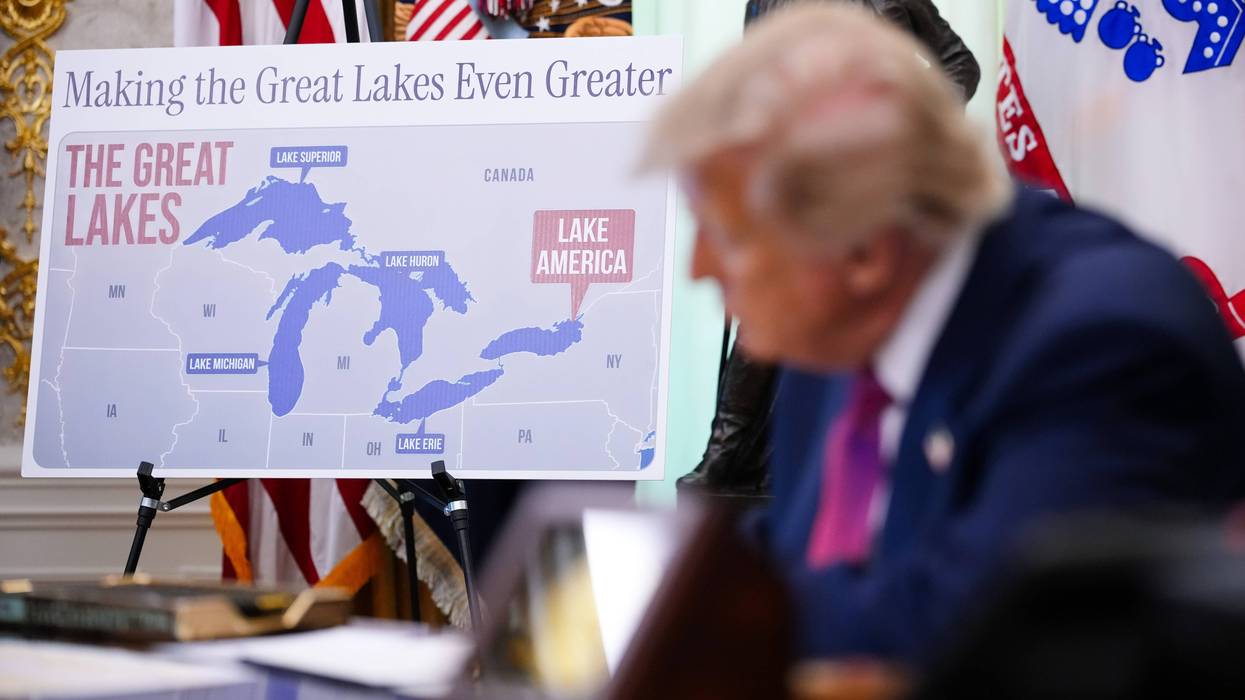
In the following essay, Game Changers takes on corporate-friendly trade deals, including those in North America. And as the US-Canada trade war rages on, beyond the dizzying headlines—including renaming Lake Ontario to Lake America—what does this mean for North American workers, and what is a more sensible trade policy for North America?
This Thursday, Sept. 17th, the Game Changers webinar, Oh Canada: Trump Vs. North American Workers, will dig beyond the headlines to answer these questions, putting focus on the international trade collaboration we need to make the economy work for working America, not just big corporations. Register for the webinar here.
Corporate-driven free trade agreements have distorted global trade and investment relationships over the past 40 years – including in North America. The power and freedom they grant business has produced deindustrialization, job loss, and inequality for workers in the US, Canada, and Mexico. Donald Trump weaponized this hardship, but his erratic tariffs and other actions are only making things worse for workers in America.
NAFTA hurt workers in all three countries; Trump’s policies are making it worse
Starting in the 1980s, global business interests, backed by leaders of both main parties, pushed hard for an ambitious new approach to international trade policy. Instead of straightforward and mutual tariff reduction to promote two-way trade, they pioneered a new generation of trade agreements (bilateral, regional, and global through the World Trade Organization) that entrenched corporate rights, undermined national policy autonomy, and pitted workers in different countries against each other in a race to the bottom. This model was imposed in North America through a Canada-US deal in 1989, followed by the North American Free Trade Agreement (NAFTA, including Mexico) in 1994. NAFTA was negotiated by a Republican president, but passed under a Democrat, and it cemented corporate power across the continent, providing a template for future deals. Some changes were made to NAFTA (renamed the USMCA) in Donald Trump’s first term. But they didn’t fix the core threats facing workers in the US Now Trump’s unilateral, erratic, and destructive tariffs and unhinged attacks on our trading partners are causing chaos and uncertainty. US manufacturing employment is falling, while US companies (including the tech oligarchs) continue to profit from preferential rules that protect their profits, but undermine labor, environmental, and democratic standards.
Democratizing North American trade
Donald Trump claims his tariffs and other threats against trading partners (including challenging their very sovereignty) will help American workers. But the costs, supply bottlenecks and uncertainties he has imposed are damaging the efficiency and competitiveness of key North American industries (like auto manufacturing). US industry and employment are doing worse, not better. Instead of trying to conquer our neighbours through economic or even military force, American workers would do better through a cooperative continent-wide strategy to build a stronger, fairer, more sustainable, and more democratic North American economy.
A new plan for North American economic cooperation, development, and trade would focus on six key themes:
In addition to these six priorities, a strategy to democratize North American trade would address other concerns, including the energy transition, sustainable water management, and agriculture and food security. The three countries would also commit to complementary efforts to promote full employment and strong macroeconomic conditions throughout the continental economy. When all economies are growing strongly, each has more opportunity to benefit from expanded trade and mutual specialization. Above all, a vision of North American trade that protects and uplifts the ability of citizens and communities to make their own decisions over matters of economic, social, and environmental well-being, is a continental economy that will be democratic as well as prosperous.
Planned, managed, cooperative trade and development works better
Conventional market-oriented economic theories claim that free trade always benefits both sides. But those models are based on utopian assumptions (perfect competition, balanced trade, full employment, income distribution that automatically reflects productivity, no pricing power for large companies, and others) that have no relationship to reality. That’s why trade imbalances, capital flight, and unemployment – all things the neoclassical models rule out by assumption – are the normal state of affairs in modern trade.
In the real world, stronger international economic linkages can be mutually beneficial – but only if managed through sensible rules, macroeconomic planning, and economic democracy. A managed, mutual approach to boosting investment, job-creation, and living standards throughout the continent will benefit US workers far more than Trump’s imperial attacks on other countries. And a joint commitment to improving labor, environmental, and democratic practices across the continent will especially benefit US workers, who continue to suffer from labor laws that are the weakest of any industrial country.

What's needed are bold yet realistic policies that break cleanly from the corruption of the Trump years and the free-market fundamentalist era that preceded them. Righting the rules means an end to game-rigging by ruling elites and instead crafting rules that first and foremost protect the well-being of working people.
Editor's Note: The following is part of new series for Common Dreams based on "Game Changers: Economic Policies for a Working America," a project spearheaded by the Political Economy Research Institute (PERI) at the University of Massachusetts Amherst. Game Changers is a collaborative initiative bringing together leading economists and policy experts to develop bold, new ideas to build a stronger, fairer, greener, and more inclusive economy for all Americans. Through dozens of policy briefs, supporting research papers, and online webinars, the project offers solutions designed to help working people thrive while preparing the country for the economic challenges ahead. ""People are looking for solutions that improve their daily lives—not just marginal changes around the edges," says economist Juliet Schor. "Our proposals make housing, care, and daily life more affordable."
When a system reaches the point of breakdown, it’s time for radical change. That was the lesson of the 1930s, when the Great Depression ignited transformative labor and social movements that reset national priorities. It was also the negative lesson of the 1980s, when elites responded to stagflation with a neoliberal turn to “free markets” and enhanced corporate power. The resulting intensification of income and wealth inequality has enabled state capture by a white supremacist authoritarian movement in alliance with tech and fossil fuel interests.
The antidote is increasingly clear: recognizing the equal dignity of every human being and working to guarantee their right to economic security, the opportunity to thrive, a livable planet, a world free of racism, and democratic governance of our lives, societies, and economies. Large majorities of the public understand that the current system is failing most of us and threatening democracy itself. They’re ready to begin building an economy that we deserve.
It’s time to “right the rules” to create an economy that meets individuals’ basic needs for food, shelter, care, education, health, and free time.
Social change, and especially major economic transformation, requires a compelling positive vision of the possible. The Game Changers project was formed to provide that vision. Rooted in new economic thinking and research to address the multiple dysfunctions of the current system, it offers far-reaching ideas that go beyond the failed policies of the past, both neoliberal and liberal, and the corrupt authoritarian practices of the present.
It’s time to “right the rules” to create an economy that meets individuals’ basic needs for food, shelter, care, education, health, and free time. We envision that happening in multiple ways: local public provisioning for health, child and long-term care; federal income supports; access to work with good wages and reasonable hours; raising wages at the bottom and the middle to address longstanding racial and other inequalities; and sensible and compassionate immigration policies. We lay out plans for new public infrastructures such as high-quality mixed-income public housing with renewable energy systems and a low-cost, efficient public payments system. We need to detoxify the natural environment, restore ecosystems, and stabilize the climate system.
Investments in individuals, communities, nations and the planet are key to prosperity. But we need more than that. Changing the game implies that the game is rigged. We offer policies that help working people build power, through collective organizations, in the workplace and the state. These organizing strategies address racial and other divisions that weaken communities. They’ll help redress the asymmetries of influence that plague this moment.
A new game also requires fundamental transformation of large-scale economic structures, such as the financial architecture, the international trading system, and the functioning of the macroeconomy. Our policies do that through breaking up concentrated power, penalizing rent-seeking, stabilizing the financial system, and forcing corporations to pay their fair share of taxes. These measures help fund the investments in people and planet that are required for a decent economy.
Game Changers: The Economy We Deserve
One throughline among the wide range of proposals we have developed is that they are based on strong economic research and reasoning, but they reject the economic story that has dominated policymaking. Conventional economic thinking has been shown to be misguided in area after area. Minimum wages don’t cause unemployment; rent control doesn’t reduce housing supply; and equality and efficiency are not opposed. Climate action is cheaper than inaction, worktime reduction and higher productivity go together, and investments in social goods can pay for themselves.
The economic logic of our approach is based on game theory, as well as common sense. Zero-sum, competitive games like the one the economy has been stuck in yield much worse outcomes than cooperative games. When we join together in communities, labor unions, civic associations, and business enterprises, outcomes are far better. This recognition is the basis of a powerful new economic paradigm: invest in each other, secure the future, and realize the promise of multi-racial democracy throughout society. It’s time to change the game.
The roots of our current predicament can be situated in the early 1970s, when the economic damage wrought by an earlier wrong-headed foreign adventure—the Vietnam War—coincided with an increase in oil prices resulting from conflict in the Middle East. The resulting economic crisis of inflation and recession brought to a head longstanding political, social and economic struggles. Workers mobilized and built power through militant trade union activities; African Americans gained voice and political influence via the Civil Rights movement; the women’s movement demanded equal treatment. These developments coincided with declining competitiveness of US business and a profit squeeze. Panic arose within the American business class as they feared they were losing control.
All the proposals share the goal of helping to build a positive-sum economy that works for all, rather than a zero-sum economy where the greed of the one percent trumps the well-being of the ninety-nine percent.
An additional factor was increased environmental awareness. The first Earth Day in 1970 attracted 20 million, the largest protest action in US history. Existential panic was especially present in the fossil fuel industries of oil, gas and coal. Fossil fuel interests, including Exxon and the Kochs, fought back, investing millions to capture politicians and state institutions. They joined with other business interests to support representatives of both parties who would break unions and negotiate trade agreements that undermined the power of US workers. They de-regulated banks and other financial institutions to allow them to grow bigger, more profitable and, as we were to discover in 2007 and 2008, more dangerous to our economy and livelihoods.
In wave after wave, the state cut taxes for the rich and reduced government resources for investing in and supporting people and communities. The capture of politics and politicians by big capital directed even more money to the military industrial complex. The economic vision associated with neoliberalism was summed up most up memorably by Ronald Reagan in his First Inaugural Address: “Government is not the solution to our problem; government is the problem.”
By the 2000s, this neoliberal approach had been adopted by a significant portion of the economics profession, and “laissez-faire” became the baseline and even touchstone for economic policy. But in reality, the push for laissez-fare was a cover for state policy that boosted the rich at the expense of everyone else. This helps to explain how policy could evolve in just a few decades from the neoliberalism of Reagan to the authoritarian corruption of the Trump administration and its allies.
State capture has ensured that neither the economy nor the government works for most Americans. Naturally, and perhaps by design, this has led to general mistrust and even disdain by many Americans for the federal government, though there is less skepticism of state and local government. As a result, the potential for the public sector to act as a countervailing force against the power of big business is further undermined by angry and discouraged voters.
This top-heavy economic and political system is populated by corporations too often driven by short-term profit-seeking rather than long-term investments, and by a government that invests too little in people and communities and too much in fossil fuel interests and the military-industrial complex. The average worker’s standard of living has stagnated for decades despite large increases in productivity. Affordability may be a buzzword. It is also a pressing day-to-day issue for most American families.
The rise of billionaires and even one trillionaire, along with the enormous power of tech and fossil fuel capitalists in the Trump Administration, is in some ways the natural extension of this decades-long pattern. But we are also experiencing unprecedented perversions and pathologies, as reflected in the vast corruption exhibited by the Trump family and friends and the hyper-inequality of society, with a handful of billionaires striding over millions of Americans barely able to make ends meet. And now fossil fuel interests are redacting “climate change” from government’s—and possibly even society’s—to-do list.
It is long past time to break this destructive cycle and usher in a new economic structure, and a new paradigm to support it.
The Game Changers are examples of bold yet realistic policies that break cleanly from the corruption of the Trump years and the free-market fundamentalist era that preceded them. The policies address how both markets and government work, based on the premise that the role of government is not merely to clean up after the messes when markets fail, but to ensure that markets work consistently on behalf of working people rather than being rigged against them.
Game Changer policies span a broad canvas of economic issues—health care, housing, immigration, care work, labor, the environment, trade, and finance. All the proposals share the goal of helping to build a positive-sum economy that works for all, rather than a zero-sum economy where the greed of the one percent trumps the well-being of the ninety-nine percent. They are based on a simple set of propositions.
Childcare, health care, and a clean and safe environment are not commodities to be sold to those with the most purchasing power, nor are they privileges to be granted to those with the most political power. These are universal rights that should be shared by all.
Something is deeply wrong with an economy where people who play by the rules must struggle to get by, while the wealthy flaunt their power with impunity.
Investing in each other means strengthening personal connections by making sure that working people have time and energy to invest in their families and communities. It means uniting with those by our side who are striving for a better life. It means spurning attempts to pit us against each other—white against non-white, native-born against recent immigrant, worker against worker—to divert attention from the abuses perpetrated by those on top.
In short, investing in each other means building an economy in which everyone is free to survive, strive, and thrive.
Economic security should not be a privilege for the few. A secure economy must be resilient enough to safeguard present as well as future generations from workplace abuses, environmental destruction, and supply-chain fragility.
Securing our future means recognizing that there are things that all should be able to afford, like housing, education and care. It means recognizing that there are things we cannot afford, like the poisoning of our air and water and lavish tax breaks and handouts for the rich. And it means building an economy in which the lives of working people are not subjected to catastrophic disruptions that result from concentrated wealth and power in the hands of people who do not care.
Securing our future also means forging solidarity with others across the world with whom we share not only the same planet, but also the same struggle against transnational elites who seek to divide nations and peoples to pursue ever more wealth and power for themselves.
Today the rules for how markets and governments work are rigged in favor of the wealthy and powerful. Something is deeply wrong with an economy where people who play by the rules must struggle to get by, while the wealthy flaunt their power with impunity.
Righting the rules means ending reckless and predatory financial practices that siphon wealth from working families into the hands of speculators and banksters. It means reorienting housing markets to provide affordable homes for all rather than to maximize profits for real-estate barons. And it means ending the tragic squandering of lives and wealth to shore up a military-industrial complex that offers empty promises of national security even as it undermines the security of families and communities by engaging in immoral and unnecessary wars.
Righting the rules means an end to game-rigging by ruling elites and instead crafting rules that first and foremost protect the well-being of working people.
The call for changing the rules highlights a key aspect of our approach. Many of the Game Changer policies involve redesigning how the market works rather than calling for major new public spending. They transform market outcomes, thereby reducing the need for post-market redistributions to achieve more fairness. And in calling for more public spending in some areas, we also propose new revenue sources and fiscal priorities to improve the functioning of the economy, as detailed in the Game Changer on funding the future.
To animate the changes we are proposing, we need to restore people’s faith that change is possible. We’ve noted the existence of pervasive cynicism and disillusionment with government. In an age of state capture, when government has so frequently failed workers, communities of color, rural families, and distressed geographies, these feelings are warranted. Part of the difficulty of defending democracy against the current authoritarian threats is that the system has empowered elites while disempowering and discouraging working people.
As we’ve argued, changing the game requires far-reaching policies that offer improvements and are based on strong economic analysis. That’s a given. Overcoming cynicism and disillusionment requires something else as well: people’s actual lived experience fighting for and winning change. By being part of a truly democratic movement, and achieving victories, it’s possible to rebuild trust in government, businesses, and each other.
We must reject the false tensions between collective strategies and individual dreams, between worker welfare and business health, between climate caution and economic prosperity.
A transformative agenda won’t be enacted in one stroke. It may start with smaller victories and incremental steps. Each successful campaign engages people who can then be part of the next, bigger effort. Or perhaps we notch an early win with a big, bold Game Changer. That can be followed by smaller steps to make sure it’s implemented fairly and successfully. Social and economic restructuring will come in the form of changes, big and small. And with each positive step, trust in government—and each other—increases.
We are optimistic about the possibilities for deep transformation. Our reasoning is based on the episodes we began with—the paradigm-shifting moments in which new economic models arise and stick. While such shifts can be connected to intellectual trends, they are often more rooted in social conditions and political coalitions: New Deal thinking and labor mobilization in the context of the Great Depression, or neoliberal economics and business opportunism in the context of the stagflation of the 1970s and early 1980s.
In this moment of crisis, we need both new perspectives and new coalitions. We must reject the false tensions between collective strategies and individual dreams, between worker welfare and business health, between climate caution and economic prosperity. We must build a broad movement that includes workers, communities of color, small businesses, professionals concerned about AI, community leaders sickened by division, and anyone and everyone who knows that democracy cannot stand when oligarchy thrives.
The traditional American motto, “out of many, one” is often used to refer to the power of our diversity. Forging a broad and unified force for a better future will be key for the many—movement builders, unionists, community organizers, civic leaders, and all who stand with them—to triumph against the one percent. A transformative policy package, like the Game Changers, is one part of the coalition-building needed for the future we deserve.

There is an arsenal of bold policies out there to embrace that will “defeat fascism, preserve democracy, and help create a greener, stronger and fairer economy for American workers.”
The United States is a plutocracy. Its economy works for the wealthy and powerful at the expense of working people. It is a broken politico-economic system in need of major repairs, but as leading progressive economist Gerald Epstein points out in the interview that follows, there is indeed an arsenal of bold policies to “defeat fascism, preserve democracy, and help create a greener, stronger and fairer economy for American workers.” Epstein is professor of economics and a founding co-director of the Political Economy Research Institute (PERI) at the University of Massachusetts Amherst.
C.J. Polychroniou: It’s often been said that progressives are good in offering stinging critiques of the status quo and even making appealing policy proposals, but there is still a short supply of game changing strategies. I take it that this is the aim of Game Changers: Economic Polices for a Working America, an exciting new project from the Political Economy Research Institute (PERI) at the University of Massachusetts Amherst. You conceived of the project and serve as its director, so tell us more about it. Why now the launching of such a project, what are the major issues covered, and what do you hope will be achieved?
Gerald Epstein: I launched the Game Changers project, along with my colleagues James Boyce of the University of Massachusetts Amherst and Juliet Schor of Boston College, because of the emerging perception that progressives in the United States could not gain political power and defeat the fascists and MAGA simply by leveling criticisms and epithets against Trump and his associates. Working people in the United States are hurting and angry after decades of neoliberal economic policies implemented, with some exceptions, by both Republican and Democratic administrations. Looking for answers to their legitimate problems, many American voters either simply sit out elections, or pull the lever for extreme candidates that seek to manipulate them by identifying scapegoats—such as immigrants—as the source of their problems. So, we launched Game Changers to be a positive source of real answers to real problems facing working Americans. The idea is to offer activists, political candidates, and government officials with policy ideas that bridge the gulf between the transformative and the practical, ideas that can envisage the way to an economy that is fairer, greener, more productive and more democratic. These are ideas, we believe, that are also practical enough to offer hope to those who want to help to mobilize the political forces that can help bring them into fruition.
Importantly, though, we are not intending to offer a comprehensive program for the American left. We felt that would be presumptuous for us to do and beyond our competence and standing. Ours is more of a menu of ideas that can be picked up by those who need them and who want to mobilize on their behalf.
We geared the timing of this project so that the policy ideas would be ready by the Congressional elections in November of 2026. In fact, we are launching policy proposals this month of July 2026. They can be found at https://gamechangerspolicy.org. Some of these ideas might be taken up by candidates. If they win, they might be taken up when they serve in Congress. Some of these ideas may percolate and emerge in future campaigns and legislative actions, as well as be taken up by progressive organizations. That is our hope, anyway.
The Game Changers project consists of 9 teams of experts and practitioners, (about 45 people in total) working on a range of subjects: Care, Finance and Financial Regulation, Health Care, Housing, Immigration, Macroeconomics, Trade and Labor, and Work and Jobs. All in all, these teams have developed about 25 different policy proposals.
The range of policies is striking. They include: “The Wealth of Welcome: Immigration Reform that Works for America”; “America’s Workers Deserve a Four-Day Week”; "A Universal Basic Income for Children”; “Medicare for All”; “Polluters Pay - The Extreme Weather Superfund”; “Democratize North American Trade”; “Housing as a Human Right”; “National Rent Control”; “Public Banking”; “No More Bailouts.” (For the whole list, see GameChangersPolicy.org).
C.J. Polychroniou: Since the project is about advancing progressive economic alternatives to the problems and challenges facing the US economy, one would assume that the economists invited to be part of the project represent a common tradition in the discipline. If so, how would you define this tradition, and is it important that there is a consensus among them as to what constitutes progressive economic policies over key issues? We know that the Left has always been divided over ideology and policymaking. It is divided over the scope of government intervention in capitalist economies, and there is even disagreement over several specific issues, such as the Universal Basic Income, how to reduce inequality, and how to combat the climate crisis.
Gerald Epstein: What unites the economists and other experts involved in Game Changers is a commitment to defeat fascism, preserve democracy, and help create a greener, stronger and fairer economy for American workers. We did not invite experts based on a theoretical, methodological or ideological litmus test. Indeed, I would say that is one of the strengths of our project. The left often has great difficulties uniting sufficiently to engage in practical tasks like winning elections, or even achieving small practical goals, because they are riven by ideological, theoretical or methodological differences. We are not subject to that problem. Big egos are also a problem in politics—left, right and center and, for sure, in academia. Thankfully, we have avoided that problem as well. For us, the litmus test was a commitment to the ideals of Game Changers, expertise in their subject areas, and, for the most part, a willingness to volunteer their time.
C.J. Polychroniou: The 1930s posed the biggest and most severe challenge in US economic history. The New Deal was a response to the calamity of the Great Depression and reshaped the United States in a major and profound way. But the New Deal ultimately gave way to the neoliberal order and the results have been nothing but catastrophic for working-class people. Is the US today in a similar state of affairs as it was in the 1930s in the sense that the system is badly broken? Is this the message behind the launching of Game Changers? If so, can different issues still be addressed separately or does the entire system need restructuring before anything meaningful can be done?
Gerald Epstein: You are certainly correct that the neoliberal order wreaked havoc on America’s workers, but now things are even worse. In the U.S. we are facing a particularly pernicious form of capitalism, an authoritarian, and profoundly corrupt version that is dominated by a self-seeking Presidential family and a lethal coalition of techno-fossil-fuel-financialized capitalists. While our specific issues and policy proposals stand on their own terms, we see them as part of a broader vision of what our economy needs to overcome this lethal form of capitalism. The antidote is to recognize the equal dignity of every human being and working to guarantee their right to economic security, the opportunity to thrive, a livable planet, a world free of racism, and democratic governance of our lives, societies and economies.
More specifically, Game Changers is posing a set of policies to help defeat this form of capitalism by “changing the game,” based on three principles.
Changing the game means (1) investing in each other, through public provisioning of care, health care and other critical services; (2) securing our future by, for example, breaking the power of the fossil fuel capitalists and addressing climate change; and (3) righting the rules, by ending reckless and predatory financial practices, changing tax policies so that the super-rich have less wealth and contribute a bigger share for the operations of our government, preventing capitalists from firing workers arbitrarily and without just cause.
At one level, these, of course, are not revolutionary demands in a traditional sense. But if widely implemented, they would bring about a revolutionary improvement in the lives of working people, not only in the short term but in the longer term as well.
C. J. Polychroniou: In your view, what are the most pressing issues facing today the US economy and working-class people?
Gerald Epstein: While the US economy’s productivity has grown significantly over the last 40 years, the standard of living of American workers has, for the most part, barely budged. This is especially true if one includes American workers’ ability to acquire many of the most important basics of life: housing, time and the wherewithal to care for children, family members and their communities; a sustainable environment in the face of climate change and degradation; quality health care and education; and dignity, respect and a voice in their workplace. American capitalists, especially but not exclusively those on Wall Street, engage in speculative and extractive activities, rather than investing in socially productive assets for the future. Even when a new technology is developed that could improve workers’ lives, such as AI, these are weaponized by big capitalists in their efforts to control and extract wealth from American workers. We have a bailout economy, whereby Wall Street financiers undertake highly risky investments, grab the rewards, and when these threaten themselves and the economy, they get bailed out by the government. All of this has led to an obscene level of income and wealth inequality. And we have a political economic system where those at the top use xenophobia, and racial and ethnic baiting and oppression to try to divide and conquer America’s workers in order to stay in control.
At Game Changers, we are trying to do our small part to help overturn this immoral and destructive system.