5
#000000
#FFFFFF
To donate by check, phone, or other method, see our More Ways to Give page.
Daily news & progressive opinion—funded by the people, not the corporations—delivered straight to your inbox.
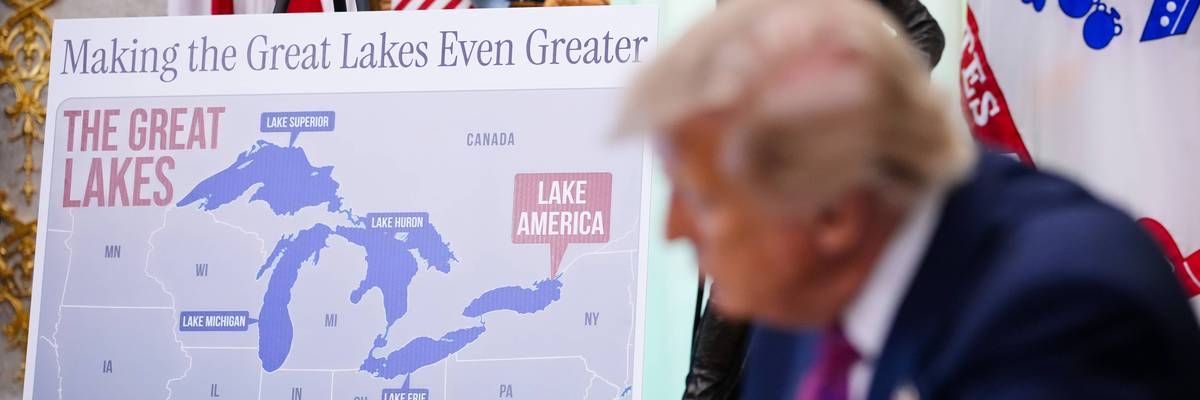
A map labeling Lake Ontario as "Lake America" is displayed as US President Donald Trump signs an executive order during an event in the Oval Office of the White House on August 27, 2026 in Washington, DC. President Trump signed an executive order to rename Lake Ontario as "Lake America" amid an ongoing trade war between the US and Canada.
In the real world, stronger international economic linkages can be mutually beneficial—but only if managed through sensible rules, macroeconomic planning, and economic democracy.
Editor’s Note: The following is part of new series for Common Dreams based on “Game Changers: Economic Policies for a Working America,” a project spearheaded by the Political Economy Research Institute (PERI) at the University of Massachusetts Amherst. Game Changers is a collaborative initiative bringing together leading economists and policy experts to develop bold, new ideas to build a stronger, fairer, greener, and more inclusive economy for all Americans.
In the following essay, Game Changers takes on corporate-friendly trade deals, including those in North America. And as the US-Canada trade war rages on, beyond the dizzying headlines—including renaming Lake Ontario to Lake America—what does this mean for North American workers, and what is a more sensible trade policy for North America?
This Thursday, Sept. 17th, the Game Changers webinar, Oh Canada: Trump Vs. North American Workers, will dig beyond the headlines to answer these questions, putting focus on the international trade collaboration we need to make the economy work for working America, not just big corporations. Register for the webinar here.
Corporate-driven free trade agreements have distorted global trade and investment relationships over the past 40 years – including in North America. The power and freedom they grant business has produced deindustrialization, job loss, and inequality for workers in the US, Canada, and Mexico. Donald Trump weaponized this hardship, but his erratic tariffs and other actions are only making things worse for workers in America.
NAFTA hurt workers in all three countries; Trump’s policies are making it worse
Starting in the 1980s, global business interests, backed by leaders of both main parties, pushed hard for an ambitious new approach to international trade policy. Instead of straightforward and mutual tariff reduction to promote two-way trade, they pioneered a new generation of trade agreements (bilateral, regional, and global through the World Trade Organization) that entrenched corporate rights, undermined national policy autonomy, and pitted workers in different countries against each other in a race to the bottom. This model was imposed in North America through a Canada-US deal in 1989, followed by the North American Free Trade Agreement (NAFTA, including Mexico) in 1994. NAFTA was negotiated by a Republican president, but passed under a Democrat, and it cemented corporate power across the continent, providing a template for future deals. Some changes were made to NAFTA (renamed the USMCA) in Donald Trump’s first term. But they didn’t fix the core threats facing workers in the US Now Trump’s unilateral, erratic, and destructive tariffs and unhinged attacks on our trading partners are causing chaos and uncertainty. US manufacturing employment is falling, while US companies (including the tech oligarchs) continue to profit from preferential rules that protect their profits, but undermine labor, environmental, and democratic standards.
Democratizing North American trade
Donald Trump claims his tariffs and other threats against trading partners (including challenging their very sovereignty) will help American workers. But the costs, supply bottlenecks and uncertainties he has imposed are damaging the efficiency and competitiveness of key North American industries (like auto manufacturing). US industry and employment are doing worse, not better. Instead of trying to conquer our neighbours through economic or even military force, American workers would do better through a cooperative continent-wide strategy to build a stronger, fairer, more sustainable, and more democratic North American economy.
A new plan for North American economic cooperation, development, and trade would focus on six key themes:
In addition to these six priorities, a strategy to democratize North American trade would address other concerns, including the energy transition, sustainable water management, and agriculture and food security. The three countries would also commit to complementary efforts to promote full employment and strong macroeconomic conditions throughout the continental economy. When all economies are growing strongly, each has more opportunity to benefit from expanded trade and mutual specialization. Above all, a vision of North American trade that protects and uplifts the ability of citizens and communities to make their own decisions over matters of economic, social, and environmental well-being, is a continental economy that will be democratic as well as prosperous.
Planned, managed, cooperative trade and development works better
Conventional market-oriented economic theories claim that free trade always benefits both sides. But those models are based on utopian assumptions (perfect competition, balanced trade, full employment, income distribution that automatically reflects productivity, no pricing power for large companies, and others) that have no relationship to reality. That’s why trade imbalances, capital flight, and unemployment – all things the neoclassical models rule out by assumption – are the normal state of affairs in modern trade.
In the real world, stronger international economic linkages can be mutually beneficial – but only if managed through sensible rules, macroeconomic planning, and economic democracy. A managed, mutual approach to boosting investment, job-creation, and living standards throughout the continent will benefit US workers far more than Trump’s imperial attacks on other countries. And a joint commitment to improving labor, environmental, and democratic practices across the continent will especially benefit US workers, who continue to suffer from labor laws that are the weakest of any industrial country.
Dear Common Dreams reader, It’s been nearly 30 years since I co-founded Common Dreams with my late wife, Lina Newhouser. We had the radical notion that journalism should serve the public good, not corporate profits. It was clear to us from the outset what it would take to build such a project. No paid advertisements. No corporate sponsors. No millionaire publisher telling us what to think or do. Many people said we wouldn't last a year, but we proved those doubters wrong. Together with a tremendous team of journalists and dedicated staff, we built an independent media outlet free from the constraints of profits and corporate control. Our mission has always been simple: To inform. To inspire. To ignite change for the common good. Building Common Dreams was not easy. Our survival was never guaranteed. When you take on the most powerful forces—Wall Street greed, fossil fuel industry destruction, Big Tech lobbyists, and uber-rich oligarchs who have spent billions upon billions rigging the economy and democracy in their favor—the only bulwark you have is supporters who believe in your work. But here’s the urgent message from me today. It's never been this bad out there. And it's never been this hard to keep us going. At the very moment Common Dreams is most needed, the threats we face are intensifying. We need your support now more than ever. We don't accept corporate advertising and never will. We don't have a paywall because we don't think people should be blocked from critical news based on their ability to pay. Everything we do is funded by the donations of readers like you. When everyone does the little they can afford, we are strong. But if that support retreats or dries up, so do we. Will you donate now to make sure Common Dreams not only survives but thrives? —Craig Brown, Co-founder |
Editor’s Note: The following is part of new series for Common Dreams based on “Game Changers: Economic Policies for a Working America,” a project spearheaded by the Political Economy Research Institute (PERI) at the University of Massachusetts Amherst. Game Changers is a collaborative initiative bringing together leading economists and policy experts to develop bold, new ideas to build a stronger, fairer, greener, and more inclusive economy for all Americans.
In the following essay, Game Changers takes on corporate-friendly trade deals, including those in North America. And as the US-Canada trade war rages on, beyond the dizzying headlines—including renaming Lake Ontario to Lake America—what does this mean for North American workers, and what is a more sensible trade policy for North America?
This Thursday, Sept. 17th, the Game Changers webinar, Oh Canada: Trump Vs. North American Workers, will dig beyond the headlines to answer these questions, putting focus on the international trade collaboration we need to make the economy work for working America, not just big corporations. Register for the webinar here.
Corporate-driven free trade agreements have distorted global trade and investment relationships over the past 40 years – including in North America. The power and freedom they grant business has produced deindustrialization, job loss, and inequality for workers in the US, Canada, and Mexico. Donald Trump weaponized this hardship, but his erratic tariffs and other actions are only making things worse for workers in America.
NAFTA hurt workers in all three countries; Trump’s policies are making it worse
Starting in the 1980s, global business interests, backed by leaders of both main parties, pushed hard for an ambitious new approach to international trade policy. Instead of straightforward and mutual tariff reduction to promote two-way trade, they pioneered a new generation of trade agreements (bilateral, regional, and global through the World Trade Organization) that entrenched corporate rights, undermined national policy autonomy, and pitted workers in different countries against each other in a race to the bottom. This model was imposed in North America through a Canada-US deal in 1989, followed by the North American Free Trade Agreement (NAFTA, including Mexico) in 1994. NAFTA was negotiated by a Republican president, but passed under a Democrat, and it cemented corporate power across the continent, providing a template for future deals. Some changes were made to NAFTA (renamed the USMCA) in Donald Trump’s first term. But they didn’t fix the core threats facing workers in the US Now Trump’s unilateral, erratic, and destructive tariffs and unhinged attacks on our trading partners are causing chaos and uncertainty. US manufacturing employment is falling, while US companies (including the tech oligarchs) continue to profit from preferential rules that protect their profits, but undermine labor, environmental, and democratic standards.
Democratizing North American trade
Donald Trump claims his tariffs and other threats against trading partners (including challenging their very sovereignty) will help American workers. But the costs, supply bottlenecks and uncertainties he has imposed are damaging the efficiency and competitiveness of key North American industries (like auto manufacturing). US industry and employment are doing worse, not better. Instead of trying to conquer our neighbours through economic or even military force, American workers would do better through a cooperative continent-wide strategy to build a stronger, fairer, more sustainable, and more democratic North American economy.
A new plan for North American economic cooperation, development, and trade would focus on six key themes:
In addition to these six priorities, a strategy to democratize North American trade would address other concerns, including the energy transition, sustainable water management, and agriculture and food security. The three countries would also commit to complementary efforts to promote full employment and strong macroeconomic conditions throughout the continental economy. When all economies are growing strongly, each has more opportunity to benefit from expanded trade and mutual specialization. Above all, a vision of North American trade that protects and uplifts the ability of citizens and communities to make their own decisions over matters of economic, social, and environmental well-being, is a continental economy that will be democratic as well as prosperous.
Planned, managed, cooperative trade and development works better
Conventional market-oriented economic theories claim that free trade always benefits both sides. But those models are based on utopian assumptions (perfect competition, balanced trade, full employment, income distribution that automatically reflects productivity, no pricing power for large companies, and others) that have no relationship to reality. That’s why trade imbalances, capital flight, and unemployment – all things the neoclassical models rule out by assumption – are the normal state of affairs in modern trade.
In the real world, stronger international economic linkages can be mutually beneficial – but only if managed through sensible rules, macroeconomic planning, and economic democracy. A managed, mutual approach to boosting investment, job-creation, and living standards throughout the continent will benefit US workers far more than Trump’s imperial attacks on other countries. And a joint commitment to improving labor, environmental, and democratic practices across the continent will especially benefit US workers, who continue to suffer from labor laws that are the weakest of any industrial country.
Editor’s Note: The following is part of new series for Common Dreams based on “Game Changers: Economic Policies for a Working America,” a project spearheaded by the Political Economy Research Institute (PERI) at the University of Massachusetts Amherst. Game Changers is a collaborative initiative bringing together leading economists and policy experts to develop bold, new ideas to build a stronger, fairer, greener, and more inclusive economy for all Americans.
In the following essay, Game Changers takes on corporate-friendly trade deals, including those in North America. And as the US-Canada trade war rages on, beyond the dizzying headlines—including renaming Lake Ontario to Lake America—what does this mean for North American workers, and what is a more sensible trade policy for North America?
This Thursday, Sept. 17th, the Game Changers webinar, Oh Canada: Trump Vs. North American Workers, will dig beyond the headlines to answer these questions, putting focus on the international trade collaboration we need to make the economy work for working America, not just big corporations. Register for the webinar here.
Corporate-driven free trade agreements have distorted global trade and investment relationships over the past 40 years – including in North America. The power and freedom they grant business has produced deindustrialization, job loss, and inequality for workers in the US, Canada, and Mexico. Donald Trump weaponized this hardship, but his erratic tariffs and other actions are only making things worse for workers in America.
NAFTA hurt workers in all three countries; Trump’s policies are making it worse
Starting in the 1980s, global business interests, backed by leaders of both main parties, pushed hard for an ambitious new approach to international trade policy. Instead of straightforward and mutual tariff reduction to promote two-way trade, they pioneered a new generation of trade agreements (bilateral, regional, and global through the World Trade Organization) that entrenched corporate rights, undermined national policy autonomy, and pitted workers in different countries against each other in a race to the bottom. This model was imposed in North America through a Canada-US deal in 1989, followed by the North American Free Trade Agreement (NAFTA, including Mexico) in 1994. NAFTA was negotiated by a Republican president, but passed under a Democrat, and it cemented corporate power across the continent, providing a template for future deals. Some changes were made to NAFTA (renamed the USMCA) in Donald Trump’s first term. But they didn’t fix the core threats facing workers in the US Now Trump’s unilateral, erratic, and destructive tariffs and unhinged attacks on our trading partners are causing chaos and uncertainty. US manufacturing employment is falling, while US companies (including the tech oligarchs) continue to profit from preferential rules that protect their profits, but undermine labor, environmental, and democratic standards.
Democratizing North American trade
Donald Trump claims his tariffs and other threats against trading partners (including challenging their very sovereignty) will help American workers. But the costs, supply bottlenecks and uncertainties he has imposed are damaging the efficiency and competitiveness of key North American industries (like auto manufacturing). US industry and employment are doing worse, not better. Instead of trying to conquer our neighbours through economic or even military force, American workers would do better through a cooperative continent-wide strategy to build a stronger, fairer, more sustainable, and more democratic North American economy.
A new plan for North American economic cooperation, development, and trade would focus on six key themes:
In addition to these six priorities, a strategy to democratize North American trade would address other concerns, including the energy transition, sustainable water management, and agriculture and food security. The three countries would also commit to complementary efforts to promote full employment and strong macroeconomic conditions throughout the continental economy. When all economies are growing strongly, each has more opportunity to benefit from expanded trade and mutual specialization. Above all, a vision of North American trade that protects and uplifts the ability of citizens and communities to make their own decisions over matters of economic, social, and environmental well-being, is a continental economy that will be democratic as well as prosperous.
Planned, managed, cooperative trade and development works better
Conventional market-oriented economic theories claim that free trade always benefits both sides. But those models are based on utopian assumptions (perfect competition, balanced trade, full employment, income distribution that automatically reflects productivity, no pricing power for large companies, and others) that have no relationship to reality. That’s why trade imbalances, capital flight, and unemployment – all things the neoclassical models rule out by assumption – are the normal state of affairs in modern trade.
In the real world, stronger international economic linkages can be mutually beneficial – but only if managed through sensible rules, macroeconomic planning, and economic democracy. A managed, mutual approach to boosting investment, job-creation, and living standards throughout the continent will benefit US workers far more than Trump’s imperial attacks on other countries. And a joint commitment to improving labor, environmental, and democratic practices across the continent will especially benefit US workers, who continue to suffer from labor laws that are the weakest of any industrial country.