SUBSCRIBE TO OUR FREE NEWSLETTER
Daily news & progressive opinion—funded by the people, not the corporations—delivered straight to your inbox.
5
#000000
#FFFFFF
To donate by check, phone, or other method, see our More Ways to Give page.

Daily news & progressive opinion—funded by the people, not the corporations—delivered straight to your inbox.
Today the forces of wealth and power are wielding unprecedented weapons that threaten the fundamentals of the republic. It’s not just policies and government departments that are under assault, but the very foundations of our democracy.
Not since those sweltering days in Philadelphia in 1787 at the Constitutional Convention has the United States confronted so fundamental a restructuring of the federal government. What’s happening! Today, the mainstream press declares “it can’t happen here” because we are not an authoritarian society, which is a reference to Sinclair Lewis’ 1935 novel, about a dictatorial take over of the United States. No we are not heading into a coup d’etat, they say, nor are we heading into an oligarchy.
Well, in fact, we are in the midst of a coup d’etat and we are living under an oligarchy.
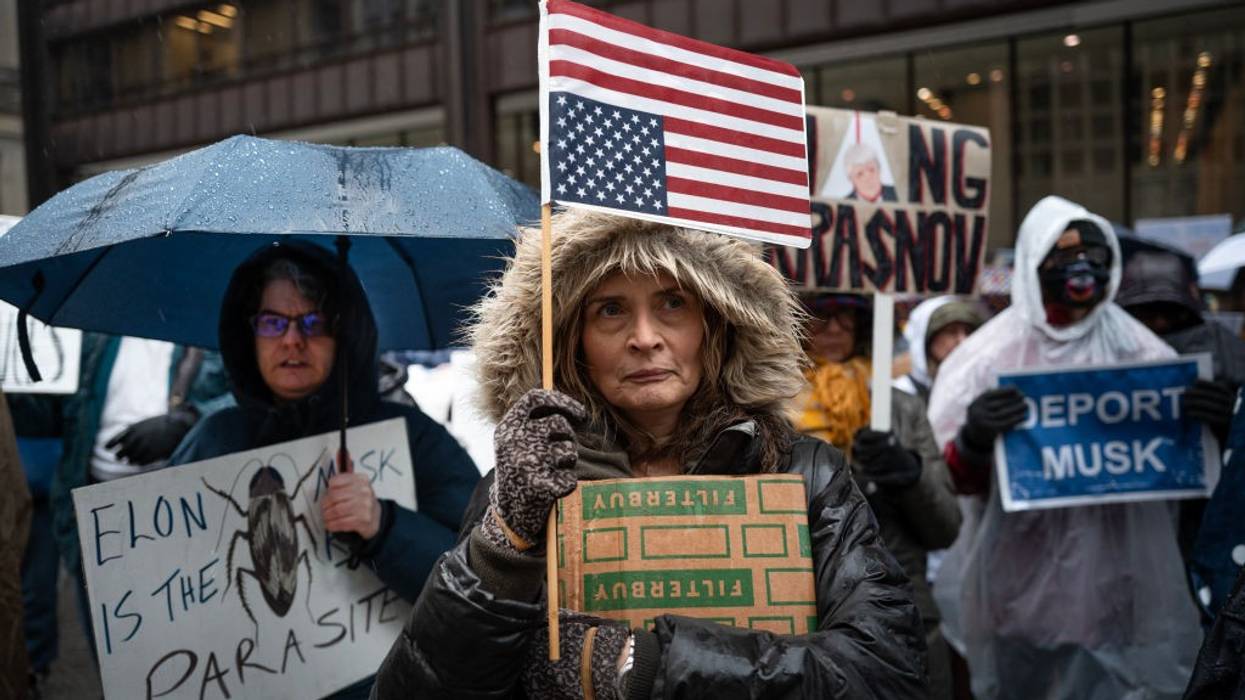
The Trump-Musk regime and Republican Party are transforming how we are governed. This is not an unconstitutional assault, but rather an anti-constitutional assault. Virtually every ruling tradition is being pillaged all in the name of democracy. As the old maxim goes, “When fascism comes to America it will be wrapped in the flag and carrying a cross.”
This is not an unconstitutional assault, but rather an anti-constitutional assault.
Those leaders in 1787 contrary to their stated intentions did not resolve to reform the Articles of Confederation, rather to create a new government, the U.S. Constitution. After considerable and impassioned debate an uneasy consensus was forged among the 13 states. At the conclusion of the convention with philosophical differences still painfully evident, the esteemed Benjamin Franklin urged his fellow delegates to “place trust in their own fallibility” and endorse the new republic.
With all of its manifest imperfections and unremitting political and economic crises, many self inflicted, this government has survived for nearly 240 years. Of course, through it all the elites thrived while those not fortunate enough to be white and wealthy were obliged to endure. The influential federalist Fisher Ames, in defense of the Constitution, likened our new republic to traveling on a “raft where we never sink but our feet are always in the water.”
This time in our history is different. Today the forces of wealth and power are wielding unprecedented weapons that threaten the fundamentals of the republic. It’s not just policies that are under assault.
Unique concentrations of economic and political authority, dysfunctional legislative and judicial branches, a collapsed political party system, race and class scapegoating and toadying by influential sectors of the mass media combine to provide opportunities for demagogues to sell snake oil to an economically vulnerable and politically disillusioned public. This could be, in the words of the American sage Mel Brooks, a “springtime for Hitler” moment.
Just as Trump’s rise to power is a symptom of undemocratic features of the political economy, an oligarchy and coup d’etat can emerge from a regime that incessantly consolidates power by and for the wealthy. It’s not the greed it’s the need. Power concentration is baked into the scheme. The internal logic dictates that elite political power consolidates and expands in order to preserve and amplify economic power.
Capitalism, according to noted economist Sam Bowles, is a never-ending race that requires aggressive undemocratic strategies to persevere. Well, democracy gets in the way of all of this; it organically interferes with the forces of wealth and power. Thus elite self-aggrandizement is compulsory for survival. Predictably this ceaseless jockeying for advantage in the race comes at the expense of the general welfare of the people or as the African proverb has it “when the elephants dance the mice gets trampled.”
It is widely understood that Trump is not known for his intellectual curiosity or acuity. During his first term he seldom read his briefing books preferring to lean on his confidantes for any particulars. Presidents, in part are judged by who the advisors are. So who are some of Trump’s “brain trust”?
In the early 1970’s, Roy Cohn, the legal henchman for Senator Joseph McCarthy, became a trusted mentor to Trump. Cohn bragged that, “My scare value is high. My arena is controversy. My tough front is my biggest asset.” He admonished Trump to never admit a mistake. Sound familiar? Another key influencer was—and remains—Steve Bannon, publisher of Breitbart News, a reactionary platform for Republican extremism. Bannon is credited with saying the goal is the “destruction of the administrative state.” Then there’s Stephen Miller, the ever-dyspeptic long-time insider who stated, “I would be happy if not a single refugee’s foot ever again touched American soil.”
In the words of historian Doris Kearns Goodman, in another context, these people are not a “team of rivals” like those that Lincoln assembled. Trump’s team of advisors and cabinet secretaries are the mandatory paragons of sycophancy.
The Trump-Republican agenda is in part based on Project 2025, which is a wish list of extremist proposals of an influential ultra conservative think tank, the Heritage Foundation. As will be shown the ultimate goal is to challenge and repeal foundational theories, structures and methods of how this country operates.
Their methods are straight out of an authoritarian’s playbook. The process consists of serial deceit, edict and executive orders all in arrogant violation of congressional and constitutional mandates and methods. This is a “shock and awe” that sabotages the rule of law. Trump’s second term is a barrage of dismantling of departments and agencies and the firing of hundreds of thousands with no regard for due process or social and human consequences. This is a coup d’etat.
This Trump –Musk and Republican Party coup is not a palace revolt that merely changes the faces in power. This is not about tinkering or modifying policy. This is not about upholding long cherished principles and values or a return to the “good old days.” This is about systemic change, about power and how it is structured and wielded and for who’s benefit.
What follows is an exposition of the coup’s structural attacks on governance. The actual specifics of the daily policy plundering will not be emphasized. Rather what will be explored are the why and how of this destruction of the basic architecture and operation of constitutional government. While historically this governing design and process has never been perfect it has always held the virtue of an ideal, of being a worthy democratic goal.
The insurrectionists intend to break the “Social Contract.” Philosopher John Locke’s foundational principle embodied in the Declaration of Independence and the Constitution of an implicit agreement between the citizens and their government whereby the people abide by the authority in exchange for a freedom and the security of a stable society. People of good will understand that with freedom comes responsibility. This coup represents a comprehensive attack on the very purpose and methods of governing. Trump and Republicans are willfully undermining citizen’s trust in their government by demolishing the Contract.
Trump, Inc. is sabotaging the principle of Popular Sovereignty whereby government’s power derives from the consent of the people. There is no need for consent in an authoritarian regime. Do citizens now want more voter suppression with fewer people voting, do they want the wealthy to have more control over campaign financing and who gets to run for office? Do citizens want an electoral system that they can’t trust? Not long ago Trump in his juvenile and artless way mused that when he becomes president the country would be so great that there would be no need for further elections.
An effective coup will subvert basic notions of how power should operate. The constitutional principles of the Separation of Powers and Checks and Balances are designed to prevent one branch from dominating the others and to insure the sharing of powers and accountability.
Republicans and Trump are consciously undermining that balance by promoting dubious theories, such as the “unitary executive” that bestows unrestrained power to the executive. Trump is impounding funds that were congressionally authorized. He is ignoring congressional oversight, thereby making a mockery of committee hearings and denying the senate it’s Advice and Consent authority. “Being president means I can do anything, I have Article 2,” thus spake Trump, the learned constitutional scholar during his first term.
In the early 1970s mainstream historian, Arthur Schlesinger, Jr. in his book, The Imperial Presidency, warned of the escalation and dangers of an omnipotent president. One of his subjects of course was Richard Nixon who by comparison to Trump looks like a Mr. Rogers in his neighborhood oval office.
Revamping and controlling the judicial system is vital to the effectiveness of a coup. The U.S. Supreme Court wields extraordinary powers through a legalism concocted in 1803 that bestowed through “judicial review” the irrevocable authority to determine what laws are constitutional. This enables an unelected branch the ability to overturn a decision of elected representatives.
That power, now in the hands of the Trump-Roberts court, is a form of despotism. If insurgents can shape the ideological tenor of the court then politics will replace judicial fairness rendering the court a confederate in the unraveling of democracy.
Working with the Federalist Society over recent decades, the right-wing movement has spent millions to colonize the Supreme Court with a super majority of conservative and reactionary jurists. This hostile takeover of our highest court has turned a once esteemed branch into an ideological bunker where the robber barons take on cases to further limit the “excesses” of democracy.
The Robert’s Court has, among other things, destroyed voting rights protections, eliminated campaign finance regulations, undermined first amendment rights, eroded immigrant and women’s rights and unabashedly championed corporate interests. And perhaps most egregiously has put the president above the law by anointing him with unprecedented immunity. Sen. Sheldon Whitehouse, the Senate’s most effective judicial watchdog, describes the Robert’s Court as having “advanced a far right agenda” that is “deeply out of touch with the will of Americans.” This court has virtually overturned the rule of law and enabled extremism to reign supreme.
The party system is being destroyed enabling coup mutineers to demagogue their way to power. They have been aided and abetted by two political parties that are no longer honest or effective advocates for citizens interests.
For a long time the political party system has been a poor representative of the interests of a broad cross section of the population. Class considerations and structural weakness of government has disenfranchised many. Historically it has been up to minorities, the poor and working classes, women, and others to compel political parties and others make the country live up to its founding ideals. Yes, if the people will lead the leaders will eventually follow.
The party system is being destroyed enabling coup mutineers to demagogue their way to power. They have been aided and abetted by two political parties that are no longer honest or effective advocates for citizens interests.
The perennial issue is how well the parties have represented the citizens. The Democratic Party once an advocate for minorities, the poor and working classes has over the past 50 years abandoned its grassroots focus and party building. Aided by the myopic assistance of the Bill Clinton wing of the party, the old New Deal coalition has been abandoned in order to pander to the interests of Wall Street.
Republicans, starting in the 20th century, consistently represented business and elite interests, nothing new here. What is new and distinctive is the impact of the growing reactionary wing that gained traction in the 1970’s and surged during the1980s Reagan era. With a shrinking middle class, a tidal wave of unregulated corporate money, a new high tech Internet media combined with an economically vulnerable populace provided an opportunity for cynical Republican Party exploitation. With Trump as the carnival barker the fringe elements of the party grew in popularity and became amenable to extremist ideas.
Today Republicans are more of a cult than a party while most Democrats dither as they try to figure out what they stand for other than re-election.
With the major parties in existential disarray they are less capable of countering the anti democratic forces of oligarchy. The logical consequence is a coup d’etat to “save the country.”
Not since the Civil War have the principles, structure, and means of governance been so ferociously attacked. The Lockean Social Contract between the people and the government is being torn apart.
While it was not a mandate, only about 30% of the voting age population supported Trump (76 out of c. 259 million adults), that’s nonetheless a significant portion of voters. Clearly citizens are angry with a government that consistently ignores the real interests of working-class Americans. They voted their frustrations, their anger and their pocketbooks. Hey that Trump guy is talking about my concerns.
But did they vote to promote fear and hatred in order to divide people by class, gender, race, and sexual orientation? Did they vote to destroy public education, Social Security, the U.S. Postal Service and healthcare by privatization or to politicize the Supreme Court and the Justice Department? Did they vote to further shrink the middle class and escalate the gap between the rich and the poor or to destroy unions? Did they vote to deny climate change or to blow up relations with our allies by abrogating treaties or start destabilizing tariff wars?
We do know that people’s contentment in life is primarily derived from a society that offers a fair chance for equal opportunity and security.
If we are like the theologian Abraham Heschel, “pessimists of the intellect and optimists of the will” this crisis offers a real opportunity to seek a newer world, a world where an authentic political and economic democracy can be made a reality.
Returning to the venerable Franklin, during the Constitutional Convention he would frequently gaze at the sun carved high on the chair of presiding officer George Washington and muse whether it was a setting or rising sun...
Time to wake up, people. It's no longer just a dream—but a nightmare one step closer to happening.
One of the right’s favorite fever dreams over the years has been to gut the US Constitution of many of its checks and balances and officially turn America into a legal oligarchy with a strongman presidency, nearly bulletproof legal immunity for the morbidly rich, and full personhood for corporations.
As of this month, it’s no longer just a dream.
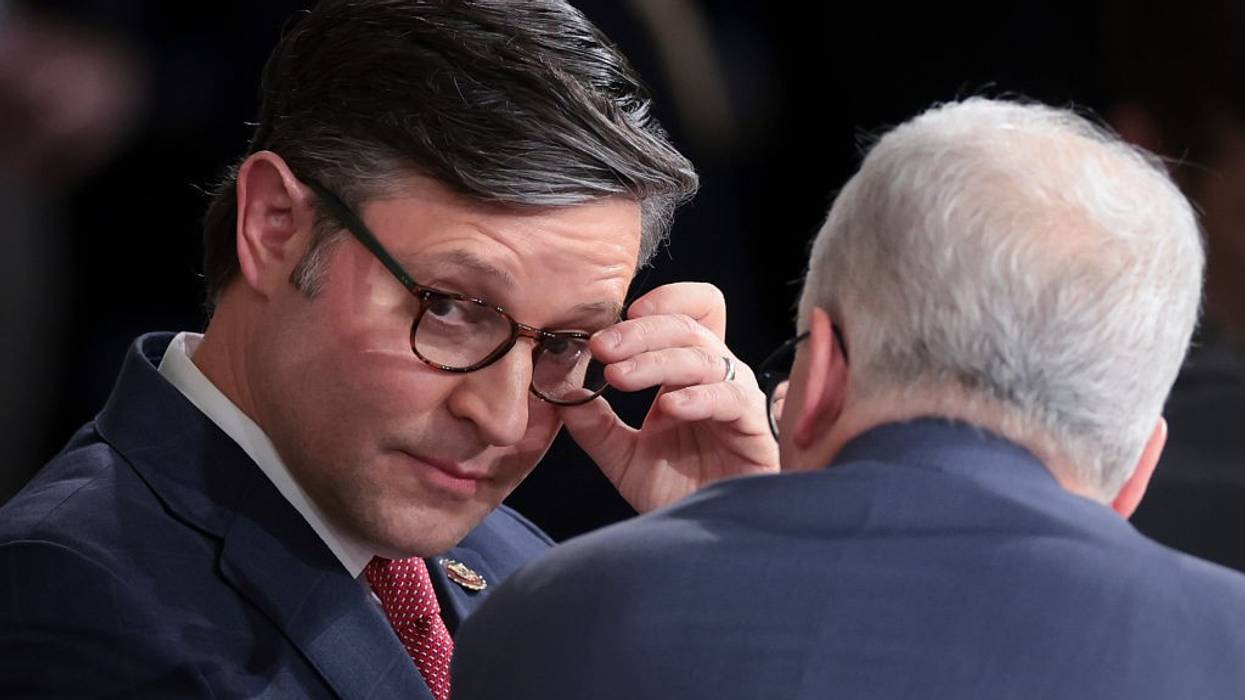
The American Legislative Exchange Council (ALEC) completed their winter “National Policy Summit” get-together in Scottsdale, Arizona last week with Speaker Mike Johnson as its keynote speaker. This is the group that’s brought “Stand Your Ground” and voter suppression “model legislation” to Red states across America and, for fifty years now, has been bringing together corporate lobbyists and Republican state-level politicians to make state after state more corporate- and billionaire-friendly.
If their plan works, these Republican toadies of the billionaires who fund and own them will rewrite our Constitution and state governors, the US Congress, and the President will have no say whatsoever in the process.
At this recent meeting they rolled out a new strategy to convene a Constitutional Convention, so they can finally remake America in their own image: they’re going to try to get the six corrupt Republicans on the Supreme Court — who all have direct or indirect ties back to ALEC, its related/affiliated organizations, and/or its funders — to go along with it.
Former Wisconsin Senator Russ Feingold (now a professor of law and president of the American Constitution Society) is not prone to hyperbole; he’s always been a thoughtful and measured speaker and writer. So, it’s worth taking him seriously when he recently said of MAGA Mike Johnson:
“It is alarming to have a speaker of the House who supports the extremist Convention of States movement, which is striving to radically rewrite the U.S. Constitution.”
Please consider the horrifying possibilities.
Morbidly rich billionaires and the groups they fund are working to rewrite our Constitution to do all this and more.
They want to provide corporations and the rich with more and more protections and benefits while chopping away at anything smelling of “socialism” like Social Security, child labor laws, or inheritance, income, and wealth taxes.
The Constitution provides for three ways to change or amend itself. The first is that Congress can propose a constitutional amendment, pass it with a supermajority in both houses, and have three-quarters of the states ratify it. This is the way it’s been done for every one of the existing 27 amendments.
The second strategy is done by using Article V of the Constitution and driving the process up from the states. The easiest way to do this is for three-quarters of the states to legislatively approve (with simple majority votes in the legislatures of each state) an amendment, in which case Congress is unnecessary and upon ratification by the 38th state, it becomes a permanent amendment to the Constitution.
While this strategy has never been used, it’s one process many of the good-government groups like Move To Amend and Public Citizen are pushing for a “Corporations are not people, and money is not speech” amendment to reverse Citizens United.
The third — and incredibly dangerous — strategy to amend the Constitution is to simply call a “Convention of the States,” again using Article V, and open the entire document itself up to rewriting and tinkering.
This third strategy is the one ALEC was pushing this month. If they can pull it off in the states (where it’s cheaper to buy politicians), then Congress, state governors, the president, and even the courts would have no say over it. And ALEC has spent the past 50 years becoming a major — some would say controlling — factor in Republican-controlled state legislatures.
Their barrier has been that it takes 34 states to call for a convention, and there have never been that many states calling call for one at the same time since the founding of our republic. However, as was pointed out at ALEC last week, every state except Hawaii has — at one time or another, starting with Virginia in 1788 — passed a resolution proposing a constitutional convention (there have been 400 such resolutions since the founding of our nation).
While most of history’s resolutions for a convention have been specific to one issue or another (New York’s 1789 resolution called for a Bill of Rights to be added to the Constitution, for example, something that Congress and the states did in 1791), a half-dozen were simply calls for a convention without specifics. These are sometimes referred to as “generic” convention resolutions.
The theory pushed at ALEC, first rolled out three years ago at an ALEC workshop by conservative activist David Biddulph but now apparently fully endorsed, is to combine the existing 28 Red state resolutions along with the six “generic” ones (going all the way back to 1789) to hit the magic number of 34 states to open the convention.
The key to the strategy is to get it before the Supreme Court and let the billionaire-owned Republican justices do ALEC’s work for it by ruling that those old resolutions are still valid, even though the people who proposed and passed them are all long dead.
Utah Republican State Rep. Ken Ivory told ALEC lawmakers it was imperative to get the issue before the Supreme Court:
“Please join us in the state of Utah as we look into the legal mechanisms that we have under the Constitution… to [get the Court to] declare that Congress must count the [old] applications. … And if, as we believe, we’ve already achieved 34 applications to Congress for a fiscal responsibility convention, call [it]… and hold a Convention of States.”
If their plan works, these Republican toadies of the billionaires who fund and own them will rewrite our Constitution and state governors, the US Congress, and the President will have no say whatsoever in the process. Only state legislatures are necessary for rewriting the Constitution and then ratifying their own work, according to Article V of the Constitution, and governors can’t veto their actions.
Much like the many cases that have suddenly burst onto the scene and then been used by the six corrupt Republicans on the Court to alter American law and take away citizens’ rights, this one could move quickly. Now that the ALEC meeting is over, expect to see states begin putting together the lawsuits or other legal actions necessary to get this proposal before the Court.
Alexander Hamilton was prescient: in the last sentence of Federalist 85, he warns us of efforts to re-write or replace our Constitution:
“I dread the more the consequences of new attempts, because I know that powerful individuals, in this and in other States, are enemies to a general national government in every possible shape.”
Common Cause and the Center for Media and Democracy have been at the forefront of sounding the alarm and I’ve hot-linked their names to their most recent articles about the work they’re doing to try to stop the billionaire machine devoted to rewriting our Constitution.
Please check them out, get on their mailing lists, and spread the word. This is one of those things that Republicans on the Court could use to seemingly spring out of nowhere and bring down our democracy once and for all.
About two weeks after the tragedy at Marjory Stoneman Douglas High School, I appeared on AtlanticLive's "Schools Across America: a Miami Town Hall," produced by Atlantic Magazine. It was planned well before a troubled teen with a legally purchased weapon of war killed a football coach, athletic director, a geography teacher and 14 students at his former high school.
When asked about Parkland, I responded that, "The gun laws we have in our state and country are deplorable. We are one of two countries that constitutionally have a right to bear arms, it's prehistoric. Personally, it motivates me to think more about what it takes to do a constitutional amendment, and maybe we need to think about that because that's what needs to be done."
Gun control will never get around the Second Amendment. We can dance around it like Muhammad Ali, perhaps jab at it with policy like Sugar Ray. But we will never Tyson TKO gun control without amending -- or completely repealing the Second Amendment so that individual states can determine for themselves how to regulate personal gun use.
Retired Supreme Court Justice John Paul Stevens agrees. He recently challenged young activists to take it a step further and, "Seek more effective and more lasting reform ... demand a repeal of the Second Amendment."
In 1789, the population of America was approximately 4 million, half of which were women, and 800,000 were African slaves -- two groups to whom the Constitution did not apply equally.
To even discuss in public the idea of a constitutional convention or congressional approval for three-quarters of the states' legislatures (38) to ratify a constitutional amendment, draws the ire of Democrats and Republicans alike. Do we honestly think that the 39 men that signed the U.S. Constitution 230 years ago, are some sort of deified superheroes who cannot be questioned by mere mortals in 2018? In 1789, the population of America was approximately 4 million, half of which were women, and 800,000 were African slaves -- two groups to whom the Constitution did not apply equally.
Supreme Court Justice Thurgood Marshall said during a speech to lawyers and jurists that he would not accept offers to speak at constitutional bicentennial celebrations in 1987 -- "For I do not believe," he said, "that the meaning of the Constitution was forever 'fixed' at the Philadelphia Convention. Nor do I find the wisdom, foresight and sense of justice exhibited by the Framers particularly profound. To the contrary, the government they devised was defective from the start, requiring several amendments, a civil war and momentous social transformation to attain the system of constitutional government, and its respect for the individual freedoms and human rights, we hold as fundamental today."
Imagine a sitting U.S. Supreme Court justice saying that to a crowd of legal minds. Let that sink in.
Florida should be leading the charge, we have more ways to amend our Florida Constitution than any other state. Florida today is in the midst of a mandatory revision process as the Constitutional Revision Commission meets every 20 years by law. The revision-commission process is entirely unique to Florida. I usually don't agree with many of the amendments proposed, but appreciate living in a state that seriously considers amendments through a customary practice that acknowledges change in our country.
Of all firearm homicides in the world, 82 percent occur in the United States.
We have regular constitutional change in Florida. What are we afraid of at the federal level? America has not witnessed a constitutional amendment since 1971 (26th Amendment) when the right to vote was lowered to the age of 18. (I'm intentionally omitting the 27th Amendment regarding compensation for congressional lawmakers. It was introduced in 1789 and passed 203 years later). I wasn't on this Earth in 1971 and neither were 63 percent of Americans today. Only 6 percent of Americans were adults in the 1960s when three constitutional amendments were passed. American seniors might view a constitutional convention a little differently, and that is a key voter constituency along with the youth leading a new movement in America for gun gontrol.
We've never held an Article V Constitution Convention. Why not a Constitutional Convention to discuss gun control among other proposed changes? I think individual states in today's world should decide this issues. Shootings kill more than 36,000 Americans each year; every day, there is a average of 96 deaths and 222 injuries by gun violence. Of all firearm homicides in the world, 82 percent occur in the United States. African-American children have the highest rates of firearm mortality overall; they are 10 times more likely to be killed by guns in a country where African-Americans make up 14 percent of the population.
Florida should be leading an effort for a U.S. Constitutional Convention. The country is under assault because Democrats and reasonable Republicans will not address racially charged appeals with big ideas that bring people together. But big ideas win elections.
Right-wing resistance to meaningful gun control is driven, in part, by a false notion that America's Founders adopted the Second Amendment because they wanted an armed population that could battle the U.S. government. The opposite is the truth, but many Americans seem to have embraced this absurd, anti-historical narrative.

The men who gathered in Philadelphia in 1787 weren't precursors to France's Robespierre or Russia's Leon Trotsky, believers in perpetual revolutions. In fact, their work on the Constitution was influenced by the experience of Shays' Rebellion in western Massachusetts in 1786, a populist uprising that the weak federal government, under the Articles of Confederation, lacked an army to defeat.
Daniel Shays, the leader of the revolt, was a former Continental Army captain who joined with other veterans and farmers to take up arms against the government for failing to address their economic grievances.
The rebellion alarmed retired Gen. George Washington who received reports on the developments from old Revolutionary War associates in Massachusetts, such as Gen. Henry Knox and Gen. Benjamin Lincoln. Washington was particularly concerned that the disorder might serve the interests of the British, who had only recently accepted the existence of the United States.
On Oct. 22, 1786, in a letter seeking more information from a friend in Connecticut, Washington wrote: "I am mortified beyond expression that in the moment of our acknowledged independence we should by our conduct verify the predictions of our transatlantic foe, and render ourselves ridiculous and contemptible in the eyes of all Europe."
In another letter on Nov. 7, 1786, Washington questioned Gen. Lincoln about the spreading unrest. "What is the cause of all these commotions? When and how will they end?" Lincoln responded: "Many of them appear to be absolutely so [mad] if an attempt to annihilate our present constitution and dissolve the present government can be considered as evidence of insanity."
However, the U.S. government lacked the means to restore order, so wealthy Bostonians financed their own force under Gen. Lincoln to crush the uprising in February 1787. Afterwards, Washington expressed satisfaction at the outcome but remained concerned the rebellion might be a sign that European predictions about American chaos were coming true.
"If three years ago [at the end of the American Revolution] any person had told me that at this day, I should see such a formidable rebellion against the laws & constitutions of our own making as now appears I should have thought him a bedlamite - a fit subject for a mad house," Washington wrote to Knox on Feb. 3, 1787, adding that if the government "shrinks, or is unable to enforce its laws ... anarchy & confusion must prevail."
Washington's alarm about Shays' Rebellion was a key factor in his decision to take part in - and preside over - the Constitutional Convention, which was supposed to offer revisions to the Articles of Confederation but instead threw out the old structure entirely and replaced it with the U.S. Constitution, which shifted national sovereignty from the 13 states to "We the People" and dramatically enhanced the power of the central government.
A central point of the Constitution was to create a peaceful means for the United States to implement policies favored by the people but within a structure of checks and balances to prevent radical changes deemed too disruptive to the established society. For instance, the two-year terms of the House of Representatives were meant to reflect the popular will but the six-year terms of the Senate were designed to temper the passions of the moment.
Within this framework of a democratic Republic, the Framers criminalized taking up arms against the government. Article IV, Section 4 committed the federal government to protect each state from not only invasion but "domestic Violence," and treason is one of the few crimes defined in the Constitution as "levying war against" the United States as well as giving "Aid and Comfort" to the enemy (Article III, Section 3).
But it was the Constitution's drastic expansion of federal power that prompted strong opposition from some Revolutionary War figures, such as Virginia's Patrick Henry who denounced the Constitution and rallied a movement known as the Anti-Federalists. Prospects for the Constitution's ratification were in such doubt that its principal architect James Madison joined in a sales campaign known as the Federalist Papers in which he tried to play down how radical his changes actually were.
To win over other skeptics, Madison agreed to support a Bill of Rights, which would be proposed as the first ten amendments to the Constitution. Madison's political maneuvering succeeded as the Constitution narrowly won approval in key states, such as Virginia, New York and Massachusetts. The First Congress then approved the Bill of Rights which were ratified in 1791. [For details, see Robert Parry's America's Stolen Narrative.]
Behind the Second Amendment
The Second Amendment dealt with concerns about "security" and the need for trained militias to ensure what the Constitution called "domestic Tranquility." There was also hesitancy among many Framers about the costs and risks from a large standing army, thus making militias composed of citizens an attractive alternative.
So, the Second Amendment read: "A well-regulated Militia, being necessary to the security of a free State, the right of the people to keep and bear Arms, shall not be infringed." Contrary to some current right-wing fantasies about the Framers wanting to encourage popular uprisings over grievances, the language of the amendment is clearly aimed at maintaining order within the country.
That point was driven home by the actions of the Second Congress amid another uprising which erupted in 1791 in western Pennsylvania. This anti-tax revolt, known as the Whiskey Rebellion, prompted Congress in 1792 to expand on the idea of "a well-regulated militia" by passing the Militia Acts which required all military-age white males to obtain their own muskets and equipment for service in militias.
In 1794, President Washington, who was determined to demonstrate the young government's resolve, led a combined force of state militias against the Whiskey rebels. Their revolt soon collapsed and order was restored, demonstrating how the Second Amendment helped serve the government in maintaining "security," as the Amendment says.
Beyond this clear historical record - that the Framers' intent was to create security for the new Republic, not promote armed rebellions - there is also the simple logic that the Framers represented the young nation's aristocracy. Many, like Washington, owned vast tracts of land. They recognized that a strong central government and domestic tranquility were in their economic interests.
So, it would be counterintuitive - as well as anti-historical - to believe that Madison and Washington wanted to arm the population so the discontented could resist the constitutionally elected government. In reality, the Framers wanted to arm the people - at least the white males - so uprisings, whether economic clashes like Shays' Rebellion, anti-tax protests like the Whiskey Rebellion, attacks by Native Americans or slave revolts, could be repulsed.
However, the Right has invested heavily during the last several decades in fabricating a different national narrative, one that ignores both logic and the historical record. In this right-wing fantasy, the Framers wanted everyone to have a gun so they could violently resist their own government. To that end, a few incendiary quotes are cherry-picked or taken out of context.
This "history" has then been amplified through the Right's powerful propaganda apparatus - Fox News, talk radio, the Internet and ideological publications - to persuade millions of Americans that their possession of semi-automatic assault rifles and other powerful firearms is what the Framers intended, that today's gun-owners are fulfilling some centuries-old American duty.
The mythology about the Framers and the Second Amendment is, of course, only part of the fake history that the Right has created to persuade ill-informed Tea Partiers that they should dress up in Revolutionary War costumes and channel the spirits of men like Washington and Madison.
But this gun fable is particularly insidious because it obstructs efforts by today's government to enact commonsense gun-control laws and thus the false narrative makes possible the kinds of slaughters that erupt periodically across the United States, most recently in Newtown, Connecticut, where 20 schoolchildren and six teachers were murdered in minutes by an unstable young man with a civilian version of the M-16 combat rifle.
While it's absurd to think that the Founders could have even contemplated such an act - in their 18th Century world of single-fire muskets that required time-consuming reloading - right-wing gun advocates have evaded that obvious reality by postulating that Washington, Madison and other Framers would have wanted a highly armed population to commit what the Constitution defined as treason against the United States.
Today's American Right is drunk on some very bad history, which is as dangerous as it is false.