

SUBSCRIBE TO OUR FREE NEWSLETTER
Daily news & progressive opinion—funded by the people, not the corporations—delivered straight to your inbox.
5
#000000
#FFFFFF
To donate by check, phone, or other method, see our More Ways to Give page.
Daily news & progressive opinion—funded by the people, not the corporations—delivered straight to your inbox.
"Senate Democrats should eliminate every barrier possible" to confirm President Joe Biden's judicial nominees, said Indivisible.
With Democrats hoping to confirm dozens more federal judges following President Joe Biden's milestone of appointing 100 new members of the judiciary, progressives on Friday said the party has no choice but to eliminate a tradition they say has been exploited by Republicans to block the president's nominees.
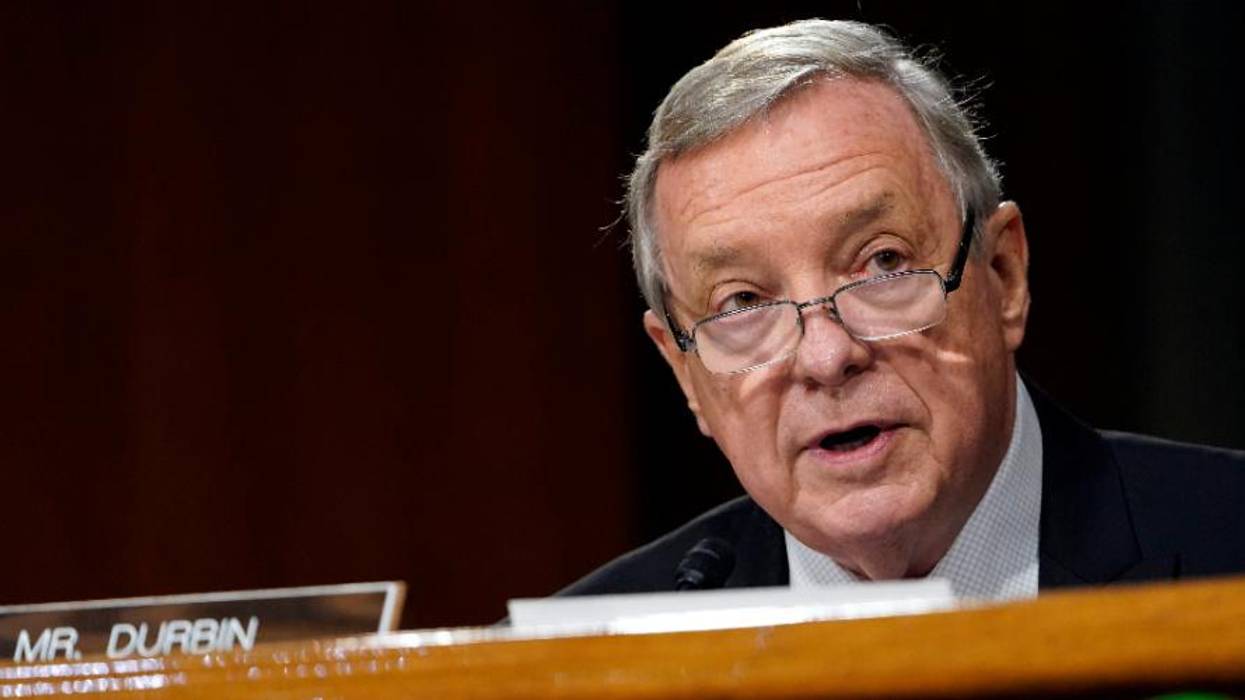
Advocacy group Alliance for Justice said Democratic leaders, particularly Senate Judiciary Committee Chair Dick Durbin (D-Ill.) must make a choice: They can "transform our federal courts by confirming so many more judges with a respect for the rights of all of us," or they can allow Republicans to continue the tradition of using so-called "blue slips" to reject nominees.
The Senate "can't do both," said the group.
Under the blue slip practice, which is not an official Senate rule, senators can unilaterally block federal district court judge nominees from being considered by the committee if the nominee is from their home state. Only if they submit a "blue slip" for the judge can the nomination proceed.
Prior to last year's midterm elections, Durbin said the party has "made it work" and would continue to abide by the blue slip tradition, but earlier this month he said he will no longer honor the withholding of a blue slip if he believes it "discriminates because of race, gender, or sexual discrimination."
Republicans including Sens. Lindsey Graham (R-S.C.) and Marsha Blackburn (R-Tenn.) have protested, with the latter claiming the practice is "essential to the Senate's constitutional obligation to provide advice and consent."
But as NBC News reported this week, Durbin noted Republicans have made clear that they're intentionally using the tradition to block Biden's nominees, submitting only 12 blue slips since Biden took office, compared to the 120 Democrats submitted under the Trump administration.
Also under former President Donald Trump, Republicans in control of the Judiciary Committee at the time did away with the use of blue slips for circuit nominees and as a result rapidly confirmed 54 judges to the circuit court.
Demand Justice noted that under the Obama administration, Republicans blocked 17 judicial nominees using the practice.
"When Republicans had the advantage, they just didn't hesitate to eliminate blue slips for the courts of appeals, which are an even higher court," he said.
Senate Majority Leader Chuck Schumer (D-N.Y.) has said he wants his party to top the 234 federal judges the Republicans confirmed in four years. There are currently 72 district court vacancies and nine open seats on appeals courts.
To secure judicial seats, said Meagan Hatcher-Mays, director of democracy policy for Indivisible, Democrats must "be for real" and recognize that the question of whether to continue to allow blue slips is "existential."
"Republicans have used [blue slips] to successfully keep seats open on the federal bench in their states, not because they have an objection to Biden's nominees on the merits, but because they want to hold seats open in the hopes that a future MAGA president will install even more anti-abortion, anti-democracy federal judges instead," said Hatcher-Mays.
"President Biden’s judicial nominees have been exceptional and among his signature achievements throughout his presidency," she added. "Senate Democrats should eliminate every barrier possible to continue to confirm his nominees at a historic pace, including getting rid of blue slips."
Government watchdogs are warning that the Republican takeover of state legislatures in recent years could imminently have major implications for the United States, as a right-wing effort to hold a new constitutional convention appears closer than ever to being realized.
" Republicans always tell us what they want to do. We should believe them and think broadly and in the long term of where we should be working to stop this from happening."
On Monday, former Democratic U.S. Sen. Russ Feingold wrote in an op-ed at The Guardian that Article 5 of the U.S. Constitution allows the document to be amended, either with amendments being proposed by two-thirds of Congress and ratified by three-quarters of the states, or through a method that has never been tested: the establishment of a new constitutional convention.
To hold a new convention, two-thirds of all state legislatures--34 total--must apply to hold the gathering, where lawmakers would have broad freedom to change the Constitution however they saw fit. Three-quarters of states would have to ratify their proposed amendments.
"The right has already packed the Supreme Court and is reaping the rewards, with decisions from Dobbs to Bruen that radically reinterpret the Constitution in defiance of precedent and sound legal reasoning," wrote Feingold, referencing recent rulings on abortion rights and gun control. "But factions of the right are not satisfied to wait for the court to reinterpret the constitution. Instead, they have set their sights on literally rewriting our foundational document."
Feingold--now president of the American Constitution Society--is among those warning that a new constitutional convention is "closer to reality than most people realize," as The New York Times reported earlier this month.
As the Democratic Party expended considerable effort on passing federal legislation during the Obama administration, ACLU communications strategist Rotimi Adeoye wrote at The Daily Beast last month, Republicans focused on taking control at the state and local level, with Democrats losing 13 governorships and 816 legislative seats between 2008 and 2016.
As a result, Republicans now just need control of four more states to reach the threshold needed to call a second constitutional convention.
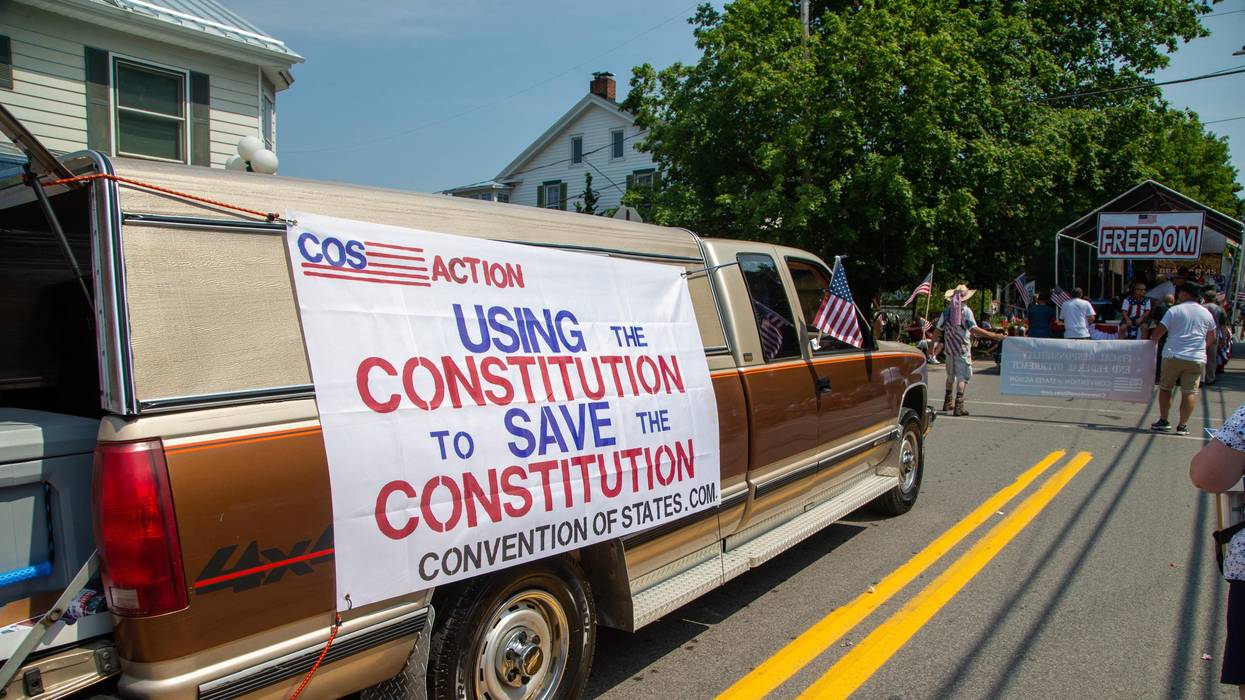
Feingold noted that if right-wing advocates for a new convention like the Convention of States Project and the American Legislative Exchange Council (ALEC) get their way, there would be few limits on how Republicans could change the constitution:
There is nothing in the Constitution about how delegates would be selected, how they would be apportioned, or how amendments would be proposed or agreed to by delegates. And there is little useful historical precedent that lends insight to these important questions. This means that nearly any amendment could be proposed at such a convention, giving delegates enormous power to engage in political and constitutional redrafting.
"The framers left no rules," wrote Feingold in his new book, The Constitution in Jeopardy. "In this uncertainty lies great danger and, possibly, great power."
The former Wisconsin senator wrote at The Guardian that Republicans could use a new convention to craft an amendment banning abortion care, strip Americans of voting rights, gut federal anti-poverty programs, and further threaten people's right to be safe from gun violence by enshrining "their interpretation of the Second Amendment."
On Sunday, Common Cause president Karen Hobert Flynn told MSNBC that in the hands of Republicans, a second constitutional convention could "put all of our constitutional rights up for grabs."
Feingold noted that a national policy discussion regarding the "founding failures of the Constitution" is warranted.
"That said, any conversation about how to go about amending the Constitution needs to be transparent, inclusive, and informed," he wrote at The Guardian. "What factions of the right are pursuing is anything but. They are pursuing exclusively partisan outcomes and have sought to keep their efforts opaque. They do not seem interested in a representative, democratic process."
The Convention of States Project has received millions of dollars from the right-wing Donors Capital Fund and has been endorsed by Republican Govs. Ron DeSantis of Florida and Greg Abbott of Texas, Sens. Rand Paul (R-Ky.) and Marco Rubio (R-Fla.), and influential conservative commentators Sean Hannity and Ben Shapiro.
Rep. Jodey Arrington (R-Texas), a strong proponent of a new constitutional convention, recently proposed legislation to direct the National Archives to conduct an official count of all the states that have called for a convention at various times.
"Democrats should take the threat seriously," Amanda Litman, co-founder of progressive group Run for Something, told The Daily Beast. "Republicans always tell us what they want to do. We should believe them and think broadly and in the long term of where we should be working to stop this from happening."
With the midterm elections fast approaching, wrote Adeoye, "Democrats must emphasize to voters that Republicans still control most state legislatures, and if they remain in power, they can drastically change the Constitution."
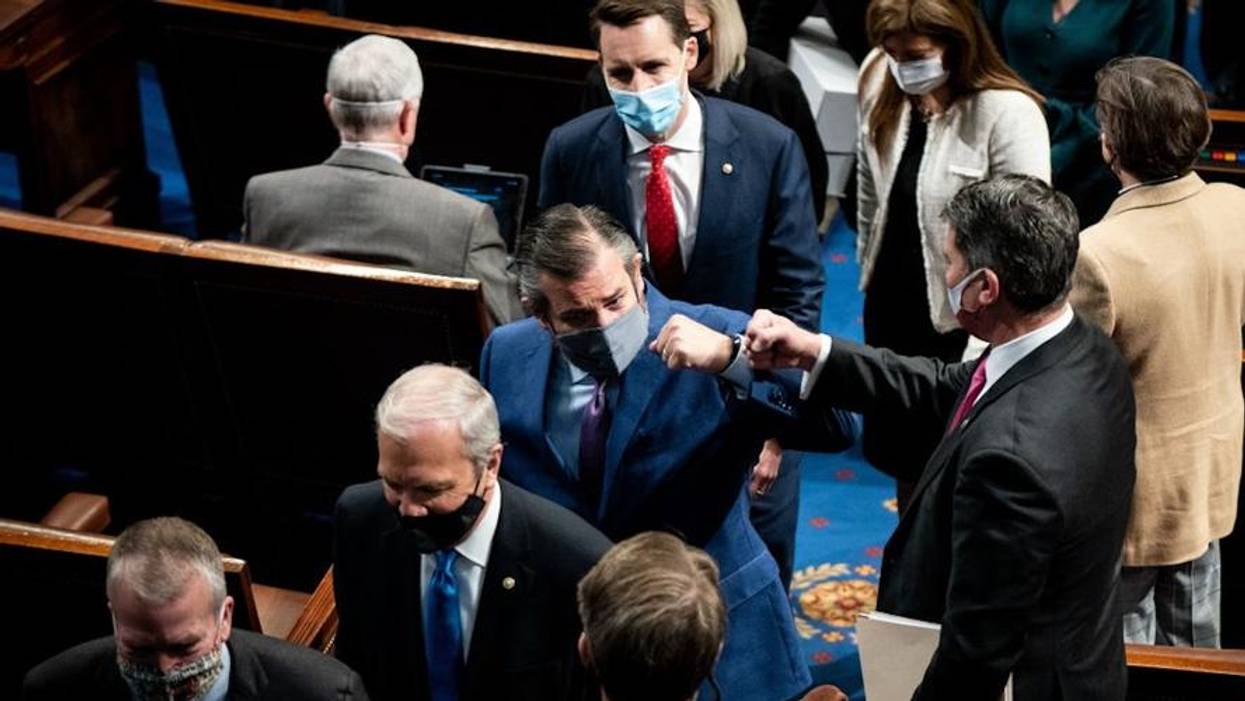
A petition circulating among lawyers and law students calling for the disbarment of Republican Sens. Josh Hawley and Ted Cruz for their roles in inciting last week's deadly attack on the U.S. Capitol has received more than 7,000 signatures as of Monday afternoon, including over 1,000 members of the Missouri and Texas bar associations.
"In leading the efforts to undermine the peaceful transition of power after a free and fair election, Sens. Hawley [Mo.] and Cruz [Texas] attacked the foundations of our democracy," the petition reads. "Hawley and Cruz directly incited the January 6th insurrection, repeating dangerous and unsubstantiated statements regarding the election and abetting the lawless behavior of President [Donald] Trump."
"In leading the efforts to undermine the peaceful transition of power after a free and fair election, Sens. Hawley and Cruz attacked the foundations of our democracy."
--Lawyers' and law students' petition
"A violent mob attacked the U.S. Capitol," the petition continues. "Five people have died. The nation and the world watched as rioters took over the very halls and chambers that embody our democracy."
"Yet after the violence and terror of the day's events, Sens. Hawley and Cruz still chose to stand in the chamber of the U.S. Senate and persist in their baseless objections to the will of the people," it adds.
The Washington Post reports prominent signatories of the petition include former U.S. Sen. Russ Feingold (D-Wis.) and constitutional scholar Lawrence Tribe, a professor at Harvard Law School, Cruz's alma mater.
In less than 72 hours, thousands of lawyers and law students have called for the disbarment of Sens. Hawley and Cruz.
Lawyers--even U.S. Senators--must defend our democracy, not sabotage it. Join the movement, sign the petition, and share widely.https://t.co/mYcXJ2VWhh
-- Daniel Ki (@danielrki) January 10, 2021
The petition was started by seven students at Yale Law School, where Hawley earned his juris doctorate. One of the students, Daniel Ki, told the Post that "we thought it was important to speak up."
"We decided to ask other law students and members of the bar to join in the call to begin immediate disbarment proceedings against Sens. Hawley and Cruz and have been inspired and heartened by the overwhelming response," said Ki.
The petition follows calls by Democratic Sens. Sherrod Brown (Ohio), Chris Coons (Del.), Patty Murray (Wash.), and Ron Wyden (Ore.) for Hawley and Cruz to step down. Murray on Friday accused the pair of having "broken their oath of office."
Even Republicans have strongly condemned the senators, with Sen. Pat Toomey (R-Pa.) on Sunday calling them "complicit in the big lie" that the 2020 presidential election was "stolen" or plagued with "widespread fraud." Toomey, however, stopped short of calling on the senators to resign.
Across the nation, people still reeling from what they saw unfold last week on live television joined in the chorus of condemnation of the senators and demanded their immediate resignation. Several hundred protesters braved subfreezing temperatures and the Covid-19 pandemic to take to the streets of downtown St. Louis on Saturday, chanting, "No Hawley. No KKK. No fascist USA" and painting "RESIGN HAWLEY" in the street in front of the historic Old Courthouse.
The petition comes as the House of Representatives on Monday moved closer to impeaching Trump for inciting insurrection after Republican lawmakers blocked a House resolution calling on Vice President Mike Pence to invoke the 25th Amendment to remove the president from office.
The vice president--who was apparently marked by some of the Capitol insurrectionists for possible execution due to his perceived disloyalty to Trump--has given no indication that he would consider such a constitutional remedy.
Even for voters devastated by Tuesday's election of Donald Trump to the U.S. presidency, there were glimmers of hope around the country--down-ballot wins on the local and national level that speak to the creation of a progressive farm team nationwide.
From Pramila Jayapal in Washington state to Ilhan Omar in Minnesota to Martin Quezada in Arizona, a number of candidates endorsed by the Bernie Sanders campaign offshoot Our Revolution and grassroots social justice group People's Action won their respective races for Congress or state legislatures.
"These victories are a rejection of Trump's strategy of divide and conquer, of pitting working people against each other across lines of race, class, and gender."
--LeeAnn Hall and George Goehl, People's Action
Jayapal, for her part, became the first Indian-American woman elected to Congress when she beat rival Brady Walkinshaw in Washington's liberal 7th congressional district. Speaking to supporters Tuesday night in Seattle before the presidential race was called, "Jayapal said the result of her race meant the 7th district could be 'a light in the darkness' if Donald Trump were to emerge triumphant," the Seattle Times reported.
"If our worst fears are realized, we will be on the defense as of tomorrow," she said. "We will have to fight for social justice as never before."
Omar, meanwhile, became the nation's first Somali-American state legislator, winning a seat representing Minneapolis in the Minnesota House. Minnesota Public Radio reported:
While her election wasn't a surprise in a reliably Democratic district--she was elected by almost 80 percent of the vote there--it carried huge symbolic importance in Minnesota, home to the nation's largest Somali immigrant population. It came just days after Republican presidential candidate Donald Trump ripped Somali immigration as a threat to Minnesota.
"Minneapolis said no tonight, said no to hatred, said no to the narrative of making America hate again," said Habon Abdulle, executive director of the nonprofit Women Organizing Woman, where Omar is director of policy. "Minneapolis, and [the] 60B district particularly, you said Muslim women have space in the governing body of our state. Thank you."
Quezada--who "cruised to victory over Republican Crystal Nuttle" to represent Phoenix's West Valley in the state Senate, according to the Arizona Capitol Times--described his win on Twitter as "bittersweet."
Advocates celebrated other progressive victories on social media:
Referring to both individual candidates as well as minimum wage state ballot measures, People's Action co-directors LeeAnn Hall and George Goehl said: "These victories are a rejection of Trump's strategy of divide and conquer, of pitting working people against each other across lines of race, class, and gender."
Still, there were painful progressive losses, too, including those of Zephyr Teachout, who lost her congressional race in New York, and Russ Feingold, who failed to beat GOP Sen. Ron Johnson in Wisconsin.
Our Revolution has a full breakdown of its wins and losses here.
Tuesday also saw the repudiation of at least two candidates whose terms were marked by the kind of discrimination and injustice that many see as hallmarks of Trump's candidacy and the Republican establishment.
As Quezada and Jane Sanders noted in their tweets, former Phoenix Police Sgt. Paul Penzone defeated longtime Maricopa County sheriff Joe Arpaio, a controversial figure who was found in contempt of court in May and again last month for failing to stop his practice of racial profiling and targeting of Hispanic people in "immigration patrols."
CNN political analyst and Republican strategist Ana Navarro, who publicly opposed Trump, called Arpaio's defeat a "silver lining" of Election Day--and she wasn't the only one.
And in North Carolina, Gov. Pat McCrory--who backed the anti-LGBTQ "hate bill" HB2 and supported the state's discriminatory voter ID law--appears to have lost to challenger Roy Cooper, though McCrory has yet to concede.
"Pat McCrory's historic defeat is a beacon of hope for equality," said Human Rights Campaign president Chad Griffin and Equality North Carolina executive director Chris Sgro in a joint statement on Tuesday night.
"By electing Roy Cooper their next governor, North Carolinians have sent a powerful message across their state and this country that the days of anti-LGBTQ politicians targeting our community for political gain are over," they said. "While McCrory may have been surprised by the overwhelming opposition in this state and across the country to his discriminatory politics, the same will not be true for lawmakers who are considering doubling down on anti-LGBTQ extremism in the future. This is a wake-up call."
Russ Feingold has led most of the polls for most of 2016 in the race for Wisconsin's US Senate seat. But the billionaire class is determined to prevent the election of the progressive populist foe of bank bailouts, bad trade deals and crony capitalism. So, as Election Day approaches, some of the richest people in America are pouring millions into a last-ditch effort to defeat the Democrat.
This will come as no surprise to anyone who recalls Feingold's record as a senator who from 1993 to 2011 stood up to Democratic and Republican presidents on economic issues--opposing the North American Free Trade Agreement and the permanent normalization of trade relations with China, opposing giveaways to Wall Street speculators, opposing attacks on banking regulations and crony-capitalist giveaways to multinational corporations. And, of course, there's the small matter of Feingold's determination to prevent billionaires and millionaires from buying elections.
" Russ Feingold is backed by Bernie Sanders and Elizabeth Warren, and opposed by billionaire defenders of oligarchy."
Like Vermont Senator Bernie Sanders and Massachusetts Senator Elizabeth Warren--both of whom are ardent Feingold backers--the Wisconsin Democrat understands that a campaign-finance system that allows "legalized bribery" is rigging the economy to benefit billionaires. And that scares the idle rich. So the very rich are opening their checkbooks once more, in hopes of keeping a very serious reformer out of the Senate.
It's not just about Feingold. The billionaires would happily fund campaigns against Sanders or Warren. But Sanders and Warren are not on the November 8 ballot. Feingold is. And if he wins, the progressive caucus in the Senate will be strengthened at precisely the point when Americans are demanding the sort of reforms Feingold has long proposed.
Russ Feingold is backed by Bernie Sanders and Elizabeth Warren, and opposed by billionaire defenders of oligarchy.

That prospect is so scary that billionaire donors--and the political front groups they fund-are spending astronomical amounts to help reelect Feingold's hapless foe, US Senator Ron Johnson, R-Wisconsin. Arguably the most nondescript member of Senator majority leader Mitch McConnell's obstructionist caucus, Johnson was elected in 2010 on a Republican wave that is unlikely to hit again this year. It has been clear for months that the incumbent's only hope for winning reelection is a smear campaign against Feingold.
The negative television ads and mailings that deliver the smears cost money. And here it comes. Johnson, a millionaire whose primary mission in the US Senate has been to serve as an errand boy for economic elites, is getting a last-minute boost from the oligarchy.
Wisconsin billionaire Diane Hendricks, a political associate of the Koch brothers and close ally of anti-labor Wisconsin Governor Scott Walker, gave $1.3 million to a pro-Johnson super PAC in September. "With her latest donation to Reform America, Hendricks is now up to $5.6 million that she had given to various PACs, super PACs, political parties and other entities helping out Johnson in his re-election bid," reported the Milwaukee Journal Sentinel.
Hendricks is not alone. As the election approaches, Feingold aides say, the Republican senator is "turning to his handful of billionaire backers to bail him out again." Most of the money is going to supposedly independent groups. Those groups are spending heavily on negative ads that amplify themes associated with Johnson's fiercely negative campaign. Desperate and angry, the erratic incumbent is lashing out at his challenger in increasingly visceral language that is often at odds with reality.
While Feingold has long been known as an independent progressive who works across lines of partisanship and ideology to get things done--as he did during his Senate tenure, when he partnered with sincere conservatives on issues ranging from campaign finance reform to privacy rights, trade policy, and presidential accountability--Johnson is now trying to dismiss his opponent as a political charlatan.
While Feingold sticks to the high road--telling reporters who ask about the incumbent's startlingly-negative campaign that: "I respect Senator Johnson and his office, and I'm going to continue to talk about the issues and not get involved in that sort of thing"--Johnson rants about how his challenger is "lying about me, distorting my record and engaging in class warfare."
Feingold's foe is millionaire Trump backer Ron Johnson, who chirps about campaigning as "the Ronald and the Donald."
A Donald Trump backer who chirps about campaigning with the Republican presidential nominee as "the Ronald and the Donald," Johnson has brought Trump-style politics to the Senate race. Of Feingold, the senator says, "He's a complete phony and I'm actually genuine."
In particular, Johnson is attacking Feingold for his post-Senate service, during which the Democrat taught at two prestigious universities (Stanford and Marquette), wrote a book on foreign policy in general and fighting terror threats in particular that continues to be praised by Democrats and Republicans (Arizona Senator John McCain: "Russ illuminates some of the challenges our nation faces in the post-9/11 era with his trademark integrity and independence"), and served as special envoy for the Great Lakes Region of Africa and the Democratic Republic of the Congo.
Johnson's attacks have grown so bizarre that they have been a certain level of amusement among commentators in Wisconsin. But the incumbent's "hysterical scorched-earth strategy" cannot be casually neglected, as it is backed up by a billionaire class that fears genuine reformers like Russ Feingold.
Offering hope to those who feel "dispirited" by the presidential contest, the grassroots political organization People's Action on Tuesday released its list of 22 down-ballot endorsements for the 2016 election.
"These candidates come from out of the justice movement in America--some as leaders within our own organizations," said LeeAnn Hall, co-executive director of People's Action.
"They know what it's like to not be able to make ends meet," Hall said. "They understand how it feels to have to choose between meals or medicine for your children. They understand what it's like to be targeted for police violence because you are black, or have your family threatened by deportation. They represent families in America, not America's corporate elite."
Observers will notice overlap between the People's Action endorsements and those of Our Revolution, the organization launched to carry on the progressive ideals of Bernie Sanders' presidential campaign. Among the names on both lists are higher-profile candidates like Russ Feingold in Wisconsin, Zephyr Teachout in New York, and David Zuckerman in Vermont; as well as lesser-knowns like Ilhan Omar in Minnesota, Chris Rabb in Pennsylvania, and Jamie Raskin in Maryland.
That's no coincidence.
In a press statement, People's Action said that by endorsing these candidates, it is "building on the progressive political revolution ignited by Sen. Bernie Sanders' presidential campaign. We are lifting up grassroots leaders who are committed to fighting for people instead of corporate profits; standing up for racial and gender justice; working for an equitable people's economy, and fighting global warming and for climate justice."
To be sure, such platforms also invite the ire of billionaire-funded super PACs, as Our Revolution warned in a fundraising email sent to supporters just this week. Citing her work to get big money out of politics, Our Revolution's Jeff Weaver wrote that Teachout, along with three other grassroots candidates (Morgan Carroll in Colorado, Rick Nolan in Minnesota, and Tom Nelson in Wisconsin), is "up against millions of dollars from a single super PAC."
"These billionaires want to buy seats in Congress for a pretty simple reason: they want people in office who will fight to expand corporate tax breaks, oppose efforts to raise the minimum wage, and to pass disastrous trade deals," Weaver wrote. "We believe that there's a different way our democracy should work."
The full slate of People's Action candidates is:
Russ Feingold
Wisconsin, U.S. Senate
Christina Hartman
Pennsylvania, U.S. House of Representatives District 16
Washington, U.S. House of Representatives, District 7
Zephyr Teachout
New York, U.S. House of Representatives, District 19
Heidi Brooks
Maine, State House of Representatives District 61
Mari Cordes
Vermont, House of Representatives, Addison, District 4
Arturo Fierro
New Mexico, State House of Representatives District 7
Lauren Freedman
Michigan, Kalamazoo School Board
Kim Foxx
Illinois, Cook County, State's Attorney
LaTonya Johnson
Wisconsin, State Senate District 6
Denise Lopez
Nevada, Sparks City Council Ward 1
Theresa Mah
Illinois, State House of Representatives, District 2
Gina Melaragno
Maine, State House of Representatives District 62
Sara Niccoli
New York, State Senate, District 46
Minnesota, State House of Representatives District 60B
Chris Rabb
Pennsylvania, State House of Representatives District 200
Maryland, Congressional District 8
Gustavo Rivera
New York, State Senate District 33
J. Alejandro Urrutia
New Hampshire, State House of Representatives District Hillsborough 37
Andru Volinsky
New Hampshire, Executive Council District. 2
Mandy Wright
Wisconsin, State Assembly, District 85
David Zuckerman
Vermont, Lieutenant Governor
Russ Feingold won the Democratic primary for the U.S. Senate seat for Wisconsin on Tuesday, setting up a long-awaited face-off with incumbent Republican Ron Johnson in November.
The Associated Press called the open primary just after 8pm on Tuesday. Feingold defeated businessman Scott Harbach of Kenosha to make it onto the ticket.
"I'm incredibly grateful for the thousands of Wisconsinites who voted in today's primary, and I'm proud to accept the Democratic nomination to serve the people of this state in the U.S. Senate," Feingold said in a statement following the vote.
Feingold represented Wisconsin in the Senate for 18 years before being ousted during a 2010 Tea Party wave that elected Johnson to his seat. In 2015, however, Politico described Johnson as "one of the most vulnerable incumbents on the 2016 Senate map."
On Tuesday, Feingold told volunteers in Racine that his campaign wants to address economic inequality in Wisconsin, where the rightwing billionaire Koch brothers have long had undue political influence.
"The fundamental issue is that the very wealthy interests...the corporations, the billionaires, the multimillionaires have taken over this country and our democracy," Feingold said, adding that the Koch brothers have staged "an unfriendly takeover of the state of Wisconsin."
"We're going to turn that around," he said.
The Milwaukee Journal Sentinel reports:
For months, Feingold has held a consistent lead in the Marquette University Law School Poll. In June, the poll showed Feingold leading Johnson by 7 percentage points among registered voters and 5 points among likely voters. The poll releases its latest findings Wednesday.
"Wisconsinites now have a clear choice in this election. Sen. Johnson has spent years in Washington ignoring the people of this state. Instead he's fought to protect a system that benefits multi-millionaires like himself, oil billionaires, powerful corporations and the special interests funding the super PACs dedicated to his reelection bid," Feingold said.
"Wisconsinites deserve an economy that works for everyone--not just corporate CEOs and the special interests. Wisconsinites deserve leaders who will actually listen to and fight for them."
Feingold announced his re-election campaign in 2015. At the time, National Journal political editor Josh Kraushaar noted that he was the Democrats' "leading campaign finance scold" while in the Senate--and he "lived up to his principles in practice."
"Feingold is a favorite of progressives, and his candidacy would be a reliable way to energize the grassroots base," Kraushaar wrote.
Former U.S. Senator Russ Feingold, Democrat from Wisconsin, on Thursday announced plans to run for reelection and regain the seat, setting up a rematch with Republican Ron Johnson, whom Politico describes as "one of the most vulnerable incumbents on the 2016 Senate map."
Feingold represented Wisconsin in the U.S. Senate for 18 years before he was defeated by the conservative Johnson in 2010's "Tea Party wave." However, as Politico points out, Feingold appears to have an advantage even two years ahead of the election, with a Marquette Law School poll conducted last month giving him 54 percent of the vote.
In a video announcing his run, Feingold singled out money in politics as a major factor in his campaign.
"People tell me all the time that our politics in Washington are broken and that multi-millionaires, billionaires and big corporations are calling all the shots," he stated. "They especially say this about the U.S. Senate, and it's hard not to agree."
The Senate needs "strong independence, bipartisanship, and honesty," Feingold said.
While in the Senate, Feingold "was the Democrats' leading campaign finance scold--and he "lived up to his principles in practice," writes National Journal political editor Josh Kraushaar. "He refused any outside spending from the Democratic Senatorial Campaign Committee in his unsuccessful 2010 campaign, and from any other outside super PACs... Feingold is a favorite of progressives, and his candidacy would be a reliable way to energize the grassroots base."
His announcement is seen as a solid development for the progressive wing of his party. Grabbing an endorsement from the Democratic Senatorial Campaign Committee almost immediately, DSCC chairman Jon Tester called Feingold "a tenacious champion for the people of Wisconsin throughout his career."
In an email heralding Feingold's announcement, the Progressive Change Campaign Committee said that should the former senator win, "Elizabeth Warren will have another bold ally by her side."
After an eventful six months, Edward Snowden will be hoping for a quieter time ahead - but not as quiet as life in a maximum-security American jail. In Russia since fleeing Hong Kong in June, the NSA computer specialist-turned-whistleblower is living under fairly restrictive conditions. But at least he still has access to the internet - crucial to him - although the Russian president, Vladimir Putin, made it a condition of granting Snowden temporary asylum that he do nothing to embarrass the US further.
Snowden has said he no longer has the documents he leaked, having passed all of them to the journalists he met in Hong Kong in June.
On 21 June, his 30th birthday, the US indicted him on three charges, including two under the Espionage Act: theft of government property, unauthorised communication of national defence information and wilful communication of classified intelligence to an unauthorised person, with a possible combined sentence of up to 30 years in jail. Further charges could be added. The death penalty is also available under a section of the act but the US attorney general, Eric Holder, said in July that Snowden would not face execution.
America would "do everything in its power short of snatching him from Russia to try to have Edward Snowden put on trial in the US", said Elizabeth Goitein, co-director of the Brennan Centre's liberty and national security programme at New York University law school. If he was to try to move somewhere other than Russia, the US would go to great lengths to intercept him, she said.
Goitein, who has worked on government secrecy and privacy rights while serving as counsel to the Democratic senator Russ Feingold, the chairman of the constitution subcommittee of the Senate judiciary committee, predicted that if Snowden were to go on trial in the US, conviction and a long sentence were likely: "I do not think they would settle for a few years in the case of Edward Snowden. [He] is likely to face some very significant jail time."
What are his chances in front of a jury? "Most Americans see him as a whistleblower but many do see him as a traitor. So he would be really rolling the dice," Goitein said.
In the past, whistleblowers have tended to be treated leniently. The most famous in recent American history, Daniel Ellsberg, who in 1971 leaked the Pentagon papers that revealed the US government had misled Congress and the public about its activities in Vietnam, was also charged under the Espionage Act but had all charges dismissed.
In 2011, a former NSA executive, Thomas Drake, faced serious charges but they were dropped on the eve of the trial and he was sentenced to a year's probation and community service.
But the Obama administration is becoming tougher, with former soldier Chelsea Manning sentenced this year to 35 years over the WikiLeaks cables. Goitein said Manning's conviction changed the legal landscape. "The Espionage Act has been used only a handful of times to try to prosecute leaks to the media, and until recently, the effort hasn't been very successful. That's why the verdict and 35-year sentence in Manning's case was such a breakthrough for the government."
Under Obama, there have been seven prosecutions, some of which are still under way. Jennifer Elsea, a lawyer at the independent Congressional Research Service, wrote in a recent report: "A number of other cases involving charges under the Espionage Act, including efforts to extradite Edward Snowden, demonstrate the Obama administration's relatively hardline policy with respect to the prosecution of persons suspected of leaking classified information to the media."
There is almost no legal protection for whistleblowers disclosing misconduct or abuse.
Like Goitein, Dinah PoKempner, general counsel of Human Rights Watch, is pessimistic about Snowden's chances in a US court. "While there is little doubt that Edward Snowden would have highly credible claims under international human rights standards for protection as a whistleblower, US law offers no protection for those who reveal to the public wrongdoing in the areas of national security or intelligence," she said. "His rights would not be protected, and he would not be able to count on this as a defence to criminal charges."
Snowden has permission to live, work and travel in Russia until 31 July next year, although he is likely to be granted further extensions beyond that. His supporters in Germany, including prominent members of the Green party, are pushing for him to be granted asylum in the country, given the service they say he has done in revealing the scale of surveillance, particularly the secret US monitoring of Angela Merkel's mobile phone. But the German government has made it clear that this is an unlikely as it does not view him as a political refugee.
One of the worst-case scenarios for Snowden is if Russia, after a few years of exploiting his presence for propaganda purposes, decided to do a deal with the US, possibly exchanging him for a high-profile Russian in an American jail.

The United States is loosening controls over military exports, in a shift that former U.S. officials and human rights advocates say could increase the flow of American-made military parts to the world's conflicts and make it harder to enforce arms sanctions.

Come tomorrow, thousands of parts of military aircraft, such as propeller blades, brake pads and tires will be able to be sent to almost any country in the world, with minimal oversight - even to some countries subject to U.N. arms embargos. U.S. companies will also face fewer checks than in the past when selling some military aircraft to dozens of countries.
Critics, including some who've worked on enforcing arms export laws, say the changes could undermine efforts to prevent arms smuggling to Iran and others.
Brake pads may sound innocuous, but "the Iranians are constantly looking for spare parts for old U.S. jets," said Steven Pelak, who recently left the Department of Justice after six years overseeing investigations and prosecutions of export violations.
"It's going to be easier for these military items to flow, harder to get a heads-up on their movements, and, in theory, easier for a smuggling ring to move weapons," said William Hartung, author of a recent report on the topic for the Center for International Policy.
In the current system, every manufacturer and exporter of military equipment has to register with the State Department and get a license for each planned export. U.S. officials scrutinize each proposed deal to make sure the receiving country isn't violating human rights and to determine the risk of the shipment winding up with terrorists or another questionable group.
Under the new system, whole categories of equipment encompassing tens of thousands of items will move to the Commerce Department, where they will be under more "flexible" controls. Final rules have been issued for six of 19 categories of equipment and more will roll out in the coming months. Some military equipment, such as fighter jets, drones, and other systems and parts, will stay under the State Department's tighter oversight.
Commerce will do interagency human rights reviews before allowing exports, but only as a matter of policy, whereas in the State Department it is required by law.
The switch from State to Commerce represents a big win for defense manufacturers, who have long lobbied in favor of relaxing U.S. export rules, which they say put a damper on international trade. Among the companies that recently lobbied on the issue: Lockheed, which manufactures C-130 transport planes, Textron, which makes Kiowa Warrior helicopters, and Honeywell, which outfits military choppers.
Overall, industry trade groups and big defense companies have spent roughly $170 million over the last three years lobbying on a variety of issues, including export control reform, a ProPublica analysis of disclosure forms shows.
The administration says in a factsheet that "spending time and resources protecting a specialty bolt diverts resources from protecting truly sensitive items," and that the effort will allow them to build "higher fences around fewer items." Commerce says it will beef up its enforcement wing to prevent illegal re-exports or shipments to banned entities. The military has also supported the relaxed controls, arguing that the changes will make it easier to arm foreign allies.
An interview with Commerce Department officials was canceled due to the government shutdown, and the State Department did not respond to questions.
The shift is part of a larger administration initiative to update the arms export process, which many acknowledge needed to be streamlined. But critics of the move to Commerce say that decision has been overly driven by the interests of defense manufacturers.
"They've cut through the fat, into the meat, and to the bone," said Brittany Benowitz, who was defense adviser to former Senator Russ Feingold, D-Wisc., and recently co-authored a paper on the pending changes.
"I think it's fair to say that the views of the enforcement agencies and actors charged with carrying out the controls haven't won the day," said Pelak, the former Justice Department official.
Current controls haven't prevented the U.S. from dominating arms exports up to now: In 2011, the U.S. concluded $66 billion in arms sales agreements, nearly 80 percent of the global market. The State Department denied just one percent of arms export licenses between 2008 and 2010.
At a recent hearing, a State Department official touted the economic benefits, saying the "defense industry is going to become even more competitive than they are already."
Under the new policy, military helicopters, transport planes and other types of military equipment that typically need approval may be eligible for license-free export to 36 allied governments, including much of Europe, Argentina, Japan, South Korea, and New Zealand.
According to Colby Goodman, an arms-control expert with the Open Society Policy Center, once an item is approved for that exemption, it's not clear that there will be any ongoing, country-specific human rights review. (The State Department hasn't yet responded to our request for comment on that point.)
Goodman is particularly concerned about Turkey, where in the last year authorities violently suppressed protests and "security forces committed unlawful killings," according to the most recent State Department Human Rights report.
Under the new system, some military parts can now be sent license-free to any country besides China, Cuba, Iran, North Korea, Sudan or Syria. Other parts that are deemed not "specially designed" for military use, while also initially banned from those countries, have even fewer restrictions on re-exports.
Spare parts are in high demand from sanctioned countries and groups, which need them to keep old equipment up and running, according to arms control researchers. Indonesia scrambled to keep its C-130s in the air after the U.S. blocked exports for human rights violations in the 1990s. In a report on trade in arms parts, Oxfam noted that by the time of the 2011 NATO intervention in Libya, Muammar Qaddafi's air combat fleet was in dire shape, referred to by one analyst as "the world's largest military parking lot." Goodman said Congolese militia members may be using aging arms that the U.S. sold decades ago to the former Zaire.
Pelak says the changes will make enforcement harder by getting rid of part of the paper trail as parts and munitions exit the U.S.: "When you take away that licensing record, you put the investigation overseas." His office handled dozens of cases each year in which military items had been diverted to prohibited countries. The Government Accountability Office raised concerns last year about Commerce's enforcement abilities as it takes control of exports that once went through the State Department.
The president is authorized - in fact, required - to revise the list of items under State Department control. But the massive shift to Commerce means that laws and regulations that were designed with the longstanding State Department system in place may now be up to presidential prerogative.
Vetting for human rights compliance is one such requirement. The Commerce Department said it will also continue to publicly report the sales of so-called "major defense equipment."
Other laws may not get carried over, however. For example, if firearms are moved to Commerce, manufacturers may no longer have to notify Congress of foreign sales.
Several organizations, including the Center for International Policy, the Open Society Policy Center, and the American Bar Association's Center for Human Rights, have called on the administration to hold off moving some military items from the State Department, and have asked Congress to apply State's reporting requirements and restrictions to more of the military items and parts soon to be under Commerce control.
In one area, the administration does appear to have temporarily backed off - firearms and ammunition. Any decision to loosen exports for firearms could have conflicted with the president's call for enhanced domestic gun control.
According to a memo obtained by the Wall Street Journal last spring, the Departments of Justice and Homeland Security both opposed draft versions of revisions to the firearms category. (The Justice Department press office is out of operation due to the government shutdown, and the Department of Homeland Security did not respond to requests for comment.) Shifting firearms was also likely to be a lightning rod for arms control groups. As the New York Times' C.J. Chivers has documented, small arms trafficking has been the scourge of conflicts around the world.
Draft rules for firearms and ammunitions were ready in mid-2012, according to Lawrence Keane, general counsel for the National Shooting Sports Foundation, a trade group for gun manufacturers. The Commerce Department even sent representatives to an industry export conference to preview manufacturers on the new system they might fall under.
But since the school shooting in Newtown, Conn., last December, no proposed rule has been published.
Keane thinks the connection is irrelevant. "This has nothing to do with domestic gun control legislation. We're talking about exports," he said. "Our products have not moved forward, and we're disappointed by that."
The defense industry has long pushed for a loosening of the U.S. export controls. Initial wish-lists were aimed at restructuring and speeding up the State Department system, where the wait for a license had sometimes stretched to months. The current focus on moving items to Commerce began under the Obama administration.
The aerospace industry has been particularly active, as new rules for aircraft are the first to take effect. Commercial satellites had been moved briefly to Commerce in the 1990s, but when U.S. space companies were caught giving technical data to China in 1998, Congress returned them to State control. Last year, satellite makers successfully lobbied Congress to lift satellite-specific rules that had kept them from being eligible for the reforms.
Newer industries want to cash in, too. Virgin Galactic wrote in a comment on a proposed rule that the "nascent but growing" space tourism industry was hindered by current rules. At a conference in 2011, the chief executive of Northrup Grumman warned of "the U.S. drone aircraft industry losing its dominance" if exports weren't boosted. (Drones are regulated under missile technology controls, and are mostly unaffected by the current changes.)
Lauren Airey, of the National Association of Manufacturers, named two main objections to the current system. First off, fees: Any company that makes a product on the State Department list has to be registered whether or not they actually export, with yearly costs starting at $2,500. There's no fee for the Commerce list.
Secondly, any equipment that contains a listed part gets "lifetime controls," Airey said. If a buyer wants to resell something, even for scrap, they need U.S. approval. (For example, the U.S. is currently debating whether to let Turkey re-sell American attack helicopters to Pakistan.) Under Commerce, "there are still limitations, but they are more flexible," Airey said.
Airey's association (and other trade groups) makes the case that foreign competitors are "taking advantage of perceived and real issues in U.S. export controls to promote foreign parts and components - advertising themselves as State-Department-free." Airey demurred when asked for an estimate on the amount of business lost: "It's hard to put a number directly on how much export controls cause U.S. companies to be avoided."
An Aerospace Industries Association executive noted at a panel this spring, "We really did not move the needle at all by complaining about the fact that we weren't making as much money as we wanted to."
But at a recent hearing of the House Committee on Foreign Affairs, members of Congress highlighted economic impact.
"In my district in Rhode Island," said David Cicilline, D-R.I., "as many of our defense companies are looking to expand their business, really, to respond to declines in defense domestic spending, international sales are becoming even more important and really critical...to the job growth in my state."
William Keating, D-Mass., said that "with declining defense budgets, arms sales are even more critical to the defense industry in my state to maintain production lines and keep jobs."
"That would not have been the response a decade ago," said one staffer who works on the issue. "National security hawks would have been worried about defense items moving to the Commerce list. The environment on the Hill has dramatically changed."
One concern came from the International Association of Machinists and Aerospace Workers, which believes that easing controls on military technology and software could actually lead to more outsourcing of production.
William Lowell, who spent a decade of his 30 years at the State Department directing defense trade controls, told ProPublica that the move represents a major shift in the U.S. attitude towards international arms trade. U.S. policy has long been aimed at "denying the entry of U.S. military articles of any type into the international gray arms market - for which small arms and military parts are the lifeblood," Lowell wrote in comments opposing the new rules. "Commercial arms exports have never been considered normal commercial trade."