

SUBSCRIBE TO OUR FREE NEWSLETTER
Daily news & progressive opinion—funded by the people, not the corporations—delivered straight to your inbox.
5
#000000
#FFFFFF
To donate by check, phone, or other method, see our More Ways to Give page.
Daily news & progressive opinion—funded by the people, not the corporations—delivered straight to your inbox.
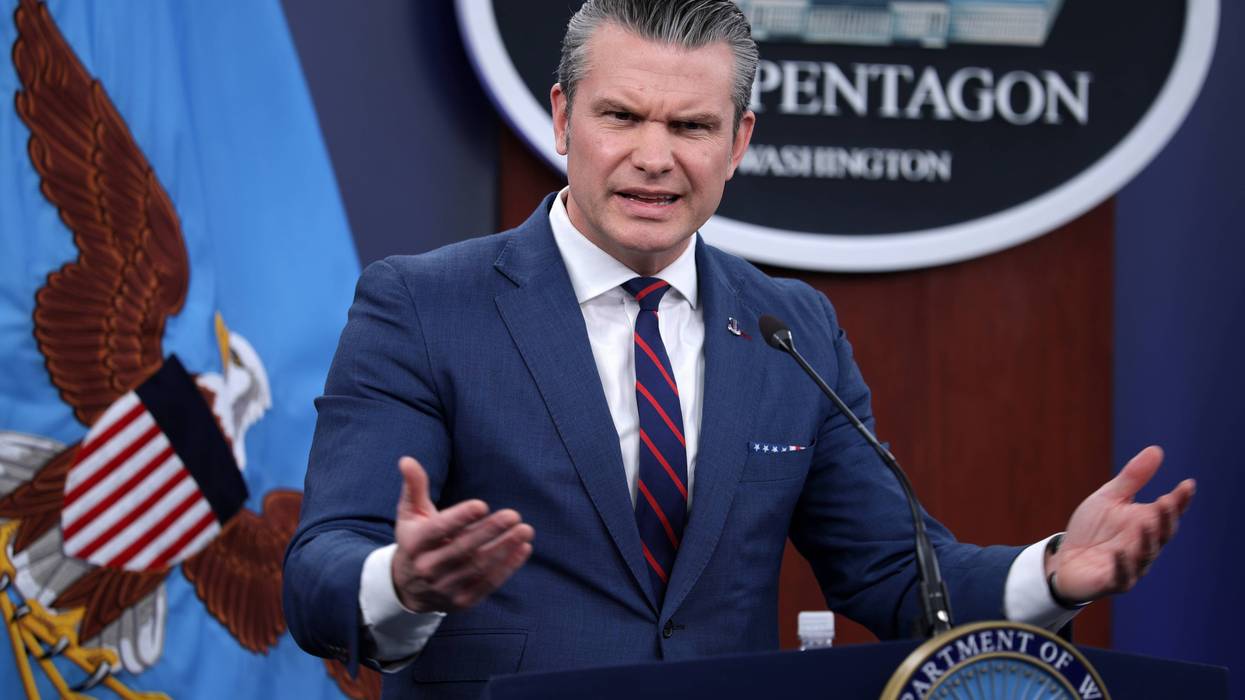
While Hegseth’s rhetoric on the post-9/11 wars often reflects mainstream Republican talking points, his zeal indicated something deeper.
Earlier this year, President Donald Trump surveyed his top military brass on the prospect of making war in Iran. Chairman of the Joint Chiefs of Staff General Dan Caine urged caution, presciently predicting that a ramped-up campaign against Iran could lead its leaders to close the Strait of Hormuz. However, Pete Hegseth, Trump’s self-styled “Secretary of War,” jumped at the prospect of such a conflict.
“Pete, I think you were the first one to speak up,” Trump recently recalled at a press event. “And you said, ‘Let’s do it, because you can’t let them have a nuclear weapon.’”
Americans join the military for any number of reasons: to serve their country, gain economic stability, or simply join a community. For Hegseth, a thirst for martial victory and a desire for a masculine metamorphosis seemed to surpass all else.
Much to Hegseth’s chagrin, however, his career as an Army officer corresponded to a series of distinctly failed military campaigns. After graduating from Princeton in 2003, he deployed to two doomed military locales—Afghanistan and Iraq—and then relentlessly defended the Pentagon’s occupation of parts of those places in essays, speeches, and, ultimately, as a weekend host on Fox News. While Hegseth’s rhetoric on those wars long reflected mainstream Republican talking points—papering over chaos and death in the Middle East and beyond with pledges that stable democracies were close at hand—his zeal indicated something deeper: a desperation, it seemed, to wring some sort of personal validation from his time in uniform.
“The rank and file, and even some of the officers, have accepted the gravity of the war’s failures,” Adam Weinstein, a Marine Corps veteran and deputy director for Middle East policy at the Quincy Institute, a nonpartisan think tank focused on peace and diplomacy, told me, speaking of Iraq and Afghanistan. “There’s a deep sense of sacrifice and loss for nothing. And that can lead to fatalistic beliefs, it can lead to Islamophobia. In its healthier form, it can lead to questioning the principles of interventionism and the U.S. foreign policy establishment.”
Hegseth, for his part, chose to totally avoid any personal or geopolitical reckoning. Once the Global War on Terror became politically untenable to defend, he cast about for excuses that wouldn’t implicate his own career in the military. Rather than zero in on tactical or intelligence failures, his rhetoric took a dark turn, increasingly inflected by Islamophobia, misogyny, and a distinctly toxic version of masculinity.
As his profile rose, Hegseth argued ever more forcefully that the Pentagon was weak-willed, insufficiently lethal, and overrun by incompetent and cowardly leaders, many of them women or minorities who (in his eyes) had been unfairly promoted. His proposed remedy was as blunt and dense as his diagnosis: America simply needed to fight harder in the Middle East until the mission was accomplished and “Islamic extremism” was eliminated. As one of his former co-workers told me, “I never got the feeling that he wanted to abandon the Middle East.”
I asked Weinstein if, during his own 2012 deployment to Afghanistan, he saw Islamophobia bubbling below the surface. “It was right on the surface,” he responded. “But what do you think the World War II generation was saying about the Japanese? Dehumanization is a natural outgrowth of war.”
“If You Want Something, You Go After It”
As a boy growing up in Minnesota, Hegseth appeared to be a perfect version of the American male. He was religious, athletic, well-spoken, and remarkably handsome. He was ashamed, however, of his self-perceived softness. “I didn’t get in fights as a kid and shied from confrontation because, frankly, I was scared of it,” he wrote in his 2016 book In the Arena, Good Citizens, a Great Republic, and How One Speech Can Reinvigorate America . In it, he went on to hail his father, Brian, for his “integrity” and “Scandinavian work ethic,” before evincing thinly veiled resentment for not having been reared effectively in the masculine art of aggression. “My father was—and is—an incredible man,” he reflected, “but confrontation isn’t necessarily his forte.”
Military service, Hegseth figured, would imbue him with some much needed and previously missing manliness. It was also his best path to class mobility and prestige. When it came time for college, he applied to West Point, America’s most prestigious service academy, and Princeton, where he was gunning for a ROTC scholarship. He got into both schools and chose the latter, touching down on its verdant New Jersey campus in 1999.
In deciding on Princeton, Hegseth launched himself on a path eerily paralleling that of another Minnesota native of a previous era, novelist F. Scott Fitzgerald. Both of them were working-class lads who attended Princeton, where they bristled at the elitism while craving its validation. Both developed a writing voice on campus and then joined the Army. Both also struggled with the bottle and with women, though Fitzgerald, unlike Hegseth, was somewhat reflective about his vices. He initially called his first novel The Romantic Egotist (later, This Side of Paradise). It followed a handsome, middle-class Princeton man whose greed and social ambition inhibited his ability to find true love. Hegseth himself expressed a similar ambition in a 2015 interview: “If you want something, you go after it—you’re willing to sleep a little less, put up with more, put up with a little insanity and do things you don’t want to do.”
In a widely read 1927 essay on his alma mater, Fitzgerald asserted that Princeton men “resent any attempt at analysis.” Hegseth also did his best to make such analysis impossible. At Princeton, he was deemed a man with “many faces,” loudly endorsing the Iraq war and attacking feminist groups on campus (even if, in quieter moments, he showed a capacity for nuance and kindness).
One of his former professors has pointed out that Hegseth’s current persona and his Princeton one “don’t fit.” Part of the disconnect stems from the fact that his puffed-up, bellicose military posturing in the Trump era doesn’t match either his Ivy League education or his actual service record. Hegseth came away from the war in Iraq with a Bronze Star that, it’s worth noting, was issued “without valor.” (It was, in short, a lesser version of the medal that, according to the Washington Post, was “issued somewhat liberally” during the War on Terror years. Some enlisted personnel joked that such a decoration was little more than a “participation trophy” for needy officers.)
Hegseth’s award citation was indeed dry and formulaic, chock-full of the soaring platitudes then used by the White House to sell the American public on the disastrous war in Iraq. It asserted (in what was, historically speaking, a fantasy) that he had “contributed immeasurably to the success of building a free and democratic nation for the citizens of Iraq.”
In reality, the supposed heroes of Hegseth’s war were generally not pedigreed Army National Guard officers like him, but door-busting, ass-kicking Green Berets and Navy SEALs. This was largely thanks to movies like American Sniper and Zero Dark Thirty that lionized their contributions.
After returning home, Hegseth made inroads with such operators via his advocacy work at a series of astro-turf veterans groups, including the “Concerned Veterans of America” (backed by the billionaire Koch brothers), which advocates for the privatization of the Veterans Administration. As part of his duties, he embarked on a 10-city “Defend Freedom” tour in 2014. Such events featured Madison Rising, billed as “America’s most patriotic rock band,” as well as speeches from decorated military heroes and family members.
On that tour, Hegseth connected with Karen Vaughn, a Gold Star mother whose son, Aaron, a SEAL Team Six member, had been killed in Afghanistan. Vaughn told me that she supports Hegseth mostly because he listens to those who have experienced conflict up close. “His friends are the people who fought these wars,” she said. “They are not the people who sat around white linen tablecloths with glasses of wine discussing them.”
Vaughn later introduced Hegseth to Eddie Gallagher, a SEAL who ignited a simmering debate over the military’s rules of engagement when he was accused of killing civilians and fatally stabbing a wounded captive. Hegseth used the case of Gallagher and two others accused of grisly war crimes against civilians in an attempt to move the Overton window on what should be deemed acceptable rules of wartime engagement. “These are men who went into the most dangerous places on earth with a job to defend us and made tough calls on a moment’s notice,” he brashly asserted. “They’re not war criminals, they’re warriors.” Ultimately, President Trump agreed with him and reversed Gallagher’s demotion after he was acquitted of the most serious charges, while pardoning other troops who had been convicted of war crimes.
It was through this work that Hegseth earned serious credibility among that badass class of warfighters and ultimately came to embody the essential Trumpian soldier archetype of this moment: White, male, and god-fearing.
The Jerusalem Cross Secretary of War
According to 2019 Department of Defense data, approximately 70% of active-duty service members were Christian (and that undoubtedly hasn’t changed in the era of Donald Trump). It’s the people who look, talk, and pray like Hegseth who also seem most receptive to opposing women serving in combat roles and in favor of Islamophobic war rhetoric. “If we’re going to send our boys to fight—and it should be boys,” he wrote in his memoirs, “we need to unleash them to win. [America needs] them to be the most ruthless.”
But the United States had already sent too many boys into harm’s way in disastrous wars and its citizens were becoming exhausted by conflict. By 2013, as Hegseth’s star was rising, 53% of polled Americans already saw the Iraq war as a mistake. That same year, Hegseth first ventured to Jerusalem, where, in a piece penned for the National Review, he hailed “Israel’s sense of purpose.” Unlike other nations, Hegseth observed, Israel maintained “an ever-present understanding that the fragile peace they enjoy and their nation itself are preserved only through intentional, purposeful, and courageous action.”
Here was a nation that could satisfy Hegseth’s unquenched thirst for military dominance in the Arab world. And unlike the United States, which sought technocratic rationales for war, Israel had the advantage of framing everything in biblical terms. “I find myself envious,” Hegseth concluded, “of the gravity and substance of the Israelis’ task.”
He repeatedly visited Israel in the years that followed, something that helped rejuvenate his faith in both God and war. In Israel, Hegseth consulted with conservative political figures and soldiers of the Israeli Defense Forces; visited military bunkers on that country’s northern border; and toured Hebron, a Palestinian city in the West Bank that Israel has targeted with attacks and settlements. He also produced a series of on-the-ground, pro-Israel documentaries for Fox News’s streaming service, including “Battle in the Holy Land,” “Battle in Bethlehem,” and “Life of Jesus.” While filming one of those projects, he first spotted a Jerusalem Cross, a symbol once used by the medieval crusaders, and had it tattooed on his chest “to show that my religion is front and center in my life.”
Hegseth’s skin would come to perfectly illustrate his signature version of hyper-aggressive Christian masculinity. His collage of body ink today includes an American flag, an assault rifle, and the words “Deus Vult” or “God wills it”—a motto from the Crusades that has been adopted by White supremacists and was seen at the deadly 2017 march in Charlottesville, Virginia. Hegseth also inked the word “kafir,” meaning “infidel” or “non-believer,” on his right bicep.
By 2016, he had come to see Israel’s success as inexorably bound to that of the United States. That January, when President Barack Obama ratified a historic nuclear deal with Iran, Hegseth saw a cowardly capitulation to a country that, he argued then, “would wipe both Israel and America off the map if it could.” During a visit to Israel that year, he pledged to an audience that the United States was forever prepared to “lock arms and shields with all of you in defense of freedom and western civilization.”
It’s this history, as much as anything, that helps explain America’s current war with Iran. In Secretary of War Hegseth, America now has a man with a bone-deep desire for national revenge, one largely animated by his poorly disguised sense of embarrassment at, and personal emasculation over, the utter failures of the wars he fought in.
These are, of course, profoundly flimsy, deeply egotistical excuses for sending American troops into harm’s way yet again. Not surprisingly, then, there have even been a series of public rejections and defections by former Trump administration figures frustrated by the conflict with Iran. The most notable of these is Joe Kent, a former counterterrorism official in the Trump administration who resigned his post, citing “no imminent threat to our nation” from that country. Director of National Intelligence Tulsi Gabbard and CIA Director John Ratcliffe have also tacitly acknowledged that the war in Iran was not launched by an actual threat index.
As Hegseth has made clear in his words and deeds, the latest American war is largely animated by emotional factors, plus (as reporting has shown) intense pressure from Israel. Now being in charge of the Pentagon, and with a renewed opportunity to pummel the Middle East, he has dropped all institutional pretense to compassion or caution. “We are punching them while they’re down,” he recently told reporters, “which is exactly how it should be.” In practice, this has meant a brutal bombing campaign in conjunction with Israel that targeted, among many other things, a girl’s primary school and oil tankers in the Strait of Hormuz, acts that respectively killed children and polluted the region. Hegseth also pledged not to offer quarter to enemy combatants in violation of international law.
He certainly hopes that faith and masculine posturing alone can secure success. Absent tangible intelligence, he has taken a page out of Israel’s book by injecting religiosity across the ranks, recently promising on CBS News that “the providence of our almighty God is there protecting those troops, and we’re committed to this mission.” Asked directly if he views this conflict as a religious one, Hegseth said, “Obviously, we’re fighting religious fanatics who seek a nuclear capability in order for some religious Armageddon.”
To bolster such an atmosphere, he has hosted Pentagon prayer services involving fiery Christian nationalist pastors and a Grammy-award-winning religious singer. His department’s promotional videos have displayed Bible verses alongside military footage. Watchdogs further claimed that U.S. commanders have counseled troops that the war is fulling biblical prophecies around Armageddon. Hegseth’s fusion of strength, religion, and violence was encapsulated in a poster allegedly displayed at a U.S. military installation in recent days. It featured Jesus Christ firing a mortar round.
Hegseth’s 2024 book, The War on Warriors, further sketches out his theory for reinvigorating the military’s masculine ethos, often through half-assed aphorisms that could fit on a Ford F-350 bumper. Sprinkled in are mythical tales, most of which have Hegseth or another aggrieved White guy at their center. The military has become so warped and woke, he writes, that it has diluted standards to allow women in combat while simultaneously kicking out “good soldiers for having naked women tattooed on their arms.” In Hegseth’s eyes, of course, women should only be on the front lines if they’re naked and in ink.

Our leaders continue to spend money on wars they think will make the United States the undisputed power in the world—wars that instead kill millions of people abroad, endanger US troops, and make life harder at home.
As Memorial Day approached, polls showed nearly two-thirds of US voters oppose the war against Iran. They’re right. After decades of war since 9/11, Americans now largely agree: War isn’t worth it.
The Iran war has killed thousands of Iranians and Lebanese and displaced hundreds of thousands more. People in poor countries around the world are facing fuel shortages, power outages, and food insecurity, with much worse to come.
Here in the United States, the war has already cost more than $50 billion, and the cost is only going up—not just at the gas pump but in opportunity. For that $50 billion, we could have paid for healthcare for 3 million people in this country and gotten about 1.5 million kids into Head Start, according to the Institute for Policy Studies National Priorities Project.
Which makes us safer?
For the $16 trillion the US had spent on the military after 9/11 before the Iran war, we could have made transformative investments in healthcare, education, and renewable energy.
President Donald Trump would like us to believe that no price is too high to stop Iran’s “nuclear threat.” But Iran isn’t a nuclear threat. Year after year, including 2026, US intelligence agencies agreed that Iran is not building nuclear weapons.
In 2015, Iran agreed to cut its stockpile of enriched uranium, reduce its reactors, and submit to unprecedentedly intrusive United Nations inspections. The United States, in return, agreed to end many of the sanctions that were crippling Iran’s economy.
It worked. Intelligence agencies around the world, including in the United States, agreed that Iran was complying. UN inspectors kept a watchful eye on Iran’s reactors, traffic through the Strait of Hormuz flowed freely, and Iran was still not trying to build a nuclear weapon, maintaining that a bomb would violate Islamic law.
However, Trump tore up the agreement in 2018. He didn’t pretend Iran was violating it; he just claimed he could “get a better deal.” He couldn’t.
Instead, Trump joined Israeli Prime Minister Benjamin Netanyahu and ratcheted up threats against Iran. Eventually, those threats turned into reality—first in a short-term bombing campaign in June 2025 and then a full-scale US-Israeli war this year.
Despite repeated ceasefire declarations and claims from the White House that “we’ve won,” the war continues months later. Thousands are dead, gas prices are shockingly high, and the Strait of Hormuz (which was running fine before Trump trampled the nuclear deal) remains largely closed.
It’s easy to say that diplomacy works and war does not. That’s not just a statement of principle—it’s the truth.
Diplomacy is the only strategy that’s ever worked to change Iran’s behavior. It wasn’t because the US asked nicely. It was because the US negotiated seriously; changed its own aggressive behavior; and stopped using its economic, political, and strategic power as acts of war against Iran.
Is this war worth the human, economic, or environmental costs? Clearly not. You could say the same of Trump’s other second-term conflicts—including his support for Israel’s genocide in Gaza and his attacks on Somalia, Yemen, Venezuela, and Nigeria.
In fact, today most Americans would agree that none of the major wars in this country’s recent memory have been worthwhile—not in Vietnam, Central America, Iraq, Afghanistan, or Iraq again.
For the $16 trillion the US had spent on the military after 9/11 before the Iran war, we could have made transformative investments in healthcare, education, and renewable energy. We could have erased student debt and virtually wiped out child poverty at home and globally.
Instead, our leaders continue to spend money on wars they think will make the United States the undisputed power in the world—wars that instead kill millions of people abroad, endanger US troops, and make life harder at home.
Veterans know this. “The US has been at war in one form or another since my deployment in the Persian Gulf, 36 years ago,” said Michael McPhearson, executive director of Veterans for Peace.
“Trillions of tax dollars spent, thousands of US military service members dead, and tens of thousands wounded. The toll on the rest of the world is even more staggering, while warmongers and those who send us to war get richer,” he added.
“It’s time to invest in people and life and stop spending money on death and destruction,” McPhearson said.
I agree—and so do most Americans.
This piece was originally published in DC Journal.

Consumers won’t see a dime from the refunded tariffs—and in all likelihood they’ll keep paying for them
The Trump administration collected $166 billion in tariff payments before the Supreme Court struck them down. Refunds have already started hitting the bank accounts of US importers—and more could be owed soon.
As more than 300,000 companies scramble to get their money back, one large group is getting stiffed: American consumers.
After President Donald Trump imposed sweeping, indiscriminate tariffs on so-called “Liberation Day” last year, companies moved swiftly to pass on their higher prices to consumers. Consumers, already facing an affordability crisis—and reporting historic dissatisfaction with the economy—paid those higher prices at the grocery store, hardware store, and clothing store.
Instead of focusing on strategic sectors where American manufacturers were being undercut or where we’re developing new technologies, Trump imposed tariffs seemingly on a whim—hitting inputs that drove up costs for manufacturers and goods (like bananas or coffee) that are not made in the mainland United States and never will be.
With corporate profits at record highs, Congress should step in to ensure that consumers see some relief.
The results were as expected.
New data from the Federal Reserve found that businesses were able to pass through tariffs almost completely, raising core goods inflation by 3.1%. The Harvard Pricing Lab finds that retail prices for imported goods are up 5.4% compared with pre-Liberation Day trends.
Furthermore, the shock and confusion of the Liberation Day tariffs and dozens of subsequent adjustments allowed companies to take advantage of the pricing environment, raising prices even if they were not directly affected. Some even bragged about it on calls with their investors.
Unsurprisingly, consumers think this arraignment is unfair.
Polling from my organization, Groundwork Collaborative, found that 44% of Americans think refunds should go to consumers—and 34% believe that refunds should go to consumers and businesses.
Just 7% say that only businesses should get their money back. But that’s what’s happening.
Consumers won’t see a dime from the refunded tariffs—and in all likelihood they’ll keep paying for them. Prices, as retail experts like to say, are like “rockets and feathers.” When they go up, they go up quickly. But when costs fall, prices come down slowly—if they come down at all.
Big corporations that were able to pass through the price increases will now get a windfall, with no plans to pass on those savings. Costco made news by announcing they planned to use their sizable refund to lower prices, but almost no other corporations have followed their lead.
In addition to hurting consumers, the benefits of tariff refunds are unequally distributed between big and large corporations. Some 56% of small businesses reported that tariffs negatively impacted their operations, and many have shared difficulties and confusion with navigating the tariff refund portal.
Larger companies have used their size and market power to negotiate with suppliers and push costs onto consumers, but many small businesses had to pay whopping bills or risk going under. Some even sold the rights to their future refunds to Wall Street for pennies on the dollar to get cash up front to weather the storm, and now companies like Commerce Secretary Howard Lutnik’s old firm are profiting.
Families are hurting in this economy. They’re facing rising prices at the pump—up 50% because of Trump’s war in Iran—along with runaway utility bills and further uncertainty as Trump’s latest round of tariffs wind their way through the courts.
Meanwhile, the Trump administration hasn’t lifted a finger to ensure that corporations pass their savings through to consumers. In fact, Trump has even asked businesses not to claim the refunds at all, telling them he’ll “remember” companies that opt out.
With corporate profits at record highs, Congress should step in to ensure that consumers see some relief. Americans already paid these tariffs once—they shouldn’t have to pay again while corporations cash the checks.

Despite positioning itself to the conservative center of the political spectrum in recent decades, the Democratic Party can yet build on its members' near universal call for a more muscular confrontation with Republicans and Trump.
The Democrat's 2026 midterm electoral strategy remains essentially the same as it was during the melted-down 2024 presidential election: Focus on President Donald Trump's obvious character flaws and failings rather than highlight the critical issues and offer progressive alternatives. Waiting for Trump to shoot himself in the foot is not a winning campaign strategy. Neither are abstract ideas about defending democracy and saving the nation from autocracy or fascism. Voters want practical approaches to everyday challenges of rising food costs, prohibitively expensive and inadequate health insurance, skyrocketing medical costs, exorbitant childcare and pre-K expenses, and spiraling energy pricing.
Since the last quarter of the 20th century, establishment Democrats and their leaders have slid so far to the political right that progressive, populist initiatives are undermined by fear of taxes and debt. The Democratic Party has allowed conservatives to label it as a party of spendthrift liberals and radical leftists rather than actually embracing a progressive agenda offering optimistic, creative, and constructive alternatives to the conservatives' agenda favoring the wealthy and corporations. Due to its conservative turn, moreover, Democratic leadership is decidedly reluctant to back progressive and politically aggressive Democratic candidates, as seen in the candidacies of Zohran Mamdani in New York and Graham Platner in Maine.
The political table has been so tilted toward conservative goals that the survival of the Democratic Party and popular elections itself are clearly threatened. Gerrymandering, opposing mail-in ballots, requiring stricter voter identification, confiscating state voting records and increasing the presence of security forces at polls are among the voter suppression tactics that conservatives are employing to rig the midterm and other future elections. The use of the military to confiscate ballots in the upcoming midterm elections is far from out of the question. Financing independent candidates to siphon off votes from Democratic ones is another ploy to be expected. To counter these anti-democratic tactics, Democrats must frame these challenges in practical personal terms—as corrupt means to prevent citizens from influencing policy, as ways to deny such popular initiatives as universal healthcare and control over other cost-of-living expenses. Complaining about the threat to democracy simply isn't concrete and personal enough.
Absent vociferous opposition to the conservative direction in international affairs, the Democrats also cede this critical ground to Republicans. This effectively facilitates the displacement of diplomacy by militarism as the principal approach to resolving global issues and conflicts. Without alerting and educating the American public to its profound and eminently dangerous military, political, and economic implications, the Democrats' influence here is essentially neutered. The present conflicts in the Middle East illustrate this point. Despite expressed public concern for supplying Israel with the munitions used against Palestinians in Gaza, the Democrats demurred from leveraging the removal of military support to promote a ceasefire and negotiated settlement. Neither did the party bring to the public's attention the US abandoning diplomatic negotiations with Iran in February, negotiations that were reportedly making progress on nuclear energy concerns. The combination of unrestricted military aid and disingenuous diplomacy fueled a regional war. This is a reality that must be made emphatically clear to American citizens.
Running against a personality cult and election rigging without offering hope for a better future through specific, concrete policy commitments effectively puts Democrats on the defensive and abandons the progressive populist movement in its own party.
Despite positioning itself to the conservative center of the political spectrum in recent decades, the Democratic Party can yet build on its members' near universal call for a more muscular confrontation with Republicans and Trump. One starting point is massive military spending. The disastrous domestic and global effects of US military campaigns and overall defense spending present Democrats with a historic political opportunity. To take advantage of this opportunity the party must immediately take the offensive by highlighting the deleterious impact of unparalleled military expenditures. This campaign strategy can unfold in specific ways, drawing into high relief the connection between allocating vast resources away from social programs into military coffers.
First, levels of defense spending are inversely, and critically, correlated with spending for services that profoundly impact the quality of life of the vast majority of Americans. The proposed $1.5 trillion military expenditure for 2027—a 44% increase over 2026 and more than half of the total government budget—sequesters funding that could be used for domestic purposes, programs ranging from education, public health, housing, transportation, and social services to agriculture, science, and environmental protection. This comparison highlights the distorted priorities of the nation and directly relates to the jaundiced attitude toward the federal government and the disaffection of large swaths of American voters. It further counters the impact of disinformation and misinformation that aggravate divisions and suspicions fueled by negative propaganda and conspiracy rhetoric promoted by the Trump administration.
Second, heavy defense spending and military confrontation and conflict contribute to global economic and political instability beyond the devastating human suffering inflicted by military tactics and war. This course blazes a treacherous path that violates human rights and international law, fraying alliances and degrading the country's respect and reputation internationally. The escalation of military exchanges and strategies that Iran and the US are pursuing in the Strait of Hormuz signify not only the destructive international impact but also the extensive domestic economic stress it thrusts on Americans. The price of gasoline and its broad inflationary effect are prime examples. Defense spending drives up national debt with minimal social benefit. While military expenditure does provide jobs in the defense industry, a portion of savings resulting from limiting military spending can be used to retrain displaced workers for new high-paying employment in renewable energy and other industries the government could incentivize, industries where workers and their unions could be protected by statutory law.
Third, and amply illustrated by the militarized standoff in the Gulf of Hormuz, the Iran War is strengthening American economic competitors while splintering alliances with nations now losing confidence in US military and commercial relations. Fearful of the impulsive, unreliable posturing and military aggression of the Trump administration, countries in various regions of the world are forging commercial relations with China. Moreover, Beijing's massive investment in improving and producing renewable energy and its delivery—a strategic market position the current administration and its congressional supporters have ceded to the Chinese—is a wise and calculated enterprise. This investment displaces future scientific, technological, and commercial development in this country, further restricting employment and scientific investment in a growing sustainable energy source. At the same time, the progressive shift from oil and gas to renewable fuels may redirect international finance based in Wall Street to direct and indirect investment in economic expansion in China and in parts of the world that adopt and eventually depend on Chinese technology.
Last, the enormous investment in defense is not justified relative to defense spending worldwide. The US spends more on defense than the next six countries combined—three times as much as China and five times as much as Russia. With an over 40% boost in next year's military budget the disparity in military expenditures will even widen the military spending gap between America and other countries. Given the many social needs in this country and the military's aggressive engagement in projecting its power, enormous resources heedlessly dedicated to the military undermines quality of life across the nation and is simply unsustainable. Favoring diplomacy over military action, moreover, brings greater stability to international relations, reduces unnecessary military expenditures, and, in turn, can redirect funds to investment in international commercial relations to spur sustainable domestic economic growth.
As this brief examination of America's misplaced priorities demonstrates, the Democrats not only have clear opportunities to undermine the false narratives of the present administration and its supporters, they also have the public responsibility to do so. A similarly focused, analytical, and expansive argument may be made with tax cuts for the wealthy, with the severe personnel reductions at the Centers for Disease Control and Prevention and elsewhere, and with myriad other issues. These campaign arguments should be, moreover, framed as national security threats.
Squandering such a political opportunity and advantage will weaken the party overall. It further undercuts the groundwork laid by local party members—through demonstrations and campaigns to increase voter turnout—by ignoring local calls for a more aggressive campaign strategy that directly challenges Republicans and offers sustainable social, economic, and environmental policies.
The party should not wait for a wave of nationalism to be ginned up in the wake of a specious “deal” with Iran or for an “October surprise” like the sudden discovery of funds to help pay Americans' medical bills. Running against a personality cult and election rigging without offering hope for a better future through specific, concrete policy commitments effectively puts Democrats on the defensive and abandons the progressive populist movement in its own party, sacrificing forward-thinking and future planning to backward-thinking and complacency. This is a losing proposition in the short-term and long-term future. It not only erodes the power of the vote but it will also alienate millions more Americans at a time when creative, constructive leadership and citizen engagement are imperative to meet the existential social, economic, and ecological challenges of the coming years and decades.