SUBSCRIBE TO OUR FREE NEWSLETTER
Daily news & progressive opinion—funded by the people, not the corporations—delivered straight to your inbox.
5
#000000
#FFFFFF
To donate by check, phone, or other method, see our More Ways to Give page.
Daily news & progressive opinion—funded by the people, not the corporations—delivered straight to your inbox.
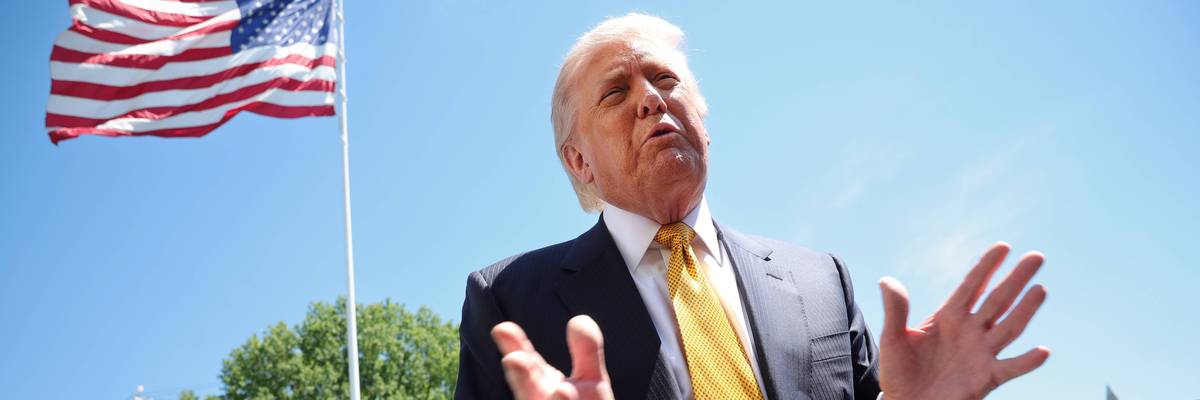
President Donald Trump speaks in front of the American flag to the press as he departs the White House on May 12, 2026 in Washington, DC.
Sen. Ron Wyden said the $1.8 billion slush fund was "staggeringly corrupt even by Trump's bottom-dwelling standards."
President Donald Trump's attempt to create a $1.8 billion slush fund for his political allies is coming under bipartisan attack, and congressional Democrats are proposing a 100% tax on any of its future beneficiaries to thwart what's being described as an unprecedented form of corruption in the nation's nearly 250-year history.
Rep. Mike Thompson (D-Calif.) on Tuesday introduced the first bill taxing Trump slush-fund payouts at a 100% rate, and he was followed on Thursday by Sens. Chuck Schumer (D-NY) and Ron Wyden (D-Ore.), who introduced a similar bill in the US Senate.
If enacted, the legislation would negate the entire $1.8 billion venture, which was created as purported restitution for Trump politcal allies who have been convicted of committing crimes on his behalf, and force beneficiaries to return any payments received to the US Department of Treasury.
The bill would slap on an additional 50% penalty "in the case of any willful attempt to avoid or evade the tax."
Wyden described the president's slush fund, which could be used to pay out cash to Trump supporters who violently stormed the US Capitol building on January 6, 2021, as "staggeringly corrupt even by Trump’s bottom-dwelling standards."
"Congress must do whatever it takes to prevent Donald Trump from stealing $1.8 billion from the American people to fund right-wing violence and handouts to insurrectionists," said Wyden. "This money doesn’t belong to Donald Trump, it belongs to the taxpayer.”
Thompson, the ranking member of the House Ways and Means Subcommittee on Tax, said that the legislation is need to stop Trump's attempt "to line the pockets of January 6th insurrectionists who attacked law enforcement and tried to overturn our democratic election."
"My legislation ensures if a sitting president sues our government while in office," added Thompson, "they get taxed 100% on any money paid through a trial or settlement."
Rep. Mike Levin (D-Calif.) took some time on Thursday to provide an overview of the Trump slush fund's creation in a lengthy social media post.
As explained by Levin, the fund came about after Trump filed a $10 billion lawsuit against the Internal Revenue Service (IRS) earlier this year over the 2019 leaking of his tax returns.
Levin noted that "IRS lawyers did their jobs" by writing a memo of legal arguments they believed would defeat Trump's lawsuit in court.
However, before the case could be fully heard in a courtroom, Trump agreed to drop his lawsuit while the US Department of Justice (DOJ) announced the creation of the $1.8 billion "anti-weaponization fund" as a settlement.
Levin also called attention to the structure of the committee, which he said was riddled with conflicts of interest.
"The acting attorney general, Trump’s former criminal defense attorney, picks the five commissioners who decide who gets paid," he said. "Trump can fire any of them. Proud Boys and Oath Keepers are not ruled out."
Levin concluded by calling the fund "the most corrupt thing I've ever seen from an American president."
While Democrats are taking the lead in the effort to block Trump's slush fund, some Republicans have also indicated their opposition to the initiative.
Rep. Brian Fitzpatrick (R-Pa.), one of the most vulnerable GOP members of the House, said on Wednesday that "a nearly $1.8 billion DOJ-controlled fund cannot be created, defined, and distributed in the shadows," and he demanded acting US Attorney General Todd Blanche provide answers about who will be eligible to receive payouts and under what legal authority.
"Taxpayer dollars will not be turned into a discretionary payout fund," Fitzpatrick emphasized. "Transparency is not optional. Accountability is not negotiable."
According to a Thursday report from Punchbowl News, Senate Republicans are preparing to slap restrictions on the $1.8 billion fund that could prevent any payments from going to January 6 rioters who attacked police officers.
In an interview with Punchbowl News, Sen. Thom Tillis (R-NC) expressed incredulity that such guardrails were even necessary.
"Imagine that—a fund that is set up to compensate people who assaulted Capitol Police officers," Tillis said. "How absurd does that sound coming out of my mouth?"
Dear Common Dreams reader, It’s been nearly 30 years since I co-founded Common Dreams with my late wife, Lina Newhouser. We had the radical notion that journalism should serve the public good, not corporate profits. It was clear to us from the outset what it would take to build such a project. No paid advertisements. No corporate sponsors. No millionaire publisher telling us what to think or do. Many people said we wouldn't last a year, but we proved those doubters wrong. Together with a tremendous team of journalists and dedicated staff, we built an independent media outlet free from the constraints of profits and corporate control. Our mission has always been simple: To inform. To inspire. To ignite change for the common good. Building Common Dreams was not easy. Our survival was never guaranteed. When you take on the most powerful forces—Wall Street greed, fossil fuel industry destruction, Big Tech lobbyists, and uber-rich oligarchs who have spent billions upon billions rigging the economy and democracy in their favor—the only bulwark you have is supporters who believe in your work. But here’s the urgent message from me today. It's never been this bad out there. And it's never been this hard to keep us going. At the very moment Common Dreams is most needed, the threats we face are intensifying. We need your support now more than ever. We don't accept corporate advertising and never will. We don't have a paywall because we don't think people should be blocked from critical news based on their ability to pay. Everything we do is funded by the donations of readers like you. When everyone does the little they can afford, we are strong. But if that support retreats or dries up, so do we. Will you donate now to make sure Common Dreams not only survives but thrives? —Craig Brown, Co-founder |
President Donald Trump's attempt to create a $1.8 billion slush fund for his political allies is coming under bipartisan attack, and congressional Democrats are proposing a 100% tax on any of its future beneficiaries to thwart what's being described as an unprecedented form of corruption in the nation's nearly 250-year history.
Rep. Mike Thompson (D-Calif.) on Tuesday introduced the first bill taxing Trump slush-fund payouts at a 100% rate, and he was followed on Thursday by Sens. Chuck Schumer (D-NY) and Ron Wyden (D-Ore.), who introduced a similar bill in the US Senate.
If enacted, the legislation would negate the entire $1.8 billion venture, which was created as purported restitution for Trump politcal allies who have been convicted of committing crimes on his behalf, and force beneficiaries to return any payments received to the US Department of Treasury.
The bill would slap on an additional 50% penalty "in the case of any willful attempt to avoid or evade the tax."
Wyden described the president's slush fund, which could be used to pay out cash to Trump supporters who violently stormed the US Capitol building on January 6, 2021, as "staggeringly corrupt even by Trump’s bottom-dwelling standards."
"Congress must do whatever it takes to prevent Donald Trump from stealing $1.8 billion from the American people to fund right-wing violence and handouts to insurrectionists," said Wyden. "This money doesn’t belong to Donald Trump, it belongs to the taxpayer.”
Thompson, the ranking member of the House Ways and Means Subcommittee on Tax, said that the legislation is need to stop Trump's attempt "to line the pockets of January 6th insurrectionists who attacked law enforcement and tried to overturn our democratic election."
"My legislation ensures if a sitting president sues our government while in office," added Thompson, "they get taxed 100% on any money paid through a trial or settlement."
Rep. Mike Levin (D-Calif.) took some time on Thursday to provide an overview of the Trump slush fund's creation in a lengthy social media post.
As explained by Levin, the fund came about after Trump filed a $10 billion lawsuit against the Internal Revenue Service (IRS) earlier this year over the 2019 leaking of his tax returns.
Levin noted that "IRS lawyers did their jobs" by writing a memo of legal arguments they believed would defeat Trump's lawsuit in court.
However, before the case could be fully heard in a courtroom, Trump agreed to drop his lawsuit while the US Department of Justice (DOJ) announced the creation of the $1.8 billion "anti-weaponization fund" as a settlement.
Levin also called attention to the structure of the committee, which he said was riddled with conflicts of interest.
"The acting attorney general, Trump’s former criminal defense attorney, picks the five commissioners who decide who gets paid," he said. "Trump can fire any of them. Proud Boys and Oath Keepers are not ruled out."
Levin concluded by calling the fund "the most corrupt thing I've ever seen from an American president."
While Democrats are taking the lead in the effort to block Trump's slush fund, some Republicans have also indicated their opposition to the initiative.
Rep. Brian Fitzpatrick (R-Pa.), one of the most vulnerable GOP members of the House, said on Wednesday that "a nearly $1.8 billion DOJ-controlled fund cannot be created, defined, and distributed in the shadows," and he demanded acting US Attorney General Todd Blanche provide answers about who will be eligible to receive payouts and under what legal authority.
"Taxpayer dollars will not be turned into a discretionary payout fund," Fitzpatrick emphasized. "Transparency is not optional. Accountability is not negotiable."
According to a Thursday report from Punchbowl News, Senate Republicans are preparing to slap restrictions on the $1.8 billion fund that could prevent any payments from going to January 6 rioters who attacked police officers.
In an interview with Punchbowl News, Sen. Thom Tillis (R-NC) expressed incredulity that such guardrails were even necessary.
"Imagine that—a fund that is set up to compensate people who assaulted Capitol Police officers," Tillis said. "How absurd does that sound coming out of my mouth?"
President Donald Trump's attempt to create a $1.8 billion slush fund for his political allies is coming under bipartisan attack, and congressional Democrats are proposing a 100% tax on any of its future beneficiaries to thwart what's being described as an unprecedented form of corruption in the nation's nearly 250-year history.
Rep. Mike Thompson (D-Calif.) on Tuesday introduced the first bill taxing Trump slush-fund payouts at a 100% rate, and he was followed on Thursday by Sens. Chuck Schumer (D-NY) and Ron Wyden (D-Ore.), who introduced a similar bill in the US Senate.
If enacted, the legislation would negate the entire $1.8 billion venture, which was created as purported restitution for Trump politcal allies who have been convicted of committing crimes on his behalf, and force beneficiaries to return any payments received to the US Department of Treasury.
The bill would slap on an additional 50% penalty "in the case of any willful attempt to avoid or evade the tax."
Wyden described the president's slush fund, which could be used to pay out cash to Trump supporters who violently stormed the US Capitol building on January 6, 2021, as "staggeringly corrupt even by Trump’s bottom-dwelling standards."
"Congress must do whatever it takes to prevent Donald Trump from stealing $1.8 billion from the American people to fund right-wing violence and handouts to insurrectionists," said Wyden. "This money doesn’t belong to Donald Trump, it belongs to the taxpayer.”
Thompson, the ranking member of the House Ways and Means Subcommittee on Tax, said that the legislation is need to stop Trump's attempt "to line the pockets of January 6th insurrectionists who attacked law enforcement and tried to overturn our democratic election."
"My legislation ensures if a sitting president sues our government while in office," added Thompson, "they get taxed 100% on any money paid through a trial or settlement."
Rep. Mike Levin (D-Calif.) took some time on Thursday to provide an overview of the Trump slush fund's creation in a lengthy social media post.
As explained by Levin, the fund came about after Trump filed a $10 billion lawsuit against the Internal Revenue Service (IRS) earlier this year over the 2019 leaking of his tax returns.
Levin noted that "IRS lawyers did their jobs" by writing a memo of legal arguments they believed would defeat Trump's lawsuit in court.
However, before the case could be fully heard in a courtroom, Trump agreed to drop his lawsuit while the US Department of Justice (DOJ) announced the creation of the $1.8 billion "anti-weaponization fund" as a settlement.
Levin also called attention to the structure of the committee, which he said was riddled with conflicts of interest.
"The acting attorney general, Trump’s former criminal defense attorney, picks the five commissioners who decide who gets paid," he said. "Trump can fire any of them. Proud Boys and Oath Keepers are not ruled out."
Levin concluded by calling the fund "the most corrupt thing I've ever seen from an American president."
While Democrats are taking the lead in the effort to block Trump's slush fund, some Republicans have also indicated their opposition to the initiative.
Rep. Brian Fitzpatrick (R-Pa.), one of the most vulnerable GOP members of the House, said on Wednesday that "a nearly $1.8 billion DOJ-controlled fund cannot be created, defined, and distributed in the shadows," and he demanded acting US Attorney General Todd Blanche provide answers about who will be eligible to receive payouts and under what legal authority.
"Taxpayer dollars will not be turned into a discretionary payout fund," Fitzpatrick emphasized. "Transparency is not optional. Accountability is not negotiable."
According to a Thursday report from Punchbowl News, Senate Republicans are preparing to slap restrictions on the $1.8 billion fund that could prevent any payments from going to January 6 rioters who attacked police officers.
In an interview with Punchbowl News, Sen. Thom Tillis (R-NC) expressed incredulity that such guardrails were even necessary.
"Imagine that—a fund that is set up to compensate people who assaulted Capitol Police officers," Tillis said. "How absurd does that sound coming out of my mouth?"