SUBSCRIBE TO OUR FREE NEWSLETTER
Daily news & progressive opinion—funded by the people, not the corporations—delivered straight to your inbox.
5
#000000
#FFFFFF
To donate by check, phone, or other method, see our More Ways to Give page.
Daily news & progressive opinion—funded by the people, not the corporations—delivered straight to your inbox.
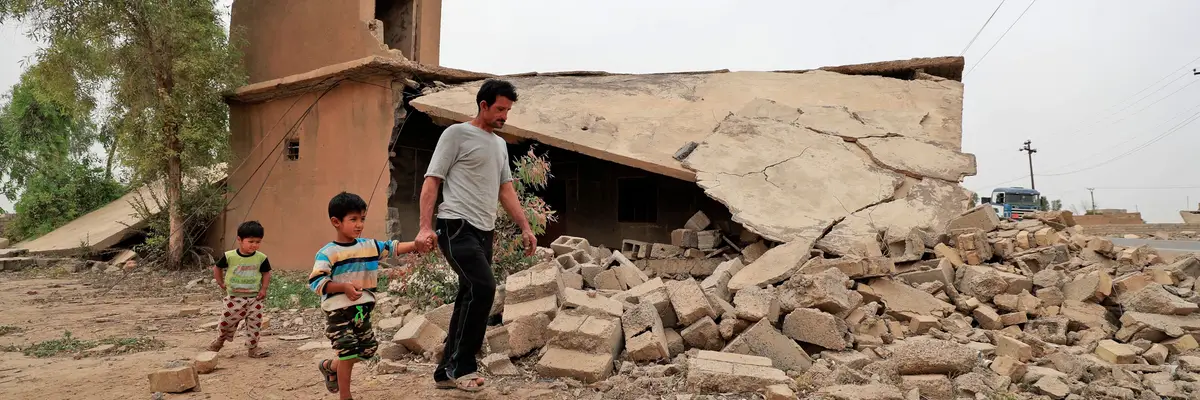
Iraqi father-of-five Issa al-Zamzoum walks past a destroyed house in the war-ravaged village of Habash, some 180 kilometers north of Iraq's capital Baghdad, on April 25, 2022.
Our leaders continue to spend money on wars they think will make the United States the undisputed power in the world—wars that instead kill millions of people abroad, endanger US troops, and make life harder at home.
As Memorial Day approached, polls showed nearly two-thirds of US voters oppose the war against Iran. They’re right. After decades of war since 9/11, Americans now largely agree: War isn’t worth it.
The Iran war has killed thousands of Iranians and Lebanese and displaced hundreds of thousands more. People in poor countries around the world are facing fuel shortages, power outages, and food insecurity, with much worse to come.
Here in the United States, the war has already cost more than $50 billion, and the cost is only going up—not just at the gas pump but in opportunity. For that $50 billion, we could have paid for healthcare for 3 million people in this country and gotten about 1.5 million kids into Head Start, according to the Institute for Policy Studies National Priorities Project.
Which makes us safer?
For the $16 trillion the US had spent on the military after 9/11 before the Iran war, we could have made transformative investments in healthcare, education, and renewable energy.
President Donald Trump would like us to believe that no price is too high to stop Iran’s “nuclear threat.” But Iran isn’t a nuclear threat. Year after year, including 2026, US intelligence agencies agreed that Iran is not building nuclear weapons.
In 2015, Iran agreed to cut its stockpile of enriched uranium, reduce its reactors, and submit to unprecedentedly intrusive United Nations inspections. The United States, in return, agreed to end many of the sanctions that were crippling Iran’s economy.
It worked. Intelligence agencies around the world, including in the United States, agreed that Iran was complying. UN inspectors kept a watchful eye on Iran’s reactors, traffic through the Strait of Hormuz flowed freely, and Iran was still not trying to build a nuclear weapon, maintaining that a bomb would violate Islamic law.
However, Trump tore up the agreement in 2018. He didn’t pretend Iran was violating it; he just claimed he could “get a better deal.” He couldn’t.
Instead, Trump joined Israeli Prime Minister Benjamin Netanyahu and ratcheted up threats against Iran. Eventually, those threats turned into reality—first in a short-term bombing campaign in June 2025 and then a full-scale US-Israeli war this year.
Despite repeated ceasefire declarations and claims from the White House that “we’ve won,” the war continues months later. Thousands are dead, gas prices are shockingly high, and the Strait of Hormuz (which was running fine before Trump trampled the nuclear deal) remains largely closed.
It’s easy to say that diplomacy works and war does not. That’s not just a statement of principle—it’s the truth.
Diplomacy is the only strategy that’s ever worked to change Iran’s behavior. It wasn’t because the US asked nicely. It was because the US negotiated seriously; changed its own aggressive behavior; and stopped using its economic, political, and strategic power as acts of war against Iran.
Is this war worth the human, economic, or environmental costs? Clearly not. You could say the same of Trump’s other second-term conflicts—including his support for Israel’s genocide in Gaza and his attacks on Somalia, Yemen, Venezuela, and Nigeria.
In fact, today most Americans would agree that none of the major wars in this country’s recent memory have been worthwhile—not in Vietnam, Central America, Iraq, Afghanistan, or Iraq again.
For the $16 trillion the US had spent on the military after 9/11 before the Iran war, we could have made transformative investments in healthcare, education, and renewable energy. We could have erased student debt and virtually wiped out child poverty at home and globally.
Instead, our leaders continue to spend money on wars they think will make the United States the undisputed power in the world—wars that instead kill millions of people abroad, endanger US troops, and make life harder at home.
Veterans know this. “The US has been at war in one form or another since my deployment in the Persian Gulf, 36 years ago,” said Michael McPhearson, executive director of Veterans for Peace.
“Trillions of tax dollars spent, thousands of US military service members dead, and tens of thousands wounded. The toll on the rest of the world is even more staggering, while warmongers and those who send us to war get richer,” he added.
“It’s time to invest in people and life and stop spending money on death and destruction,” McPhearson said.
I agree—and so do most Americans.
This piece was originally published in DC Journal.
Dear Common Dreams reader, It’s been nearly 30 years since I co-founded Common Dreams with my late wife, Lina Newhouser. We had the radical notion that journalism should serve the public good, not corporate profits. It was clear to us from the outset what it would take to build such a project. No paid advertisements. No corporate sponsors. No millionaire publisher telling us what to think or do. Many people said we wouldn't last a year, but we proved those doubters wrong. Together with a tremendous team of journalists and dedicated staff, we built an independent media outlet free from the constraints of profits and corporate control. Our mission has always been simple: To inform. To inspire. To ignite change for the common good. Building Common Dreams was not easy. Our survival was never guaranteed. When you take on the most powerful forces—Wall Street greed, fossil fuel industry destruction, Big Tech lobbyists, and uber-rich oligarchs who have spent billions upon billions rigging the economy and democracy in their favor—the only bulwark you have is supporters who believe in your work. But here’s the urgent message from me today. It's never been this bad out there. And it's never been this hard to keep us going. At the very moment Common Dreams is most needed, the threats we face are intensifying. We need your support now more than ever. We don't accept corporate advertising and never will. We don't have a paywall because we don't think people should be blocked from critical news based on their ability to pay. Everything we do is funded by the donations of readers like you. When everyone does the little they can afford, we are strong. But if that support retreats or dries up, so do we. Will you donate now to make sure Common Dreams not only survives but thrives? —Craig Brown, Co-founder |
As Memorial Day approached, polls showed nearly two-thirds of US voters oppose the war against Iran. They’re right. After decades of war since 9/11, Americans now largely agree: War isn’t worth it.
The Iran war has killed thousands of Iranians and Lebanese and displaced hundreds of thousands more. People in poor countries around the world are facing fuel shortages, power outages, and food insecurity, with much worse to come.
Here in the United States, the war has already cost more than $50 billion, and the cost is only going up—not just at the gas pump but in opportunity. For that $50 billion, we could have paid for healthcare for 3 million people in this country and gotten about 1.5 million kids into Head Start, according to the Institute for Policy Studies National Priorities Project.
Which makes us safer?
For the $16 trillion the US had spent on the military after 9/11 before the Iran war, we could have made transformative investments in healthcare, education, and renewable energy.
President Donald Trump would like us to believe that no price is too high to stop Iran’s “nuclear threat.” But Iran isn’t a nuclear threat. Year after year, including 2026, US intelligence agencies agreed that Iran is not building nuclear weapons.
In 2015, Iran agreed to cut its stockpile of enriched uranium, reduce its reactors, and submit to unprecedentedly intrusive United Nations inspections. The United States, in return, agreed to end many of the sanctions that were crippling Iran’s economy.
It worked. Intelligence agencies around the world, including in the United States, agreed that Iran was complying. UN inspectors kept a watchful eye on Iran’s reactors, traffic through the Strait of Hormuz flowed freely, and Iran was still not trying to build a nuclear weapon, maintaining that a bomb would violate Islamic law.
However, Trump tore up the agreement in 2018. He didn’t pretend Iran was violating it; he just claimed he could “get a better deal.” He couldn’t.
Instead, Trump joined Israeli Prime Minister Benjamin Netanyahu and ratcheted up threats against Iran. Eventually, those threats turned into reality—first in a short-term bombing campaign in June 2025 and then a full-scale US-Israeli war this year.
Despite repeated ceasefire declarations and claims from the White House that “we’ve won,” the war continues months later. Thousands are dead, gas prices are shockingly high, and the Strait of Hormuz (which was running fine before Trump trampled the nuclear deal) remains largely closed.
It’s easy to say that diplomacy works and war does not. That’s not just a statement of principle—it’s the truth.
Diplomacy is the only strategy that’s ever worked to change Iran’s behavior. It wasn’t because the US asked nicely. It was because the US negotiated seriously; changed its own aggressive behavior; and stopped using its economic, political, and strategic power as acts of war against Iran.
Is this war worth the human, economic, or environmental costs? Clearly not. You could say the same of Trump’s other second-term conflicts—including his support for Israel’s genocide in Gaza and his attacks on Somalia, Yemen, Venezuela, and Nigeria.
In fact, today most Americans would agree that none of the major wars in this country’s recent memory have been worthwhile—not in Vietnam, Central America, Iraq, Afghanistan, or Iraq again.
For the $16 trillion the US had spent on the military after 9/11 before the Iran war, we could have made transformative investments in healthcare, education, and renewable energy. We could have erased student debt and virtually wiped out child poverty at home and globally.
Instead, our leaders continue to spend money on wars they think will make the United States the undisputed power in the world—wars that instead kill millions of people abroad, endanger US troops, and make life harder at home.
Veterans know this. “The US has been at war in one form or another since my deployment in the Persian Gulf, 36 years ago,” said Michael McPhearson, executive director of Veterans for Peace.
“Trillions of tax dollars spent, thousands of US military service members dead, and tens of thousands wounded. The toll on the rest of the world is even more staggering, while warmongers and those who send us to war get richer,” he added.
“It’s time to invest in people and life and stop spending money on death and destruction,” McPhearson said.
I agree—and so do most Americans.
This piece was originally published in DC Journal.
As Memorial Day approached, polls showed nearly two-thirds of US voters oppose the war against Iran. They’re right. After decades of war since 9/11, Americans now largely agree: War isn’t worth it.
The Iran war has killed thousands of Iranians and Lebanese and displaced hundreds of thousands more. People in poor countries around the world are facing fuel shortages, power outages, and food insecurity, with much worse to come.
Here in the United States, the war has already cost more than $50 billion, and the cost is only going up—not just at the gas pump but in opportunity. For that $50 billion, we could have paid for healthcare for 3 million people in this country and gotten about 1.5 million kids into Head Start, according to the Institute for Policy Studies National Priorities Project.
Which makes us safer?
For the $16 trillion the US had spent on the military after 9/11 before the Iran war, we could have made transformative investments in healthcare, education, and renewable energy.
President Donald Trump would like us to believe that no price is too high to stop Iran’s “nuclear threat.” But Iran isn’t a nuclear threat. Year after year, including 2026, US intelligence agencies agreed that Iran is not building nuclear weapons.
In 2015, Iran agreed to cut its stockpile of enriched uranium, reduce its reactors, and submit to unprecedentedly intrusive United Nations inspections. The United States, in return, agreed to end many of the sanctions that were crippling Iran’s economy.
It worked. Intelligence agencies around the world, including in the United States, agreed that Iran was complying. UN inspectors kept a watchful eye on Iran’s reactors, traffic through the Strait of Hormuz flowed freely, and Iran was still not trying to build a nuclear weapon, maintaining that a bomb would violate Islamic law.
However, Trump tore up the agreement in 2018. He didn’t pretend Iran was violating it; he just claimed he could “get a better deal.” He couldn’t.
Instead, Trump joined Israeli Prime Minister Benjamin Netanyahu and ratcheted up threats against Iran. Eventually, those threats turned into reality—first in a short-term bombing campaign in June 2025 and then a full-scale US-Israeli war this year.
Despite repeated ceasefire declarations and claims from the White House that “we’ve won,” the war continues months later. Thousands are dead, gas prices are shockingly high, and the Strait of Hormuz (which was running fine before Trump trampled the nuclear deal) remains largely closed.
It’s easy to say that diplomacy works and war does not. That’s not just a statement of principle—it’s the truth.
Diplomacy is the only strategy that’s ever worked to change Iran’s behavior. It wasn’t because the US asked nicely. It was because the US negotiated seriously; changed its own aggressive behavior; and stopped using its economic, political, and strategic power as acts of war against Iran.
Is this war worth the human, economic, or environmental costs? Clearly not. You could say the same of Trump’s other second-term conflicts—including his support for Israel’s genocide in Gaza and his attacks on Somalia, Yemen, Venezuela, and Nigeria.
In fact, today most Americans would agree that none of the major wars in this country’s recent memory have been worthwhile—not in Vietnam, Central America, Iraq, Afghanistan, or Iraq again.
For the $16 trillion the US had spent on the military after 9/11 before the Iran war, we could have made transformative investments in healthcare, education, and renewable energy. We could have erased student debt and virtually wiped out child poverty at home and globally.
Instead, our leaders continue to spend money on wars they think will make the United States the undisputed power in the world—wars that instead kill millions of people abroad, endanger US troops, and make life harder at home.
Veterans know this. “The US has been at war in one form or another since my deployment in the Persian Gulf, 36 years ago,” said Michael McPhearson, executive director of Veterans for Peace.
“Trillions of tax dollars spent, thousands of US military service members dead, and tens of thousands wounded. The toll on the rest of the world is even more staggering, while warmongers and those who send us to war get richer,” he added.
“It’s time to invest in people and life and stop spending money on death and destruction,” McPhearson said.
I agree—and so do most Americans.
This piece was originally published in DC Journal.