SUBSCRIBE TO OUR FREE NEWSLETTER
Daily news & progressive opinion—funded by the people, not the corporations—delivered straight to your inbox.
5
#000000
#FFFFFF
To donate by check, phone, or other method, see our More Ways to Give page.
Daily news & progressive opinion—funded by the people, not the corporations—delivered straight to your inbox.
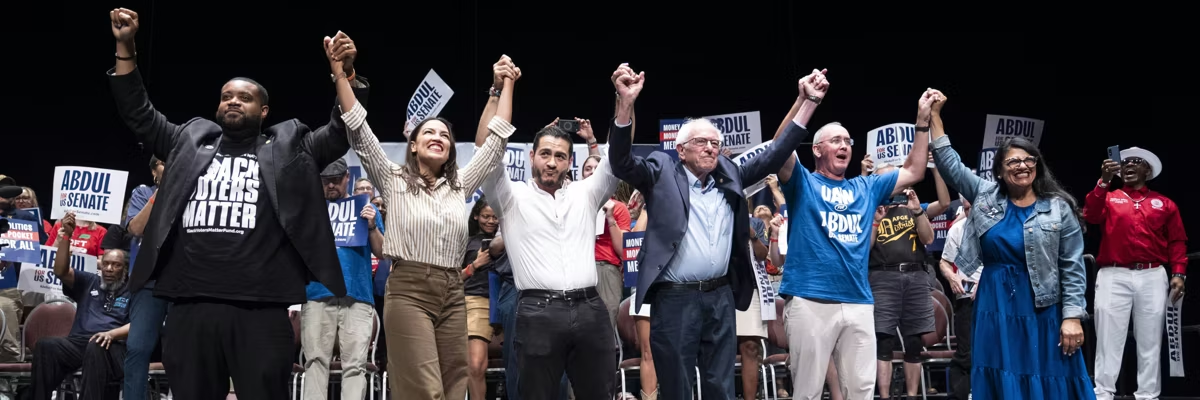
Michigan State Rep. Donavan McKinney, US Rep. Alexandria Ocasio-Cortez (D-NY), Michigan Democratic candidate for Senate Abdul El-Sayed, US Sen. Bernie Sanders (I-VT), U.A.W. President Shawn Fain and Congresswoman Rashida Tlaib greet the crowd after El-Sayed spoke at The People V. The Powerful rally at the Detroit Opera House on July 18, 2026 in Detroit, Michigan. Sanders, Ocasio-Cortez and others joined El-Sayed to rally the crowds.
What’s different now compared to past crises is that many bold progressive leaders have won competitive primaries in this year’s midterms—often putting opposition to war and genocide at the center of their messaging.
In this run-up to the 2026 mid-term elections, progressive movements and candidates remain caught up in the challenges of rising authoritarianism and militarism both at home and around the world.
We are mobilizing against new US-Israeli wars against Iran and across the Middle East/West Asia region, including Israel’s US-enabled genocide in Gaza and ethnic cleansing in the West Bank. We face explosive US bombing raids and illegal military interventions in Latin America, Africa, and beyond, as well as threats to Canada, Greenland, Mexico, and elsewhere — with President Donald Trump at the center of all of it.
What’s different now compared to past crises is that many bold progressive leaders have won competitive primaries in this year’s midterms — often putting opposition to war and genocide at the center of their messaging.
While all of the self-defined democratic socialist and progressive candidates around the country have their own sets of priorities, the most common areas in their electoral platforms include opposition to ICE and military support for Israel, support for expanding health care, affordability, and housing, and anti-authoritarianism writ large.
What’s still needed, beyond the broad principles of progressive foreign policy (see also my 2018 article on the same question as the Squad was winning primaries) is a set of ideas for specific policy proposals to address at least some of the key priority foreign policy issues that will face a new Congress during two more years of the Trump administration and going forward into the elections of 2028.
Part 1 of this series identified key principles of a progressive foreign policy. Briefly, foreign policy should reject the goals of US military and economic domination and instead be grounded in global cooperation, international law, human rights, and real diplomacy. It must also take responsibility to repair damage that US military, economic, climate, and other policies have wrought.
This section looks at some of the key global issues that progressive members of Congress will face — and what initiatives may best respond to them.
Official “US foreign policy” will never completely match the much broader internationalist goals of progressive and left movements. But there are examples of good (however limited) and bad foreign policies chosen by past governments.
The Obama administration chose some of each. Its foreign policy victories were all diplomatic: the Paris climate accord, moves towards normalization with Cuba, and especially relevant now as the US-Israeli war against Iran continues to rage, the 2015 Iran nuclear deal. Its greatest foreign policy failures occurred because Obama chose military action instead of diplomacy, including its escalations and new illegal interventions in Afghanistan, Libya, Syria, Iraq, Yemen, and Somalia.
The Biden administration’s important (though still completely insufficient) domestic successes have already been largely relegated to the sidelines and will likely be forgotten by history when weighed against his massive international catastrophes — including the failure in execution (though not in principle) of the Afghanistan withdrawal and, especially, Biden’s enthusiastic arming, financing, and defense of Israel’s genocide against Gaza.
During both of those administrations, including during the periods when Democrats also controlled both House and Senate, only a few progressives in Congress directly challenged the White House — never enough to force an end to the dangerous policies. With more candidates winning elections backed by explicitly left and socialist organizations, as well as the broader progressive movement, their political base will likely expect much more. And the work of movements in highlighting the human and economic costs of wars means that the public will accept — and increasingly will demand — much more as well.
Here are some brief ideas on a few global priorities — and potential crisis points — with some ideas of what policy responses should look like.
This is the second article in a two-part series. The first part, Progressive Principles for a New US Foreign Policy, can be found here.
Dear Common Dreams reader, It’s been nearly 30 years since I co-founded Common Dreams with my late wife, Lina Newhouser. We had the radical notion that journalism should serve the public good, not corporate profits. It was clear to us from the outset what it would take to build such a project. No paid advertisements. No corporate sponsors. No millionaire publisher telling us what to think or do. Many people said we wouldn't last a year, but we proved those doubters wrong. Together with a tremendous team of journalists and dedicated staff, we built an independent media outlet free from the constraints of profits and corporate control. Our mission has always been simple: To inform. To inspire. To ignite change for the common good. Building Common Dreams was not easy. Our survival was never guaranteed. When you take on the most powerful forces—Wall Street greed, fossil fuel industry destruction, Big Tech lobbyists, and uber-rich oligarchs who have spent billions upon billions rigging the economy and democracy in their favor—the only bulwark you have is supporters who believe in your work. But here’s the urgent message from me today. It's never been this bad out there. And it's never been this hard to keep us going. At the very moment Common Dreams is most needed, the threats we face are intensifying. We need your support now more than ever. We don't accept corporate advertising and never will. We don't have a paywall because we don't think people should be blocked from critical news based on their ability to pay. Everything we do is funded by the donations of readers like you. When everyone does the little they can afford, we are strong. But if that support retreats or dries up, so do we. Will you donate now to make sure Common Dreams not only survives but thrives? —Craig Brown, Co-founder |
In this run-up to the 2026 mid-term elections, progressive movements and candidates remain caught up in the challenges of rising authoritarianism and militarism both at home and around the world.
We are mobilizing against new US-Israeli wars against Iran and across the Middle East/West Asia region, including Israel’s US-enabled genocide in Gaza and ethnic cleansing in the West Bank. We face explosive US bombing raids and illegal military interventions in Latin America, Africa, and beyond, as well as threats to Canada, Greenland, Mexico, and elsewhere — with President Donald Trump at the center of all of it.
What’s different now compared to past crises is that many bold progressive leaders have won competitive primaries in this year’s midterms — often putting opposition to war and genocide at the center of their messaging.
While all of the self-defined democratic socialist and progressive candidates around the country have their own sets of priorities, the most common areas in their electoral platforms include opposition to ICE and military support for Israel, support for expanding health care, affordability, and housing, and anti-authoritarianism writ large.
What’s still needed, beyond the broad principles of progressive foreign policy (see also my 2018 article on the same question as the Squad was winning primaries) is a set of ideas for specific policy proposals to address at least some of the key priority foreign policy issues that will face a new Congress during two more years of the Trump administration and going forward into the elections of 2028.
Part 1 of this series identified key principles of a progressive foreign policy. Briefly, foreign policy should reject the goals of US military and economic domination and instead be grounded in global cooperation, international law, human rights, and real diplomacy. It must also take responsibility to repair damage that US military, economic, climate, and other policies have wrought.
This section looks at some of the key global issues that progressive members of Congress will face — and what initiatives may best respond to them.
Official “US foreign policy” will never completely match the much broader internationalist goals of progressive and left movements. But there are examples of good (however limited) and bad foreign policies chosen by past governments.
The Obama administration chose some of each. Its foreign policy victories were all diplomatic: the Paris climate accord, moves towards normalization with Cuba, and especially relevant now as the US-Israeli war against Iran continues to rage, the 2015 Iran nuclear deal. Its greatest foreign policy failures occurred because Obama chose military action instead of diplomacy, including its escalations and new illegal interventions in Afghanistan, Libya, Syria, Iraq, Yemen, and Somalia.
The Biden administration’s important (though still completely insufficient) domestic successes have already been largely relegated to the sidelines and will likely be forgotten by history when weighed against his massive international catastrophes — including the failure in execution (though not in principle) of the Afghanistan withdrawal and, especially, Biden’s enthusiastic arming, financing, and defense of Israel’s genocide against Gaza.
During both of those administrations, including during the periods when Democrats also controlled both House and Senate, only a few progressives in Congress directly challenged the White House — never enough to force an end to the dangerous policies. With more candidates winning elections backed by explicitly left and socialist organizations, as well as the broader progressive movement, their political base will likely expect much more. And the work of movements in highlighting the human and economic costs of wars means that the public will accept — and increasingly will demand — much more as well.
Here are some brief ideas on a few global priorities — and potential crisis points — with some ideas of what policy responses should look like.
This is the second article in a two-part series. The first part, Progressive Principles for a New US Foreign Policy, can be found here.
In this run-up to the 2026 mid-term elections, progressive movements and candidates remain caught up in the challenges of rising authoritarianism and militarism both at home and around the world.
We are mobilizing against new US-Israeli wars against Iran and across the Middle East/West Asia region, including Israel’s US-enabled genocide in Gaza and ethnic cleansing in the West Bank. We face explosive US bombing raids and illegal military interventions in Latin America, Africa, and beyond, as well as threats to Canada, Greenland, Mexico, and elsewhere — with President Donald Trump at the center of all of it.
What’s different now compared to past crises is that many bold progressive leaders have won competitive primaries in this year’s midterms — often putting opposition to war and genocide at the center of their messaging.
While all of the self-defined democratic socialist and progressive candidates around the country have their own sets of priorities, the most common areas in their electoral platforms include opposition to ICE and military support for Israel, support for expanding health care, affordability, and housing, and anti-authoritarianism writ large.
What’s still needed, beyond the broad principles of progressive foreign policy (see also my 2018 article on the same question as the Squad was winning primaries) is a set of ideas for specific policy proposals to address at least some of the key priority foreign policy issues that will face a new Congress during two more years of the Trump administration and going forward into the elections of 2028.
Part 1 of this series identified key principles of a progressive foreign policy. Briefly, foreign policy should reject the goals of US military and economic domination and instead be grounded in global cooperation, international law, human rights, and real diplomacy. It must also take responsibility to repair damage that US military, economic, climate, and other policies have wrought.
This section looks at some of the key global issues that progressive members of Congress will face — and what initiatives may best respond to them.
Official “US foreign policy” will never completely match the much broader internationalist goals of progressive and left movements. But there are examples of good (however limited) and bad foreign policies chosen by past governments.
The Obama administration chose some of each. Its foreign policy victories were all diplomatic: the Paris climate accord, moves towards normalization with Cuba, and especially relevant now as the US-Israeli war against Iran continues to rage, the 2015 Iran nuclear deal. Its greatest foreign policy failures occurred because Obama chose military action instead of diplomacy, including its escalations and new illegal interventions in Afghanistan, Libya, Syria, Iraq, Yemen, and Somalia.
The Biden administration’s important (though still completely insufficient) domestic successes have already been largely relegated to the sidelines and will likely be forgotten by history when weighed against his massive international catastrophes — including the failure in execution (though not in principle) of the Afghanistan withdrawal and, especially, Biden’s enthusiastic arming, financing, and defense of Israel’s genocide against Gaza.
During both of those administrations, including during the periods when Democrats also controlled both House and Senate, only a few progressives in Congress directly challenged the White House — never enough to force an end to the dangerous policies. With more candidates winning elections backed by explicitly left and socialist organizations, as well as the broader progressive movement, their political base will likely expect much more. And the work of movements in highlighting the human and economic costs of wars means that the public will accept — and increasingly will demand — much more as well.
Here are some brief ideas on a few global priorities — and potential crisis points — with some ideas of what policy responses should look like.
This is the second article in a two-part series. The first part, Progressive Principles for a New US Foreign Policy, can be found here.