

SUBSCRIBE TO OUR FREE NEWSLETTER
Daily news & progressive opinion—funded by the people, not the corporations—delivered straight to your inbox.
5
#000000
#FFFFFF
To donate by check, phone, or other method, see our More Ways to Give page.
Daily news & progressive opinion—funded by the people, not the corporations—delivered straight to your inbox.
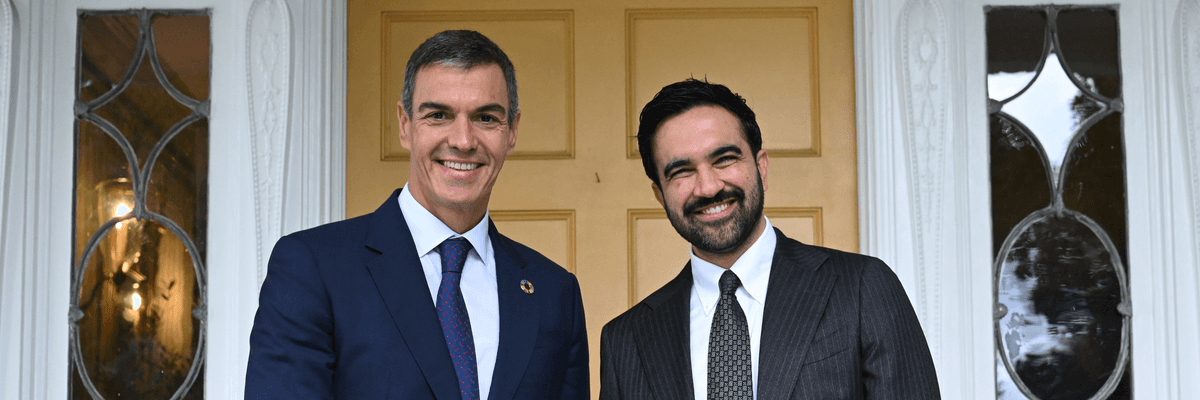
Spanish Prime Minister Pedro Sánchez and New York City Mayor Zohran Mamdani met in New York on September 23, 2026 as world leaders gathered for the United Nations General Assembly.
The two leaders spoke about policies to promote economic justice and immigrant rights at an event, as nearly 130 world leaders gather in New York for the United Nations General Assembly.
As New York City plays host to nearly 130 world leaders gathered for the United Nations General Assembly, progressive Mayor Zohran Mamdani is making a point of meeting with a number of international politicians who share his commitment to “building an economy for the many"—the official theme of a Wednesday morning breakfast he held at Gracie Mansion, where Spanish Prime Minister Pedro Sánchez was a key guest.
The event gave the two leaders an opportunity to discuss, as the prime minister said on social media, "more jobs, better wages, less inequality."
"Social justice is not the enemy of economic growth," he said.
Sánchez spoke to a group of assembled leaders—including Barbados Prime Minister Mia Mottley, a fierce critic of government inaction on the climate emergency and inequality, and socialist European Council President António Costa—about Spain's economic policies, such as a 66% increase in the national minimum wage over the past eight years.
“Spain is showing that another economic model is possible, and New York is demonstrating that the same ambition can transform our cities," said Sánchez, who represents the Spanish Socialist Workers' Party. "That is why the powerful fear us, because every day we show that there is another possible path and that it works."
“We were told that if you want growth, you have to accept inequality. That the workers have to make sacrifices. That if you want to be competitive, you have to have low wages and bad public services. I never believed it," Sánchez added. "Spain has shown that it was not true. We have raised the [Spanish minimum income] by 66%. We were told it would destroy jobs, but we have more workers than ever. One in every two jobs created in Europe are Spanish. We were told that with clean energy we would be less competitive. Now we have 60% and the cheapest energy. They always tell us that [these policies] are not going to work. The reality is that they do work for ordinary people."
The policies of Sánchez and Mamdani have angered right-wing leaders, including President Donald Trump. The president threatened Spain with a trade embargo earlier this year when Sánchez refused to allow US war planes to refuel at Spanish military bases as the US and Israel waged war on Iran.
Administration officials also condemned Sánchez's pro-immigration stance in July when migrants from Africa entered the self-governing Spanish city of Ceuta. The prime minister offered hundreds of thousands of migrants a chance at permanent legal residency in Spain earlier this year, contrasting with Trump's violent mass deportation campaign.
"Migration has made Spain stronger," said Sánchez on Wednesday. "Migration makes us a better country. No question."
Spanish PM Pedro Sánchez:
Migration has made Spain stronger. Economically, socially, culturally, migrants work in our companies, contribute to our public finances, sustain our welfare state and enrich our communities. Migration makes us a better country. No question.
This… pic.twitter.com/3GEIy7IWtR
— Clash Report (@clashreport) September 23, 2026
Without mentioning Trump by name, he added: "This matters because there are politicians on both sides of the Atlantic trying to convince working people that their problem is another working person—someone born somewhere else, someone who earns even less than they do. It is one of the oldest political tricks in history: Make people look sideways so they never look up."
While appearing to admire the charismatic and ultrapopular Mamdani—whose 69% approval rating among his constituents contrasts sharply with the 29% of Americans who currently support the president—Trump has railed against recent electoral victories of politicians who share Mamdani's commitment to universal, government-funded social services, raising taxes on billionaires, and ensuring life is affordable for working people.
In June, he called democratic socialists like Mamdani "the most serious threat to our country since its existence," and during Mamdani's mayoral campaign, the candidate confronted border czar Tom Homan over Trump's anti-immigration agenda.
At the Wednesday morning event, where Mamdani praised Sánchez for sending a message through his minimum wage policy that "work matters... dignity matters," the mayor said that working together, the two leaders and other progressives in power can build "a better world, bringing the movement for equality and justice to more distant horizons.”
Costa, who served as the prime minister of Portugal, added on social media that "in an interdependent world, we need coordinated solutions to global and local challenges."
"That is why we must defend international law and multilateral institutions like the UN," said Costa. "And that is why we must put the well-being of our citizens at the center of our policies."
“It is truly a privilege to be able to learn from one another, emulate each other's successes, and develop strategies that imitate the great progress those in this room have achieved," said Mamdani at the event.
The mayor has also met with progressive mayors from Barcelona, Paris, Rome, Mexico City, and other cities to discuss housing, migration, and climate policies. On Tuesday, he visited a New York City public school with Norwegian Prime Minister Jonas Gahr Støre, and the two leaders discussed limiting artificial intelligence in education.
Dear Common Dreams reader, It’s been nearly 30 years since I co-founded Common Dreams with my late wife, Lina Newhouser. We had the radical notion that journalism should serve the public good, not corporate profits. It was clear to us from the outset what it would take to build such a project. No paid advertisements. No corporate sponsors. No millionaire publisher telling us what to think or do. Many people said we wouldn't last a year, but we proved those doubters wrong. Together with a tremendous team of journalists and dedicated staff, we built an independent media outlet free from the constraints of profits and corporate control. Our mission has always been simple: To inform. To inspire. To ignite change for the common good. Building Common Dreams was not easy. Our survival was never guaranteed. When you take on the most powerful forces—Wall Street greed, fossil fuel industry destruction, Big Tech lobbyists, and uber-rich oligarchs who have spent billions upon billions rigging the economy and democracy in their favor—the only bulwark you have is supporters who believe in your work. But here’s the urgent message from me today. It's never been this bad out there. And it's never been this hard to keep us going. At the very moment Common Dreams is most needed, the threats we face are intensifying. We need your support now more than ever. We don't accept corporate advertising and never will. We don't have a paywall because we don't think people should be blocked from critical news based on their ability to pay. Everything we do is funded by the donations of readers like you. When everyone does the little they can afford, we are strong. But if that support retreats or dries up, so do we. Will you donate now to make sure Common Dreams not only survives but thrives? —Craig Brown, Co-founder |
As New York City plays host to nearly 130 world leaders gathered for the United Nations General Assembly, progressive Mayor Zohran Mamdani is making a point of meeting with a number of international politicians who share his commitment to “building an economy for the many"—the official theme of a Wednesday morning breakfast he held at Gracie Mansion, where Spanish Prime Minister Pedro Sánchez was a key guest.
The event gave the two leaders an opportunity to discuss, as the prime minister said on social media, "more jobs, better wages, less inequality."
"Social justice is not the enemy of economic growth," he said.
Sánchez spoke to a group of assembled leaders—including Barbados Prime Minister Mia Mottley, a fierce critic of government inaction on the climate emergency and inequality, and socialist European Council President António Costa—about Spain's economic policies, such as a 66% increase in the national minimum wage over the past eight years.
“Spain is showing that another economic model is possible, and New York is demonstrating that the same ambition can transform our cities," said Sánchez, who represents the Spanish Socialist Workers' Party. "That is why the powerful fear us, because every day we show that there is another possible path and that it works."
“We were told that if you want growth, you have to accept inequality. That the workers have to make sacrifices. That if you want to be competitive, you have to have low wages and bad public services. I never believed it," Sánchez added. "Spain has shown that it was not true. We have raised the [Spanish minimum income] by 66%. We were told it would destroy jobs, but we have more workers than ever. One in every two jobs created in Europe are Spanish. We were told that with clean energy we would be less competitive. Now we have 60% and the cheapest energy. They always tell us that [these policies] are not going to work. The reality is that they do work for ordinary people."
The policies of Sánchez and Mamdani have angered right-wing leaders, including President Donald Trump. The president threatened Spain with a trade embargo earlier this year when Sánchez refused to allow US war planes to refuel at Spanish military bases as the US and Israel waged war on Iran.
Administration officials also condemned Sánchez's pro-immigration stance in July when migrants from Africa entered the self-governing Spanish city of Ceuta. The prime minister offered hundreds of thousands of migrants a chance at permanent legal residency in Spain earlier this year, contrasting with Trump's violent mass deportation campaign.
"Migration has made Spain stronger," said Sánchez on Wednesday. "Migration makes us a better country. No question."
Spanish PM Pedro Sánchez:
Migration has made Spain stronger. Economically, socially, culturally, migrants work in our companies, contribute to our public finances, sustain our welfare state and enrich our communities. Migration makes us a better country. No question.
This… pic.twitter.com/3GEIy7IWtR
— Clash Report (@clashreport) September 23, 2026
Without mentioning Trump by name, he added: "This matters because there are politicians on both sides of the Atlantic trying to convince working people that their problem is another working person—someone born somewhere else, someone who earns even less than they do. It is one of the oldest political tricks in history: Make people look sideways so they never look up."
While appearing to admire the charismatic and ultrapopular Mamdani—whose 69% approval rating among his constituents contrasts sharply with the 29% of Americans who currently support the president—Trump has railed against recent electoral victories of politicians who share Mamdani's commitment to universal, government-funded social services, raising taxes on billionaires, and ensuring life is affordable for working people.
In June, he called democratic socialists like Mamdani "the most serious threat to our country since its existence," and during Mamdani's mayoral campaign, the candidate confronted border czar Tom Homan over Trump's anti-immigration agenda.
At the Wednesday morning event, where Mamdani praised Sánchez for sending a message through his minimum wage policy that "work matters... dignity matters," the mayor said that working together, the two leaders and other progressives in power can build "a better world, bringing the movement for equality and justice to more distant horizons.”
Costa, who served as the prime minister of Portugal, added on social media that "in an interdependent world, we need coordinated solutions to global and local challenges."
"That is why we must defend international law and multilateral institutions like the UN," said Costa. "And that is why we must put the well-being of our citizens at the center of our policies."
“It is truly a privilege to be able to learn from one another, emulate each other's successes, and develop strategies that imitate the great progress those in this room have achieved," said Mamdani at the event.
The mayor has also met with progressive mayors from Barcelona, Paris, Rome, Mexico City, and other cities to discuss housing, migration, and climate policies. On Tuesday, he visited a New York City public school with Norwegian Prime Minister Jonas Gahr Støre, and the two leaders discussed limiting artificial intelligence in education.
As New York City plays host to nearly 130 world leaders gathered for the United Nations General Assembly, progressive Mayor Zohran Mamdani is making a point of meeting with a number of international politicians who share his commitment to “building an economy for the many"—the official theme of a Wednesday morning breakfast he held at Gracie Mansion, where Spanish Prime Minister Pedro Sánchez was a key guest.
The event gave the two leaders an opportunity to discuss, as the prime minister said on social media, "more jobs, better wages, less inequality."
"Social justice is not the enemy of economic growth," he said.
Sánchez spoke to a group of assembled leaders—including Barbados Prime Minister Mia Mottley, a fierce critic of government inaction on the climate emergency and inequality, and socialist European Council President António Costa—about Spain's economic policies, such as a 66% increase in the national minimum wage over the past eight years.
“Spain is showing that another economic model is possible, and New York is demonstrating that the same ambition can transform our cities," said Sánchez, who represents the Spanish Socialist Workers' Party. "That is why the powerful fear us, because every day we show that there is another possible path and that it works."
“We were told that if you want growth, you have to accept inequality. That the workers have to make sacrifices. That if you want to be competitive, you have to have low wages and bad public services. I never believed it," Sánchez added. "Spain has shown that it was not true. We have raised the [Spanish minimum income] by 66%. We were told it would destroy jobs, but we have more workers than ever. One in every two jobs created in Europe are Spanish. We were told that with clean energy we would be less competitive. Now we have 60% and the cheapest energy. They always tell us that [these policies] are not going to work. The reality is that they do work for ordinary people."
The policies of Sánchez and Mamdani have angered right-wing leaders, including President Donald Trump. The president threatened Spain with a trade embargo earlier this year when Sánchez refused to allow US war planes to refuel at Spanish military bases as the US and Israel waged war on Iran.
Administration officials also condemned Sánchez's pro-immigration stance in July when migrants from Africa entered the self-governing Spanish city of Ceuta. The prime minister offered hundreds of thousands of migrants a chance at permanent legal residency in Spain earlier this year, contrasting with Trump's violent mass deportation campaign.
"Migration has made Spain stronger," said Sánchez on Wednesday. "Migration makes us a better country. No question."
Spanish PM Pedro Sánchez:
Migration has made Spain stronger. Economically, socially, culturally, migrants work in our companies, contribute to our public finances, sustain our welfare state and enrich our communities. Migration makes us a better country. No question.
This… pic.twitter.com/3GEIy7IWtR
— Clash Report (@clashreport) September 23, 2026
Without mentioning Trump by name, he added: "This matters because there are politicians on both sides of the Atlantic trying to convince working people that their problem is another working person—someone born somewhere else, someone who earns even less than they do. It is one of the oldest political tricks in history: Make people look sideways so they never look up."
While appearing to admire the charismatic and ultrapopular Mamdani—whose 69% approval rating among his constituents contrasts sharply with the 29% of Americans who currently support the president—Trump has railed against recent electoral victories of politicians who share Mamdani's commitment to universal, government-funded social services, raising taxes on billionaires, and ensuring life is affordable for working people.
In June, he called democratic socialists like Mamdani "the most serious threat to our country since its existence," and during Mamdani's mayoral campaign, the candidate confronted border czar Tom Homan over Trump's anti-immigration agenda.
At the Wednesday morning event, where Mamdani praised Sánchez for sending a message through his minimum wage policy that "work matters... dignity matters," the mayor said that working together, the two leaders and other progressives in power can build "a better world, bringing the movement for equality and justice to more distant horizons.”
Costa, who served as the prime minister of Portugal, added on social media that "in an interdependent world, we need coordinated solutions to global and local challenges."
"That is why we must defend international law and multilateral institutions like the UN," said Costa. "And that is why we must put the well-being of our citizens at the center of our policies."
“It is truly a privilege to be able to learn from one another, emulate each other's successes, and develop strategies that imitate the great progress those in this room have achieved," said Mamdani at the event.
The mayor has also met with progressive mayors from Barcelona, Paris, Rome, Mexico City, and other cities to discuss housing, migration, and climate policies. On Tuesday, he visited a New York City public school with Norwegian Prime Minister Jonas Gahr Støre, and the two leaders discussed limiting artificial intelligence in education.

