SUBSCRIBE TO OUR FREE NEWSLETTER
Daily news & progressive opinion—funded by the people, not the corporations—delivered straight to your inbox.
5
#000000
#FFFFFF
To donate by check, phone, or other method, see our More Ways to Give page.
Daily news & progressive opinion—funded by the people, not the corporations—delivered straight to your inbox.
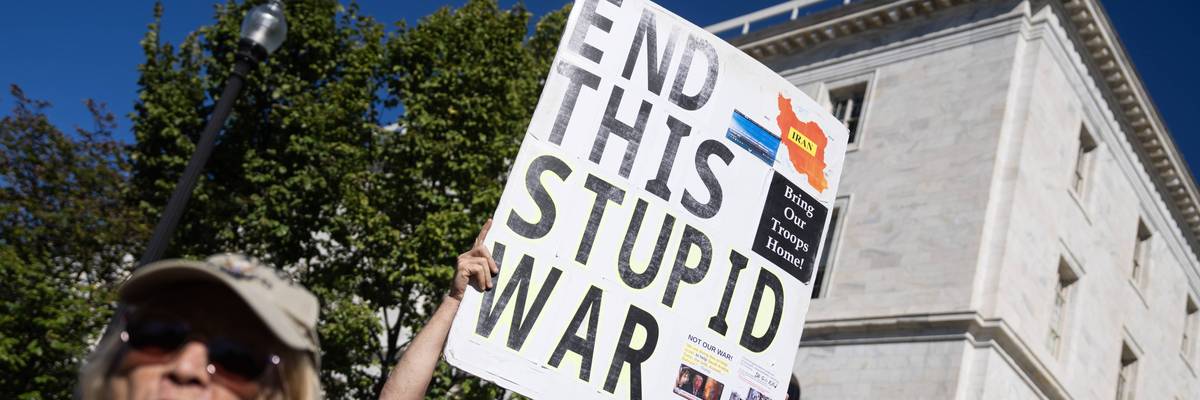
Anti-war protesters are seen outside the Capitol Hill Club where Vice President JD Vance met with House Republican Conference on Tuesday, September 15, 2026.
A wave of progressive, left-wing, and socialist candidates and elected officials face an enormous challenge in articulating a foreign policy for the future. Here’s a start.
For many years, progressive movements and activists have longed for the moment when we could imagine a real foreign policy rooted in true internationalism and solidarity.
But in our efforts to influence actual policy decisions, we’ve settled for important but smaller asks—ending specific wars, blocking the transfer of certain weapons to Israel, reducing military aid, cutting the military budget. That made sense—our movements’ view of the world was rarely fully reflected in Congress, the State Department, or the White House.
Now some of those limitations are fading. There are new possibilities rising as we see new candidates with incredibly progressive politics win their campaigns—and even more importantly, we see in recent years the extraordinary shift in public discourse about the US role in the world, especially (though not only) throughout the almost three years of US -enabled genocide in Gaza.
The escalation of global crises—especially those caused, exacerbated, and sponsored by the United States—means we need to do more as movements, and to demand more from our elected representatives. Israel has lost the battle of legitimacy. US credibility and influence around the world are crumbling, not only as a result of President Trump and his MAGA movement extremism but also because of the foreign policy failures of discredited establishment Democrats like President Biden.
The US, long the wealthiest, militarily strongest country in the history of humanity, is certainly still powerful, but is increasingly losing its ability to impose its will.
The flailing White House and its hollowed-out State Department are stumbling through the huge failures of Trump’s insatiably wealth- and ego-driven foreign policy. They face an unending war with Iran that has spread across the region and is threatening the entire global economy, Ebola exploding across parts of Africa, poverty and unprecedented inequality shattering lives around the world, and a genocide in Gaza visible globally in real time. The US, long the wealthiest, militarily strongest country in the history of humanity, is certainly still powerful, but is increasingly losing its ability to impose its will.
The new cohort of progressive candidates and the movements supporting them face a huge challenge of not only defeating the current foreign policy but also creating the beginnings of an entirely new approach. And for candidates, electeds, and campaigns who have focused overwhelmingly on progressive domestic issues, nothing about that challenge will be easy.
Many countries around the world—from Spain to the Philippines, South Africa to Greece, and Brazil to Uruguay and beyond—have a legacy of powerful left movements morphing into more formal organizations, and from there transforming into political parties. Eventually the parties choose candidates to run for political office, in more or less democratic multi-party systems, and ultimately some of those candidates even reach, at least for a while, the highest levels of government.
That path provides not only a clear arc from organizing to power, but also a set of consistent political principles and policies on which left candidates can ground their campaigns for office. But the left and even the broad progressive movements here in the United States have not been able to claim that particular arc of history for a very long time. As a result, we are operating, in this unusually electorally focused year, without a clear set of unifying principles.
Those principles are not completely missing. Policy initiatives once sidelined as positions only of the left have instead unified broad movements and become part of mainstream discourse. The most prominent probably include Medicare for All, the Green New Deal, the Fight for Fifteen, and the Dream Act/DACA. A generation of young people came of political age mobilizing on those issues alongside the crucial struggles against racist police violence, and many turned towards various strands of socialism to support and build those campaigns.
The central mobilizing issues of today’s Trump era—including ending ICE, rejecting AI/data center construction, housing for all, and challenging authoritarianism and the billionaires—emerged on the scene alongside those earlier priorities. Today’s arguably most influential democratic socialist leader, New York Mayor Zohran Mamdani, cut his political teeth on those issues.
What we still don’t have is a clear set of foreign policy principles, let alone specific policies responding to particular global crises, around which progressive movements will unite. The one exception, paid for with Palestinian blood, is Gaza. The most massive mobilizations in the country responding to Israel’s live-streamed genocide in Gaza took place during the Biden years. Those mobilizations and the movement behind them animated politics, and shaped big new majorities for ending Washington’s military support of Tel Aviv. Following decades of elite adulation and broad public support, Israel is now widely reviled as a pariah state.
Trump’s re-election changed much of the political picture, but the centrality of Gaza as the moral core of our movements—especially, though not only, among the young—represents a vitally important crack in that pro-Israel consensus. It has profoundly reshaped longstanding political assumptions, normalizing unflinching criticism of Israel and rejecting AIPAC funding as requirements for progressive candidates. As a result, Israel and the legitimacy of Palestinian rights are central issues in many races. Even in places where the assumed campaign focus would be domestic, candidates are inescapably being compelled to talk about it.
What principles should undergird a progressive official US foreign policy?
And yet Gaza is not enough. Certainly, ending the US-Israeli war on Iran emerged quickly as another specific demand within the broad anti-authoritarianism/anti-fascist movement, and there are other foreign policy positions on which most progressives would agree. The easy ones (to agree on—not necessarily to achieve!) would probably start with cutting the military budget, abolishing nuclear weapons, opposing US wars and military interventions, and working cooperatively with other countries on international crises including climate and global health.
But there is no clearly articulated set of principles, or of specific policy goals based on those principles, which represents a consensus position claimed by candidates and electeds, and upheld by the diverse progressive, left, and socialist activist constituencies across this country. We need to step up that process now, both in anticipation of the coming elections of this year and 2028, and to define what US foreign policy could or should look like in the future.
Understanding that official US positions will never completely match all that our movements fight for, what principles should undergird a progressive official US foreign policy? What follows here is an attempt to identify some of those principles, with a few examples of what they might look like in practice.
That means strengthening real diplomacy rooted in a serious commitment to international law and multilateral treaties, diplomacy that aims to prevent and/or solve conflicts through genuine, good-faith negotiations. It means rejecting the use of “soft power” diplomacy designed merely to strengthen US domination and supremacy.
What might that look like in practice?
That means massive reductions in the military budget and redirecting hundreds of billions of dollars saved to jobs, health care, environmental justice, education, child and elder care, and other social needs across the US , and to increased humanitarian and development needs around the world, especially in countries devastated by past and curren US wars.
That means abandoning efforts towards global military control and “full spectrum dominance,” including by shutting the 750-800 military bases and other installations outside the United States designed for projection of military force.
Other progressive demands stemming from this principle could include:
That means recognizing US accountability to international law, including joining the International Criminal Court as a full member and pledging to implement all decisions of both the International Court of Justice and the International Criminal Court.
Related steps would include:
That means creating and implementing laws to guarantee legal, social, and financial support for communities and people to rebuild their lives at home, and to recognize, respect, and implement the internationally guaranteed rights of refugees and asylum-seekers to seek and find better lives inside the United States.
Related demands include:
That means rejecting all efforts towards regime change of governments who disagree with the US, and ending all campaigns using claims of “democratization” as an excuse to escalate militarism.
That means supporting multilateral institutions and creating new US institutions designed to supply urgent and long-term humanitarian aid, speed green energy transition, provide development support and more, while rejecting the hegemony-driven goals of earlier aid systems.
That means both creating multilateral institutions and coalitions, and providing support to civil society institutions (without imposing control over them) to address international crises including wars, endemic diseases, extreme inequality, and climate catastrophes (especially those caused or exacerbated by the United States).
Progressives should also support:
Hopefully these principles can serve as a beginning reference point for what foreign policy could look like as more progressives, leftists, and socialists are elected to bring those new policy ideas to life in a much-changed—and far more open—political environment.
Dear Common Dreams reader, It’s been nearly 30 years since I co-founded Common Dreams with my late wife, Lina Newhouser. We had the radical notion that journalism should serve the public good, not corporate profits. It was clear to us from the outset what it would take to build such a project. No paid advertisements. No corporate sponsors. No millionaire publisher telling us what to think or do. Many people said we wouldn't last a year, but we proved those doubters wrong. Together with a tremendous team of journalists and dedicated staff, we built an independent media outlet free from the constraints of profits and corporate control. Our mission has always been simple: To inform. To inspire. To ignite change for the common good. Building Common Dreams was not easy. Our survival was never guaranteed. When you take on the most powerful forces—Wall Street greed, fossil fuel industry destruction, Big Tech lobbyists, and uber-rich oligarchs who have spent billions upon billions rigging the economy and democracy in their favor—the only bulwark you have is supporters who believe in your work. But here’s the urgent message from me today. It's never been this bad out there. And it's never been this hard to keep us going. At the very moment Common Dreams is most needed, the threats we face are intensifying. We need your support now more than ever. We don't accept corporate advertising and never will. We don't have a paywall because we don't think people should be blocked from critical news based on their ability to pay. Everything we do is funded by the donations of readers like you. When everyone does the little they can afford, we are strong. But if that support retreats or dries up, so do we. Will you donate now to make sure Common Dreams not only survives but thrives? —Craig Brown, Co-founder |
For many years, progressive movements and activists have longed for the moment when we could imagine a real foreign policy rooted in true internationalism and solidarity.
But in our efforts to influence actual policy decisions, we’ve settled for important but smaller asks—ending specific wars, blocking the transfer of certain weapons to Israel, reducing military aid, cutting the military budget. That made sense—our movements’ view of the world was rarely fully reflected in Congress, the State Department, or the White House.
Now some of those limitations are fading. There are new possibilities rising as we see new candidates with incredibly progressive politics win their campaigns—and even more importantly, we see in recent years the extraordinary shift in public discourse about the US role in the world, especially (though not only) throughout the almost three years of US -enabled genocide in Gaza.
The escalation of global crises—especially those caused, exacerbated, and sponsored by the United States—means we need to do more as movements, and to demand more from our elected representatives. Israel has lost the battle of legitimacy. US credibility and influence around the world are crumbling, not only as a result of President Trump and his MAGA movement extremism but also because of the foreign policy failures of discredited establishment Democrats like President Biden.
The US, long the wealthiest, militarily strongest country in the history of humanity, is certainly still powerful, but is increasingly losing its ability to impose its will.
The flailing White House and its hollowed-out State Department are stumbling through the huge failures of Trump’s insatiably wealth- and ego-driven foreign policy. They face an unending war with Iran that has spread across the region and is threatening the entire global economy, Ebola exploding across parts of Africa, poverty and unprecedented inequality shattering lives around the world, and a genocide in Gaza visible globally in real time. The US, long the wealthiest, militarily strongest country in the history of humanity, is certainly still powerful, but is increasingly losing its ability to impose its will.
The new cohort of progressive candidates and the movements supporting them face a huge challenge of not only defeating the current foreign policy but also creating the beginnings of an entirely new approach. And for candidates, electeds, and campaigns who have focused overwhelmingly on progressive domestic issues, nothing about that challenge will be easy.
Many countries around the world—from Spain to the Philippines, South Africa to Greece, and Brazil to Uruguay and beyond—have a legacy of powerful left movements morphing into more formal organizations, and from there transforming into political parties. Eventually the parties choose candidates to run for political office, in more or less democratic multi-party systems, and ultimately some of those candidates even reach, at least for a while, the highest levels of government.
That path provides not only a clear arc from organizing to power, but also a set of consistent political principles and policies on which left candidates can ground their campaigns for office. But the left and even the broad progressive movements here in the United States have not been able to claim that particular arc of history for a very long time. As a result, we are operating, in this unusually electorally focused year, without a clear set of unifying principles.
Those principles are not completely missing. Policy initiatives once sidelined as positions only of the left have instead unified broad movements and become part of mainstream discourse. The most prominent probably include Medicare for All, the Green New Deal, the Fight for Fifteen, and the Dream Act/DACA. A generation of young people came of political age mobilizing on those issues alongside the crucial struggles against racist police violence, and many turned towards various strands of socialism to support and build those campaigns.
The central mobilizing issues of today’s Trump era—including ending ICE, rejecting AI/data center construction, housing for all, and challenging authoritarianism and the billionaires—emerged on the scene alongside those earlier priorities. Today’s arguably most influential democratic socialist leader, New York Mayor Zohran Mamdani, cut his political teeth on those issues.
What we still don’t have is a clear set of foreign policy principles, let alone specific policies responding to particular global crises, around which progressive movements will unite. The one exception, paid for with Palestinian blood, is Gaza. The most massive mobilizations in the country responding to Israel’s live-streamed genocide in Gaza took place during the Biden years. Those mobilizations and the movement behind them animated politics, and shaped big new majorities for ending Washington’s military support of Tel Aviv. Following decades of elite adulation and broad public support, Israel is now widely reviled as a pariah state.
Trump’s re-election changed much of the political picture, but the centrality of Gaza as the moral core of our movements—especially, though not only, among the young—represents a vitally important crack in that pro-Israel consensus. It has profoundly reshaped longstanding political assumptions, normalizing unflinching criticism of Israel and rejecting AIPAC funding as requirements for progressive candidates. As a result, Israel and the legitimacy of Palestinian rights are central issues in many races. Even in places where the assumed campaign focus would be domestic, candidates are inescapably being compelled to talk about it.
What principles should undergird a progressive official US foreign policy?
And yet Gaza is not enough. Certainly, ending the US-Israeli war on Iran emerged quickly as another specific demand within the broad anti-authoritarianism/anti-fascist movement, and there are other foreign policy positions on which most progressives would agree. The easy ones (to agree on—not necessarily to achieve!) would probably start with cutting the military budget, abolishing nuclear weapons, opposing US wars and military interventions, and working cooperatively with other countries on international crises including climate and global health.
But there is no clearly articulated set of principles, or of specific policy goals based on those principles, which represents a consensus position claimed by candidates and electeds, and upheld by the diverse progressive, left, and socialist activist constituencies across this country. We need to step up that process now, both in anticipation of the coming elections of this year and 2028, and to define what US foreign policy could or should look like in the future.
Understanding that official US positions will never completely match all that our movements fight for, what principles should undergird a progressive official US foreign policy? What follows here is an attempt to identify some of those principles, with a few examples of what they might look like in practice.
That means strengthening real diplomacy rooted in a serious commitment to international law and multilateral treaties, diplomacy that aims to prevent and/or solve conflicts through genuine, good-faith negotiations. It means rejecting the use of “soft power” diplomacy designed merely to strengthen US domination and supremacy.
What might that look like in practice?
That means massive reductions in the military budget and redirecting hundreds of billions of dollars saved to jobs, health care, environmental justice, education, child and elder care, and other social needs across the US , and to increased humanitarian and development needs around the world, especially in countries devastated by past and curren US wars.
That means abandoning efforts towards global military control and “full spectrum dominance,” including by shutting the 750-800 military bases and other installations outside the United States designed for projection of military force.
Other progressive demands stemming from this principle could include:
That means recognizing US accountability to international law, including joining the International Criminal Court as a full member and pledging to implement all decisions of both the International Court of Justice and the International Criminal Court.
Related steps would include:
That means creating and implementing laws to guarantee legal, social, and financial support for communities and people to rebuild their lives at home, and to recognize, respect, and implement the internationally guaranteed rights of refugees and asylum-seekers to seek and find better lives inside the United States.
Related demands include:
That means rejecting all efforts towards regime change of governments who disagree with the US, and ending all campaigns using claims of “democratization” as an excuse to escalate militarism.
That means supporting multilateral institutions and creating new US institutions designed to supply urgent and long-term humanitarian aid, speed green energy transition, provide development support and more, while rejecting the hegemony-driven goals of earlier aid systems.
That means both creating multilateral institutions and coalitions, and providing support to civil society institutions (without imposing control over them) to address international crises including wars, endemic diseases, extreme inequality, and climate catastrophes (especially those caused or exacerbated by the United States).
Progressives should also support:
Hopefully these principles can serve as a beginning reference point for what foreign policy could look like as more progressives, leftists, and socialists are elected to bring those new policy ideas to life in a much-changed—and far more open—political environment.
For many years, progressive movements and activists have longed for the moment when we could imagine a real foreign policy rooted in true internationalism and solidarity.
But in our efforts to influence actual policy decisions, we’ve settled for important but smaller asks—ending specific wars, blocking the transfer of certain weapons to Israel, reducing military aid, cutting the military budget. That made sense—our movements’ view of the world was rarely fully reflected in Congress, the State Department, or the White House.
Now some of those limitations are fading. There are new possibilities rising as we see new candidates with incredibly progressive politics win their campaigns—and even more importantly, we see in recent years the extraordinary shift in public discourse about the US role in the world, especially (though not only) throughout the almost three years of US -enabled genocide in Gaza.
The escalation of global crises—especially those caused, exacerbated, and sponsored by the United States—means we need to do more as movements, and to demand more from our elected representatives. Israel has lost the battle of legitimacy. US credibility and influence around the world are crumbling, not only as a result of President Trump and his MAGA movement extremism but also because of the foreign policy failures of discredited establishment Democrats like President Biden.
The US, long the wealthiest, militarily strongest country in the history of humanity, is certainly still powerful, but is increasingly losing its ability to impose its will.
The flailing White House and its hollowed-out State Department are stumbling through the huge failures of Trump’s insatiably wealth- and ego-driven foreign policy. They face an unending war with Iran that has spread across the region and is threatening the entire global economy, Ebola exploding across parts of Africa, poverty and unprecedented inequality shattering lives around the world, and a genocide in Gaza visible globally in real time. The US, long the wealthiest, militarily strongest country in the history of humanity, is certainly still powerful, but is increasingly losing its ability to impose its will.
The new cohort of progressive candidates and the movements supporting them face a huge challenge of not only defeating the current foreign policy but also creating the beginnings of an entirely new approach. And for candidates, electeds, and campaigns who have focused overwhelmingly on progressive domestic issues, nothing about that challenge will be easy.
Many countries around the world—from Spain to the Philippines, South Africa to Greece, and Brazil to Uruguay and beyond—have a legacy of powerful left movements morphing into more formal organizations, and from there transforming into political parties. Eventually the parties choose candidates to run for political office, in more or less democratic multi-party systems, and ultimately some of those candidates even reach, at least for a while, the highest levels of government.
That path provides not only a clear arc from organizing to power, but also a set of consistent political principles and policies on which left candidates can ground their campaigns for office. But the left and even the broad progressive movements here in the United States have not been able to claim that particular arc of history for a very long time. As a result, we are operating, in this unusually electorally focused year, without a clear set of unifying principles.
Those principles are not completely missing. Policy initiatives once sidelined as positions only of the left have instead unified broad movements and become part of mainstream discourse. The most prominent probably include Medicare for All, the Green New Deal, the Fight for Fifteen, and the Dream Act/DACA. A generation of young people came of political age mobilizing on those issues alongside the crucial struggles against racist police violence, and many turned towards various strands of socialism to support and build those campaigns.
The central mobilizing issues of today’s Trump era—including ending ICE, rejecting AI/data center construction, housing for all, and challenging authoritarianism and the billionaires—emerged on the scene alongside those earlier priorities. Today’s arguably most influential democratic socialist leader, New York Mayor Zohran Mamdani, cut his political teeth on those issues.
What we still don’t have is a clear set of foreign policy principles, let alone specific policies responding to particular global crises, around which progressive movements will unite. The one exception, paid for with Palestinian blood, is Gaza. The most massive mobilizations in the country responding to Israel’s live-streamed genocide in Gaza took place during the Biden years. Those mobilizations and the movement behind them animated politics, and shaped big new majorities for ending Washington’s military support of Tel Aviv. Following decades of elite adulation and broad public support, Israel is now widely reviled as a pariah state.
Trump’s re-election changed much of the political picture, but the centrality of Gaza as the moral core of our movements—especially, though not only, among the young—represents a vitally important crack in that pro-Israel consensus. It has profoundly reshaped longstanding political assumptions, normalizing unflinching criticism of Israel and rejecting AIPAC funding as requirements for progressive candidates. As a result, Israel and the legitimacy of Palestinian rights are central issues in many races. Even in places where the assumed campaign focus would be domestic, candidates are inescapably being compelled to talk about it.
What principles should undergird a progressive official US foreign policy?
And yet Gaza is not enough. Certainly, ending the US-Israeli war on Iran emerged quickly as another specific demand within the broad anti-authoritarianism/anti-fascist movement, and there are other foreign policy positions on which most progressives would agree. The easy ones (to agree on—not necessarily to achieve!) would probably start with cutting the military budget, abolishing nuclear weapons, opposing US wars and military interventions, and working cooperatively with other countries on international crises including climate and global health.
But there is no clearly articulated set of principles, or of specific policy goals based on those principles, which represents a consensus position claimed by candidates and electeds, and upheld by the diverse progressive, left, and socialist activist constituencies across this country. We need to step up that process now, both in anticipation of the coming elections of this year and 2028, and to define what US foreign policy could or should look like in the future.
Understanding that official US positions will never completely match all that our movements fight for, what principles should undergird a progressive official US foreign policy? What follows here is an attempt to identify some of those principles, with a few examples of what they might look like in practice.
That means strengthening real diplomacy rooted in a serious commitment to international law and multilateral treaties, diplomacy that aims to prevent and/or solve conflicts through genuine, good-faith negotiations. It means rejecting the use of “soft power” diplomacy designed merely to strengthen US domination and supremacy.
What might that look like in practice?
That means massive reductions in the military budget and redirecting hundreds of billions of dollars saved to jobs, health care, environmental justice, education, child and elder care, and other social needs across the US , and to increased humanitarian and development needs around the world, especially in countries devastated by past and curren US wars.
That means abandoning efforts towards global military control and “full spectrum dominance,” including by shutting the 750-800 military bases and other installations outside the United States designed for projection of military force.
Other progressive demands stemming from this principle could include:
That means recognizing US accountability to international law, including joining the International Criminal Court as a full member and pledging to implement all decisions of both the International Court of Justice and the International Criminal Court.
Related steps would include:
That means creating and implementing laws to guarantee legal, social, and financial support for communities and people to rebuild their lives at home, and to recognize, respect, and implement the internationally guaranteed rights of refugees and asylum-seekers to seek and find better lives inside the United States.
Related demands include:
That means rejecting all efforts towards regime change of governments who disagree with the US, and ending all campaigns using claims of “democratization” as an excuse to escalate militarism.
That means supporting multilateral institutions and creating new US institutions designed to supply urgent and long-term humanitarian aid, speed green energy transition, provide development support and more, while rejecting the hegemony-driven goals of earlier aid systems.
That means both creating multilateral institutions and coalitions, and providing support to civil society institutions (without imposing control over them) to address international crises including wars, endemic diseases, extreme inequality, and climate catastrophes (especially those caused or exacerbated by the United States).
Progressives should also support:
Hopefully these principles can serve as a beginning reference point for what foreign policy could look like as more progressives, leftists, and socialists are elected to bring those new policy ideas to life in a much-changed—and far more open—political environment.