
SUBSCRIBE TO OUR FREE NEWSLETTER
Daily news & progressive opinion—funded by the people, not the corporations—delivered straight to your inbox.
5
#000000
#FFFFFF
To donate by check, phone, or other method, see our More Ways to Give page.


Daily news & progressive opinion—funded by the people, not the corporations—delivered straight to your inbox.
"The Supreme Court should be the gold standard for judicial ethics," said one reform advocate, "yet billionaires like Harlan Crow are buying the loyalty of justices one private jet flight at a time."
New reporting on Monday that U.S. Supreme Court Justice Clarence Thomas failed to report even more private travel gifted by a Republican mega-donor sparked renewed calls for reforms including a binding code of ethics for members of the nation's highest court.
The New York Times reported that Senate Finance Committee Chair Ron Wyden (D-Ore.) detailed in a letter to Michael Bopp, an attorney representing billionaire businessman Harlan Crow, how Thomas "has never disclosed" round-trip travel by Thomas and his wife, conservative activist Virginia Thomas, between Hawaii and New Zealand in November 2010 on Crow's private jet.
"Furthermore, it was revealed just a few weeks ago that Justice Thomas enjoyed complimentary use of private jets paid for by Mr. Crow on 17 different occasions since 2016, with nine of those flights coming in the last three years," Wyden wrote.
"While Justice Thomas has only recently updated his financial disclosures to include an eight-day voyage aboard the Michaela Rose in Indonesia in 2019, Justice Thomas still has not disclosed other trips on the Michaela Rose," the senator continued, referring to Crow's yacht. "Public reports show evidence that Justice Thomas was a passenger aboard the Michaela Rose in Greece, New Zealand, and elsewhere."
Thomas' 2023 disclosure, which was published in June, includes food and lodging during 2019 trips to Bali and Bohemian Grove—a secretive, men-only retreat in Sonoma County, California—paid for by Crow. The trips and other gifts for Thomas—including yacht excursions, flights on private jets, and private school tuition for the justice's grandnephew—were first revealed by ProPublica last year. Thomas claimed key disclosures were "inadvertently omitted at the time of filing."
Also in June, the advocacy group Fix the Court published a database listing 546 total gifts valued at over $4.7 million given to 18 current and former justices mostly between 2004 and 2023, as identified by the U.S. Federal Trade Commission (FTC). The database also lists "likely" gifts received by the justices and their estimated values, bringing the grand total to 672 gifts valued at nearly $6.6 million.
Thomas led the pack with 193 FTC-identified gifts collectively valued at over $4 million. Of these, he listed only 27 in financial disclosure reports.
Wyden wrote:
I seek to understand the means and scale of Mr. Crow's undisclosed largesse to Justice Thomas to inform several pieces of legislation that the committee is drafting, including but not limited to: reforms to the tax code concerning filing requirements for gift tax returns, audit requirements for Supreme Court justices, and comprehensive ethics reform that would strengthen the Ethics in Government Act and other laws related to the disclosure of complimentary private jet and yacht travel by Supreme Court justices...
Unfortunately, your prior responses to the committee have done nothing to address concerns that personal trips aboard Mr. Crow's superyacht and private jets for lavish vacations, including complimentary private jet travel for Justice Thomas, may have been used to help Mr. Crow avoid or evade paying federal taxes. This is not a particularly complicated matter. Mr. Crow could easily clarify for the committee whether tax deductions were claimed on superyacht and private jet use by Justice Thomas, but he refuses to do so.
This is particularly troubling in light of the committee's discovery of additional lavish international travel by Justice Thomas at Mr. Crow's expense that Justice Thomas has failed to properly disclose.
Wyden's letter asks Bopp to provide financial statements for Rochelle Charter, the holding company for the Michaela Rose, and to answer questions including whether Thomas ever reimbursed Crow for the private jet trip from Hawaii to New Zealand and other travel.
Last month, Sen. Sheldon Whitehouse (D-R.I.), who chairs a Senate Judiciary subcommittee on the federal courts and oversight, and Wyden asked the Biden administration to appoint a special counsel to investigate Thomas for alleged ethics violations.
Government ethics advocates weighed in on the new revelations.
"These new reports are as appalling as they are unsurprising," Demand Justice managing director Maggie Jo Buchanan said in a statement. "Justice Thomas' actions and—critically—[Supreme Court Chief Justice John Roberts'] refusal to assure the public that the court takes these never-ending revelations seriously, shows the necessity of meaningful and immediate reform."
"Trust for the Supreme Court remains at historic lows in part because the MAGA justices openly display their allegiances to wealthy billionaires and partisan interests instead of the public, whom they are meant to serve," Buchanan added. "We call on Congress to urgently pass full-scale reform, including an enforceable code of ethics as President [Joe] Biden proposed last week."
Biden called for, and Vice President Kamala Harris—who is replacing the incumbent atop the Democratic presidential ticket— endorsed reforms including term limits for Supreme Court justices, an enforceable code of ethics, and a constitutional amendment reversing the court's decision to grant presidents broad immunity for official acts.
Last year, the Supreme Court formally announced a new 14-page
code of conduct that watchdog groups dismissed as what the Revolving Door Project called a "toothless PR stunt."
Brett Edkins, managing director of policy and political affairs for the advocacy group Stand Up America, said Monday that "the Supreme Court should be the gold standard for judicial ethics, yet billionaires like Harlan Crow are buying the loyalty of justices one private jet flight at a time."
"Our nation's highest court has become a political plaything for the ultra-wealthy and well-connected," Edkins added. "Congress must step up as a co-equal branch of government and tackle the corruption plaguing the court. It's time for our leaders to restore integrity and transparency to the Supreme Court by passing a binding code of ethics and term limits."
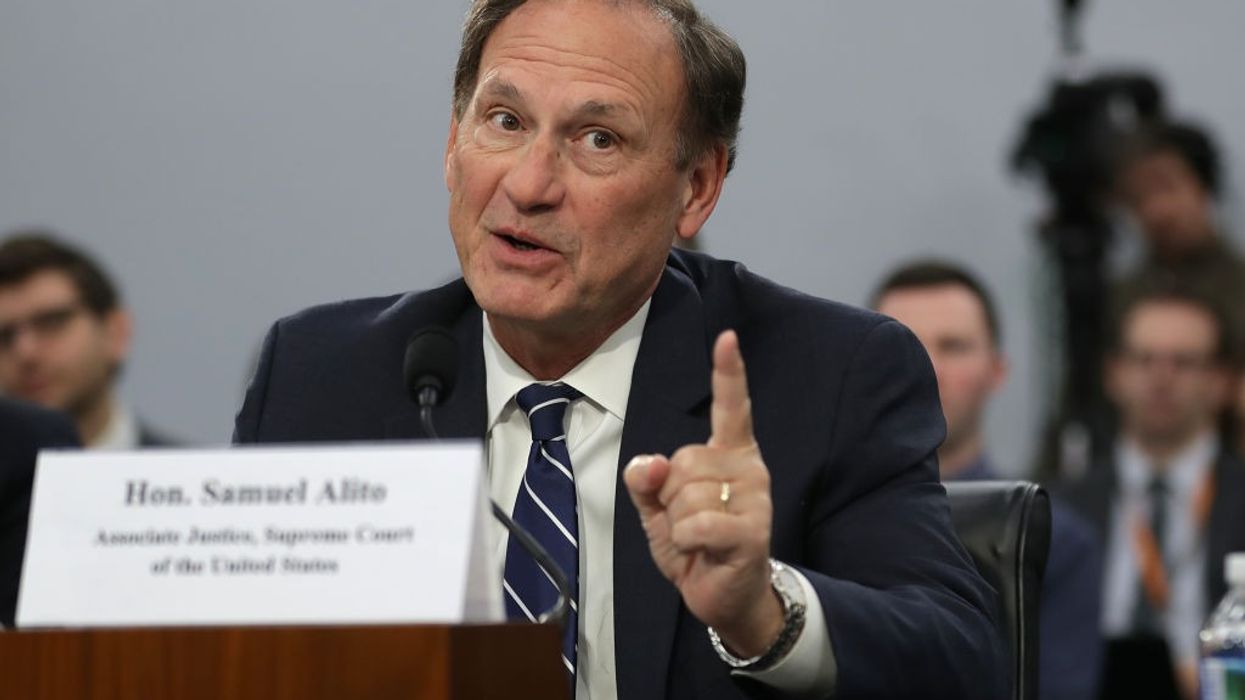
"The fact of such a political statement at your home creates, at minimum, the appearance of improper political bias."
Citing recent reporting that an inverted American flag—an alleged symbol of the "Stop the Steal" election denialism stoked by former U.S. President Donald Trump—was flown at the home of Supreme Court Justice Samuel Alito following January 6, 2021, 45 House Democrats on Tuesday demanded his recusal from all cases involving the right-wing insurrection or 2020 presidential contest.
Earlier this month, The New York Times revealed that the inverted flag flew in front of Alito's home in Alexandria, Virginia during the period between the January 6 attack on the U.S. Capitol by Trump supporters and the inauguration of President Joe Biden.
"It is incontrovertible that at the time the upside-down flag flew from your front lawn, 'Stop the Steal' activists had adopted the inverted flag as their symbol of protest. Their belief that widespread election fraud had thrown the election from former President Trump to then-President-Elect Biden has never been supported by any evidence," a letter signed by the Democrats states.
The lawmakers cite a section of the U.S. Flag Code—which is legally unenforceable—barring the display of inverted American flags "except as a signal of dire distress in instance of extreme danger to life or property."
"No such dire distress was in existence at the time the inverted flag flew from your front yard," the letter notes. "Indeed, your own public statement attempts to pass responsibility to your wife, but you nonetheless acknowledge that it was a political statement in support of Donald Trump's effort to overturn the 2020 election."
Alito told the Times he "had no involvement whatsoever in the flying of the flag," which he said "was briefly placed by Mrs. Alito in response to a neighbor's use of objectionable and personally insulting language on yard signs."
The lawmakers' letter continues:
Even if you had "no involvement" in the display yourself, the fact of such a political statement at your home creates, at minimum, the appearance of improper political bias. According to Canon 5 of the recently promulgated, non-binding, non-enforceable U.S. Supreme Court ethics guidelines, on which you are listed as a signatory, a justice "should refrain from political activity." In fact, the court's own employee guidelines explicitly prohibit public displays of political views—including yard signs and bumper stickers—because they create an appearance of a conflict of interest...
In Canon 3B, the guidelines declare that "a justice should disqualify himself or herself in a proceeding in which the justice's impartiality might reasonably be questioned, that is, where an unbiased and reasonable person who is aware of all relevant circumstances would doubt that the justice could fairly discharge his or her duties."
There are currently two cases related to January 6 and the 2020 election before the court. Trump v. United States concerns the presumptive 2024 GOP nominee's claim he has absolute presidential immunity for any official acts—in this case, trying to subvert the 2020 election—while Fischer v. United States is about whether January 6 insurrections committed felony obstruction of an official proceeding.
"Sadly, you are now the second justice who has demonstrated at least an appearance of a conflict of interest related to the events surrounding the January 6 insurrection," the letter laments. "In the aftermath of the 2020 election, text messages revealed that Virginia 'Ginni' Thomas, the wife of Justice Clarence Thomas, was actively strategizing with the White House chief of staff about how to overturn the election results and attending the January 6 'Stop the Steal' rally—precisely the same underlying conduct charged in Trump and Fischer."
"Although Justice Thomas seemingly acknowledged this conflict of interest by recusing himself from the court's case related to Trump attorney John Eastman, he has shockingly refused to recuse himself from Trump and Fischer," the lawmakers noted.
"Undoubtedly, public trust and confidence in the Supreme Court is in shambles, which jeopardizes our democracy and the rule of law upon which it is based. And given that your decisions in Trump and Fischer will profoundly affect the future of a past and potentially future president, and of democracy itself, it is essential that the court attempt to bolster the public's trust in the integrity of the court," the letter to Alito states.
"In order to protect the legitimacy of the court's ultimate decision in these historic cases," it concludes, "it is clear that both you and Justice Thomas must recuse yourselves from participating any further in these, or any other cases, related to January 6 or the 2020 election."
"When you're saying things like 'No mention of Ginni, of course' when talking about paperwork for the wife of a Supreme Court Justice—you're probably doing a crime."
U.S. Supreme Court Justice Clarence Thomas and his wife Ginni Thomas are under fresh scrutiny as yet another revelation, this one reported by the Washington Post on Thursday evening shows Ginni received tens of thousands of dollars in off-the-book compensation from a powerful right-wing nonprofit shortly before the group "soon would have an interest before the court"—a pivotal voting rights case.
Based on documents reviewed by the Post, right-wing judicial activist Leonard Leo used his role as an advisor to the nonprofit, the Judicial Education Project, to ask GOP pollster Kellyanne Conway, later a top aide to President Donald Trump, to pay Ginni Thomas a large sum but keep her name off the financial records.
"Leo, a key figure in a network of nonprofits that has worked to support the nominations of conservative judges," the reporting explains, "told Conway that he wanted her to 'give' Ginni Thomas 'another $25K,' the documents show. He emphasized that the paperwork should have 'No mention of Ginni, of course.'"
"Leonard Leo has written the definition of court corruption. These shady schemes are a call to action to bring about ethics reform at the highest levels of the judiciary." —Kyle Herrig, Accountable.US
In response to the new revelations, Kyle Herrig, president of the public interest advocacy group Accountable.US, said "Leonard Leo has written the definition of court corruption. These shady schemes are a call to action to bring about ethics reform at the highest levels of the judiciary."
In defense of the secrecy of the payments to Ginni Thomas's firm—which according to the Post totaled $80,000 between June 2011 and June 2012, but may have been more overall—Leo said in a statement to the newspaper that it was necessary to keep her name out of any disclosures because of how "disrespectful, malicious and gossipy people" can be in the political sphere.
"I have always tried to protect the privacy of Justice Thomas and Ginni," Leo claimed.
"Each day that passes, the Supreme Court is looking less like a bench and more like an auction house. Thomas should resign immediately..." —Congresswoman Alexandria Ocasio-Cortez
Crucially, months after these payments were made to Ginni Thomas, the Judicial Education Project filed an amicus brief in the case Shelby County v. Holder, taking the side of those opposed to a key provision in the Voting Rights Act of 1965. As the Post notes:
The court struck down a formula in the Voting Rights Act that determined which states had to obtain federal clearance before changing their voting rules and procedures. Clarence Thomas was part of the 5-to-4 majority.
Thomas issued a concurring opinion in the case, arguing that the preclearance requirement itself is unconstitutional. Thomas's opinion, which was consistent with a previous opinion he wrote, favored the outcome the Judicial Education Project and several other conservative organizations had advocated in their amicus briefs. He did not cite the Judicial Education Project brief.
But progressive political observers said the corruption was impossible not to see—especially given the wave of revelations about lavish gifts and financial arrangements between Justice Thomas and billionaire Harlan Crow, a right-wing mega-donor.
"This is corruption. Plain and simple," said Rep. Alexandria Ocasio-Cortez (D-N.Y.) in reaction to the latest revelation. "And each day that passes, the Supreme Court is looking less like a bench and more like an auction house. Thomas should resign immediately and Roberts should see to it that he does."
"It is well past time for the Supreme Court to align with the rest of government in a proper code of ethics enforced by independent investigation and reporting."
As congressional Democrats scoffed at U.S. Supreme Court Justice Clarence Thomas' attempt to defend taking luxury vacations funded by a billionaire Republican mega-donor, a group of 16 Democratic lawmakers on Friday urged Chief Justice John Roberts to investigate "allegations of unethical and potentially unlawful conduct" by a member of the nation's highest court.
In a letter led by Sen. Sheldon Whitehouse (D-R.I.) and Rep. Hank Johnson Jr. (D-Ga.), the Democrats—who include eight members of the Senate and eight House lawmakers—cited Thursday's bombshell report by ProPublica detailing how "Thomas has repeatedly accepted and failed to disclose gifts and travel from billionaire Harlan Crow."
"To date, the court has barely acknowledged, much less investigated, these allegations," the lawmakers wrote. "Amidst all of this—perhaps due in part to the court's inaction—the American people's trust in the Supreme Court has plummeted to an all-time low."
"We believe that it is your duty as chief justice 'to safeguard public faith in the judiciary,' and that fulfilling that duty requires swift, thorough, independent, and transparent investigation into these allegations," the legislators added.
The letter notes that "gifts that Mr. Crow reportedly provided to Justice Thomas include international travel on private jets and yachts, and stays at private resorts, including annual retreats to a resort owned by Mr. Crow's company. The value of some of these gifts exceeds $500,000, according to ProPublica's reporting."
The lawmakers continued:
Just last year, a right-wing activist admitted to coordinating a previously undisclosed 20-year, $30 million judicial lobbying campaign at the Supreme Court. As part of this operation, this activist reportedly "coached" wealthy donors "to wine, dine, and entertain conservative Supreme Court justices" in an attempt to "embolden the justices" to write "unapologetically conservative" opinions. These donors apparently "financed numerous expensive dinners with [Justices] Thomas, [Samuel] Alito, [Antonin] Scalia, and their wives at Washington, D.C. hotspots" and hosted at least one justice at a private retreat. According to the activist who led this campaign, the donors involved in this lobbying effort were even able to secure advance notice from Justice Alito of the Supreme Court's 2014 decision in a pending case.
"Over the course of the past year, Justice Thomas has participated in numerous cases implicating his wife's activities related to the 2020 election and the January 6 attack on the U.S. Capitol," the letter continues, referencing Virginia Thomas' attempt to push Arizona state lawmakers to help then-President Donald Trump overturn the results of the last presidential contest.
"Justice Thomas' failure to recuse in these cases raises questions about whether he violated both federal law and canons of judicial ethics regarding conflicts of interest and recusal," the lawmakers argued. "It has been said that he knew nothing of his spouse's activities; that is an assertion of fact that can and should be investigated, and would be in the ordinary course for other judges and officials."
"It is well past time for the Supreme Court to align with the rest of government in a proper code of ethics enforced by independent investigation and reporting," they added.
In addition to the letter, there have been calls by progressive groups and congressional Democrats including Rep. Alexandria Ocasio-Cortez (D-N.Y.) to impeach Thomas.
The right-wing Supreme Court justice "broke the law, and it isn't particularly close," argued two legal analysts.
Under fire after reporting offered a detailed look at his decades of billionaire-funded luxury vacations, U.S. Supreme Court Justice Clarence Thomas claimed Friday that he was "advised" by colleagues not to report personal hospitality gifts from friends, a story that drew immediate derision from lawmakers and legal analysts.
In a statement responding to ProPublica's reporting, which shined additional light on trips bankrolled by billionaire real estate mogul Harlan Crow, Thomas acknowledged joining the GOP megadonor and his wife on "a number of" family trips over the past two decades but insisted that he was told such hospitality "from close personal friends, who did not have business before the court, was not reportable."
"I have endeavored to follow that counsel throughout my tenure, and have always sought to comply with the disclosure guidelines," said Thomas, who in 2011 amended 20 years of financial disclosure forms after failing to disclose income that his wife, Ginni Thomas, received from the right-wing Heritage Foundation and other organizations.
Thomas claimed at the time that he had a "misunderstanding of the filing instructions," an excuse that watchdogs found highly implausible.
On Friday, Sen. Sheldon Whitehouse (D-R.I.) scoffed at Thomas' explanation for declining to disclose his many luxury vacations, specifically criticizing the justice's assertion that those involved with the trips had no business before the court.
ProPublica reported that Federalist Society co-chair Leonard Leo, who has helped drag the U.S. judicial system to the right, was among the guests of one Crow-funded trip that Thomas attended.
"Oh, please," Whitehouse tweeted in response to Thomas' statement. "If you're smoking cigars with Leonard Leo and other right-wing fixers, you should know they don't just have business before the court—their business IS the court."
Mark Joseph Stern, a legal writer for Slate, added that the justice's statement "fails to account for Thomas' alleged use of Crow's private jet for his own personal travel, presumably because it cannot possibly be squared with the disclosure guidelines in effect at the time."
ProPublica reported that Thomas' trips included multiple flights on Crows' private jet and rides on his superyacht—none of which the justice disclosed. The investigative outlet noted that "Thomas has even used the plane for a three-hour trip."
"On Feb. 11, 2016, the plane flew from Dallas to Dulles to New Haven, Connecticut, before flying back later that afternoon," ProPublica revealed. "There are no reports of Thomas making a public appearance that day, and the purpose of the trip remains unclear."
According to The Washington Post, Thomas "has reported receiving only two gifts since 2004"—a bronze bust of Frederick Douglass, which came from Crow, and an award from Yale Law School.
After the Los Angeles Times reported in 2004 that Thomas "had accepted expensive gifts and private plane trips paid for by Harlan Crow," the justice "appears to have continued accepting free trips from his wealthy friend," the newspaper reported Thursday.
"But he stopped disclosing them," the Times added.
On Thursday, Stern and fellow Slate court writer Dahlia Lithwick argued that by failing to report gifts from Crow, Thomas "broke the law, and it isn't particularly close."
"The best argument in his defense is that the old definition of 'personal hospitality' did not require him to disclose transportation, including private flights," the pair wrote. "This reading works only by torturing the English language beyond all recognition. The old rule, like the statute it derives from, defined the term as hospitality that is 'extended' either 'at' a personal residence or 'on' their 'property or facilities.'
"A person dead-set on defending Thomas might be able to squeeze these yacht trips into this definition, arguing that, by hosting Thomas on his boat for food, drink, and sightseeing, Crow 'extended' hospitality 'on' his own property. But lending out the private jet for Thomas’ personal use? Come on. There’s no plausible way to shoehorn these trips into the old rule—which quotes the statute verbatim—even under the most expansive interpretation imaginable."
Following pressure from Whitehouse and other lawmakers, the Judicial Conference of the United States—the policymaking body for federal courts—clarified its disclosure requirements surrounding "personal hospitality."
The updated regulations state that disclosure exemptions do not include "gifts other than food, lodging or entertainment, such as transportation that substitutes for commercial transportation"—like a private jet.
Rep. Alexandria Ocasio-Cortez (D-N.Y.) said in an interview with The Lever on Thursday that articles of impeachment against Thomas "need to be introduced" in response to ProPublica's revelations.
"If no one's going to introduce it, I would certainly be open to doing so and drafting them myself," said the New York Democrat. "I think this has gone far, far beyond any sort of acceptable standard in any democracy, let alone American democracy."
"Barring some dramatic change," said the New York Democrat, "this is what the Roberts court will be known for: rank corruption, erosion of democracy, and the stripping of human rights."
Rep. Alexandria Ocasio-Cortez said Thursday that right-wing Supreme Court Justice Clarence Thomas should be impeached by the U.S. House in the wake of ProPublica reporting that exposed the judge's billionaire-funded luxury vacations.
"This is beyond party or partisanship. This degree of corruption is shocking—almost cartoonish. Thomas must be impeached," Ocasio-Cortez (D-N.Y.), who demanded Thomas' resignation last year amid a separate ethics scandal, wrote on Twitter.
"Barring some dramatic change," she added, "this is what the Roberts court will be known for: rank corruption, erosion of democracy, and the stripping of human rights."
The new investigative reporting revealed that Thomas has taken trips funded by billionaire real estate magnate Harlan Crow "virtually every year" for more than two decades.
Thomas did not disclose any of the vacations, which experts and watchdog organizations said is likely a violation of federal law.
"Thomas failed even to follow the obscenely weak ethics standards on the books for Supreme Court justices," Jeff Hauser, executive director of the Revolving Door Project, said in a statement.
"If the information in this report is correct—and there is no reason at all to believe that it isn't—and if the point of the United States judiciary is still to neutrally interpret and uphold the law, then it is obvious what should happen next," said Hauser. "The House of Representatives must immediately draw articles of impeachment against Justice Clarence Thomas."
This isn't the first time Thomas has come under fire for failing to adhere to federal disclosure requirements, which were recently strengthened for Supreme Court justices and other federal judges thanks to a pressure campaign led by Sen. Sheldon Whitehouse (D-R.I.).
Between 1997 and 2007, Thomas failed to disclose income that his wife, right-wing activist Ginni Thomas, received from the conservative Heritage Foundation and other sources. The justice amended his disclosures in 2011, claiming he misunderstood the filing instructions—an explanation that watchdogs met with skepticism.
And while ProPublica's reporting offered the most detailed look yet at Thomas' relationship with Crow, the ties between the two were spotlighted more than a decade ago by The New York Times, which noted in a 2011 story the billionaire "has done many favors for the justice and his wife... helping finance a Savannah library project dedicated to Justice Thomas, presenting him with a Bible that belonged to Frederick Douglass, and reportedly providing $500,000 for Ms. Thomas to start a Tea Party-related group."
"These actions are part of a pattern of corruption that betrays Thomas' deep-seated contempt for the rule of law."
Brett Edkins, managing director of policy and political affairs for the progressive advocacy group Stand Up America, said Thursday that Thomas' repeated failure to disclose gifts from Crow represents "a shameless abuse of power and an affront to the American people."
"Sadly, these actions are part of a pattern of corruption that betrays Thomas' deep-seated contempt for the rule of law. No one is above the law—not even Supreme Court justices," said Edkins. "Our highest court must be held to a higher ethical standard. Congress has a constitutional duty to act quickly by passing a Supreme Court code of ethics and investigating the full extent of Justice Thomas' wrongdoing."
The Supreme Court is the only court in the U.S. that does not currently have a binding ethics code, opening the door to the kinds of conflicts of interest that have plagued the powerful judicial body for decades.
Hauser argued that because the House is highly unlikely to launch impeachment proceedings given the GOP's control of the chamber, Senate Judiciary Committee Chair Dick Durbin (D-Ill.) should "immediately begin extensive investigations into Thomas' violations of ethics laws and norms as well as the broader collapse of the Supreme Court's integrity."
"Anyone who believes that the law is only legitimate if it applies to everyone should understand and endorse that Durbin must immediately investigate these allegations, that the House must immediately draw articles of impeachment, and that if this information proves accurate, Thomas must immediately leave the bench," Hauser said. "Moreover, it should be indisputable that the judiciary as a whole, and the Supreme Court especially, needs far stronger ethical rules and enforcement."
In a statement, Durbin said that Thomas' behavior is "simply inconsistent with the ethical standards the American people expect of any public servant, let alone a justice on the Supreme Court."
"The ProPublica report is a call to action," he added, "and the Senate Judiciary Committee will act."
We may be subject to the court's authority and bound by its rulings, but we can and must call out the court’s hypocrisy and its betrayal of democracy.
Under the guise of the regressive legal theory of “originalism,” the United States Supreme Court Republican-appointed majority has issued a series of ultra-right rulings on such vital issues as voting rights, gerrymandering, union organizing, the death penalty, environmental protection, gun control, abortion, and campaign finance. The end goal appears to be nothing less than the dismantling of the last vestiges of the New Deal and the Civil Rights movement.
But in addition to being reactionary, is the court also guilty of corruption? The answer depends on how we define and think of corruption.
In the strictest legal sense, the justices appear to be in the clear. Under federal law, “public corruption” is defined as “a breach of the public’s trust by government officials who use their public office to obtain personal gain,” asking for or receiving anything of value in exchange for an official act. In a 2016 decision reversing the bribery conviction of former Virginia GOP Governor Bob McDonnell, the Supreme Court narrowed the legal definition of public corruption to require strict proof of a “quid pro quo”—a swap of money or another benefit in return for a specific governmental favor.
But from a larger moral and political perspective, the court’s Republican majority is far from innocent. We expect all federal judges—and particularly those at the top of the judicial pyramid—not only to be law-abiding but to be free of political bias and conflicts of interest. We expect them to honor the enormous faith we have placed in them to use their lifetime appointments to be forthright stewards of justice and democracy.
That faith has been breached time and again.
Ethical Cannon 2A of The Code of Conduct for United States Judges requires those who don the robe to “respect and comply with the law,” and “to act at all times in a manner that promotes public confidence in the integrity and impartiality of the judiciary.” Cannon 2B further advises that a “judge should not allow family, social, political, financial, or other relationships to influence judicial conduct or judgment.”
There also is federal statute, found at Title 28, section 455 of the United States Code, that requires judges to disqualify themselves when they have a personal bias or prejudice toward a party, or when the judge or their spouse has a financial interest in a proceeding, or they or their spouses have “any other interest that could be substantially affected by the outcome” of a proceeding before them.
The problem is that the Code of Conduct does not apply to the Supreme Court. And there is no mechanism for enforcing the disqualification criteria against a sitting justice. The Supreme Court stands alone as the only tribunal in the nation without any ethical accountability beyond impeachment, which for all practical purposes is an ineffective remedy. (Only one Justice in our entire history has been impeached—Samuel Chase in 1804—and he was acquitted by the Senate.)
The most obvious offender is Clarence Thomas, who has gotten away with flagrant misconduct as a result of this lack of accountability. Under the 1978 Ethics in Government Act, all high-ranking federal officials are required to file yearly financial disclosure statements for themselves and their spouses to safeguard against conflicts of interest. But for many years, Thomas failed to report his wife Ginni's earnings on the mandatory annual financial disclosure forms that he signed under penalty of perjury, indicating that his spouse had no non-investment income. In fact, she was steadily employed in high-level jobs as a policy analyst and an outspoken conservative activist.
According to Common Cause, Ginni—who is also a lawyer—received more than $686,000 between 2003 and 2007 working for the Heritage Foundation. In 2011, claiming incredulously that he had misunderstood his reporting responsibilities, Thomas amended his financial disclosures, which can now be examined on the OpenSecrets.org website.
Thomas again generated headlines when he refused to recuse himself in cases involving the January 6 insurrection and Trump’s efforts to overturn the results of the 2020 election, despite Ginni’s prominent role as an organizer of the “stop the steal” campaign.
Thomas is not the only justice with a spouse whose work has raised conflict-of-interest questions. According to The New York Times, Chief Justice Roberts’ wife Jane has made millions in her career as a recruiter for high-profile law firms, some of which litigate cases before the Supreme Court. The Chief Justice, however, has never recused himself from a matter involving his wife’s recruits and has never disclosed her client list on his annual financial reports.
Additional potential conflicts of interest have surfaced around donations made to the Supreme Court Historical Society, a non-profit charity founded in 1974 to promote and celebrate the court’s legacy. Over the past two decades, the society reportedly raised more than $23 million from corporations, law firms, and other groups. The donors, in turn, receive special access to the Justices, who regularly attend the society’s annual black-tie dinner as well as lectures and other functions the society sponsors.
Among those who have attended society events and helped raise donations on its behalf is the Reverend Rob Schenck, an Evangelical minister and anti-abortion crusader. In a June 2022 letter to Chief Justice Roberts and in later interviews with The New York Times, Schenck claimed he was told in advance of the court’s 2014 decision in Burwell v. Hobby Lobby, which held that the owners of for-profit corporations may lawfully refuse to fund health insurance coverage for employees for contraception on religious grounds. The source of the leak, Schenck alleged, was Justice Samuel Alito, the author of the Hobby Lobby majority opinion.
Alito also has been at the center of the scandalous leak last May of the draft majority opinion in Dobbs v. Jackson Women’s Health Organization, which Alito wrote, overruling Roe v. Wade.
After an eight-month internal investigation, the court announced in January that it has been unable to determine the source of the leak. Rightwing zealots like Senator Ted Cruz, Republican of Texas, have suggested that a clerk for one of the court’s liberal justices is the likely culprit. Pundits on the left, such as former Secretary of Labor Robert Reich, have argued that Alito more likely was the source, seeking to lock in the votes of the Justices Thomas, Neil Gorsuch, Brett Kavanaugh, and Amy Coney Barrett, who joined his opinion.
Additional potential conflicts of interest have surfaced around donations made to the Supreme Court Historical Society, a non-profit charity founded in 1974 to promote and celebrate the court’s legacy.
Alito, for his part, has denied all wrongdoing in connection with both the Hobby Lobby and Dobbs leaks. However, neither Alito nor any of the other members of the court were questioned under oath as part of the Dobbs probe.
Any discussion of Supreme Court corruption would be incomplete without mentioning the serious defects that attend the confirmation process for high-court nominees. The nonprofit watchdog group Citizens for Responsibility & Ethics in Washington (CREW) has reported that rightwing dark money groups such as the Judicial Crisis Network raised staggering sums to support the nominations of Gorsuch, Kavanaugh, and Barrett in an effort to push the court hard to the right. The dark money forces won, unbeknownst to the general public.
And then there are the Senate confirmation hearings, which are also critically flawed. The nominees testify under oath, but pay no price for making false, misleading, and possibly perjurious statements. Every member of the five-vote Dobbs majority arguably lied about their true views on the precedential value of Roe and the constitutional right to abortion during their confirmation hearings—Thomas in 1991, Alito in 2005, Gorsuch in 2017, Kavanaugh in 2018, and Barrett in 2020.
All six Republicans on the court are also current or former members of the Federalist Society, yet another fact that calls their impartiality into question.
Unfortunately, there is little that can be done in the near term to rein in corruption at the Supreme Court. Even a modest bill introduced by Senate Democrats to pass an ethics code for the court has little prospect of getting through the MAGA-dominated House of Representatives.
But we are not powerless. We may be subject to the court’s authority and bound by its rulings, but we can and must call out the court’s hypocrisy and its betrayal of democracy at every possible turn.
Signals from U.S. Supreme Court justices during oral arguments in Moore v. Harper on Wednesday heightened concerns that the right-wing majority may issue a ruling that partly or fully embraces a "dangerous" legal theory and would radically transform federal elections.
"Their theory would invalidate constitutional provisions in every single state, many tracing back to the founding."
The case stems from the North Carolina Supreme Court striking down a congressional map drawn by GOP state legislators as a partisan gerrymander. North Carolina Republican lawmakers unhappy with that decision are now pushing the "independent state legislature" theory (ISLT), an argument that the U.S. Constitution gives only state legislatures control over the regulation of federal elections, without checks from state constitutions, courts, or governors.
"This reckless case out of North Carolina could explode the unifying understanding that power ultimately rests with the people of this country," said Kathay Feng, national redistricting director for Common Cause, after about three hours of arguments on Wednesday. "We cherish our right to vote in free and fair elections. But that sacred right could be undermined if the court disregards the essential role checks and balances serve in our federal elections."
A pair of ACLU experts, Kristi Graunke and Ari Savitzky, warned earlier this week that "if the Supreme Court adopts the North Carolina legislators' proposed rule in Moore, it will make it even easier for state legislatures to suppress the vote and subvert election results, and it will give both political parties the green light to draw gerrymandered election districts."
Legal reporters and other observers noted after the arguments Wednesday that the high court seemed to be split into three camps for this case: right-wing Justices Samuel Alito, Clarence Thomas, and Neil Gorsuch "appeared willing to embrace" ISLT, according to Reuters, while liberal Justices Ketanji Brown Jackson, Elena Kagan, and Sonia Sotomayor came across as concerned that the theory threatens U.S. democracy.
The New York Times' Adam Liptak explained that "the remaining members of the court--Chief Justice John G. Roberts Jr. and Justices Brett M. Kavanaugh and Amy Coney Barrett--seemed to be searching for a compromise under which state supreme courts would generally have the last word on disputes over state laws governing federal elections but be subject to oversight from federal courts in rare cases."
Liptak pointed out that when Roberts suggested to David Thompson, the North Carolina GOP legislators' lawyer, that a 1932 Supreme Court decision about the U.S. Constitution's election clause undermined his argument, the attorney "responded with a distinction that did not seem to persuade the chief justice or his colleagues."
After also highlighting that exchange, Politico reported:
Kavanaugh's and Barrett's questions to Thompson were less revealing than those from Roberts. But Kavanaugh seemingly suggested that the version of the independent state legislature theory advanced by the North Carolina lawmakers was going too far. He noted that North Carolina was trying to go further than then-Chief Justice William Rehnquist's concurrence in the 2000 case Bush v. Gore, which is the origin of the theory that state courts have overstepped their role and that they could be hemmed in in some way.
Kavanaugh also raised a brief from the Conference of Chief Justices, a collection of chief jurists from the states, asking how to square their writing about the history of state courts applying state constitutions to federal elections, with the independent state legislature theory. Barrett, meanwhile, also seemed skeptical at times of the argument that Thompson was advancing, noting that state constitutions could be amended.
But later, Roberts' questioning to Neal Katyal, who represented the groups that challenged the initial legislatively drawn maps, showed how some of the court's swing conservative justices could still potentially rule in favor of the GOP lawmakers without embracing the most robust interpretation of the independent state legislature theory.
Just ahead of this week's arguments, Eliza Sweren-Becker and Ethan Herenstein at the Brennan Center for Justice, pointed out that "in recent months, the theory's proponents have tried to persuade the Supreme Court and the broader public that there are more moderate, less problematic variants of the theory out there."
"But there's no 'lite version' of the independent state legislature theory," they asserted. "The gerrymanderers who put the theory on the Supreme Court's doorstep in Moore v. Harper are asking for a radical upending of election law and all the chaos that comes with it, no matter how they try to soft-pedal it."
During arguments Wednesday, the trio of liberal justices touched on concerns that have mounted from pro-democracy groups since June, when the high court agreed to hear Moore.
Mother Jones' Ari Berman highlighted one of those moments:
"This is a theory with big consequences," Justice Elena Kagan told Thompson, getting to the heart of the huge significance of the case. "It would say that if a legislature engages in the most extreme forms of gerrymandering, there is no state constitutional remedy even if the courts think that that's a violation of the constitution. It would say that legislators could enact all manner of restrictions on voting, get rid of all kinds of voter protections that the state constitution in fact prohibits. It might allow the legislatures to insert themselves and to give themselves a role in the certification of elections and the way election results are calculated. So in all these ways, I think what might strike a person is that this is a proposal that gets rid of the normal checks and balances on the way big governmental decisions are made in this country.'
"Our position is that checks and balances do apply, but they come from the federal Constitution and the panoply of federal laws like the Voting Rights Act," Thompson responded.
Berman also stressed that "the overwhelming bulk of historical evidence refutes the idea that the Founders intended to give state legislatures such unchecked power," and shared Sotomayor's comment to Thompson that his position could only prevail "if you rewrite history."
As the two ACLU experts similarly wrote earlier this week:
Proponents of the independent state legislature theory try to hang their hat on the U.S. Constitution, but their position is contrary to the Constitution's original and ordinary meaning. The Framers fundamentally understood the power of "legislatures" to be drawn from and limited by written constitutions. They fought a war to break away from a runaway legislature, and they founded a new government based on the precept that legislatures and all government bodies can only act within the limitations placed on them by written constitutions ordained by the people. The suggestion that the Framers trashed that fundamental principle when it comes to legislating the rules of democracy makes no sense.
The theory is also contrary to the constitutional principle of federalism, whereby federal courts are bound to respect the various ways in which states organize their own governments, and to allow the state lawmaking process, including activity by state courts, to operate without undue interference. Deferring to the governmental arrangements set forth in state constitutions is a basic tenet of federalism. But the independent state legislature theory would require federal courts to constantly intervene in politicized conflicts between state legislatures and state courts over state constitutional matters--and then to reorder the way that the checks and balances of state government are arranged in the state's own constitution to put a thumb on the scale for the state legislature. That arrangement would dishonor federalism principles.
Katyal, a former acting solicitor general, issued similar warnings to the justices on Wednesday, saying that "I'm not sure I've ever come across a theory in this court that would invalidate more state constitutional clauses as being federally unconstitutional, hundreds of them, from the founding to today."
"The blast radius from their theory will sow elections chaos, forcing a confusing two-track system with one set of rules for federal elections, and another for state ones," he continued. "Case after case would wind up in this court with a political party on either side of the dais."
Solicitor General Elizabeth B. Prelogar, who is representing the Biden administration in the case, also told the court that ILST rejects U.S. history and "would wreak havoc in the administration of elections across the nation."
"Their theory would invalidate constitutional provisions in every single state, many tracing back to the founding," she said. "That would sow chaos on the ground as state and federal elections would have to be administered under divergent rules and federal courts, including this court, would be flooded with new claims, often at the eleventh hour, in the midst of hotly contested elections."
Some who have raised the alarm about ISLT in recent months have recalled the attempt by former President Donald Trump--who is now seeking the GOP's 2024 nomination--and his allies to reverse President Joe Biden's victory in 2020, which culminated in a deadly attack on the U.S. Capitol that briefly delayed certification of the election results.
As Slate's Mark Joseph Stern wrote Wednesday: "It's the argument that Trump deployed when he tried to nullify millions of votes in 2020. And it's the argument that Ginni Thomas, wife of Justice Clarence Thomas, relied upon when lobbying state legislators to appoint 'alternate electors' who would support Trump."
Notably, despite his wife's involvement in what Stern and others have called Trump's failed "coup," Justice Thomas has not recused himself from this case.
"In the end, Moore v. Harper probably comes down to Justice Amy Coney Barrett," Stern argued. "Thomas, Alito, Gorsuch, and Kavanaugh have all endorsed the ISLT in the past. Roberts, along with Justices Sonia Sotomayor, Elena Kagan, and Ketanji Brown Jackson, clearly have no desire to revive it. So Moore is in Barrett's hands, and it serves as the ultimate test of her self-proclaimed originalism."
Fears about how the six right-wing justices, including three Trump appointees, will rule in the case have fueled fresh calls for expanding the court--though legislation to do so is unlikely to pass any time soon, with Republicans set to seize control of the U.S. House of Representatives in under a month.
A long-standing call for U.S. Supreme Court Justice Clarence Thomas to face impeachment proceedings was renewed Monday after the right-wing judge indicated in an unsigned dissent that he would have blocked enforcement of the House January 6 panel's subpoena for the communications records of Arizona Republican Party Chair Kelli Ward.
The House committee investigating the deadly January 6 insurrection "is seeking Ward's records related to her role in former President Donald Trump's effort to steal the 2020 election as a fake elector casting ballots in the Electoral College for Trump," HuffPost reported.
In a 7-2 vote, the Supreme Court on Monday paved the way for the panel to obtain Ward's phone records, rejecting the Arizona GOP chair's appeal. Right-wing Justice Samuel Alito joined Thomas in dissenting.
This marked the second time Thomas has tried to hinder the committee's probe of the Trump-led effort to remain in office despite his 2020 election loss--a plot in which Thomas' wife, right-wing activist Ginni Thomas, played a major role.
Thomas in January was the only justice to vote against the release of White House records to the panel. Two months later, text messages between former White House chief of staff Mark Meadows and Ginni Thomas showed that she had been in communication with Trump's team about efforts to overturn President Joe Biden's electoral victory.
Weeks later, it was revealed that Ginni Thomas had lobbied Republican lawmakers in Arizona and other states to reject Biden's electors and appoint fake ones who would support Trump. Since late March, congressional Democrats have called on Clarence Thomas to recuse himself, resign, or be impeached for apparently trying to shield his wife's anti-democratic political activities from scrutiny.
"His wife, Ginni Thomas, pressured Arizona officials to illegally overturn Trump's loss," Citizens for Responsibility and Ethics in Washington (CREW), a D.C.-based watchdog, noted Monday. "It's absurd that Thomas did not recuse."
"Justice Thomas must face an impeachment inquiry," the pro-democracy advocacy group Free Speech for People tweeted.
A petition calling for the impeachment of Clarence Thomas has garnered more than 1.2 million signatures since details about Ginni Thomas' direct participation in Trump's failed coup were first made public.
Progressives on Monday repeated calls for a federal investigation into U.S. Supreme Court Justice Clarence Thomas and his wife, right-wing activist Ginni Thomas, after the judge unilaterally granted a request to shield Sen. Lindsey Graham from a subpoena regarding the 2020 election.
Thomas, who handles emergency requests filed in Georgia, temporarily blocked the subpoena, which was issued by the Fulton County district attorney and called on the South Carolina Republican senator to answer questions about phone calls he made to Georgia election officials after the election.
"This out of control Supreme Court must be reined in."
The U.S. Circuit Court of Appeals for the 11th Circuit ruled last week that Graham should be required to testify before a grand jury about the phone calls, in which the senator allegedly asked Georgia Secretary of State Brad Raffensperger if he could reject certain absentee ballots to secure a more favorable outcome for then-President Donald Trump.
Thomas has faced calls to recuse himself from all cases related to the 2020 election because his wife contacted White House officials and Republican lawmakers in at least two other states following the election, asking them to help reverse Trump's loss.
Thomas' Monday ruling is a temporary stay, and the Supreme Court may act in the case again later this week and may rule that Graham must testify.
Critics said, however, that the justice's ruling indicates the kind of conflict of interest that that he has been accused of as his wife's involvement in spreading the "Big Lie" that the election was "stolen" from Trump.
" Clarence Thomas should not be ruling on any 2020 election-related case given his wife's behavior," said Emily C. Singer, a reporter at The American Independent. "Period. Full stop."
While Thomas' decision "doesn't really signal any cause for concern in terms of getting Sen. Graham before the Special Purpose Grand Jury eventually," added Georgia State University law professor Anthony Michael Kreis, "the optics for the court are less than ideal to say the least."
The ruling sparked renewed outrage from groups that advocate for the expansion of the Supreme Court.
"This out of control Supreme Court must be reined in," said Demand Justice, which advocates for the expansion of the high court.
Grassroots group Stand Up America called the unilateral decision "an affront to justice and democracy."
"Once again, Justice Thomas is attempting to throw up a roadblock to investigations into the criminal conspiracy to overthrow the 2020 election," said Christina Harvey, the group's executive director. "If the court is to ever restore its credibility, it must be held to the same ethical standards as lower courts and four seats must be added to counterbalance the power of shameless, unethical partisans like Justice Thomas."