

SUBSCRIBE TO OUR FREE NEWSLETTER
Daily news & progressive opinion—funded by the people, not the corporations—delivered straight to your inbox.
5
#000000
#FFFFFF
To donate by check, phone, or other method, see our More Ways to Give page.
Daily news & progressive opinion—funded by the people, not the corporations—delivered straight to your inbox.
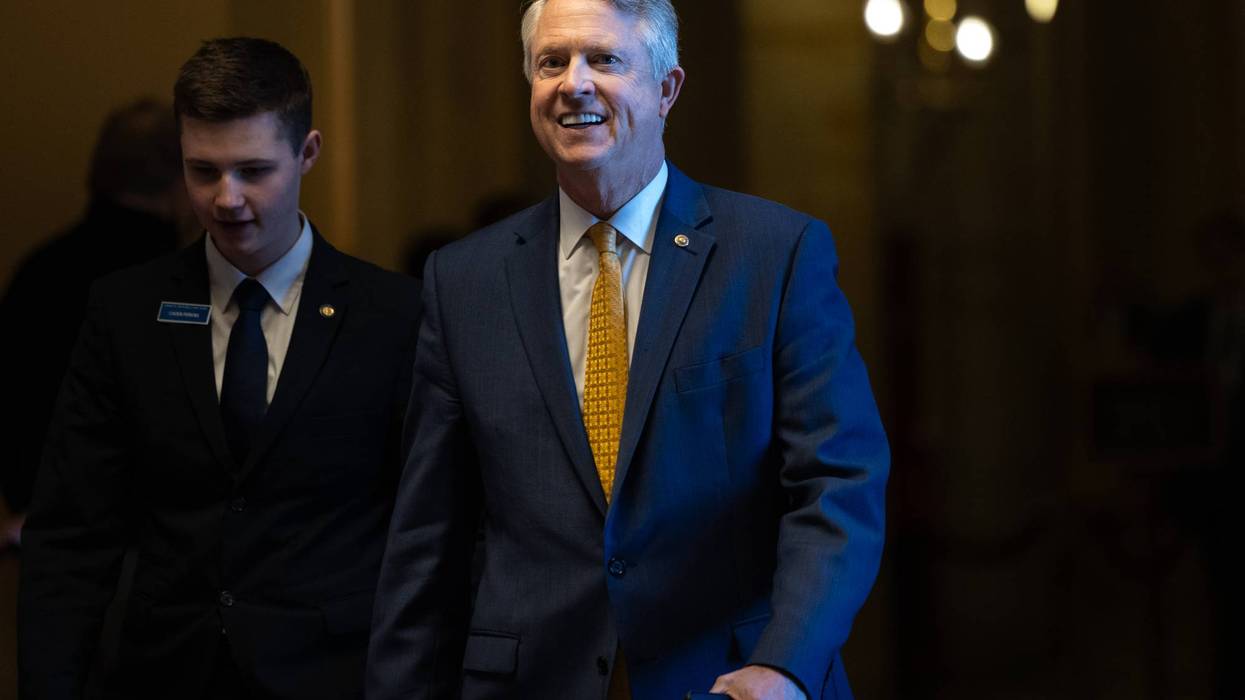
"Roger Marshall REALLY doesn't want you to see this ad," said Kansas Democratic US Senate candidate Adam Hamilton.
Attorneys representing Sen. Roger Marshall on Monday accused Democratic challenger Adam Hamilton of producing a "defamatory" ad centered on a former patient who was arrested for missing court dates related to unpaid medical debt owed to the Kansas Republican.
In a letter sent to Hamilton, Marshall's attorneys claimed that the ad released last week by the Kansas Democrat's campaign contained "false" information and must be taken down.
"We demand that you immediately cease and desist from any further publication, broadcast, distribution, or promotion of the advertisement," the letter said.
The ad in question features Meischa Zimmerman—a one-time patient of Marshall, a former obstetrician-gynecologist—who was arrested in 2011 after missing a $50 payment.
Meischa was Roger Marshall's patient. This is her story. pic.twitter.com/M6bmqK92gm
— Team Hamilton (@TeamHamiltonHQ) September 25, 2026
As The New York Times reported earlier this month, Zimmerman, who was eight months pregnant at the time of her arrest, owed Marshall nearly $3,600 for a C-section he performed while delivering one of her children. She had previously agreed to a $50 monthly repayment plan for the procedure after being sued by Marshall's office for unpaid medical debts.
Marshall's attorneys objected to the ad's portrayal of events, arguing that Zimmerman's $50 missed payment was only a fraction of the total that she owed to the future senator.
"Falsely accusing a physician of having a pregnant patient arrested over a $50 bill strikes directly at Senator Marshall’s professional integrity as a physician and his fitness for public office," they wrote, "and it has been broadcast to thousands of Kansas voters in the final weeks of an election."
The attorneys' letter does not appear to have deterred Hamilton, who continued to promote the ad featuring Zimmerman in a Monday social media post.
"Roger Marshall REALLY doesn't want you to see this ad," Hamilton wrote. "Meischa's story is true. Roger Marshall and his lawyers can’t hide the truth about his record from Kansas voters."
Tyson Brody, spokesperson for Hamilton's campaign, defended the ad in an interview with the Kansas Reflector.
“The lies in his letter are blatant and reek of desperation,” Brody said. “The truth is what Roger Marshall did is extreme and hurt Kansans. Voters should know the truth about who their senator is and what he’s done."
According to the Times' reporting, at least 81 one-time Marshall patients have been arrested for missing court dates stemming from their unpaid medical bills, with one patient taken into custody owing just $114.
The Times investigation also found that Marshall or his office sued more than 700 patients for unpaid bills throughout his two-decade career.
Kellie Clutts, another former patient of Marshall, told the Times she was sued by the Kansas Republican in 2015 over a $129 bill, which eventually resulted in her bank account being garnished.
"I was recently divorced, trying to do everything on my own," Clutts told the Times. "I told them I could make partial payments, but it seemed like no matter what I said, they wanted the full amount at once."
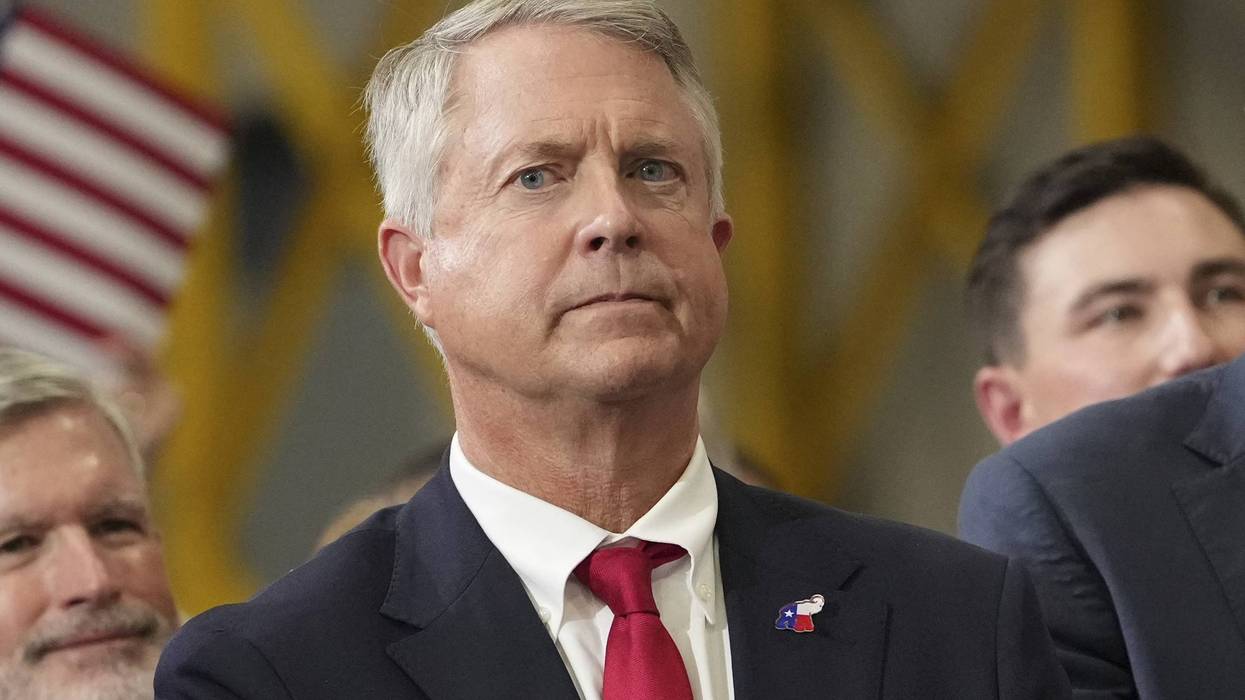
'The healthcare system is broken, but not for Roger Marshall. He's absolutely profiting from it."
The campaign of Kansas Democratic US Senate candidate Adam Hamilton on Friday released an ad highlighting incumbent Republican Sen. Roger Marshall's history of having patients arrested for medical debt.
The ad features Meischa Zimmerman, a one-time patient of Marshall, who prior to running for political office had a long career as an obstetrician-gynecologist.
Zimmerman begins the ad by recounting her 2011 arrest.
"One evening, I see [police] lights, I open the door, and it's a police officer," Zimmerman explains. "They arrested me because I didn't make a $50 payment to Roger Marshall."
"I was eight months pregnant," she continues. "And I said, 'Please do not handcuff me in front of my two-year-old daughter.'"
At the end of the ad, Zimmerman turns Marshall's aggressive debt collection tactics into an indictment of the for-profit US healthcare system.
"Roger Marshall preyed on the low-income families of Kansas," she says. "The healthcare system is broken, but not for Roger Marshall. He's absolutely profiting from it."
Meischa was Roger Marshall's patient. This is her story. pic.twitter.com/M6bmqK92gm
— Team Hamilton (@TeamHamiltonHQ) September 25, 2026
Zimmerman's story was highlighted earlier this month in a report from The New York Times, which found that Marshall filed lawsuits against more than 700 patients for medical debt, leading to at least 81 of them getting arrested.
Zimmerman owed Marshall $3,596 for a C-section her performed while delivering one of her children and, after his office sued her for outstanding medical debt, she agreed to undertake a monthly $50 payment plan.
Zimmerman told the Times that, while she tried to make the monthly payments, there were times when she couldn't keep up.
"I had to choose whether I’d pay my electricity," Zimmerman said, "or pay $50 to a doctor who didn’t need it."
Additionally, the law firm representing Marshall began charging 18% interest on her unpaid bill, which she said nearly doubled the total value she owed.
The Times story found that many patients Marshall sued didn't have anywhere close to the thousands of dollars in medical debt owed by Zimmerman, and that one of his patients was arrested for owing as little as $114.
The anti-Marshall ad drew praise from many political observers, who described it as a searing indictment of the Kansas Republican's character.
"This is a killer ad," wrote Larry Sabato, director of the University of Virginia's Center for Politics, in a social media post. "If Hamilton defeats Marshall for Senate in Kansas, include it in your analysis."
Bloomberg columnist Francis Wilkerson similarly described the ad as "among the best... I've seen."
Amanda Litman, president of Run for Something, declared after watching the ad that "Roger Marshall is a real piece of shit."
James Goodwin, policy director at the Center for Progressive Reform, argued that the ad was so strong that it could break through a key barrier progressives have long faced when challenging right-wing politicians.
"One of the structural advantages that Republicans have enjoyed the last 10 to 15 years is ordinary people didn't believe you when you told them how evil they were," Goodwin wrote. "After all, how could anyone be that evil? That's just the left exaggerating again, right? It feels like that is starting to fall apart."
"Saying a war should come to a successful end hardly repudiates the president who started it," said one critic.
Republican politicians who have spent years kowtowing to President Donald Trump are suddenly scrambling to distance themselves from him, as his approval ratings hit record lows less than six weeks before the midterm elections.
Some critics, however, are questioning the seriousness of the Republicans' purported dissents.
A Thursday report from The New York Times highlighted instances of Republican Senate candidates in battleground states such as Iowa and Michigan calling for an end to Trump's illegal war with Iran, which has sent energy prices soaring over the last six months.
Apparent Republican queasiness over Trump policies in an election year isn't limited to the Iran War, as Sen. Roger Marshall (R-Kan.) on Wednesday issued a statement pushing back on tactics used by US Immigration and Customs Enforcement (ICE) in his home state.
"When ICE operates in Kansas, it needs to coordinate with our local law enforcement," Marshall wrote in a social media post. "Our sheriffs and police know these communities better than anyone, and working together keeps officers and residents safe."
Marshall's statement came one week after Rep. Maria Elvira Salazar (R-Fla.) publicly broke with Trump on immigration policy, telling the president that his mass deportations were going "too far" and leaving Latino voters who backed him in 2024 feeling "betrayed."
Former Rep. Carlos Curbelo (R-Fla.) told the Times that the abrupt breaks with Trump show that "this is survival mode time for Republicans," as they no longer have to fear that the unpopular president will back primary challengers against them this year.
Marc Short, former chief of staff to Vice President Mike Pence, told the Times he was skeptical about Republicans succeeding in portraying themselves as independent-minded Trump critics given how they have dutifully supported him in lockstep for the last two years.
"If you’ve been carrying the president’s water on all his legislation priorities and his issues, it’s hard now to distance yourself," Short explained. "It appears now as if it’s just for political convenience."
Former CBS News anchor John Dickerson similarly questioned how sincere Republicans were being in their last-minute pushback against certain Trump policies.
Specifically, Dickerson pointed to Iowa GOP US Senate candidate Ashley Hinson, who called on Trump to bring his illegal war "to a successful and immediate end" to lower energy costs for American farmers.
"Hinson hasn't said starting the war was a mistake," Dickerson wrote in an analysis published Thursday on his Substack page. "She has repeatedly voted against House resolutions to limit Trump's war powers, most recently last week... Saying a war should come to a successful end hardly repudiates the president who started it."
Drop Site News reporter Ryan Grim echoed Dickerson's analysis in a Tuesday social media post.
"Ashley Hinson [is] out with a statement whining and crying about the consequences of the war she supported," Grim wrote. "If you read far enough in, you find she’s calling for an end to it. But just last week the House voted on a war powers resolution to end the war and she voted against it."
In an op-ed published Thursday, Bloomberg columnist Mary Ellen Klas offered a critical examination of Salazar's seeming revolt against Trump's hardline immigration policies, describing it as a signal "to fellow Republicans that they had permission to publicly distance themselves from their party leader to save themselves from electoral collapse."
"Republicans who didn’t have the courage to speak up as Trump corrupted the executive branch and usurped congressional authority," Klas added, "have suddenly grown backbones."
In a separate social media post promoting her column, Klas accused Republicans of showing "cowardice, not conviction" in their last-minute shifts.
One foreign policy analyst said the senator was effectively admitting that “we’re literally committing crimes against humanity.”
A Republican US senator proudly declared that President Donald Trump's blockade of Iranian ports is "starving" Iranians on Wednesday, in yet another piece of counterevidence to the idea that the president's war there is meant to "liberate" the people.
"We have this embargo working, this blockade, and we're literally starving them," said Sen. Roger Marshall (R-Kan.) during an interview on Newsmax. "Both financially, and they can't feed themselves either, very long."
During the same interview, Marshall said Trump must “take everything into consideration” to finish the war against Iran and compared the decision Trump must make to "President [Harry] Truman’s decision on dropping the bomb, and D-Day for President [then-Gen. Dwight] Eisenhower.”
The comments came after Trump announced that he would extend a two-week ceasefire while continuing his naval blockade of Iranian ports, enacted as a counter to Iran's closure of the Strait of Hormuz, which has caused chaos and inflation across the global economy.
It was yet another 180-degree spin from Trump, who just days before had issued another genocidal threat to "blow up" the "whole country" of Iran, including civilian infrastructure, if it did not capitulate to his demands in a ceasefire agreement, which was roundly condemned by international organizations as a pledge to commit war crimes.
The Iranian population suffered tremendously under Trump's "maximum pressure sanctions" before the war, which fueled 58% food inflation year over year in September 2025.
The war launched by the US and Israel in February has only heightened the pain: Last month, Iran's inflation rate hit a record 72%, and the cost of its staple food basket soared to 134% compared with the previous year.
More than 750,000 jobs had been lost as of last week, and the United Nations Development Program predicted that Iran's economy could contract by as much as 10% as a result of the war. In just 40 days of war, the UNDP found that 3.5-4.1 million Iranians have fallen below the poverty line.
Trump's blockade of Iranian ports has tightened the noose even more, cutting off about 90% of the nation's maritime trade.
According to The Wall Street Journal, the blockade immediately affected nearly a million tons of grain and oilseeds. Prices for commodities like rice, which have already increased sevenfold in recent months, are expected to soar even further.
While Iran is much larger and more self-sufficient than Cuba, the blockade mirrors the economic warfare Trump has waged against the island in what he has said is an effort to force its leadership from power or outright "take" it for the US.
The blockade of fuel shipments to the island enacted through tariff threats has paralyzed its economy and resulted in rolling blackouts that have disrupted hospital care, agriculture, and every other facet of daily life for the Cuban people, drawing condemnation from United Nations human rights experts, who have called it a "serious violation of international law" and an act of "extreme unilateral economic coercion."
The Trump administration and its cheerleaders in Congress have not been shy about their goal for sanctions in Iran—to inflict suffering upon the people of Iran in hopes that they will rise up and overthrow their government. But Marshall's declaration that Trump was trying to "starve" Iran was seen by critics as an even more explicit endorsement of collective punishment than most.
Dylan Williams, the vice president for government affairs at the Center for International Policy, said it confirmed that Trump was pitching "genocide as a tactic in Iran."
In less than two months, at least 1,700 civilians have been killed, including more than 250 children, according to the US-based Human Rights Activist News Agency. More than 26,000 people have been injured, according to the Iranian Health Ministry.
The international affairs researcher Derek Davison wrote that by cheering a policy he said was "literally starving" Iran, Marshall was basically saying: "We're literally committing crimes against humanity. It's awesome."

"People in the United States are literally skipping meals and the Republican Congress won’t even hold a hearing about this unplanned disastrous war," said one critic.
A Republican senator on Tuesday tried to sell wary Americans on President Donald Trump's war with Iran by telling them that national security is more important than any financial pain they're feeling in the form of higher energy costs.
During an appearance on Newsmax's "Wake Up America" program, Sen. Roger Marshall (R-Kan.) tried to assuage Americans' concerns about the spike in gas prices caused by the war by informing viewers that the US is "the leading producer of oil in the world, we're exporting more than we're importing."
Sen. Roger Marshall: "I'm sorry that gas prices are going up, but help is on the way, and your national security is even more important than your pocketbook." pic.twitter.com/GSUEDVHQml
— Aaron Rupar (@atrupar) April 14, 2026
The US exporting more of its own oil to foreign countries whose regular supplies have been disrupted by the closure of the Strait of Hormuz does nothing to lower US gas prices and, if anything, will push them higher.
As a Monday Wall Street Journal article explained, "prices at the pump are poised to keep rising if the US exports more oil and gas and drains its inventories," especially since "the jump in exports doesn’t yet correspond to an increase in US oil production."
Later in the segment, Marshall acknowledged that Americans were feeling pain at the gas pump, but he said it was worth it to stop the supposed threat from Iran, which did not attack the US and, according to US intelligence estimates, was not close to producing nuclear weapons.
"I'm sorry that gas prices are going up," he said. "But help is on the way, and your national security, yes, is even more important than your pocketbook."
Marshall's claims about the Iran War being worth the cost came days after Harvard Kennedy School professor Linda Bilmes, an expert in war budgeting, estimated the total cost of the conflict would top $1 trillion.
Criminal defense attorney Sara Spector pounced on Marshall's comments as symbolic of Republicans' tone deafness to Americans' economic concerns.
"Octogenarians are door dashing to pay for medical bills," she remarked, "and Senator Marshall wants you to pay for a war while Donald Trump golfs and attends VIP sporting events. Wow!"
Fred Wellman, a Democratic candidate for the US House of Representatives in Missouri, noted that the GOP-run Congress isn't even having hearings where elected representatives can ask Trump administration officials about the war.
"People in the United States are literally skipping meals and the Republican Congress won’t even hold a hearing about this unplanned disastrous war," Wellman wrote. "No, we won’t accept anymore assurances or urges to sacrifice for the greater good when the leaders won’t even respect us enough to go under oath and tell us why."
Jennifer Schulze, a former local TV news executive, pointed out that the claims about the Iran War being essential to US security were totally false.
"Iran was not: 1.) close to having a nuclear weapon; 2.) Posing an imminent threat to the US," she wrote.
Jon Bauman, president of Social Security Works PAC, said Marshall's claim that high gas prices are worth the cost of launching an unprovoked war with Iran was a "losing argument."