SUBSCRIBE TO OUR FREE NEWSLETTER
Daily news & progressive opinion—funded by the people, not the corporations—delivered straight to your inbox.
5
#000000
#FFFFFF
To donate by check, phone, or other method, see our More Ways to Give page.
Daily news & progressive opinion—funded by the people, not the corporations—delivered straight to your inbox.
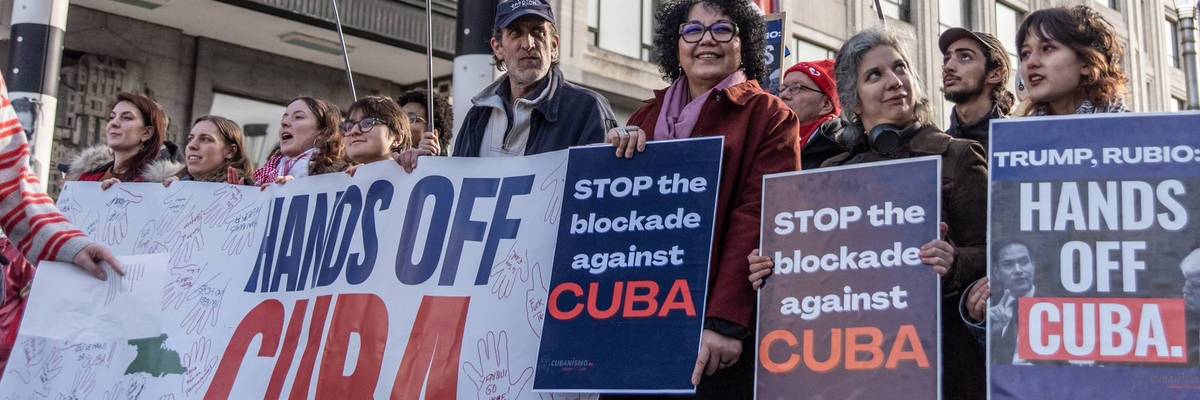
People protest the internationally condemned US blockade of Cuba and the Trump administration's military threats against the socialist nation, in Brussels on February 7, 2026.
"Trump is preparing to take the US into another illegal war against Cuba," warned one progressive critic of the US president. "We must stop him. It’s not too late."
Is Cuba next in line for a US attack?
US President Donald Trump has repeatedly said it could be, and USA Today on Wednesday cited "sources familiar" with the matter who said that the Pentagon is "quietly ramping up" preparations to wage war on the socialist nation if Trump gives the order.
On Monday, Trump flippantly declared that “we may stop by Cuba after we’re finished with this," referring to the illegal US-Israeli war of choice on Iran that's left thousands of Iranians dead or wounded, including hundreds of children.
Trump has also said that he believes he’ll “be having the honor of taking Cuba,” language echoing the 19th century US imperialists who conquered the island along with Puerto Rico and the Philippines from Spain in another war waged on dubious pretense.
"Whether I free it, take it—I think I can do anything I want," Trump said of the island and its 11 million inhabitants.
The USA Today report—authored by Kim Hjelmgaard, Rick Jervis, and Francesca Chambers—sparked widespread alarm among advocates for peace.
"This is not a drill. Trump is preparing to take the US into another illegal war against Cuba to appease the Miami mafia," Progressive International co-general coordinator David Adler said Wednesday on X. "We must stop him. It’s not too late."
Cubans—who have been subjected to generations of privation and hardship due largely to the internationally condemned US economic embargo of their island—have mostly shrugged off Trump's threats, with some observers noting that Cuba's socialist era has outlasted a dozen American presidents.
Responding to a question about a possible US attack on his country, Cuban President Miguel Díaz-Canel said Sunday on NBC News' "Meet the Press" that “if that happens, there will be fighting, and there will be a struggle, and we will defend ourselves, and if we need to die, we’ll die, because as our national anthem says, ‘Dying for the homeland is to live’.”
Numerous observers expressed shock, but not surprise, that Trump—the self-proclaimed "peace president" who has bombed 10 countries, more than any other US president—is setting his sights on Cuba, which American presidents since Thomas Jefferson have coveted.
Trump has been threatening Cuba since his first administration, when he systematically rolled back the Obama administration's diplomatic normalization with the island's socialist government. He also activated a provision of the Helms-Burton Act allowing lawsuits over property confiscated after the Cuban Revolution.
On the last day of his first term, Trump re-designated Cuba a state sponsor of terrorism, a move critics slammed as absurd given that Cuba has never carried out any acts of terrorism—unlike the United States and the militant Cuban exiles it harbors, who have a decadeslong record of terrorist bombings and other attacks, as well as numerous failed or aborted attempts to assassinate former revolutionary leader Fidel Castro.
Since returning to office, Trump has ratcheted up military threats and economic pressure on Cuba, which was already reeling from decades of US sanctions and the inefficiencies of centralized state control. Trump tightened the embargo by severely restricting fuel imports, exacerbating an energy emergency characterized by blackouts and deadly suffering among the most vulnerable Cubans, including sick people and children.
Last month, US Sens. Tim Kaine (D-Va.), Adam Schiff (D-Calif.), and Ruben Gallego (D-Ariz.) introduced a war powers resolution aimed at preventing Trump from attacking Cuba without congressional authorization as required by law. Numerous war powers resolutions related to Iran, Venezuela, and Trump's extralegal high-seas boat bombings have failed to pass.
Dear Common Dreams reader, It’s been nearly 30 years since I co-founded Common Dreams with my late wife, Lina Newhouser. We had the radical notion that journalism should serve the public good, not corporate profits. It was clear to us from the outset what it would take to build such a project. No paid advertisements. No corporate sponsors. No millionaire publisher telling us what to think or do. Many people said we wouldn't last a year, but we proved those doubters wrong. Together with a tremendous team of journalists and dedicated staff, we built an independent media outlet free from the constraints of profits and corporate control. Our mission has always been simple: To inform. To inspire. To ignite change for the common good. Building Common Dreams was not easy. Our survival was never guaranteed. When you take on the most powerful forces—Wall Street greed, fossil fuel industry destruction, Big Tech lobbyists, and uber-rich oligarchs who have spent billions upon billions rigging the economy and democracy in their favor—the only bulwark you have is supporters who believe in your work. But here’s the urgent message from me today. It's never been this bad out there. And it's never been this hard to keep us going. At the very moment Common Dreams is most needed, the threats we face are intensifying. We need your support now more than ever. We don't accept corporate advertising and never will. We don't have a paywall because we don't think people should be blocked from critical news based on their ability to pay. Everything we do is funded by the donations of readers like you. When everyone does the little they can afford, we are strong. But if that support retreats or dries up, so do we. Will you donate now to make sure Common Dreams not only survives but thrives? —Craig Brown, Co-founder |
Is Cuba next in line for a US attack?
US President Donald Trump has repeatedly said it could be, and USA Today on Wednesday cited "sources familiar" with the matter who said that the Pentagon is "quietly ramping up" preparations to wage war on the socialist nation if Trump gives the order.
On Monday, Trump flippantly declared that “we may stop by Cuba after we’re finished with this," referring to the illegal US-Israeli war of choice on Iran that's left thousands of Iranians dead or wounded, including hundreds of children.
Trump has also said that he believes he’ll “be having the honor of taking Cuba,” language echoing the 19th century US imperialists who conquered the island along with Puerto Rico and the Philippines from Spain in another war waged on dubious pretense.
"Whether I free it, take it—I think I can do anything I want," Trump said of the island and its 11 million inhabitants.
The USA Today report—authored by Kim Hjelmgaard, Rick Jervis, and Francesca Chambers—sparked widespread alarm among advocates for peace.
"This is not a drill. Trump is preparing to take the US into another illegal war against Cuba to appease the Miami mafia," Progressive International co-general coordinator David Adler said Wednesday on X. "We must stop him. It’s not too late."
Cubans—who have been subjected to generations of privation and hardship due largely to the internationally condemned US economic embargo of their island—have mostly shrugged off Trump's threats, with some observers noting that Cuba's socialist era has outlasted a dozen American presidents.
Responding to a question about a possible US attack on his country, Cuban President Miguel Díaz-Canel said Sunday on NBC News' "Meet the Press" that “if that happens, there will be fighting, and there will be a struggle, and we will defend ourselves, and if we need to die, we’ll die, because as our national anthem says, ‘Dying for the homeland is to live’.”
Numerous observers expressed shock, but not surprise, that Trump—the self-proclaimed "peace president" who has bombed 10 countries, more than any other US president—is setting his sights on Cuba, which American presidents since Thomas Jefferson have coveted.
Trump has been threatening Cuba since his first administration, when he systematically rolled back the Obama administration's diplomatic normalization with the island's socialist government. He also activated a provision of the Helms-Burton Act allowing lawsuits over property confiscated after the Cuban Revolution.
On the last day of his first term, Trump re-designated Cuba a state sponsor of terrorism, a move critics slammed as absurd given that Cuba has never carried out any acts of terrorism—unlike the United States and the militant Cuban exiles it harbors, who have a decadeslong record of terrorist bombings and other attacks, as well as numerous failed or aborted attempts to assassinate former revolutionary leader Fidel Castro.
Since returning to office, Trump has ratcheted up military threats and economic pressure on Cuba, which was already reeling from decades of US sanctions and the inefficiencies of centralized state control. Trump tightened the embargo by severely restricting fuel imports, exacerbating an energy emergency characterized by blackouts and deadly suffering among the most vulnerable Cubans, including sick people and children.
Last month, US Sens. Tim Kaine (D-Va.), Adam Schiff (D-Calif.), and Ruben Gallego (D-Ariz.) introduced a war powers resolution aimed at preventing Trump from attacking Cuba without congressional authorization as required by law. Numerous war powers resolutions related to Iran, Venezuela, and Trump's extralegal high-seas boat bombings have failed to pass.
Is Cuba next in line for a US attack?
US President Donald Trump has repeatedly said it could be, and USA Today on Wednesday cited "sources familiar" with the matter who said that the Pentagon is "quietly ramping up" preparations to wage war on the socialist nation if Trump gives the order.
On Monday, Trump flippantly declared that “we may stop by Cuba after we’re finished with this," referring to the illegal US-Israeli war of choice on Iran that's left thousands of Iranians dead or wounded, including hundreds of children.
Trump has also said that he believes he’ll “be having the honor of taking Cuba,” language echoing the 19th century US imperialists who conquered the island along with Puerto Rico and the Philippines from Spain in another war waged on dubious pretense.
"Whether I free it, take it—I think I can do anything I want," Trump said of the island and its 11 million inhabitants.
The USA Today report—authored by Kim Hjelmgaard, Rick Jervis, and Francesca Chambers—sparked widespread alarm among advocates for peace.
"This is not a drill. Trump is preparing to take the US into another illegal war against Cuba to appease the Miami mafia," Progressive International co-general coordinator David Adler said Wednesday on X. "We must stop him. It’s not too late."
Cubans—who have been subjected to generations of privation and hardship due largely to the internationally condemned US economic embargo of their island—have mostly shrugged off Trump's threats, with some observers noting that Cuba's socialist era has outlasted a dozen American presidents.
Responding to a question about a possible US attack on his country, Cuban President Miguel Díaz-Canel said Sunday on NBC News' "Meet the Press" that “if that happens, there will be fighting, and there will be a struggle, and we will defend ourselves, and if we need to die, we’ll die, because as our national anthem says, ‘Dying for the homeland is to live’.”
Numerous observers expressed shock, but not surprise, that Trump—the self-proclaimed "peace president" who has bombed 10 countries, more than any other US president—is setting his sights on Cuba, which American presidents since Thomas Jefferson have coveted.
Trump has been threatening Cuba since his first administration, when he systematically rolled back the Obama administration's diplomatic normalization with the island's socialist government. He also activated a provision of the Helms-Burton Act allowing lawsuits over property confiscated after the Cuban Revolution.
On the last day of his first term, Trump re-designated Cuba a state sponsor of terrorism, a move critics slammed as absurd given that Cuba has never carried out any acts of terrorism—unlike the United States and the militant Cuban exiles it harbors, who have a decadeslong record of terrorist bombings and other attacks, as well as numerous failed or aborted attempts to assassinate former revolutionary leader Fidel Castro.
Since returning to office, Trump has ratcheted up military threats and economic pressure on Cuba, which was already reeling from decades of US sanctions and the inefficiencies of centralized state control. Trump tightened the embargo by severely restricting fuel imports, exacerbating an energy emergency characterized by blackouts and deadly suffering among the most vulnerable Cubans, including sick people and children.
Last month, US Sens. Tim Kaine (D-Va.), Adam Schiff (D-Calif.), and Ruben Gallego (D-Ariz.) introduced a war powers resolution aimed at preventing Trump from attacking Cuba without congressional authorization as required by law. Numerous war powers resolutions related to Iran, Venezuela, and Trump's extralegal high-seas boat bombings have failed to pass.